


Community hub
Recent from talks
Contribute something
Nothing was collected or created yet.
Microgram
View on Wikipedia| Microgram | |
|---|---|
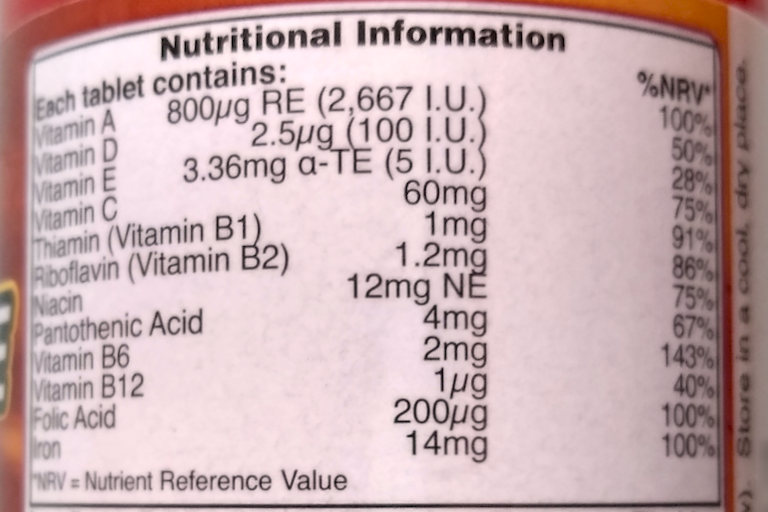
 A nutrition facts label displaying, for example, the amount of folic acid in micrograms | |
| General information | |
| Unit system | SI |
| Unit of | mass |
| Symbol | μg |
In the metric system, a microgram or microgramme is a unit of mass equal to one millionth (1×10⁻⁶) of a gram. Two different abbreviations are commonly used. The International System of Units (SI) uses μg, where the SI prefix "micro-" is represented by the Greek letter μ (mu). However, mcg is preferred for medical information in the United States (US), United Kingdom and other places. A third abbreviation, the Greek letter γ (gamma), is no longer recommended.[1] The US Institute for Safe Medication Practices (ISMP) and the US Food and Drug Administration (FDA) recommend that mcg should be used, rather than μg, when communicating medical information.[2] This is due to the risk that μ might be misread as m, for "milli-", which is equal to one thousandth (1×10⁻³). Such a misreading could result in a thousandfold overdose of a drug or medicine. However, mcg is also the symbol for the obsolete unit millicentigram, derived from the centimetre–gram–second system of units and equal to 10 μg.
Typography
[edit]Usually, a sequence of the Unicode code point U+03BC μ GREEK SMALL LETTER MU followed by the Latin letter U+0067 g LATIN SMALL LETTER G should be used. However, if μ is not available it may be represented with U+0075 u LATIN SMALL LETTER U or the legacy Unicode symbol U+00B5 µ MICRO SIGN. In Chinese, Japanese and Korean writing a fullwidth version U+338D ㎍ SQUARE MU G should be used.[3]
See also
[edit]
- List of SI prefixes
- Orders of magnitude (mass), listing a few items that have a mass of around 1 μg.
References
[edit]- ^ NIST Handbook 133 - 2018, Appendix E. General Tables of Units of Measurement, page 159 (17)
- ^ "ISMP's List of Error-Prone Abbreviations, Symbols, and Dose Designations". ISMP. Retrieved 2018-03-28.
- ^ Unicode Consortium (2019). "The Unicode Standard 12.0 – CJK Compatibility ❰ Range: 3300—33FF ❱" (PDF). Unicode.org. Retrieved May 24, 2019.
Microgram
View on GrokipediaDefinition and Fundamentals
Definition
The microgram (μg) is a unit of mass equal to one millionth of a gram, or grams (g).[8]Mathematically expressed as this unit represents a decimal submultiple within the metric system.[1] As a derived unit in the International System of Units (SI), the microgram forms part of the coherent framework for measuring mass, which is anchored to the base unit of the kilogram (kg).[8] The gram, to which the microgram relates directly, is an accepted unit in SI equivalent to kg, enabling precise scaling for small masses.[8] The prefix "micro-" derives from the Greek word mikros, meaning "small," and denotes a factor of one millionth () when attached to SI units.[9] This prefix facilitates the expression of minute quantities in scientific and technical contexts, such as pharmacology and environmental analysis.[1]
Relation to Base Units
The microgram (µg) is derived from the SI base unit of mass, the kilogram (kg), through the application of SI prefixes. Specifically, the prefix "micro-" denotes a factor of 10^{-6}, so one microgram equals one millionth of a gram, and since one gram is defined as 10^{-3} kg, one microgram is 10^{-9} kg.[10][1] This relationship can be expressed by the conversion equation: where is the mass in kilograms and is the mass in micrograms.[1] Within the International System of Units (SI), the microgram is a coherent derived unit of mass, seamlessly integrating with the seven base units—particularly the kilogram for mass—without requiring conversion factors in equations. This coherence allows the microgram to be directly substituted into expressions for derived quantities, such as density (expressed as micrograms per cubic meter) or force (in newtons, where 1 N = 1 kg·m/s²), maintaining dimensional consistency across scientific calculations.[11][12] In contrast to non-coherent units from other systems, the microgram's prefix-based scaling ensures it aligns precisely with the decimal structure of the SI, facilitating accurate and factor-free computations in physics, chemistry, and engineering.[1]Notation and Representation
Symbol and Typography
The official symbol for the microgram is μg, consisting of the lowercase Greek letter mu (μ) immediately followed by the lowercase Latin letter g, with no space between them. This notation represents one millionth (10^{-6}) of a gram and is the standard form prescribed by the International System of Units (SI).[8] In typography, the symbol μ is rendered in lowercase and in upright (roman) typeface, regardless of the font style used in the surrounding text, to distinguish it from variables or quantities, which are italicized. For example, a quantity such as 5 micrograms is written as 5 μg, with a thin space between the numeral and the symbol, but no space within the symbol itself; superscripts are not used for the prefix, as in μg rather than µg. Unit symbols like μg do not take a period, are not pluralized (e.g., 10 μg, not 10 μgs), and remain unchanged in form.[13][8] For digital rendering, the preferred Unicode code point for the mu symbol in SI contexts is U+03BC (GREEK SMALL LETTER MU), rather than the compatibility character U+00B5 (MICRO SIGN), to ensure semantic accuracy in mathematical and scientific typesetting. Common issues arise in fonts or systems where μ may render ambiguously as a Latin "u" or resemble other characters, leading to potential confusion with informal notations like "ug" or "mcg" in non-standard environments. These conventions are codified in international standards, including ISO 80000-1, which specifies the SI symbol as μg without alteration for plural or punctuation, aligning with the SI Brochure's guidelines for consistent global usage.[8]Alternative Notations
In contexts where the official symbol μg is impractical, such as handwriting or plain text environments, the abbreviation "mcg" is commonly used as a substitute for microgram, particularly in pharmacology to prevent misinterpretation of the Greek letter μ as "m" for milligram.[14][15] This notation avoids a potential thousand-fold dosing error by ensuring clarity in prescriptions and labels.[14] Historical and regional variants include "ug" as an informal abbreviation for microgram, appearing in older medical documentation and environmental reports where keyboard limitations preclude the use of μ.[16] Additionally, "μgm" has been observed in some legacy scientific texts as a spelled-out variant combining the prefix with "gm" for gram, though it is non-standard today.[17] The symbol γ (gamma) served as an obsolete non-SI unit equivalent to one microgram until its deprecation in modern metric standards.[18] These alternatives arise primarily from legibility challenges in handwritten notes, where μ resembles m, and digital constraints lacking Greek characters, as well as regulatory preferences to minimize errors in high-stakes settings like healthcare.[14][19] The U.S. Food and Drug Administration (FDA) specifically endorses "mcg" over μg in drug listings and labeling to enhance readability.[15] Guidelines from accrediting bodies like the Joint Commission recommend employing "mcg" or spelling out "microgram" in prescriptions, electronic records, and consumer labels to promote safety, reserving μg for formal scientific publications where typography supports it.[14] Such practices ensure consistent communication across plain text, printed materials, and regulatory submissions without compromising precision.[20]Historical Development
Origins in Metric System
The metric system originated in France during the late 18th century amid the Revolution, with the French Academy of Sciences tasked in 1790 by the National Assembly to develop a universal system of measurements based on decimal divisions. By 1795, this effort culminated in the formal adoption of the gram as the base unit of mass, defined as the mass of one cubic centimeter of water at maximum density, accompanied by initial decimal prefixes such as deci- (10^{-1}), centi- (10^{-2}), and milli- (10^{-3}) to express submultiples. These prefixes enabled precise scaling of the gram for practical applications, laying the groundwork for finer graduations as scientific inquiry demanded measurements of increasingly minute quantities.[1] As 19th-century advancements in chemistry and physics necessitated quantification of trace substances, the prefix "micro-," derived from the Greek mikros meaning "small," emerged to denote 10^{-6}. This prefix was formally incorporated into the metric framework in 1873 through the adoption of the centimeter-gram-second (CGS) system by the British Association for the Advancement of Science, which extended decimal notation to smaller scales including mega- (10^{6}) and micro-. The microgram thus represented one-millionth of a gram, addressing the growing need for accurate measurement of minuscule masses in electrolysis experiments and atomic theory.[21] Early instances of the microgram appeared in scientific literature during the 1880s, particularly in analytical chemistry for quantifying trace elements and impurities in substances. For example, researchers employed it to describe minute quantities in spectroscopic analyses and pharmaceutical preparations, reflecting the prefix's utility in fields requiring high precision. This endorsement marked a key step in the microgram's evolution from an ad hoc tool to a recognized component of the pre-SI metric lexicon, driven by the demands of emerging disciplines in physics and chemistry.[10]Standardization in SI
The International System of Units (SI) was formally established by the 11th General Conference on Weights and Measures (CGPM) in 1960, incorporating the microgram as a decimal submultiple of the gram through the application of the micro prefix (μ, denoting 10^{-6}). This resolution formalized the use of existing metric prefixes within the new coherent system, ensuring the microgram's integration as a practical unit for expressing small masses while maintaining compatibility with the base unit of mass, the kilogram.[22] Subsequent refinements to SI prefix usage were addressed at later CGPM meetings. The 15th CGPM in 1975 confirmed the established prefixes, including micro, by adopting peta (P, 10^{15}) and exa (E, 10^{18}) for larger scales, thereby reinforcing the systematic application of micro to units like the gram without alteration. Additionally, in response to potential ambiguities in notation—particularly the Greek letter μ resembling other characters in certain typographic contexts—updates around 1993, as reflected in international standards, encouraged consistent symbol usage to enhance clarity, though the official SI symbol remained μg.[23][1] The Bureau International des Poids et Mesures (BIPM) plays a central role in maintaining the microgram's coherence within the SI, as outlined in its official brochure. While the base SI units form a coherent set where equations between quantities yield numerical factors of unity, the addition of prefixes like micro introduces a scaling factor, rendering units such as the microgram non-coherent but essential for practical measurements; BIPM guidelines emphasize their standardized use to preserve system integrity and traceability.[8] Following the 26th CGPM in 2019, which redefined the kilogram in terms of the Planck constant for enhanced stability, the microgram retained its validity unchanged, as the redefinition affects only the base unit and not the invariant prefixes. The 27th CGPM in 2022 further extended the prefix range with ronna (R, 10^{27}), quetta (Q, 10^{30}), ronto (r, 10^{-27}), and quecto (q, 10^{-30}), but existing prefixes including micro remained unaltered, affirming the microgram's ongoing status in the revised SI.Conversions and Comparisons
Equivalents in Other Units
The microgram (μg) relates to other metric mass units through standard SI prefixes, where 1 μg = 0.001 milligrams (mg) exactly, since the micro- prefix denotes 10^{-6} and the milli- prefix denotes 10^{-3}, making the microgram one-thousandth of a milligram.[8] Similarly, 1 μg = 1000 nanograms (ng) exactly, as the nano- prefix denotes 10^{-9}, positioning the microgram as one thousand nanograms.[8] In imperial units, conversions from the microgram derive from the avoirdupois system, where 1 pound (lb) = 453 592.37 grams exactly. Thus, 1 μg = 2.204 622 621 848 775 7 × 10^{-9} lb, or approximately 2.204 623 × 10^{-9} lb.[24] For ounces, 1 avoirdupois ounce (oz) = 28.349 523 125 grams exactly, so 1 μg = 3.527 396 194 958 041 × 10^{-8} oz, or approximately 3.527 396 × 10^{-8} oz.[24] The grain (gr), common to avoirdupois, troy, and apothecaries' systems, equals 64.798 91 milligrams exactly across these systems, yielding 1 μg = 1.543 235 835 294 143 × 10^{-5} gr, or approximately 1.543 236 × 10^{-5} gr; note that while the grain itself is identical, larger units like the apothecaries' ounce (480 grains) differ slightly from the avoirdupois ounce (437.5 grains), affecting indirect conversions.[24] A general conversion formula for mass in avoirdupois pounds from micrograms is given by: where is the mass in pounds and is the mass in micrograms; this factor stems from the exact relation 1 lb = 453 592.37 g.[24] The following table summarizes key exact and approximate equivalents:| Unit | Exact Equivalent | Approximate Value |
|---|---|---|
| Milligram (mg) | 0.001 mg | 0.001 mg |
| Nanogram (ng) | 1000 ng | 1000 ng |
| Pound (lb, avdp.) | 2.204 622 621 848 775 7 × 10^{-9} lb | 2.204 623 × 10^{-9} lb |
| Ounce (oz, avdp.) | 3.527 396 194 958 041 × 10^{-8} oz | 3.527 396 × 10^{-8} oz |
| Grain (gr) | 1.543 235 835 294 143 × 10^{-5} gr | 1.543 236 × 10^{-5} gr |