Hubbry Logo
AcatenangoAcatenangoMain
Open search
Acatenango
Community hub
Acatenango
logo
8 pages, 0 posts
0 subscribers
Be the first to start a discussion here.
Acatenango
Acatenango
from Wikipedia

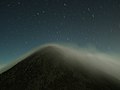
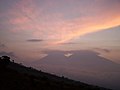
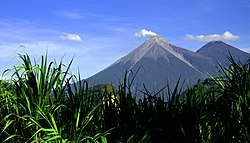
Acatenango is a stratovolcano in Guatemala, close to the city of Antigua. It is part of the mountain range of the Sierra Madre. The volcano has two peaks, Pico Mayor (Highest Peak) and Yepocapa (3,880 m) which is also known as Tres Hermanas (Three Sisters). Acatenango is joined with Volcán de Fuego and collectively the volcano complex is known as La Horqueta.

Key Information

Description

[edit]

The Fuego-Acatenango massif comprises a string of five or more volcanic vents along a north–south trend that is perpendicular to that of the Central American Volcanic Arc in Guatemala. From north to south, known centres of volcanism are Ancient Acatenango, Yepocapa, Pico Mayor de Acatenango, Meseta, and Fuego. Volcanism along the trend stretches back more than 200,000 years. Although many of the centres have been active contemporaneously, there is a general sequence of younger volcanism, from north to south along the trend.[2]

This massive volcano complex towers more than 3,500 metres above the Pacific coastal plain to the south and 2,000 metres above the Guatemalan Highlands to the north. The volcano complex comprises remnants of multiple eruptive centres, which periodically have collapsed to form huge debris avalanches. The largest of these avalanches extended more than 50 kilometres from its source and covered more than 300 square kilometres.[2]

Eruption history

[edit]

The only known historical eruptions of Acatenango volcano occurred in the 20th century, between 1924 and 1927 from just north of the summit peak (Pico Mayor) and again in December 1972 from the saddle between Yepocapa and Pico Mayor. These phreatic explosions generated ballistic volcanic bombs that fell near the summit craters and fine volcanic ash that fell up to 25 km away.

In prehistoric time, Acatenango has erupted explosively to form widespread fall deposits, hot pyroclastic flows and lava flows. There have been numerous eruptions during the past 80,000 years from vents along the massif. The most recent explosive eruptions of Acatenango occurred 1,900 years ago (Pico Mayor), 2,300 years ago (Pico Mayor) and about 5,000 years ago (Yepocapa). If such eruptions were to recur, many people and costly infrastructure would be at risk.

Major Volcanoes of Guatemala

Economy

[edit]

The Acatenango Valley is a designated coffee-producing region of Anacafé.

[edit]

See also

[edit]

References

[edit]
[edit]
Revisions and contributorsEdit on WikipediaRead on Wikipedia
from Grokipedia
Acatenango (sometimes misspelled Catenango) is a in southern , part of the Sierra Madre de Chiapas mountain range, rising to an elevation of 3,976 meters (13,045 feet) and recognized as the third-highest peak in . Located approximately 20 kilometers southwest of the historic city of , it features two summit peaks—Pico at 3,976 meters and Yepocapa (also known as Tres Hermanas) at 3,880 meters—and is closely connected to the adjacent active via a volcanic ridge, collectively known as the Acatenango-Fuego complex or La Horqueta. Geologically, Acatenango is characterized by its composite structure, with explosion craters at the summit and a history of explosive eruptions, the most recent occurring in 1972. The volcano's formation is tied to the subduction of the Cocos Plate beneath the Caribbean Plate along the Pacific Ring of Fire, contributing to the region's high volcanic activity. Despite its dormancy since 1972, observations in 1981 noted a strong sulfur odor near the summit craters, indicating ongoing fumarolic activity, though no visible emissions were reported at that time. As of November 2025, the area experiences ongoing seismic activity but no eruptive events. Acatenango holds significant cultural and recreational importance, serving as a premier destination that attracts adventurers seeking panoramic views of Volcán de Fuego's frequent eruptions from its slopes. The challenging ascent, typically an overnight trek covering about 13.8 kilometers with over 1,500 meters of gain, begins near the village of La Soledad and culminates at base camps around 3,600 meters, offering a unique vantage point on one of Central America's most active volcanoes. Its proximity to , a , enhances its appeal as an accessible , though the hike demands physical due to steep, sandy and variable weather conditions.

Geography and Topography

Location and Regional Setting

Acatenango is a situated at coordinates 14°30′03″N 90°52′33″W in south-central . It forms part of the Sierra Madre de Chiapas mountain range, which extends along the country's southern Pacific coast and encompasses significant volcanic activity as a segment of the broader Volcanic Arc. This arc represents a chain of es resulting from , where the Cocos Plate subducts eastward beneath the Caribbean Plate at the , driving magmatic activity across the region. The volcano's position places it approximately 17 km southwest of the colonial city of and about 45 km west-northwest of the national capital, . From its summit, Acatenango overlooks the expansive Pacific coastal plain to the south and the rolling terrain of the to the north, providing a dramatic visual prominence in the landscape. It rises more than 3,500 m above the coastal plain and about 2,000 m above the adjacent highland ridges, emphasizing its role as a dominant topographic feature in this tectonically active zone. Acatenango stands in close proximity to its twin volcano, , approximately 3 km to the south, within the same volcanic . This strategic location not only integrates the volcano into Guatemala's densely populated central highlands but also underscores its vulnerability to regional seismic and volcanic influences from the ongoing dynamics.

Physical Characteristics

Acatenango is a featuring a symmetrical morphology that rises prominently from the surrounding landscape. Its highest summit, Pico Mayor, reaches an elevation of 3,976 meters with a of 1,835 meters, establishing it as the third-highest peak in . The 's overall form is defined by two principal peaks: the southern Pico Mayor and the northern Yepocapa, also referred to as Tres Hermanas, which stands at 3,820 meters. A notable topographic feature is the saddle connecting the two peaks, which hosts multiple explosion craters formed during historical phreatic activity. These craters contribute to the 's rugged upper profile. Additionally, large-scale debris avalanches have shaped the surrounding , with deposits extending more than 50 kilometers from the edifice and covering over 300 square kilometers. The volcano's surface transitions from densely forested lower slopes, dominated by and agricultural zones, to barren, rocky upper reaches where vegetation thins to alpine scrub and exposed volcanic material. This varied terrain supports established hiking trails that ascend through these ecological zones to the summit.

Geology

Formation and Composition

Acatenango volcano formed as part of the , driven by the of the Cocos Plate beneath the Caribbean Plate along the , approximately 100 km to the south. This tectonic process generates through of the subducting and overlying mantle wedge, leading to the construction of stratovolcanoes like Acatenango over the period. Volcanism at the broader Fuego-Acatenango complex, which includes Acatenango, began more than 230,000 years ago, with Acatenango's edifice developing significantly after about 84,000 years ago following major regional ash deposits. The volcano's structure consists of alternating layers of lava flows, ash falls, and pyroclastic deposits, characteristic of buildup through repeated effusive and explosive activity. These layered deposits accumulate over time from ascent and eruption, forming a steep-sided that reaches an of 3,976 meters. The composition reflects the intermediate nature of subduction-related magmas, with contributions from both and more evolved sources in the arc setting. Dominant rock types at Acatenango are andesites and basaltic andesites, with subordinate dacitic components that indicate fractional crystallization and magma mixing processes. These intermediate to silicic lavas differ from the more mafic basalts typically erupted at the adjacent Fuego volcano, highlighting compositional variability within the paired complex. Andesitic rocks from Acatenango exhibit higher concentrations of incompatible elements and distinct ratios compared to Fuego's products, underscoring the complex magmatic evolution in this segment of the arc.

Structural Features

Acatenango forms part of the Fuego-Acatenango , a complex of coalesced volcanic cones and domes that includes multiple eruptive vents such as Ancient Acatenango, Yepocapa, and the prominent Pico Mayor de Acatenango summit cone. This structural arrangement is evident in the La Horqueta complex, where Acatenango connects directly to the adjacent , creating a paired edifice with shared features that facilitate migration between the two. The main edifice of Acatenango, characterized by its stratovolcanic build-up, has an estimated age exceeding 230,000 years, reflecting prolonged volcanic activity along the Central American arc. Evidence of past structural instability includes sector collapses that generated large debris avalanches, with at least two such events occurring within the last 80,000 years. The largest documented originated from the Meseta sector approximately 10,000 years ago, covering over 300 km² and extending up to 50 km from the , indicative of major flank failures. An earlier collapse from the Ancient Acatenango vent around 40,000 years ago produced a exceeding 40 km in length, highlighting the volcano's vulnerability to edifice instability due to steep, dissected flanks often altered by hydrothermal processes. While no intact rim is preserved, these collapse scars contribute to the irregular topography of the lower flanks. At the summit, Acatenango features explosion craters associated with activity, alongside areas of fumarolic venting that emit sulfurous gases. Observations indicate that fumarolic activity has been inactive or minimal since at least February 1981, with no visible emissions noted around the craters during that period, though a strong odor persisted. These summit structures, reaching elevations over 3,970 meters at Pico Mayor, underscore the 's complex internal architecture without active surface manifestations in recent decades.

Eruption History

Prehistoric Activity

The prehistoric activity of Acatenango volcano is characterized by several major explosive eruptions that occurred prior to , with evidence derived from geological mapping, stratigraphic analysis, and of and pyroclastic deposits. These events, primarily from vents at Pico Mayor and Yepocapa, produced widespread ash falls and pyroclastic flows that significantly influenced the regional landscape through the accumulation of thick volcanic layers and associated mass-wasting processes. Approximately 5,000 years ago, an from the Yepocapa vent generated pyroclastic flows and tephra-fall deposits, contributing to the buildup of the volcano's stratovolcanic structure and leaving extensive layers observable in proximal outcrops. This event, dated through stratigraphic correlation and radiocarbon methods, exemplifies the volcano's capacity for Plinian-style activity during the , with deposits extending several kilometers from the source and aiding in the formation of the edifice's foundational layers. More recent prehistoric eruptions include those around 2,300 years ago and 1,900 years ago, both from the Pico Mayor vent, which involved explosive phases producing pyroclastic flows traveling up to 12 km and broad distributions. These eruptions triggered secondary hazards such as debris avalanches and lahars, which remobilized volcanic material during heavy rains, depositing debris across valleys and shaping the topography over areas up to 50 km away, as mapped in hazard assessments. of organic material within these deposits confirms the timing and underscores the volcano's recurring explosive potential in the late .

Historical Eruptions

The historical eruptions of volcano in the were relatively modest in scale compared to its prehistoric activity, consisting primarily of explosions that produced localized and minor ash dispersal. The first documented eruption began on 18 December 1924 and continued intermittently until 19 May 1927, centered just north of the summit peak known as Pico Mayor. This event involved weak to moderate explosions, including bursts that ejected volcanic bombs and blocks ballistically near the summit craters, along with ash emissions that extended up to 25 km from the vent. Ashfall was reported in nearby areas, such as the town of Pochuta on 14 March 1925, but the activity caused no recorded fatalities or significant structural damage, though it likely disrupted local and travel in the surrounding . A subsequent eruption occurred from 12 November to 16 December 1972, located in the saddle between the Yepocapa and Pico Mayor peaks. This episode featured explosions accompanied by steam, , and gas emissions, including (H₂S) and (SO₂), with accumulation of 5-10 cm at the . Fine plumes dispersed up to 25 km away, resulting in minor ashfall over nearby regions, but no external deposits were substantial enough to cause widespread impacts. The event produced no major casualties and was limited in its immediate effects to temporary disruptions in local communities, such as visibility issues and minor contamination of water sources. These 20th-century eruptions represent a shift from the more voluminous prehistoric lava flows and pyroclastic deposits, highlighting Acatenango's intermittent phreatomagmatic behavior in recent times. No major eruptive activity has been confirmed since , marking it as the volcano's last historical event.

Monitoring and Recent Developments

Current Volcanic Status

Acatenango has remained dormant since its last eruption in , with no subsequent eruptive activity recorded. The Instituto Nacional de Sismología, Vulcanología, Meteorología y Hidrología (INSIVUMEH) continuously monitors the volcano through a regional network of seismic stations, sensors, and periodic gas sampling to detect any signs of unrest. As of November 17, 2025, observations indicate low-level background with no significant earthquakes (M>3) reported near the throughout the year, including none in or . Historical field visits noted a strong odor near the summit craters in 1981, indicating fumarolic activity though no visible emissions were observed, and current assessments confirm a normal dormant state without visible or thermal anomalies. Risk assessments classify Acatenango's eruption probability as low, though potential hazards such as explosions or lahars could arise if subsurface changes occur, prompting INSIVUMEH to issue alerts based on seismic patterns. Monitoring efforts emphasize early detection of any anomalies, given the volcano's proximity to populated areas.

Interactions with Adjacent Volcanoes

Acatenango and form the La Horqueta volcanic complex in Guatemala's Sierra Madre range, connected by the Meseta ridge that represents remnants of an older volcanic edifice dating back approximately 230,000 years. This shared structure suggests potential pathways, as geological evidence indicates a southward progression of younger eruptive centers within the Fuego-Acatenango , spanning over 200,000 years of activity across multiple vents. Eruptions at Fuego frequently influence Acatenango through ashfall and associated hazards, leading to restrictions on access to Acatenango's flanks. For instance, in March 2025, a significant Fuego eruption prompted the suspension of hikes on Acatenango due to elevated risks of injury from falling and gas emissions. Similarly, Fuego's activity from 2023 to 2025 has heightened regional hazards, including plumes that reached altitudes of 4.9 km and drifted up to 30 km, depositing in communities around Acatenango and necessitating evacuations. A notable example occurred in June 2025, when Fuego's explosions produced dense plumes and pyroclastic flows, directly impacting Acatenango with fallout and prompting coordinated evacuations. As of November 2025, Fuego continued to exhibit 1-10 daily explosions, with gas-and- plumes rising to 4.5-4.8 km and occasional impacts on nearby areas including Acatenango. The volcanoes exhibit geological overlap in their hazard zones, particularly through shared debris fields from sector collapses. Large debris avalanches from the have extended over 50 km and covered up to 300 km², affecting the and underscoring the interconnected risk profile of the complex. Monitoring efforts for both volcanoes are coordinated by Guatemala's Instituto Nacional de Sismología, Vulcanología, Meteorología e Hidrología (INSIVUMEH), which maintains a network of seismic, , and visual observation stations across the region to track activity and shared threats in real time.

Human Interactions

Economic Role

The Acatenango Valley, located in 's central highlands near the Acatenango volcano, is officially designated as one of the country's eight primary coffee-producing regions by the National Coffee Association of Guatemala (Anacafé). This recognition highlights the valley's role in cultivating high-quality coffee, where the mineral-rich volcanic soils derived from ancient eruptions impart unique flavor profiles, including bright acidity and notes of caramel and citrus. The fertile slopes of Acatenango support not only but also and cultivation, benefiting from the nutrient-dense that historically enriches the soil and improves moisture retention for diverse crops. These conditions enable sustainable farming practices, with shade-grown varieties thriving at altitudes between 1,600 and 2,000 meters, contributing to the valley's . Production in the region is largely carried out by smallholder indigenous farmers. In the broader Guatemalan , coffee from regions like Acatenango Valley plays a key role in the nation's -oriented , where accounts for approximately 40% of agricultural , employs over 125,000 families, and generates around 500,000 jobs nationwide. This sector generated approximately $900 million in as of the 2023-2024 coffee year, underscoring the valley's contribution to and rural livelihoods through premium exports. However, the proximity to the active Fuego volcano poses occasional challenges, as ashfall from eruptions can disrupt coffee harvests by coating plants and hindering , leading to reduced yields in affected areas. Despite these intermittent issues, the overall mineral enrichment from such events sustains long-term .

Tourism and Recreation

Acatenango, Guatemala's third-highest at 3,976 meters, serves as a premier destination for adventure , particularly for hikers seeking challenging overnight treks to base camps at approximately 3,600 meters elevation. These multi-day excursions typically begin from the village of La Soledad, ascending through cloud forests and farmlands over 5-6 hours to reach the base camp, where visitors can camp amid panoramic views. The volcano's prominence as an accessible draws adventure seekers for its rewarding summit push, often culminating in sunrise vistas overlooking the surrounding Central American landscape. Travelers are recommended to visit during the dry season from November to April to avoid clouds and achieve the best visibility for these sunrise vistas and views of the volcano. For tourists who find the strenuous hike challenging, 4x4 jeep tours provide an accessible alternative, suitable for all ages and non-professional hikers. These tours utilize off-road vehicles to transport participants to higher elevations near the base camps or viewpoints, reducing physical exertion while offering spectacular sights of Volcán de Fuego's eruptions from a safe distance, even during periods of volcanic activity, with experienced guides ensuring compliance with safety protocols. Key attractions include the dramatic nighttime spectacles of nearby Volcán de Fuego's eruptions, with visible lava flows and ash plumes providing a thrilling backdrop for experiences. Hikers frequently participate in early-morning summit ascents to witness Fuego's activity up close from a safe distance, combining physical challenge with natural wonder. Most tours originate from , Guatemala's colonial hub about an hour away, and are operated by local outfitters offering guided packages that include transportation, meals, and equipment rental. Annually, the Acatenango-Fuego area attracts thousands of visitors, with 200-400 participants daily during peak seasons and up to 1,000 on busy weekends, underscoring its status as a must-do for backpackers and eco-tourists. Access requires registration and a through CONAP, Guatemala's National Council for Protected Areas, typically handled by guides at the . Safety considerations are paramount due to the volcano's high altitude and proximity to Fuego's unpredictable activity, necessitating cold-weather gear such as insulated jackets, gloves, and sturdy boots to combat sub-freezing nighttime temperatures. Tours have been suspended periodically, such as in March 2025 amid Fuego's intense eruptions that prompted evacuations and heightened ashfall risks. Participants are advised to choose experienced local guides who monitor real-time volcanic alerts from INSIVUMEH, ensuring compliance with access restrictions during elevated hazard levels. This activity significantly bolsters the local economy around and La Soledad by employing indigenous guides, porters, and support staff, while fueling demand for hostels, transportation, and gear rentals. In 2023, Guatemala's broader sector, heavily influenced by such volcanic adventures, generated over £838 million in revenue, with Acatenango hikes contributing to job creation and community income in the Sacatepéquez region.

Acatenango (municipality)

Acatenango is a municipality in the Chimaltenango department of Guatemala with a population of approximately 23,228 according to the 2018 census.

References

Add your contribution
Related Hubs
User Avatar
No comments yet.