Hubbry Logo
Santa Ana VolcanoSanta Ana VolcanoMain
Open search
Santa Ana Volcano
Community hub
Santa Ana Volcano
logo
8 pages, 0 posts
0 subscribers
Be the first to start a discussion here.
Santa Ana Volcano
Santa Ana Volcano
from Wikipedia
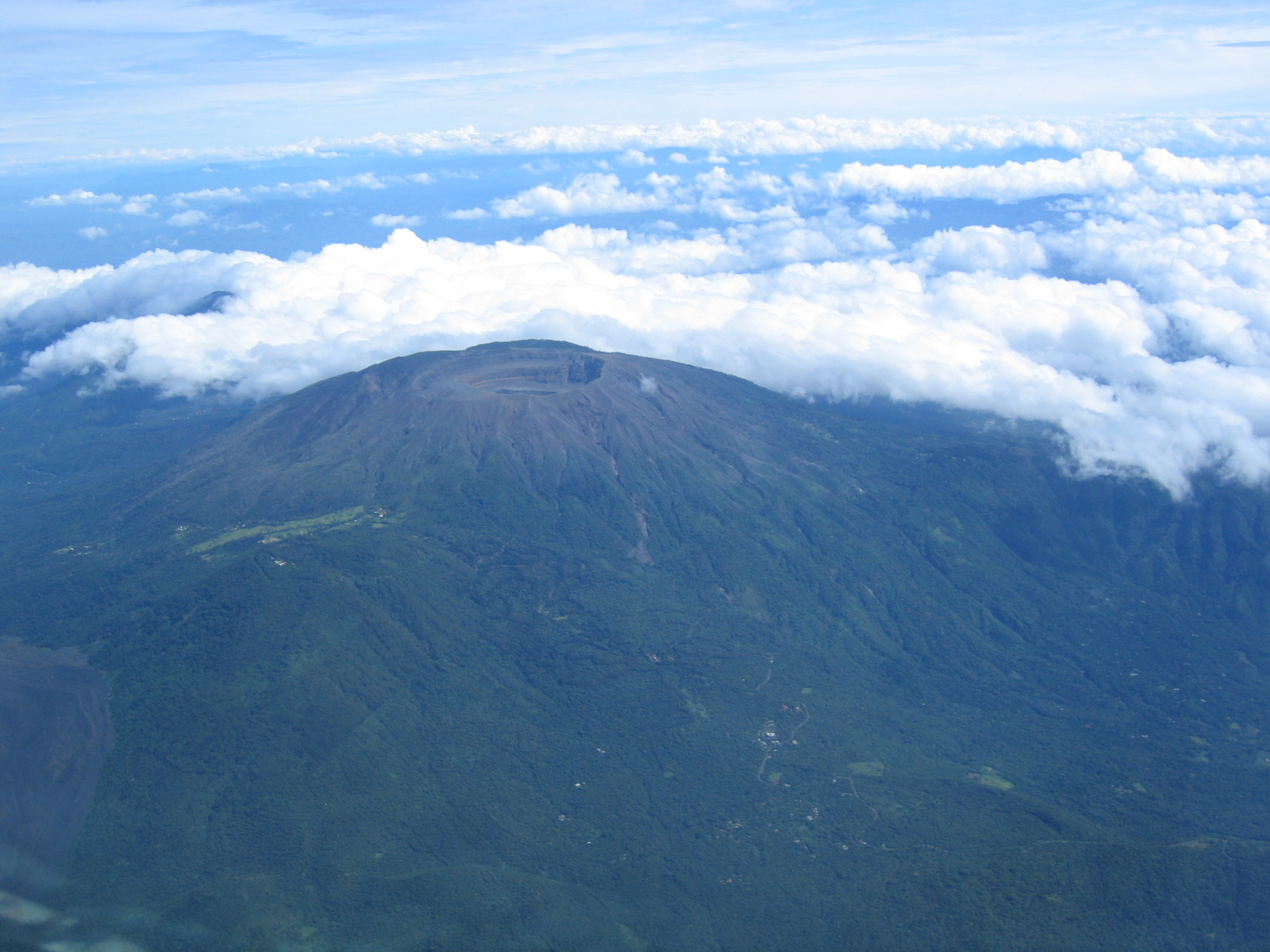
Ilamatepec Lake at the crater

Key Information

The Santa Ana Volcano or Ilamatepec (Spanish: volcán de Santa Ana) is a large stratovolcano located in the Santa Ana department of El Salvador. At 2,381 metres (7,812 ft) above sea level, it is the highest volcano in the country. It is located immediately west of Coatepeque Caldera.

The volcano was the inspiration for one of the active volcanoes in Antoine de Saint-Exupéry's famous French novella (The Little Prince), based on his life with his Salvadoran wife Consuelo de Saint-Exupéry, who was The Rose in the story.[citation needed]

Geography

[edit]
Santa Ana volcano with Izalco to the far left, Cerro Verde center, ilamatepec right, and San marcelino vents in the foreground.

The summit of Santa Ana features four nested calderas and volcanic craters, with the innermost containing a small crater lake. Collapse of the summit during the late Pleistocene (inferring from underlying soil samples, the upper age limit is no more than 57,000 years ago) produced a massive debris avalanche that reached the Pacific Ocean, forming the Acajutla Peninsula. Subsequent eruptions have largely rebuilt the edifice.[1]

There have been numerous historical eruptions since the 16th century, both at the summit and from cinder cones on the lower flanks, and also the flank vents of San Marcelino located east of Santa Ana. The San Marcelino vents erupted in 1722 and flowed eastwards for 11 km, destroying the village of San Juan Tecpan.

In October, 2005, the volcano erupted, killing at least two people, injuring seven people, forcing many people to flee their villages. The volcano spat rocks for over 1.5 km (0.93 mi) with rocks the size of cars.[2] The eruption contributed to the damage from Hurricane Stan. The most recent previous eruption had been in 1904.

Climate

[edit]

The climate on the northeast facing slope of the volcano sees substantial rainfall in the summer months. Located at 13.9 N, 89.6 W, altitude : 1770 m, the climate is classified as a subtropical highland climate (Köppen Cwb).

Climate data for Santa Ana, Volcano; 13.9 N, 89.6 W, altitude : 1771 m
Month Jan Feb Mar Apr May Jun Jul Aug Sep Oct Nov Dec Year
Mean daily maximum °C (°F) 19.3
(66.7)
20.6
(69.1)
23.3
(73.9)
23.2
(73.8)
22.7
(72.9)
21.6
(70.9)
21.6
(70.9)
21.6
(70.9)
20.9
(69.6)
20.0
(68.0)
19.2
(66.6)
18.9
(66.0)
21.1
(69.9)
Daily mean °C (°F) 14.7
(58.5)
15.3
(59.5)
17.0
(62.6)
17.7
(63.9)
17.9
(64.2)
17.2
(63.0)
17.1
(62.8)
17.1
(62.8)
16.9
(62.4)
16.2
(61.2)
15.2
(59.4)
14.7
(58.5)
16.4
(61.6)
Mean daily minimum °C (°F) 11.2
(52.2)
11.6
(52.9)
12.8
(55.0)
13.9
(57.0)
14.6
(58.3)
14.3
(57.7)
14.0
(57.2)
14.0
(57.2)
14.2
(57.6)
13.6
(56.5)
12.7
(54.9)
11.8
(53.2)
13.2
(55.8)
Average precipitation mm (inches) 8
(0.3)
5
(0.2)
19
(0.7)
64
(2.5)
223
(8.8)
427
(16.8)
417
(16.4)
393
(15.5)
452
(17.8)
208
(8.2)
48
(1.9)
10
(0.4)
2,274
(89.5)
Source: HKO[3]

See also

[edit]

References

[edit]
[edit]
Revisions and contributorsEdit on WikipediaRead on Wikipedia
from Grokipedia
Santa Ana Volcano, also known as Ilamatepec, is a massive situated in the Santa Ana department of western , at coordinates 13.85°N, 89.63°W. Rising to an elevation of 2,381 meters (7,812 feet) above sea level, it represents the highest peak in the country and features four nested summit craters, the innermost containing the acidic, turquoise Laguna Verde crater , along with a 20-kilometer-long fissure system hosting parasitic vents and cones. Composed primarily of andesitic to basaltic materials, the is part of the Central American Volcanic Arc, resulting from the subduction of the Cocos Plate beneath the Caribbean Plate. Geologically, Santa Ana developed within the Pleistocene-age Coatepeque Caldera, formed by explosive eruptions and collapse between 72,000 and 57,000 years ago, with a debris avalanche contributing to the nearby Peninsula. The volcano's activity includes persistent fumaroles on its western and southern flanks, with temperatures reaching 70–95°C, and a subaqueous in the that episodically releases gas bubbles; the lake itself maintains a maximum of around 57.5°C. A northwest-southeast fault system dissects the summit craters, linking Santa Ana to adjacent volcanoes like Izalco and Cerro Verde. Historical eruptions have been documented since the , primarily consisting of small-to-moderate from both craters and flank vents, alongside occasional lava flows. A notable flank eruption in 1722 originated from the on the southeast side, producing a 13-kilometer-long lava flow that extended down the eastern flank. The most recent major event was a sudden phreatomagmatic eruption on 1 October 2005, triggered by interaction between magma and the crater lake, which generated an ash-and-gas plume exceeding 10 kilometers in height, volcanic blocks up to 1 meter in diameter ejected 2 kilometers from the vent, and lahars that damaged 1,400 hectares of crops. This eruption caused two deaths—likely from landslides—several injuries, ashfall affecting communities to the west such as Nahuizalco, and the evacuation of over 2,000 residents within a 5-kilometer radius, prompting a red alert level. Post-eruption monitoring revealed continued low-level activity, including steam plumes up to 200 meters high and sulfur dioxide emissions of 500–1,000 tons per day as of March 2006.

Geography

Location and Topography

Santa Ana Volcano, also known as Ilamatepec, is situated in the Santa Ana department of western , with precise coordinates at 13°51′11″N 89°37′48″W. Rising to an elevation of 2,381 meters (7,812 ft), it stands as the highest peak in the country. The is positioned immediately west of the Coatepeque Caldera and forms part of the Cordillera de Apaneca volcanic range. The surrounding features a proximity of approximately 50 km to the to the southeast, influencing through past volcanic . A significant from the extended southward, covering about 200 km² and contributing to the formation of the along the . This event highlights the 's in shaping El Salvador's coastal landscape. Topographically, Santa Ana exhibits morphology, characterized by a massive edifice with a broad summit truncated by four nested craters. Steep slopes dominate the structure, particularly along the eastern that drops sharply from around 1,500 m toward the Coatepeque . A prominent NW-SE trending fault underlies the edifice, creating a graben-like feature that accommodates parasitic vents and extends the volcanic over 20 km from Chalchuapa in the north-northwest to San Marcelino and Cerro Chino in the southeast.

Calderas and Crater Lake

The summit of Santa Ana Volcano features four nested craters formed by successive collapses during the Pleistocene epoch, with the outermost crater measuring approximately 1.5 km in width. A major sector collapse of the edifice during the late Pleistocene generated a voluminous debris avalanche extending about 50 km southward to form the Peninsula. The crater walls rise steeply, reaching heights of up to 300 meters in places, enclosing the inner features and contributing to the volcano's rugged internal topography. At the center of the innermost crater, which spans about 0.5 km in diameter, lies Laguna Verde, a prominent acidic crater lake that serves as a key hydrothermal feature of the volcano. Prior to the 2005 eruption, the lake measured roughly 200 meters in diameter with a maximum depth of 27 meters and a volume of approximately 200,000 cubic meters. Following the eruption, the lake shifted westward and reformed. Its striking turquoise-green hue arises from dissolved minerals and colloidal sulfur particles, while high sulfur content is evident in sulfate concentrations ranging from 2,500 to 9,800 mg/L, reflecting active subsurface hydrothermal processes. The lake's water temperature typically ranges from 24°C to 66°C, often around 30°C in stable periods, driven by geothermal inputs including subaqueous hot springs emitting pulses of gas and steam. Fumaroles along the western and southern crater walls, with temperatures between 70°C and 95°C, further indicate ongoing hydrothermal activity, occasionally producing sulfur crystals and a faint sulfurous odor. Laguna Verde is visible from the summit rim, offering hikers a dramatic view of its vibrant waters surrounded by the sheer crater walls, though access to the lake floor is restricted due to its acidity and steep terrain.

Geology

Tectonic Setting

Santa Ana Volcano is situated along the Middle American Trench, where the Cocos Plate subducts obliquely beneath the Caribbean Plate at a rate of approximately 8-9 cm per year, driving the region's intense volcanic and seismic activity. This convergent boundary forms the foundational tectonic framework for volcanism in El Salvador, with the subducting oceanic crust descending at a shallow angle initially before steepening, influencing the distribution of magmatic activity across the overriding plate. As a prominent feature of the , which extends over 1,100 km from central through , , , , and into , Santa Ana represents a key in the Salvadoran segment of this chain. The arc's alignment parallels the , resulting from the of the mantle wedge above the subducting slab, and hosts around 40 active es, with Santa Ana's position highlighting the arc's continuity and segmentation influenced by variations in subduction parameters. Regional tectonics are further shaped by the Motagua Fault system, a major left-lateral strike-slip boundary approximately 100 km north of the volcanic front, marking the interaction between the Caribbean Plate's Chortis Block and the North American Plate. This fault contributes to the oblique component of and local stress fields that align the volcanic front, enhancing the structural control on ascent pathways in the Salvadoran highlands. Geodynamically, the volcano's magmatism arises from flux melting in the mantle wedge, triggered by the release of volatiles and fluids from dehydration reactions within the subducting Cocos Plate slab as it reaches depths of 80-150 km. These processes lower the solidus temperature of the peridotitic mantle, generating hydrous basaltic melts that rise and differentiate to form the andesitic compositions typical of the arc, underscoring the slab's role in fueling Santa Ana's persistent activity.

Rock Composition and Formation

Santa Ana Volcano, also known as Ilamatepec, is a stratovolcano primarily constructed from andesitic to basaltic lavas and pyroclastic deposits, reflecting its position within the calc-alkaline magmatic series typical of the Central American volcanic arc. Subordinate basaltic components occur, particularly associated with Holocene activity along a 20-km-long fissure system extending southward from the main edifice, which has produced minor olivine-pyroxene basalts. These rock types indicate fractional crystallization and magma mixing processes within a subduction-related setting, with lavas exhibiting porphyritic textures and pilotaxitic groundmasses. The mineralogy of the volcanic rocks features phenocrysts of zoned , clinopyroxene, orthopyroxene (), and set in a hypocrystalline groundmass, evidencing disequilibrium conditions such as resorption in and clinopyroxene that suggest interaction between compositionally distinct batches. Chemical analyses reveal bimodal compositions, further supporting stratification and mixing between superficial chambers possibly linked to a deeper beneath the Santa Ana-Izalco complex. The presence of points to relatively oxidized conditions during crystallization, consistent with the volcano's andesitic suite. The volcano's formation commenced in the , shortly after the development of the adjacent Coatepeque Caldera around 72,000–57,000 years ago, with major constructive phases accumulating the stratovolcano's through repeated effusive and eruptions over the subsequent tens of thousands of years. Structural evolution involved multiple edifice s, reshaping the volcano's morphology and contributing to caldera-like features; a prominent event was the sector that generated the voluminous Acajutla , with an estimated volume of 16 ± 5 km³, which traveled approximately 50 km southward to the and formed the Acajutla Peninsula. This , dated to younger than 57,000 years B.P. based on overlying deposits, exposed the modern nested and influenced subsequent growth phases that rebuilt the edifice within the collapse scarp. The deposits contain a mix of basaltic-andesitic to dacitic fragments with elevated TiO₂ contents, confirming their origin from Santa Ana's magmatic .

Eruption History

Prehistoric Eruptions

Geological evidence indicates that Santa Ana Volcano, also known as Ilamatepec, underwent significant explosive activity during the late Pleistocene, including plinian-style eruptions that produced widespread tephra deposits. These events are documented through stratigraphic analysis of ash layers, primarily identified in terrestrial and marine sediment cores across western El Salvador and the Pacific offshore region. Such tephra layers, associated with high-velocity eruption columns, reflect the volcano's capacity for large-scale dispersal of fine ash, contributing to regional paleoenvironmental changes. A major sector occurred approximately years ago, releasing an estimated 16 km³ (range 11–21 km³) of in a voluminous that traveled about 50 km southward into the . This event formed the Acajutla Peninsula by extending the shoreline by roughly 7 km and covering an area of approximately 390 km² with blocky and matrix-supported deposits. The likely followed or accompanied a climactic phase, destabilizing the edifice and altering local dramatically. Detailed mapping and calculations from field studies confirm the deposit's mobility and scale, highlighting the volcano's of catastrophic flank failures. The volcano's features four nested craters formed by successive volcanic collapses during the , including activity related to the adjacent around 57,000–72,000 years ago. These collapses involved eruptions that ejected substantial volumes of , leading to edifice destabilization. falls from these events, preserved in regional cores, suggest impacts on paleoclimate and , such as temporary cooling and disruption of forest cover through acid deposition and burial. Inferred from and geochemical analyses in lake and marine sediments, these eruptions influenced ecosystems over hundreds of kilometers, promoting shifts in and .

Historical Eruptions

The recorded history of eruptions at Santa Ana Volcano begins in the , with small to moderate activity from both and flank vents documented in colonial . These events typically involved ash emissions and effusive flows, contributing to the volcano's complex edifice built on older structures. Historical eruptions begin in the early , with small to moderate activity documented in colonial . Other eruptions occurred in and , involving similar small-to-moderate activity. One of the most significant historical eruptions occurred in 1722 from flank vents at the San Marcelino cinder cone on the southeast side of the volcano. This event produced a prominent lava flow that extended approximately 13 km eastward, representing the largest documented eruption in the volcano's historical record and altering local landscapes significantly. Although primarily effusive, associated pyroclastic activity was limited compared to later events, with no major fatalities reported but notable impacts on nearby terrain. In 1904, Santa Ana experienced an lasting from mid-January, classified as (VEI) 2, with both explosive and effusive components. The eruption produced scoria deposits across the summit rim. Over the 18th and 19th centuries, repeated eruptions generated cumulative effects including fallout and lahars that periodically disrupted agriculture, particularly coffee plantations in the surrounding highlands, through burial of soils and acidification from volcanic gases. These impacts highlighted the volcano's role in shaping regional land use, with ash layers preserving evidence of multiple moderate events that affected farming without widespread destruction.

Modern Activity and Monitoring

2005 Eruption

The 2005 eruption of , also known as Ilamatepec, began on October 1 at approximately 0820 with a series of explosions originating from the summit , which had been heating up due to prior magmatic activity. These initial blasts ejected ballistic blocks up to 1 meter in , traveling distances of up to 2 kilometers from the vent, with some reaching heights inferred from trajectories of around 1-1.5 kilometers. The event was classified as a with a Volcanic Explosivity Index (VEI) of 3, marking the volcano's first major activity since 1904. The eruption sequence transitioned from phreatic to magmatic phases, involving the interaction of ascending rhyolitic with the waters, generating hydromagmatic pyroclastic density currents (PDCs) that extended up to 1.8 kilometers east-northeast and knocked down trees in their path. The main explosive phase produced a dense ash-and-gas plume rising to 10-14 kilometers above the , with the activity lasting approximately 23 hours before subsiding into smaller explosions and that continued through 11. fallout was heaviest on the western flanks, with deposits exceeding 10 centimeters near the source and thinning to 1 millimeter up to 20 kilometers away. The eruption resulted in two deaths and seven injuries, primarily from landslides and falling debris, while authorities evacuated over 2,000 residents from nearby villages within a 5-kilometer , such as Los Naranjos and Nahuizalco. Occurring concurrently with Hurricane Stan, which brought heavy rainfall to the region, exacerbated hazards through remobilization of loose volcanic into lahars that flowed southeast up to 2 kilometers, damaging across about 1,400 hectares and affecting coffee plantations. Geologically, the eruption deposited ballistic and fine grey-to-yellow layers an estimated 50 square kilometers, with PDC surge deposits preserving of the hydromagmatic interactions. The was partially ejected during the blasts, leading to a temporary and alteration of its morphology, followed by rapid refilling and spikes to 67°C in subsequent months to ongoing hydrothermal activity.

Current Seismicity and Hazards

Since the 2005 eruption, Santa Ana Volcano has exhibited low-level seismicity, characterized by occasional small earthquakes with magnitudes typically ranging from 1.6 to 3.2. In March 2025, monitoring recorded 10 earthquakes near the volcano, the largest reaching magnitude 2.4, indicating a brief increase in microseismicity but remaining below thresholds for significant unrest. More recently, in early November 2025, nine small events occurred between November 4 and 8, with magnitudes up to 2.3 and depths of 3.6–15 km, located 13–17 km west of the summit near Ahuachapán. No major seismic swarms or patterns suggestive of magma intrusion have been observed from 2020 to 2025. Monitoring efforts are led by El Salvador's Servicio Nacional de Estudios Territoriales (SNET), under the Ministry of Environment and Natural Resources (MARN), which operates a seismic network around the volcano, including recent enhancements with community-based Shake seismographs installed in for real-time detection within 20 km. observations and gas measurements, such as differential optical () systems upgraded in 2023, are integrated through the Smithsonian Institution's Global Volcanism Program (GVP). These systems track seismicity, ground deformation, and emissions, confirming no eruptions or elevated activity since 2005. Hazard assessments identify risks primarily from phreatic explosions triggered by the acidic crater lake, seasonal lahars during rainy periods that could mobilize deposits down drainages, and localized ash fall affecting nearby communities. The volcano maintains a permanent red alert level (highest) within a 5-km radius of the summit crater to restrict access, with no changes reported through 2025; outer zones remain at lower vigilance levels absent unrest. In March 2025, the microseismic increase prompted enhanced surveillance but showed no associated deformation or gas anomalies indicative of an imminent eruption. Overall, risks are managed through ongoing surveillance, emphasizing the volcano's potential for sudden steam-driven events similar to the 2005 baseline.

Ecology and Climate

Biodiversity

The Santa Ana Volcano supports a rich array of ecosystems shaped by its elevational gradient, spanning from subtropical lowlands around 500 meters to high-altitude zones above 2,000 meters that resemble habitats. This fosters diverse microenvironments from moist broadleaf forests at mid-elevations to sparser vegetation near the summit, including more than 125 varieties of trees. The volcano's slopes are dominated by cloud forests, characterized by dense canopies of epiphytes, bromeliads, and orchids that thrive in the humid, misty conditions. These forests provide critical for plants and contribute to stability on the volcanic terrain. Near the , ecosystems transition to open alpine grasslands interspersed with shrubs and herbaceous adapted to cooler temperatures and stronger , supporting a unique highland resilient to periodic disturbances. Fauna in these ecosystems includes a variety of mammals such as coyotes, deer, armadillos, and the elusive , alongside reptiles like iguanas and snakes that inhabit the undergrowth. Bird diversity is particularly notable, with over 120 species recorded, including the endemic —a vibrant indicator of healthy habitats—and the in the zones. The crater lake, Laguna Verde, with its ultra-acidic waters (pH approximately 1) and high content, sustains microbial communities, including acid-tolerant that demonstrate remarkable adaptations to volcanic extremes. As part of Cerro Verde National Park and the Apaneca-Ilamatepec Reserve, the volcano's benefits from protected status that promotes ecological connectivity across volcanic landscapes. However, these habitats face ongoing threats from volcanic eruptions, which can alter vegetation and displace wildlife, as well as regional driven by agricultural expansion and human , reducing and fragmenting ecosystems.

Weather Patterns

The climate at Santa Ana Volcano is classified as a subtropical highland climate (Köppen Cwb), featuring mild temperatures year-round and a pronounced seasonal variation in precipitation influenced by its elevation above 2,300 meters. Average temperatures at the summit typically range between 15°C and 20°C, with cooler conditions during the nights and occasional dips below 10°C in the dry season due to the high altitude. Precipitation in the region averages between 1,800 mm and 2,300 mm annually, with the majority falling during the wet season from May to October. The peak occurs in September, when monthly totals can exceed 400 mm, driven by the convergence of the Intertropical Convergence Zone and tropical moisture flows. In contrast, the dry season spans December to April, with minimal rainfall often below 50 mm per month, resulting in clear skies and lower humidity levels. The volcano's topography creates distinct effects, including on the windward slopes facing prevailing easterly winds, which enhances condensation and leads to frequent , , and higher rainfall intensities compared to surrounding lowlands. These slopes experience persistent during the , contributing to localized enhancements of up to 20-30% over regional averages. Additionally, the area is periodically influenced by Pacific hurricanes and tropical storms, which can deliver , short-duration rainfall exceeding 300 mm in a single day. Historical meteorological records from nearby stations in the Santa Ana department indicate variability in patterns, with an observed increase in extreme rainfall events in recent decades, attributed to broader regional trends such as shifting dynamics and more frequent tropical disturbances. For instance, totals in the post-2005 period have reached up to approximately 2,400 in wet years, such as 2011, reflecting heightened variability linked to El Niño-Southern Oscillation influences. As of 2023, in nearby stations ranged from 1,450 to 1,926 .

Human Aspects

Cultural Importance

The Santa Ana Volcano, known indigenously as Ilamatepec, holds profound cultural significance among the of , derived from the language spoken by this pre-Columbian group. The name Ilamatepec translates to "Hill of the Old Woman," symbolizing its revered status as a sacred tied to ancestral myths and legends. For the Pipil, the volcano represented a spiritual landmark integrated into their cosmological narratives, embodying the earth's power and fertility, with its form evoking maternal or grandmotherly reverence in oral traditions. Documented in colonial records since the Spanish arrival in the 16th century, the volcano's activity was chronicled as a notable natural phenomenon influencing early European accounts of the region. These historical summaries, drawing from primary observations during the colonial period, highlight eruptions such as those in 1722, underscoring the volcano's role in shaping settler perceptions of the landscape's volatility and awe-inspiring presence. In modern literature, Santa Ana Volcano inspired elements of Antoine de Saint-Exupéry's 1943 novella , where its distinctive profile, visible from the Salvadoran hometown of the author's wife Consuelo Suncín, informed the depiction of the two active volcanoes on the protagonist's . This connection elevates the volcano as a of El Salvador's natural identity, bridging indigenous heritage with global cultural narratives and appearing in artistic representations that the nation's volcanic heritage.

Tourism and Risk Management

The Santa Ana Volcano, part of the Los Volcanes National Park Complex in , attracts hikers seeking panoramic views of its and surrounding landscapes, including Lake Coatepeque and the Izalco Volcano. The primary activity is a guided hike from the Cerro Verde National Park base to the rim, typically lasting 3-4 hours round trip, covering approximately 7 kilometers of moderate terrain with rocky paths and an gain of about 500 meters. Access requires mandatory local guides, available from park entrances or organized tours departing from nearby Santa Ana , ensuring and environmental compliance; tours often start early morning to avoid crowds and afternoon weather changes. Tourism to the volcano contributes to the local economy by generating revenue through entry fees of $3 for foreigners and $1.50 for nationals, which support park infrastructure and maintenance, as well as guide services costing $3 per person for groups. These activities sustain jobs for local guides, many trained through tourism programs, and bolster nearby eco-lodges and transportation services in the coffee-growing region around Santa Ana. The influx of visitors, primarily domestic and international hikers, enhances economic opportunities in an area historically reliant on agriculture, aligning with El Salvador's broader tourism growth that reached $3.7 billion in national revenue in 2024. This growth continued into 2025, with projections for 4 million visitors by year-end. Risk management protocols, established following the 2005 eruption, include real-time seismic monitoring by the Servicio Nacional de Estudios Territoriales (SNET) and alert levels that enforce exclusion zones, such as a 5 km radius during red alerts to prevent access. Evacuation plans, coordinated by civil protection authorities, were successfully implemented in past events, sheltering thousands and minimizing casualties through predefined routes and community drills. Educational initiatives by park guides and local authorities emphasize volcanic hazards like acidic fumes and unstable terrain, promoting visitor awareness during hikes. As a protected , the Santa Ana Volcano benefits from conservation measures to balance with preservation, including regulated visitor numbers and maintenance to minimize erosion. Reforestation projects in the surrounding highlands, such as the "Suma un bosque" initiative near Cerro Tecana, aim to restore cover and prevent wildfires, supporting while allowing sustainable access. These efforts underscore the volcano's role in El Salvador's network of natural reserves, where entry fees partially fund ongoing .

References

Add your contribution
Related Hubs
User Avatar
No comments yet.