Hubbry Logo
search
logo
1979121

Adam Elsheimer

logo
Community Hub0 Subscribers
Read side by side
from Wikipedia

Adam Elsheimer (18 March 1578 – 11 December 1610)[2] was a German Baroque painter who worked in Rome. Though his career was short, his relatively few paintings were very influential in the early 17th century. His works were nearly all small oils on copper plates, of the type often known as cabinet paintings. They include a variety of light effects, and an innovative treatment of landscape. He was an influence on many other artists, including Rembrandt and Peter Paul Rubens.

Key Information

Life and work

[edit]
Photo of 1900 of the house in Frankfurt where Elsheimer was born and grew up. Destroyed 1944.

Elsheimer was born in Frankfurt am Main, one of ten children and the son of a master tailor.[3] His father's house (which survived until destroyed by Allied bombs in 1944) was a few metres from the church where Albrecht Dürer's Heller Altarpiece was then displayed. He was apprenticed to the artist Philipp Uffenbach.[4] He probably visited Strasbourg in 1596. At the age of twenty, he travelled to Italy via Munich, where he was documented in 1598.[5]

His stay in Venice is undocumented, but the influence on his style is clear. He probably worked as an assistant to Johann Rottenhammer, some of whose drawings he owned.[6] Rottenhammer was a German who had been living in Italy for some years, and was the first German painter to specialize in cabinet paintings. Uffenbach had specialized in large altarpieces, and although Elsheimer's earliest small paintings on copper seem to date from before he arrived in Italy, Rottenhammer's influence is clear in his mature work.[5]

Elsheimer is believed to have produced some significant works in Venice, such as The Baptism of Christ (National Gallery, London) and The Holy Family (Gemäldegalerie, Berlin) which show the influence of the Venetian painters Tintoretto and Paolo Veronese, as well as Rottenhammer.

The burning of Troy, c. 1604, Alte Pinakothek, 36 x 50 cm

Rome

[edit]

In early 1600, Elsheimer arrived in Rome and quickly made friends with contacts of Rottenhammer, notably Giovanni Faber, a Papal doctor, botanist and collector originally from Bamberg. He was Curator of the Vatican Botanical Garden, and a member of the Accademia dei Lincei, a small intellectual coterie founded in 1603, and mainly concerned with the natural sciences.

Another friend of Rottenhammer was the Flemish landscape painter Paul Bril, already established in Rome, who was (with Faber) a witness at Elsheimer's marriage, painted a picture together with him (now Chatsworth House), and was owed money by him at his death. Like Faber, Bril was a long-term resident in Rome who had converted from Lutheranism to Catholicism, as Elsheimer did later.

Both Faber and Bril knew Rubens, who was in Rome in 1601, and who became another friend, later reproaching Elsheimer for not producing more work. He knew David Teniers the Elder, recently Rubens' pupil, and there is evidence that they lodged together. In 1604 Karel van Mander, a Dutchman recently returned from Rome, published his Schilder-Boeck which praised Elsheimer's work, and described him as slow-working and making few drawings. He also spent much time in churches, studying the works of the masters. Other writers mention his exceptional visual memory, his melancholy and his kind-heartedness. In a letter after his death, Rubens wrote: "he had no equal in small figures, landscapes, and in many other subjects. ...one could have expected things from him that one has never seen before and never will see."

Holy Family with St John the Baptist, 37.5 x 24 cm, Berlin-

In 1606, Elsheimer married Carola Antonia Stuarda da Francoforte (i.e. Stuart of Frankfurt – she was of Scottish ancestry and a fellow Frankfurter), and in 1609 they had a son. The son was not mentioned in a census a year later, possibly (Klessman says optimistically) because he had been put out to a wet-nurse. She was the recent widow of the artist Nicolas de Breul (born in Verdun) and after Elsheimer's death remarried an Italian artist, Ascanio Quercia, within a year of his death. Elsheimer converted to Catholicism by 1608 (possibly 1606). He was admitted to the Accademia di San Luca, the Roman painters' Guild, in 1606, giving them a self-portrait (his only portrait, and only painting on canvas) now in the Uffizi. In spite of his fame and talents, he appears to have both lived and died in difficult financial circumstances.

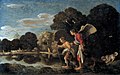
Elsheimer's painting of Tobias and the Angel (1602–1603; the "small" Tobias, now at Frankfurt) was especially well received because of its new conception of landscape. This picture was engraved by Count Hendrick Goudt and as a result, was published across Europe. However, his association with Goudt, who lodged and trained with him for several years, was difficult. Elsheimer seems to have borrowed money from Goudt, which according to one account resulted in his brief incarceration in Debtor's prison. After Elsheimer's early death in 1610 in Rome, Goudt owned several of his pictures. Goudt made seven engravings of Elsheimer's paintings, which were crucial in spreading his influence, as very few of his paintings were viewable even by artists; as cabinet paintings they were mostly kept in small and very private rooms.

Elsheimer had a definite preference for choosing rare or original subjects, both for his mythological and religious paintings. Jupiter and Mercury in the house of Philemon and Baucis, (c. 1608, now Dresden) is based on an episode in Ovid, and had never been painted before. The Mocking of Ceres (Kingston, Ontario, a copy exists in the Prado), Apollo and Coronis (Liverpool), and Il Contento (Edinburgh) were equally new. Some of his religious scenes were more conventional, but his selection of the moment to depict, as in St Lawrence prepared for Martyrdom (London), is often unusual.

Influence

[edit]
Copy after the large Tobias and the Angel, National Gallery, London 19 × 28 cm
The Exaltation of the Cross from the Frankfurt Tabernacle, c. 1605, 48 × 35 cm

His perfectionism, and an apparent tendency to depression, resulted in a small total output, despite the small size of all his pictures. In all about forty paintings are now generally agreed to be by him (see Kressmann below). He made a few etchings, but not very successfully. However, his work was highly regarded by other artists and a few important collectors for its quality. He had a clear and direct influence on other Northern artists who were in Rome such as Paul Bril, Jan Pynas, Leonaert Bramer and Pieter Lastman, later Rembrandt's master, who was probably in Rome by 1605. Rembrandt's first dated work is a Stoning of St Stephen which appears to be a response to Elsheimer's painting of the subject, now in Edinburgh. Some works by Italian artists, such as the six pictures from Ovid by Carlo Saraceni now in the Museo di Capodimonte, Naples, also show Elsheimer's clear influence. Rubens, who owned at least four of his works, knew Elsheimer in Rome, and praised him highly in a letter after his death.

In a wider sense, he was influential in three respects. Firstly his night scenes were highly original. His lighting effects in general were very subtle, and very different from those of Caravaggio. He often uses as many as five different sources of light. He graduates the light relatively gently, with the less well-lit parts of the composition often containing important parts of it.

Secondly, his combination of poetic landscape with large foreground figures gives the landscape a prominence that had rarely been seen since the Early Renaissance. His landscapes do not always feature an extensive view; often the lushness of the vegetation closes it off. They are more realistic, but no less poetic, than those of Bril or Jan Brueghel, and play a part in the formation of those of Poussin and Claude. His treatment of large figures with a landscape backdrop looks forward, through Rubens and van Dyck, to the English portrait in the eighteenth century. Soon after his death, he became very popular with English collectors, notably King Charles I of England, the Earl of Arundel, and George Villiers, 1st Duke of Buckingham, and over half his paintings have been in English collections at some time (nearly one third are still in the UK).

Thirdly, his integration of Italian styles with the German tradition he was trained in is perhaps more effective than that of any Northern painter since Dürer (with the exception of his friend Rubens). His compositions tend to underplay the drama of the events they depict (in noticeable contrast to those of Rubens), but often show the start of moments of transformation. His figures are relatively short and stocky, and reflect little of classical ideals. Their poses and gestures are unflamboyant, and their facial expressions resemble those in Early Netherlandish painting rather than the bella figura of most Italian Renaissance work.

Galleries

[edit]

The largest collection of his work is in Frankfurt. The Alte Pinakothek, Munich has two of his finest night-scene paintings, and Berlin, Bonn, Dresden and Hamburg[clarification needed] have paintings. The National Gallery, London has three paintings with others in the National Gallery of Scotland, Edinburgh, Apsley House, Windsor Castle, Petworth House, the Wellcome Library and Liverpool. In 2006 an exhibition at the Städel, Frankfurt, then Edinburgh, and Dulwich Picture Gallery in London reunited almost all of his oeuvre.[7]

There are drawings in Paris (Musée du Louvre) and Edinburgh among other locations.

Only two works are on public display outside Europe. One is in the Kimbell Art Museum, Fort Worth (The Flight into Egypt),[8] and the other is the Mocking of Ceres, now in the Agnes Etherington Art Centre in Kingston, Ontario,[9] badly damaged by fire at some point in its history; it had been part of the Dutch Gift to Charles II of England in 1660.[10]

Examples of his work

[edit]

See also

[edit]

References

[edit]

Main source

[edit]

Source unless otherwise stated

  • Rüdiger Klessmann and others, Adam Elsheimer 1578-1610, 2006, Paul Holberton publishing/National Galleries of Scotland; ISBN 1-903278-78-3

Further reading

[edit]
[edit]
Revisions and contributorsEdit on WikipediaRead on Wikipedia
from Grokipedia
Adam Elsheimer (1578–1610) was a German painter, draughtsman, and etcher of the Baroque period, celebrated for his small-scale, jewel-like cabinet paintings executed on copper panels, which featured intricate landscapes, religious narratives, and mythological scenes illuminated by innovative multiple light sources and atmospheric effects.[1] Born in Frankfurt am Main in the Holy Roman Empire, Elsheimer received his early training in that city under the goldsmith and engraver Philipp Uffenbach before departing for Munich around 1598, where he likely worked in the court of Duke William V.[1][2] From Munich, he traveled to Venice circa 1598–1600, absorbing the influences of masters such as Tintoretto and Veronese, evident in works like his The Baptism of Christ, which showcases a luminous, multi-figured composition on copper.[1] Settling permanently in Rome by 1600, Elsheimer integrated into the vibrant expatriate artist community, earning the moniker "Adamo Tedesco" (Adam the German) and forming a close friendship with Peter Paul Rubens, who later lamented Elsheimer's "sin of sloth" in producing so few works despite his genius.[2][3] There, he crafted exquisite, miniature-scale paintings such as Il Contento (c. 1605–1610), an unfinished allegorical scene inspired by Spanish literature depicting contentment as a goddess amid a nocturnal landscape, and The Flight into Egypt (c. 1609), renowned for its pioneering naturalistic night sky with the Milky Way.[3] Elsheimer's perfectionist approach resulted in a limited oeuvre of around forty authenticated paintings, many left incomplete at his death on 11 December 1610 at age 32, yet his precise technique, exotic figures, and dramatic mood through light profoundly shaped Northern European art.[1][3] His compositions, disseminated widely via engravings by artists like Hendrick Goudt, inspired Rembrandt's use of chiaroscuro, Claude Lorrain's landscapes, and even Rubens's own history paintings, establishing Elsheimer as a pivotal bridge between Italian and Northern traditions.[1]

Biography

Early Life and Family

Adam Elsheimer was born on March 18, 1578, in Frankfurt am Main, Germany, to a family of modest means.[4] His father was a master tailor, and Elsheimer was one of ten children in the household.[5] Growing up in Frankfurt, a major commercial center, Elsheimer would have been exposed to a variety of artistic influences through the city's renowned trade fairs, which attracted artworks and prints from across Europe.[6] The family's proximity to St. Katharinenkirche, home to the influential Rosenkranzaltar by Master Wilhelm of Mainz, further shaped his early familiarity with Renaissance painting and Protestant iconography. This environment, combined with familial encouragement, led him to pursue formal artistic training in his youth.

Apprenticeship and Early Career

Elsheimer began his formal artistic training as an apprentice to the Frankfurt painter and etcher Philipp Uffenbach around 1594, where he acquired foundational skills in German Renaissance techniques, including precise rendering of details through etching and painting.[6][7] This apprenticeship emphasized fine workmanship, likely influencing his later affinity for intricate, small-scale compositions on metal supports.[6] In 1598, at age twenty, Elsheimer relocated to Munich with support from his Frankfurt family, entering the orbit of the Bavarian court and its prominent artists.[5] There, he studied under or collaborated in the workshop of the Mannerist painter Hans von Aachen, while absorbing influences from Bartholomäus Spranger, the court's leading figure, which exposed him to elegant, elongated figures and dynamic compositions characteristic of late Mannerism.[6][1] During this early phase, Elsheimer produced or contributed to larger-format works, including copies after masters and possible panels for altarpieces, experimenting with religious subjects such as biblical narratives.[6] These efforts, though few survive, demonstrate his initial engagement with thematic depth and narrative structure. Through connections with Bavarian court artists like Aachen and Spranger, he secured minor commissions and gained access to collections of Flemish and Italian prints, broadening his exposure to diverse stylistic approaches.[1][6]

Life in Rome

Elsheimer arrived in Rome in the spring of 1600, where he would reside and work for the remainder of his life until his death in 1610.[1] The city's vibrant artistic environment, including the innovative techniques of Caravaggio, profoundly influenced his development, leading him to adopt a more naturalistic style while maintaining his precision in small-scale compositions.[8] As part of the German expatriate community in Rome—often referred to as the "German colony"—he integrated into a network of northern European artists, sharing ideas and resources amid the competitive Roman art scene.[9] In Rome, Elsheimer formed close professional and personal ties with fellow German painters such as Hans Rottenhammer and Johann König, as well as Flemish contemporaries including Paul Bril, Jan Brueghel the Elder, and Pieter Schoubroeck.[10] He also struck up a notable friendship with Peter Paul Rubens around 1601, likely facilitated through mutual contacts like the scholar Johann Faber or Cardinal Cesare Baronio.[1][10] Hendrick Goudt, a Dutch artist, even worked in Elsheimer's studio during this period, though their relationship was reportedly strained. These interactions provided opportunities for collaboration and exchange, particularly in cabinet paintings and landscape elements, within the expatriate circles that sustained northern artists far from home. Recent scholarship highlights how this "German colony" fostered a distinct cultural enclave, enabling Elsheimer to adapt his Frankfurt training to the luminous Roman atmosphere while drawing inspiration from the surrounding countryside. Recent scholarship, including Julian Bell's 2023 biography Natural Light: The Art of Adam Elsheimer and the Dawn of Modern Science, highlights Elsheimer's engagement with contemporary scientific ideas through his artistic circle in Rome.[10][11][12] In 1606, following his conversion to Roman Catholicism, Elsheimer married Carola Antonia Stuart, a fellow Frankfurter of Scottish ancestry, marking a period of personal stability amid his professional endeavors.[13] The couple lived modestly in the Trastevere district, relying on small commissions from patrons within the expatriate and ecclesiastical communities to sustain their household. However, financial difficulties plagued Elsheimer's later years; he accumulated debts from limited patronage and the high cost of materials for his meticulous works on copper. These struggles were intensified by the devastating plague that ravaged Rome from 1606 to 1608, disrupting artistic production and economic stability across the city. In 1609, Carola gave birth to a son, though records of the child's fate are unclear. This period marked increasing personal and financial hardships for Elsheimer. By 1610, he faced imprisonment for unpaid debts, which likely weakened his health and contributed to his untimely death at age 32.[14][11]

Death and Estate

Adam Elsheimer died on December 11, 1610, at the age of 32 in Rome, following a period of severe financial distress and declining health.[8] His reclusive lifestyle in Rome, marked by intense focus on his art and limited productivity, contributed to exhaustion and vulnerability to illness. Imprisoned in debtors' prison during his final year due to unpaid loans—possibly stemming from an unproductive partnership with the Dutch etcher Hendrick Goudt—Elsheimer succumbed to a stomach ailment compounded by depression and melancholy.[11][15] He was buried in the church of San Lorenzo in Lucina in Rome, where a commemorative plaque was erected in 2010.[11] Following his death, an inventory of Elsheimer's estate revealed a modest studio filled with unfinished works, including notable paintings such as The Flight into Egypt (on copper, approximately 16 inches across) and Il Contento (begun around 1605), both left incomplete at the time of his passing.[11][3] These small-scale pieces, primarily on copper panels, along with drawings, were dispersed to settle outstanding debts, often sold at low prices reflecting his poverty and the urgency of his widow's situation.[15] Elsheimer left no will, leading to the rapid handling of his assets by his widow, Carola Antonia Stuarda da Francoforte, who remarried the Italian artist Ascanio Quercia within a year.[11] Recent archival studies, including analyses from the 2020s, have traced some estate pieces to early collectors, underscoring the undervaluation of Elsheimer's output at the time; for instance, works entered collections associated with patrons like Cardinal Francesco Maria del Monte, who owned at least two of his paintings and supported northern artists in Rome.[3] Other pieces found their way to figures such as Vincenzo Gonzaga, Duke of Mantua, highlighting the swift dispersal amid financial pressures.[11] Friends, including fellow artists like Peter Paul Bril (who witnessed the inventory), provided support during this period, though the estate's handling emphasized Elsheimer's ongoing impoverishment despite his emerging reputation.[3]

Artistic Style and Techniques

Innovative Use of Light and Atmosphere

Elsheimer demonstrated a profound mastery of both artificial and natural light sources, employing them to craft dramatic chiaroscuro effects that imbued his compositions with emotional intensity and spatial realism. In The Flight into Egypt (1609), he innovatively depicted the nocturnal scene illuminated by moonlight, starlight, and a distant fire, creating a balanced interplay of multiple light sources that produced a naturalistic glow unprecedented in its subtlety and accuracy.[16] This technique not only heightened the painting's serene yet mysterious atmosphere but also reflected early modern astronomical insights, distinguishing Elsheimer's night scenes from the more theatrical tenebrism of his contemporaries.[17] Building on influences from Venetian painters like Titian and Tintoretto, as well as Caravaggio's stark contrasts, Elsheimer advanced beyond mere dramatic spotlighting by using glowing highlights and finely graduated tones to evoke nuanced moods and psychological depth. His subtle modulation of light allowed shadows to recede organically, fostering an intimate luminosity that surpassed Caravaggio's bolder tenebrism through a more integrated harmony of form and illumination.[18] For instance, in works like Jupiter and Mercury in the House of Philemon and Baucis (c. 1609–1610), candlelight diffuses softly across figures and surroundings, creating a warm, enveloping ambiance that draws viewers into the narrative's emotional core.[1] In his landscape paintings, Elsheimer pioneered the use of atmospheric perspective to achieve profound depth and environmental verisimilitude, blending sharply detailed foregrounds with progressively hazier backgrounds to simulate the diffusion of light through air. This method, evident in pieces such as Landscape with a Goat and a Shepherd (c. 1600–1610), conveys a sense of expansive natural space within compact formats, enhancing the ethereal quality of his scenes and influencing later landscapists like Claude Lorrain.[19] The small-scale intimacy of his copper panels amplified these optical effects, making the subtle play of atmosphere feel immediate and immersive.[1] Recent scholarly examinations underscore Elsheimer's technical innovation through layered glazing techniques, where translucent oil layers were built up to produce radiant, jewel-like luminosity and depth in light rendering. These methods reveal how Elsheimer achieved glowing highlights and atmospheric haze via meticulous veiling glazes that allowed underlying tones to shimmer, marking a pivotal advancement in the depiction of light's ephemeral qualities.[1]

Preference for Small-Scale Works

Elsheimer consistently employed small-scale formats for his paintings, producing cabinet pictures on copper or wooden panels that typically measured between 10 and 30 cm in height or width. These diminutive works were crafted for private enjoyment and contemplation, often housed in collectors' cabinets or studioli rather than intended for grand public altars or ecclesiastical settings.[1][20] This preference aligned with Elsheimer's reclusive temperament and bouts of melancholy, which contributed to his limited productivity—fewer than 40 paintings in total—and suited his solitary studio practice in Rome, avoiding the logistical challenges of large-scale commissions that required workshops and apprentices. By focusing on intimate scales, he catered to an elite market of princely collectors and connoisseurs, such as King Charles I of England, who prized these jewel-like objects for their portability and exclusivity, enabling the inclusion of meticulously rendered details without the overhead of expansive productions.[20] While rooted in Northern European miniaturist traditions of finely wrought small-format art, Elsheimer's approach elevated landscape elements to match the narrative depth and atmospheric ambition of monumental works by contemporaries like Annibale Carracci or Caravaggio. The compact dimensions intensified viewer engagement, drawing the eye into intricate scenes of nature and mythology that conveyed a sense of vastness despite their size. In these confined spaces, his techniques for rendering light were particularly amplified, fostering a profound sense of immersion.[1][20]

Materials and Methods

Adam Elsheimer predominantly used small copper plates as supports for his oil paintings, which were often polished to create a smooth, non-porous surface that facilitated meticulous fine brushwork and contributed to an enamel-like finish in the final works.[21] This choice of material allowed for exceptional luminosity and detail, as the reflective properties of copper enhanced the vibrancy of applied layers.[15] Recent technical examinations, including macroscopic X-ray fluorescence (MA-XRF) scanning conducted in the 2010s on paintings such as the Altarpiece of the Holy Cross (ca. 1603–1605), have confirmed the prevalence of copper supports in his oeuvre and provided insights into their production and elemental composition.[22][23] In his oil painting process, Elsheimer employed thin glazes built up progressively from dark to light grounds, achieving subtle tonal transitions and intricate light effects through layered application.[1] Highlights were often rendered using pointillist dots of pigment, particularly for celestial or luminous elements, which added precision and sparkle to his miniature-scale compositions.[15] Pigment analyses from these MA-XRF studies, alongside historical accounts, reveal his commitment to high-quality materials despite documented poverty in Rome.[22] Elsheimer also incorporated etchings and drawings as both preparatory studies and independent works, drawing on burin techniques acquired during his apprenticeship with the engraver Philipp Uffenbach in Frankfurt.[24] Uffenbach's expertise in etching and engraving influenced Elsheimer's early handling of line and form, evident in his rare etched plates that complemented his painted output.[1] These graphic works served to explore compositions before transferring them to copper, integrating a multidisciplinary approach honed from his training.[1]

Major Works

Religious and Mythological Paintings

Adam Elsheimer's religious paintings often drew from biblical narratives, portraying sacred events with intimate, human-centered compositions that emphasized emotional depth and spiritual drama. Commissioned by prominent Roman patrons such as Cardinal Francesco Maria del Monte, who supported Elsheimer's work during his time in the city, these small-scale oils on copper—typically no larger than 30 by 40 centimeters—served as devotional objects for private contemplation. Approximately 30 of Elsheimer's surviving religious oils explore themes of martyrdom, divine intervention, and the life of Christ, blending Northern precision with Italianate naturalism to create scenes that feel immediate and relatable.[3][25] One of Elsheimer's early masterpieces in this vein is The Stoning of Saint Stephen (c. 1602–1605), housed in the National Galleries of Scotland. This work depicts the martyrdom of the first Christian martyr, with Stephen kneeling amid his tormentors, his gaze fixed on a visionary heaven cracked open by divine light. Elsheimer innovates the narrative by compressing the dramatic action into a tightly framed, nocturnal urban setting, where the saint's ethereal upward vision contrasts sharply with the earthly violence below, underscoring themes of faith amid persecution. The painting's subtle use of light enhances the spiritual tension, drawing the viewer's eye from the chaos to the transcendent.[13] In mythological subjects, Elsheimer similarly humanized divine figures, as seen in Jupiter and Mercury in the House of Philemon and Baucis (c. 1608), now in the Gemäldegalerie Alte Meister, Dresden. Based on Ovid's Metamorphoses, the painting captures the gods disguised as travelers receiving humble hospitality from the elderly couple, with Jupiter and Mercury seated at a modest table illuminated by a warm oil lamp. Elsheimer grounds the myth in a domestic interior that opens to a starry landscape background portraying a Phrygian town amid a flood, portraying the deities on a human scale to highlight virtues of generosity and recognition of the divine in everyday life, diverging from grandiose allegorical traditions. This integration of naturalistic landscape elements anchors the supernatural event, making the narrative accessible and immersive.[26][27] Another significant allegorical work is Il Contento (c. 1605–1610, National Gallery of Scotland), an unfinished scene depicting contentment as a goddess in a nocturnal landscape, inspired by Spanish literature.[3] Elsheimer's religious oeuvre also includes innovative depictions of the Holy Family, such as The Flight into Egypt (1609) in the Alte Pinakothek, Munich, where the nocturnal journey is illuminated by the Milky Way as a symbolic path of divine protection. Recent scholarship has examined variants and attributions related to Rest on the Flight into Egypt scenes, refining understandings of Elsheimer's workshop practices and compositional evolution. These works collectively demonstrate his narrative ingenuity, weaving landscape backdrops to contextualize mythic and biblical events within a tangible world, often employing light effects to amplify their devotional impact.[28]

Landscape and Genre Scenes

Elsheimer's landscape and genre scenes demonstrate a profound engagement with the natural world, drawing heavily from sketches of the Roman countryside that he executed during his residence in the city from around 1600 onward. These works emphasize the topography of the Italian landscape, integrating subtle human activity to evoke a sense of harmony between people and environment, prefiguring Romantic sensibilities in their focus on nature's transient beauty. Approximately 10 pure landscapes survive, many executed on small copper panels that allowed for portable field studies and meticulous detail.[29] Elsheimer frequently employed nocturnal or twilight settings in these compositions to capture transient natural phenomena, such as the play of moonlight on foliage or the glow of distant fires, infusing his scenes with atmospheric depth and a sense of ephemerality. This approach is evident in genre-like vignettes of rural life, where everyday activities unfold under dim light, highlighting the fragility of human presence in vast, changing landscapes.[8] In the 2010s, scholars began interpreting Elsheimer's mining and flooded scenes through an ecological lens, linking their portrayal of resource extraction and natural disasters to contemporary concerns about environmental degradation and humanity's impact on the planet, as seen in analyses tying his works to early modern observations of nature's vulnerability.[11]

Notable Collaborations and Etchings

Elsheimer's collaborations with the German painter Hans Rottenhammer, whom he assisted in Venice around 1598–1600, exemplify his role in joint projects on copper panels, where Elsheimer often supplied intricate landscape settings for Rottenhammer's figural elements. These partnerships produced harmonious small-scale works blending Mannerist figures with innovative atmospheric backdrops.[30][31] In addition to painting, Elsheimer ventured into printmaking with a small corpus of original etchings, executed with exceptional precision and fine line work that highlighted his mastery of light and texture on a miniature scale. These prints, typically depicting mythological or biblical subjects, were valued for their technical innovation and influenced subsequent reproductive engravings by artists like Hendrick Goudt. Scholarly catalogues attribute eight such etchings to Elsheimer, underscoring his experimentation with etching techniques alongside his preferred oil medium on copper, which allowed seamless adaptation to print processes.[2][32]

Legacy and Influence

Impact on Contemporaries

Joachim von Sandrart praised Adam Elsheimer in his 1675 Teutsche Academie as a painter of rare talent, particularly for his inventive compositions and luminous effects, which profoundly influenced young German artists working in Italy, including Johann Liss.[33] Liss, who arrived in Rome around 1620, adopted Elsheimer's intimate scale and dramatic use of light in religious and mythological scenes, as seen in works like his Ecstasy of St. Paul, blending Venetian color with Elsheimer's northern precision.[34] This admiration extended to Elsheimer's role in shaping a generation of German émigrés who bridged northern and Italian traditions.[35] Elsheimer's small-scale paintings were eagerly acquired by collectors in Rome for their innovative nocturnal atmospheres.[36] Early dissemination was facilitated as copies and engravings of Elsheimer's works circulated northward; notably, Hendrick Goudt produced seven precise engravings after Elsheimer's compositions between 1608 and 1613, introducing motifs like The Flight into Egypt to Dutch and German audiences and amplifying Elsheimer's reputation beyond Italy.[37] Within the Bentvueghels, the lively fraternity of northern artists in Rome where Elsheimer was an active member from around 1600, his pioneering nocturnal experiments—such as St. Paul on Malta with its flickering torchlight—spurred contemporaries like Leonaert Bramer to explore similar dramatic illuminations in cabinet pictures, influencing the tenebrist trends emerging in Italian art circles.[38] These shared motifs of moonlight and shadow fostered collaborative innovation among the group, extending Elsheimer's techniques into broader Roman practice.[39]

Influence on Later Artists

Elsheimer's innovative treatment of light and landscape profoundly impacted Rembrandt van Rijn, who drew inspiration from his small-scale copper paintings, particularly through reproductive prints that circulated widely in the Netherlands. This is evident in Rembrandt's etching Landscape with the Flight into Egypt (1651), which echoes Elsheimer's atmospheric effects and nocturnal luminosity, as well as his painted version of The Flight into Egypt (c. 1627, National Gallery of Ireland), directly modeled after Elsheimer's 1609 masterpiece with its moonlit path and detailed starry sky.[40][41] Peter Paul Rubens not only acquired several of Elsheimer's miniatures for his collection but also lauded his technical mastery in depicting lifelike figures in challenging lighting, such as dawn, moonlight, or firelight, which helped elevate the prestige of small-format cabinet paintings in Flemish art. Rubens' own copper panels, like The Flight into Egypt (c. 1614, Gemäldegalerie Alte Meister, Kassel), reflect Elsheimer's influence in their intimate scale and luminous landscapes, contributing to the genre's popularity among Flemish artists in the early 17th century.[42][43][44] In the 19th century, Elsheimer's legacy revived through the English landscape tradition, where artists like John Constable and J.M.W. Turner admired his pioneering atmospheric skies, which emphasized natural light diffusion and emotional depth in nocturnal scenes. This admiration stemmed from Elsheimer's indirect influence via Claude Lorrain, whose idealized landscapes—infused with Elsheimer's subtle tonal gradations—in turn shaped Constable's cloud studies and Turner's dramatic vaporous effects. Recent scholarship, such as Julian Bell's 2023 analysis, highlights Elsheimer's foundational role in Northern Romanticism by linking his precise, light-infused vignettes to the introspective naturalism of later German and English painters.[45][46][47]

Modern Reception and Rediscovery

During the 19th century, Adam Elsheimer's works experienced relative neglect, largely due to their intimate small scale, which contrasted with the era's preference for larger, more monumental art forms.[48] His paintings and drawings, often executed on copper or in miniature formats, were overshadowed amid the Romantic and historicist movements that favored grand historical scenes. However, scholarly interest began to revive through the efforts of art historian Gustav Friedrich Waagen, whose catalogs from the 1830s and 1840s, such as Treasures of Art in Great Britain (1838), documented Elsheimer's pieces in prominent British collections, highlighting their technical innovation and luminous effects.[49] This cataloging work played a pivotal role in reintroducing Elsheimer to connoisseurs, establishing a foundation for later attributions and appreciation of his contributions to early Baroque landscape and light depiction. The early 21st century marked a significant resurgence in scholarly and public engagement with Elsheimer's oeuvre, driven by major exhibitions that employed advanced technical analysis to resolve longstanding attribution debates. The 2006 exhibition Adam Elsheimer: 1578–1610, organized by the Städel Museum in Frankfurt, followed by venues in Edinburgh and Dulwich Picture Gallery in London, assembled nearly all of his surviving paintings—around 40 works—allowing for comprehensive study.[10] Curator Rüdiger Klessmann's accompanying catalog incorporated X-radiography and other imaging techniques to confirm attributions, revealing underdrawings and alterations that affirmed Elsheimer's authorship for several disputed pieces, such as variants of religious scenes on copper.[50] These exhibitions not only illuminated his innovative use of light and atmosphere but also addressed gaps in provenance, drawing crowds and critical acclaim for reuniting dispersed cabinet paintings long held in private collections. Ongoing scholarly interest continued into the 2020s, with Julian Bell's 2023 book *Natural Light: The Art of Adam Elsheimer and the Dawn of Modern Science* receiving reviews in 2024 that further emphasized his scientific and artistic innovations.[51] In 2025, workshops such as Tico Seifert's examination of Il Contento at the Zentrum für interdisziplinäre Kunst- und Geschichtsforschung revisited key works, highlighting persistent debates on iconography and technique.[52] Today, Elsheimer's works are preserved in key institutions, including the British Museum, which holds significant drawings and etchings, and the Städel Museum, home to several oil paintings on copper like The Deluge (c. 1600–1601).[2][53] Conservation efforts continue to grapple with the inherent vulnerabilities of his preferred copper supports, which are prone to corrosion from environmental factors, paint delamination due to the metal's expansion and contraction, and challenges in stabilizing thin oil layers applied directly to the surface.[43] Ongoing projects at these museums emphasize climate-controlled storage and non-invasive treatments to mitigate these issues, ensuring the longevity of his delicate masterpieces amid growing recognition of his influence on European art history.

References

User Avatar
No comments yet.