Hubbry Logo
Adnan SaidiAdnan SaidiMain
Open search
Adnan Saidi
Community hub
Adnan Saidi
logo
8 pages, 0 posts
0 subscribers
Be the first to start a discussion here.
Adnan Saidi
Adnan Saidi
from Wikipedia

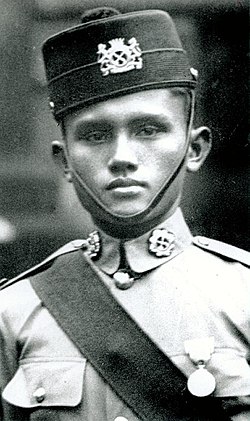
Adnan bin Saidi (Jawi: عدنان بن سيدي‎; 14 August 1915 – 14 February 1942) was a Malayan military officer who served under the 1st Malaya Infantry Brigade within the Malaya Command during the Second World War. Born in Selangor, Adnan pursued his education and graduated from the Sultan Idris Training College. He was initially a schoolteacher before enlisting in the Straits Settlements Volunteer Force (SSVF), where his leadership potential quickly became apparent. Rising through the ranks, he became a commissioned officer in the Malay Regiment, one of the few Malay officers at the time to attain such a position. Known for his discipline, strategic acumen and unwavering dedication, Adnan played a vital role in the defence of Singapore during the Japanese invasion.

Key Information

In February 1942, as Japanese forces launched an all-out assault on Singapore, Adnan commanded a platoon of the 1st Battalion of the Malay Regiment during the critical Battle of Pasir Panjang. Tasked with defending the approach to Alexandra Hospital and the surrounding ridges, Adnan and his men held their ground against overwhelming Japanese numbers. Despite being outgunned and outflanked, they mounted a fierce resistance over two days of intense combat. Refusing to surrender even when wounded, Adnan was eventually captured and executed by Japanese troops. His defiance and bravery have been immortalised in both Malaysia and Singapore, where he is remembered as a national hero. Monuments, educational materials and public commemorations continue to honour his sacrifice and commitment to duty in the face of insurmountable odds.

Family background and early life

[edit]

Adnan was born in a Minangkabau family in Sungai Ramal, near Kajang, Selangor, Malaya. He was the eldest of six children in his family and attended Pekan Sungei Ramal School. After graduating, he worked as a trainee teacher at his alma mater for over a year.[2]

He is the great-grandson of renowned Negri warrior Datuk Siamang Gagap.[3]

Career

[edit]

Adnan enlisted in the Malay Regiment in 1933 and was selected as the regiment's best recruit for his outstanding performance. He was promoted to sergeant in 1936. A year later, he marched alongside the Colonial Contingent representing the Federated Malay States at the coronation parade of George VI and earned a coronation medal.[2]

In late 1941, Adnan was posted to Singapore to attend an officer conversion course and lived with his family in a house at Pasir Panjang reserved for the Malay Regiment's officers. After completing his training, he was commissioned as a lieutenant and appointed as company officer of the 7th Platoon in C Company of the Malay Regiment's 1st Battalion. In December 1941, he sent his family back to their hometown in Kajang, Selangor for their safety.[2]

Battle of Pasir Panjang

[edit]

In February 1942, Adnan led his 42-men platoon of the 1st Malaya Infantry Brigade to defend Singapore from attacks by the 56th Infantry Regiment of the Imperial Japanese Army. They fought at Pasir Panjang Ridge around Bukit Chandu between 12 and 14 February.[4] Despite being heavily outnumbered, Adnan refused to surrender and urged his men to fight to the end. They held off the Japanese for two days amid heavy shelling from Japanese artillery and tanks, as well as chronic shortages of food, medical supplies and ammunition. On the last day of the battle, Adnan and his men were left with only a few grenades and had to fight the Japanese with their bayonets in brutal hand-to-hand combat. Adnan was shot but continued fighting.

During the battle, Adnan identified Japanese soldiers who were attempting to infiltrate the Malay Regiment's base in disguise as "Punjabi soldiers",[5] who were marching four abreast (Japanese style) instead of three (British style).[6]

Capture and death

[edit]

Although it is widely agreed that Adnan was killed during the Battle of Pasir Panjang on 14 February 1942,[2] the exact details surrounding his death differed between accounts from both sides of the war. The actual circumstances of his death were never officially recorded.

The Imperial Japanese Army's official account indicated that Adnan was executed and then hung upside down from a cherry tree after two days of stubborn resistance and refusal to surrender. Other accounts suggest that he might have been tied to the tree and repeatedly bayoneted to death.[6][7] British accounts confirmed that his corpse was found hung upside down after the surrender and this has been repeated in a number of authoritative texts on the Malayan Campaign. His remains are buried at the Kranji War Memorial.

Personal life

[edit]

Adnan's younger brothers, Ahmad and Amarullah, also served in the armed forces. Ahmad was killed in action after his ship, HMS Pelandok, was sunk in January 1942 in a Japanese air raid en route to Australia.[2]

Adnan married Sophia Pakih, an Islamic religious teacher, in 1938. They had a daughter who died soon after birth, and two sons: Mokhtar, who lives in Seremban, and Zainudin, who lives in Johor. Mokhtar recalled that his father "did not talk a lot", was "a strict man and believed in discipline", and was "always serious and fierce ... yet had a good heart. There seemed to be a 'light' illuminating his face."[8] Sophia died in 1949.

Legacy

[edit]

Adnan is considered a war hero in Singapore due to his courageous and valiant actions at the Battle of Pasir Panjang.[9] The promotion of Adnan as a national hero was championed by the Singaporean Malay-language newspaper Berita Harian in 1995. In 1999, Singapore Prime Minister Goh Chok Tong honoured Adnan as a national hero and his story begun appearing in history school books.[10]

Adnan is also well recognised in Malaysia as a national hero and his story is made into a novel used in secondary schools as part of the Malay-language curriculum.

War memorial

[edit]

A war memorial plaque honouring Adnan and the Malay Brigade was commissioned by Singapore Prime Minister Lee Kuan Yew in 1995 at Vigilante Drive, Kent Ridge Park, Singapore.[11]

A colonial-era bungalow at Bukit Chandu was converted into Reflections at Bukit Chandu, an interpretative centre about the Battle of Pasir Panjang.[12]

The Art-in-Transit programme of Pasir Panjang MRT station, titled Lieutenant Adnan, by Ho Tzu Nyen, features mock posters all around the station and lift shaft for a fictional movie about Adnan, who is portrayed by Singaporean actor Aaron Aziz.[13]

Portrayal in film

[edit]

Adnan was portrayed by Malaysian actor Hairie Othman in the 2000 film Leftenan Adnan.[14]

He was also portrayed by an unknown Malay actor in the 2001 Singaporean television series A War Diary.

Aaron Aziz also portrayed Adnan in an episode of the 2004 historical series Life Story from Mediacorp Channel 5, which also covers his personal life.[15]

In May 2016, a Singaporean actor Fadhlur Rahman also played as Adnan in Heroes: Battle of Bukit Chandu aired by Mediacorp Channel 5, Channel 8, Suria, Vasantham and Channel NewsAsia. In the episodes, there were interviews with Adnan's granddaughter Wan Sofia Zainuddin.

Singapore's bicentennial

[edit]

On 5 June 2019, on Hari Raya Aidilfitri, Singapore President Halimah Yacob launched commemorative notes featuring Adnan along with 7 other historical Singaporean figures in a $20 commemorative notes marking Singapore's bicentennial celebrations, 1819–2019 edition.[16]

See also

[edit]

References

[edit]
[edit]
Revisions and contributorsEdit on WikipediaRead on Wikipedia
from Grokipedia
Adnan Saidi (c. 1915 – 14 February 1942) was a in the 1st of the Malay Regiment, a British colonial infantry unit, who led a resolute defense against Japanese forces during the final stages of the in . Enlisting in 1933 after brief service as a trainee teacher, Saidi rose through the ranks to command the 7th Platoon of C Company, participating in earlier actions such as the before the retreat to . On 13–14 February 1942, amidst the , he directed his outnumbered platoon—initially around 42 men—in holding Bukit Chandu (Opium Hill) against repeated assaults by elements of the Japanese 18th Division, inflicting significant casualties and delaying the enemy's push toward Singapore's administrative district. Captured after ammunition ran out, Saidi refused to surrender and was subjected to torture before execution by bayoneting, an act witnessed by fellow prisoners. His leadership, marked by orders to fire only when targets were visible despite the odds, has since been honored in Malaysian and Singaporean commemorations, including the Reflections at Bukit Chandu museum, as emblematic of Malay martial valor under British command.

Early Life and Background

Family and Origins

Adnan Saidi was born in 1915 in Kampung Sungai Ramal near , , in the (present-day ). He belonged to a Muslim family of ethnicity, tracing origins to the of , , who had migrated to Malaya and maintained traditions such as adherence to and matrilineal customs. As the eldest of six children—born to Saidi, from whom he derived his patronymic "bin Saidi"—Adnan grew up in a rural kampung environment typical of early 20th-century Malay agrarian communities in . His siblings included younger brothers such as Ahmad Saidi, who later pursued a military career, reflecting a family inclination toward service amid British colonial rule in Malaya. Limited records detail his parents' backgrounds beyond their Minangkabau heritage and residence in , where they engaged in local livelihoods supporting the household in a pre-industrial setting.

Education and Upbringing

Adnan Saidi was born in 1915 in Kampong Sungei Ramal near , , into a Malay family as the eldest of six children. He grew up in a rural village environment typical of early 20th-century Malaya, where agricultural life and community ties shaped daily existence amid British colonial rule. Saidi received his at Pekan Sungei Ramal School, studying in the English medium, which was uncommon for many in rural areas and indicative of access to colonial-era schooling systems. Accounts describe him as a diligent and persistent during this period, reflecting a disciplined upbringing that emphasized perseverance. After graduating, Saidi briefly worked as a trainee teacher at his , applying his in a local capacity before enlisting in the in 1933 at age 18. This early career choice bridged civilian instruction with military service, influenced by limited opportunities in colonial Malaya for educated Malays.

Military Career

Enlistment and Initial Training

Adnan Saidi enlisted in the Malay Regiment in 1933 at the age of 18, having previously worked as a trainee teacher in his hometown of Kajang, Selangor. The regiment, newly formed by the British colonial authorities to employ Malays in military service, conducted initial recruitment from over 1,000 candidates, selecting only 25 for the inaugural batch at Port Dickson. Saidi underwent basic training emphasizing discipline, marksmanship, and , during which he demonstrated exceptional aptitude and commitment. His performance stood out among recruits, leading to his selection as the regiment's best recruit and receipt of the top award in 1934. This early recognition facilitated swift promotions, including to , , and within the first few years, positioning him as one of the regiment's most capable non-commissioned officers. By the late , as tensions in escalated, training regimens intensified with more rigorous field exercises, further honing Saidi's leadership skills in preparation for potential combat duties.

Promotions and Pre-War Service

Adnan Saidi enlisted in the British Army's 1st Experimental Company, which later formed the basis of the Malay Regiment, in 1933 at the age of 18 while working as a trainee teacher in Kajang, Selangor. The unit, initially an experimental formation to test the feasibility of an all-Malay infantry battalion, underwent training focused on basic infantry drills and marksmanship at locations such as Port Dickson. In 1934, Saidi was recognized as the regiment's best recruit for his discipline and performance during initial training. By 1936, his leadership qualities led to his promotion to , making him the first Malay in the regiment's history. Saidi's pre-war service included participation in ceremonial duties, such as marching in a combined contingent during a 1937 military parade in , demonstrating the regiment's growing proficiency. Prior to the outbreak of in 1939, he traveled to for an officer conversion course, where he earned a commission as a , advancing from enlisted ranks to junior officer status based on merit. This promotion reflected the British colonial administration's gradual expansion of local officer roles within the Malay Regiment, though such opportunities remained limited.

Deployment in the Battle of

As Japanese forces invaded on 8 February 1942, the 1st Battalion of the Malay Regiment, part of the Allied defenses under Lieutenant-Colonel Charles Rose-Price, was deployed to the sector on the island's southwestern coast to block enemy advances toward the city center, reservoirs, and Alexandra Barracks. This positioning aimed to secure the Ridge, a critical defensive line against the Japanese 56th Regiment's push from the northwest. The battalion, headquartered at nearby Normanton Camp since 1940, consisted of approximately 800 men organized into companies, with C Company holding forward positions along the ridge. Lieutenant Adnan Saidi commanded a of soldiers within C Company, assigned to defend elevated terrain including areas adjacent to Opium Hill (Bukit Chandu), a strategic vantage point overlooking potential Japanese landing zones and supply routes. On 12 February, patrols scouted Japanese movements in the vicinity, confirming enemy amid deteriorating Allied lines following the fall of earlier positions held by Indian and Australian units. By 13 February, as Japanese and assaults intensified, Saidi's fortified their positions with machine guns and rifles, preparing to repel infiltrations while coordinating with adjacent units amid supply shortages and communication breakdowns. The platoon's deployment emphasized holding ground at all costs to delay the Japanese breakthrough, with Saidi instructing his men to fire only on confirmed threats, a tactic that proved vital against attempts. This stance contributed to initial repulses of Japanese probes, buying time for rearward reinforcements, though the faced overwhelming numerical superiority—Japanese forces numbered over 13,000 in the sector against the regiment's limited strength. Casualties mounted rapidly, with the Malay Regiment suffering 159 killed across the campaign's final days, underscoring the ferocity of engagements in this phase.

Defense of Bukit Chandu

During the Battle of Pasir Panjang on 13 February 1942, Second Lieutenant Adnan Saidi commanded No. 7 Platoon of C Company, 1st Battalion, Malay Regiment, which retreated to Bukit Chandu (also known as Opium Hill) after fierce fighting along Pasir Panjang Ridge. With approximately 42 soldiers under his command, Adnan's unit faced overwhelming Japanese forces advancing towards key objectives including Alexandra Hospital and the Singapore waterfront. Adnan detected a Japanese infiltration attempt when enemy troops disguised as British Indian soldiers approached; he noted their irregular marching in groups of three rather than the standard four and ordered his men to open , thwarting the ruse. His platoon held their positions tenaciously, inflicting significant casualties on the attackers through determined and machine-gun despite being heavily outnumbered and low on . Adnan, wounded multiple times, refused to surrender and urged his men to fight to the last, continuing to direct from exposed positions even as Japanese troops closed in with grenades and bayonets. By 14 February 1942, the defenders were overwhelmed after sustaining near-total casualties, with most of Adnan's . Adnan, captured while still resisting, was executed by the Japanese through shooting and repeated bayoneting; his body was subsequently hung upside down from a as a warning to others. This stand at Bukit Chandu delayed the Japanese advance and exemplified the Malay Regiment's resolve amid the broader collapse of Allied defenses in .

Capture and Execution

Following the intense fighting at Bukit Chandu (also known as Opium Hill) on 14 February 1942, during the , Japanese forces overwhelmed the positions held by C Company of the 1st Battalion, Malay Regiment, capturing the remaining defenders after most had been killed or wounded. Lieutenant Adnan Saidi, who had continued directing fire despite sustaining wounds, was taken prisoner along with a few survivors, including Yaakob bin Razak, amid the Japanese massacre of the . Adnan was then executed by Japanese troops through shooting and bayoneting, with his body subsequently hung from a as a warning to others; this occurred shortly after capture on the same day, 14 1942. Accounts from survivors, such as Yaakob, confirm the summary nature of the execution without formal trial, reflecting Japanese practices during the of . The precise sequence of events varies slightly in eyewitness recollections, but the outcome—immediate execution following defiance in combat—is consistent across preserved testimonies.

Personal Life

Marriage and Family

Adnan Saidi married Sophia Pakih Muda, a schoolteacher from his village in , at the age of 23 in 1938. The couple relocated to in late 1941 amid rising tensions with Japanese forces, with Sophia pregnant at the time and accompanied by their two young sons. They had three children: sons Mokhtar and Zainudin, and a daughter who died shortly after the fall of in February 1942. Mokhtar, the eldest son born around 1938, later resided in , . Sophia Pakih Muda passed away in 1949.

Personal Traits and Motivations

Adnan Saidi demonstrated exceptional discipline and dedication early in his , earning recognition as the outstanding recruit of and selection for a ceremonial in to honor King George VI. These traits underscored his rapid rise from enlistee to commissioned officer, reflecting a commitment to rigorous training and regimental standards. His leadership qualities were evident in tactical acumen and resolve, as he directed the fortification of Opium Hill with sandbags, regrouped his outnumbered platoon under fire, and identified Japanese troops disguised in British uniforms, enabling a counterattack that inflicted significant casualties on the enemy. Saidi's bravery manifested in sustaining a three-day defense against a force of approximately 13,000 Japanese soldiers with just 42 men, resorting to bayonet charges once ammunition depleted, and rejecting surrender even after sustaining wounds. Saidi's motivations stemmed from a deep-seated sense of , influenced by his transition from to in and adherence to the Malay Regiment's of "Taat Setia" (faithfulness and loyalty). Central to this was the regimental "Biar putih tulang, jangan putih mata," advocating death in honorable combat over survival in disgrace, which guided his refusal to yield ground critical to Singapore's defense despite inevitable defeat. This commitment prioritized collective defense and personal integrity over self-preservation, as seen in his final orders to his men to continue fighting amid encirclement.

Legacy and Commemoration

Memorials and Honors

Adnan Saidi is commemorated on Column 385 of the Singapore Memorial at the Kranji War Memorial, alongside 26 other soldiers from the 1st Battalion, Malay Regiment, whose bodies were not recovered after the Battle of Pasir Panjang. The Reflections at Bukit Chandu interpretative centre, opened in 2006 on the site of the former Opium Hill battleground, honors Saidi's defense of Pasir Panjang Ridge, featuring a bronze bust of him and multimedia exhibits on the Malay Regiment's stand. A memorial plaque dedicated to Saidi and his Malay Brigade comrades was erected at Vigilante Drive in Kent Ridge Park, commissioned in 1995 by then-Prime Minister Lee Kuan Yew. For his actions, Saidi received posthumous British campaign medals, including the 1939-1945 Star, the Pacific Star, and the War Medal 1939-1945. In 1999, Prime Minister publicly recognized Saidi as a national hero during commemorative events. The Adnan Award, established in 2017 by the Singapore Muslim Education Fund, annually honors Malay/Muslim tertiary students who excel despite adversity, drawing inspiration from Saidi's resilience. On 5 June 2019, President launched a series of commemorative banknotes featuring Saidi among eight historical figures, marking Hari Raya Aidilfitri.

Depictions in Film and Media

Adnan Saidi was portrayed by Malaysian actor Hairie Othman in the 2000 Malaysian film , which chronicles his leadership of the Malay Regiment's 7th Platoon in the defense of Bukit Chandu against Japanese forces during the Battle of on February 14, 1942. A 1938 British titled Five Faces includes footage of Adnan Saidi on parade with the Malay Regiment, providing an early visual record of his pre-war service. At the Reflections at Bukit Chandu museum in , actor portrays Saidi in a permanent exhibit featuring the The Battle of Bukit Chandu, which depicts the Malay Regiment's final stand at Opium Hill. The 2020 short film The Last Battle of Bukit Chandu, produced for the My RØDE Reel competition by Studio Five TV, focuses on Saidi's command during the regiment's desperate defense, emphasizing themes of sacrifice and resistance. Saidi has also appeared as a subject in various documentaries and animated features highlighting Malay contributions to the Allied defense of , though specific titles beyond the aforementioned productions remain less documented in primary sources.

Historical and National Significance

Adnan Saidi's defense of Bukit Chandu during the Battle of Singapore on 13–14 February 1942 exemplifies a rare instance of effective localized resistance amid the broader collapse of Allied defenses. Commanding a of approximately men from the 1st Battalion, Malay Regiment, Saidi repelled multiple Japanese assaults by the 56th Infantry Regiment of the Imperial Japanese Army's 18th Division, which numbered around 13,000 troops overall in the sector. His forces detected and countered Japanese , including soldiers disguised as Allied troops, inflicting notable casualties—estimated at over 20 in initial clashes—while holding the position for hours beyond ammunition exhaustion, resorting to bayonets and . This delayed the enemy's advance along Ridge, providing temporary cover for retreating Allied units and contesting narratives of inevitable Japanese superiority through disciplined firepower and refusal to yield ground. The historical import lies in Saidi's stand as a tactical outlier in the , where British-led forces often faltered due to poor coordination and morale issues; his platoon's endurance demonstrated that determined infantry, leveraging terrain and vigilance, could exact a measurable toll on numerically superior foes, even if ultimately overwhelmed. Japanese accounts, including those from General , acknowledged the ferocity of opposition on Singapore's western flank, with over 4,000 enemy casualties reported in related actions. This episode underscores causal factors in wartime outcomes—leadership resolve versus strategic overextension—rather than ethnic determinism, though it highlighted the Malay Regiment's training efficacy against odds of 10:1 or greater. In national contexts, Saidi symbolizes martial valor and duty in both and . Singaporean heritage institutions portray him as an emblem of sacrificial defense, with the Reflections at Bukit Chandu interpretive center (opened 2002, reopened 2021) dedicated to the battle, preserving artifacts and narratives of his 7th Platoon's role to educate on multi-ethnic wartime contributions. In , originating from , his legacy reinforces pride in the Malay Regiment's heritage, evidenced by the 1982 renaming of his Kajang to Sekolah Kebangsaan Adnan Saidi, integrating his story into educational frameworks emphasizing honor over surrender, as per the regiment's "Biar putih tulang, jangan putih mata." Across both nations, commemoration at sites like Kranji War Memorial fosters shared appreciation for individual agency in collective security, distinct from broader imperial failures.

References

Add your contribution
Related Hubs
User Avatar
No comments yet.