


Community hub
Recent from talks
Contribute something
Nothing was collected or created yet.
Rhythm in Sub-Saharan Africa
View on Wikipedia


Sub-Saharan African music is characterised by a "strong rhythmic interest"[1] that exhibits common characteristics in all regions of this vast territory, so that Arthur Morris Jones (1889–1980) has described the many local approaches as constituting one main system.[2] C. K. Ladzekpo also affirms the profound homogeneity of approach.[3] West African rhythmic techniques carried over the Atlantic were fundamental ingredients in various musical styles of the Americas: samba, forró, maracatu and coco in Brazil, Afro-Cuban music and Afro-American musical genres such as blues, jazz, rhythm & blues, funk, soul, reggae, hip hop, and rock and roll were thereby of immense importance in 20th century popular music.[citation needed] The drum is renowned throughout Africa.
Rhythm in Sub-Saharan African culture
[edit]


Many Sub-Saharan languages do not have a word for rhythm, or even music.[citation needed] Rhythms represent the very fabric of life and embody the people's interdependence in human relationships.[citation needed] Cross-beats can symbolize challenging moments or emotional stress: playing them while fully grounded in the main beats prepares one for maintaining life-purpose while dealing with life's challenges.[4] The sounding of three beats against two is experienced in everyday life and helps develop "a two-dimensional attitude to rhythm". Throughout Western and Central Africa child's play includes games that develop a feeling for multiple rhythms.[5]
Among the characteristics of the Sub-Saharan African approach to rhythm are syncopation and cross-beats which may be understood as sustained and systematic polyrhythms, an ostinato of two or more distinct rhythmic figures, patterns or phrases at once. The simultaneous use of contrasting rhythmic patterns within the same scheme of accents or meter lies at the core of African rhythmic tradition. All such "asymmetrical" patterns are historically and geographically interrelated.[6]
As a result of the migrations of Niger-Congo peoples (e.g., Bantu expansion), polyrhythmic culture (e.g., dance, music), which is generally associated with being a common trait among modern cultures of Africa, spread throughout Africa.[7] Due to the Trans-Atlantic slave trade, music of the African diaspora, many of whom descend from Niger-Congo peoples, has had considerable influence upon modern Western forms of popular culture (e.g., dance, music).[7]
Instruments
[edit]
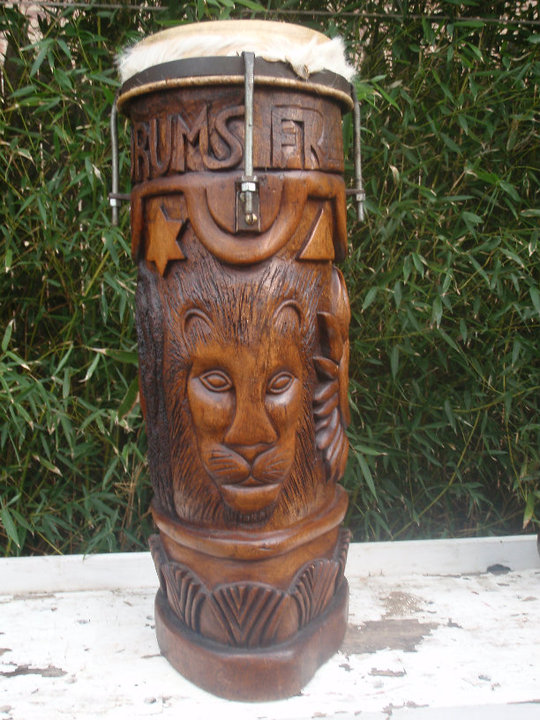
African music relies heavily on fast-paced, upbeat rhythmic drum playing found all over the continent, though some styles, such as the Township music of South Africa do not make much use of the drum and nomadic groups such as the Maasai do not traditionally use drums. Elsewhere the drum is the sign of life: its beat is the heartbeat of the community.[8]
Drums are classed as membranophones and consist of a skin or "drumhead" stretched over the open end of a frame or "shell". Well known African drums include the djembe[9] and the talking drum.[9]
Many aspects of African drumming, most notably time-keeping, stem from instruments such as shakers made of woven baskets or gourds or the double bell, made of iron and creating two different tones.[10] Each region of Africa has developed a different style of double bell but the basic technology of bell-making is the same all over the continent, as is often the bell's role as time keeper. The South American agogo is probably a descendant from these African bells. Other idiophones include the Udu and the slit drum or log drum.
Tuned instruments such as the mbira and the marimba often have a short attack and decay that facilitates their rhythmic role.
Cross-rhythm
[edit]African rhythmic structure is entirely divisive in nature[11] but may divide time into different fractions at the same time, typically by the use of hemiola or three-over-two (3:2), which Novotney has called the foundation of all West African polyrhythmic textures.[12] It is the interplay of several elements, inseparable and equally essential, that produces the "varying rhythmic densities or motions" of cross-rhythmic texture.[13] 3 and 2 belong to a single Gestalt.[14]
Cross-rhythm is the basis for much of the music of the Niger–Congo peoples, speakers of the largest language family in Africa. For example, it "pervades southern Ewe music".[15]
Key patterns
[edit]
Key patterns, also known as bell patterns, timeline patterns, guide patterns and phrasing referents express a rhythm's organizing principle, defining rhythmic structure and epitomizing the complete rhythmic matrix. They represent a condensed expression of all the movements open to musicians and dancers.[16] Key patterns are typically clapped or played on idiophones such as bells, or else on a high-pitched drumhead.[17] Musics organized around key patterns convey a two-celled (binary) structure, a complex level of African cross-rhythm.[18]
The standard pattern
[edit]
The most commonly used key pattern in sub-Saharan Africa is the seven-stroke figure known in ethnomusicology as the standard pattern.[19][20][21] The standard pattern, composed of two cross-rhythmic fragments, is found both in simple (4
4 or 2
2) and compound (12
8 or 6
8) metrical structures.[22]
Until the 1980s, this key pattern, common in Yoruba music, Ewe music and many other musics, was widely interpreted as composed of additive groupings. However the standard pattern represents not a series of durational values, but a series of attack points that divide the fundamental beat with a cross-rhythmnic structure.[23]
Tresillo
[edit]
The most basic duple-pulse figure found in Sub-Saharan African music is a figure the Cubans call tresillo, a Spanish word meaning 'triplet'. The basic figure is also found within a wide geographic belt stretching from Morocco in North Africa to Indonesia in South Asia. This pattern may have migrated east from North Africa to Asia with the spread of Islam: use of the pattern in Moroccan music can be traced back to Trans-Saharan exchanges during the Green Sahara.This influence increased due to slaves brought north across the Sahara Desert from present-day Mali.[26] In African music, this is a cross-rhythmic fragment generated through cross-rhythm: 8 pulses ÷ 3 = 2 cross-beats (consisting of three pulses each) with a remainder of a partial cross-beat (spanning two pulses). In divisive form, the strokes of tresillo contradict the beats while in additive form, the strokes of tresillo are the beats. From a metrical perspective, the two ways of perceiving tresillo constitute two different rhythms. On the other hand, from the perspective of the pattern of attack-points, tresillo is a shared element of traditional folk music from the northwest tip of Africa to southeast tip of Asia.
References
[edit]- ^ Stapleton C. and May C., African All-Stars, Paladin 1989, page 6
- ^ Jones, A. M. (1959), Studies in African Music, London: Oxford University Press. 1978 edition: ISBN 0-19-713512-9.
- ^ Ladzekpo, C.K. (1996), Cultural Understanding of Polyrhythm http://home.comcast.net/~dzinyaladzekpo/PrinciplesFr.html.
- ^ Peñalosa 2009, p. 21.
- ^ Steppin' on the Blues by Jacqui Malone. University of Illinois Press. 1996. page 21. ISBN 0-252-02211-4
- ^ Kubik, Gerhard (1999). Africa and the blues ([Nachdr] ed.). Jackson: University Press of Mississippi. p. 54. ISBN 1-57806-145-8.
- ^ a b Kubik, Gerhard (1994). Theory of African Music: I. Xylophone playing in southern Uganda. University of Chicago Press. p. 9. ISBN 9780226456911.
- ^ Bakare, Sebastian (1997). The Drumbeat of Life. ISBN 9782825412299.
- ^ a b "Britannica Academic".
- ^ Uribe, Ed. The Essence of Afro-Cuban Percussion & Drum Set. Alfred.
- ^ Novotney, Eugene D. (1998), The Three Against Two Relationship as the Foundation of Timelines in West African Musics, Urbana, IL: University of Illinois, page 147
- ^ Novotney, Eugene D. The Three Against Two Relationship as the Foundation of Timelines in West African Musics Urbana, IL: University of Illinois (1998), page 201. UnlockingClave.com.
- ^ "The Myth of Cross-Rhythm". Home.comcast.net. Retrieved 30 January 2014.
- ^ Agawu, Kofi (2003). Representing African music : postcolonial notes, queries, positions. New York, N.Y.; London: Routledge. ISBN 0-415-94390-6.
- ^ Locke, David (1982). "Principles of Off-Beat Timing and Cross-Rhythm in Southern Ewe Dance Drumming" Society for Ethnomusicology Journal 11 Nov.. (1982), p. 231
- ^ Agawu, Kofi (22 March 2006). "Structural analysis or cultural analysis? Competing perspectives on the "standard pattern" of West African rhythm". Journal of the American Musicological Society. 59 (1): 1–47. Gale A146258931.
- ^ Peñalosa 2009, p. 51.
- ^ Peñalosa 2009, p. 53.
- ^ Jones, A.M. (1971). Studies in African music (1st; reprint ed.). London: Oxford University Press. ISBN 0-19-713512-9.
- ^ King, Anthony (1960). "The Employment of the Standard Pattern in Yoruba Music" American Music Society Journal.
- ^ "3-2 THESIS ABSTRACT". Unlocking Clave. Retrieved 30 January 2014.
- ^ Peñalosa 2009, p. s58; 63–64.
- ^ Novotney, Eugene D. The Three Against Two Relationship as the Foundation of Timelines in West African Musics, Urbana, IL: University of Illinois (1998) page 158
- ^ Garrett, Charles Hiroshi (2008). Struggling to Define a Nation: American Music and the Twentieth Century, p. 54. ISBN 978-0-520-25486-2. Shown in common time and then in cut time with tied sixteenth & eighth note rather than rest.
- ^ Sublette, Ned (2007). Cuba and its music : FROM THE FIRST DRUMS TO THE MAMBO (1. ed.). Chicago: Non-Approval Trade. ISBN 978-1-55652-632-9.
- ^ Peñalosa 2009, p. 236.
Sources
[edit]- Agawu, Kofi (2003). Representing African music : postcolonial notes, queries, positions. New York, N.Y.; London: Routledge. ISBN 0-415-94390-6.
- Novotney, Eugene D. (1998). The Three Against Two Relationship as the Foundation of Timelines in West African Musics. Urbana, IL: University of Illinois.
- Peñalosa, David (2009). Greenwood, Peter (ed.). The Clave Matrix: Afro-Cuban Rhythm : Its Principles and African Origins. Bembe Books. ISBN 978-1-886502-80-2.
- Ladzekpo, C. K. (1995). "The Myth of Cross-Rhythm", Foundation Course in African Dance-Drumming (webpage, accessed 24 April 2010).
Further reading
[edit]- Godfried T. Toussaint, "On the question of meter in African rhythm: A quantitative mathematical assessment", In Proceedings of Bridges: Mathematics, Music, Art, Architecture, and Culture, G. Hart and R. Sarhangi, (Eds.), Enschende, The Netherlands, 27–31 July 2013, pp. 559–562, Phoenix: Tessellations Publishing.
Rhythm in Sub-Saharan Africa
View on GrokipediaCultural and Historical Context
Role in Society and Daily Life
In Sub-Saharan African societies, rhythm plays a pivotal role in ceremonies and rituals, serving to invoke spirits, mark life transitions, and foster communal unity. During initiations, funerals, and harvest celebrations, drumming patterns provide a structured framework that guides participants through sacred rites, such as ancestor veneration among the Yoruba or communal thanksgiving in agricultural communities of the Congo Basin. These rhythmic elements not only synchronize collective movements in dance but also act as spiritual conduits, believed to bridge the physical and metaphysical realms, thereby reinforcing social cohesion and cultural continuity.[4][2] Rhythm is integral to oral traditions, particularly through the performances of griots—professional storytellers and historians in West African Manding societies—who employ rhythmic speech and drumming to preserve and transmit history, proverbs, and moral lessons. Griots' narratives, often accompanied by percussive beats, enhance memorability and engagement, transforming spoken words into dynamic, participatory events that educate and entertain communities. This rhythmic delivery underscores the griot's function as a cultural repository, ensuring the intergenerational passing of knowledge without written records.[5][6] Communal participation in rhythm-making strengthens group identity and social bonds, evident in call-and-response dynamics that encourage collective improvisation during music and dance gatherings. These interactions, common in village ensembles, promote inclusivity and shared expression, where individuals contribute to interlocking patterns that symbolize unity and reciprocity. Such practices extend to daily life, integrating rhythm into work songs and social events to alleviate labor and celebrate community ties.[2][4] As a form of non-verbal communication, rhythm enables "talking drums" in Yoruba culture to imitate speech tones, conveying messages like announcements of events or praises across distances. These hourglass-shaped instruments, adjustable in pitch, replicate tonal languages to summon gatherings, resolve disputes, or honor leaders, thus serving as an auditory extension of oral culture in rituals and daily interactions.[7]Historical Origins and Evolution
The rhythmic traditions of Sub-Saharan Africa trace their ancient roots to oral literature, myths, and epics that predate written records, serving as vehicles for cultural transmission and communal identity across diverse ethnic groups. These oral forms, encompassing praise songs, griot narratives, and ritual chants, integrated rhythmic structures to enhance memorability and performative impact, with percussion elements like drums and bells underscoring narrative pulses.[8] These patterns provided a conceptual basis for later rhythmic complexities, influencing musical practices throughout West and Central Africa. Pre-colonial evolution of these rhythms occurred through extensive trade routes and migrations, notably the Bantu expansions from circa 1000 BCE to 500 CE, which spread percussion-based ensembles across Central, Eastern, and Southern Africa. Originating in the Nigeria-Cameroon border region, Bantu-speaking peoples carried idiophones, membranophones, and aerophones, adapting local rhythmic idioms to foster communal rituals and labor songs during their southward and eastward movements.[9] This dissemination emphasized layered percussion rhythms, such as those produced by slit drums and talking drums, which encoded linguistic tones and facilitated social cohesion among migrating communities.[10] Trade networks along the Sahel and Indian Ocean coasts further exchanged rhythmic techniques, blending Akan, Yoruba, and Mandinka styles into hybrid forms that prioritized polyrhythmic interplay.[11] Colonial rule from the late 19th century imposed significant disruptions, including the suppression of indigenous rhythms through missionary bans on drumming deemed "pagan," which aimed to erode cultural resistance in Sub-Saharan territories.[12] European powers hybridized these traditions by introducing brass bands and binary meters, leading to early fusions in coastal urban centers where African percussion merged with Western harmonies. Post-independence revivals in the mid-20th century reclaimed these elements, exemplified by highlife music in Ghana and Nigeria, which blended traditional call-and-response patterns with imported guitars and horns to symbolize national unity during decolonization.[13] Highlife bands, such as those led by E.T. Mensah, revived suppressed rhythms in upbeat dance forms that celebrated emerging African identities.[14] In the 21st century, global influences have propelled further adaptations, with Afrobeat exemplifying the fusion of traditional polyrhythms and Western structures, pioneered by Fela Kuti (1938–1997). Kuti's Africa 70 ensemble layered Yoruba-derived cross-rhythms with jazz improvisation and funk basslines, creating extended grooves that critiqued post-colonial governance while drawing international acclaim.[4] This synthesis, rooted in highlife precedents, has influenced contemporary genres like Afrobeats, perpetuating Sub-Saharan rhythmic continuity amid worldwide dissemination.[15]Core Rhythmic Principles
Polyrhythms and Cross-Rhythms
Polyrhythms constitute a foundational element of rhythmic complexity in Sub-Saharan African music, characterized by the simultaneous performance of two or more independent rhythmic patterns that each imply distinct meters. These layered rhythms create a dense, interlocking texture where individual parts maintain their own temporal organization while contributing to a cohesive ensemble sound. A classic example is the 3:2 polyrhythm, in which one rhythmic strand divides the temporal unit into three equal parts while another divides it into two, resulting in a hemiola-like tension that propels the music forward. This structure is not merely additive but generative, allowing performers to weave intricate patterns that enhance the overall groove without a dominant meter imposing hierarchy.[16] Cross-rhythms represent a specific subset of polyrhythms, emphasizing accentuations on off-beats or weak pulses that generate perceptual conflict and rhythmic drive. The term "cross-rhythm" was coined in 1934 by ethnomusicologist Arthur Morris Jones to describe these accentual clashes, often notated as 2:3 or 3:2 ratios, where accents in one layer contradict the expected beats of another. In practice, this manifests as a deliberate misalignment of stresses, fostering a sense of propulsion and surprise that is central to the expressive power of Sub-Saharan rhythms. Jones's analysis, drawn from field observations in Zambia and Uganda, highlighted how such conflicts arise naturally in ensemble playing, distinguishing them from simpler additive rhythms. Central to navigating polyrhythms and cross-rhythms is the performers' "metronome sense," an internalized framework of equal pulses that anchors the music amid layered complexities. Coined by Richard A. Waterman in 1952, this concept refers to the subjective, steady pulse that musicians and listeners intuitively supply, enabling the execution and comprehension of interlocking patterns without explicit reference to a shared downbeat. This internal orientation facilitates the seamless integration of multiple rhythms in ensembles, where each participant adheres to their part while perceiving the whole. For instance, in Ewe drumming traditions, ratios such as 4:3—where four pulses align against three—exemplify this through cyclic repetitions that resolve periodically, underscoring the mathematical precision underlying the apparent improvisation.[17][18] These principles occasionally inform foundational patterns like the standard bell pattern, providing a referential layer against which polyrhythmic elaborations unfold.[16]Timeline Patterns and Metric Cycles
In Sub-Saharan African music, timeline patterns serve as short, repeating motifs that function as referential ostinatos, providing a stable rhythmic foundation for ensemble performances. These patterns typically consist of 12- or 16-pulse cycles, often notated in 12/8 or 4/4 time, and are commonly played on iron bells (such as the dawuro in Akan traditions) or clappers to maintain temporal orientation amid layered rhythms.[19][20] In Asante Kete drumming from Ghana, for instance, the bell pattern unfolds over a 12-pulse cycle in 12/8 time, creating a ternary-quadruple structure that anchors the entire ensemble and supports a measured, non-hurried feel aligned with cultural aesthetics.[20] Metric cycles in these traditions emphasize additive rhythms, where beats are divided into uneven groupings rather than the even subdivisions typical of Western divisive meters. A common example is the 3+3+2 division within an 8-beat cycle, which contrasts with symmetrical binary or ternary divisions by prioritizing asymmetrical pulse streams that enhance rhythmic complexity.[19] In Akan music, such as the Fontomfrom drum suite, patterns like 2+2+2+3+3 illustrate this additive approach, often realized through interlocking percussion that builds cohesion without hierarchical strong-weak accents.[21] These cycles operate without fixed barlines, relying instead on repetitive markers to delineate structure, as seen in clave-like timelines in adowa ensembles where metal bells reinforce the ostinato.[21][22] The perception of time in Sub-Saharan rhythms is fundamentally circular, viewing cycles as endless loops rather than linear progressions, which allows for perpetual variation and improvisation within the established framework. This cyclical orientation influences performance practices, enabling musicians to phase-shift patterns while maintaining ensemble unity, in contrast to Western music's emphasis on directional closure and metrical hierarchies.[22][23] Timeline patterns and metric cycles thus interact briefly with polyrhythms to generate rhythmic density, but their primary role remains as organizational anchors.[19]Instruments and Ensembles
Percussion Instruments
Percussion instruments form the backbone of rhythmic expression in Sub-Saharan African music, providing the layered pulses, timelines, and polyrhythmic textures essential to communal performances. These instruments, primarily drums, bells, and shakers, are crafted from local materials like wood, animal skins, and metals, enabling a wide range of timbres and dynamic variations that support dance, ritual, and social events. Their construction emphasizes durability and resonance, while playing techniques—such as hand strikes, tension adjustments, and interlocking patterns—facilitate complex interactions within ensembles.[24] The djembé, originating from Mandinka culture in West Africa, is a goblet-shaped drum carved from hardwoods like dimbe or lenge, with a goatskin or cowskin head secured by interwoven cords and iron rings.[25] Its construction involves soaking the skin for hours, mounting it taut, and allowing it to dry for several days to achieve optimal resonance, ensuring the drum produces distinct sounds in ensemble settings.[25] Played exclusively with bare hands, the djembé yields three primary tones: a deep bass struck openly in the center with a clenched fist, a mid-range tone hit closed-fisted near the rim, and a sharp slap delivered openly at the edge with spread fingers.[25] In layered ensembles, these techniques allow the djembé to contribute dynamic layers, with multiple players interlocking bass, tone, and slap patterns to build polyrhythmic density alongside supporting dunun drums and bells.[25] The talking drum, known as dùndún among the Yoruba, features an hourglass-shaped body hollowed from òmòn wood, covered with taut animal skins (goat or cow) at both ends, and equipped with tension cords that run parallel to the laces binding the heads.[26] Players strike the drumheads with curved sticks while squeezing the cords under one arm to vary pitch, mimicking the tonal inflections of Yoruba speech and enabling the instrument to function as a surrogate voice in communication.[26] This pitch modulation produces gliding tones and vibrato, essential for rendering praise poetry (oríkì) or narratives, while the rhythmic framework supports hora dances through steady pulses interspersed with melodic variations.[26] In Yoruba ensembles, the lead ìyáàlù drum directs these elements, with supporting omele drums providing complementary rhythms that fill polyrhythmic gaps and enhance the overall texture.[26] Bell and shaker ensembles anchor the rhythmic cycle in Sub-Saharan performances, with clapperless iron bells—often single or double bells in shapes like banana or vessel forms—struck with metal beaters to establish fixed timeline patterns that guide the group.[24] These bells, forged from iron and tuned by size, produce a resonant, penetrating tone that maintains interlocking ostinatos, serving as the unchanging pulse against which drums improvise.[27] The shekere, a shaker made from a dried gourd encased in a net of beads or seeds, adds syncopated fills when shaken or struck, its rattling timbre providing textural contrast and rhythmic density in West African traditions.[28] Together, these idiophones create a foundational layer, enabling the ensemble's polyrhythmic interplay by delineating metric cycles without overpowering melodic elements.[27] In percussion ensembles, the master drummer assumes a leadership role, improvising variations on core patterns using techniques like rolls (rapid alternating strikes), slaps (sharp edge hits), and presses (dampened tones) to signal transitions and respond to dancers.[29] Supporting drums fill polyrhythmic gaps with steady ostinatos, interlocking with the master's lead to sustain complex textures, as seen in Ewe and Yoruba traditions where low-pitched drums provide stable foundations for spontaneous ornamentation.[30] This hierarchical structure ensures cohesive layering, with the master cuing endings or intensifying energy through rhythmic dialogue, while the collective maintains the timeline's integrity.[29]Melodic Instruments with Rhythmic Roles
In Sub-Saharan African music, melodic instruments often transcend their primary role of producing tunes by actively contributing to the rhythmic framework through specialized playing techniques that integrate with percussion ensembles. These instruments, such as lamellophones, harp-lutes, and xylophones, employ cyclic patterns and interlocking phrases to create layered polyrhythms, enhancing the overall metric complexity without dominating the percussive foundation. This rhythmic integration supports communal performances, where melody and rhythm blur to foster a cohesive sonic texture.[31] The mbira, a Zimbabwean lamellophone also known as the thumb piano, exemplifies this dual role through its cyclic plucking patterns that generate hocket-like rhythms in Shona music traditions. Constructed with 22-25 metal keys arranged in three manuals, the mbira dzavadzimu is played by plucking with thumbs and index fingers, producing interlocking patterns across a six-pulse cycle, as seen in pieces like "Nhemamusasa," which unfolds over 48 pulses divided into four 12-pulse phrases. The right hand alternates between index finger and thumb strikes (e.g., I-T-I-T sequences), while the left hand mirrors with bass and upper manual interlocks (e.g., L-B-L-B), creating a polymetric effect such as 3/4 against 6/8 in two-part performances like kushaura and kutsinhira. This results in a hocket-style alternation of notes and rests between hands or players, up to seven parts in complex arrangements like "Taireva," which reinforces ensemble timelines through continuous cyclic motion.[32] The kora, a 21-string harp-lute central to Griot traditions in Mandé societies of West Africa, utilizes ostinato bass lines to underpin polyrhythmic melodies, blending melodic expression with rhythmic stability. The left thumb plucks a repeating bass ostinato on the lower strings, while the left forefinger and right thumb interweave two-note patterns, allowing the right forefinger to improvise melodic lines over this foundation, as documented in standard kumbengo cycles. These ostinatos, often spanning 20 pulses in equal halves, establish a compound metric background that interlocks with ensemble percussion, such as the djembe, to produce textural polyrhythms without emphasizing tension—exemplified in pieces like the hunter's dance "Kulanjan," where the bass reinforces the tonic while higher parts add rhythmic density. This technique enables the kora to serve as both a narrative accompaniment for storytelling and a rhythmic anchor in social gatherings.[31] Similarly, the balafon, a West African xylophone with gourd resonators, contributes to cross-rhythmic effects through struck interlocking patterns that complement melodic solos in ensemble settings. In Mandé traditions among the Susu and Malinké peoples of Guinea, balafonists perform complementary accompaniment parts alongside solos, forming an interpenetrating network of rhythms unified by a shared pulse, as in celebrations where multiple layers reinforce the groove via multidimensional stratification. Specific patterns include rhythmic repeated-note sequences and simultaneous duple-triple divisions in 12/8 meter, such as the triple-based Acc. 1 and duple Acc. 2 in "Kalata Mori," or the interlocking accompaniments in "Sunjata" and "Lamban," where parts weave across meters to create cohesive yet complex textures. These techniques allow the balafon to dialogue with percussion, supporting dance through flexible, interlocking phrases that bridge melodic and rhythmic domains.[33] Key techniques across these instruments include hocketing, where players alternate notes to simulate a single continuous line, and ostinato variations that adapt repeating motifs to interact with percussion layers. In mbira and balafon play, hocketing manifests as hand or inter-player interlocks, producing phantom patterns that enhance polyrhythmic depth, while kora ostinatos evolve through subtle variations to maintain cyclic momentum. These methods integrate melody into the rhythmic ensemble, prioritizing textural interplay over isolated tunes.[32][31][33]Prominent Rhythmic Patterns
The Standard Bell Pattern
The standard bell pattern serves as a foundational rhythmic timeline in Sub-Saharan African music, providing a fixed ostinato that orients ensemble performances across multiple layers of rhythm. This pattern, often played on a double bell such as the Ewe gankogui, functions as a referential "metronome," maintaining cyclic structure and enabling synchronization among percussionists and dancers without relying on a conductor. Its asymmetric design contrasts with symmetrical Western meters, emphasizing off-beat accents that contribute to the polyrhythmic density characteristic of the tradition.[34][35][36] Structurally, the pattern unfolds over a 12-pulse cycle in 12/8 time, with accents typically on pulses 1, 4, 5, 9 (repeating to 1 in the next cycle), creating a repeating ostinato of five primary strokes amid rests.[35] In binary notation, it is commonly transcribed as:X . . X X . . . X . . . .
X . . X X . . . X . . . .
Tresillo and Related Syncopations
The tresillo rhythm is a foundational syncopated pattern in Sub-Saharan African-derived musics, structured as a 3-3-2 grouping of pulses that creates accent displacement against an underlying duple meter.[37] In a 4/4 time signature, it manifests through eighth-note accents spaced at pulse intervals of 3:3:2, typically on the "and" of beat 1, the downbeat of beat 3, and the "and" of beat 4, producing a forward-leaning propulsion. This pattern, known as the duple-pulse version of a triple-based rhythm, derives from West African 3:2 cross-rhythms prevalent in traditions like Ewe drumming from Ghana and Gyil xylophone melodies from Burkina Faso.[37] A simple rhythmic transcription of the tresillo in 4/4 meter, using eighth-note divisions, illustrates its syncopation:Beat: 1 & 2 & 3 & 4 &
Pulse: - x - x - x - -
Beat:  1   &   2   &   3   &   4   &
Pulse: -   x   -   x   -   x   -   -