Hubbry Logo
Ajoy BiswasAjoy BiswasMain
Open search
Ajoy Biswas
Community hub
Ajoy Biswas
logo
8 pages, 0 posts
0 subscribers
Be the first to start a discussion here.
Ajoy Biswas
Ajoy Biswas
from Wikipedia

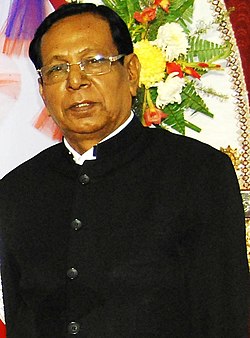
Ajoy Biswas is an Indian politician from Tripura, and former member of the Communist Party of India (Marxist) (CPI(M)).

Key Information

Political career

[edit]

Biswas started in politics by becoming an independent MLA in 1972.[1] He was elected as a Member of the Legislative Assembly in Tripura, defeating the Indian National Congress MLA in the elections of 1977.[2] Biswas gradually moved to national politics and was elected as a member of the Indian Parliament's 7th and 8th Lok Sabha from 1980 to 1989.[3][4] Biswas was a trade union activist in Tripura and founded several trade unions there, including the Tripura Employees Coordination Committee, and the Tripura branches of the AITUC, and the DYFI. He also held important positions in several workers' unions in the state.[5]

After the split of the Communist Party of India (CPI) in 1964, the CPI-M came to be known as the party of the tribals in the state of Tripura. Until the early 1970s CPI(M) was not popular in the Bengali community of the state. Biswas played an important role in building the party organisation among the Bengalis of Tripura.[6] With this mass movement, he was able to help defeat the locally strong Indian National Congress in the elections of 1977.[7] This played a pivotal role in bringing the CPI-M to power in 1978.[8][9][10]

During the 8th Lok Sabha, he took part in a debate on 31 August 1987 with the then Defence Minister K. C. Pant, in what became known in the national press as the "Bofors debate".[11][12][13][14][15][16][17]

Biswas was a trade union leader and social worker, and several trade and workers' unions in the state were formed under his leadership.[18] He was arrested in connection with political activities in 1966, 1969, 1971 and 1977.[18]

Ideological differences and formation of People's Democratic Front

[edit]

In late 1980s Biswas became vocal against then Tripura's Chief Minister and CPI(M) president Nripen Chakraborty's style of leadership.[19][20] The ideological objection was regarding Chakraborty's way of governance and non-compliance with section 112 of CPI(M) working principle,[21] which emphasizes "more power to people" rather than government.[22]

This ideological difference widened and attracted a central stage of CPI(M) national and politbureau meetings,[23] eventually leading Biswas to quit the party and form Janganotantrik Morcha.[24][25][26]

A number of supporters of Biswas' ideology also followed him, including the Tripura Employees coordination committee (TECC), originally founded by Biswas in 1968. TECC comprises 13 unions, with TGTA and TTA being the largest. As a result of this split Biswas retained the TECC unions.[27] This eventually led to the loss of CPI(M) in the elections of 1988.[20][28][29]

Biswas continues to campaign for the Tripura employees’ demands and welfare.[30][31][32][33]

References

[edit]
Revisions and contributorsEdit on WikipediaRead on Wikipedia
from Grokipedia
Ajoy Biswas is an Indian and trade union leader from . He represented the West constituency in the as a Communist Party of India (Marxist) member during the seventh parliament (1980–1984), having won the seat in the 1980 general against opponents including the candidate. Biswas began his career as a trade union activist, establishing organizations such as the Tripura Employees Coordination Committee to advocate for workers' rights in the state. Later diverging from CPI(M) over ideological differences, he formed splinter left-wing groups, including the People's Democratic Front, and continued critiquing state governments on issues like and labor policies. His political trajectory reflects persistent engagement in 's left-leaning opposition dynamics, including consultations with emerging parties like on strategies against ruling coalitions.

Personal background

Early life and entry into activism

Ajoy Biswas began his political engagement in through activities, focusing on organizing workers and advocating for amid the state's emerging industrial and growth in the post-independence era. As a prominent leader, he headed the Employees Coordination Committee, an organization that coordinated efforts among employees to address grievances related to wages, working conditions, and job security. This foundation in labor activism positioned him within left-wing circles, facilitating his transition to electoral politics by the late 1970s, when he contested as a CPI(M) nominee in state assembly elections.

Career in CPI(M)

Rise within the party

Biswas emerged as a prominent figure in the Communist Party of India (Marxist) through grassroots activism in , initially focusing on organization among Bengali workers and establishing multiple unions to mobilize labor support for the party. His efforts contributed to strengthening CPI(M)'s base in the state, leading to his inclusion in the Tripura state committee prior to 1985. In the 1980 general elections, Biswas secured victory as the CPI(M) candidate for the , entering the with substantial voter backing. He was re-elected in 1984 to the from the same seat, polling 232,339 votes (48.7% of the valid votes), which solidified his parliamentary stature within the party. These electoral successes marked the peak of his ascent, positioning him as a vocal advocate for CPI(M) interests in national forums, including disruptive interventions during debates such as the 1987 discussion.

Parliamentary service and key roles

Ajoy Biswas was elected to the from the West constituency in the January 1980 Indian general election as the Communist Party of India (Marxist) candidate, defeating the Congress(I) opponent by a margin reflecting 46.83% vote share amid 79.11% turnout. His election faced a legal challenge alleging disqualification due to holding an under the government as a local authority employee, but the matter was adjudicated without barring his service in the (1980–1984). During his tenure, Biswas engaged in parliamentary proceedings focused on Tripura's regional concerns, including questioning the implementation of the Autonomous Act on 11 June 1980. He also intervened in national debates, such as opposing government industrial policies in sessions on 5 August 1986—though post his primary term—and critiquing defense matters. A notable incident involved Biswas snatching documents from the Defence Minister during a reading, prompting immediate House adjournment and subsequent disciplinary correspondence. No ministerial positions or formal committee chairmanships are recorded for him, aligning with CPI(M)'s opposition status holding limited seats.

Ideological break from CPI(M)

Grievances against leadership

Biswas's primary grievances targeted the leadership style of , then Chief Minister of Tripura and CPI(M) state secretary, whom he accused of authoritarian governance that undermined inner-party democracy. By the mid-1980s, Biswas had grown vocal in opposing Chakraborty's centralized control, which he viewed as deviating from the CPI(M)'s foundational principles emphasizing collective decision-making and cadre consultation. This opposition intensified after Chakraborty's assumption of power in 1978, with Biswas criticizing the suppression of dissent within the unit and the prioritization of top-down directives over input. A key point of contention was the leadership's alleged non-adherence to Section 112 of the CPI(M)'s , which mandates "more in party affairs" through expanded inner-party discussions and avoidance of cults. contended that Chakraborty's tenure fostered a cult-like , marginalizing alternative voices and eroding the party's mass-line approach to policy formulation. His public and internal critiques, including through party journals, highlighted instances where state-level decisions on land reforms and tribal issues bypassed broader consultation, leading to his from the state committee on 1985. These grievances extended to broader ideological lapses, where argued the leadership had compromised revolutionary principles for administrative expediency, particularly in handling ethnic tensions and economic policies in . Despite temporary reconciliations, such as an uneasy truce in the early 1990s, the rift persisted, framing Biswas's dissent as a defense of orthodox Marxism-Leninism against perceived bureaucratic degeneration. The party's response labeled his actions as factionalism, culminating in formal charges of anti-party conduct.

Public criticisms and expulsion

In the late 1980s, Ajoy Biswas publicly criticized the leadership style of and CPI(M) member , accusing him of , egotism, and dictatorial tendencies that stifled internal party democracy. These grievances stemmed from Chakraborty's centralized control over party decisions, which dissidents argued prioritized personal authority over collective decision-making and alienated younger members advocating for greater accountability. Biswas, known for his aggressive parliamentary interventions—including an incident in 1987 where he snatched documents from the Defence Minister during a session, leading to his suspension from the for the remainder of the session—amplified these critiques through public statements and party forums. Biswas' vocal opposition intensified after his exclusion from the Tripura CPI(M) state committee in 1985, a move interpreted by supporters as retaliation for challenging Chakraborty's dominance. He argued that the party's shift toward bureaucratic entrenchment undermined its revolutionary principles, fostering complacency and resistance to grassroots input. These public rebukes, disseminated via interviews and dissident publications, highlighted broader tensions within the unit, where Chakraborty's tenure—marked by rapid cadre expansion but also allegations of suppressing dissent—drew parallels to centralized control in other CPI(M) strongholds. The escalating rift culminated in Biswas' expulsion from the CPI(M) in 1989, framed by party leadership as a response to "anti-party activities" that violated organizational discipline. Post-expulsion accounts described the action as a of ideological nonconformists, with Biswas maintaining that it reflected the leadership's intolerance for internal reform rather than any deviation from core Marxist-Leninist tenets. This event underscored factional fractures in the CPI(M)'s northeastern operations, where state-level power consolidation often clashed with national directives on .

Formation of People's Democratic Front

Founding and initial organization

The People's Democratic Front (PDF), formally known as Janganotantrik Morcha, was established by as a breakaway faction from the Communist Party of India (Marxist) in . , having grown critical of the CPI(M)'s leadership and policies on ethnic issues and ideological deviations, positioned the PDF as an alternative adhering more strictly to Marxist-Leninist principles. The party's formation capitalized on discontent among some activists and local communists disillusioned with the parent party's handling of 's tribal-Bengali tensions. Initial organizational efforts involved assembling a core group of supporters from Biswas's existing networks, including the Tripura Employees Coordination he had founded earlier, to build grassroots presence in urban and industrial areas of the state. The setup emphasized decentralized committees for mobilization, though the party remained small-scale with Biswas as its central figure and general secretary.

Core ideology and policy positions

The People's Democratic Front (PDF), also known as Janganotantrik Morcha, maintains a left-wing orientation, operating primarily in Tripura's tribal belts as a splinter from the CPI(M). Biswas founded the party following his expulsion from the CPI(M) amid vocal criticisms of the state leadership's approach to ethnic conflicts between indigenous tribes and Bengali settlers, accusing it of inadequate protection for tribal lands and . The PDF emphasizes greater internal party and tailored socialist policies to address Tripura's ethnic imbalances, including advocacy for tribal development and safeguards against demographic shifts favoring non-tribals. Key policy positions include calls for strengthening tribal autonomous districts under the Sixth Schedule of the to enhance local governance and resource control, reflecting Biswas's earlier parliamentary interventions on empowering Tripura's government in tribal affairs. The party has also opposed militant training camps run by tribal insurgents, such as the Tribal National Volunteers, while pushing for resolutions to underlying ethnic grievances through democratic fronts rather than centralized party diktats. Economically, the PDF aligns with proletarian-led people's democratic initiatives, prioritizing worker unions and measures in reforms, as evidenced by Biswas's role in uniting staff federations against perceived inefficiencies.

Leadership and electoral record of PDF

Major campaigns and election outcomes

The People's Democratic Front (PDF), also known as Janganotantrik Morcha, under Ajoy Biswas's leadership, has maintained a peripheral role in Tripura's electoral politics since its formation around 2001. The party has not secured any seats in the elections of 2018, where the won 36 seats and the Communist Party of India (Marxist) secured 16, or in the 2023 polls, dominated by the BJP with 32 seats and CPI(M) with 11. This absence of representation underscores the PDF's inability to translate ideological dissent from CPI(M) into voter support amid Tripura's polarized ethnic and partisan dynamics. No major campaigns led by Biswas or the PDF are documented as achieving measurable impact on assembly-level outcomes, with the party's efforts confined largely to critiquing established left-wing structures rather than broad mobilization.

Alliances, challenges, and decline

The People's Democratic Front (PDF), led by Ajoy Biswas, operated largely independently without forming significant electoral , positioning itself as a alternative to the CPI(M) amid Tripura's entrenched left-wing dominance. This isolation limited its organizational reach and voter , particularly in a state where major parties relied on coalitions involving tribal fronts like the Ganamukti Parishad or, later, ethnic outfits such as the Tipra Indigenous Progressive Regional Alliance (TIPRA). The PDF's challenges were compounded by internal ideological fractures inherited from Biswas's expulsion from the CPI(M) in the late 1980s and early 1990s, including disputes over leadership and policy that eroded potential left-leaning support bases. Electoral underperformance further hampered the PDF, with the party securing negligible vote shares in assembly polls following its 2001 founding. In the 2014 election, Biswas highlighted systemic against the long-ruling CPI(M) but noted the weakness of opposition structures, underscoring the PDF's struggle to capitalize on discontent amid fragmented rivals like a debilitated and nascent BJP presence. By the 2023 elections, the PDF failed to win any seats in the 60-member assembly, as the BJP-IPFT dominated with 37 seats while ethnic and national parties split the opposition vote. These persistent hurdles—limited alliances, competition from resurgent BJP and tribal-centric groups, and failure to build a robust cadre—precipitated the PDF's decline into marginal status by the mid-2010s. The party's inability to address Tripura's ethnic divides, where non-tribal Bengali voters (CPI(M)'s core) clashed with indigenous demands, further diminished its relevance as TIPRA Motha captured tribal aspirations with 13 seats in 2023. Biswas's ongoing criticisms of ruling dispensations, such as claims of governmental obstruction to mechanisms, reflected vocal but ineffective opposition amid the PDF's waning influence.

Controversies and criticisms

Internal party disputes

In 2001, Janganotantrik Morcha (also known as People's Democratic Front) experienced a significant internal when founder Ajoy and a group of his supporters departed to establish the Ganatantrik Manch (TGM), a splinter faction. This split reflected ongoing tensions within the party over leadership and strategic direction following 's earlier expulsion from CPI(M) in the late 1980s due to ideological disagreements with state leadership. The formation of TGM marked a further fragmentation of leftist politics in , with continuing as its leader, emphasizing democratic socialist principles amid criticisms of rigid party hierarchies. The dispute weakened PDF's organizational cohesion, contributing to its limited electoral influence thereafter, as resources and cadre were divided between the rival entities. No formal occurred, and both groups maintained separate identities within Tripura's fragmented opposition landscape, though neither achieved substantial seats in subsequent assembly elections. Biswas's move underscored persistent factionalism rooted in personal and policy divergences, a pattern observed in post-split communist outfits in the region.

Accusations of opportunism and external critiques

Biswas faced expulsion from the Communist Party of India (Marxist) (CPI(M)) on allegations of anti-party activities, a charge leveled by party leadership following his persistent internal dissent against figures like former Chief Minister Nripen Chakraborty. In 1985, he was removed from the CPI(M) state committee for vocally opposing the leadership's decisions, which critics within the party framed as disruptive behavior undermining collective discipline. The formation of the Janganotantrik Morcha (People's Democratic Front) in 2001, shortly after his ouster, drew accusations from CPI(M) affiliates of opportunism, portraying it as a self-serving splinter group designed to fragment the Left vote and sustain Biswas's personal influence rather than advance principled ideological reform. Party organs and leaders implied such splits prioritized individual ambition over organizational unity, especially amid Tripura's competitive Left politics. External critiques extended beyond the CPI(M), with broader political observers and opponents questioning the PDF's viability and Biswas's strategy of aligning sporadically with non-Left entities, such as consultations with representatives in 2021 on opposition tactics against the BJP-led government. These interactions fueled perceptions of tactical flexibility bordering on , as Biswas leveraged his veteran status to advise rivals while maintaining a nominally independent platform. In assessments of 's Left decline, some analysts attributed partial responsibility to figures like for diluting the front's cohesion through successive dissents and party formations, though direct evidence of personal gain remains anecdotal rather than empirically documented.

Political legacy

Assessments of contributions

's primary contributions to 's political and labor spheres center on his activism, where he founded and led the Tripura Employees Coordination Committee (TECC), establishing it as a prominent organization representing non-tribal workers' interests. As TECC's long-serving secretary-general, he spearheaded campaigns for pay commissions and improved employment conditions, culminating in public advocacy as recently as March 2025 for a state pay revision to address inflation and wage disparities. This work has been described by contemporaries as pivotal in amplifying employee voices against perceived governmental neglect under prolonged CPI(M) rule. His political break from CPI(M) in the early , following expulsion for anti-party activities, led to the establishment of the People's Democratic Front (PDF), which positioned itself as an alternative emphasizing democratic reforms and critiques of one-party dominance. PDF's platform, under Biswas's general secretaryship, demanded governmental accountability over partisan control, as articulated in 2006 calls to replace the administration for failing to prioritize public welfare. Assessments credit this initiative with mobilizing Bengali discontent and providing electoral contestation, though its limited success in seats won underscores constraints in altering Tripura's ethnic and ideological power dynamics. As a former member from Tripura West (elected 1985 on CPI ticket), Biswas contributed to parliamentary discourse on state issues, including and agriculture, through active participation in debates. Overall evaluations portray his legacy as that of a organizer who advanced labor advocacy but struggled to translate union popularity into broader political shifts, reflecting deeper challenges in Tripura's polarized landscape.

Influence on Tripura's ethnic politics

Ajoy Biswas, as a former CPI(M) member and founder of the Janganotantrik Morcha (People's Democratic Front), operated within Tripura's polarized political environment where ethnic tensions between the indigenous Tripuri tribes—reduced to about 31% of the by due to Bengali influx—and the Bengali majority have driven demands for land restoration, greater autonomy under the Tripura Tribal Areas Autonomous (ADC), and protection against demographic displacement. His parties, formed as left-wing splinters from CPI(M), emphasized and workers' rights over tribal-specific grievances, attracting limited support from non-tribal voters disillusioned with mainstream left governance. During Biswas's tenure as MP for West in the , he raised parliamentary questions on development infrastructure, such as rail surveys and tourism facilities, which indirectly intersected with ethnic concerns over equitable in tribal areas, though without explicit advocacy for . Post-split from CPI(M), his PDF contested elections but secured negligible seats, failing to challenge tribal parties like the (IPFT), which captured key reserved constituencies by prioritizing ethnic nationalism. This fragmentation of the non-tribal left vote arguably weakened broader coalitions capable of mediating ethnic conflicts, as CPI(M)'s historical dominance had relied on tribal fronts like Ganamukti Parishad for stability. wait no, no wiki. Critics within 's viewed Biswas's ventures as opportunistic, diluting left unity without advancing ethnic reconciliation, evidenced by PDF's absence from major tribal alliance formations amid rising in the 1990s-2000s. His later Tripura Ganatantrik Manch aligned with minor communist confederations, further marginalizing it from the ethnic mainstream dominated by parties demanding constitutional safeguards like enhanced ADC powers. Overall, Biswas's legacy in ethnic remains peripheral, with no verifiable record of innovations or electoral breakthroughs addressing core issues like land alienation, which affected over 80% of tribal holdings by the under settler encroachments.

References

Add your contribution
Related Hubs
User Avatar
No comments yet.