



Community hub
Recent from talks
Contribute something to knowledge base
Content stats: 0 posts, 0 articles, 1 media, 0 notes
Members stats: 0 subscribers, 0 contributors, 0 moderators, 0 supporters
Subscribers
Supporters
Contributors
Moderators
Hub AI
Alanya AI simulator
(@Alanya_simulator)
Hub AI
Alanya AI simulator
(@Alanya_simulator)
Alanya
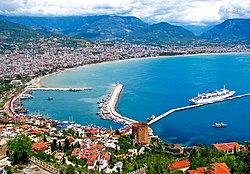
Alanya (/əˈlɑːnjə/ ⓘə-LAHN-yə; Turkish pronunciation: [aˈɫanja] ⓘ), formerly Alaiye, is a beach resort city, a municipality and district of Antalya Province, Turkey. It is on the southern coast of Turkey, in the country's Mediterranean Region, 133 kilometres (83 mi) east of the city of Antalya. Its area is 1,577 km2, and its population is 364,180 (2022). The city proper has 189,222 inhabitants (2022).
Because of its natural strategic position on a small peninsula into the Mediterranean Sea below the Taurus Mountains, Alanya has been a local stronghold for many Mediterranean-based empires, including the Ptolemaic, Seleucid, Roman, Byzantine, and Ottoman Empires. Alanya's greatest political importance came in the Middle Ages, with the Seljuk Sultanate of Rûm under the rule of Alaeddin Kayqubad I, from whom the city derives its name. His building campaign resulted in many of the city's landmarks, such as the Kızıl Kule (Red Tower), Tersane (Shipyard), and Alanya Castle.
The Mediterranean climate, natural attractions, and historic heritage make Alanya a popular destination for tourism, and responsible for nine percent of Turkey's tourism sector and thirty percent of foreign purchases of real estate in Turkey. Tourism has risen since 1958 to become the dominant industry in the city, resulting in a corresponding increase in city population. Warm-weather sporting events and cultural festivals take place annually in Alanya. In 2014 Mayor Adem Murat Yücel, of the Nationalist Movement Party unseated Hasan Sipahioğlu, of the Justice and Development Party, who had previously led the city since 1999. Adem Murat Yücel has served two terms as the Mayor of Alanya, first elected in 2014 and then elected for a second time in 2019. In March 31st 2024 Turkish local elections Osman Tarık Özçelik of the Republican People's Party has been elected as the new Mayor of Alanya, making an historic mark as the Republican People's Party was able to win an election in the city after 74 years.
The city has changed hands many times over the centuries, and its name has reflected this. Alanya was known in Latin as Coracesium or in Greek as Korakesion (Ancient Greek: Κορακήσιον) from the Luwian Korakassa meaning "point/protruding city". The Roman Catholic Church still recognizes the Latin name as a titular see in its hierarchy. Under the Byzantine Empire it became known as Kalonoros or Kalon Oros, meaning "beautiful/fine mountain" in Greek. The Seljuks renamed the city Alaiye (علائیه), a derivative of the Sultan Alaeddin Kayqubad I's name. In the 13th and 14th centuries, Italian traders called the city Candelore or Cardelloro. In his 1935 visit, Mustafa Kemal Atatürk finalized the name in the new alphabet as Alanya, changing the 'i' and 'e' in Alaiye, reportedly because of a misspelled telegram in 1933.
Finds in the nearby Karain Cave indicate occupation during the Paleolithic era as far back as 20,000 BC, and archeological evidence shows a port existed at Syedra, south of the modern city, during the Bronze Age around 3,000 BC. A Phoenician language tablet found in the district dates to 625 BC, and the city is specifically mentioned in the 4th-century BC Greek geography manuscript, the periplus of Pseudo-Scylax. The castle rock was likely inhabited under the Hittites and the Achaemenid Empire, and was first fortified in the Hellenistic period following the area's conquest by Alexander the Great. Alexander's successors left the area to one of the competing Macedonian generals, Ptolemy I Soter, after Alexander's death in 323 BC. His dynasty maintained loose control over the mainly Isaurian population, and the port became a popular refuge for Mediterranean pirates. The city resisted Antiochus III the Great of the neighboring Seleucid kingdom in 199 BC, but was loyal to the pirate Diodotus Tryphon when he seized the Seleucid crown from 142 to 138 BC. His rival Antiochus VII Sidetes completed work in 137 BC on a new castle and port, begun under Diodotus.
The Roman Republic fought Cilician pirates in 102 BC, when Marcus Antonius the Orator established a proconsulship in nearby Side, and in 78 BC under Servilius Vatia, who moved to control the Isaurian tribes. The period of piracy in Alanya finally ended after the city's incorporation into the Pamphylia province by Pompey in 67 BC, with the Battle of Korakesion fought in the city's harbor. In Strabo's reckoning, Coracesium marked the boundary between ancient Pamphylia and Cilicia (Cilicia Trachaea, in particular); though other ancient authors placed the boundary elsewhere. Isaurian banditry remained an issue under the Romans, and the tribes revolted in the fourth and fifth centuries AD, with the largest rebellion being from 404 to 408.
With the spread of Christianity Coracesium, as it was called, became a bishopric. Its bishop Theodulus took part in the First Council of Constantinople in 381, Matidianus in the Council of Ephesus in 431, Obrimus in the Council of Chalcedon in 451, and Nicephorus (Nicetas) in the Third Council of Constantinople in 680. Coracesium was a suffragan of the metropolitan see of Side, the capital of the Roman province of Pamphylia Prima, to which Coracesium belonged. It continued to be mentioned in the Notitiae Episcopatuum as late as the 12th or 13th century. No longer a residential bishopric, Coracesium is today listed by the Catholic Church as a titular see.
Islam arrived in the 7th century with Arab raids, which led to the construction of new fortifications. The area fell from Byzantine control after the Battle of Manzikert in 1071 to tribes of Seljuk Turks, only to be returned in 1120 by John II Komnenos.
Alanya
Alanya (/əˈlɑːnjə/ ⓘə-LAHN-yə; Turkish pronunciation: [aˈɫanja] ⓘ), formerly Alaiye, is a beach resort city, a municipality and district of Antalya Province, Turkey. It is on the southern coast of Turkey, in the country's Mediterranean Region, 133 kilometres (83 mi) east of the city of Antalya. Its area is 1,577 km2, and its population is 364,180 (2022). The city proper has 189,222 inhabitants (2022).
Because of its natural strategic position on a small peninsula into the Mediterranean Sea below the Taurus Mountains, Alanya has been a local stronghold for many Mediterranean-based empires, including the Ptolemaic, Seleucid, Roman, Byzantine, and Ottoman Empires. Alanya's greatest political importance came in the Middle Ages, with the Seljuk Sultanate of Rûm under the rule of Alaeddin Kayqubad I, from whom the city derives its name. His building campaign resulted in many of the city's landmarks, such as the Kızıl Kule (Red Tower), Tersane (Shipyard), and Alanya Castle.
The Mediterranean climate, natural attractions, and historic heritage make Alanya a popular destination for tourism, and responsible for nine percent of Turkey's tourism sector and thirty percent of foreign purchases of real estate in Turkey. Tourism has risen since 1958 to become the dominant industry in the city, resulting in a corresponding increase in city population. Warm-weather sporting events and cultural festivals take place annually in Alanya. In 2014 Mayor Adem Murat Yücel, of the Nationalist Movement Party unseated Hasan Sipahioğlu, of the Justice and Development Party, who had previously led the city since 1999. Adem Murat Yücel has served two terms as the Mayor of Alanya, first elected in 2014 and then elected for a second time in 2019. In March 31st 2024 Turkish local elections Osman Tarık Özçelik of the Republican People's Party has been elected as the new Mayor of Alanya, making an historic mark as the Republican People's Party was able to win an election in the city after 74 years.
The city has changed hands many times over the centuries, and its name has reflected this. Alanya was known in Latin as Coracesium or in Greek as Korakesion (Ancient Greek: Κορακήσιον) from the Luwian Korakassa meaning "point/protruding city". The Roman Catholic Church still recognizes the Latin name as a titular see in its hierarchy. Under the Byzantine Empire it became known as Kalonoros or Kalon Oros, meaning "beautiful/fine mountain" in Greek. The Seljuks renamed the city Alaiye (علائیه), a derivative of the Sultan Alaeddin Kayqubad I's name. In the 13th and 14th centuries, Italian traders called the city Candelore or Cardelloro. In his 1935 visit, Mustafa Kemal Atatürk finalized the name in the new alphabet as Alanya, changing the 'i' and 'e' in Alaiye, reportedly because of a misspelled telegram in 1933.
Finds in the nearby Karain Cave indicate occupation during the Paleolithic era as far back as 20,000 BC, and archeological evidence shows a port existed at Syedra, south of the modern city, during the Bronze Age around 3,000 BC. A Phoenician language tablet found in the district dates to 625 BC, and the city is specifically mentioned in the 4th-century BC Greek geography manuscript, the periplus of Pseudo-Scylax. The castle rock was likely inhabited under the Hittites and the Achaemenid Empire, and was first fortified in the Hellenistic period following the area's conquest by Alexander the Great. Alexander's successors left the area to one of the competing Macedonian generals, Ptolemy I Soter, after Alexander's death in 323 BC. His dynasty maintained loose control over the mainly Isaurian population, and the port became a popular refuge for Mediterranean pirates. The city resisted Antiochus III the Great of the neighboring Seleucid kingdom in 199 BC, but was loyal to the pirate Diodotus Tryphon when he seized the Seleucid crown from 142 to 138 BC. His rival Antiochus VII Sidetes completed work in 137 BC on a new castle and port, begun under Diodotus.
The Roman Republic fought Cilician pirates in 102 BC, when Marcus Antonius the Orator established a proconsulship in nearby Side, and in 78 BC under Servilius Vatia, who moved to control the Isaurian tribes. The period of piracy in Alanya finally ended after the city's incorporation into the Pamphylia province by Pompey in 67 BC, with the Battle of Korakesion fought in the city's harbor. In Strabo's reckoning, Coracesium marked the boundary between ancient Pamphylia and Cilicia (Cilicia Trachaea, in particular); though other ancient authors placed the boundary elsewhere. Isaurian banditry remained an issue under the Romans, and the tribes revolted in the fourth and fifth centuries AD, with the largest rebellion being from 404 to 408.
With the spread of Christianity Coracesium, as it was called, became a bishopric. Its bishop Theodulus took part in the First Council of Constantinople in 381, Matidianus in the Council of Ephesus in 431, Obrimus in the Council of Chalcedon in 451, and Nicephorus (Nicetas) in the Third Council of Constantinople in 680. Coracesium was a suffragan of the metropolitan see of Side, the capital of the Roman province of Pamphylia Prima, to which Coracesium belonged. It continued to be mentioned in the Notitiae Episcopatuum as late as the 12th or 13th century. No longer a residential bishopric, Coracesium is today listed by the Catholic Church as a titular see.
Islam arrived in the 7th century with Arab raids, which led to the construction of new fortifications. The area fell from Byzantine control after the Battle of Manzikert in 1071 to tribes of Seljuk Turks, only to be returned in 1120 by John II Komnenos.
Recent media
Recent media