Hubbry Logo
Alex CallinicosAlex CallinicosMain
Open search
Alex Callinicos
Community hub
Alex Callinicos
logo
8 pages, 0 posts
0 subscribers
Be the first to start a discussion here.
Alex Callinicos
Alex Callinicos
from Wikipedia

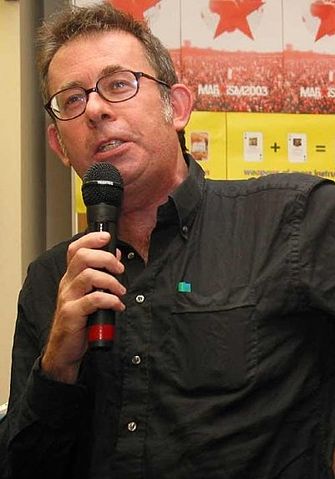
Alexander Theodore Callinicos (born 24 July 1950) is a Rhodesian-born British political theorist and activist. An adherent of Trotskyism, he is a member of the Central Committee of the Socialist Workers Party (SWP) and serves as its International Secretary. Between 2009 and 2020 he was the editor of International Socialism, the SWP's theoretical journal, and has published a number of books.

Key Information

Biography

[edit]

Early life

[edit]

He became involved in revolutionary politics as a student at Balliol College, Oxford, where he studied for a BA and came to know Christopher Hitchens, then himself active in the International Socialists (the SWP's forerunner).[1] He also received his DPhil at Oxford. The earliest writing by Callinicos for the International Socialists was an analysis of the student movement of the period. His other early writings focused on southern Africa and the French structuralist-Marxist philosopher Louis Althusser. In 1977, Callinicos married Joanna Seddon, a fellow Oxford doctoral student.[citation needed]

Career and activism

[edit]

Callinicos participated in the Counter-Summit to the IMF/World Bank Meeting in Prague, September 2000 and the demonstration against the G8 in Genoa, June 2001. He has also been involved in organising the Social Forum movement in Europe. He was a contributor to Dictionnaire Marx Contemporain (2001),[2] and has written articles in New Left Review.

He was Professor of Politics at the University of York before being appointed Professor of European Studies at King's College London in September 2005. He succeeded Chris Harman as editor of International Socialism in January 2010 shortly after Harman died and is a British correspondent for Actuel Marx. Callinicos joined the central committee of the SWP in the late 1970s; he retains this position.[citation needed]

Callinicos was a critic of the humanitarian interventions in Bosnia and Kosovo, arguing that they were conducted solely to promote the global capitalist expansion.[3][4] He has described Russia's invasion of Ukraine as "an ongoing battle between imperialist rivals, driving forward by capitalist competition".[5][6] He has argued against Western efforts to provide arms for Ukraine.[5][6]

In January 2013, in the context of a serious crisis inside the UK Socialist Workers Party (SWP) associated with the party's response to an allegation of rape against a leading member of the party, Martin Smith, referred to internally as Comrade Delta, and with the demand for changes to the existing form of the system of democratic centralism within the SWP, he wrote a defence of Leninism and democratic centralism. Callinicos disagreed with those who argued for the need to change the existing system.[7] He called the allegation of rape a "difficult disciplinary case",[7] a comment for which socialist feminist Laurie Penny thought he "[mistook] a plea for some basic respect for women's sexual autonomy as an attempt to undermine the revolution from within."[8]

Callinicos took a prominent position on another issue which had divided the Socialist Workers Party (SWP): the use of the Internet in disagreements about confidential party issues. He complained about "the dark side of the Internet" in which individuals have "used blogs and social media to launch a campaign within the SWP".[7]

In order to disentangle a conference organised by the Historical Materialism journal in Delhi during 2013 from the SWP crisis, his invitation to the conference was withdrawn in March 2013.[9]

Works

[edit]

Books/pamphlets

[edit]
  • 1976: Althusser's Marxism (London: Pluto Press) ISBN 0-904383-02-4
  • 1977: Southern Africa after Soweto (with John Rogers) (London: Pluto Press), ISBN 0-904383-42-3
  • 1981: Southern Africa after Zimbabwe (London: Pluto) ISBN 0-86104-336-7
  • 1982: Is there a future for Marxism? (London: Macmillan). ISBN 0-333-28477-1
  • 1983: Marxism and Philosophy (Oxford: Clarendon). ISBN 0-19-876126-0
  • 1983: The revolutionary ideas of Karl Marx (London: Bookmarks). ISBN 0-906224-09-8
  • 1983: The Revolutionary Road to Socialism (London: Socialist Workers Party). ISBN 0-905998-53-7
  • 1985: South Africa: the Road to Revolution (Toronto: International Socialists). ISBN 0-905998-55-3
  • 1985: The Great Strike : the miners’ strike of 1984-5 and its lessons (with Mike Simons) (London: Socialist Worker) ISBN 0-905998-50-2
  • 1987: The Changing Working Class: Essays on Class Structure Today (with Chris Harman) (London: Bookmarks) ISBN 0-906224-40-3
  • 1988: South Africa Between Reform and Revolution (London: Bookmarks). ISBN 0-906224-46-2
  • 1988: Making History: Agency, Structure, and Change in Social Theory (Ithaca, N.Y.: Cornell University Press). ISBN 0-8014-2121-7
  • 1989: Marxist Theory (editor) (Oxford: Oxford University Press). ISBN 0-19-827294-4
  • 1990: Trotskyism (Minneapolis: University of Minnesota Press). ISBN 0-8166-1904-2
  • 1991: The Revenge of History: Marxism and the East European Revolutions ISBN 0-271-00767-2
  • 1991: Against Postmodernism: a Marxist critique (Cambridge: Polity Press). ISBN 0-312-04224-8
  • 1992: Between Apartheid and Capitalism: conversations with South African socialists (editor) (London: Bookmarks). ISBN 0-906224-68-3
  • 1994: Marxism and the New Imperialism (London; Chicago, Ill. : Bookmarks). ISBN 0-906224-81-0
  • 1995: Theories and Narratives (Cambridge: Polity Press). ISBN 0-7456-1201-6
  • 1995: Race and Class (London: Bookmark Publications). ISBN 0-906224-83-7
  • 1995: Socialists in the trade unions (London: Bookmarks) ISBN 1-898876-01-0
  • 1996: New Labour or socialism? (London: Bookmarks) ISBN 1898877076
  • 1999: Social Theory: Historical Introduction (New York: New York University Press). ISBN 0-8147-1593-1
  • 2000: Equality (Themes for the 21st Century) (Cambridge: Polity Press). ISBN 0-7456-2324-7
  • 2002: Against the Third Way (Cambridge: Polity Press). ISBN 0-7456-2674-2
  • 2003: An anti-Capitalist manifesto (Cambridge: Polity Press). ISBN 0-7456-2903-2
  • 2003: New Mandarins of American Power: the Bush administration’s plans for the world (Cambridge: Polity Press). ISBN 0-7456-3274-2
  • 2006: Universities in a Neoliberal World (London: Bookmarks) ISBN 1898877467
  • 2006: The Resources of Critique (Cambridge: Polity). ISBN 0-7456-3160-6
  • 2009: Imperialism and Global Political Economy (Cambridge, Polity). ISBN 0-7456-4045-1
  • 2010: Bonfire of Illusions: The Twin Crises of the Liberal World (Polity). ISBN 0-7456-4876-2
  • 2012: The Revolutionary Ideas of Karl Marx (Haymarket) ISBN 978-1-6084-6138-7
  • 2014: Deciphering Capital: Marx's Capital and its destiny (London: Bookmarks).
  • 2023: The New Age of Catastrophe (London: Polity).

Articles

[edit]

References

[edit]
[edit]
Revisions and contributorsEdit on WikipediaRead on Wikipedia
from Grokipedia
Alexander Theodore Callinicos (born 24 July 1950) is a British Marxist political theorist, academic, and activist known for his contributions to , , and Trotskyist organizing. Callinicos, born in Salisbury, (now , ), studied at Balliol College, Oxford, followed by at the London School of Economics. He held academic positions including Professor of Politics at the before becoming Professor of European Studies at in 2005, from which he retired as Emeritus Professor. His research focuses on , European social and political theory, , and critiques of contemporary , with over 100 publications cited in scholarly work. A longstanding Trotskyist, Callinicos serves on the of the UK's Socialist Workers Party (SWP) and as International Secretary of the , influencing far-left and anti-imperialist movements. Among his notable books are Social Theory: A Historical Introduction (1999), which traces sociological thought from to , and Imperialism and the Global Political Economy (2009), analyzing uneven development under . Callinicos has also critiqued and defended against liberal and revisionist interpretations, positioning himself as a defender of amid academic left-wing dominance.

Early Life and Education

Family Origins and Childhood

Alexander Theodore Callinicos was born on 24 July 1950 in , the capital of (now , ). His father, John Alexander Callinicos, bore a surname indicative of Greek heritage, while his mother, the Honourable Ædgyth Bertha Milburg Mary Antonia Frances Lyon-Dalberg-Acton, descended from as the daughter of John Lyon-Dalberg-Acton, 2nd Baron Acton. This mixed parentage positioned the family within a privileged stratum amid the colony's white settler minority, which comprised roughly 5% of the population under British colonial administration formalized by the 1923 Constitution. The societal structure enforced racial segregation through laws like the , allocating prime farmland disproportionately to whites and exposing residents to entrenched imperial and racial hierarchies. Callinicos spent his early years in this environment, where white minority rule maintained economic dominance via agriculture, mining, and urban professions, often insulating expatriate families from indigenous African realities. No records indicate early family involvement in local or overt radicalism; instead, his upbringing aligned with the standard privileges of settler colonial society, including access to segregated and social networks. By November 1965, at age 15, he witnessed the (UDI) by Ian Smith's regime, which defied British oversight to perpetuate amid rising African nationalist pressures, marking a pivotal moment in Rhodesia's descent into international isolation. This event underscored the colony's racial tensions but did not evidently spur immediate personal politicization in Callinicos's youth.

University Studies and Initial Influences

Callinicos pursued undergraduate studies in at , beginning in 1968. This program exposed him to analytical philosophy, which dominated Oxford's philosophical curriculum at the time, alongside initial engagements with liberal political thought through canonical texts in and . Following his bachelor's degree, completed around 1972, Callinicos studied at the London School of Economics, broadening his focus on scientific methodology and its implications for social inquiry. He subsequently returned to for postgraduate research, earning a DPhil in 1978 with a thesis centered on , which examined foundational questions in and structural analysis. During this period, Callinicos encountered key Marxist thinkers, including and structuralists such as , whose influence is evident in his early scholarly output. His first major , Althusser's Marxism (1976), critiqued Althusser's structuralist interpretation of Marxism while engaging deeply with its philosophical underpinnings, signaling an intellectual pivot from mainstream toward dialectical and materialist frameworks. This work, alongside seminars and writings in the mid-1970s, reflected nascent explorations of Marxism's explanatory power for social structures, though without yet delving into organizational applications.

Academic Career

Teaching Positions and Academic Roles

Callinicos held a Junior Research Fellowship in Contemporary Social Thought at St Peter's College, , from 1979 to 1981. Following this, he joined the , where he taught social and political theory and advanced to the position of Professor of Politics, serving until 2005. In 2005, Callinicos was appointed of at , a role he maintained until his retirement in October 2021. At King's, his teaching encompassed European and international studies, with an emphasis on and . Upon retirement, he was conferred the title of of .

Scholarly Contributions and Research Areas

Callinicos's research primarily revolves around , which he employs as a framework for analyzing , emphasizing the causal primacy of material production relations over idealist or discursive factors. In Making History: Agency, Structure and Change in Social Theory (1987), he critiques dualistic structure-agency debates prevalent in Western , arguing from materialist premises that human agency operates within historically determined constraints while retaining transformative potential, thereby resolving antinomies without recourse to postmodern fragmentation. This approach privileges causal mechanisms rooted in economic , as opposed to voluntaristic or relativist alternatives. A key strand of his work involves anti-postmodernist polemics, defending Marxist epistemology against what he terms the "idealist irrationalism" of post-structuralism and postmodernism. In Against Postmodernism: A Marxist Critique (1989), Callinicos contends that postmodern claims of a radical break from modernity lack empirical grounding, instead reflecting a conservative accommodation to neoliberal fragmentation; he counters with a naturalistic account of language and cognition integrated into historical materialism, rejecting relativism in favor of objective truth-conditions verifiable through materialist analysis. This critique extends to historiography, where he advocates realist interpretations of historical processes over narrative deconstructions. Callinicos's engagements with apply historical materialism to contemporary capitalism, particularly critiques of as a phase of intensified . Works such as Imperialism and the Global Political Economy (2009) dissect interstate rivalries and , positing deregulation as exacerbating tendencies toward crisis, evidenced by the 2008 global financial meltdown which exposed contradictions between expansion and productive stagnation. His analyses highlight empirical patterns like persistent uneven development post-1990s, though Marxist predictions of chronic encountered counter-evidence in periods of sustained growth and (e.g., 1990s-2000s U.S. expansion), prompting refinements toward polycrisis dynamics over linear decline. Broader research spans European social and political theory, , and , with over 16,700 citations reflecting targeted impact in Marxist scholarship. Methodologically, Callinicos integrates first-principles reasoning—deriving explanations from foundational economic laws—with empirical scrutiny of global events, such as austerity and geopolitical shifts, to argue for capitalism's inherent instability without unsubstantiated .

Political Engagement and Ideology

Affiliation with Trotskyist Organizations

Callinicos became involved with the International Socialists (IS), a British revolutionary socialist group founded by that rejected orthodox in favor of a "state capitalist" analysis of the , during the 1970s as a student activist. The IS reorganized into the Socialist Workers Party (SWP) in 1977, and Callinicos continued as a member, contributing to its journal International Socialism with articles on rank-and-file movements and socialist strategy amid post-1970s industrial decline. By the 1990s, Callinicos had ascended to the SWP's , where he defended organizational tactics oriented toward intervening in broader movements despite diminishing working-class militancy and union density in Britain following the Thatcher era's economic restructuring. In this role, he helped sustain the party's focus on united fronts and campaigns, including anti-war efforts coordinated through networks like the , which mobilized hundreds of thousands against the 2003 Iraq invasion but reflected the limits of Trotskyist-influenced in mass organizations. As the SWP's international secretary since at least the early 2000s, Callinicos has overseen ties to the (IST), a loose of sister parties employing similar interventionist strategies in countries from to , though empirical data shows consistent membership contraction in the SWP from peaks of several thousand in the to low thousands today amid broader far-left fragmentation. This decline parallels reduced industrial leverage, with trade union membership falling from 13 million in 1979 to about 6.5 million by 2023, underscoring challenges to the permanent revolution-oriented framework the leadership, including Callinicos, has upheld against reformist alternatives.

Key Theoretical Positions on Marxism and Imperialism

Callinicos champions Leon Trotsky's theory of uneven and combined development as a cornerstone of Marxist analysis, positing it as an explanatory framework for imperialism's dynamics and a bulwark against Stalinist doctrines of isolated national development. This theory underscores how capitalist expansion integrates disparate economic formations, fostering combined backwardness and advanced features within states, thereby generating inter-imperialist rivalries and revolutionary potentials globally. In works such as Imperialism and Global Political Economy (2009), he integrates this with Lenin's imperialism thesis to argue that uneven development sustains capitalism's contradictions, including widening inequalities between core and periphery nations. Yet, empirical data challenges the associated immiseration thesis—central to early Marxist expectations of proletarian pauperization—revealing instead a marked decline in global extreme poverty from 1.9 billion people in 1990 to approximately 692 million by 2024, driven by market integrations and state policies in Asia and elsewhere, which have elevated living standards without precipitating systemic collapse. On imperialism, Callinicos frames the and as the dominant aggressors in post-Cold War , critiquing their interventions as extensions of capitalist while applying uneven development to explain multipolar tensions. In analyses of the 2022 , he portrays the conflict as a proxy for Western strategies, downplaying Russian expansionism in favor of emphasizing 's eastward push as the causal trigger, consistent with Trotskyist that prioritizes opposition to the strongest imperial power. This stance, echoed in debates with figures like , aligns with broader leftist traditions but invites scrutiny for understating Russia's revanchist motives—rooted in restoring influence over former Soviet spheres—and the proxy elements involving non-state actors, potentially reflecting selective causal emphasis that privileges anti-Western narratives over balanced empirical accounting of aggressor intentions. Rejecting social democracy as an illusory reformist path, Callinicos advocates Trotsky's permanent revolution doctrine, which demands a vanguard-led proletarian upheaval transcending national bourgeois stages toward international socialism, rather than parliamentary accommodations. He substantiates this through historical precedents, such as the British Labour governments of 1945–1951 under Clement Attlee, which nationalized key industries and expanded welfare but faltered amid sterling crises, export slumps, and reliance on U.S. loans, ultimately reinforcing capitalist structures without advancing toward worker control. Similar patterns marked Harold Wilson's 1964–1970 administrations, beset by devaluation, strikes, and IMF pressures, illustrating how electoralism integrates labor movements into state capitalism. This insistence on vanguardism stems from causal realism about class agency, yet Trotskyist forecasts of cascading world revolutions—post-1917—have empirically yielded to liberal democratic stability, where welfare concessions, technological productivity gains, and geopolitical pacts have diffused revolutionary pressures, exposing theoretical overreliance on economic determinism amid capitalism's institutional adaptations.

Major Publications

Monographs and Theoretical Books

Callinicos's early monograph The Revolutionary Ideas of Karl Marx (1983, with a second edition in 2010) presents a defense of Marx's core concepts, including dialectical materialism, against charges of obsolescence, arguing for their continued relevance in analyzing capitalist contradictions and revolutionary potential. In Making History: Agency, Structure, and Change in Social Theory (1987, revised edition 2004), Callinicos examines the interplay between human agency and social structures in historical materialism, critiquing structuralist and voluntarist extremes to emphasize class struggle as the driver of change within Marxist frameworks. Imperialism and the Global Political Economy (2009) analyzes the persistence of imperialist dynamics in contemporary , integrating Marxist theories of uneven development with empirical patterns of global inequality and state competition. Bonfire of Illusions: The Twin Crises of the Liberal World (2010) dissects the 2007–2008 financial crash alongside geopolitical tensions, such as the 2008 , as symptoms of deeper neoliberal instability rooted in overaccumulation and imperial rivalries. Callinicos's later work The New Age of Catastrophe (2022) addresses intersecting crises including climate disruption, pandemics, and under , highlighting worker mobilizations and far-right surges while linking these to systemic capitalist decay.

Edited Works and Shorter Writings

Callinicos co-edited The Routledge Handbook of Marxism and Post-Marxism (2021) with Stathis Kouvelakis and Lucia Pradella, a volume comprising contributions from various scholars examining the evolution of Marxist theory alongside post-Marxist variants in a global context. The handbook addresses key debates on , , and , drawing on to analyze contemporary applications without prioritizing any single interpretive strand. His shorter writings, often published in outlets affiliated with the Socialist Workers Party (SWP), extend analyses of current events through a Marxist lens, appearing regularly in journals like International Socialism—where he served as editor from 2009 to 2020—and . These pieces, typically 5,000–10,000 words, focus on geopolitical shifts and economic crises rather than developing novel theoretical frameworks. For example, in April 2021, Callinicos published "Neoliberal capitalism implodes: global catastrophe and the far right" in International Socialism, critiquing the escalation of authoritarian tendencies amid capitalist instability. Contributions on recent conflicts include articles in addressing the war, such as "Support for Ukraine looks shaky in the West" (17 September 2024), which argues that waning Western political backing reveals underlying imperialist contradictions, and "West's weakness is exposed by Ukraine war" (20 February 2024), highlighting proxy dynamics in the conflict. Earlier in the , writings tied to his lectures at (October 2015) interrogated neoliberalism's crises in Western economies, emphasizing state interventions post-2008 financial crash. Callinicos has also addressed pandemics in SWP periodicals, as in the March 2020 International Socialism piece "Socialism in a time of pandemics," which links outbreaks to capital's encroachment on ecological frontiers, and January 2021's "Covid-19 hasn't stopped capitalism from changing" in , noting accelerated transformations like vaccine development amid systemic stagnation. These outputs, numbering dozens since the , predominantly channel through SWP platforms, reinforcing organizational perspectives on and class struggle up to 2025.

Controversies and Internal Conflicts

The 2013 SWP Crisis and Leadership Role

In late 2010 and 2012, two female members of the Socialist Workers Party (SWP) raised allegations of rape and sexual assault against Martin Smith, a prominent central committee member known internally as "Comrade Delta." The party's leadership opted to address these claims through an internal Disputes Committee (DC) rather than involving external authorities such as the police, with the panel—composed of seven members familiar with Smith—ultimately dismissing the accusations as "not proven" without forwarding them for independent investigation. This approach reflected the SWP's centralized Leninist structure, where loyalty to party hierarchy and internal resolution mechanisms prioritized organizational cohesion over impartial scrutiny, enabling a process critics described as akin to a "kangaroo court" due to its lack of procedural safeguards for complainants. Alex Callinicos, serving as the SWP's international and a member, publicly defended the DC's handling as a non-judicial internal disputes process unfit for characterization as a formal , arguing it aligned with the party's revolutionary traditions rather than bourgeois legal norms. In the lead-up to the 2013 national , where delegates voted to endorse the DC's findings by a slim (approximately 200-110), Callinicos contributed to statements framing as factional disloyalty, which facilitated the expulsion of at least four critics beforehand on charges of "secret factionalism." This suppression of opposition, rooted in the party's democratic centralist , exacerbated internal fractures, as from leaked documents and member testimonies revealed procedural flaws, including inadequate support for victims and of witnesses. The crisis intensified through , culminating in mass resignations—estimated in the hundreds—and a significant party split, with groups like rs21 forming from defectors disillusioned by the leadership's intransigence. A special March 2013 conference established a review body for DC procedures, but subsequent annual conferences in upheld leadership motions amid ongoing expulsions, documenting a vote pattern where opposition motions garnered 20-30% support yet failed to alter the entrenched . Callinicos later characterized aspects of the handling as a "dogmatic mistake" in theoretical reflections, but the empirical fallout included lasting to the SWP, membership decline from around 5,000 to under 2,000 by mid-decade, and diminished influence in broader left movements, attributable to the causal chain of centralized control stifling accountability. In May 2024, the SWP Central Committee issued a statement acknowledging mishandlings in the 2013 crisis, admitting failures such as insufficient sensitivity to victims' challenges and over-reliance on internal processes that retraumatized complainants, while committing to updated guidelines on sexual misconduct. However, the apology has been critiqued as inadequate by former members and observers, given its belated timing, lack of accountability for surviving leaders like Callinicos, and absence of reparative measures, underscoring persistent structural incentives in hierarchical organizations that delay reckoning with abuse until organizational survival demands it.

Recent Debates on Geopolitics

In 2022, Callinicos engaged in a public debate with fellow Marxist on the nature of Russia's invasion of , framing the conflict as an inter-imperialist rivalry by proxy while acknowledging 's defensive war against Russian aggression. He argued that both expansionism and Russian imperialism exacerbated the crisis, advocating opposition to arms supplies to on the grounds that they prolong a war between rival powers without advancing socialist goals, though he condemned Putin's invasion as unjustifiable. Achcar countered that prioritizing anti- rhetoric risks equating Western liberal democracies with Russian authoritarianism, emphasizing empirical evidence of Russia's war crimes—such as documented atrocities in Bucha and —and 's popular resistance as a model of democratic against autocratic expansionism. Critics of Callinicos's position, including Ukrainian solidarity advocates, contend it underweights data on authoritarian regimes' systemic failures, noting Russia's pre-invasion (GDP lagging behind Poland's by over 50% since 2014) and military setbacks despite initial advantages, which highlight the causal efficacy of decentralized, aid-supported defense over centralized command structures. Callinicos extended these analyses into 2025 writings on prospective U.S.-brokered ceasefires in , portraying them as maneuvers in a declining American amid rising Sino-Russian alignment, evidenced by joint drills and trade volumes exceeding $200 billion annually by 2023. He posited that U.S. efforts to detach from —potentially via Ukraine concessions—reflect geopolitical realism in a multipolar order, but warned of escalating global antagonisms without proletarian intervention. Opposing perspectives, drawn from liberal internationalist sources, challenge this by citing metrics of persistent U.S. dominance, such as control over 60% of global and financial networks, arguing that narratives of hegemony's "decline" overlook how democratic alliances have empirically constrained authoritarian bids for influence, as seen in coordinated sanctions reducing 's oil revenues by 40% post-2022. In his 2023 book The New Age of Catastrophe, Callinicos integrated geopolitical tensions with cascading crises like the COVID-19 pandemic (which killed over 7 million globally by 2023 per WHO data) and energy disruptions from the Ukraine war, theorizing capitalism's tendency toward compounded breakdowns via uneven development and ecological strain. He linked these to broader "polycrisis" dynamics, critiquing state responses—such as EU energy rationing leading to 20% industrial output drops in Germany by 2023—for prioritizing capital accumulation over human needs. At the Marxism 2023 event in London, Callinicos debated economist Adam Tooze on these themes, defending Marxist causal analysis against "system crash" fatalism while urging organized resistance. Detractors, including empirical economists, fault such frameworks for downplaying adaptive capacities in mixed economies, pointing to post-COVID recoveries (global GDP rebounding 6% in 2021) and renewable energy transitions mitigating fossil fuel shocks, which suggest resilience beyond dialectical inevitability.

Reception, Criticisms, and Legacy

Praise from Marxist Circles

Callinicos's The New Age of Catastrophe (2022), which analyzes capitalism's interlocking crises in , , , and through a Marxist lens, has drawn significant acclaim from Trotskyist publications. In a review published in International Socialism—the theoretical journal of the Socialist Workers Party (SWP)—historian Donny Gluckstein hailed the work as a "hugely important book" that executes a "necessarily tricky balancing act" between dissecting discrete crises and revealing their systemic interconnections "with panache," terming it an "invaluable contribution" to grasping capitalism's trajectory toward catastrophe. This praise underscores recognition of Callinicos's ability to integrate empirical data on phenomena like sovereign debt and climate breakdown with undiluted Marxist , positioning the text as both diagnostic and oriented toward revolutionary praxis. Beyond monographs, Callinicos's broader oeuvre has been valued in Marxist activist networks for bolstering theoretical defenses against reformist dilutions of and . As a longstanding SWP theorist and former editor of International Socialism (2009–2020), his interventions—such as elucidating imperialism's persistence amid —have informed cadre education and debate, with comrades crediting his frameworks for clarifying anti-capitalist strategy amid conjunctural shifts like the 2008 financial crash. Such endorsements highlight his role in sustaining coherent, first-principles-based critiques within anglophone Trotskyist circles, distinct from academic post-Marxism's eclecticism.

Critiques from Broader Perspectives and Empirical Challenges

Critics of Trotskyism, including Callinicos's variant, contend that its core causal claims—such as the inevitability of global amid capitalist crises—have been empirically falsified by historical outcomes. Trotskyist theory anticipated that the contradictions of would precipitate worldwide socialist upheaval following , yet no such materialized; instead, in the Global South largely resulted in nationalist bourgeois regimes rather than proletarian dictatorships. The 1991 collapse of the USSR, which Trotsky had foreseen as a potential capitalist restoration absent proletarian intervention, instead validated critiques that state socialism's bureaucratic inefficiencies and failure to achieve undermined its own predictions, leading to market-oriented transitions in without sparking global insurgency. Post-Cold War data further challenges these expectations: global fell from 38% in 1990 to under 10% by 2015, driven by market liberalization and trade integration in , contradicting forecasts of inexorable capitalist decay into barbarism. Theoretical objections highlight Trotskyism's over-reliance on Hegelian dialectics, which posits historical progress through inevitable class contradictions, while sidelining individual agency and the decentralized efficiencies of markets. Analytical Marxists argue that this dialectical framework neglects , treating social outcomes as structurally determined rather than emergent from human choices, thus failing to account for how entrepreneurial and price signals resolve information problems that central planning exacerbates. from post-1991 prosperity supports this: rapid technological adoption and supply-chain efficiencies in liberalized economies outpaced socialist models, as seen in China's partial market reforms yielding GDP growth averaging 9-10% annually from 1990-2010, outcomes unattributable to dialectical inevitability but to pragmatic incentives. The SWP crisis exemplifies organizational pathologies in vanguardist structures, where Callinicos's leadership role drew accusations of that contradicted egalitarian rhetoric. Handling of allegations against a senior member involved opaque internal trials and suppression of dissent, resulting in mass resignations—over 200 members left by early —and factional splits, eroding the party's credibility and illustrating how Leninist centralism prioritizes cadre loyalty over accountability. Critics from libertarian socialist perspectives view this as inherent to Trotskyist models, fostering hierarchical control that mirrors the bureaucratic deformations Trotsky critiqued in , yet replicates them in microcosm without delivering broader egalitarian advances. Mainstream scholarship rejects Callinicos's imperialism theory as ahistorical, particularly in downplaying China's evolution into and the stabilizing effects of integration. While Callinicos frames contemporary rivalries as extensions of classical inter-imperialist competition, detractors argue this overlooks China's hybrid model—combining with private enterprise and WTO integration since 2001—which has generated sustained growth without igniting predicted global war, instead channeling energies into . On the EU, Trotskyist portrayals of it as a supranational imperialist cartel ignore empirical stability: post-1992 expansions correlated with intra-bloc trade rising to 60% of members' totals by 2020 and reduced conflict probabilities, fostering prosperity that undercuts narratives of inevitable rupture. Right-leaning analysts further critique such ideologies for promoting polarization through and perpetual opposition, yielding no scalable policy successes—like viable alternatives to market-driven —while fragmenting potential coalitions for incremental reforms.

References

Add your contribution
Related Hubs
User Avatar
No comments yet.