


Community hub
Recent from talks
Contribute something
Nothing was collected or created yet.
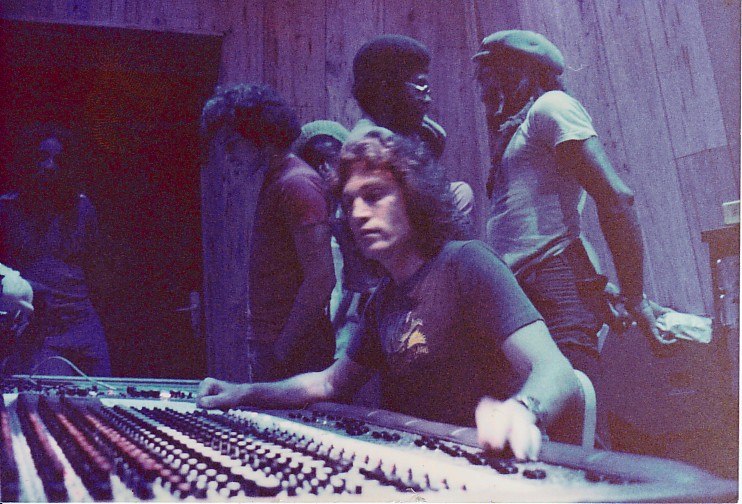
Alex Sadkin
View on Wikipedia
 | This article needs additional citations for verification. (September 2024) |
Key Information


Alex Sadkin (April 9, 1949 – July 23, 1987[1]) was an American record producer, engineer, mixer and mastering engineer.
Early life
[edit]Sadkin grew up in Fort Lauderdale, Florida, and played saxophone in Sunrise Junior High School and Fort Lauderdale High School. Sadkin attended the University of Miami in Coral Gables for his first year of college as a biology major. He attended Florida State University in Tallahassee where he played bass guitar with childhood friends Lyle LaBarbera (rhythm guitar) and Jim Hendee (drums), and singer Phil Turk. He eventually received his Bachelor of Science degree in geology in 1971. He got his start in the music industry as a saxophonist for the Las Olas Brass in Fort Lauderdale.
Career
[edit]After graduation, Sadkin worked with Jim Hendee at a sea turtle farm called Mariculture, Ltd. on Grand Cayman Island, where they both lived on Seven Mile Beach, a few miles from the town of Hell. During their six months of living and scuba diving there, they got their first taste of playing reggae at several clubs around the island.
When Sadkin returned to South Florida he began his recording career. He was first trained as a mastering engineer but eventually moved into recording studio work as a "tape-op" (Assistant Engineer) at Criteria Studios in Miami, Florida. He got his first big break after impressing Neil Young with his mixing ability, and he eventually became head engineer at Compass Point Studio in Nassau, Bahamas. He worked alongside Island Records boss Chris Blackwell on many of the label's projects, most famously with Bob Marley and the Wailers' Survival album in 1979.
A full member of the Compass Point All Stars from day one, he began producing artists for Island Records (Grace Jones, Marianne Faithfull, Robert Palmer, Joe Cocker), while doing mixing work for other labels (Talking Heads). Among the other artists he produced in the 1980s are James Brown, the J. Geils Band, Thompson Twins, Classix Nouveaux, Foreigner, Duran Duran, Simply Red, Arcadia, Robbie Nevil and Paul Haig.
Sadkin produced the first two of the Thompson Twins' (as a trio) albums, Quick Step & Side Kick (1983) and Into the Gap (1984) as well as the original UK single release of "Lay Your Hands on Me", in late 1984. However, the band parted company with him as the producer for their next album and opted to produce Here's to Future Days by themselves in Paris; after the collapse of the singer Tom Bailey, the release was postponed. The postponement caused them to rethink the project and producer Nile Rodgers was subsequently called in to rework the album with them, along with Sadkin's production of the single "Lay Your Hands on Me" and was released in 1985.
Sadkin was a mentor to engineer and producer Phil Thornalley, who would go on to work with The Cure, Bryan Adams,[2] and Natalie Imbruglia. He had a special gift of being able to sense and analyze an artist's inner creative abilities and talents, even if the artist could not.[citation needed] Composer-keyboardist Wally Badarou had this to say about Sadkin: "His dedication to maintaining genuine 'mixes in progress' from the word go, was a great lesson. I made it a system for my subsequent production from then on."[3]
Death
[edit]Sadkin died in a motor accident in Nassau on July 23, 1987 at the age of 38, shortly after completing production work on Boom Crash Opera's eponymous 1987 album, and just before he was due to begin working with Ziggy Marley. The songs "Do You Believe in Shame?" by Duran Duran, "Too Soon" by Robbie Nevil, and Grace Jones' "Well Well Well" are all dedicated to his memory. Joe Cocker's album Unchain My Heart (1987) is dedicated to the memory of Alex Sadkin, the quote from the album cover stating 'A Man who lived for music, and a good friend'.
Selected production credits
[edit]- Stephen Stills – Illegal Stills (1976) — mixing
- Bob Marley and the Wailers - Rastaman Vibration (1976) — mixing
- Stills-Young-Band – Long May You Run (1976) — mixing
- Third World – Journey to Addis (1978)
- Bob Marley and the Wailers – Survival (1979)
- Grace Jones – Warm Leatherette (1980)
- Robert Palmer – Clues (1980) — mixing
- Grace Jones – Nightclubbing (1981)
- Grace Jones – Living My Life (1982)
- Joe Cocker – Sheffield Steel (1982)
- Thompson Twins – Quick Step & Side Kick (1983)
- Paul Haig (ex-Josef K) – Rhythm of Life (1983)
- Talking Heads – Speaking in Tongues (1983) — mixing credit
- Duran Duran – Is There Something I Should Know? (1983) — mixing credit[4]
- Duran Duran – Seven and the Ragged Tiger (1983)
- Classix Nouveaux - Secret (1983)
- Thompson Twins – Into the Gap (1984)
- Thompson Twins – "Lay Your Hands on Me" (1984) — original single production, later retooled by Nile Rodgers (1985)
- Foreigner – Agent Provocateur (1984)
- Arcadia – So Red the Rose (1985)
- Robbie Nevil – Robbie Nevil (1986)
- Boom Crash Opera – Boom Crash Opera (1987)
- Simply Red – Men and Women (1987)
- XTC – Wonderland_(XTC_song) (1983) mixing
References
[edit]- ^ Obituary: Alex B Sadkin 23.7.87. Drive.google, August 5, 2024.
- ^ "Phil Thornalley: I Want it to Sound Like This". Tapeop.com.
- ^ "Session Player". Wallybadarou.com. Retrieved August 21, 2019.
- ^ "Duran Duran - Is There Something I Should Know?". Discogs.com. March 26, 1983. Retrieved August 21, 2019.
External links
[edit]- Alex Sadkin at AllMusic
- Alex Sadkin discography at Discogs

| International | |
|---|---|
| Artists | |
Alex Sadkin
View on GrokipediaEarly Life and Education
Childhood in Florida
Alex Sadkin was born on April 9, 1949, in Glen Ridge, New Jersey, to parents Berthold L. Sadkin and Mary L. Lee, though some records list his birthplace as Fort Lauderdale, Florida.[2][1] His family relocated to Florida shortly after his birth, where he spent his formative years in Fort Lauderdale, a coastal city with a burgeoning mid-20th-century music scene influenced by R&B and jazz traditions prevalent in South Florida.[3] Sadkin grew up across the street from Bennett Elementary School, immersing himself in the local community from an early age. He attended Sunrise Junior High School and later Fort Lauderdale High School, where his academic pursuits initially focused on non-musical subjects such as science.[3] Despite this, the vibrant cultural environment of Fort Lauderdale, with its proximity to Miami's rhythm and blues clubs and jazz venues, began shaping his early interests.[4] Sadkin's first significant involvement with music came during his school years, when he took up the saxophone and played in school ensembles at both Sunrise Junior High and Fort Lauderdale High School. This experience ignited a lasting passion for music, drawing him toward the soulful sounds of R&B and jazz that echoed through Florida's entertainment districts in the 1950s and 1960s.[3][5]Academic Background and Musical Training
Sadkin initially pursued a scientific education, attending the University of Miami in Coral Gables for his first year as a biology major. He later transferred to Florida State University in Tallahassee, where he completed his studies and earned a Bachelor of Science degree in geology in 1971.[3] Following graduation, Sadkin shifted his focus to music, marking a decisive pivot from geology to a full-time career in the arts during the early 1970s. He began performing professionally as a saxophonist with the Las Olas Brass Band, a prominent Florida R&B ensemble based in Fort Lauderdale. The group featured collaborations with emerging talents, including bassist Jaco Pastorius, with whom Sadkin had attended high school and shared early musical experiences.[6] Sadkin's foundational musical training was largely informal, developed through extensive band performances and local gigs that honed his technical ear for sound and rhythm. Building on saxophone skills cultivated during his school years in Fort Lauderdale, these experiences provided practical exposure to ensemble dynamics and live production elements, laying the groundwork for his later professional endeavors in music.[7]Professional Career
Early Engineering Roles
Sadkin entered the recording industry in the early 1970s, initially training as a mastering engineer before shifting focus to hands-on studio engineering.[1] This foundational experience equipped him with a strong technical base in audio processing and quality control. By 1975, he had advanced to the role of tape operator and assistant engineer at Criteria Studios in Miami, Florida, a premier facility known for its state-of-the-art equipment and high-profile sessions.[1][8] At Criteria, Sadkin contributed to engineering sessions for major rock acts, gaining expertise in multi-track recording techniques amid the era's growing complexity in overdubbing and mixing.[1] Notable early projects included assistant engineering on the Eagles' One of These Nights (1975), where he supported the capture of the band's intricate harmonies and instrumentation. These experiences allowed him to progress from assistant duties to full engineering responsibilities, particularly in reggae sessions that introduced him to rhythmic layering and live ensemble recording.[1] Sadkin's involvement in reggae deepened with Bob Marley and the Wailers' Rastaman Vibration (1976), where he engineered tracks emphasizing the genre's propulsive bass and percussion. This culminated in his full engineering role on Marley's Survival (1979), co-produced with the band, where he mixed the album's urgent political themes with crisp, vibrant soundscapes at Tuff Gong Studios.[9] Around 1977, Sadkin relocated from Florida to pursue international opportunities, joining Island Records' newly established Compass Point Studios in the Bahamas as head engineer, which broadened his scope beyond local sessions.[1]Production Work at Compass Point Studios
In 1977, Alex Sadkin relocated to Nassau, Bahamas, to take on the role of in-house engineer at the newly established Compass Point Studios, founded by Island Records owner Chris Blackwell.[1] His prior experience as an assistant engineer at Criteria Studios in Miami served as a key prerequisite for the position, showcasing his technical prowess in mastering and mixing.[6] Sadkin was swiftly promoted to head engineer, a role he held through the late 1980s, overseeing operations at the state-of-the-art facility designed to attract international artists seeking a tropical creative escape.[1] The studio's environment fostered a collaborative, high-energy vibe, centered around the Compass Point All Stars—a house band of elite session musicians including drummer Sly Dunbar and bassist Robbie Shakespeare, who brought reggae rhythms and improvisational flair to recordings.[10] This setup encouraged live, spontaneous sessions where artists, producers, and musicians jammed together, blending genres in real time and capturing the raw energy of the Bahamas' laid-back yet innovative atmosphere.[11] Sadkin's oversight ensured these improvisational takes translated into polished tracks, leveraging the studio's advanced 24-track facilities and isolation from mainland distractions.[12] Sadkin's technical innovations were instrumental in defining the signature "Compass Point sound"—a crisp, punchy aesthetic that fused reggae grooves with rock edges and new wave synths, achieved through meticulous mixing techniques emphasizing clarity, deep bass, and dynamic range.[11] As both engineer and co-producer, he refined mastering processes to highlight instrumental interplay, creating a spacious yet forceful sonic profile that became a hallmark of the era's global hits.[12] His approach prioritized balance and punch, often layering dub-inspired effects with live instrumentation to produce recordings that felt both intimate and expansive. Throughout his tenure, Sadkin took on a mentorship role, guiding emerging engineers such as Phil Thornalley, who credited him as a pivotal influence in honing production skills amid high-stakes sessions.[13] This leadership extended to his final major project, engineering Boom Crash Opera's self-titled debut album in 1987, where he applied his refined techniques to capture the band's energetic new wave rock.[14] Completed just before his untimely departure from the studio, the work exemplified Sadkin's enduring impact on the facility's output.[15]Notable Collaborations and Credits
Sadkin's production work in the 1980s significantly shaped the sound of new wave, synth-pop, and reggae-influenced recordings, often in collaboration with artists at Compass Point Studios. His partnership with Grace Jones yielded breakthrough albums such as Nightclubbing (1981), where he co-produced, engineered, and mixed tracks that blended reggae, new wave, and soul, achieving international chart success including a peak at number 35 on the UK Albums Chart.[16] He continued this collaboration on Living My Life (1982), handling similar roles to refine Jones's eclectic style. Key credits extended to pop and rock acts, including full production on Thompson Twins' Into the Gap (1984), which featured the hit single "Hold Me Now" reaching number 3 on the Billboard Hot 100 and propelled the album to multi-platinum status in the UK.[17] Sadkin also produced Duran Duran's Seven and the Ragged Tiger (1983), incorporating synth elements into tracks like "Union of the Snake," which hit number 3 on the UK Singles Chart.[18] For Robert Palmer, he oversaw production on Riptide (1985), including the global number 1 single "Addicted to Love," earning a Grammy nomination for Best Male Rock Vocal Performance.[19] His contributions demonstrated genre diversity, from reggae engineering on Bob Marley's Survival (1979), where he handled production and engineering to capture the album's militant themes, peaking at number 70 on the Billboard 200, to synth-pop mixes for Simply Red's debut Picture Book (1985) and Robbie Nevil's self-titled album (1986), the latter featuring the top 10 hit "C'est La Vie" on the Billboard Hot 100.[20][21]Selected Discography Highlights
| Artist | Album | Year | Role | Notable Impact |
|---|---|---|---|---|
| Bob Marley & The Wailers | Survival | 1979 | Engineer, Producer | Peaked at #70 on Billboard 200, key reggae album.[20] |
| Grace Jones | Nightclubbing | 1981 | Producer, Engineer, Mixer | UK #35, commercial breakthrough with hits like "Pull Up to the Bumper."[16] |
| Duran Duran | Seven and the Ragged Tiger | 1983 | Producer | UK #1, included "Union of the Snake" (#3 UK Singles).[18] |
| Thompson Twins | Into the Gap | 1984 | Producer | UK #1, multi-platinum; "Hold Me Now" #3 Billboard Hot 100.[17] |
| Simply Red | Picture Book | 1985 | Producer | UK #2, launched band's career with "Money's Too Tight (To Mention)." |
| Robert Palmer | Riptide | 1985 | Producer | US #8, "Addicted to Love" #1 Billboard Hot 100, Grammy nominee. |
| Robbie Nevil | Robbie Nevil | 1986 | Producer | US #37 Billboard 200, "C'est La Vie" #2 Hot 100.[21] |
| Thompson Twins | Here's to Future Days | 1985 | Producer (select tracks) | UK #5, included "King for a Day" #22 UK Singles. |