Hubbry Logo
Thompson TwinsThompson TwinsMain
Open search
Thompson Twins
Community hub
Thompson Twins
logo
8 pages, 0 posts
0 subscribers
Be the first to start a discussion here.
Thompson Twins
Thompson Twins
from Wikipedia

Thompson Twins were an English pop band, formed in 1977 in Sheffield.[3] Initially a new wave group, they switched to a more mainstream pop sound and achieved considerable popularity during the early and mid-1980s, scoring a string of hits in the United Kingdom, the United States, and around the world. In 1993, they changed their name to Babble, to reflect their change in music from pop to dub-influenced chill-out. They continued as Babble until 1996, at which point the group permanently broke up.

Key Information

The band's name was based on the two bumbling detectives Thomson and Thompson (who are close doubles, not twins) in the English-language version of The Adventures of Tintin (Les aventures de Tintin).[4] At various stages they had up to seven members, but their best known line-up was as a trio from 1982 to 1986. The band became a prominent act in the US during the Second British Invasion, and in 1985 performed at Live Aid in Philadelphia, where they were joined on stage by Madonna.[4]

Career

[edit]

Early days

[edit]

In 1977, the original Thompson Twins line-up consisted of Tom Bailey[5] on bass guitar and vocals, Pete Dodd on guitar and vocals, John Roog on guitar, and Jon Podgorski (known as "Pod") on drums.[1]

Arriving in London with little money, they lived as squatters in Lillieshall Road, Clapham. Future Thompson Twins member Alannah Currie lived in another squat in the same street, which is how she met Bailey. Their roadie at that time was John Hade, who lived in the same house, and who later became their manager.[6]

As Podgorski had decided to stay in the north, the group auditioned for drummers at the Point Studio in Victoria, London. Andrew Edge joined them on drums for 18 months, and went on to join Savage Progress, who later toured with the Thompson Twins as the support act on the band's 1984 UK tour.[6]

In 1980, the band (now consisting of Bailey, Dodd, Roog and drummer Chris Bell, who had replaced Edge the previous year) released their first single, "Squares and Triangles", on their own Dirty Discs label.[7] A follow-up single, "She's in Love with Mystery", was issued later that year.

Line-up changes

[edit]
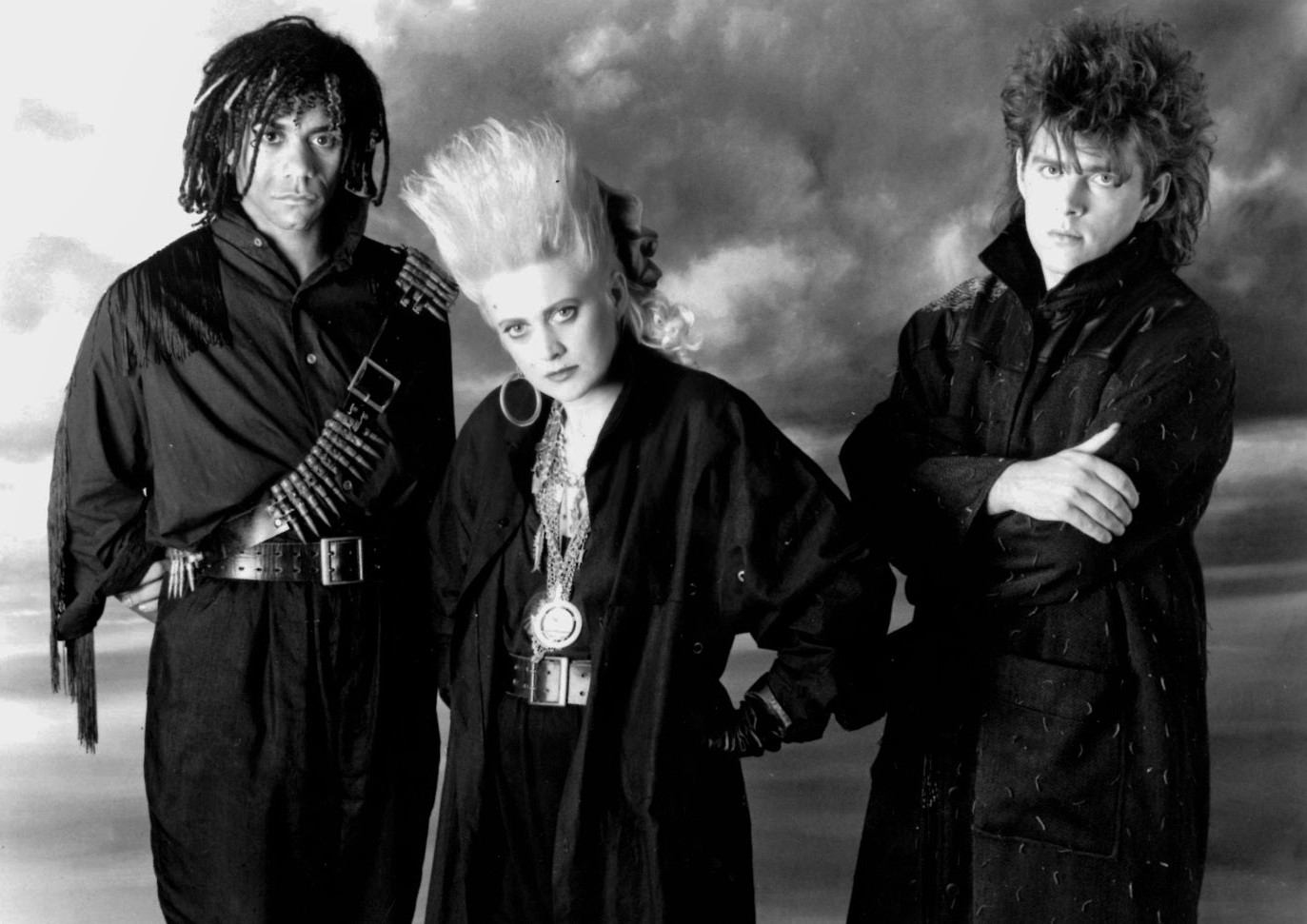
Thompson Twins, c. 1982

In 1981, the line-up became Bailey, Dodd, Roog, Bell and two new members: former band roadie Joe Leeway on congas and percussion, and Jane Shorter on saxophone. This line-up recorded the debut Thompson Twins studio album A Product Of... (Participation), documented in the film Listen to London (1981).[8] Currie, who had been associated with the band for a few years, played and sang on their debut studio album, but was not yet a full member.

After their debut studio album, the band's line-up shifted yet again. Saxophonist Jane Shorter left and was replaced by Currie (who also played percussion), and bassist Matthew Seligman, a former member of the Soft Boys and the Fallout Club, joined;[1] leaving Bailey to switch to keyboards, with Leeway starting to handle lead vocals on some tracks.

The band signed a recording contract with Arista Records and released their second studio album Set.[1] Thomas Dolby played some keyboards on Set and some live gigs, for Bailey at that time had little experience with synthesizers. Set contained the single "In the Name of Love", sung and largely written by Bailey. It became a No. 1 dance club hit in the US,[9] and an album titled In the Name of Love (consisting mainly of tracks from Set, with two others from A Product Of... (Participation)) was released in the US to capitalize on the song's popularity. It entered the US Billboard 200.[9]

Trio

[edit]
Thompson Twins in a publicity shot, c. 1984

After the success of "In the Name of Love", Bailey, Currie and Leeway, wanting to pursue the single's different sound, toyed with the idea of starting a new band on the side, which they planned to call 'The Bermuda Triangle'.[10] When "In the Name of Love" (and its parent studio album Set) failed to make a substantial impact in the UK record charts, this plan was abandoned. However, at the same time, manager Hade convinced Bailey, Leeway and Currie to downsize the Thompson Twins to a core of the three in April 1982.[10] Accordingly, the other four members of the band were notified that the band was breaking up; they were each paid £500 and were allowed to keep their instruments and equipment in exchange for an understanding not to perform together under the name "Thompson Twins".

The remaining Thompson Twins, who had not in fact broken up, decided to go abroad to free themselves of any UK influence, as well as to combine the songwriting for their first studio album as a trio with a long holiday. They first went to Egypt and then to the Bahamas, where they recorded at Compass Point Studios in Nassau with record producer Alex Sadkin.

Alannah Currie (left) and Joe Leeway (right), performing in 1984

Bailey commented on the band's reduction to a trio in a 1983 interview: "When we reformed the band, we were making a statement. We weren't going to be a rock 'n' roll band, we weren't going to have a guitar. We were going to move on. You know, Lou Reed said whenever he played live he ended up going back to heroin music. There are old associations, associations we don't want because they don't reflect the way we feel today. ... Right now, technology is what's important, and that's what our music tries to reflect."[11]

International success

[edit]

The band broke into the UK Singles Chart and the US Billboard Hot 100 chart at the beginning of 1983 with "Lies" and "Love On Your Side", which became the band's first UK Top 10 single.[4][9][12] They then released their third studio album, Quick Step & Side Kick (called simply Side Kicks in the US),[9] which peaked at number 2 in the UK and was later certified platinum. Further singles followed with "We Are Detective" (another Top 10 UK hit)[13] and "Watching" (UK No. 33).[4] All three band members worked collectively on songwriting with Currie providing lyrics and Bailey melodies. In addition Leeway was responsible for stagecraft, Currie for music videos and imagery and Bailey for musicianship and production.[14] During 1983, the band had the opening spot on the Police's concert tour in the US.

Following the band's reduction to a trio, designer Andy Airfix created a logo consisting of outlines of their heads and respective hairstyles. It was voted fourth best out of 13 candidates by Classic Pop Magazine in May 2022.[15]

"Hold Me Now" was released in late 1983. The song was an international chart success, peaking at No. 4 in the UK[16] where it became the band's biggest seller earning a gold disc,[17] and reached No. 3 in the US in the spring of 1984 becoming their biggest American hit.[9]

The band's fourth studio album, Into the Gap, was released in February 1984 and became one of the year's biggest sellers, selling five million copies worldwide. It topped the UK Albums Chart[4] and was later certified double platinum there. Further hit singles from the album followed with "Doctor! Doctor!" (UK No. 3)[18] and "You Take Me Up" (UK No. 2, their highest UK singles chart placing[4] and which earned a silver disc).[19] Other singles included a new version of the album track "Sister of Mercy" (UK No. 11), and "The Gap" (though this was not released in the UK). The band embarked on a world tour in support of the album, which had also made the US top ten.

Thompson Twins performing in Lakeland, Florida, 1986.

A brand new single, "Lay Your Hands on Me", was released in the UK in late 1984 and reached No. 13 on the UK Singles Chart.[4] Following this, the band parted company with their producer Alex Sadkin and opted to produce their fifth studio album, Here's to Future Days, by themselves in Paris. However, in March 1985, while promoting their new single "Roll Over" and the forthcoming studio album, Bailey collapsed in his London hotel room from nervous exhaustion. The "Roll Over" single was then cancelled at the last minute and the new album postponed. Though the band had chosen to produce themselves, the postponement caused them to rethink the project and producer Nile Rodgers was subsequently called in to rework the album with them. The album was eventually released in September 1985, reaching the UK Top 5 and US Top 20,[9] though failed to come close to the success of Into the Gap. It was preceded by the single "Don't Mess with Doctor Dream" (UK No. 15)[4] and followed by the single "King for a Day", which peaked at No. 22 in the UK,[4] but reached No. 8 on the US chart.[9] Other singles included a new US version of "Lay Your Hands on Me" (US No. 6),[9] and a cover of the Beatles' 1968 hit "Revolution", which failed to make the UK Top 40.

Prior to the album's release, the Thompson Twins performed on the American leg of Live Aid in July 1985 and were joined onstage by Madonna.[4] The planned summer 1985 tour of the UK (and a headlining appearance at the Glastonbury Festival) had to be cancelled due to Bailey's health problems (fans with tickets received a free live album as compensation), though international dates were rescheduled and the latter half of 1985 saw sell out tours for the band in the US and Japan.[20] A second planned tour of the UK in 1985 was also scrapped due to the promoter declaring bankruptcy.

Duo

[edit]

Leeway left the band in 1986, and the remaining duo of Bailey and Currie carried on making music for another seven years.[1] The act's first release as a duo was the North America-only single "Nothing in Common", released in July 1986. It peaked at No. 54 in the US, and No. 68 in Canada.

1987 saw the release of their sixth studio album Close to the Bone and the single "Get That Love", which climbed to No. 31 in the US[9] but only reached No. 66 in the UK.[21] The album was a commercial flop. It spent only one week on the UK Albums Chart at No. 90 and yielded no further chart singles.[21]

"In the Name of Love" was given a new lease on life in 1988, after a remix by Shep Pettibone made the Top 50 in the UK.[4] 1989 saw the release of another studio album, Big Trash, and a new recording contract with Warner Bros. Records.[1] The single "Sugar Daddy" peaked at No. 28 in the US[9] and would be their last brush with mainstream chart success.[1] 1991's Queer would be the band's swansong, and was supported by various techno-inspired singles under the moniker of Feedback Max (in the UK) to disguise the identity of the band to club DJs. The single "Come Inside" reached No. 7 in the US Dance Chart[9] and No. 1 in the UK Dance Chart.

Prior to this, Bailey and Currie (who were now a couple) had their first child together in 1988,[1] and in the following years they spent a lot of time writing material for other artists including the hit single "I Want That Man" for Deborah Harry of Blondie in 1989.[22] In 1990, Bailey and Currie contributed the song "Who Wants to Be a Millionaire?" to the Cole Porter tribute album Red Hot + Blue produced by the Red Hot Organization. In 1991, Bailey and Currie were married in Las Vegas, US and the following year moved to New Zealand. In 1992, the Thompson Twins contributed the song "Play with Me" to the soundtrack of the Ralph Bakshi film Cool World; Bailey alone contributed a second track, "Industry and Seduction". The following year, the duo teamed up with engineer Keith Fernley and changed their band name to Babble. They released two studio albums: The Stone (1993) and Ether (1996).[1]

Thompson Twins declined to follow the example of many of their contemporaries and reform in order to tie in with a trend of nostalgia for the 1980s, although Bailey, Currie and Leeway appeared together on the UK Channel 4 show Top Ten Electro Bands in 2001. Thompson Twins were placed ninth.

After the Twins

[edit]

Babble released two studio albums, The Stone (1993)[1] and Ether (1996), with songs featured in the films Coneheads (1993) and With Honors (1994).

In the mid-1990s, Currie gave up the music business to set up her own glass-casting studio in Auckland and concentrated on raising her two children. In 2001, she founded and ran the anti-genetic engineering group called MAdGE (Mothers Against Genetic Engineering in food and the environment), and networked thousands of women across New Zealand in a resistance movement, aimed at keeping the biotech industry from using New Zealand as an experimental playground.[14] Currie described this group as a "rapidly growing network of politically non-aligned women who are actively resisting the use of genetically-engineered material in our food and on our land". During that time she designed a billboard to spark a debate on the ethics of genetically modifying cows with human genes to produce a new milk.[23] The billboard, featuring a young woman with four breasts hooked up to a milking machine, caused huge controversy but won several international art awards.[24][25] Bailey and Currie divorced in 2003, and both left New Zealand to live separately in the UK. Currie later married Jimmy Cauty (formerly of the KLF) and now lives and works in London. She is a visual artist who works under the pseudonym "Miss Pokeno",[26] as well as the Armchair Destructivists[27] and The Sisters of Perpetual Resistance.[28] As well as several solo shows in London her work has also been exhibited at both the Guildhall Art Gallery and the Geffrye Museum.[29]

In 1999, Bailey produced and played keyboards on the studio album Mix by the New Zealand band Stellar, and won the Producer of the Year Award at the 2000 New Zealand Music Awards.[30] He has also arranged soundtracks and has provided instrumental music for several films. He continues to make music under the moniker International Observer and has released the studio albums Seen (2001), All Played Out (2005), and Felt (2009).[31] He also performs with the Holiwater group from India.[32] He began performing live again as Thompson Twins' Tom Bailey in 2014 and has since toured the UK, North America and Japan. In 2016 he released his debut solo single, "Come So Far". In 2018 Bailey released his debut solo studio album titled Science Fiction.[33]

After leaving the Thompson Twins in 1986, Leeway briefly dabbled in acting and attempted a solo music career, though neither were successful. As of 2006, he resides in Los Angeles, and works in the field of hypnotherapy. He is on the staff at the Hypnosis Motivation Institute (HMI) in the Los Angeles district of Tarzana, and is also a certified trainer in neuro-linguistic programming.[34]

The earlier members went on to do other things:

  • Dodd and Roog formed a band called Big View (with Edge on drums) and recorded a single called, "August Grass", which was released on Point Records (owned by Merton, the Thompson Twins publisher) in 1982.[35] Dodd is now living back in Chesterfield working as a freelance journalist – and has released his own History of Rock album billed as Peter & the Wolves. Dodd still sees Podgorski on a regular basis. Dodd and John Roog play in a band called "The Flow"[36]
  • Roog lives in Chesterfield, and was previously in a senior position in Tower Hamlets Adult Services, and the London Borough of Lambeth, until his retirement in 2011. He now plays in a band with Pete Dodd called the Flow.[37]
  • Seligman worked for a law firm in London and has played in the Soft Boys reunions as well as releasing his own studio albums.[38] He had moved to Sendai, Japan with his Japanese wife and their daughter and, in 2009, contributed to the Thomas Dolby studio album A Map of the Floating City. In 2012, he collaborated with Jan Linton on the CD Sendai, a fundraiser for reconstruction after the 11 March Tōhoku earthquake. Seligman died in 2020 of complications from COVID-19.[39][40]
  • Bell moved from London to Bath, and played in or for Spear of Destiny, Gene Loves Jezebel and Hugh Cornwell of the Stranglers.[41]
  • Booth helped Chinese music artists in production and development. She is now a consultant and executive producer at RIBA since 9 February 2022.[42]

Tom Bailey solo shows

[edit]
Bailey performing Hold Me Now, Northcote Theatre, October 2022.

Bailey performed Thompson Twins songs live for the first time in 27 years on 17 August 2014 at Temple Island Meadows, Henley-on-Thames, Oxfordshire, for the Rewind South Festival.[43]

In 2014, Bailey also took part in the Retro Futura Tour in the US, along with Howard Jones, Midge Ure, China Crisis and Katrina Leskanich formerly of Katrina and the Waves.[44]

He continues to tour internationally, under the moniker "Thompson Twins' Tom Bailey," performing in the UK and also in North America in 2016.[45]

In 2016, Bailey received the Classic Pop magazine's 'Best Live Show' award.[46]

In 2018, Bailey toured the US with the B-52's and Culture Club, dubbed The Life Tour.[47]

On 3 September 2022, Bailey performed the entire 'Into the Gap' studio album for the first time ever along with his band consisting of Alice Offley (bass guitar and backing vocals), Charlotte Raven (keyboards and cello) and Paulina Szczepaniak (drums and percussion) collectively known as 'The Sisters of Mercy' in Aylesbury, UK (at the Aylesbury Waterside Theatre) to a sold out audience.

This performance also featured a surprise full live performance of Thompson Twins hit "We Are Detective". Bailey had produced a reimagined purely instrumental version of the song that had served as the band's walk-on music for live performances since 2014, but this was the first time the full song appeared as part of the actual set since Bailey's return to performing Thompson Twins material. Alice Offley performed Alannah Currie's vocal parts, in addition to playing bass.

Awards and nominations

[edit]
Award Year Nominee(s) Category Result Ref.
Pollstar Concert Industry Awards 1985 Thompson Twins Favorite New Headliner of the Year Nominated [48]
1986 Most Creative Tour Package Nominated [49]
Most Creative Stage Set Nominated

Personnel

[edit]

Members

[edit]

Discography

[edit]

Bibliography

[edit]

See also

[edit]

References

[edit]
[edit]
Revisions and contributorsEdit on WikipediaRead on Wikipedia
from Grokipedia
The Thompson Twins were a British new wave and synth-pop band formed in April 1977, renowned for their commercial success during the 1980s as part of the Second British Invasion. Initially a larger ensemble experimenting with post-punk and new wave sounds, the group evolved into a streamlined trio by 1982, featuring Tom Bailey on bass, guitar, keyboards, and vocals; Alannah Currie on percussion and vocals; and Joe Leeway on percussion and vocals. Their name derived from the detective duo Thomson and Thompson in Hergé's The Adventures of Tintin comic series, reflecting an ironic nod to multiplicity despite the "twins" moniker. The band's breakthrough came with albums like Quick Step & Side Kick (1983), which achieved platinum status in the UK and spawned hits such as "Love on Your Side" (UK No. 9), and Into the Gap (1984), their sole UK number-one album that also peaked at No. 10 on the US Billboard 200. Key singles from Into the Gap included "Hold Me Now," a poignant ballad that reached No. 3 on the US Billboard Hot 100 and spent 21 weeks on the chart, alongside "Doctor! Doctor!" and "You Take Me Up." The trio performed at the 1985 Live Aid concert, cementing their status in the era's pop landscape, though Joe Leeway departed in 1986, leading Bailey and Currie to continue as a duo before rebranding as Babble in 1993. Subsequent releases like Here's to Future Days (1985) sold over a million copies in the US, but later efforts failed to replicate early peaks.

Origins and Early Development

Formation in Sheffield (1977)

The Thompson Twins originated in Sheffield, England, in 1977, when Tom Bailey, a multi-instrumentalist born in 1956, assembled an initial lineup including guitarists Pete Dodd and John Roog to pursue musical collaboration. Bailey, who had recently settled in Sheffield—where he worked as a music teacher—drew on the city's emerging post-punk environment to form the group as a loose collective rather than a fixed band, enabling flexible participation amid the DIY ethos spurred by punk's accessibility. This structure prioritized experimentation over formal commitments, reflecting punk's influence in democratizing music creation without requiring professional pedigrees. The band's name derived directly from the near-identical detectives Thomson and Thompson in Hergé's The Adventures of Tintin series, selected by Bailey to symbolize multiplicity and detachment from personal egos, accommodating the ensemble's interchangeable roles. Unlike ego-centric naming conventions common in rock, this choice underscored a pragmatic approach to group identity, allowing for evolution without tied-to-individual branding. Early activities involved rehearsals focused on blending guitar-driven sounds with Bailey's vocal and bass contributions, grounded in the raw, immediate energy of 1977's punk wave—exemplified by acts like the Sex Pistols—yet oriented toward iterative sonic exploration rather than overt rebellion. The formation thus represented a causal response to cultural shifts enabling amateur musicians to coalesce around shared creative impulses in industrial locales like Sheffield.

Initial Lineup and Debut Efforts (1977–1980)

The Thompson Twins formed in Sheffield in 1977, initially comprising Tom Bailey on bass and vocals, Pete Dodd on guitar and vocals, John Roog on guitar, and Jon Podgorski (known as "Pod") on drums. This lineup reflected an ad-hoc assembly assembled for local gigs in bars and clubs, with Dodd and Roog having known each other since age 13. Membership rotated pragmatically to accommodate performances, prioritizing availability over fixed roles amid the band's nascent stage. Seeking broader opportunities, the group relocated to London, where financial constraints led them to live as squatters on Lillieshall Road. This move facilitated self-produced demos and independent output, including the debut single "Squares and Triangles," released on May 6, 1980, via their own Dirty Discs label, backed by "Could Be Her... Could Be You." A follow-up single, "She's in Love with Mystery," followed later in 1980. These efforts yielded a raw new wave sound but garnered minimal commercial attention, with no chart entries or widespread distribution. In March 1980, Bailey, Roog, Dodd, and session player Chris Bell recorded tracks that formed the basis for the band's debut album, self-released in 1981 on T Records as A Product of... (Participation), though the core work occurred within the 1977–1980 period of lineup flux and logistical challenges. The album's tracklist included "When I See You," "Politics," "Slave Trade," "Could Be Her... Could Be You," "Make Believe," "Don't Go Away," "The Price," and "Oumma Aularesso (Animal Laugh)," emphasizing DIY production amid the squat-based existence.

Evolution to Mainstream Success

Transition to Core Trio (1981–1982)

Following multiple lineup changes and the departure of earlier members, Thompson Twins stabilized as a core trio in 1981, consisting of Tom Bailey on vocals and keyboards, Alannah Currie on percussion and vocals, and Joe Leeway on keyboards and percussion. This reduction from a larger ensemble to three members enhanced operational efficiency, allowing greater focus on songwriting and performance without the logistical challenges of a bigger group. Currie, a New Zealand-born former saxophonist from a punk band with no formal percussion training, adapted quickly to provide rhythmic and vocal support, while Leeway contributed electronic elements, reflecting the band's shift toward a streamlined new wave sound. The trio's persistence in honing their material culminated in the release of the album Set in early 1982 on T Records in the UK, which peaked at number 48 on the UK Albums Chart after three weeks. Accompanying singles like "In the Name of Love," produced by Steve Lillywhite, marked a polished evolution from their earlier post-punk roots, incorporating synth-driven arrangements and gaining modest airplay on BBC Radio 1, though failing to achieve significant commercial breakthrough in the UK charts. These efforts, built on repeated demo refinements rather than reliance on industry connections or hype, demonstrated the causal impact of sustained creative discipline in transitioning to a more accessible electronic style. This groundwork led to a recording contract with Arista Records in 1982, secured through the quality of their demos showcasing the trio's refined output, which prompted the label to invest in broader distribution, including a US compilation In the Name of Love that adapted Set tracks for international markets. The signing underscored how the band's methodical persistence in iterating on their sound outweighed factors like transient scene favoritism, positioning them for enhanced production resources and paving the way for subsequent upgrades in studio capabilities.

Breakthrough with Set and Quick Step (1983–1984)

The Thompson Twins' album Quick Step & Side Kick, released in February 1983, represented a refinement in their synth-driven sound and propelled the band toward mainstream recognition. The record peaked at number 2 on the UK Albums Chart, driven by singles such as "Love On Your Side," which reached number 13 in the UK, and "Lies," which climbed to number 30 on the US Billboard Hot 100. "Lies" also topped the US Dance Club Songs chart for two weeks in January 1983, underscoring the band's growing appeal in club and radio formats. In the US, the album was reissued as Side Kicks with an altered track listing, including extended mixes that facilitated crossover success amid the era's synth-pop surge. Building on the foundation of their prior release Set (1982), which featured the dance chart-topper "In the Name of Love," the 1983 output benefited from strategic remixing and video production tailored for MTV rotation. These visuals, emphasizing the trio's polished image, aligned with the Second British Invasion's momentum, where UK acts dominated US airwaves through cable television exposure. Empirical evidence of this visibility includes Quick Step & Side Kick's sales exceeding 300,000 copies in the UK alone, reflecting sustained consumer demand. Extensive touring in 1983 and 1984 amplified the albums' impact, with live performances reinforcing the band's transition to arena-ready pop. This period's chart performance and promotional efforts causally linked refined synthesizer integration to broader commercial viability, as US airplay for tracks like "Lies" evidenced without relying on prior indie constraints.

Commercial Peak and International Fame

Into the Gap Era and Major Hits (1984)

The Thompson Twins released their fourth studio album, Into the Gap, on 17 February 1984 through Arista Records. Co-produced by Alex Sadkin at Compass Point Studios in Nassau, Bahamas, the album featured a polished synth-pop sound characterized by layered synthesizers and infectious hooks, building on the band's earlier innovations in electronic arrangements. Sadkin's production emphasized multi-textured keyboard layers, including prominent use of Oberheim OB-Xa synthesizers, which contributed to the tracks' radio-friendly structure and commercial appeal. Key singles from Into the Gap included, along with the lead single 'Hold Me Now' released in November 1983, which peaked at number 4 on the UK Singles Chart and number 3 on the US Billboard Hot 100.), "Doctor! Doctor!", released in January 1984 ahead of the album, which peaked at number 3 on the UK Singles Chart and spent 9 weeks in the top 40, ranking as the 29th best-selling single of 1984 in the UK. In the US, it reached number 18 on the Dance Club Songs chart. "You Take Me Up", issued in March 1984, achieved the band's highest UK chart position at number 2 and later peaked at number 44 on the US Billboard Hot 100. These releases demonstrated the album's strength in delivering market-validated pop constructions, with syncopated rhythms and melodic refrains driving sustained chart presence. Into the Gap attained 2× Platinum status in the UK and Platinum status in the US, reflecting strong global sales exceeding certified figures on both sides of the Atlantic. The album's success was bolstered by extensive live performances in 1984, including a full concert at the Del Mar Fairgrounds on 30 September, where the trio showcased the new material to enthusiastic audiences, solidifying their peak commercial momentum. This era marked the band's alignment of studio craftsmanship with live energy, evidenced by appearances on programs like Top of the Pops promoting the singles.

Here's to Future Days and Global Reach (1985)

Here's to Future Days, the fifth studio album by Thompson Twins, was released on September 20, 1985, by Arista Records. Produced in collaboration with Nile Rodgers, the album incorporated funk elements into the band's synth-pop sound, resulting in tracks like "King for a Day" and "Lay Your Hands on Me." These singles achieved significant chart success, with "Lay Your Hands on Me" peaking at number 13 on the UK Singles Chart and number 6 on the US Billboard Hot 100, while "King for a Day" reached number 22 in the UK and entered the US top 10. The album's promotion emphasized global expansion through extensive touring, including dates across North America and Europe as part of the Tour for Future Days, which comprised 63 concerts from October 1985 to February 1986. Venues included the Edinburgh Playhouse in Scotland on October 17, 1985, and Dane County Coliseum in Madison, Wisconsin, on November 25, 1985. This touring schedule, amid the 1980s synth-pop surge and heavy MTV and radio airplay, helped solidify the band's penetration into the US market. Commercially, Here's to Future Days reached number 5 on the UK Albums Chart and earned gold certification from the RIAA in the US on November 26, 1985, for 500,000 units sold, with additional platinum status in Canada for 100,000 copies. The album's sales reflected sustained popularity driven by its hit singles and the era's media saturation for synth-driven acts.

Later Years and Breakup

Shift to Duo After Leeway's Departure (1986–1987)

In 1986, following the conclusion of the Here's to Future Days world tour, percussionist Joe Leeway departed from Thompson Twins to pursue personal interests outside the band, citing a desire for real-world experiences after finding solo music efforts unfulfilling without the group's camaraderie. This left core members Tom Bailey and Alannah Currie to continue as a songwriting and performing duo, streamlining operations around their established creative partnership without replacing Leeway. The duo released Close to the Bone on 6 April 1987 via Arista Records, their first album without Leeway, which retained the group's synth-pop foundation through electronic instrumentation and layered production handled primarily by Bailey alongside co-producer Rupert Hine. The record peaked at number 90 on the UK Albums Chart, a significant drop from prior top-10 entries, reflecting broader shifts in popular music tastes away from mid-1980s synth-driven sounds toward emerging genres. Lead single "Get That Love," issued in March 1987, similarly underperformed commercially compared to earlier hits. Bailey and Currie supported Close to the Bone with live performances as a duo augmented by session musicians, maintaining touring commitments to promote the album while exercising greater control over production and stage presentation in the absence of Leeway's theatrical staging contributions. This period marked an adaptive phase, emphasizing the duo's self-reliant approach amid declining chart momentum.

Final Releases and Dissolution (1989–1993)

Following the departure of percussionist Joe Leeway, Thompson Twins, now consisting of Tom Bailey and Alannah Currie, released their seventh studio album, Big Trash, on September 26, 1989, through Warner Bros. Records in both the UK and US markets. The album marked an experimental turn toward funkier, club-oriented sounds amid a broader shift in pop music tastes, but it achieved limited commercial success, peaking at number 143 on the Billboard 200 chart and spending only six weeks there. The lead single, "Sugar Daddy," reached number 28 on the Billboard Dance Club Songs chart, signaling some niche appeal in dance circles but failing to recapture the band's earlier mainstream momentum. In 1991, the duo issued their eighth and final album under the Thompson Twins name, Queer, which further embraced groove-heavy, rhythmic experimentation with tracks like "Come Inside" and "My Funky Valentine," reflecting influences from emerging house and funk styles. However, Queer garnered negligible chart presence, underscoring a sharp decline in sales and radio play compared to prior releases, as empirical metrics indicated market saturation for the band's evolving sound. The 1992 single "Play with Me (Jane)," featuring extended mixes tailored for club play, exemplified this pivot to house-infused production but similarly lacked resonance, failing to enter major charts and highlighting diminished audience engagement. The band's output waned thereafter, culminating in their official disbandment in 1993 amid creative differences between Bailey and Currie, compounded by strains in their personal relationship and challenges from label transitions after being dropped by Warner Bros. following underwhelming returns on the prior two albums. This dissolution aligned with broader industry shifts away from 1980s synth-pop toward grunge and alternative genres, rendering the duo's adaptations insufficient to sustain viability.

Artistry and Musical Approach

Style Evolution from New Wave to Synth-Pop

The Thompson Twins originated in 1977 as a new wave band, employing guitar and bass-driven arrangements alongside live percussion, reflective of the Sheffield post-punk scene's emphasis on raw, energetic rock structures. This foundational approach prioritized organic instrumentation over electronic elements, producing angular, guitar-centric tracks that aligned with early new wave conventions. Following the band's reconfiguration to a trio in 1981, their sound pivoted toward synth-pop by incorporating extensive keyboard and synthesizer usage, with Tom Bailey handling instruments such as the Sequential Circuits Prophet-5, Pro-One, and later Oberheim models for melodic and harmonic layers. Drum machines, notably the Movement Systems Drum Computer, replaced traditional kits, enabling programmed rhythms that added mechanical precision and repeatability to compositions. Sequencers further facilitated repetitive electronic motifs, marking a technical shift from ad-libbed live performances to structured, machine-assisted builds. Post-1982 production refinements transitioned from sparse, unpolished mixes to layered, hook-oriented tracks, blending verse-chorus frameworks with synthetic textures for broader appeal. Custom sampling via tools like the Mimic allowed tailored percussion and effects, enhancing sonic density while maintaining rhythmic drive through electronic augmentation rather than acoustic depth. This evolution prioritized accessibility via repetitive, sequencer-driven hooks over improvisational rawness, as evidenced in their mid-1980s output's formulaic integration of pop structures with digital instrumentation.

Influences and Production Techniques

The Thompson Twins incorporated influences from electronic pioneers like Kraftwerk, blending their mechanical precision with funk grooves reminiscent of Talking Heads and reggae rhythms to craft a hybrid pop sound. Tom Bailey, the band's primary composer, cited early exposure to classical and baroque music as foundational, which informed melodic structures amid their shift from punk roots to synth-driven arrangements. Later collaborations, such as with producer Nile Rodgers on the 1985 album Here's to Future Days, amplified funk elements through rhythmic layering and groove-oriented production, drawing on Rodgers' expertise from Chic. In production, the trio's multi-instrumentalism—spanning synthesizers, percussion, and bass—enabled self-sufficient studio work, with Bailey often handling keyboards, guitars, and programming. They pioneered the use of the Fairlight CMI sampler for creating basic arrangements, integrating drum machines like the Movement with sampled sounds to achieve polished, layered textures without large ensembles. Sessions for key albums, including Into the Gap (1984), took place at Compass Point Studios in Nassau, Bahamas, where the tropical environment and advanced facilities facilitated experimentation with digital recording—the first for the band—and real-time overdubs. Post-punk affordability of synthesizers and samplers democratized access to professional-grade tools, allowing the group to rival major-label productions through iterative DIY refinement rather than reliance on session players. This approach emphasized causal integration of technology, where hardware like the Fairlight directly shaped compositional choices, yielding dense, rhythmic soundscapes that prioritized sonic innovation over traditional instrumentation.

Reception and Critical Assessment

Commercial Metrics and Achievements

The Thompson Twins sold over 10 million albums worldwide during their career, with peak commercial performance in the mid-1980s driven by synth-pop hits that dominated international charts. Their 1984 album Into the Gap became a bestseller, moving more than five million copies globally and topping the UK Albums Chart while reaching number ten on the US Billboard 200. The record earned RIAA Platinum certification in the United States for one million units shipped and BPI 2× Platinum in the UK for 600,000 sales. Follow-up Here's to Future Days (1985) also achieved RIAA Gold status in the US. Key singles contributed substantially to their metrics, with seven Top 40 entries on the Billboard Hot 100 and ten in the UK. "Hold Me Now" peaked at number 3 on the US Hot 100 and number 4 in the UK, while "Doctor! Doctor!" reached number 11 in the US and number 3 in the UK. "Lay Your Hands on Me" charted at number 6 on the Billboard Hot 100 and number 13 in the UK.
SingleUS Billboard Hot 100 PeakUK Singles Chart Peak
Hold Me Now (1984)34
Doctor! Doctor! (1984)113
Lay Your Hands on Me (1985)613
King for a Day (1986)811
The band's videos received heavy MTV rotation, amplifying sales during the network's formative years, though specific Video Music Award nominations remain unconfirmed in primary records. Tracks like "In the Name of Love" appeared in soundtracks, sustaining licensing revenue into later decades.

Criticisms and Debates on Artistic Merit

Critics of the Thompson Twins' artistry have centered on their transition from an eclectic, multi-instrumentalist post-punk setup in the late 1970s to a streamlined synth-pop formula by the mid-1980s, arguing that the latter sacrificed organic energy for glossy, machine-driven superficiality. Early reviews commended the band's initial chaotic vitality as a seven-piece ensemble, but subsequent works like Quick Step & Side Kick (1983) drew fire for predictable structures and repetitive choruses that prioritized hooks over innovation. This evolution coincided with broader 1980s backlash against synthesizer acts, where detractors claimed acts like the Twins epitomized manufactured pop devoid of depth, replacing textured live instrumentation with "shallow synth sounds." A 1984 Rolling Stone profile encapsulated ongoing debates by questioning the band's shift from "post-punk oddballs" to mainstream pop entities, portraying their slick production as emblematic of commercial pragmatism that alienated purists who saw it as a betrayal of experimental origins for chart accessibility. Accusations of shallowness extended to lyrics, with some analyses decrying them as lightweight pairings to otherwise infectious melodies, as in early singles like "Love on Your Side" (1982), which blended catchy refrains with ostensibly superficial themes. Such views framed the Twins' success—evidenced by multi-platinum albums and top-10 singles across the UK and US—as proof of formulaic appeal rather than substantive merit, pitting sellout narratives against arguments for sustainable adaptation in a volatile industry. The band's nomenclature has fueled ancillary irony in merit discussions: derived from the near-identical but non-twin detectives Thomson and Thompson in Hergé's The Adventures of Tintin, the "Twins" label belied their fluctuating roster, from seven members in 1977 to a trio by 1981 and duo post-1986, underscoring perceptions of contrived identity amid pop reinvention. Non-participation in the 1984 Band Aid single recording, attributed to managerial decisions rather than ethical lapses, has been debated as emblematic of detached commercialism, though the group offset this by directing royalties from "Lay Your Hands on Me" (1985) to the Ethiopian famine relief fund. These critiques, often rooted in rockist preferences for authenticity over pop efficiency, persist in tension with the band's verifiable metrics—over 10 million albums sold globally by 1985—suggesting elitist biases undervalue pragmatic evolution's role in achieving broad, lasting resonance.

Legacy and Cultural Impact

Influence on 1980s Pop and Synth Genres

The Thompson Twins contributed to the mainstreaming of synth-pop during the early 1980s Second British Invasion, a wave of British acts that dominated U.S. charts through MTV exposure and accessible electronic sounds. Their transition from new wave roots to polished pop, evident in albums like Quick Step & Side Kicks (1983) and Into the Gap (1984), featured catchy melodies and synthesizer-driven arrangements that aligned with contemporaries such as Duran Duran and The Human League, helping to broaden synth-pop's appeal beyond underground scenes. Key production techniques, including layered percussion by Alannah Currie and synthesizer work by Tom Bailey under producer Alex Sadkin, added rhythmic drive and textural depth to tracks like "Hold Me Now" (1984), which emphasized emotional hooks over experimentalism. This approach influenced subsequent pop production by prioritizing studio polish and global rhythmic fusions, as seen in Sadkin's prior work with reggae and funk artists, echoing in 1990s acts blending electronic and organic elements. Empirical evidence of their stylistic impact includes covers and samples of their hits in later works; for instance, "If You Were Here" (1983) was covered by artists like Ben Lee (1998) and Cary Brothers (2007), while "Love on Your Side" (1983) appeared in samples by Jazzemani's "Sunshine" (2002) and Alan Coulthard's "Atlantic Crossing" (1985), demonstrating sustained borrowing of their melodic and synth motifs in pop and electronic tracks.

Post-Disbandment Recognition and Recent Activity

Following the band's dissolution in the early 1990s, Thompson Twins' music experienced periodic revivals driven by nostalgia for 1980s synth-pop, evidenced by reissues in the 2010s such as the 2014 compilation Remixes & Rarities, which remastered and collected extended mixes and B-sides from original tapes to appeal to collectors and streaming audiences. This market interest continued with deluxe editions, including the 2024 Into the Gap reissue featuring Dolby Atmos remixes exclusive to high-resolution formats. Tom Bailey has sustained recognition through live performances reinterpreting Thompson Twins' hits, drawing crowds to events like the 2024 Totally Tubular Festival and 2025 UK and US shows, where audiences have responded enthusiastically to updated renditions emphasizing the original electronic production. These outings, including a planned 2026 UK "Greatest Hits" tour with support from Blancmange, highlight sustained fan engagement without involving former members, as Bailey prioritizes creative autonomy over potential high-earning full reunions. Media retrospectives in 2024 and 2025, such as anniversary interviews and the October 31, 2025, release of the career-spanning anthology Industry & Seduction—a 3-CD set with remastered tracks, deep cuts, and live material—affirm the catalog's value in affirming 1980s pop's lasting appeal amid digital remastering trends. A 2025 documentary-style video further explores the band's behind-the-scenes dynamics and cultural footprint, reinforcing empirical interest in their era without fabricating contemporary relevance.

Personnel

Core and Long-Term Members

The Thompson Twins' core lineup, responsible for the band's signature sound during its commercial peak, centered on Tom Bailey as the foundational creative force, alongside Alannah Currie and Joe Leeway, who joined to form the stable trio configuration by 1982. This group emphasized synthesizer-driven arrangements augmented by percussion layers, with Bailey handling lead vocals and keyboard programming to drive melodic structures, Currie delivering taut percussion patterns and harmonic vocals, and Leeway contributing conga rhythms and atmospheric backing elements that enriched the live and recorded percussion interplay. Tom Bailey established the band in Sheffield in 1977, initially as a larger ensemble before streamlining, and served through its dissolution in 1993 as primary vocalist, keyboardist, multi-instrumentalist on bass and guitar, and chief songwriter, composing the bulk of material that propelled hits like "Hold Me Now" through his focus on accessible synth hooks and lyrical themes. His production choices, including layered electronic textures, defined the evolution from new wave roots to polished synth-pop. Alannah Currie integrated in 1981, providing essential percussion—including drums and auxiliary instruments—alongside backing and occasional lead vocals until 1993, her precise rhythms underpinning the band's danceable grooves and adding textural depth to tracks on albums like Quick Step & Side Kick. Joe Leeway joined concurrently in 1981 as a percussionist specializing in congas and bongos, with backing vocals, bolstering the tribal percussion foundation central to early 1980s releases such as In the Name of Love until exiting after the 1986 album Here's to Future Days. His contributions emphasized organic rhythmic propulsion that complemented Bailey's electronic elements during the trio's formative hit-making era.

Early and Transient Contributors

Pete Dodd and John Roog served as the band's primary guitarists from its formation in 1977 until 1982, with Dodd also providing vocals alongside Tom Bailey's bass and lead duties. Dodd and Roog, who had met as teenagers, co-founded the group in Sheffield and shaped its initial post-punk orientation through their guitar contributions on early singles like "Squares and Triangles" in 1980. The original drummer, Jon Podgorski, departed after 1978, succeeded by Andrew Edge, who played from 1978 to 1979 amid frequent lineup flux that included other percussionists like Chris Bell. These transient drummers supported live performances and rehearsals but left minimal recorded legacy, as the band relied on session players for its 1981 debut album A Product Of.... Dodd and Roog's recorded output extended to the debut album A Product Of... (1981) and the second album Set (1982), after which they exited during the band's contraction to a trio comprising Bailey, Alannah Currie, and Joe Leeway. This reduction streamlined operations for international touring and production, limiting Dodd and Roog's further involvement to co-writing credits on select 1982 tracks like "In the Name of Love" but excluding them from subsequent albums and hits such as "Hold Me Now" (1983). Post-departure, neither received performance royalties nor performance credits on the band's commercial peak material.

Discography

Studio Albums

The Thompson Twins released eight studio albums between 1981 and 1991, transitioning from post-punk and new wave roots to synth-pop and electronic styles, primarily under Arista Records after an initial independent release. Early efforts like A Product of... (Participation) saw limited distribution, while mid-1980s releases achieved commercial peaks amid the band's core trio lineup of Tom Bailey, Alannah Currie, and Joe Leeway. Later albums reflected lineup changes and stylistic shifts, with declining chart performance.
YearAlbumLabelUK PeakUS PeakCertification
1981A Product of... (Participation)T Records
1982SetArista Records
1983Quick Step & Side KickArista Records2Platinum (UK)
1984Into the GapArista Records1102× Platinum (UK); Platinum (US)
1985Here's to Future DaysArista Records520
1987Close to the BoneArista Records9076
1989Big TrashWarner Bros. Records
1991QueerWarner Bros. Records
Sales for Into the Gap exceeded 600,000 units in the UK and one million in the US, marking the band's commercial zenith. Quick Step & Side Kick (released as Side Kicks in the US) sold over 300,000 copies globally but lacked explicit US certification data in available records. Post-1985 releases saw reduced visibility, with Big Trash and Queer failing to register significant chart entries amid the band's evolution toward electronica.

Key Singles and Chart Performance

The Thompson Twins achieved commercial success primarily through a series of synth-pop singles that dominated mid-1980s charts in the UK and US, with their hit-driven strategy generating substantial revenue via radio airplay, MTV exposure, and 12-inch extended mixes tailored for club play. Releases like "Hold Me Now" exemplified this model, peaking at number 4 on the UK Singles Chart in November 1983 and number 3 on the US Billboard Hot 100 in May 1984, while earning a gold certification from the British Phonographic Industry for over 400,000 UK sales. Similarly, "Doctor! Doctor!" reached number 3 in the UK in February 1984 and number 11 on the US Billboard Hot 100 later that year, bolstered by promotional remixes that extended its dance chart presence.
SingleUK Peak (Date)US Billboard Hot 100 Peak (Date)Certifications
Hold Me Now (1983)#4 (Nov 1983)#3 (May 1984)BPI Gold (UK)
Doctor! Doctor! (1984)#3 (Feb 1984)#11 (Jul 1984)None specified
Lay Your Hands on Me (1984)#13 (Oct 1984)#6 (Jan 1985)None specified
You Take Me Up (1984)#20 (Aug 1984)#44 (Oct 1984)None specified
B-sides such as "Roll Over (Again)" and "Love Lies Fierce" served as cost-effective extensions of single promotions, often featuring experimental tracks or live versions to encourage collector purchases without additional production costs, while region-specific edits—like shortened US radio versions of "Hold Me Now" versus extended European 12-inch mixes—optimized market penetration and vinyl sales. This approach, common in the era's pop landscape, prioritized chart momentum over album cohesion, with singles accounting for the bulk of their revenue through licensing and format variants.

Individual Post-Band Pursuits

Tom Bailey's Solo Work and Performances

Following the Thompson Twins' disbandment in 1993, Tom Bailey pursued production and experimental electronic work. In 1999, he produced the debut album Mix for the New Zealand band Stellar*, contributing to its synthesis of guitars and electronic elements. Under the alias International Observer, Bailey crafted dub and electronic tracks from his base in Aotearoa, New Zealand, releasing material that advanced his synthesizer and production techniques, including the album Bat in the early 2020s. In 2010, he co-founded the Bailey-Salgado Project with astronomer José Francisco Salgado, producing audiovisual live shows that integrated electronic compositions with astronomical imagery to explore cosmic themes. Bailey's debut solo vocal album, Science Fiction, arrived on July 13, 2018, comprising ten synth-pop tracks like the title song and "What Kind of World," which revisited his 1980s roots while incorporating modern electronic production. The record emphasized melodic structures and keyboard-driven arrangements, reflecting Bailey's ongoing refinement of synthesizer-based sound design. From 2014 onward, Bailey initiated tours performing Thompson Twins' catalog, delivering hits such as "In the Name of Love," "Lies," and "Hold Me Now" with a new ensemble and updated arrangements that highlighted evolved modular synthesis and live improvisation. These outings, including the Retro Futura Tour and Into the Gap 40th Anniversary shows, marked his return to stage after 27 years, blending nostalgia with technical innovation in synth performance. By 2025, Bailey's live activity persists through festival appearances like Rewind and OC REWIND, where setlists interweave Thompson Twins material with selections from Science Fiction and International Observer, underscoring his sustained focus on synthesizer heritage and adaptive electronic expression.

Alannah Currie's Later Projects

Following the disbandment of Thompson Twins in 1993, Currie collaborated with Tom Bailey, whom she married in 1991, to form the electronic duo Babble in 1992. Babble released two albums: Am I Beautiful? in 1994 on A&M Records, featuring Currie's percussion and lyrical contributions alongside Bailey's production, and Ether in 1996, after which the project concluded with no further musical output from Currie. This marked her departure from music, as she cited a desire for quieter creative pursuits amid raising their two children, born in the early 1990s. In 1996, Currie relocated to New Zealand, shifting focus to visual arts, particularly glass artistry, which emphasized functional objects infused with environmental themes. Her work during this period involved crafting glass pieces that critiqued consumerism and ecological harm, produced in a rural setting to prioritize sustainability over commercial music demands. By 2001, motivated partly by her sister's death from Creutzfeldt-Jakob disease in 2000, Currie founded Mothers Against Genetic Engineering in Food and the Environment (MAdGE), a women's activist group opposing genetically modified organisms. MAdGE organized protests, marches, and public awareness campaigns in collaboration with organizations like Greenpeace, including high-profile actions such as displaying anti-GM posters and badges featuring provocative imagery of modified foods. Currie and Bailey separated around 2004, after which she returned to London while maintaining her New Zealand ties, further diverging their paths—Bailey resuming musical performances, Currie deepening artistic and activist endeavors. Adopting the pseudonym Miss Pokeno, she developed the Sisters of Perpetual Resistance collective, creating provocative installations and furniture using luxurious veneers to embed narratives on resistance, nuisance, and environmental disruption, such as "instruments of nuisance" including glass hammers and gold bricks exhibited in her 2013 solo show. Operating from Doyce Street Studios in London, her output included group exhibitions like Five Needle Five Wire in 2022, focusing on upholstered works that blend utility with political commentary, without resuming percussion or significant musical releases.

Joe Leeway's Career Shift

Joe Leeway announced his departure from Thompson Twins in 1986 at the conclusion of the tour supporting the band's album Into the Gap, marking the end of his primary involvement in the group's activities. Bandmate Alannah Currie later attributed the exit in part to Leeway's decision to start a family, reflecting a shift away from the demands of touring and recording toward personal priorities. Leeway himself has indicated that attempts to pursue music independently after leaving did not fulfill him in the same manner as his band tenure, underscoring a deliberate pivot from the industry. Post-departure, Leeway eschewed a solo music career, producing no major discography or performances, and instead immersed himself in holistic and therapeutic fields emphasizing personal development. Relocating to California, he trained as a hypnotherapist and became a certified practitioner in neuro-linguistic programming (NLP), techniques he applies to help clients reframe past experiences and establish resourceful orientations to the present. By the late 1990s, he had established a practice in the area, joining the staff of the Hypnosis Motivation Institute in Tarzana as an instructor, a role he has held for over 20 years. In instructional videos and interviews from the institute, Leeway demonstrates practical applications of hypnosis and NLP, such as altering client timelines for therapeutic outcomes, without referencing returns to musical endeavors. This career trajectory highlights his sustained commitment to therapeutic work over any nostalgic or commercial revival of his pop music background.

References

Add your contribution
Related Hubs
User Avatar
No comments yet.