Hubbry Logo
Arm triangle chokeArm triangle chokeMain
Open search
Arm triangle choke
Community hub
Arm triangle choke
logo
8 pages, 0 posts
0 subscribers
Be the first to start a discussion here.
Arm triangle choke
Arm triangle choke
from Wikipedia

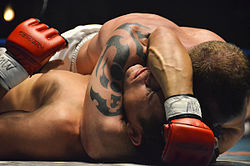
Arm triangle choke, side choke, or head and arm choke are generic terms describing blood chokeholds in which the opponent is strangled in between their own shoulder and the practitioner's arm. This is as opposed to the regular triangle choke, which denotes a chokehold using the legs, albeit with a similar mechanism of strangulation against the opponent's own shoulder. An arm triangle choke where the practitioner is on the side of the opponent and presses a forearm into the opposite side of the neck of the opponent is known as a side choke, such as from the kata-gatame hold. The time it takes for the opponent to be rendered unconscious does vary depending on the configuration of the grip and position, although the standard arm triangle is one of the fastest at 7.2 seconds.[1]

Key Information

Mounted arm triangle

[edit]

A Mounted arm triangle is an arm triangle from the mount position. The top player scoops the head of the bottom player and raises the bottom player's arm above their head to connect the neck and the shoulder. In this position, shoulder of the bottom player along with the bicep/forearm of the top player cut off both carotid arteries. The top player then applies pressure by locking their grip on the side of the raised shoulder and squeezing their arms together while applying even more pressure on the side of the shoulder with their head and neck. In the case where this is not enough pressure to force the bottom player to tap, the top player then dismounts and circles outward in a corkscrew motion while settling their hips to multiply the choking force. This is one of the lowest-risk, highest-reward submissions that can put an opponent to sleep within a matter of seconds when applied correctly.

Anaconda choke

[edit]

An anaconda choke is an arm triangle from the front headlock position.[2] The performer threads his or her arm under the opponent's neck and through the armpit, and grasps the biceps of the opposing arm. The performer then attempts to pin the opponent onto the trapped shoulder so as to better interrupt the flow of blood, all the while applying pressure with the grasped biceps. The performer may accomplish this by rolling the opponent over the trapped shoulder, (known as a gator roll) and use the momentum to turn the opponent onto his or her trapped shoulder. The creator of this choke is unknown, although many sources point towards UFC veteran Milton Vieira.[3] Viera himself has disputed this however and has gone on record as not claiming to be the originator of the Anaconda Choke, explaining that it is likely that multiple people came up with the same choke simultaneously.[4]

D'Arce choke/Brabo choke

[edit]

The D'Arce choke and Brabo choke use similar techniques except the Brabo choke is used in gi BJJ by gripping your opponent's gi, in contrast to the D'Arce choke which does not.[5] The D'Arce choke, or Brabo choke, is similar to the Anaconda choke. The difference is that the choking arm is threaded under the near arm, in front of the opponent's neck, and on top of the far arm.

The D'Arce choke gets its name from Joe D'Arce, a third-degree Brazilian Jiu-Jitsu black belt under Renzo Gracie. D'Arce is not the inventor of the choke however, he merely popularized its use in competition. Instead the Luta Livre practitioners point to its originator being Björn Dag Lagerström who discovered the choke when attempting to perform an Anaconda Choke in practice, and getting his arms the wrong way around.[6] During a sparring session between D'Arce and Jason Miller, the choke surprised Miller, who gave it the name and pronunciation "Darce" rather than the proper "D-Arsee," when D'Arce did not have a title for the technique.[7]

The Brabo choke gets its name from Leonardo Vieira, founder of the Checkmat academy. Vieira first saw one of his white belt students get into a similar position by instinct and he started working on this position. He used this position to submit most of his opponents at the 2004 Pan American Championship and at the World Cup of 2004. Vieira's friend, Kid Pelligro, calling this position "Brabo choke" deriving from Vieira's email address "leobrabo@...." which fit the actual meaning of the word "brabo" in Portuguese of angry, aggressive or toughness.[8]

References

[edit]
[edit]
Revisions and contributorsEdit on WikipediaRead on Wikipedia
from Grokipedia
The arm triangle choke, also known as the head-arm choke or in , is a submission technique that functions as a blood choke by compressing the opponent's carotid arteries to restrict blood flow to the , potentially causing if applied correctly. In this hold, the attacker threads one arm under the opponent's neck and through the armpit to trap the head and one arm, forming a triangular configuration with the attacker's arms—typically secured in a figure-four or gable grip—while using the opponent's own shoulder and trapped arm to apply pressure from the opposite side. The choke relies on leverage from the attacker's bicep and body weight rather than brute arm strength, making it effective across various body sizes in disciplines like (BJJ) and (MMA). Originating as the judo technique kata gatame—a pinning hold documented since the Kodokan's founding in 1882—the arm triangle evolved from a control position into a lethal submission through adaptations in BJJ during the 20th century. Rooted in traditional Japanese jujutsu and formalized in early judo around the turn of the 20th century, it was refined by BJJ pioneers who emphasized ground fighting, transforming it from a shoulder pin to a versatile finisher. The technique rose to prominence in MMA in the late 1990s and 2000s, with notable applications by fighters such as Randy Couture, Georges St-Pierre, and Fabricio Werdum, contributing to its status as one of the most reliable submissions in no-gi and gi competitions. Commonly executed from positions like mount, , or north-south, the arm triangle offers strategic advantages in controlling larger opponents and transitioning seamlessly from dominant top positions. It belongs to a broader family of upper-body triangle chokes, including variations like the D'arce choke (developed in the 1990s) and anaconda choke (popularized in the early 2000s), which modify the entry and grip for different setups such as front headlocks. Despite its effectiveness—accounting for numerous competition finishes—the hold demands precise alignment to avoid slippage, and it is practiced worldwide in arts for both sport and applications.

Overview

Definition and Description

The arm triangle choke is a submission hold commonly employed in (BJJ), , and (MMA), classified as a blood choke that restricts blood flow to the brain by compressing the carotid arteries and jugular veins on both sides of the neck, rather than an air choke that obstructs the trachea. This vascular compression leads to rapid onset of symptoms including and , distinguishing it from slower-acting airway restrictions. Also known by alternative names such as head and choke, (in ), or side choke, the technique's core structure involves isolating the opponent's head and one to form a triangular configuration around the , utilizing the practitioner's for leverage and the opponent's own and trapped to seal the hold against the carotid arteries. This setup creates a figure-four lock with the practitioner's arms, effectively trapping the target area and minimizing defensive options once properly applied. The arm triangle choke offers a favorable risk-reward profile in scenarios, characterized by a high success rate and low escape potential when locked in, making it a reliable finishing option from dominant positions such as mount or . Studies on similar blood chokes indicate an average time to unconsciousness of approximately 9-10 seconds upon full application. Specialized variations, such as the anaconda choke or D'Arce choke, adapt this foundational structure for different entries but retain the same vascular targeting principle.

Physiological Effects

The arm triangle choke functions primarily as a blood choke by compressing the carotid arteries on one or both sides of the neck, which significantly reduces cerebral blood flow and leads to , ultimately causing . This compression disrupts the delivery of oxygenated blood to the brain, with studies on vascular neck restraints showing a rapid drop in flow velocity to near-zero levels within approximately 1.6 seconds of application. The technique's effectiveness stems from this biomechanical , where the attacker's arm and shoulder apply targeted force against the opponent's neck, isolating the vascular structures without necessarily involving the trachea. Secondary physiological effects include potential compression of the jugular veins, which elevates by impeding venous drainage and further diminishes , exacerbating the hypoxic state. Additionally, pressure on the may stimulate the , triggering reflex bradycardia and a reduction in , which can contribute to fainting through lowered systemic . These combined vascular and neural responses explain the choke's rapid onset, with initial symptoms such as or visual disturbances emerging within 3-5 seconds, followed by loss of consciousness typically in 7-10 seconds if the hold is maintained. Unlike air chokes, which obstruct the trachea and induce asphyxiation through oxygen deprivation—a process that is slower (often 10-20 seconds or more to ) and more immediately painful due to respiratory distress—the arm triangle targets blood flow directly, rendering it faster and initially less distressing, as the opponent may not feel acute airway . Risks to the opponent are generally low in controlled training environments, with possible minor bruising from surface pressure, but prolonged application beyond can lead to serious vascular damage, including carotid or dissections and rare ischemic strokes. Safe practices, such as immediate release upon submission and avoiding holds on unresponsive individuals, are essential to mitigate these risks, as evidenced by forensic reviews of incidents showing near-zero mortality in sanctioned events when protocols are followed.

History

Origins in Grappling Arts

The arm triangle choke originates from kata-gatame, or "shoulder arm hold," a foundational pinning position in Kodokan judo established in 1882. In judo, kata-gatame isolates the opponent's head and arm for control, often holding for 20 seconds to score an ippon, though it can transition into a blood choke by adjusting pressure on the carotid arteries. It also appears in catch wrestling as the "Japanese" or "head and arm hold," a variation of strangleholds used in early 20th-century submission matches. Practitioners like Evan "Strangler" Lewis utilized forearm-across-the-throat strangles, applying pressure to the neck in a manner akin to head-arm control. Such holds were legal in "all-in" or no-holds-barred bouts common to the era, reflecting catch wrestling's roots in folk styles where emphasized pins and breaks over purely athletic takedowns. Catch wrestlers like Karl Gotch, who trained in India and incorporated judo elements during his mid-20th-century career, helped blend aggressive submissions with precise control in hybrid grappling systems. Gotch's teachings in Japan influenced the evolution of grappling styles. The technique transitioned into submission grappling through its integration into sambo and freestyle wrestling in the mid-20th century, particularly via Soviet developments in the 1930s and 1940s. Sambo, founded by Vasiliy Oshchepkov—a judo black belt under Jigoro Kano—directly incorporated kata-gatame as a control hold in sport sambo (where chokes are prohibited), while combat sambo permitted its use as a choke, blending judo's pins with wrestling's takedowns. In freestyle wrestling, influenced by international exchanges, the head-arm isolation appeared as a control mechanism for pins during the post-World War II era, though submissions remained prohibited in competition rules. This foundational role laid the groundwork for its later popularization in modern mixed martial arts and Brazilian jiu-jitsu.

Development and Popularization

The arm triangle choke was incorporated into Gracie Jiu-Jitsu during its foundational development in the mid-20th century as an essential ground control and submission technique that enabled smaller fighters to dominate larger opponents from dominant positions like mount and . In modern , the technique saw further refinement and promotion during the 1990s through competitive settings, while instructors like Milton Vieira experimented with variations, notably the anaconda choke, enhancing its versatility in no-gi . The choke's spread to accelerated with Royce Gracie's participation in in 1993, which highlighted Brazilian jiu-jitsu's effectiveness in no-holds-barred fighting and paved the way for submissions like the arm triangle to become staples in promotions such as Pride FC, where it featured in numerous high-profile finishes during the late and early . Its cultural impact within the grappling community has been amplified through instructional media, including DVDs by Marcelo Garcia that detail mount-based attacks incorporating the arm triangle, alongside its frequent use in major competitions, establishing it as a core fundamental submission in both BJJ and MMA curricula.

Technique

Setup and Entry Methods

The arm triangle choke, also known as the head-arm triangle, is commonly initiated from dominant top-control positions including full mount, high mount, side control, or north-south to establish initial dominance and isolate the opponent's head and one arm. From full or high mount, the attacker posts one hand on the mat for base while using the other arm to scoop under the opponent's near-side elbow, walking the arm upward toward the head to trap it against the neck; the free arm then wraps around the opponent's neck from the opposite side, securing a gable grip behind the trapped tricep before transitioning to a side position for completion. In side control, the setup begins with immobilizing the opponent using body weight and underhooks, followed by feeding the top arm around the neck while trapping the far arm in a gift-wrap configuration to align the head and arm for the choke entry. The north-south position facilitates entry by forcing the opponent onto their side from side control, removing the crossface, threading the arm under the armpit and around the neck, then sprawling backward to apply downward pressure while linking hands in an S-grip. Entries into the arm triangle often occur during guard passes, where breaking the opponent's posture—such as by driving the head into their —allows the attacker to isolate the and head as the opponent attempts guard recovery, enabling a quick wrap and link of the arms to transition into or a mounted variation. Common setups include transitions from knee-on-belly, where from a kesa gatame (scarf hold) the attacker switches hips to release the far-side , threads the arm around the neck, links hands, and pushes the tricep downward while rotating to the mat for isolation. Arm drags provide another effective entry, particularly from the guard, by gripping the opponent's or dragging the across, ducking under to a wrestling-style position, shooting the arm around the neck, linking grips, and using a butterfly hook for a potential sweep into top control if needed. Practitioners must anticipate defensive counters during entry, such as the opponent using an elbow frame against the neck or a gable grip to create space and push away early in the setup, or bridging and escaping if deeper in the position to prevent the arm isolation. In gi grappling, adaptations involve utilizing collar grips to pull the head downward and grips to control and isolate the arm more securely during the initial breakdown from mount or , enhancing stability compared to no-gi where reliance shifts to friction-based underhooks, body wedges, and S-grips for the same control.

Execution and Finishing Mechanics

Once the arm triangle position is established from a dominant entry such as mount or , the execution begins with precise arm placement. The attacking arm is threaded under the opponent's , with the bicep pressing against one side of the and the against the other, trapping the opponent's isolated arm tightly against their own body to prevent defensive posting. This forms the foundational "figure-four" or gable grip, where the attacking hand clasps the opposite bicep, ensuring the opponent's arm remains immobilized and the choke's structure is sealed. Head control follows immediately to complete the seal. The free wraps around the opponent's head or far arm, pulling it downward while the attacker's head presses firmly against the trapped arm's tricep, creating a vice-like around the neck. This step eliminates space for the opponent to turn or frame, with the attacker's shoulder driving into the neck for added leverage. With the lock secured, posture and squeeze mechanics apply the choking pressure. The attacker drops their toward the while rotating the hips and basing the body at a diagonal angle, using body weight to compress the opponent's carotid arteries circumferentially rather than relying on arm strength alone. The squeeze is generated by sprawling the legs for stability and walking the body sideways, directing perpendicular force through the shoulder into the neck to bypass any remaining frames. Finishing adjustments emphasize to counter common escapes like bridging or rolling. The attacker bases out with one planted firmly while shifting hips low and close to the opponent, maintaining downward pressure to prevent posture recovery and forcing a rapid tap-out. This low, heavy posture ensures the choke tightens progressively without allowing space for defense. Common errors in execution include loose insertion, which leads to slippage during the squeeze, and improper diagonal posture that permits the opponent to frame against the . To correct slippage, re-thread the deeper under the before re-gripping; for framing issues, adjust by moving the body more diagonally into the mat to eliminate space and accelerate the finish.

Variations

Anaconda Choke

The Anaconda choke is a dynamic variation of the arm triangle choke, primarily executed from a front headlock or position, where the attacker traps the opponent's head and arm before rolling to apply pressure on the neck. This submission emphasizes an inverted, rolling entry that distinguishes it from more static applications, allowing for quick transitions in fluid scenarios. To enter the Anaconda choke, the practitioner typically secures a front headlock, often by snapping the opponent's head down to force them into a position or defending a with a sprawl. From here, the attacker rolls the opponent—known as a gator roll, a maneuver adapted from —while threading the attacking arm under the opponent's neck and through their far armpit. The hand then clasps the attacker's own bicep to form a figure-four grip, isolating the head and trapping the arm tightly against the body. This setup inverts the opponent's posture, creating leverage for the choke without relying on a mounted position. Finishing the Anaconda involves completing the roll to the or back-take position, where the attacker drives their shoulder forward into the opponent's neck while squeezing the arms inward to compress the carotid arteries. The attacker's body weight and leg hook on the opponent's far leg enhance the pressure, often leading to a rapid tap-out due to blood flow restriction. Unlike the standard arm triangle, which typically finishes from a mounted or side position with downward pressure, the Anaconda's inverted rolling motion allows for its application in open guards or during scrambles, prioritizing mobility and surprise over positional dominance. The Anaconda choke is often attributed to Brazilian grappler Milton Vieira, who popularized it in the late 1990s during his time training at Gama Filho University, where he adapted wrestling rolls into a submission hold while competing in and . However, Vieira himself has downplayed claims of sole invention, noting that he combined existing jiu-jitsu and wrestling techniques as a blue belt and that similar mechanics likely evolved independently. Earlier uses of related rolling front headlock controls, such as the gator roll for pinning, appear in traditions predating its formalization as a choke in modern arts.

D'Arce Choke

The D'Arce choke is a blood choke submission in and , functioning as a lateral variation of the arm triangle by trapping one of the opponent's arms while compressing the carotid arteries against the attacker's shoulder and bicep. It emphasizes precise arm isolation and body leverage to secure the hold without relying on fabric grips. Entry into the D'Arce choke typically occurs from top positions such as or knee-on-belly, where the attacker first isolates the opponent's near arm by pinning it to the body or framing it away to prevent defense. From , the attacker shifts weight to control the hips while threading the arm; in knee-on-belly, downward pressure on the facilitates the arm's insertion under the near side. This setup exploits defensive postures, allowing the attacker to bridge or slightly for optimal alignment. The core arm threading involves sliding the attacking arm deep under the opponent's near armpit, across the , and over the far , then feeding the hand back to clasp the attacker's own bicep in a gable grip for a figure-four lock. This creates a vise-like encasement around the and trapped arm, with the elbow of the choking arm aligning near the opponent's spine for leverage. The non-choking arm reinforces by hugging the body or controlling the far arm, preventing escapes. To finish, the attacker falls to the side of the trapped arm, using body weight to roll the opponent onto their side while arching the back to drive the choking arm's bicep into the , compressing it against the for arterial restriction. This lateral maximizes without flattening out, often requiring a hip switch to maintain chest-to-back contact and squeeze the elbows together. The technique's effectiveness stems from this biomechanical squeeze, typically yielding a submission within seconds if properly seated. As a no-gi technique, the D'Arce relies on underhooks and body cinches rather than collar grips, enhancing its adaptability in MMA where clothing is absent and transitions to takedowns are fluid. It serves as the no-gi counterpart to the Brabo choke, prioritizing direct arm control over lapel assistance. The choke was popularized by Joe D'Arce, a third-degree black belt under , through his frequent use in early 2000s BJJ competitions, earning its name despite earlier origins.

Brabo Choke

The Brabo choke is a gi-specific variation of the arm triangle family, adapted from the no-gi D'Arce choke to incorporate Brazilian jiu-jitsu's traditional for enhanced grip security. It targets the opponent's neck by trapping one arm against the carotid arteries while leveraging the gi to restrict blood flow, distinguishing it through its reliance on fabric tension rather than pure body mechanics. Entry into the Brabo choke typically begins from top side control in gi grappling, where the attacker lifts the opponent's far-side shoulder off the mat to create space and disrupt their posture. The attacker then secures a deep collar grip on the far lapel with one hand, threading it under the opponent's near armpit and over their far shoulder to position it behind the head for control. This setup counters common defenses like underhooks by flattening the opponent to the mat, often while advancing the hips toward knee-on-belly for added pressure. The threading modification involves sliding the choking arm under the opponent's near arm and over their far shoulder, with the sleeve or now resting against the neck to prevent escape. The free hand pulls the secured tightly to lock the figure-four configuration, stapling it to the ground for stability and using the fabric to cinch the trap without slippage. From here, the attacker drops their chest onto the trapped arm to isolate it, completing the arm base while the collar grip adds compressive force. Finishing the Brabo emphasizes squeezing with gi tension by driving the shoulder forward and pulling the lapel to compress the neck's arteries, often prompting a rapid tap due to the blood choke's efficiency. Practitioners frequently transition to north-south position for superior leverage, arching the back and walking the feet around the head to increase torque without releasing the grip. This adjustment exploits the gi's friction to maintain control during the shift, amplifying the choke's tightness. The gi's advantages in the Brabo choke stem from the collar's role in providing additional leverage and preventing arm slippage, making it more reliable in fabric-based scenarios compared to no-gi applications. The acts as an extension of the attacker's grip, distributing force evenly and allowing sustained pressure even against defensive bridging. The technique was coined and popularized by Brazilian jiu-jitsu competitor Leonardo Vieira in the early 2000s, specifically for gi tournaments within the circuit. Vieira, a multiple-time world champion under the and later Checkmat teams, developed it during his competitive peak, using it to submit opponents at events like the 2004 Pan-American and World Championships. The name "Brabo," meaning "tough" in , originated from Vieira's "leobrabo" and was suggested by Kid Peligro to honor its aggressive style.

Applications

In Brazilian Jiu-Jitsu

In (BJJ), the arm triangle choke is typically introduced during blue belt progression as a fundamental counter to common mount escapes, building on white belt fundamentals of positional control and basic submissions. This placement emphasizes its role in developing offensive capabilities from top positions, where practitioners learn to isolate the opponent's arm during defensive movements like the elbow or bridge escape to secure the choke setup. The technique holds significant strategic value in BJJ as a high-percentage submission from top control positions such as mount and , where it exploits the opponent's defensive reactions to apply pressure efficiently. It is often chained with guard passes like the toreando, allowing practitioners to transition seamlessly from passing to dominant positioning and then to the submission attempt. Training for the arm triangle in BJJ commonly involves positional starting from mount, with a focus on arm isolation techniques against resisting opponents to simulate live resistance and refine timing. These drills prioritize maintaining posture and leverage over strength, helping students develop the precision needed for consistent execution in rolling scenarios. Under IBJJF tournament rules, the arm triangle choke is fully legal across all belt levels and divisions, as it qualifies as a permitted blood choke without restrictions on application. Competitors can earn points for achieving and holding mount control (four points) prior to the submission tap, rewarding dominant positioning even if the choke is not immediately finished. Defensive strategies against the arm triangle in BJJ emphasize gi-specific dynamics, such as using grips for strong framing to prevent head and arm isolation or executing hip escapes with underhooks to create space. These methods leverage the gi's friction for better control, allowing the bottom player to away or recover guard while countering the attacker's pressure. In gi training, variations like the Brabo choke are preferred for their enhanced grip options, adapting the arm triangle mechanics to the uniform's advantages.

In Mixed Martial Arts

In mixed martial arts, the arm triangle choke is primarily executed in no-gi formats, with variations such as the D'Arce choke often preferred due to their compatibility with boxing gloves, which can complicate traditional arm threading in standard setups. The D'Arce, a lateral compression choke that locks the opponent's arm across their neck using a figure-four grip, allows for quicker entries from positions like half guard or side control without relying on fabric grips, making it ideal for the fast-paced, gloved environment of MMA. This adaptation emphasizes perpendicular body alignment to maximize leverage while minimizing exposure to counters. The technique integrates seamlessly with striking elements, enabling setups from clinch takedowns where a fighter secures an during a body lock before driving the opponent to the mat and transitioning into the choke. Similarly, after establishing dominant positions like mount or through ground-and-pound, practitioners can isolate an arm amid strikes, using the opponent's defensive posture to thread the choking arm and surprise with a submission finish. These hybrid approaches exploit MMA's blend of stand-up and , turning offensive pressure into control opportunities. In cage-based promotions such as the UFC, the enclosure provides additional leverage through wall pressure, where the attacker pins the opponent's body against the to restrict rolling escapes and enhance shoulder-of-the-neck compression during the finish. This positional adjustment contrasts with open-mat by utilizing the to maintain top control against dynamic defenses. is critical, as attackers must remain vigilant against ground strikes from the position or reversal attempts like bridging and shrimping, which are amplified by the threat of elbows or punches absent in pure submission arts. The arm triangle's usage in MMA evolved significantly after the adoption of unified rules in the early , which standardized ground control and permitted extended exchanges, leading to a rise in submission attempts including this choke as fighters capitalized on dominant positions without immediate stand-up interruptions. Analyses of UFC finishes show the arm triangle among the most reliable chokes, contributing to numerous victories by restricting blood flow effectively in prolonged ground scenarios.

Notable Uses in Competition

One of the earliest notable uses of the arm triangle choke in UFC history occurred at in 1999, when defeated via inverted arm triangle choke in the first round, showcasing the technique's effectiveness in early MMA against a rising striker. In competitions, Marcelo Garcia has secured multiple finishes with the Anaconda variation, a rolling arm triangle entry. In wrestling applications, the technique appears in catch wrestling tournaments of the 2010s, such as finishes in events like the 2015 submission series where wrestlers adapted head-and-arm chokes akin to the arm triangle for pins and submissions. More recently, Benoit Saint-Denis submitted Joel Alvarez via arm triangle choke at UFC 315 in May 2025, and Ion Cutelaba finished with an arm triangle at UFC Fight Night in February 2025, highlighting the choke's continued relevance in high-level MMA. Statistically, the arm triangle ranks among the top five most common submissions in UFC history, accounting for approximately 7.2% of all submission finishes and exceeding 50 victories as of 2025, underscoring its reliability across eras.

References

Add your contribution
Related Hubs
User Avatar
No comments yet.