Hubbry Logo
Angola ThreeAngola ThreeMain
Open search
Angola Three
Community hub
Angola Three
logo
8 pages, 0 posts
0 subscribers
Be the first to start a discussion here.
Angola Three
Angola Three
from Wikipedia

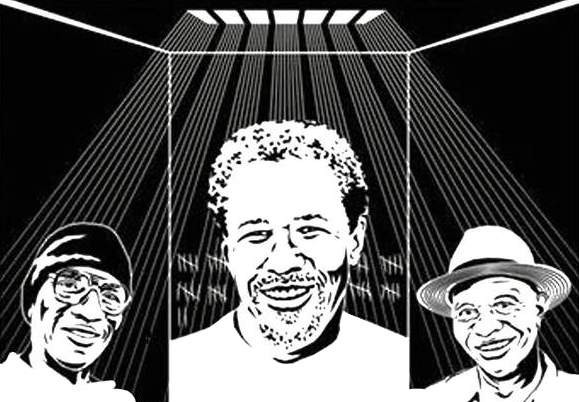
The Angola Three, left to right: Herman Wallace, Albert Woodfox, and Robert Hillary King
Louisiana State Penitentiary, the prison where the Angola Three were confined

The Angola Three are three African American former prison inmates (Robert Hillary King, Albert Woodfox, and Herman Wallace) who were held for decades in solitary confinement while imprisoned at Louisiana State Penitentiary (also known as Angola Prison). The latter two were indicted in April 1972 for the killing of a prison corrections officer; they were convicted in January 1974.[1] Wallace and Woodfox served more than 40 years each in solitary, the "longest period of solitary confinement in American prison history".[2]

Robert King was convicted of a separate prison murder in 1973 and spent 29 years in solitary confinement before his conviction was overturned on appeal; he was released in 2001 after taking a plea deal.[3] Starting in the late 1990s, each case was assessed, and activists began to work to have the cases appealed and convictions overturned because of doubts raised about the original trials.

In July 2013, Amnesty International called for the release of 71-year-old Herman Wallace, who had been diagnosed with terminal liver cancer.[4] He was released October 1, 2013, due to a judge overturning his original indictment due to the lack of female jurors. The state re-indicted him on October 3, 2013,[5] but he died on October 4, 2013, before he could be re-arrested.[6]

On November 20, 2014, Woodfox's conviction was overturned by the US Court of Appeals. In April 2015, his lawyer applied for an unconditional writ for his release.[7][8] His unconditional release was decided on June 10, 2015. He was released on February 19, 2016, after the prosecution agreed to drop its push for a retrial and accept his plea of no contest to lesser charges of burglary and manslaughter. He said he would have liked the chance to prove his innocence, but chose the plea deal because of advanced age and health issues.[9] Woodfox died from COVID-19 complications on August 4, 2022, at the age of 75.[10]

Initial imprisonment

[edit]

Wallace and Woodfox were each sent to Angola Prison in 1971: Wallace was convicted of bank robbery, and Woodfox was convicted of armed robbery. Woodfox was sentenced to 50 years in prison.[11][12]

Woodfox had escaped from the Orleans Parish courthouse during his sentencing hearing and fled to Harlem in New York City. There he was captured and jailed pending extradition to Louisiana. During this period, he met men for the first time who were members of the Black Panther Party. They taught other inmates to read, led political discussions, and began his education.[2] "For Woodfox, the teachings of the Panthers were revelatory, giving his life a direction and moral meaning he had never previously found."[13] He joined the Black Panther Party and kept his intellectual connection after it dissolved.[2] He began to learn about African-American history and the justice system. When returned to Louisiana, Woodfox was incarcerated at Angola.[11]

At Angola, Wallace also became a member of the Black Panthers. He and Woodfox were among activists seeking to improve conditions at the notoriously cruel and violent prison.[12] They helped organize education of other prisoners, and petitions and hunger strikes to protest segregation within the prison, and to end widespread rape and violence.[14] They were targeted by the prison administration, who feared the politically active prisoners.[13]

The day after a prison guard was burned to death in 1972, 23-year-old prison guard Brent Miller was found dead of multiple stab wounds.[11] Woodfox and Wallace were indicted and convicted of his murder.[15]

King had also been convicted of robbery, but he was not assigned to Angola until after Miller's murder. (He said he was accused of acting as a "prison lawyer" for other inmates. He was convicted in 1973 in a separate prison murder.)[16] These three men were soon taken out of the general prison population and were held in solitary confinement.[15]

Rahim and Fleming investigation

[edit]

In 1997, Malik Rahim, a community activist in New Orleans and a former Black Panther member, together with young lawyer Scott Fleming, who had worked as a prisoner advocate while a law student, learned that Wallace, King, and Woodfox were still incarcerated in solitary confinement. (Wallace had written to Fleming appealing for help in his case.)[2] The two men initiated an investigation of the case, challenging the conclusions of the original investigations at Angola about the murder of guard Miller, and also raising questions about the conduct of the prisoners' original trials in 1972. Anita Roddick, founder of The Body Shop and known for her humanitarian activism, learned about the case from Fleming and helped raise international awareness about the Angola Three.[2]

Appeals and transfers

[edit]

On appeal, Woodfox's 1974 conviction for the murder of Miller was overturned in 1993, on the constitutional grounds of inadequate counsel at the first trial. The state quickly indicted Woodfox again that year, the result of a grand jury that was headed by a white foreman appointed by the court. In 1998 Woodfox was convicted a second time for the prison murder. His defense mounted another appeal.

King's 1973 conviction, on charges unrelated to Miller's murder, was overturned in 2001 on appeal. The court ordered a new trial. While the state had the option to dismiss the charges, it reindicted King and said it would retry him. Before going to trial, the prosecutor offered him a plea deal, with the sentences for the lower charges to be offset by the time he had already served. King took the plea in order to gain release after 29 years in solitary confinement, but he said that he was innocent of the charges. He was released in 2001, the first of the Angola 3 to gain freedom.

In 2000, the Angola Three filed a civil suit against the Louisiana Department of Corrections "challenging the inhumane and increasingly pervasive practice of long-term solitary confinement".[17] They seek damages against the state Department of Corrections because of the adverse effects of extended time in solitary confinement. As of 2019, their case is still pending.[11]

While the men's civil suit and appeals of their cases were pending, in March 2008 Woodfox and Wallace were moved to a maximum-security dormitory at Angola. They had each been held for 36 years in solitary confinement. State Representative Cedric Richmond (D-New Orleans) (now a Congressman) was granted permission to visit them, which authorities rarely granted. He told an NPR reporter that he believed that they had been moved from solitary because of increasing political pressure about the case, as well as the men's civil suit against the state regarding solitary confinement.[18]

Woodfox had two appeal hearings in federal district court (one in November 2008 and one in May 2010), which resulted in his second conviction being overturned and his being granted full habeas corpus. The rulings by the federal district court were overturned by the federal Fifth District Circuit Court of Appeals.[citation needed][clarification needed]

Immediately after Woodfox's first appeal hearing in November 2008, both men were moved out of the maximum-security dormitory, separated, and returned to solitary confinement. In March 2009 Wallace, along with a group of 15 inmates from Angola, was moved to Elayn Hunt Correctional Center and placed in a newly created closed-cell isolation tier. The state argued that this was not solitary confinement. In November 2010, Woodfox was moved from Angola to David Wade Correctional Center, which was a much greater travelling distance for his lawyers and supporters.

Both Wallace and Woodfox, who had served past their original sentences for armed robbery, have allegedly suffered from a range of different medical issues—some due in part to their reported conditions of confinement and their enforced sedentary lifestyle. Prison officials had long maintained that the reason for keeping Wallace and Woodfox in solitary confinement was out of concern that they would instigate a prison uprising because of their belonging to the Black Panthers.[19]

In July 2013 Wallace was diagnosed with advanced liver cancer. He had earlier been thought to have a stomach condition. Wallace's defense team had filed a writ of habeas corpus, saying that he had not received a fair trial and was thus being held illegally by the state. In October 2013 federal district judge Brian A. Jackson ruled that Wallace had not received a fair trial because no women were included on his jury. Judge Jackson vacated the original grand jury indictment and ordered Wallace's immediate release. The original indictment was unconstitutional.[1] The state announced its intention to re-indict Wallace for Miller's murder, but he died on October 4, 2013, a few days after being released from jail.

In March 2013, a federal District Court judge in New Orleans overturned Woodfox's second (1998) conviction for the prison murder, ruling that it was based on racially discriminatory grounds because a white foreman had been appointed to the grand jury, and that this was part of a pattern of discriminatory practice found in the state. Louisiana Attorney General James Caldwell promised to appeal the District Court's decision, saying, "We feel confident that we will again prevail at the Fifth Circuit Court of Appeals. However, if we do not, we are fully prepared and willing to retry this murderer again."[20]

On November 20, 2014, a three-person panel of Fifth Circuit judges unanimously upheld the lower court's opinion that Woodfox's conviction had been secured through racially discriminatory means. The panel found that the selection of a white grand-jury foreperson in the 1993 indictment hearing prior to trial formed part of a discriminatory pattern in that area of Louisiana. Concluding that this action amounted to a violation of the US Constitution, the judges struck down Woodfox's conviction.[7]

The state of Louisiana refused to release Woodfox, pending their decision as to whether to pursue a new trial against him. The prison also refused to move him out of solitary confinement. On February 12, 2015, the state indicted Woodfox for a third time for the 1972 murder of Brent Miller, the prison guard.[21]

On June 8, 2015, U.S. District Judge James Brady ordered the release of Woodfox, after having overturned his second conviction for the killing of the guard Miller. His order barred a third trial from taking place, as he noted that most of the witnesses had died and he believed that it was unlikely that Woodfox could gain a fair trial.[22][23][24] He also noted "evidence suggesting Mr. Woodfox's innocence".[11]

Four days later, the majority of a three-judge panel of the US Fifth Circuit Court of Appeals reversed Brady's decision. It directed that the state could hold Woodfox in prison until the matter was resolved, and that it could mount a third trial.[11][25] "The dissenting judge, James L. Dennis, agreed with Judge Brady that the state had failed to remedy the problem of racial discrimination [in the second trial]. Judge Dennis noted that more than a dozen witnesses, including the state's only purported eyewitness to the murder and two alibi witnesses for Mr. Woodfox, were no longer alive."[26]

The state announced that it would try Woodfox for murder a third time but offered him a plea deal after negotiation with his defense. Woodfox pleaded "no contest" (nolo contendere) to lesser charges of manslaughter and aggravated burglary. Together with his time for armed robbery, he had already served 45 years, the total of the sentences for those crimes. He was released based on time served, on February 19, 2016, his 69th birthday.[9] Woodfox's civil suit filed in 2000, with plaintiffs King and Wallace, is still pending against the Louisiana Department of Corrections over the practice of extended solitary confinement.[9]

Releases

[edit]

Robert King

[edit]

King was released in 2001, following 29 years in solitary confinement. His first conviction was overturned on appeal, and he pleaded guilty to a lesser conspiracy to commit murder charge.[citation needed]

Herman Wallace

[edit]

(October 13, 1941 – October 4, 2013)[27] In July 2013 Amnesty International called for Herman Wallace's release on humanitarian grounds, saying, "Wallace is 71 years old and has advanced liver cancer. After decades of cruel conditions and a conviction that continues to be challenged by the courts, he should be released immediately to his family so that he can be cared for humanely during his last months."[4] He had been transferred to the hospital unit in his prison. On October 1, 2013, Wallace was granted immediate release by U.S. District Chief Judge Brian A. Jackson of Baton Rouge, Louisiana, ending Wallace's forty-year incarceration in solitary confinement. The court had overturned Wallace's conviction in the murder of Miller, based on the unconstitutional exclusion of women from his jury, in violation of the 14th Amendment.[17] Jackson ordered a new trial. The state chose to prosecute Wallace again for the murder of Miller although he was dying of liver cancer.

Wallace was taken to the house of a close friend in New Orleans.[28] The state appealed the judge's orders, seeking to keep Wallace in prison. When East Baton Rouge District Attorney Hillar Moore appealed Judge Jackson's order, Jackson responded with a threat of charging him with contempt of court.[29]

Jackie Sumell, a Wallace supporter, visited him at the Louisiana State University Medical Center in New Orleans after his release. She said, "This is a tremendous victory and a miracle that Herman Wallace will die a free man." She continued, "He's had 42 years of maintaining his innocence in solitary confinement, and if his last few breaths are as a free man, we've won."[6]

On October 3, 2013, a West Feliciana Parish grand jury indicted Wallace again for the 1972 murder of Miller, the corrections officer.[30] Herman Wallace died on October 4, 2013, three days after being released from prison.

Albert Woodfox

[edit]

(February 19, 1947 – August 4, 2022)[31] Amnesty International called for the release of Woodfox after Wallace's release.[32] He had been held in solitary confinement since 1972. After more court challenges, Woodfox was finally released from prison on February 19, 2016, after being imprisoned for 45 years, 43 of them in solitary confinement.[33] At the time, he spoke to a reporter from The New York Times and said, "When I began to understand who I was, I considered myself free."[11] He was referring to learning via the Black Panthers and reading while in prison about his history as an African American and racial inequities in the US.[11]

After his release, Woodfox wrote a memoir, Solitary: Unbroken by Four Decades in Solitary Confinement. My Story of Transformation and Hope (2019), about his early life and four decades in prison. Dwight Garner of The New York Times said that it was "uncommonly powerful".[34] In 2020, the book won the Hurston/Wright Legacy Award for Nonfiction and the Stowe Prize. It was also a finalist for the 2020 Pulitzer Prize for General Nonfiction and a 2019 National Book Award for Nonfiction.

Woodfox died from complications of COVID-19 in New Orleans, Louisiana, on August 4, 2022, at the age of 75.[35][36]

Opposition to release

[edit]

Miller's family continued to oppose Woodfox's release, believing that he was guilty. His father had worked in the prison, and a brother was a prison guard at the same time as Brent Miller. Another brother had earlier served as a prison guard. They were not changed in their opinions by the wavering of witnesses and lack of physical evidence in the case. However, Miller's widow, Teenie Verret, came to doubt Wallace and Woodfox's guilt.[11] "If they did not do this," she says, "and I believe that they didn't, they have been living a nightmare."[2]

State officials continued to strongly oppose the inmates' release. Louisiana's Attorney General, James Caldwell, said in 2013 that he opposed releasing the two men "with every fiber of my being".[37] He said that they had never been held in solitary confinement but were in "protective cell units known as CCR [Closed Cell Restricted]".[20]

Burl Cain, the former warden of Angola, said repeatedly in 2008 and 2009 that Woodfox and Wallace had to be held in CCR because they subscribed to "Black Pantherism".[37][38]

[edit]
Albert Woodfox and Robert King at an Angola Three event at Manchester Metropolitan University, November 2016.

These cases received increased national and international interest following publicity related to King's release in 2001. Supporters mounted new challenges by appeals in court. Since his release, King has worked to build international recognition for the Angola Three. He spoke before the parliaments of the Netherlands, France, Portugal, Indonesia, Brazil and United Kingdom about the case, and about political prisoners in the United States. King was received as a guest and dignitary by the African National Congress in South Africa, and spoke with Desmond Tutu. Amnesty International added Wallace and Woodfox to their watch list of "political prisoners"/"prisoners of conscience".[39]

NPR was the first to examine the case in depth in 2008 with a 3-part series by Laura Sullivan which unearthed new witnesses and won a Peabody Award.[40] The Angola Three were the subject of two documentaries: Angola 3: Black Panthers and the Last Slave Plantation (2006), produced by Scott Crow and Ann Harkness;[41][42][citation needed] and In the Land of the Free (2010), directed by Vadim Jean and narrated by Samuel L. Jackson.[42] The film features Robert King, telephone interviews with Woodfox and Wallace, and interviews with attorneys and others involved with the cases. These include the widow of the late guard Brent Miller, who believes the three men are innocent of her husband's murder.[2]

The men were also the subject of a music video produced by Dave Stewart of the Eurythmics in protest of the incarceration of the Angola 3. It features Saul Williams, Nadirah X, Asdru Sierra, Dana Glover, Tina Schlieske, Derrick Ashong and Stewart.[43] The song "The Rise of the Black Messiah" (2015), written by Amy Ray and performed by Indigo Girls, was inspired by the Angola 3.[44]

Herman Wallace was the subject of an ongoing socio-political art project entitled The House That Herman Built. Artist Jackie Sumell asked Wallace what his dream home would be like, and expressed his response in various media.[45] Angad Singh Bhalla made a feature-length documentary, Herman's House (2012), about Sumell's project.[46] It was nationally broadcast on PBS's POV program, on July 8, 2013.[47] The film was followed by an interactive documentary, The Deeper They Bury Me: A Call from Herman Wallace (2015).[48]

References

[edit]

Further reading

[edit]
[edit]
Revisions and contributorsEdit on WikipediaRead on Wikipedia
from Grokipedia

The Angola Three were Robert King, Herman Wallace, and Albert Woodfox, three African-American inmates at the (commonly known as ) convicted in the early of separate murders occurring within the prison grounds. King was found guilty in 1973 of killing fellow inmate Lewis Johnston, while Wallace and Woodfox were convicted in 1974 for the 1972 stabbing death of corrections officer Brent Miller, a case reliant on inmate eyewitness accounts without corroborating physical evidence such as fingerprints or DNA matching the defendants. The trio, who had formed a chapter inside to protest inhumane conditions and armed inmate guards, were placed in shortly after these events—King for 29 years, Wallace for 41 years, and Woodfox for over 43 years, marking the longest documented stretches of continuous isolation in American penal history.
Their cases garnered international scrutiny due to the severity of prolonged solitary, which they and supporters attributed to retaliation for political , alongside allegations of trial irregularities including coerced testimonies and racial in . Appeals repeatedly highlighted evidentiary weaknesses, such as recantations and incentives for witnesses, leading to King's being vacated in 2001 after the primary accuser admitted , prompting his release via a to lesser charges. Wallace's was overturned in 2013 on grounds of , allowing his release days before he succumbed to . Woodfox, facing a third trial, entered an —no contest—to reduced and counts in 2016, acknowledging sufficient evidence for while protesting innocence, resulting in immediate freedom at age 69 amid health concerns. Despite these outcomes, which stemmed from procedural rulings rather than definitive exonerations, opposition from Miller's family persisted, emphasizing multiple affirmations of guilt and rejecting narratives of systemic fabrication. The Angola Three's saga underscores tensions between punitive isolation practices and challenges in U.S. corrections, with source accounts varying in emphasis—advocacy groups stressing innocence amid , while judicial records affirm initial verdicts under prevailing evidentiary standards.

Background and Prison Context

Louisiana State Penitentiary (Angola) Overview

The Louisiana State Penitentiary, commonly referred to as Angola, was established in 1901 when the State of Louisiana purchased approximately 18,000 acres of former plantation land along the Mississippi River in West Feliciana Parish. The property, originally Angola Plantation named for the African origins of its enslaved laborers, retained agricultural operations where inmates were compelled to perform field labor growing crops such as cotton and corn under conditions mirroring antebellum practices. Prisoners were housed in scattered camps, with daily routines centered on manual labor supervised by armed overseers. Pre-1972, Angola's inmate population was predominantly , aligning with Louisiana's incarceration patterns where Black individuals accounted for roughly two-thirds of state prisoners by the . The operated under a trusty system formalized in , designating well-behaved inmates as "trusty guards" armed with rifles to police fellow prisoners, supplementing a limited cadre of free-world staff. This arrangement, involving around 200 armed convict guards, fostered internal hierarchies prone to exploitation and abuse. In the and early , acquired a reputation as the "bloodiest in the " owing to pervasive violence, including routine stabbings and assaults among inmates. Escape attempts were frequent, exemplified by the mass breakout that resulted in deaths and spurred construction of secure cell blocks, with responses including shoot-to-kill directives and reinforcement of the trusty system to manage unrest. Inmate assaults on guards also marked the era's tensions.

Pre-1972 Activism and Tensions

In the late 1960s, () was characterized by extreme violence, with inmates facing frequent stabbings, rapes, and predatory exploitation by armed "trusties"—convicted inmates granted authority over others by prison staff. This environment, where weaker prisoners were routinely victimized, led to the emergence of informal inmate groups aimed at self-protection, as official oversight failed to curb the brutality. By 1971, amid escalating incidents—including 82 stabbings and three inmate deaths that year—Herman Wallace, Albert Woodfox, and Ronald Ailsworth established Angola's chapter of the , one of the few such prison-based units. The group sought to instill self-pride among Black inmates and organize against the prevailing abuses, including through internal patrols to deter rapes and assaults, drawing on the Panthers' broader of defense. However, this activism introduced confrontational tactics, such as protests and demands for reform, which clashed with the prison's hierarchical structure reliant on trusty control and punitive discipline. Prison administrators perceived the Panther chapter as a source of agitation that exacerbated divisions and undermined authority, prioritizing ideological challenges over cooperative rehabilitation efforts. Officials argued that the group's emphasis on resistance fostered a culture of defiance, contributing to heightened frictions and security responses in the lead-up to , as inmate organizing shifted from passive survival to active opposition against entrenched power dynamics.

The 1972 Murder and Initial Investigations

Brent Miller Killing Details

On April 17, 1972, Corrections Sergeant Brent Miller, a 23-year-old guard at (), was found dead in the Pine 1 dormitory from multiple stab wounds inflicted during an attack inside the facility. Miller, who had been employed at the prison for a short period and came from a family with ties to —his father had worked there and a brother served as a guard—was conducting routine duties in the dormitory housing inmates when assaulted around 7:30 a.m. The absence of signs of forced entry into the dormitory indicated the perpetrator or perpetrators were likely among the inmates already present. The weapon used was a homemade , fashioned from a sharpened , which inflicted between 32 and 38 stab wounds to Miller's body, leaving him in a pool of blood on the dormitory floor. Initial examination of the scene revealed bloody fingerprints and the , but forensic analysis at the time yielded no direct physical matches to specific individuals beyond the immediate context of the inmate-occupied area. officials promptly secured the and initiated an internal investigation, focusing on the lack of external intrusion and the improvised nature of the weapon consistent with available within Angola's confines.

Immediate Aftermath and Suspect Identification

Following the death of corrections officer Brent on April 17, 1972, in the Ash dormitory at , prison administrators promptly initiated an investigation that included interrogations of numerous . Investigators questioned around 200 in the days immediately after the incident, seeking information on the attack in which sustained 32 stab wounds. During these interrogations, multiple inmates identified Herman Wallace and Albert Woodfox as participants, citing alleged confessions overheard from the pair or purported sightings of them fleeing the dormitory. Inmate Hezekiah Brown, present in the Ash dorm at the time, initially reported to investigators that he possessed no knowledge of the killing and provided an alibi placing himself away from the scene. Other statements linked Wallace and Woodfox to associates, including Robert King, based on reports of group discussions about targeting guards amid ongoing tensions. The suspects' identification drew on circumstantial factors, including their recent housing in or near the dorm, a site of organizing efforts that had heightened administrative scrutiny following prior inmate unrest. No , such as fingerprints or the murder weapon, directly tied Wallace, Woodfox, or their associates to the crime at this stage; reliance was placed on inmate accounts amid the absence of forensic links. In response, prison officials administratively transferred Wallace, Woodfox, and King to closed cell restriction (CCR) isolation units shortly after their naming as suspects, prior to formal indictments later that month, to prevent potential further disturbances. This placement occurred as the investigation continued, with the trio held separately from the general population.

Convictions and Sentencing

Trials of Herman Wallace and Albert Woodfox

Albert Woodfox's trial for the of Brent Miller commenced in March 1973 in , where the prosecution relied on testimony from four inmate witnesses who claimed to have observed Woodfox and others near the or in possession of bloody clothing shortly after the stabbing. One key witness, inmate Chester Jackson, testified that Woodfox had confessed involvement, though no such as fingerprints, blood matching, or shoeprints connected Woodfox to the murder weapon or victim. The defense contested the reliability of these accounts, arguing that witnesses had been coerced through promises of reduced sentences or favors from prison authorities, and emphasized the complete absence of forensic corroboration. An all-white convicted Woodfox of second-degree after deliberating for less than one hour, sentencing him to . The prosecution framed the affiliation of Woodfox and co-defendants as a motive, alleging their organizing activities in demonstrated intent to undermine prison order and target guards like Miller. Herman Wallace faced trial in 1974 under similar circumstances in West Feliciana Parish, with the state presenting overlapping inmate eyewitness testimony alleging Wallace's presence at the scene and post-murder statements implying guilt, again without any forensic linkage such as DNA, blood traces, or tool marks matching items associated with Wallace. Defense counsel highlighted inconsistencies in witness stories, potential incentives for perjured testimony amid racial tensions, and the lack of independent evidence, while challenging the prosecution's emphasis on Wallace's Panther involvement as politically motivated rather than causally tied to the killing. Wallace was convicted by another all-white jury and sentenced to , with the verdicts in both cases resting exclusively on uncorroborated oral accounts amid a context of heightened scrutiny on prisoners at .

Robert King's Separate Manslaughter Conviction

Robert Hillary Wilkerson, commonly known as Robert , faced trial for the stabbing death of a fellow inmate at Louisiana State Penitentiary () in a case unrelated to the April 1972 of guard Brent Miller. The incident involved an altercation among prisoners, with accused of wielding the knife that killed the victim; prosecutors relied primarily on identification testimony from other inmates during the 1973 trial. King was convicted of second-degree murder and sentenced to life imprisonment, leading to his indefinite placement in closed cell restriction (CCR)—a regime of continuous solitary confinement mirroring that applied to Herman Wallace and Albert Woodfox. Although King's offense lacked any connection to Miller's killing or guard assaults, prison officials cited his leadership in the Black Panther Party's Angola chapter as exacerbating the perceived threat, justifying the harsh isolation alongside the other two men and forming the basis for their collective designation as the Angola Three. On December 12, 2000, a court granted King's writ of , vacating the conviction due to violations, including inadequate confrontation of witnesses and potential prosecutorial withholding of evidence. Rather than proceeding to retrial, King accepted and entered a to a reduced charge of in February 2001, securing his release after 29 years of incarceration, 29 of them in solitary. The vacatur addressed flaws but did not affirm King's , distinguishing his legal outcome from direct exonerations while underscoring systemic issues in Angola's judicial handling of prisoner cases during the era.

Extended Solitary Confinement

Placement in Closed Cell Restriction (CCR)

Closed Cell Restriction (CCR) at , also known as , served as the facility's primary mechanism for long-term punitive isolation of inmates deemed high-security risks, involving confinement in individual cells measuring approximately 6 by 9 feet with restricted privileges such as limited out-of-cell time and controlled access to items. Following their convictions for the 1972 killing of prison guard Brent Miller—Herman Wallace and Albert Woodfox in separate trials concluded by early 1974, and Robert in a related 1973 case for another inmate's death—the three were assigned to indefinite CCR status by prison classification authorities. This assignment was mechanically determined through internal security reviews that elevated their custody level beyond standard general population housing, mandating isolation without a predefined release date. Angola officials justified the indefinite placement by citing the men's roles as organizers of the prison's chapter, which had conducted protests and work stoppages prior to the , alongside their convictions for violent offenses as of persistent threat to institutional order. explicitly testified in a deposition that Albert Woodfox's continued adherence to ideology warranted permanent CCR, even absent the conviction, due to fears of inciting riots or unrest among the inmate population. Such assessments framed the trio's activism and disciplinary history as causal factors necessitating separation from other prisoners to prevent organized disruption, overriding typical isolation durations that ranged from months to a few years for most inmates. The post-conviction CCR terms extended for Wallace and Woodfox over 40 years each until their respective releases in 2013 and 2016, while King's spanned 29 years until 2001, markedly surpassing Angola's normative practices for administrative segregation. Periodic board reviews, as required by , consistently upheld the indefinite status based on these rationales, with no successful reclassification to lower custody levels during that period.

Conditions and Health Impacts

In Closed Cell Restriction (CCR) at , Herman Wallace, Albert Woodfox, and Robert King were confined to individual cells measuring approximately 6 by 9 feet for 23 hours per day from onward, with the remaining hour allocated for showering and limited exercise, typically indoors along the cell tier or in a without access to outdoor yards. This regimen enforced through minimal human contact—no physical visits permitted—and restricted environmental stimuli, including limited and enforced idleness beyond reading or writing materials when available. Prolonged exposure to these conditions correlated with documented psychological effects, including heightened anxiety, perceptual distortions, and sleep disturbances, aligning with empirical research on extended that links and sensory restriction to elevated levels and neurological changes exacerbating . Physically, the lack of varied movement contributed to reports of and ; Wallace, for instance, lost 40 to 50 pounds prior to his 2013 diagnosis of advanced , which proved terminal and led to his death shortly after release. Woodfox experienced onset of , , , and chronic renal insufficiency during his CCR tenure, conditions that persisted post-release. King noted significant vision deterioration within months of isolation onset, attributed to disuse and to dim cell lighting. Angola's CCR practices diverged from emerging national trends post-1970s, which increasingly scrutinized indefinite solitary through court rulings like Ruiz v. Estelle (1979) limiting , yet persisted without major mitigation until partial reforms in the 2010s, such as phased outdoor access. Empirical data indicate that such extended isolation amplifies physical decline in older inmates, with studies showing associations to and weakened independent of baseline health factors.

Black Panther Party Involvement

Organizing Efforts at Angola

In 1971, inmates Herman Wallace, Albert Woodfox, and Robert King established the only prison-based chapter of the at , known as , after securing approval from the party's central committee in . This local initiative arose amid documented prison conditions including rampant inmate predation, inadequate literacy among prisoners, and exploitative labor, prompting the group to prioritize over external ideology. The chapter's core activities centered on mutual aid through informal commissaries distributing essentials such as cigarettes and stamps to inmates lacking family visits, thereby addressing immediate survival needs without reliance on official channels. Educational efforts included tutoring sessions on reading, history, legal rights, and prison dynamics to dispel myths about inmate "codes" and build self-reliance. To combat sexual exploitation by predatory inmate groups termed "wolves," members formed protective patrols that convened weekly behind the laundry facility to safeguard new arrivals, deterring assaults through presence and solidarity. These patrols complemented the distribution of literature outlining prisoner rights, which helped cultivate trust and reduce internal factionalism. Organizing extended to direct actions against verifiable abuses, including 1971 work slowdowns in Angola's fields to resist unpaid extra duties imposed on inmates. The group also boycotted the and advocated for enhanced food quality—such as fresher meals free of contamination—and expanded medical access, framing these as responses to empirical deficiencies like spoiled provisions and delayed treatments documented in contemporaneous prisoner accounts. Such demands escalated in frequency amid broader 1972 tensions, reflecting the chapter's strategy of leveraging collective leverage for incremental reforms. Empirically, these efforts correlated with a sharp decline in inmate-on-inmate , with incidents nearly eradicated by early 1972 due to vigilant patrols and unified deterrence, as reported by participants. However, the chapter's growing influence over inmate behavior fostered mutual accommodations with some guards but simultaneously bred suspicion among administration officials, who perceived the structured resistance as a challenge to hierarchical control, culminating in a mass in April 1972.

Perceived Threat to Prison Administration

Prison administrators at Angola State Penitentiary perceived the Black Panther Party's internal organizing as a subversive force that mirrored the external militancy of the group, which emphasized armed and opposition to perceived capitalist , thereby undermining hierarchical control and fostering division along racial lines. Warden , in a 2008 deposition, described "Black Pantherism" as inherently disruptive, noting that adherents "hold their fists up" and "advocated for violence," and argued that releasing Albert Woodfox from solitary would allow him to "organize the young new inmates," resulting in "chaos and conflict" and exacerbating tensions between inmates. This rationale prioritized deterrence of , which officials linked to broader security imperatives in a maximum-security environment prone to unrest. In the wake of the April 17, 1972, of corrections officer Brent Miller—carried out with a makeshift shiv during a altercation—prison leadership directly implicated Wallace, Woodfox, and other Panthers in cultivating an anti-authority ethos that enabled such assaults on staff. Cain's underscored the causal link between Panther influence and potential for inmate mobilization against guards, justifying indefinite isolation as a measure to dismantle networks capable of coordinating resistance or retaliation. By segregating key organizers, the administration aimed to restore order and prevent the replication of external Panther tactics, such as protests and strikes, within the facility's confines.

Appeals, Retrials, and Due Process Claims

In the 1990s, Albert Woodfox's original conviction was challenged through federal proceedings alleging and Brady violations, where prosecutors failed to disclose regarding witness incentives and credibility issues; these claims prompted a district court to vacate the conviction and order a retrial, which occurred in 1998 and resulted in a second guilty verdict. Following the 1998 trial, Woodfox asserted violations, including counsel's failure to effectively cross-examine witnesses or investigate alibi evidence, and a systematic exclusion of African American jurors by the prosecution in violation of ; U.S. District Judge James T. Brady granted habeas relief in 2008, ruling the jury selection process unconstitutional and ordering a third trial. Herman Wallace raised parallel claims in federal proceedings, contending ineffective counsel for not challenging coerced witness statements and Brady nondisclosures of deals offered to informants; a district found merit in some assertions but deferred to state findings on others, leading to protracted litigation without an immediate retrial order. The U.S. Court of Appeals for the Fifth Circuit reviewed these grants of relief multiple times, vacating some district court orders in 2010 for insufficient evidentiary showings under the Antiterrorism and Effective Death Penalty Act while remanding others for further analysis of prejudice from alleged violations; for instance, in Woodfox v. Cain, the court rejected hybrid Brady and ineffective counsel claims regarding undisclosed witness benefits, deeming state court rejections reasonable. The U.S. denied in several related petitions, including those contesting Fifth Circuit affirmances of state post-conviction denials, thereby upholding procedural barriers to relief without resolving underlying merits.

Transfers and Procedural Rulings

In March 2009, Herman Wallace was transferred from Closed Cell Restriction (CCR) at () to the Hunt Correctional Center in , amid ongoing federal civil litigation challenging the constitutionality of his and Albert Woodfox's decades-long . Supporters of the Angola Three argued that such relocations, which significantly increased travel distances for their Baton Rouge-based attorneys, constituted a tactical maneuver by the Department of Corrections to disrupt legal proceedings and evade potential federal oversight of Angola's CCR conditions. Woodfox followed with a transfer from Angola CCR to David Wade Correctional Center in November 2010, where he was immediately housed in a 6-by-9-foot isolation cell for 23 hours daily, replicating the restrictive conditions previously imposed at Angola. These transfers provided only temporary relief from Angola-specific CCR protocols, as both men were swiftly subjected to comparable indefinite isolation in their new facilities, underscoring the state's resistance to broader reforms sought in the litigation. Procedural rulings in related cases intermittently addressed confinement conditions; for instance, court scrutiny of prolonged solitary as prompted short-term adjustments, such as limited out-of-cell time, but these were not sustained, with returns to full isolation documented shortly thereafter. In Wallace's criminal case, a significant procedural development occurred when, on October 1, 2013, U.S. District Judge John deGravelles ruled that had violated Wallace's Sixth Amendment right to a by delaying any retrial for nearly 40 years following post-conviction challenges to his 1974 murder conviction. The decision cited the excessive delay as presumptively prejudicial, factoring in the state's deliberate postponements and Wallace's deteriorating health, though prosecutors contended the original evidence warranted upholding the verdict despite procedural lapses. This ruling effectively barred further state prosecution on speedy trial grounds, reflecting judicial recognition of systemic delays in the case but stopping short of mandating immediate changes to confinement practices beyond the litigation's scope.

Releases from Custody

Robert King's Release in 2001

Robert King, convicted in 1973 for the killing of fellow inmate Lewis "Stack" Johnson at Angola Prison, had his conviction overturned on appeal after 29 years in solitary confinement. Facing potential re-prosecution, King entered a plea of guilty to the lesser charge of manslaughter on February 8, 2001, receiving credit for time served, which resulted in his immediate release without a new trial. This procedural resolution addressed due process issues in his separate case but did not constitute a full exoneration or formal pardon, nor did it directly overturn any involvement in the 1972 Brent Miller guard killing for which the Angola Three were collectively associated. Following his release, King reported ongoing psychological effects from prolonged isolation, including disorientation and difficulty adapting to freedom, though he quickly engaged in recovery through external support networks. He immediately turned to , speaking publicly about the harms of extended and linking his experiences to the broader conditions at , while expressing continued solidarity with Herman Wallace and Albert Woodfox in challenging their convictions related to the Miller murder. King's post-release efforts focused on raising awareness of these issues without seeking personal legal vindication beyond the plea agreement.

Herman Wallace's Release and Death in 2013

On October 1, 2013, U.S. District Judge Brian A. Jackson ordered the release of Herman Wallace, ruling that his 1974 for the 1972 murder of prison guard Brent Miller violated because Wallace had not received a preliminary examination within the 72-hour timeframe mandated by law after his . The judge found the state's failure to provide this hearing, despite Wallace's repeated requests, constituted a structural defect in the proceedings that invalidated the and . Louisiana officials immediately appealed the ruling and sought to rearrest Wallace, re-indicting him on the same charges hours after his initial release from Angola State Penitentiary. Despite the state's efforts, Wallace was transported to New Orleans, where he spent his final days at the home of a supporter, effectively dying as a free man as the re-indictment did not result in further detention before his death. Wallace, aged 71 and diagnosed with terminal earlier in 2013, died on October 4, 2013, just three days after his release. Upon emerging from , he proclaimed his innocence in the Miller killing, stating to supporters, "I'm free now, I'm free," while emphasizing that the conviction had been wrongful from the start. His attorneys and family described the brief freedom as a vindication, with the ACLU noting that he passed away having outlived the flawed conviction, though state prosecutors maintained the original case's validity absent the procedural ruling.

Albert Woodfox's Release in 2016

Albert Woodfox, the last imprisoned member of the Angola Three, was released from custody on February 19, 2016, after entering a no-contest plea to manslaughter in connection with the 1972 killing of prison guard Brent Miller. The plea deal, which also addressed an aggravated burglary charge, resulted in a sentence equivalent to time served—over 43 years—allowing immediate freedom without a third trial, following repeated state appeals that had overturned prior federal orders for his release or retrial on due process grounds. Woodfox, then 68 years old and in frail health from decades of solitary confinement, stated that while he sought to prove his innocence, his advanced age and medical conditions, including hypertension and anxiety, compelled acceptance of the agreement to avoid prolonged litigation. The no-contest plea did not constitute an admission of guilt but permitted on the reduced charge, underscoring that Woodfox's release occurred without or . prosecutors, who had long maintained his culpability based on witness testimonies, agreed to the terms to resolve the case amid ongoing legal battles that had twice led to overturned s on grounds of prosecutorial misconduct and inadequate counsel. Woodfox consistently protested his innocence post-release, describing the plea as a pragmatic necessity rather than an endorsement of the original evidence, which lacked physical forensics linking him to the crime. Woodfox died on August 4, 2022, at age 75 from complications of , having spent the intervening years advocating against while grappling with lasting physical and psychological effects from his imprisonment.

Controversies Over Guilt and Innocence

Original Evidence and Witness Testimonies

The prosecution's case against Herman Wallace and Albert Woodfox for the January 13, 1972, stabbing death of Angola Prison guard Brent Miller relied primarily on eyewitness testimonies from fellow inmates, presented during Woodfox's 1973 and Wallace's 1974 . No , such as fingerprints, blood matching, or forensic links to the defendants, was introduced; a bloody print found at the scene was not attributed to either man. Central to the evidence was the testimony of inmate Hezekiah Brown, who claimed to have seen Woodfox in the shortly after the , holding a knife with blood on his clothing while bending over Miller's body. Brown further stated that Woodfox and Wallace later boasted about the killing, referring to Miller as a "pig" in Panther vernacular. Additional inmate witnesses, including Chester Jackson—who received a reduced charge in exchange for his cooperation—placed the defendants near the scene or reported hearing similar post-murder admissions. Circumstantial elements highlighted the defendants' involvement in organizing at , which prosecutors portrayed as fostering animosity toward guards amid rising tensions over prison conditions and reported brutality. Wallace and Woodfox, as active members advocating for inmate rights, had general access to the where was attacked while checking on inmates. Both juries—reportedly all-white, reflecting Louisiana's practices of the era—deliberated for under two hours before returning guilty verdicts of second-degree murder, sentencing each to .

Recantations, Lack of Forensics, and Misconduct Allegations

Several witnesses who provided key testimony implicating the Angola Three in the 1972 murder of Brent Miller recanted their statements in subsequent decades, alleging coercion, incentives, or fabrication by authorities. For instance, Hezekiah Brown, the primary eyewitness against Albert Woodfox whose testimony formed the basis of the conviction, was later revealed to have received promises of freedom from and other benefits, though Brown himself did not formally recant before his death. Other inmates, including those who claimed to see the defendants near the , admitted in affidavits during the appeals process to lying under oath due to pressure from officials or prosecutors, with at least three such retractions documented in defense filings. No forensic evidence directly linked Robert King, Herman Wallace, or Albert Woodfox to the . A bloody found on the victim's radio did not match any of the defendants or known alternative suspects, and records failed to test available fingerprints despite routine collection practices at . Potentially exculpatory biological materials, including fingernail scrapings from Miller's body and trace blood specks on clothing, were reported lost by officials, preventing DNA analysis that could have identified perpetrators or excluded the Angola Three; these items were noted as unavailable by the time of federal habeas reviews in the 2000s. Allegations of centered on the withholding of under Brady v. Maryland standards, including information about alternative suspects such as fellow inmate Paul Cann or others with motives tied to rivalries. Federal courts vacated Wallace's and Woodfox's convictions multiple times, citing structural defects like non-unanimous jury verdicts alongside claims of suppressed witness statements and incentivized testimony, though Louisiana prosecutors contested these as insufficient to prove . Supporters petitioned the FBI in the early for an investigation into a possible frame-up motivated by the men's , prompting a review of corruption but yielding no conclusive findings of orchestration. By the era of proposed retrials in the , the death of key witnesses—including and several original informants—empirically hindered re-examination, as affidavits from deceased individuals could not be tested in court, further complicating efforts to reassess the original identifications.

Counterarguments from Prosecutors and Victim's Family

Prosecutors maintained that the convictions of Herman Wallace and Albert Woodfox for the stabbing death of prison guard Brent Miller rested on credible from multiple inmates who identified the defendants as participants in the attack, with juries in both original trials finding the evidence sufficient beyond a . These accounts, given under oath during trials in 1973 and 1974, were upheld on direct , and state officials argued that the absence of tying the defendants directly to the crime did not undermine the verdicts, as circumstantial and testimonial proof met legal standards for convictions in . District attorneys and the Attorney General's office dismissed later witness recantations—such as those from inmates claiming coercion or fabrication—as inherently unreliable, noting that recanted testimony is seldom grounds for overturning convictions absent compelling corroboration, often due to motives like from campaigns or post-trial incentives. Officials emphasized that no new had emerged to exonerate the defendants, and Woodfox's 2016 no-contest plea to reduced charges was not an admission of innocence but a procedural resolution amid health concerns, preserving the state's position on guilt. The Miller family, with ties to Angola Prison—Brent Miller's father worked there and a brother served as a guard—opposed the releases of Wallace and Woodfox, arguing they constituted revictimization by disregarding the original findings and prolonging grief without proof of wrongful conviction. articulated this stance in 2008, declaring opposition to Woodfox's freedom "with every fibre of my being," underscoring the risk of eroding public confidence in verdicts if lengthy appeals alone sufficed to nullify them. State proponents viewed the decades of litigation, including vacated convictions on procedural grounds like composition rather than factual innocence, as validation of the system's checks and balances, allowing repeated scrutiny while resisting that could undermine .

Post-Release Outcomes and Legacy

Individual Aftermaths

Robert King, released on February 15, 2001, after his conviction for a separate killing was overturned on , has engaged in extensive activism against and abuses. He has conducted speaking tours worldwide, co-founded initiatives for , and published his From the Bottom of the Heap: The Autobiography of Robert Hillary King in 2009, detailing his experiences and the Black Panther Party's influence at . King has pursued civil litigation against Louisiana prison officials for conditions endured in solitary, though no formal of the underlying charges has occurred, and he has consistently denied guilt in the 1972 . As the sole surviving member of the Angola Three, he remains active in advocacy as of 2025. Herman Wallace experienced only three days of freedom following his release on October 1, 2013, via a federal judge's vacating of his conviction on grounds amid terminal . He died on October 4, 2013, at age 71 in New Orleans, surrounded by supporters, without opportunity for sustained post-incarceration activism. Wallace maintained his innocence until his death, with no civil granted and ongoing disputes over the original trial's fairness. Albert Woodfox, freed on February 19, 2016, after pleading no contest to manslaughter to avert a fourth trial—while protesting innocence—spent his remaining years advocating against prolonged isolation. He authored the memoir Solitary: Unbroken by Four Decades in Solitary Confinement in 2019, which chronicled his ordeal and became a National Book Award finalist. Woodfox filed civil suits challenging the constitutionality of his solitary confinement but received no judicial exoneration of guilt. He died on August 4, 2022, at age 75 from COVID-19 complications and other health issues.

Broader Impact on Solitary Confinement Debates and Media

The prolonged endured by the Angola Three drew international condemnation, with on Juan E. Méndez stating in October 2013 that Albert Woodfox's over four decades in isolation "clearly amounts to " and urging its immediate end. This critique amplified global advocacy against extended solitary, contributing to momentum in U.S. policy debates and litigation, including the 2015 settlement in Ashker v. , a class-action suit that restricted indefinite in prisons to cases of documented misconduct, capping durations at five years absent ongoing threats. The case's visibility underscored empirical concerns over solitary's psychological harms—such as heightened risks and effects documented in studies on prolonged isolation—prompting state-level reforms in and elsewhere to limit administrative segregation, though federal oversight remained limited without Eighth Amendment mandates. In media, the Angola Three emerged as symbols of racial injustice and institutional cruelty, featured prominently in documentaries like In the Land of the Free... (2010), narrated by Samuel L. Jackson, which framed their isolation as punitive retaliation for Black Panther activism rather than accountability for the 1972 murder conviction. Such portrayals in outlets including NPR and The Guardian emphasized the aggregate 100+ years in solitary as emblematic of systemic torture, influencing public campaigns by Amnesty International and Human Rights Watch that linked the case to broader prison abolition narratives. These narratives often highlighted procedural reversals, such as Woodfox's 2016 release following vacatur on racial jury bias grounds, as quasi-vindication. Critics, including Louisiana prosecutors, have argued that media focus on solitary conditions overshadowed testimonial evidence of guilt from multiple inmate witnesses, whose accounts withstood initial scrutiny despite later recantations deemed unreliable by courts, potentially skewing debates toward de-emphasizing integrity. Absent full —Woodfox's deal avoided retrying merits due to his age and health, with officials maintaining evidentiary sufficiency—the case's symbolic weight advanced anti-solitary but yielded incremental policy changes, such as Angola's post-2016 reviews, without dismantling administrative isolation for high-security . This selective emphasis, prevalent in advocacy-driven coverage, has been noted to reflect institutional biases favoring narrative over forensic disputes unresolved by DNA testing or appeals.

References

Add your contribution
Related Hubs
User Avatar
No comments yet.