Hubbry Logo
AnqaAnqaMain
Open search
Anqa
Community hub
Anqa
logo
8 pages, 0 posts
0 subscribers
Be the first to start a discussion here.
Anqa
Anqa
from Wikipedia
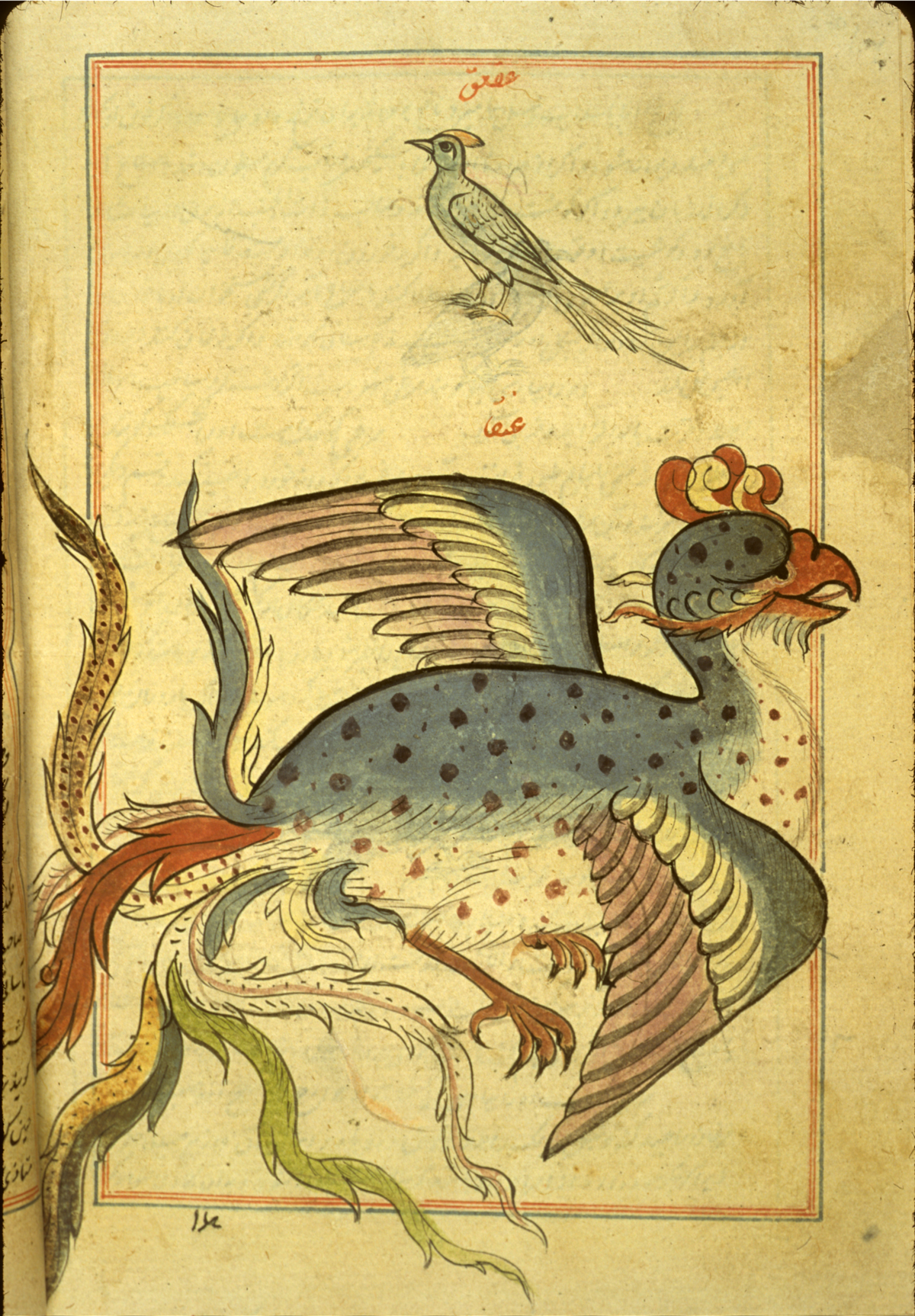
Qazwini's depiction of the anqa in The Wonders of Creation

Anqa (Arabic: عَنْقَاء, romanizedʿanqāʾ),[1] also spelled 'Anqa' , or Anka, or Anqa Mughrib or Anqa al-Mughrib (Arabic: العَنْقَاء المُغْرِب),[a] is a golden mysterious or fabulous female bird in pre-Islamic Arab mythology[2][3][4]. She is said to fly far away and only appear once in ages. However, it is also said that she can be found at "the place of the setting of the sun".[1]

Etymology and notes

[edit]

Characteristics

[edit]
Islamic prophet Safwan, father of the Islamic prophet sent to Companions of the Rass sits in prayer as he watches the Anqa devour a man.

The anqa was described as "very beautiful and colorful with a long neck, human face, four pairs of wings,[b] and some resemblance with every living being"[c] and a "whiteness" in its neck.[d][7] Zakariya al-Qazwini in this cosmological book Aja'ib al-Makhluqat "The Wonders of Creation" comments about the anqa as "the kin of birds that lived alone on Mount Qaf" and "a wise bird with experience gained throughout many ages and gives admonitions and moral advice".[8] Qazwini also says that the bird lives for 1700 years, mating at 500 years of age and that the chick, after the egg breaks, stays inside and only comes out after 125 years.[8]

It is said that Anqa eats nothing except elephants and large fish.[e]

Identification

[edit]

The anqa is frequently identified (to the point of becoming synonymous) with the simurgh of Persian mythology along with the Armenian and Byzantine eagles and the Turkic Konrul, also called semrük,[9] due to the sphere of influence of Islamic art following the fall of the Persian Empire.[10] It is also almost always glossed as a phoenix. In Turkish, the other name for the Konrul as well as a phoenix is zümrüdü anka "the emerald anqa". In modern arabic Anqa is identified as a phoenix or griffin.

See also

[edit]
  • Simurgh
  • Phoenix
  • Chalkydri, bird hybrid creatures that live near the Sun alongside phoenixes from the Second book of Enoch
  • Roc, another enormous legendary bird of Middle Eastern origin popularized in Arab folklore
  • Anzû, a massive bird divinity or monster in Mesopotamian religion
  • Konrul, also known as Zumrud Anka
  • Ziz, a giant griffin-like bird in Jewish mythology

Bibliography

[edit]

Notes

[edit]

References

[edit]
Revisions and contributorsEdit on WikipediaRead on Wikipedia
from Grokipedia
The Anqa (Arabic: ʿanqāʾ), also known as ʿAnqāʾ Mughrib, is a legendary female in pre-Islamic Arabian mythology that became a central figure in Islamic cosmology, , and , often likened to the phoenix for its themes of rebirth and longevity. Described as the largest and most magnificent , it possesses a lifespan of approximately 1,700 years, during which it mates once at 500 years and produces a single that hatches after 125 years, with one parent self-immolating to ensure the offspring's survival. Its physical form is portrayed as immensely powerful and beautiful, capable of capturing elephants as easily as a seizes a , with a flight that generates sounds like a raging or tempest. In medieval Arabic texts, such as Zakariya al-Qazwini's (Wonders of Creation), the Anqa is depicted as a hunter of vast prey including elephants, great , and sea-serpents, perching to observe lesser animals feed on the remains, underscoring its dominion over creation. Mythological narratives recount its early raids on human settlements, devouring animals and taking children. It was later confined to an unreachable island in the Encircling Ocean following prayers by the prophet Anzala (also known as Hanzala), after which it occasionally aids lost travelers. This pre-Islamic entity evolved in Islamic contexts to symbolize rarity and elusiveness, with its red, eagle-like features evoking both awe and peril. The Anqa's multifaceted role extends across genres in early , serving as a speculative zoological marvel, a for non-existence or scarcity, and a for divine essence or spiritual ascent in mystical and philosophical works. It shares iconographic and thematic parallels with Persian birds like the and Senmurv, reflecting cultural exchanges in post-Islamic while purging overt Zoroastrian ties. Through allusions and innovations, poets and scholars invoked the Anqa to explore themes of transcendence, , and the boundaries between and the mythical.

Name and Etymology

Derivation and Meaning

The Arabic term for the mythical bird is ʿanqāʾ (عَنْقَاء), romanized as ʿanqāʾ and pronounced approximately as [ʕanˈqaːʔ], with the initial ʿayn as a , the qāf as an emphatic voiceless uvular stop, and a at the end. This word is the feminine form of ʾaʿnaq (أَعْنَق), an meaning "long-necked" or "having a long and thick neck," derived from the triliteral root ʿ-n-q (ع-ن-ق), which fundamentally relates to the neck or embracing. The nomenclature likely stems from observations of real birds with elongated necks, such as or cranes, mythically amplified into a colossal creature in traditions. Early lexicons, including Lisān al-ʿArab by Ibn Manẓūr (d. 1311 CE), attest ʿanqāʾ as a vast, mysterious distinct from the eagle (ʿuqāb), emphasizing its immense size and elusiveness; it symbolizes extreme rarity, as in the proverb "rarer than the ʿanqāʾ mughrib," denoting something nearly unobtainable or nonexistent.

Linguistic Variations

The name "Anqa" exhibits several alternative spellings and transliterations rooted in its origins, reflecting adaptations across linguistic and cultural contexts. Commonly rendered as ʿanqāʾ in scholarly transliterations to preserve the original Arabic pronunciation (with the ʿayn and long ā), it appears as Anka or simply Anqā in various texts, emphasizing phonetic approximations in non-Arabic scripts. A prominent compound form is Anqāʾ Mughrib (: العَنْقَاء المُغْرِب), denoting "the Anqa of the West," which highlights its association with distant or western realms in medieval . In Persian contexts, the term evolves into Angha (Persian: عنقا), serving as a direct borrowing from Arabic to describe a phoenix-like mythical bird, often conflated with or distinguished from the indigenous Simurgh in epic poetry such as Ferdowsi's Shahnameh. This adaptation underscores cross-cultural exchanges between Arabic and Persian traditions, where Angha retains the connotation of a majestic, elusive avian figure akin to a long-necked bird. Transliteration variations in European languages, particularly in Orientalist from the 19th and 20th centuries, include forms like ', adopted to facilitate academic on Islamic mythology; for instance, early often simplified the diacritics, rendering it as Anka to align with Latin . These shifts appear in works translating medieval sources, where the name's was standardized for accessibility without altering its core structure. Regional adaptations in Arabic dialects show subtle phonetic differences, with Middle Eastern varieties (e.g., Levantine or ) typically preserving the classical qāf sound as /q/, yielding pronunciations close to ʿanqāʾ, while North African (Maghrebi) dialects often soften it to /g/ or /ʔ/, resulting in forms like ʿangā or angā, influenced by Berber substrate languages and French colonial impacts. Such variations are evident in oral retellings, where the name's western , Mughrib, resonates particularly in North African narratives tied to the region.

Mythological Description

Physical Characteristics

The Anqa is depicted in classical Islamic mythological texts as a colossal female bird, renowned as the largest and most imposing among all avian creatures, with a body surpassing the size of an and the strength to seize effortlessly, much like a preying on a . Its form emphasizes grandeur and majesty, often characterized by an immense wingspan that generates a resounding noise akin to a flood or tempest during flight, evoking the scale of its presence. Pre-Islamic and early sources portray it as a giant with a human-like face and four wings, underscoring its fantastical hybrid nature that blends avian and elements. Descriptions highlight the Anqa's radiant and beautiful appearance, rendered in vibrant colors with a notably long, white neck that contributes to its ethereal allure. , in his cosmological compendium Ajā'ib al-makhlūqāt wa ghārā'ib al-mawjūdāt (Wonders of Creation), emphasizes its supreme form as the greatest of birds, further amplified by accounts of feathers that shimmer in association with its fiery regenerative cycle. Sensory details include an enchanting vocalization produced by a featuring forty perforations, emitting melodious fine tunes that captivate listeners. The Anqa's unique traits encompass near-immortality, with a lifespan extending to 1,700 years, during which it mates only once at 500 years to produce a single that incubates for 125 years before hatching. This reproductive cycle, intertwined with and rebirth from ashes, reinforces its elusive, otherworldly aura, though its physical essence remains rooted in these enduring, sun-obscuring dimensions.

Habitat and Behavior

The Anqa inhabits remote and inaccessible locales, such as equatorial islands in the vast beyond human reach or the mythical encircling the world, where it rules over wild beasts like and rhinoceroses while evading all contact with humankind. Renowned for its profound elusiveness, the Anqa is said to be a no one has ever seen, migrating across immense distances with flights that resound like tempests or floods, thereby embodying a profound solitude that renders it a proverbial of rarity and inaccessibility in mythological lore. The creature's life cycle underscores its infrequency, with a lifespan of 1,700 years during which it mates only at 500 years of age; the resulting egg hatches after 125 years into a fully mature offspring, and reproduction culminates in one parent self-immolating in flames to enable the young to pair with the survivor, linking these events to expansive cosmic rhythms.

Historical Origins

Pre-Islamic Roots

The Anqa is believed to have origins in pre-Islamic Arabian mythology, potentially drawing from broader ancient Semitic traditions featuring avian symbols of celestial power and divine authority, such as eagles representing solar deities and intermediaries between and heavens in regional cosmologies. These motifs predate and reflect shared cultural heritage across the , though direct evidence for the Anqa specifically remains scarce. Archaeological evidence from Nabataean sites, such as , includes eagle motifs on sculptures and reliefs like the Gate and facade. These birds symbolize divine protection, majesty, and celestial oversight, linked to deities like , and may reflect pre-Islamic artistic traditions of avian figures as guardians of sacred spaces.

Medieval Islamic References

In medieval Islamic scholarship, the Anqa appears in as a for concepts that transcend human understanding, such as the incomprehensibility of certain divine stations or attributes, where terms like 'anqa denote something elusive or beyond rational grasp, akin to an imaginary or veiled reality. This usage underscores its role in illustrating divine mysteries without direct reference to Quranic verses, drawing on its legendary rarity to evoke the limits of knowledge in early theological discussions. A prominent reference occurs in the 14th-century zoological encyclopedia Ḥayāt al-ḥayawān (Life of Animals) by Kamāl al-Dīn Muḥammad ibn Mūsā al-Damīrī, where the Anqa Mughrib is portrayed as a griffin-like fabulous bird, symbolizing a perfected yet enigmatic creation of that embodies ideal and elusiveness. Al-Damīrī integrates it into his compilation of animal lore, blending anecdotal traditions with moral and symbolic interpretations to highlight its status as an exemplary, divinely ordained being amid discussions of natural and supernatural phenomena. During the Abbasid era, the Anqa's depiction evolved within bestiaries and cosmographies, such as Zakariyyāʾ al-Qazwīnī's 13th-century ʿAjāʾib al-makhlūqāt wa gharaʾib al-mawjūdāt (Wonders of Creation and Oddities of Existence), where it is described as the largest bird, comparable in size to a , capable of seizing like a takes a , and residing in remote, sunset-linked realms. This solidified the Anqa's place in Islamic wonder-literature (ʿajāʾib), a genre that compiled and transformed earlier animal lore into symbols of cosmic marvel and divine ingenuity.

Cultural and Symbolic Significance

Role in Sufism and Mysticism

In Sufi mysticism, the Anqa serves as a profound of the transcendent divine, particularly in the teachings of the 13th-century mystic Muhyiddin Ibn ʿArabī (1165–1240), who portrayed it as the "dust-cloud" (habāʾ)—a primordial veil or medium through which unveils the manifold forms of the universe. This imagery, drawn from Ibn ʿArabī's cosmological framework in works such as ʿAnqāʾ mughrib (The Fabulous Gryphon), symbolizes the ineffable process of divine manifestation (tajallī), where the Anqa represents the subtle, unseen substrate of creation akin to prime matter (hayūlā), embodying 's desire to bring the cosmos into existence through . The Anqa's elusive quality thus illustrates the soul's arduous quest for unity with the Divine, navigating illusions of multiplicity to attain direct gnosis (maʿrifa). Central to this symbolism is the Anqa's association with spiritual ascension and the doctrine of fana (annihilation of the ego), where the seeker transcends worldly attachments to dissolve into divine unity, followed by baqa (subsistence in ). Ibn ʿArabī employs the as a for the Seal of the Saints (khatm al-awliyāʾ), the pinnacle of mystical , guiding the microcosmic toward enlightenment by revealing hidden divine realities and protecting against the deceptions of sensory illusions. This portrayal underscores the Anqa's role in Sufi , evoking as an intangible, soaring pursuit that elevates the spirit beyond material confines. The Anqa also appears in the works of other Sufi mystics, such as the 12th–13th-century Persian visionary Rūzbihān Baqlī (1128–1209), who integrated it into poetic symbolism to depict the soul's enlightened ascent and guardianship against ephemeral worldly veils, reinforcing its function as a beacon for mystical realization. In these traditions, the bird's legendary rarity metaphorically captures the elusiveness of profound spiritual truths, urging seekers toward relentless inner purification.

Depictions in Literature and Art

In , the Anqa frequently appears as a motif symbolizing the elusive, the scarce, or the unattainable, evoking themes of transience akin to lost or fleeting . The poet Abū Nuwās (d. 813–15 CE), in his Dīwān, likens a miser's paltry provisions to the Anqa Mughrib—a mythical woven into kings' carpets and rugs yet never witnessed in the flesh—highlighting its rarity and illusory nature. Similarly, al-Jāḥiẓ (d. 868–9 CE) employs the Anqa in Kitāb al-Ḥayawān as a for vanished possessions or opportunities, stating that "the Anqa Mughrib flew away with it in the sky," underscoring its association with irretrievable loss. Visual depictions of the Anqa abound in medieval Islamic manuscripts, where it is rendered as a majestic, otherworldly bird amid cosmological and natural wonders. In Zakariyya al-Qazwīnī's (d. 1283 CE) ʿAjāʾib al-makhlūqāt wa gharāʾib al-mawjūdāt (Wonders of Creation), an early 15th-century Iraqi or Eastern Turkish folio illustrates the Anqa alongside a using opaque watercolor, , and on , portraying it as a colossal, colorful creature capable of seizing elephants and embodying renewal through a phoenix-like cycle every 1,700 years. Another example appears in an 18th-century Ottoman manuscript from Art Museum, depicting the Anqa as a hybrid fabulous bird—part griffon, part —with intricate feathers and a poised, mythical form that blends avian grace with supernatural power. These illuminations often frame the Anqa in borders or central vignettes, emphasizing its role in didactic and encyclopedic texts. In Persian literary traditions, the Anqa recurs in mystical as a symbol of the soul's ascent and divine mystery. Ruzbihan Baqlī (d. 1209 CE) invokes the Anqa alongside the in his verses, representing spiritual elevation and the ineffable beauty of the divine, with its multicolored plumage evoking the fleeting glimpses of enlightenment. Modern revivals of the Anqa motif appear in 20th- and 21st-century visual , bridging ancient folklore with contemporary themes. British-Lebanese artist George Lewis's 2012 painting Al-'Anqa: The Phoenix reimagines the bird soaring over urban , fusing mythological resurrection with modern resilience amid conflict and renewal. Such works draw on traditional descriptions while adapting the Anqa to explore and transformation in and Persian diasporic contexts. These depictions carry subtle mystical undertones in Sufi-inspired , portraying the bird as a guide to inner awakening.

Comparisons to Other Creatures

Parallels with the Phoenix

The Anqa and the Phoenix, originating from Arabian and Greco-Roman mythologies respectively, exhibit notable parallels in their embodiment of and cyclical renewal, reflecting a broader of the eternal mythical that transcends mortality. Both creatures are depicted as singular, extraordinarily long-lived beings whose existence symbolizes unending life and the triumph over death, with the Phoenix said to endure for centuries before regenerating and the Anqa attributed a lifespan of approximately 1,700 years. A key distinction lies in their mechanisms of renewal: the Phoenix undergoes periodic in a nest of aromatic woods, bursting into flames and rising reborn from its ashes to perpetuate its lineage through , whereas the Anqa involves by one parent after the offspring hatches from a single , ensuring generational continuity rather than individual regeneration, underscoring themes of divine permanence and familial in Islamic traditions. This process aligns the Anqa more closely with motifs of parental devotion and eternal lineage. Scholars suggest these similarities arose through Hellenistic influences along ancient trade routes, where Greek accounts of the Phoenix—often located in Arabia—intermingled with local Arabian myths, localizing the bird as the Anqa adapted to desert environments and pre-Islamic . Furthermore, the Anqa is consistently gendered as female in , evoking motifs of , protection, and cosmic harmony, in contrast to the Phoenix's ambiguous or neuter portrayal, which allows broader symbolic flexibility without tied reproductive roles. This gendering enhances the Anqa's role in myths, positioning her as a maternal guardian of life's continuity rather than a solitary regenerator.

Connections to Simurgh and Garuda

The Anqa shares significant overlaps with the , a benevolent mythical bird from prominently featured in Ferdowsi's , where the Simurgh is depicted as a wise guardian dwelling in remote mountains and possessing healing powers. In the epic, the Simurgh resides on Mount Alborz and aids heroes like Zal and , using its feathers to heal wounds and providing prophetic guidance as a protective figure. In Arab-Muslim sources, the Anqa is associated with the Simurgh, described as the largest and most imposing bird, ruler of , and an extraordinary creature symbolizing perfection and divine wisdom. This connection reflects the integration of Iranian mythological elements into Islamic lore during the early medieval period, as seen in works like Zakariyā al-Qazwini's ʿAjāʾib al-Makhlūqāt, where the Anqa's vast lifespan of 1,700 years and habitat in distant lands mirror the Simurgh's ancient, ethereal presence. In Persian mysticism and poetry, the Anqa and converge as related symbols of the soul's ascent to divinity, with the representing and the Anqa the aspiring soul seeking enlightenment and union with the divine. Sufi poet Ruzbihan Baqli (d. 1209), in texts like Shatiyat al-ʿĀshiqīn, employs the as a for and the Anqa for the aspiring soul, blending their imagery to illustrate and maturity. This symbolic parallelism extends to literature, such as Sheikh Galib's Diwan, where both birds evoke themes of regeneration, knowledge, and intimacy with the divine, drawing from shared Arabic-Persian mystical traditions. The Anqa also exhibits links to the , the divine bird from , through Islamic-Indian cultural exchanges facilitated by trade, conquests, and shared motifs along the and during the era. Both creatures are portrayed as immense in size—Garuda with wings spanning miles capable of blocking the sun, and the Anqa as a colossal ruler of birds—and serve as symbols of speed, protection, and cosmic order. In Hindu texts like the , Garuda acts as Vishnu's , transporting the gods and embodying vigilance against chaos. These parallels likely arose from Indo-Persian interactions, where Persian intermediaries like the bridged motifs, as noted in philological studies linking the Simurgh's serpentine enmity to Garuda's role as an enemy of nagas. Despite these affinities, the Anqa differs from both the Simurgh and Garuda in its narrative role, emphasizing profound elusiveness over active engagement in human affairs. While the Simurgh intervenes directly in Shahnameh tales to nurture and heal, and Garuda serves as a dynamic emissary in Vedic epics, the Anqa is characterized by rarity, appearing only once every few ages in remote locales like the sunset's edge, symbolizing unattainable mystery rather than intervention. This elusive quality underscores the Anqa's role in Islamic mysticism as an emblem of the divine's inaccessibility, contrasting the more approachable guardianship of its Persian and Indian counterparts.

References

Add your contribution
Related Hubs
User Avatar
No comments yet.