Hubbry Logo
Antelope Valley LineAntelope Valley LineMain
Open search
Antelope Valley Line
Community hub
Antelope Valley Line
logo
8 pages, 0 posts
0 subscribers
Be the first to start a discussion here.
Antelope Valley Line
from Wikipedia

Antelope Valley Line
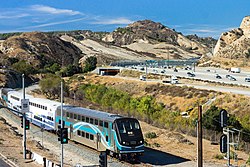
Antelope Valley Line train descending from the Newhall Pass
Overview
OwnerMetrolink (track; Los Angeles–Lancaster)[1]
LocaleNorthern Greater Los Angeles Area
Termini
Stations13
Service
TypeCommuter rail
SystemMetrolink
Operator(s)Metrolink
Daily ridership4,489 (weekdays, Q3 2025)[2]
History
OpenedOctober 26, 1992
Technical
Line length76.6 miles (123.3 km)[3]
CharacterMostly surface-level with one tunnel section
Track gauge4 ft 8+12 in (1,435 mm) standard gauge
Operating speed79 mph (127 km/h) maximum
35 mph (56 km/h) average[3]
Route map
Map Antelope Valley Line highlighted in green
Lancaster
Palmdale
Vincent Grade/Acton
Vista Canyon
Via Princessa
Santa Clarita
Newhall
Sylmar/San Fernando
Sun Valley
Burbank Airport–North
Hollywood Burbank Airport via Airport bus
enlarge… VC to Ventura–East
Downtown Burbank
Glendale
Central Maintenance Facility
L.A. Union Station
Other line sharing track
Multiple lines sharing track
Stations with Amtrak service

Handicapped/disabled access All stations are accessible

The Antelope Valley Line is a commuter rail line that serves the Northern Los Angeles County area as part of the Metrolink system. The northern segment of the line is rural in character because it travels through the sparsely populated Soledad Canyon between Santa Clarita and Palmdale, serving the small community of Acton along the way. Other portions of its route parallel the former U.S. Route 6, now San Fernando Road and Sierra Highway. This is the only Metrolink line contained entirely within Los Angeles County.

History

[edit]

The line along the Santa Clara River and into Los Angeles was completed by Southern Pacific in 1876 as the first railway to connect the city to the national network. The last passenger trains operated over the line in 1971.[4]

In 1992 the Los Angeles County Transportation Commission, predecessor of Los Angeles County Metropolitan Transportation Authority, purchased the right of way from Southern Pacific.[5][6] Control of the line was then transferred to the newly-formed Southern California Regional Rail Authority who prepared the route for commuter rail service. Passenger operations began on October 26, 1992 and was called the Santa Clarita Line at the time. It was one of three original lines in the Metrolink system along with the Ventura County and San Bernardino lines. The route initially ran from Los Angeles Union Station in Downtown Los Angeles to Santa Clarita station, with intermediate stops only at Glendale and Downtown Burbank stations.[7]

Earthquake traffic relief

[edit]

Since the beginning of service, Metrolink had plans to extend the line north to the Antelope Valley but these plans were expedited by almost ten years following the 1994 Northridge earthquake.[7] The earthquake caused the collapse of the freeway connector of State Route 14 (the Antelope Valley Freeway) onto Interstate 5 (the Golden State Freeway) at the Newhall Pass interchange, forcing all traffic in both directions to use the parallel truck route to the east of I-5 that was unaffected by the quake. With funding from the Federal Emergency Management Agency the Southern California Regional Rail Authority constructed an emergency extension of the line to Lancaster to help relieve the traffic bottleneck. The U.S. Navy Seabees construction battalion and crews from the L.A. County Public Works Department were able to construct the stations in just a few days, compared to the normal three to six months. Emergency stations in Lancaster and Palmdale were both built in just three days and Metrolink started operating trains one week after the earthquake struck. Over the next five weeks additional emergency stations were added in Sylmar/San Fernando, Vincent Grade/Acton and Santa Clarita (Via Princessa).[7][8] While most of the emergency stations have since been replaced with permanent stations, the Via Princessa station still uses the same platform built after the earthquake.

Service expansion

[edit]

Saturday service on the Antelope Valley Line has been operating since 1999,[9] Sunday service was added in September 2007.[10] As of August 2013, weekend service has expanded to 6 trains on Saturdays and Sundays.[11] Arrivals at LA Union Station are timed to allow passengers to connect with Amtrak trains and trains on Metrolink's Orange County and San Bernardino lines.[11]

Express service was added to the line in May 2011.[12] Two express trains operated in the peak commute direction between Palmdale and Los Angeles (one southbound train in the morning, one northbound train in the evening). Express trains were about 18 minutes faster than trains that stop at all stations. Express service was later removed.

On April 30, 2015, Metrolink announced it will be offering discounted fares to riders on the Antelope Valley Line beginning July 1, 2015 as part of a pilot program. The fare pilot program, which will be in place for six months following the program's launch, will include several new ticket pricing options for riders on the Antelope Valley Line. There will be a 25 percent reduction in fares on all ticket types for trips along the corridor from Los Angeles to Lancaster, with the exception of the Weekend Day Pass, which will remain at its current $10 fare. In addition, a new "station-to-station" fare will be introduced in which riders traveling during off-peak hours (9 a.m. to 2 p.m.) will be able to purchase a one-way ticket to travel between stations for $2 per station. This fare is designed to encourage local trips using Metrolink as an additional mobility option complementing local bus service.[13]

A new Burbank Airport–North station opened in 2018 to serve Antelope Valley Line passengers traveling to Hollywood Burbank Airport. The station is located near the intersection of San Fernando Boulevard and Hollywood Way, with a free shuttle bus for passengers to the airport terminal located approximately one mile away from the station site. Metrolink tickets holders may also make a free Metro bus connection with Metrolink ticket.[14]

In July 2019, additional late evening train service and bi-directional service were being considered.[15] An additional infill station at Vista Canyon in Santa Clarita began construction in 2020.[16] In September 2023, the Metro Board of Directors approved $1.6 million in funding to add more midday and evening round trips starting October 23, 2023.[17] The Vista Canyon station opened the same day the expanded timetable went into service, following a ribbon-cutting ceremony on October 20, 2023.[18]

Pacoima plane crash

[edit]

On January 9, 2022, a private Cessna 172 crashed onto the tracks of the Antelope Valley Line at Osborne Street in Pacoima after taking off from nearby Whiteman Airport and was then struck by a Metrolink train. The Cessna's pilot was injured in the initial crash, but Los Angeles Police Department officers on the scene were able to help him out of the wreckage before it was hit by the train. No one aboard the train was injured.[19][20]

Future development

[edit]

Metrolink was awarded $107 million in 2020 Intercity Rail Capital Program funds to begin a suite of upgrades to the line that would allow increasing frequencies to half-hourly between Santa Clarita and hourly to Lancaster. The improvements could add two infill stations between Burbank and Union Station,[21] but staff recommend against utilizing multiple units.[22] Metro announced in October 2020 that an environmental impact report is being prepared for a project which would add new double track between the Sylmar/San Fernando and Newhall stations and a second station platform at Santa Clarita Station. Lancaster would get a new center platform and storage tracks with this project.[23]

An expansion to Kern County has been discussed in a 2012 Kern County Council of Governments report. Trains would stop in Rosamond and Mojave.[24]

Service

[edit]
Santa Clarita station in the Soledad Canyon

As of October 23, 2023, the Antelope Valley Line is served by 30 Metrolink trains (15 in each direction) each weekday, evenly spaced throughout the day. Of those trains, 22 travel the entire length of the line from Los Angeles to Lancaster and eight trains short turn, traveling only between Los Angeles and the Vista Canyon station in Santa Clarita.[25] Four of the short turn trains (2 in each direction) are met by Antelope Valley Transit Authority route 790, the North County TRANSporter, a bus route that allows passengers on these trains to travel to the Palmdale station.[26]

On weekends, the Antelope Valley Line is served by 24 Metrolink trains (12 in each direction), evenly spaced throughout the day. Of those trains, 12 travel the entire length of the line from Los Angeles to Lancaster and 12 trains travel only between Los Angeles and the Via Princessa station.[27]

Stations

[edit]

See also

[edit]

References

[edit]
[edit]
Revisions and contributorsEdit on WikipediaRead on Wikipedia
from Grokipedia
The Antelope Valley Line is a service operated by Metrolink, connecting to the region in northern County. Spanning approximately 77 miles (123 km) with 13 stations, the line runs from L.A. Union Station northward through the , , and into the high desert areas, paralleling major highways such as and State Route 14. It provides essential regional transportation, serving over 9,000 average weekday boardings as of 2024 as Metrolink's third-busiest route, with trains operating Monday through Sunday using diesel locomotives and bi-level passenger cars. Launched on October 26, 1992, as one of Metrolink's inaugural lines alongside the Ventura County and San Bernardino lines, the Antelope Valley Line was established by the Regional Rail Authority to alleviate freeway congestion in the growing area. The route utilizes tracks originally built in the late by the Southern Pacific Railroad, with modern service emphasizing reliability and integration with local bus systems like the Antelope Valley Transit Authority. Current schedules offer peak-hour frequencies with trips taking about 2 hours and 10 minutes end-to-end, including request stops at remote stations such as Vincent Grade/Acton. Ongoing improvements, funded by measures like Measure M and state grants totaling over $220 million, aim to double-track sections, extend sidings, and upgrade the Lancaster terminal to enable 30-minute bidirectional service by 2030, supporting projected and reducing reliance on automobiles in the corridor. Recent service expansions have added off-peak trips, contributing to ridership recovery. Key stations include Glendale, Burbank-Downtown, Santa Clarita, Palmdale, and Lancaster, facilitating connections to Amtrak's at select points and enhancing multimodal access across the region.

Overview

Route description

The Antelope Valley Line extends 76.6 miles (123.3 km) from Los Angeles Union Station in downtown Los Angeles to Lancaster in northern Los Angeles County. This commuter rail corridor primarily follows established rail alignments paralleling major highways, including the Golden State Freeway (Interstate 5) in its southern portions and the Antelope Valley Freeway (State Route 14) northward. The route provides a vital link between urban centers and outlying valleys, traversing diverse terrain that shifts from densely developed areas to rugged canyons and open plains. Beginning in the urbanized southern end, the line passes through the , characterized by residential and industrial zones. It then transitions into the rural Soledad Canyon segment, where the tracks wind through sparsely populated landscapes within the , offering views of the Santa Clara River along much of this stretch. Further north, the route emerges onto the flatter plains, facilitating more straightforward travel across agricultural and developing suburban areas. The line's key segments reflect this geographical progression: the southern from Glendale to Sylmar features frequent and lower-speed navigation amid cityscapes; the rural canyon from Newhall to Acton involves winding grades through mountainous terrain; and the plains from Palmdale to Lancaster allow for higher velocities across expansive, arid lowlands. Trains operate at a maximum speed of 79 mph, constrained by track conditions, grade crossings, and federal regulations, resulting in an overall average speed of 35 mph for the full journey.

Infrastructure and operations

The Antelope Valley Line's trackage is owned by the Los Angeles County Metropolitan Transportation Authority (Metro) for the entire route from Los Angeles Union Station to Lancaster, with the Southern California Regional Rail Authority (SCRRA), operating as Metrolink, managing operations. Portions of the route are shared with freight operations, primarily by the Union Pacific Railroad, requiring coordinated scheduling to manage mixed traffic. The line features a predominantly single-track configuration with multiple passing sidings to facilitate train meets and overtakes, particularly in the more constrained sections through Soledad Canyon. These sidings, such as the one at Saugus, allow for efficient operations despite the single-track limitations, though ongoing initiatives under the Metrolink System Optimization, Capacity, and Reliability Enhancement (SCORE) program include double-tracking projects in key areas like Balboa Boulevard to boost capacity and reduce delays. Signaling and control systems on the Antelope Valley Line incorporate (PTC), a safety overlay that was fully implemented across Metrolink's network, including this route, by December 31, 2018, ahead of the federal mandate. Additionally, (CTC) governs train movements in the canyon sections, enabling remote dispatching of signals and switches for optimized flow. Rolling stock for the line consists of Metrolink's diesel-electric fleet, primarily and F59PHR locomotives paired with Bombardier BiLevel coaches designed for high-capacity commuter service. These bi-level cars, with their double-deck seating, accommodate up to 140 seated passengers per car, enhancing efficiency on peak runs. Locomotives and cars undergo routine and heavy maintenance at Metrolink's Central Maintenance Facility (CMF) in , which handles inspections, repairs, and overhauls for the entire system fleet. As of January 2025, Metrolink implemented schedule updates to improve service reliability on the line. Daily operations serve 13 stations from Los Angeles Union Station to Lancaster, with train movements integrated into a shared corridor that prioritizes time slots for freight trains while maintaining reliable passenger schedules. Dispatchers at Metrolink's operations center coordinate these interactions using real-time data from PTC and CTC systems to minimize conflicts and ensure on-time performance.

History

Origins and initial service

The Antelope Valley Line originated with the Southern Pacific Railroad, which completed construction of the rail line through the in 1876 as part of its mainline route connecting to via the . This development facilitated freight and passenger transport across the region for nearly a century, supporting in the northern Los Angeles County area. Passenger service persisted under Southern Pacific until the formation of in 1971, after which the last intercity trains ceased operations on the line between Burbank and Lancaster. By the late 1980s, growing suburbanization and freeway congestion in prompted revival efforts for . In September 1992, the Los Angeles County Transportation Commission (LACTC), predecessor to the County Metropolitan Transportation Authority, acquired the 67-mile Saugus Line right-of-way from Southern Pacific Railroad for $67.8 million to enable regional passenger service. This purchase was part of broader initiatives by the Regional Rail Authority (SCRRA), formed in 1991, to restore rail commuting options along key corridors. Metrolink service on the line debuted on October 26, 1992, initially branded as the Santa Clarita Line and terminating at Santa Clarita station. The launch featured six daily round trips, concentrated on peak-hour periods to accommodate morning inbound and evening outbound travel. Designed primarily for commuters from northern suburbs like Santa Clarita to , the service offered a reliable alternative to automobile-dependent travel amid heavy traffic on routes such as and State Route 14.

Northridge earthquake expansion

The Northridge earthquake, which struck on January 17, 1994, with a magnitude of 6.7, severely damaged key freeways in the area, including the interchange of and State Route 14, isolating commuters in the region and creating an immediate demand for alternative transportation options. This infrastructure collapse prompted an accelerated response from the Southern California Regional Rail Authority (Metrolink), which had initiated limited service on what was then known as the Santa Clarita Line in 1992. In the immediate aftermath, Metrolink rapidly extended service northward to provide emergency relief, beginning operations to Lancaster just one week after the quake on January 24, 1994. Temporary stations were constructed in record time, with facilities at Palmdale and Lancaster completed in three days and the Vincent Grade/Acton station finished in five days, enabling quick connectivity for stranded residents. By early February, additional temporary stops at Sylmar/San Fernando and Via Princessa were operational, adding essential access points along the route. A new schedule implemented on May 2, 1994, further optimized travel times between Lancaster and Union Station, solidifying the extension's role in daily commuting. The line's expansion provided significant traffic relief, with initial daily ridership reaching approximately 3,600 boardings by July 1994, a substantial increase from the pre-earthquake average of 1,000, helping to alleviate congestion on damaged highways. On the of service, the combined Antelope Valley and Santa Clarita segments carried 16,000 passengers, demonstrating the urgent need it addressed. Federal funding from the (FEMA) expedited these developments, supporting the activation of the extension. By late 1994, the temporary infrastructure had transitioned into a more permanent configuration, extending the line fully to Lancaster and incorporating seven new stations, which added about 38 miles to the original route and renamed it the Antelope Valley Line. This crisis-driven growth not only restored connectivity but also laid the foundation for long-term service in the area.

Service expansions and incidents

In 1997, Metrolink introduced Saturday service on the Antelope Valley Line through its Explorer program, marking the first weekend operations on the route. This addition aimed to accommodate growing demand from recreational and leisure travelers in the region. By September 2007, service expanded further to include Sundays, doubling weekend round trips from three to six and enhancing accessibility for non-commute travel. Service enhancements continued into the early , with the introduction of express trains in May as part of a pilot program on the and San Bernardino lines. These express runs skipped nine intermediate stops, reducing travel time by approximately 18 minutes compared to all-stops service. Concurrently, four additional midday trains were added to the weekday schedule, filling gaps in off-peak coverage and supporting broader travel patterns beyond rush hours. To boost ridership amid economic pressures, Metrolink implemented a 25% fare reduction pilot on the starting , which ran through June 2016 and resulted in increased boardings during the period. The program included a $2 station-to-station option to encourage short trips and was evaluated for its impact on usage. In 2018, access improved with the opening of the Burbank Airport–North station on May 14, providing direct rail connections to the via a complimentary shuttle, thereby integrating air and rail travel for commuters. A significant recent expansion occurred on October 23, 2023, with the opening of the Vista Canyon station as an infill stop between Vincent Grade/Acton and Via Princessa, coinciding with broader schedule enhancements including more weekday and weekend trains. This multi-modal center facilitates bus transfers and parking, serving growing residential developments in the Santa Clarita area. In fall 2024, Metrolink expanded service on the Antelope Valley Line as part of a systemwide approximately 30% increase under the 2025 , adding more trains to improve frequencies and support ridership recovery. The line has also experienced notable incidents, including a , , crash in Pacoima where a made an on Metrolink tracks near Whiteman due to engine failure. Los Angeles Police Department officers rescued the injured pilot seconds before an oncoming Antelope Valley Line train struck the wreckage at full speed, with no injuries reported among the train's passengers or crew. The event prompted investigations by the and into aviation near rail corridors. Following the , which caused a 90% drop in ridership across Metrolink by March 2020, the Antelope Valley Line saw gradual recovery starting in 2021, supported by service restorations and fare incentives. By 2022, increased train frequencies signaled renewed demand, though full pre-pandemic levels remained elusive as hybrid work patterns persisted.

Current service

Schedule and patterns

The Antelope Valley Line operates 30 full-length trains on weekdays, with 15 trains in each direction between Los Angeles Union Station and Lancaster. Rush-hour frequencies run every 30 to 60 minutes, providing enhanced service for commuters, with the line integrated into Metrolink's SCORE program, which has improved overall reliability through infrastructure upgrades like additional double-tracking. On weekends, the line runs 24 trains, consisting of 12 in each direction between Los Angeles Union Station and Lancaster to align with demand. Off-peak intervals extend to every 1-2 hours, and the full end-to-end travel time from Los Angeles Union Station to Lancaster is approximately 2 hours 15 minutes, including limited express patterns that skip minor stops during busier times. Major holidays feature reduced service following the weekend schedule, including on , , Independence Day, Labor Day, , and , to accommodate lower ridership. Special event adjustments, such as additional trains for parades or festivals like the Holiday Express runs, are implemented as needed to handle surges in demand along the route.

Ridership and fares

The Antelope Valley Line records an average of 6,897 weekday passengers as of the third quarter of FY2025 (January–March 2025), with ridership peaking during morning and evening commute periods when trains to and from Los Angeles Union Station see the highest demand. This figure reflects ongoing recovery from the sharp declines during the COVID-19 pandemic, when daily boardings fell below 2,000 amid remote work shifts and public health restrictions. Historically, ridership on the line has shown steady growth from modest beginnings in the , when average daily passengers numbered under 1,000, to pre-pandemic peaks exceeding 7,000 weekday boardings by 2019. This expansion was driven by the line's role as a reliable alternative to congested freeways like and State Route 14, though post-2020 trends have been tempered by the rise of reducing commute volumes. Recent double-digit increases, particularly on the Antelope Valley Line, stem from enhanced service frequencies and targeted promotions. As of July 2025, fares on the Antelope Valley Line follow a simplified structure, with one-way tickets from Los Angeles Union Station to Lancaster priced at $12–$17. Monthly passes for full-line access start at around $250, offering unlimited rides. Integration with Los Angeles Metro's TAP card system allows seamless transfers, as valid Metrolink tickets can be tapped for fare validation on connecting Metro buses and rail lines. To encourage usage, Metrolink implements fare capping, limiting daily expenditures to a maximum amount equivalent to a round-trip ticket, and provides a 50% / discount on all fares for youth and college commuters as of 2025. A 2015 pilot program on the Antelope Valley Line, featuring a 25% fare reduction alongside full , boosted ridership by approximately 29% during its run, demonstrating the effectiveness of affordability incentives in attracting new passengers.

Stations and connections

Northern stations

The northern stations of the Antelope Valley Line begin at Newhall, just north of Sylmar/San Fernando, and extend through the Santa Clarita Valley, scenic Soledad Canyon, and into the Antelope Valley, serving suburban, rural, and urban communities in northern Los Angeles County. These facilities provide essential commuter access, with features emphasizing park-and-ride options, bus integrations, and accessibility compliant with the Americans with Disabilities Act (ADA). All northern stations are fully ADA accessible, including level boarding platforms, handicapped parking, and tactile warning strips for visual impairments. Newhall station, at 24300 Railroad Avenue in the historic Old Town Newhall district, offers 324 parking spaces across three lots (with 17 handicapped) and basic amenities like restrooms. Situated near heritage sites and the Canyon Theatre, it connects to Santa Clarita Transit and the County of Los Angeles Acton/Agua Dulce Shuttle, providing access for residents in this culturally significant area. Santa Clarita station, located at 22122 Soledad Canyon Road, acts as a major transfer hub with 473 parking spaces (including 10 handicapped) and amenities such as bike lockers, restrooms, and public phones. It connects to extensive Santa Clarita Transit services, including lines 6 and 16, and serves as a gateway for passengers from the city's core areas, handling significant daily boardings due to its central position. Proceeding north, Via Princessa station in Santa Clarita, at 19201 Via Princessa, functions as a key park-and-ride with 395 free parking spaces and amenities including restrooms and vending machines. It provides strong bus connections via Santa Clarita Transit routes 4, 5, and 14, facilitating transfers for commuters from northern Santa Clarita neighborhoods. The station, owned by the City of Santa Clarita, underscores the area's suburban growth and integration with local transit. The next station, Vista Canyon, opened on October 23, 2023, as the fourth Metrolink station in Santa Clarita and serves as a park-and-ride facility at the Vista Canyon Multi-Modal Center. Located at 25857 Vista Canyon Drive, it offers 613 parking spaces, bike racks, and connections to Santa Clarita Transit local routes, enhancing access for residents in the growing Vista Canyon . This station supports the line's expansion to accommodate increasing demand in the . In the rural Acton area, Vincent Grade/Acton station at 730 West features 414 parking spaces (16 handicapped) and amenities including bike racks and restrooms. Its remote setting supports access to nearby trails like , with connections limited to Rally rideshare but emphasizing scenic rural commuting. Owned by Los Angeles County Department of Public Works, it caters to low-density populations along the line's canyon stretch. Palmdale station, at the Palmdale Transportation Center (39000 Plaza Drive), is a multi-modal hub with 750 parking spaces (18 handicapped, 48-hour limit) and facilities like a , vending, and vehicle charging. It connects to Antelope Valley Transit Authority (AVTA) routes including 94 (serving ) and Bus services, alongside ; this setup supports higher ridership, driven by Palmdale's role as a population center with over 160,000 residents. The northern terminus, Lancaster station at 44812 North Sierra Highway, includes 420 parking spaces (5 handicapped, 72-hour limit) and serves as the endpoint for all Antelope Valley Line trains. Adjacent to Metrolink's maintenance yard for train servicing and storage, it offers connections to AVTA routes 1 and 7, with elevated ridership reflecting Lancaster's status as the Antelope Valley's largest city (population around 173,000) and key employment hub.

Southern stations

The southern portion of the Antelope Valley Line comprises six stations from L.A. Union Station northward through the to Sylmar/San Fernando, facilitating commuter access to and connections across the regional transit network. These stations handle significant inbound and outbound traffic, with the line overall averaging about 9,000 daily riders as of 2024, reflecting heavy usage by commuters traveling to employment centers in . L.A. Union Station, located at 800 N. Alameda Street in Los Angeles, serves as the major southern terminus and a key intermodal hub for the Antelope Valley Line, accommodating multiple Metrolink routes alongside and Metro services. Amenities include bike racks and lockers, restrooms, and dining options, while parking is available in adjacent structures such as Union Station East ($8 maximum per 24 hours) and West ($16 maximum per 24 hours), with monthly permits at $110 plus a one-time fee. Connections encompass Metro Rail lines, FlyAway buses to LAX every 30 minutes from Patsaouras Transit Plaza, and the Dodger Stadium Express on game days, with Rail 2 Rail access allowing Metrolink monthly pass holders to board trains. The next stop, Glendale station at 400 W. Cerritos Avenue, offers pedestrian-friendly access in a residential and commercial area, with amenities such as bike racks and lockers, restrooms, a for food and beverages, and public phones. Free parking is provided for 426 spaces, including 17 handicapped spots, with a 72-hour maximum stay. Transit connections include Metro buses, Glendale Beeline services, Glendale Metrolink Express, via Rail 2 Rail, Metro Micro on-demand rides, and Rally rideshare. Downtown Burbank station, situated at 201 N. Front Street, supports business district commuters with secured bike areas, restrooms, and public phones. It features 458 free parking spaces across three lots, including 12 handicapped spots, allowing overnight parking up to 72 hours. Connections comprise Metro buses, BurbankBus Media District Shuttle, Downtown Burbank Loop, Empire-Downtown Shuttle, Beeline Metrolink Express, Dial-A-Ride, Santa Clarita Transit, for $1 rides, and Rally rideshare. Burbank Airport–North, opened on May 14, 2018, at 3600 N. San Fernando Boulevard, provides direct rail access to approximately one mile away via a complimentary on-demand shuttle operating from 5 a.m. to 10 p.m. daily. Amenities are limited to bike racks and lockers, with no on-site parking available. Connections include Metro buses, BurbankBus, Rally rideshare, and the airport shuttle, bookable by calling (818) 729-2245. Sun Valley station, at 8360 San Fernando Road in an industrial area, includes bike racks and lockers as primary amenities. Free parking accommodates 320 spaces, with 8 handicapped spots east of San Fernando Road at Olinda Street, permitting overnight use. Connections feature buses and Rally rideshare services. The northernmost southern station, Sylmar/San Fernando at 12219 Frank Modugno Drive, serves the Metrolink maintenance facility nearby and includes bike racks, , and public phones. Free parking offers 375 spaces with 9 handicapped spots and electric vehicle charging stations, allowing overnight parking. Connections include LADOT Commuter Express buses, Metro buses, and Rally rideshare.

Future developments

Short-term improvements

The Southern California Regional Rail Authority (SCRRA), operator of Metrolink, launched the Systemwide Capacity Optimization and Reliability Enhancement (SCORE) program as a multi-billion-dollar initiative to modernize rail infrastructure and support increased service frequencies ahead of the 2028 Olympic and Paralympic Games. Valued at approximately $1.8 billion in budgeted funds as of 2022, the program targets key corridors including the Antelope Valley Line, aiming to enable full 30-minute bi-directional service between Los Angeles Union Station and Santa Clarita by 2030 through targeted capacity upgrades, with peak-hour 30-minute service already in place as of June 2025. A core component on the Antelope Valley Line is the Canyon Siding Extension Project, which adds about 4,700 feet of new track to the existing Saugus siding between Bouquet Canyon Road and Santa Clara Street in Santa Clarita, facilitating train passing and reducing dwell times by up to 80% to accommodate more frequent operations. Construction is scheduled to begin in 2028, with completion expected in 2030. Complementing these efforts, the Lancaster Improvement Project under SCORE expands the Lancaster yard's layover facilities by adding 2,000 feet of train storage tracks near the existing terminal, enhancing operational flexibility for additional trains and maintenance. Construction is expected to begin in 2028, with completion in 2030; this upgrade supports the overall push for hourly bi-directional service extending to Palmdale and Lancaster while addressing growing ridership demands in the northern corridor. Metrolink has recovered to approximately 70% of pre-pandemic ridership systemwide as of mid-2025. Station upgrades form another pillar of short-term enhancements, focusing on accommodating longer consists and improving . At key stops like Lancaster and Santa Clarita, projects include additional or modified platforms—such as new island platforms with pedestrian underpasses or overpasses—to handle increased train lengths and passenger volumes. retrofits are integrated across these efforts, incorporating ADA-compliant features like enhanced ramps, , and improved lighting to ensure equitable access for riders with disabilities, aligning with Metrolink's broader compliance initiatives. Service enhancements implemented since late 2023 have already boosted midday and evening frequencies on the Antelope Valley Line, adding nine new weekday trains and doubling weekend service to reduce peak-hour crowding and extend operational hours. These changes, developed in coordination with Los Angeles County Metropolitan Transportation Authority (LA Metro), integrate with the broader Antelope Valley Line corridor plan to promote seamless regional connectivity and support ridership recovery.

Long-term extensions

To support increased frequencies and reliability, efforts include completing full double-tracking along the corridor from Sylmar to Newhall, addressing current single-track bottlenecks that limit service capacity. This upgrade, part of the broader Antelope Valley Line Capacity and Service Improvements Program, would enable bi-directional operations and reduce delays in the segment. The project stems from a $107 million state grant awarded in 2020, which funds key elements like the Balboa Double Track Extension south of the I-5/SR-14 interchange; design is ongoing with construction starting in 2028 and completion in 2029. Regional integration features prominently, with enhanced links to the Palmdale Transportation Center—currently serving Metrolink and buses—to position it as a pivotal intermodal node. A primary goal is achieving hourly bi-directional service to Lancaster by 2030, reducing peak wait times to 60 minutes and supporting pulsed scheduling for better connectivity with other lines. This would align with short-term improvements by leveraging new layover facilities at Lancaster while expanding overall capacity. Alignment with the California High-Speed Rail system is a core component, particularly through integration at the Palmdale Transportation Center, where the Antelope Valley Line would connect to high-speed segments linking Palmdale to Burbank and the broader Central Valley route. This synergy aims to create a seamless multi-modal hub, facilitating transfers between commuter rail, high-speed rail, and local transit services. Environmental reviews for key segments like the Palmdale-to-Burbank high-speed alignment remain ongoing as of 2025. Funding for these initiatives draws from state programs like the California Transit Intercity Rail Capital Program, which provided an $876 million grant in for Phase One of the Optimized Rail Expansion (SCORE) program encompassing the Antelope Valley Line. Federal contributions, including through the Federal Transportation Improvement Program, supplement these efforts. Timelines target completion of double-tracking and service enhancements by 2030, contingent on advancing environmental clearances and securing additional .

References

Add your contribution
Related Hubs
User Avatar
No comments yet.