Hubbry Logo
Aston ClintonAston ClintonMain
Open search
Aston Clinton
Community hub
Aston Clinton
logo
8 pages, 0 posts
0 subscribers
Be the first to start a discussion here.
Aston Clinton
Aston Clinton
from Wikipedia

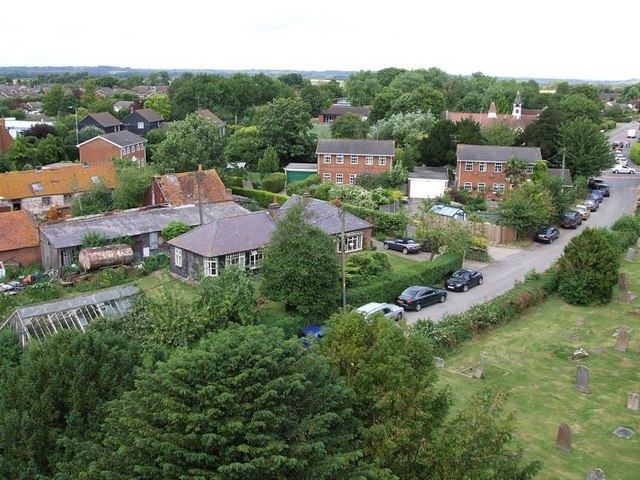
Aston Clinton is a historic village and civil parish in the Vale of Aylesbury in Buckinghamshire, England. The village lies at the foot of the Chiltern Hills, between the Wendover and Aylesbury arms of the Grand Union Canal. Surrounding towns include Wendover to the south, Aylesbury to the west, and Tring to the east - across the nearby county border with Hertfordshire.

Key Information

History

[edit]

It is believed that the village started at the crossing of two Roman roads, Akeman Street and Icknield Way,[2] both of which are still main roads in the village. After the fall of the Roman Empire, it became a Saxon settlement and remains of a Saxon cemetery were found during the construction of the Aston Clinton Bypass.

Before the Norman Conquest of England in 1066, the settlement was probably held under patronage of King Edward the Confessor. The village is recorded in the Domesday Book of 1086, where in Old English it was called Estone, which means "eastern estate".

The manor, later to be known as Aston Clinton, was for a short period after 1100 under the control of Edward de Salisbury, who was King Henry I's standard-bearer. In 1217 King Henry III gave it to Sir William de Farendon. However, by 1237 the manor was owned by the de Clinton family, hence the name at that time of Aston de Clinton. William de Clinton separated out from Aston Clinton to a new manor called Chivery as a dowry for his daughter Alice. Sometime after 1239, King Edward I granted the estates to the Montacutes, who were the ancestors of the Earls of Salisbury. Their descendant the Countess of Salisbury was beheaded by King Henry VIII in 1541. Successive families have owned the manor, passing by marriage from the Hastings to the Barringtons, Gerards, and then to Lord Lake of Aston Clinton later to become Gerard Lake, 1st Viscount Lake.

On 22 September 1934, a twin-engined biplane named Youth of New Zealand of Sir Alan Cobham's National Aviation Displays, crashed into a field near the canal at Aston Clinton.[3] The Youth of New Zealand had just departed from Heston Aerodrome after being refuelled when it crashed, killing all four crew. The probable cause was the failure of a bolt through metal fatigue.[4]

The car manufacturer Aston Martin took one part of its name from the nearby Aston Hill combining it with that of its co-founder Lionel Martin. The firm had great success in the Aston Clinton Hillclimb competition up nearby Aston Hill. A plaque now marks the site.

The modern parish of Aston Clinton was created in 1934. Of the other medieval manors:- Dundridge; Chivery; St Leonards and Vaches, historically all closely associated with Aston Clinton, only Chivery and Vaches have remained distinct parts of Aston Clinton, which now forms part of Aylesbury Vale District. Dundridge manor became part of the ecclesiastical parish of St Leonards which has itself since 1934 become part of the parish of Cholesbury-cum-St Leonards.

The village today

[edit]

There are many historic buildings with listed status in Aston Clinton including Anthony Hall, a concert hall situated in the centre of the village which was donated to the community by the widow of Anthony Nathan de Rothschild.[5] To the south-east of the village in Green Park was the former Aston Clinton House. The village also contains St. Michael and All Angels parish church, dating from the late medieval period.

The village was used as a filming location for the 1962 film Lolita.[6] The TV programme Hotel Babylon was filmed in Aston Clinton.[7][8]

Aston Clinton Household Recycling Centre opened in 2009 and was built to the north of the village off the A41 Aston Clinton bypass.[9]

In 2011 a new industrial park opened in Aston Clinton called Halton Brook Business Park, designed and developed by Horstonbridge Development Management which replaced an old dairy, demolished in 2006, that once stood in the same location. Two companies currently occupy Halton Brook, Zethon & DeSoutter Medical.

There are four pubs, three of which are on Green End Street: The Bell, The Partridge and The Oak. The Rothschild Arms is situated on Weston Road.

Notable residents

[edit]

Composer and lutenist Daniel Bacheler was born in the village in 1572.

The BAFTA and Oscar winning special effects make-up artist David Malinowski lives in the village.[10][11][12]

Australian Formula One driver Mark Webber lists Aston Clinton as his home in England where he lives with his partner Ann Neal.[13]

Robert Hendry Morton (25 September 1927 – 6 May 2002) was an English professional footballer, born in Aston Clinton, and who played for Luton Town. Morton holds the record for most appearances for the club, with 495 in the Football League and 550 overall.

Demographics

[edit]

According to the 2011 census there were 1,518 households in Aston Clinton with a Population of 3,682: 1,784 males and 1,898 females.[1] In accordance with the government plans to boost housing supply, due to the rising population, there has been an increase in new housing developments in Aston Clinton: The Burnhams (19 dwellings),[14] Stratford Close (20 dwellings),[15] 28 flats near the surgery,[16] four detached houses to the south of London Road[17] Pavilion Gardens (14 dwellings)[18] and The Willows (three large detached houses).[19] Between 2016 and 2021, further developments added 93 houses at Aston Brook (fields adjacent to Brook Street & College Road South, built by Bovis Homes) and 143 houses at Estone Grange (fields leading from Chapel Drive, built by Bellway). A further 93 houses are under construction at Little Green (fields adjacent to Aylesbury Road, Michael Shanly Homes) during 2022 and 2023[20]

Geography

[edit]

Aston Clinton is located at the northern edge of the Chiltern Hills, Buckinghamshire, to the east of Aylesbury.

Aston Clinton Civil Parish is bordered by other civil parishes to the:

Transport

[edit]

Historically, the A41 passed through Aston Clinton. A bypass was built around the north of the village, it was opened on the 3 October 2003.[21]

The village lies on several bus routes, with direct services to Aylesbury, Tring, Berkhamsted, Hemel Hempstead, Cheddington, Dunstable and Watford.

Education

[edit]

Aston Clinton School is a combined primary school located in the village. The head teacher is Carol Macdonald (known to students as Mrs Mac). The school badge bears resemblance to the Rothschild coat of arms, since the family built the first schools in the village.

See also

[edit]

References

[edit]
[edit]
Revisions and contributorsEdit on WikipediaRead on Wikipedia
from Grokipedia
Aston Clinton is a historic village and in , , situated at the foot of the and bisected by the Grand Union Canal. Covering an area of 12.32 square kilometers, it lies approximately four miles east of and had a of 4,917 at the 2021 census. The parish encompasses over 50% of the and features a mix of rural landscapes, including and , with the highest point reaching 817 feet above . The village's history traces back to before the of 1086, where it was recorded as Estone, reflecting its ancient origins at the junction of the Roman road and the prehistoric . By 1237, the manor was held by the , from whom the village derives its name, and it later passed to the in 1853, who developed Aston Clinton House into a grand estate now repurposed as , a business and conference center. Archaeological finds, including a Saxon , underscore its prehistoric and early medieval significance. Key landmarks include the 12th-century Church of St Michael and All Angels, a Grade II* listed building with medieval features, and Anthony Hall, constructed in 1884 as a village institute. The area gained motoring fame through early 20th-century hill climbs on Aston Hill, which contributed to the naming of the automobile brand. Today, serves as a commuter village with a focus on and local services, supported by its parish council, and it continues to preserve its heritage amid modern developments.

Geography and Demographics

Geography

Aston Clinton is a village and located in the district of , , positioned at the northern edge of the . The parish is notably long and narrow, stretching along the slopes of the Chilterns and encompassing a mix of rural landscapes. It lies approximately 4 miles east of , 3 miles west of in , and 11 miles south of in . The topography of Aston Clinton features gently undulating terrain at the foot of the , with the village center situated at an elevation of around 330 feet above . Elevations rise steeply to the south, reaching over 800 feet on the nearby hilltops within the Chilterns. The parish boundaries include Bierton with Broughton and Hulcott to the north, Buckland to the east, Cholesbury-cum-St Leonards and to the south, and Halton and Weston Turville to the west. To the north, the Wendover Arm of the Grand Union Canal marks a significant boundary, while expansive open countryside dominates the southern approaches. Environmentally, Aston Clinton benefits from its proximity to the Chilterns National Landscape, formerly designated as an , which encompasses diverse downlands, woodlands, and valleys supporting rich . The local geology is characterized by , evident in former quarries such as Aston Clinton Ragpits, a 3-hectare managed by the Berks, Bucks & Wildlife Trust. This site, once worked for high-quality , now features undulating grasslands that host eight species of orchids and more than 25 butterfly species, providing vital habitats for pollinators and rare flora. The region experiences a temperate maritime climate typical of , with mild winters and cool summers, average annual temperatures around 10–11°C, and rainfall averaging 700 mm per year, distributed fairly evenly but with wetter conditions in autumn influencing local farming practices.

Demographics

According to the , Aston Clinton had a of 3,682 residents living in 1,518 households. This marked a growth from its more rural character, reflecting a transition toward suburban expansion driven by proximity to major transport links. By the 2021 , the had increased to 4,917, indicating continued development and appeal as a commuter village. The age structure from the showed approximately 20% of residents under 16 years old, 60% in working age (16-64), and 20% over 65, highlighting a balanced demographic with a notable proportion of families and retirees. In 2021, the age distribution shifted slightly to 19.3% under 18 years, 59.8% aged 18-64, and 20.9% aged 65 and over. Ethnically, the population was predominantly at 95%, with small minorities including groups (3%), Asian or Asian British (1%), and mixed or other ethnicities (1%). This composition underscores the village's low ethnic diversity compared to national averages. By 2021, White residents comprised 93.5% (including 88.2% ), Asian 3.1%, mixed 1.8%, 0.8%, and other 1.0%. Housing trends have contributed to , with recent expansions including the completion of 93 homes at Aston Brook between 2016 and 2021 by Bovis Homes, located adjacent to Brook Street and College Road South. Additionally, 93 homes were constructed at Little Green, a development by Shanly Homes on fields adjacent to Road, between 2022 and 2024, featuring two-, three-, and four-bedroom houses. Average property prices in Aston Clinton reached around £500,000 in 2023, fueled by its commuter accessibility to and nearby towns like and . Socioeconomic indicators from the 2011 revealed 75% of residents aged 16-74 as economically active, with high levels of in professional and managerial roles. In 2021, the economically active rate (aged 16-74) was 72.4%, with 68.2% employed and 4.2% unemployed. Commuting patterns emphasized outward travel, with many residents journeying to via rail or to local business hubs, alongside a rise in family households that now form the majority of dwelling types.

History

Early and Medieval History

The location of Aston Clinton at the intersection of the prehistoric Icknield Way and the Roman Akeman Street—a major routeway from Verulamium (modern St Albans) to Corinium Dobunnorum (Cirencester)—provided a strategic position for early settlement. Archaeological excavations have uncovered evidence of Late Bronze Age and Early Iron Age activity, including boundary ditches, an enclosure, flint-tempered pottery sherds, animal bones (from cattle, sheep/goat, and horse), and possible ritual deposits such as human skull fragments, indicating occupation near watercourses and grazing lands. Roman influences are apparent in the vicinity, with ditches suggestive of field systems containing Roman pottery sherds, alongside nearby Late Iron Age and Romano-British settlements, underscoring the area's continuity from prehistoric times through the Roman period. Recorded as "Aston [Clinton]" in the of 1086, the settlement comprised 45 households (28 villagers, 4 smallholders, and 13 slaves), 17 ploughlands, 17 acres of meadow supporting 17 plough teams, woodland for 300 pigs, and 1 mill valued at 6 shillings and 7 pence. The manor was held by Edward of Salisbury as and lord, with its value assessed at 18 pounds in 1086 (down from 20 pounds in ), reflecting post-Conquest economic pressures amid feudal reorganization. By the early 13th century, the manor had passed to the de Clinton family, from whom the village derived its suffix around the 1230s; Geoffrey de Clinton, chamberlain to Henry I, held associated lands earlier in the century, linking the estate to royal service. In 1252, William de Clinton alienated the manor to William de Montagu in exchange for homage and service, initiating a pattern of feudal transfers involving knight's fees and agricultural obligations to overlords. The estate subsequently passed to families including the Montacutes and, by the 1500s, the Lees, who maintained its manorial structure under typical medieval tenurial duties such as renders of grain, labor, and military aid. A pivotal medieval development was the construction of St. Michael and All Angels Church around 1250, establishing a focal point for community and religious life amid the manor's feudal framework. The ancient roads continued to support local trade, channeling goods and travelers through the settlement and bolstering its economic role in the Chilterns region during the feudal era.

Modern History

In the 19th century, the of Aston Clinton's common fields was authorized by an passed in 1814, with the enclosure award finalized on 14 November 1816, fundamentally altering local farmland ownership and usage by consolidating scattered holdings into more efficient parcels. The completion of the Grand Junction Canal (now part of the Grand Union Canal) in 1805, running adjacent to the village near the former estate, enhanced agricultural trade by enabling faster and cheaper transport of goods like grain and lime to markets, stimulating local economic activity and contributing to the construction of new cottages and wharves. In 1853, Sir Anthony de purchased the manor from the , transforming the existing moated manor house into a grand Italianate mansion known as Aston Clinton House, which became a prominent with extensive gardens and served as a venue for political and social gatherings until its sale in 1923; the house was later used as a before being demolished in the 1960s, with the site now occupied by business park. During the , the village's population nearly doubled, growing from 721 inhabitants in 1801 to 1,279 by 1901, reflecting broader rural expansion driven by improved infrastructure and agricultural prosperity. The early 20th century brought notable events tied to aviation and motorsport. On 22 September 1934, a Handley Page H.P.30 aircraft named Youth of New Zealand crashed in a field at College Farm near Aston Clinton after suffering structural failure, resulting in the deaths of all four crew members: pilot Charles Henry Godwin Bremridge, engineer James Donovan, apprentice Donelly Arthur Dell Harington, and rigger Arthur Vernon Littlejohns. The village also gained cultural prominence through its association with early motorsport; in 1913, Lionel Martin and Robert Bamford's successful performance at the Aston Clinton Hill Climb inspired the naming of their automobile company as Aston Martin, combining "Aston" from the hill with Martin's surname. During World War II, Aston Clinton hosted evacuee children from London who were billeted in local homes to escape urban bombing risks. Post-war development transformed the village into a suburban commuter settlement. From the to the , significant housing expansions occurred on the village outskirts, driven by its proximity to and improved rail links, integrating Aston Clinton into the expanding commuter belt while preserving much of its rural character. The opening of the A41 on 3 October 2003 alleviated heavy through-traffic, enhancing resident quality of life by diverting commercial vehicles from village roads. In recent decades, economic diversification has marked the village's evolution. Halton Brook opened in 2011 on , providing modern facilities for industries including manufacturing, such as de Soutter Medical's expanded 35,000-square-foot operations focused on orthopaedic tools. By the 2020s, community efforts emphasized ; the Aston Clinton Council's 2025-2027 Action Plan, agreed in June 2025, outlines initiatives to enhance , including green space preservation and support for low-carbon options amid ongoing pressures.

Landmarks and Community Facilities

Historic Landmarks

St. Michael and All Angels Church, the oldest surviving structure in Aston Clinton, dates to the 13th century and serves as a central element of the village's medieval heritage. The church features a Norman font from the , reflecting early Romanesque influences, alongside later additions including a 14th-century and sedile, and 15th-century expansions to the and . High on the walls are paintings of the coats of arms belonging to historic local squires and lords of the manor, underscoring the site's ties to families that held the estate from the 13th to 18th centuries. The building underwent significant Victorian restorations in 1867, which included repairs to the and porches, with the south porch's upper storey originally functioning as a priest's room. Anthony Hall, a Grade II-listed timber-framed building in the village center, was constructed in 1884 as a memorial to Sir Anthony Nathan de Rothschild by his widow, Lady Louise de Rothschild, and designed by architect George Devey. It originally functioned as a concert and , contributing to the Rothschild family's efforts to enhance village amenities and community life during their 19th-century estate ownership. The hall's historical significance lies in its role as a venue for local gatherings, reflecting the philanthropic influence of the on Aston Clinton's social infrastructure. Aston Clinton House, a grand 19th-century mansion, was built in 1853 for Sir Anthony Nathan de Rothschild on the site of an earlier moated formerly owned by the Lake family. The structure adopted a classical style, characterized by a large square pile with a principal Grecian Doric front, and was later extended with additions such as a conservatory and . Its grounds included landscaped gardens featuring a redesigned stable block, the 'Fairy Glen' water feature, and a relocated kitchen garden with a formal parterre, all emblematic of mid-Victorian estate design. Following the Rothschild family's tenure, the house suffered fire damage and was demolished in 1956, with the site subsequently incorporated into RAF Halton and later developed as part of the Green Park estate. Among other historic sites, the Aston Clinton Ragpits represent an industrial legacy as a former worked for high-quality 'rag' freestone used in local building. Spanning approximately 6 acres at the foot of the Chiltern escarpment, the pits were abandoned after quarrying ceased, allowing natural colonization by and scrub habitats. Designated a , it became a managed by the Berkshire, Buckinghamshire and Oxfordshire Wildlife Trust around 2000, preserving its ecological value. Remnants of the Aston Clinton Hillclimb course, operational from 1904 to 1925 on land owned by , survive as sections of public road along Aston Hill, marking an early venue for motor racing events that influenced the naming of the marque.

Community and Education

Aston Clinton School serves as the village's primary , catering to children aged 4 to 11 in a community school setting with approximately 409 pupils. The school's original building, constructed in 1859 as a from Sir Anthony de Rothschild to his daughter Constance on her 16th birthday, reflects the family's historical philanthropic influence on local . The facility has undergone expansions, including a modern extension with a roof to accommodate growing enrollment, partly driven by recent housing developments in the area. Community facilities in Aston Clinton center around key venues that foster social engagement and local governance. The Anthony Hall, a Grade II-listed building erected in 1884 as a memorial to Sir Anthony de Rothschild, functions as a multi-purpose space for events, meetings, and gatherings organized by the parish council and resident groups. Local organizations, including the 1st Aston Clinton Scout Group offering programs for ages 6 to 18 and sports clubs such as the Aston Clinton Sports and Social Club and Bowls Club, utilize these spaces to promote youth development and recreational activities. Annual events like the Family Festival, held in Aston Clinton Park, feature fairground rides, live music, and community stalls, drawing residents together for celebration and fundraising. Healthcare services are accessible through the Aston Clinton Surgery, part of the Westongrove Partnership, which provides care to local residents from its location on London Road. Social hubs include the community-oriented Aston Clinton Stores for everyday essentials and The Bell pub, a historic 18th-century that hosts gatherings, live , and events, serving as a central point for village interactions. Volunteer initiatives, such as those by the Berks, Bucks and Oxon Wildlife Trust at the nearby Aston Clinton Ragpits , involve residents in maintenance and conservation efforts to enhance local . Cultural activities in Aston Clinton highlight its appeal as a filming location and commitment to heritage preservation. The village featured in the 1962 film Lolita, directed by , with scenes shot at local sites including a garage dressed as an American setting. In the 2000s, the series Hotel Babylon utilized properties in Aston Clinton for exterior and interior shots, capturing the area's picturesque charm. The Aston Clinton Society actively supports heritage efforts, including the upkeep of landmarks like the Grade II-listed , a dedicated in 1921 to commemorate local fallen soldiers from both world wars.

Economy and Transport

Economy

Aston Clinton's economy was historically centered on , serving as a remote farming community with six principal farms focused on and production during the early 19th century. The construction of the Aylesbury Arm of the Grand Union Canal in 1815 significantly enhanced economic activity by enabling the efficient transport of local goods, including and dairy products, to broader markets. Following , agricultural employment declined sharply, reflecting broader rural trends in the UK, with the sector now accounting for only 3% of local jobs as of the 2011 census. This shift transformed Aston Clinton into a commuter village, where a significant portion of the workforce relies on cars to travel to hubs such as and due to limited options. The 2011 census recorded an rate of 62.7% for residents aged 16-74, with at a low 2%, and 55.3% of workers in managerial, professional, or technical occupations. Key industries include and services (21%), wholesale and retail (18%), and (14%). As of 2018, the village supported 428 businesses, representing 5.3% of those in the then district (predecessor to the current unitary authority) and employing 4.5% of the local workforce, with a notable presence of home-based operations numbering around 34, many with fewer than 10 staff. A major employer is Halton Brook Business Park, established after 2003 on the outskirts, which hosts industrial and B2 units specializing in sectors like medical equipment production and . Other significant employers include the firm Arla. The A41 bypass, opened in October 2003, reduced through-traffic in the village center, potentially easing access for peripheral businesses while contributing to increased use of local roads as alternative routes during peak hours. Small-scale tourism bolsters the economy, drawing visitors to the Aston Clinton Ragpits , a 3-hectare site renowned for its including eight species and over 25 types, and to heritage events tied to the Aston Clinton Hillclimb, a fixture from 1904 to 1925. The reserve's orchid blooms, such as the record 19,143 counted in 2024, attract nature enthusiasts annually, while the 2025 centenary celebration of the hillclimb featured a sold-out , hill climb demonstration, and vehicle show. Home-based businesses have seen general growth in recent years, supported by improved digital infrastructure post-2020.

Transport

Aston Clinton's road network is dominated by the A41 trunk road, which historically followed the line of the Roman , a key route connecting (St Albans) to Alchester near and passing through the village center. The ancient Road, part of this alignment, served as a vital and artery in the medieval and early modern periods before modernization. To alleviate through the village, the A41 Aston Clinton —a 4-mile (6.4 km) —was constructed and opened on 3 October 2003, diverting through traffic away from local roads and completing the continuous expressway link from to Birmingham. Public transport in Aston Clinton relies on bus services, with no local railway station; the nearest is station, approximately 2 miles (3.2 km) north, on the offering frequent services to Euston and beyond. Local buses include routes 61 and 62 operated by Red Eagle, providing hourly connections to (south) and (north) from stops such as The Bell in the village center, with services running Monday to Saturday and reduced frequencies on Sundays. Additional express routes like the 500/X500 also serve the area, linking to and . For non-motorized transport, National Cycle Route 6 passes near Aston Clinton along the Grand Union Canal towpath, offering scenic off-road cycling and walking paths suitable for leisure and commuting. The canal's proximity provides accessible towpaths for pedestrians, with trails extending through nearby Buckland Wharf and integrating with local circular routes in the . Historically, the Grand Union Canal (originally the Grand Junction Canal, opened in 1805) facilitated freight transport through Aston Clinton, carrying goods like coal, timber, and agricultural products between and the Midlands until commercial traffic declined sharply in the 1950s and ceased regularly by the late 1960s due to competition from road and rail. The village also hosted the Aston Clinton Hillclimb, a pioneering event on public roads from 1904 to 1925, attracting early automobile enthusiasts and contributing to the development of as a competitive discipline.

Notable People

Historical Figures

Daniel Bacheler, baptized on 16 March 1572 in Aston Clinton, , was an English lutenist and composer who rose to prominence in the royal court. Initially apprenticed to a joiner, he transitioned to music and served as a lutenist and dancing-master at the court of Queen Elizabeth I. In 1610, Bacheler published Varieties of Lute-Lessons, a collection of 58 pieces for that showcased his innovative variations and pavans, earning dedication to court patrons. Following Elizabeth's death, he continued his career under Queen Anne of until his death in 1619. Milo Crispin, a prominent Norman also known as Miles of Wallingford, held significant lands in following the , including a portion of Aston Clinton recorded in the of 1086. As lord of and over 80 manors, Crispin's tenure in Aston Clinton reflected his role in consolidating Norman control over former Anglo-Saxon estates previously held by a woman named Wlwen. He died without issue in 1107, leading his estates to revert to the Crown or heirs through his wife. In the 19th century, Sir Anthony de Rothschild (1807–1884), a prominent member of the Rothschild banking family, acquired the Aston Clinton estate in 1853 and transformed it through philanthropy and development. He commissioned the construction of Aston Clinton House in 1855, a grand Italianate mansion that served as the family seat until its demolition in 1958. With his wife Louisa, de Rothschild funded the village's national school in 1860, providing education for local children and embodying the family's commitment to community welfare in .

Contemporary Residents

Mark Webber, born in 1976, is an Australian former driver who resided in Aston Clinton during much of his racing career in the 2000s and 2010s. He competed in from 2002 to 2013, securing nine Grand Prix victories, including wins at the in 2010 and 2012, the in 2012, and the Brazilian Grand Prix in 2011. Webber, known for his tenure with the team, also achieved 13 pole positions and 42 podium finishes over 215 race starts, contributing to his reputation as one of the sport's enduring talents. His connection to the village included community involvement, such as officially opening the Aston Clinton Tennis Courts in 2013. David Malinowski, a based in Aston Clinton, has made significant contributions to film through his work on major productions. He earned a BAFTA Award for Best Makeup and Hair and an Academy Award for Best Makeup and Hairstyling for his transformative work on as in (2017). Malinowski also contributed to the series, serving as a prosthetics and hair workshop technician on (2007), among other credits in visual effects makeup for films like (2022) and (2013). As a longtime resident, he has been recognized locally for his professional achievements while maintaining ties to the community. Robert Hendry Morton (1927–2002), born in Aston Clinton, was a professional footballer renowned for his loyalty to Luton Town, where he holds the club record for most Football League appearances with 495. Making his debut in 1948, Morton played as a and forward, scoring 48 league goals over a 16-year career that spanned the to , including a notable appearance in the . He featured in matches against top teams like Tottenham Hotspur, contributing to Luton's competitive presence in the First Division during the post-war era. Morton's local roots and enduring club service underscore his impact as a hometown figure in football history.

References

Add your contribution
Related Hubs
User Avatar
No comments yet.