


Community hub
Recent from talks
Contribute something
Nothing was collected or created yet.
Avanos
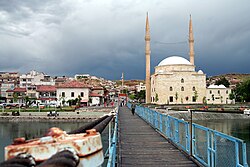
View on WikipediaAvanos is a town in Nevşehir Province in the Cappadocia region of Central Anatolia, Turkey, located 18 km (11 mi) north of Nevşehir, the capital city of the province. It is the seat of Avanos District.[2] Its population is 14,968 (2022).[1] Historically known as Venessa, modern Avanos stands on the banks of the longest river of Turkey, the Kızılırmak (Red River), the ancient Halys.
Key Information


Avanos' most important industry is pottery production, an industry which probably dates back to Hittite times and which makes use of clay from the red silt of the Kızılırmak. The town is also a popular tourist destination because of its attractive old town and riverside location.[3]
Like the rest of Cappadocia, Avanos has a continental climate with very hot, dry summers, and cold, snowy winters.
History
[edit]Old Avanos is riddled with a network of small underground "cities" which may have once been residential but are now mainly used by the many pottery enterprises. Although there is no documented evidence to prove when these structures were carved out of the earth, it is probable that work on some of them began in the Hittite period.
As Venessa, ancient Avanos was the third most important town in the Kingdom of Cappadocia (332 BC – 17 AD) according to the geographer Strabo.[3] Although it was the site of an important temple of Zeus, nothing remains of it today.[3] In Roman and Byzantine times, Avanos had a large Christian population who were responsible for the rock-cut Dereyamanlı Kilisesi.[4] Unusually, this is still occasionally used even today.
From 1867 until 1922, Avanos was part of Angora vilayet. Most of the visible remains of Avanos' history date from the 19th and early 20th centuries and take the form of many impressive stone houses, mostly built by the now-displaced Greek and Armenian populations. These houses are found in the older part of the city on the northern bank of the river.[3] Avanos expanded rapidly in the early 2000s and there is now a lot of modern housing on the southern side of the river which was extensively landscaped and developed for recreational purposes in the years after 2010.[3]
Attractions around Avanos
[edit]Çalış
[edit]- In 2019 unexpected flooding in the small settlement of Çalış, north of Avanos town, led to the discovery of an approximately 5,000-year-old three-story underground town referred to as “Gir-Gör” (Enter and See) by locals. The five-kilometre-long "city" contained homes, tunnels, and places of worship. A small human figurine was discovered inside the site. According to the locals, the site was considered a source of healing water and was called “Caesar’s bath". It is not currently open to the public.[5][6]
About 5 km (3 mi) from Avanos and 1 km (1 mi) from Paşabağ, the site of Zelve was developed across three valleys on the steep northern slopes of Aktepe. It is not known exactly when people began living in the rock-cut dwellings in a troglodytic lifestyle common to other places in the region such as Uçhisar, Göreme and Cavuşin. An important Christian community lived in Zelve which was the religious centre for the area from the 9th to the 13th centuries. The first religious seminars for priests were held in the vicinity.
- Paşabağ and Devrent
At Paşabağ there are a large number of distinctive fairy chimneys with particularly sharp points and thick trunks. There is even a police station inside one of them. Devrent is known for rock formations into which people read carvings such as a camel. [7]
The impressively frescoed Church of St John the Baptist (also known as the Nicephorus Phocas Church or the Great Pigeon House) stands beside the Avanos-Göreme road on the edge of the village of Çavuşin. It dates back to 964-965 AD.[8] A second church, also called St John the Baptist, is harder to find inside the old part of the village.[8]
- Güllüdere
Dating back to the 6th or 7th century, the church of St. Agathangelus is located on the far left side of the Güllüdere valley about 2 km (1 mi) from the village of Çavuşin. The nave is square and ends in a single broad apse added to the main structure in the 9th or 10th century. The two or three layers of frescoes in the apse indicate that it was repainted regularly. Symbols of the Gospel writers are placed on the right and left of an enthroned Jesus. In the middle of the flat ceiling a relief cross is shown in the middle of a circle surrounded with palm leaves and garlands. It probably dates back to the Iconoclastic period.[9]

Located 14 km (9 mi) northeast of Avanos, this underground city was carved out of the northern slopes of Mt. Idis in an area with many volcanic granite strata. Its extensive galleries are spread out over a large area and connected to one another by tunnels. The city was discovered in 1972 by the local muezzin and farmer Latif Acar when he was trying to discover where the water disappeared to when he was tending his crops. He uncovered one underground room which later turned out to be a whole "city" which might have housed an incredible 60,000 people for up to three months at a time. A total of 10 floors were discovered, dropping to a depth of 40m below ground, although only four are open to the public.[10]
See also
[edit]References
[edit]- ^ a b "Address-based population registration system (ADNKS) results dated 31 December 2022, Favorite Reports" (XLS). TÜİK. Retrieved 22 May 2023.
- ^ İlçe Belediyesi, Turkey Civil Administration Departments Inventory. Retrieved 22 May 2023.
- ^ a b c d e Yale, Pat. "Avanos". Turkey from the inside.
- ^ "Dereyamanlı (Avanos)". 17 October 2019.
- ^ "Mysterious flooding leads to discovery of 5,000-year-old underground city in Turkey's Cappadocia". Daily Sabah. 2019-06-08. Retrieved 2020-09-17.
- ^ "Mysterious flooding leads to the discovery of 5,000-year-old underground city in Turkey's Cappadocia | ARCHAEOLOGY WORLD". 11 December 2019. Retrieved 2020-09-17.
- ^ Yale, Pat. "Paşabağ".
- ^ a b Yale, Pat. "Çavuşi̇n".
- ^ "Güllü Dere Church 5". 16 April 2020.
- ^ Yale, Pat. "Özkonak".
External links
[edit]
- District municipality's official website (in Turkish)
- Maps of Avanos (in English)
- Zelve with pictures and information (in English)
- Hundreds of pictures of Avanos
- Travel Information for Avanos
- Information about Pottery and the Hair Museum of Avanos
- General information on Avanos, Governorship of Avanos.
| Municipalities | |
|---|---|
| Villages |
|

| International | |
|---|---|
| National | |
| Other | |

Avanos
View on GrokipediaGeography
Location and Topography
Avanos is situated in the Nevşehir Province of Central Anatolia, Turkey, within the Cappadocia region, at coordinates 38°42′54″N 34°50′48″E.[7] The town lies at an elevation of approximately 920 meters above sea level, contributing to its highland character amid the Anatolian plateau.[8] The town is positioned along the banks of the Kızılırmak River, known in antiquity as the Halys, which is Turkey's longest river at 1,355 kilometers.[9] This river has influenced the town's layout, with notable southern expansion across its course following urban development initiatives in the early 2000s, allowing growth beyond the traditional northern settlements. Avanos is approximately 18 kilometers north of Nevşehir, the provincial capital, and forms part of the broader Cappadocian triangle that includes sites like Ürgüp and Göreme, facilitating connectivity within the region's iconic landscapes.[10] The surrounding topography features dramatic rock formations, including the distinctive fairy chimneys—tall, conical spires shaped by erosion—that dot the valleys and plateaus nearby, such as Paşabağ Valley just 5 kilometers south.[11] These elements create a rugged, undulating terrain of soft volcanic rocks interspersed with deeper river-cut gorges. Geologically, the area's landscape stems from Miocene-era volcanic activity, primarily from the Erciyes and Hasan mountains, which deposited layers of ash and lava that consolidated into tuff, a soft, porous rock prone to erosion and sculpting by wind and water over millions of years.[12][13] This tuff formation underpins the fairy chimneys and broader Cappadocian topography, with the Kızılırmak River's clay-rich sediments also supporting local pottery traditions.[12]Climate
Avanos features a continental climate characterized by distinct seasonal variations, with hot, dry summers and cold, snowy winters. According to the Köppen-Geiger classification, it falls under Dsa, reflecting a hot-summer humid continental subtype typical of inland Central Anatolia. Average high temperatures in July reach 30–32°C, while January lows drop to -5°C to 0°C, with extremes occasionally exceeding 35°C in summer or falling below -10°C in winter. This temperature contrast underscores the region's exposure to the broader Anatolian plateau's influences. Annual precipitation averages around 444 mm, concentrated primarily in the winter and spring months, with April being the wettest at approximately 63 mm. This seasonal rainfall pattern replenishes the Kızılırmak River, maintaining its flow levels essential for local irrigation and supporting agricultural activities such as cereal and vegetable cultivation during the growing season. Snowfall accumulates to about 90 cm annually over the four-month snowy period from November to March, enhancing groundwater recharge but also contributing to occasional flooding risks along the riverbanks. The Kızılırmak River exerts a moderating influence on Avanos' microclimate, providing slightly higher humidity and tempering extreme temperatures compared to the drier, more arid surrounding plateaus. This riverine proximity results in marginally milder winters and cooler summer nights than in upland Cappadocian areas. However, the region remains susceptible to occasional dust storms originating from the Anatolian plateau, particularly during dry summer periods, which can reduce visibility and deposit fine sediments. In comparison to the broader Cappadocian climate, which experiences more pronounced aridity and temperature swings due to its elevated terrain, Avanos benefits from the river's stabilizing effects, fostering a relatively more balanced environmental regime.History
Ancient and Hittite Periods
The ancient settlement at Avanos traces its origins to the Bronze Age, with evidence of human activity dating back to the Hittite period (circa 2000–1200 BC). Hittite cuneiform tablets excavated from the royal archives at Boğazköy (ancient Hattusa) refer to the site as Zu-Winasa or Nenassa, indicating it was a recognized locality within the empire's central Anatolian territories.[2] Swiss linguist Emil Forrer first identified this name in 1926 while deciphering over 3,000 clay tablets, linking the toponym to a riverine settlement along the Halys River (modern Kızılırmak).[14] Archaeological surveys in the vicinity, including at Akarca near Avanos, have uncovered a Middle Bronze Age stele (dated 1900–1750 BC) featuring cultic reliefs of deified figures and ritual scenes, suggestive of early religious practices and cultural exchanges with northwest Syrian traditions like those at Ebla.[15] These finds, combined with traces of underground storage and dwelling structures carved into the soft volcanic tuff, point to organized settlements adapted to the region's terrain for defense and resource management.[2] Avanos played a key role in Bronze Age trade networks facilitated by its position on the Halys River, which served as a vital artery for commerce between central Anatolia and Mesopotamian centers. The river's red silt provided abundant clay for pottery production, a craft whose origins in the area are tied to Hittite artisans; excavations reveal early ceramics and tools indicative of local manufacturing and exchange along overland routes.[2] This economic activity positioned the settlement within the broader Assyrian trading colonies (kārum) system in Anatolia, where goods like metals, textiles, and ceramics flowed through river crossings and nearby paths.[16] Following the Hittite collapse around 1200 BC, the area experienced Phrygian influences before coming under Achaemenid Persian control in the 6th century BC, during which Cappadocia was known as Katpatuka ("land of fine horses").[17] In the Hellenistic era, after Alexander the Great's conquest in 332 BC, Avanos—renamed Venessa—emerged as a significant riverine hub in the Kingdom of Cappadocia (332 BC–17 AD). The Greek geographer Strabo described Venasa as a major temple center in the Morimene district, dedicated to Zeus Venasios, with approximately 3,000 temple servants and an annual revenue of 15 talents from sacred lands; its priesthood ranked third in influence after those at Comana and Pontic Zela.[18] Ancient texts, including Herodotus' Histories, highlight the site's strategic importance as a Halys River crossing point; in 546 BC, the philosopher Thales reportedly diverted the river's course near modern Sarıhıdır village in Avanos to aid Lydian king Croesus' army against the Persians, an event possibly evidenced by a 10-meter-wide ancient water tunnel uncovered in archaeological surveys.[19] This location on the Royal Road enhanced Venessa's role in facilitating trade and military movements between Persian satrapies and Hellenistic kingdoms.[16]Byzantine, Ottoman, and Modern Eras
During the Byzantine era, from the 4th to the 11th centuries, Avanos and the surrounding Cappadocia region served as a vital Christian center within the Theme of Cappadocia, a key administrative and military district of the empire. Monastic communities flourished starting in the 4th century, inspired by figures like Basileios the Great, Bishop of Kayseri, who encouraged anchorite settlements in rock-hewn cells carved from the soft volcanic tuff. These included numerous rock-cut churches and monasteries, such as those in the nearby Göreme Valley and Zelve Open-Air Museum, which featured frescoes depicting biblical scenes and served as refuges during periods of iconoclasm (725–842) and Arab invasions. Avanos itself benefited from this network, with troglodyte villages and subterranean complexes adapted from earlier underground structures providing protection against raids, while the region's strategic location along trade routes supported economic and cultural exchange.[10][20] The Battle of Manzikert in 1071 marked a pivotal shift, as the Seljuk Turks' victory over Byzantine forces under Emperor Romanos IV Diogenes led to the rapid erosion of imperial control in Anatolia, including Cappadocia. Following this, the Seljuk Sultanate of Rum established control over the region from the late 11th to the 14th century, promoting Turkish settlement and Islamic culture while continuing pottery traditions. During this period, the town was renamed Evronos (later evolving into Avanos) in honor of a Seljuk commander, Evranos Bey.[2][5] By the Ottoman period, Avanos integrated into the empire's administrative structure, becoming part of the Angora Vilayet from 1867 to 1922, a province centered on Ankara that encompassed much of central Anatolia. During the 19th and early 20th centuries, diverse communities thrived, with Greek Orthodox and Armenian populations constructing characteristic stone houses that blended local tuff architecture with Ottoman influences, contributing to the town's vibrant multicultural fabric amid pottery production and agriculture. These groups, who formed a significant portion of Avanos' residents, maintained religious sites and social institutions until the empire's final decades.[21][20] The early 20th century brought profound changes through the 1923–1924 population exchanges mandated by the Treaty of Lausanne, which forcibly relocated approximately 60,000 Cappadocian Greeks, including Avanos' Greek community, to Greece in exchange for Muslim populations from Greece. This demographic upheaval reshaped Avanos into a more homogeneous Turkish settlement, with many stone houses repurposed by incoming refugees. Post-World War II modernization efforts accelerated in the mid-20th century, as Turkey's economic policies promoted infrastructure development and the emergence of tourism, drawing visitors to Cappadocia's unique landscapes and historical sites by the 1960s and 1970s. In Avanos, this manifested in urban renewal projects, culminating in the development of the Kızılırmak Riverside Recreation Area along the town's riverbanks, which enhanced public spaces with amphitheaters, walkways, and event venues to support growing tourism while preserving the area's heritage.[10][22]Demographics
Population Statistics
As of the 2022 census conducted by the Turkish Statistical Institute (TÜİK), the population of Avanos town stood at 14,968 residents.[23] Projections based on recent growth trends from TÜİK data indicate an increase to approximately 16,000 by 2025, influenced in part by seasonal influxes related to tourism.[23] Historical population trends in Avanos show steady growth, rising from 12,288 in the 2000 census to the current figure, reflecting an average annual increase of about 1% over the longer term but accelerating to 2–3% in recent years (2017–2022).[23] This pattern aligns with broader migration dynamics in the region, including post-2000 shifts from surrounding rural areas to the town center driven by improved infrastructure and opportunities.[24] The urban-rural distribution within the Avanos district highlights approximately 46% of the population residing in the urban town center, with the remaining 54% in surrounding villages and towns, contributing to an overall population density of around 36 persons per km² in the district and higher in the urban core.[25]Ethnic and Religious Composition
Avanos features a predominantly ethnic Turkish population that adheres to Sunni Islam, accounting for over 95 percent of its residents, consistent with broader patterns in central Anatolia.[26] Small Alevi communities, representing a distinct heterodox Islamic tradition, persist in rural villages near the town, influenced by the region's proximity to key Alevi spiritual sites like the Hacı Bektaş Veli Complex in neighboring Hacıbektaş.[27] These Alevi groups maintain unique religious practices amid the Sunni majority, though they form a minority within the district. The ethnic and religious landscape of Avanos bears traces of Ottoman-era diversity, particularly from Greek Orthodox and Armenian Christian communities that once thrived in Cappadocia.[28] These populations, which included speakers of Cappadocian Greek and contributed to the region's multicultural fabric, were significantly reduced following the 1923 Greco-Turkish population exchange, which relocated approximately 100,000 Christians from Cappadocia to Greece.[29] Today, non-Muslim residents comprise less than 1 percent of the population, with remnants of Christian heritage visible primarily in historical architecture rather than active communities.[26] Avanos experiences temporary ethnic diversity through seasonal workers drawn to its tourism and agriculture sectors, including migrants from eastern Turkey such as Kurds who contribute to the local economy during peak periods.[30] This influx adds layers of cultural interaction but remains transient, as most workers return to their home regions outside the high season. Linguistically, Turkish serves as the primary language of daily life and administration in Avanos, reflecting the town's integration into modern Turkey. However, echoes of the Cappadocian Greek dialect—once spoken by the region's Byzantine-descended Christians—survive in local folklore, oral traditions, and scholarly reconstructions, preserving a link to pre-exchange heritage.[31]Economy
Pottery and Ceramics Industry
Avanos has a long-standing tradition in pottery production, with origins tracing back to the Hittite period in the Late Bronze Age (circa 1650–1200 BCE), where the region's fertile red clay deposits were first utilized for crafting utilitarian and ceremonial vessels.[32] Archaeological evidence from the area indicates continuous ceramic activity through subsequent Phrygian, Persian, Roman, Byzantine, Seljuk, and Ottoman eras, with the town's name evolving from the Hittite "Zuwinasa" through various forms like "Evranos" under Seljuk rule.[32] The distinctive red clay sourced from the sediments of the nearby Kızılırmak River—Turkey's longest river—remains central to this craft, providing a malleable material ideal for shaping.[33] This resource has sustained pottery as a core economic activity, blending ancient methods with evolving practices to produce items ranging from household wares to decorative pieces. Traditional techniques in Avanos emphasize handmade processes, beginning with the preparation of clay mixed with fine white sand and water to achieve pliability.[34] Artisans primarily employ wheel-throwing on a unique short-shaft, foot-powered potter's wheel positioned between the legs, allowing for precise shaping of forms like bowls, jars, and tiles.[32] Pieces are then air-dried for one to two days, trimmed, and often hand-painted with intricate Anatolian motifs such as spiral blue arabesques or floral patterns before firing. Firing occurs in traditional cylindrical "black kilns" at temperatures around 700°C, though wood-fired kilns have historically been used for their ability to impart a warm, earthy tone to the red clay.[32] These methods, passed down through family generations, highlight the labor-intensive nature of the craft, requiring years of apprenticeship to master.[33] In the contemporary era, Avanos hosts approximately 50 pottery workshops, many operating in natural rock caves, which employ around 250 artisans, including 150 skilled masters.[32] This sector supports the livelihoods of about 1,500 local residents, underscoring its role as a pillar of the community's economy, particularly through integration with Cappadocia's tourism industry. However, as of 2025, there has been a noted decline in tourist engagement with pottery workshops due to alternative activities.[32][35] Since the 1970s, Avanos pottery has gained international recognition, with exports to Europe increasing its market value and sustaining workshop growth—from around 70 ateliers in the 1980s to a peak of 75 in the 2000s.[36] Post-2000 innovations, such as the adoption of electric lathes, gas and electric furnaces, and plaster molds for replication, have enhanced production efficiency while preserving handmade aesthetics, allowing for value-added designs that appeal to global buyers.[32] Prominent figures like master potter Chez Galip (Galip Körükçü), a sixth-generation artisan, exemplify the blend of tradition and innovation; his family-run studio not only produces ceramics but also offers educational workshops to revive interest among younger generations, countering a decline in apprentices since the 1980s.[37] Overall, the pottery industry contributes substantially to Avanos's local economy by generating employment and fostering cultural continuity within the UNESCO-listed Göreme National Park and the Rock Sites of Cappadocia, where the craft bolsters regional heritage tourism.[38]Tourism and Agriculture
Tourism serves as a vital economic driver in Avanos, contributing significantly to the local economy through its integration with the broader Cappadocia region's attractions. In 2023, Cappadocia, encompassing Avanos, recorded a record 4.8 million visitors to its museums and archaeological sites, marking a substantial increase from previous years and highlighting the area's growing appeal. In 2024, the region saw further growth, with nearly 5 million visitors overall.[39][40] Hot air balloon rides over the unique landscapes and pottery tours in Avanos stand out as primary attractions, drawing adventure seekers and cultural enthusiasts alike. The hot air balloon sector hosted a record 933,195 tourists in 2024, underscoring its role in boosting visitor numbers.[41] Agriculture remains a foundational element of Avanos's economy, complementing tourism with traditional farming practices sustained by the Kızılırmak River's irrigation. The region focuses on grape and apricot cultivation, key crops that support local livelihoods and contribute to Nevşehir province's agricultural output. Apricots in Nevşehir are primarily grown for drying, while grapes fuel the area's viniculture, with production centered in nearby vineyards that produce wines from native varieties.[42] These sectors generate steady income, particularly through exports and local processing, though specific annual yields vary based on climatic conditions.[43] Supporting infrastructure enhances Avanos's accessibility for tourists and sustains agricultural operations. The town hosts over 900 accommodation options, including more than 50 hotels providing approximately 2,000 rooms, catering to the influx of visitors. Transport links include the Nevşehir Kapadokya Airport, located about 30 kilometers away, facilitating easy access for international arrivals.[44] The economy exhibits seasonal patterns, with tourism peaking in summer months due to favorable weather for outdoor activities, while winter shifts emphasis to agricultural tasks like harvesting and preparation.[45] This duality ensures year-round economic stability, with pottery workshops briefly attracting tourists as a cultural complement to these primary sectors.[46]Culture
Traditional Arts and Crafts
Avanos is renowned for its pottery traditions, which draw inspiration from Cappadocian folklore through motifs such as geometric patterns, floral designs, and representations of the region's iconic fairy chimneys and cave dwellings. These elements reflect the area's unique landscape and ancient storytelling, often incorporating spiral and arabesque styles influenced by historical Islamic art.[47][48][49] Beyond pottery, traditional crafts in Avanos include carpet weaving, utilizing wool sourced from local sheep sheared annually, woven on wooden looms with natural dyes to create intricate patterns symbolizing nomadic heritage. Onyx stone carving, drawn from regional quarries in Cappadocia, involves artisans shaping the semi-precious stone into jewelry, sculptures, and decorative items, highlighting the area's volcanic geology.[50][51][52][53] The preservation of these crafts relies on apprenticeship systems within family workshops, where techniques are passed down through generations—typically from father to son in pottery and onyx carving, and from mother to daughter in carpet weaving—countering modernization's pressures through hands-on training in traditional methods like wheel-throwing and hand-painting.[33][54][55][51] Pottery holds deep cultural significance in Avanos as a link to ancient Hittite practices dating back to 2000 BCE, embodying communal identity and artistic expression through its enduring role in daily life and heritage.[6][52]Local Traditions and Cuisine
Avanos hosts the annual International Avanos Pottery Festival in mid-August, a vibrant event that celebrates the town's ancient ceramic heritage through live demonstrations, interactive workshops, and bustling markets showcasing local artisans' works.[56] The festival draws participants and visitors to engage in pottery competitions, where skilled potters compete in traditional techniques, fostering community pride and cultural continuity.[56] Spring brings the Hıdırellez celebrations on May 6, a UNESCO-recognized festival marking the arrival of warmer weather and renewal, with locals gathering along the banks of the Kızılırmak River for picnics, bonfire rituals, and wish-making traditions tied to the flowing waters.[57] These river-side gatherings often include folk dances and communal feasts, symbolizing harmony with nature and the end of winter.[58] In Avanos, the event emphasizes rituals like tying wishes to tree branches near the river or floating offerings in the current, blending Anatolian folklore with local geography.[59] Social customs in Avanos reflect deep-rooted Turkish hospitality, where visitors and locals alike share tea in cozy pottery cafes overlooking the Kızılırmak, a gesture that embodies warmth and openness central to daily interactions.[60] These gatherings in cafes adorned with handmade ceramics encourage storytelling and connection, often extending into evening conversations. Wedding practices incorporate the town's pottery legacy, with a longstanding tradition holding that men must master ceramic skills before marriage, as families historically viewed pottery proficiency as essential for providing for a household.[61] Brides may receive sets of handmade ceramics as dowry items or gifts, symbolizing durability and craftsmanship in union.[62] Avanos' cuisine draws from Cappadocia's fertile lands and multicultural history, featuring hearty dishes that highlight local ingredients and cooking methods. Testi kebab, a signature meat stew of lamb or beef with vegetables slow-cooked in sealed clay pots sourced from Avanos' workshops, exemplifies the fusion of culinary tradition and ceramic artistry, yielding tender flavors infused with smoky essence.[63] Nevşehir tandoor bread, or tandır ekmeği, baked in earthen ovens from dough slapped against hot clay walls, accompanies meals with its crisp exterior and soft interior, a staple reflecting regional baking heritage.[64] River fish dishes from the Kızılırmak, such as grilled or stewed freshwater varieties served at splash-side eateries like Sur Balık, offer fresh, simple preparations seasoned with herbs and lemon, celebrating the town's waterside location.[65] Desserts incorporate Avanos' abundant apricots, as in kayısı tatlısı—dried apricots stuffed with walnuts, poached in syrup, and topped with kaymak (clotted cream)—a light, nutty treat that showcases the fruit's natural sweetness and the area's orchard bounty.[66] Cappadocian multiculturalism, shaped by Greek, Armenian, and Turkish influences over centuries, manifests in fusion foods like mezes: small plates of yogurt-dipped vegetables, olive oil-marinated eggplant, or herb-infused dips reminiscent of Greek traditions, served communally to evoke shared Anatolian histories.[67]Tourism and Attractions
Natural and Geological Sites
Avanos, situated in the heart of Cappadocia, is renowned for its dramatic natural landscapes shaped by millennia of volcanic activity and erosion, offering visitors a glimpse into the region's unique geological heritage. The surrounding valleys and riverine areas feature striking rock formations and terrain that highlight the interplay of tuff layers and weathering processes, creating accessible outdoor sites ideal for exploration and appreciation of Cappadocia's otherworldly terrain.[68] Paşabağ Valley, often called Monks' Valley, showcases some of the most iconic mushroom-shaped fairy chimneys in the region, with tall, slender spires topped by harder capstones that protect the softer underlying tuff from rapid erosion. These formations resulted from volcanic eruptions that deposited layers of ash approximately 10 to 15 million years ago during the Miocene epoch, followed by differential erosion from wind, rain, and temperature fluctuations that sculpted the soft volcanic tuff into isolated pillars. Hiking trails wind through the valley, allowing visitors to closely observe these geological wonders up to 40 meters high, where the interplay of erosion has preserved a high concentration of such chimneys.[68][13][69] Adjacent to Paşabağ, Devrent Valley—commonly known as Imagination Valley—presents a surreal collection of wind-eroded rock formations resembling animals and mythical figures, such as a camel, snake, and seal, formed through the same prolonged erosion of tuff deposits over millions of years. Unlike the taller chimneys elsewhere, these low-lying, rounded outcrops create a natural gallery for photography, with the valley's undulating terrain emphasizing the creative forces of nature on Cappadocia's volcanic bedrock. The site's proximity to Avanos makes it a convenient stop for those exploring the area's geological diversity.[70][71][72] To the south of Avanos, the Zelve area features eroded badlands characterized by deeply incised valleys and wind-sculpted tuff formations, representing a stark example of Cappadocia's ongoing geomorphic evolution through the weathering of soft volcanic ash layers. These badlands, part of the broader tuff plateau, exhibit pinnacles and gullies formed by fluvial and aeolian erosion over geological timescales, with the site's location in Nevşehir District enhancing its accessibility for geological observation. The rugged, barren landscape provides insight into the region's tuff-dominated geology without the denser vegetation found elsewhere.[73][74][13] The Kızılırmak River, Turkey's longest at 1,350 kilometers, meanders through Avanos, offering scenic viewpoints along its red-hued banks where riverside walks reveal layered sedimentary exposures and opportunities for birdwatching amid riparian habitats. The river's path has carved gentle valleys and supported diverse avian species, such as herons and kingfishers, in the surrounding floodplain, providing a contrasting watery element to the arid tuff landscapes. These accessible spots along the river emphasize its role in shaping Avanos' local topography over millennia.[75][76][68]Historical and Cultural Sites
Avanos boasts several remarkable historical and cultural sites that reflect its layered past, from ancient subterranean refuges to Byzantine rock-cut architecture and unique modern curiosities. These landmarks highlight the town's role as a crossroads of civilizations in Cappadocia, offering insights into early Christian worship, defensive engineering, and Ottoman-era domestic life.[77][2] The Özkonak Underground City, located approximately 14 kilometers northeast of Avanos on the northern slopes of Mount İdiş, exemplifies ancient engineering ingenuity. Dating back thousands of years with possible origins in the Hittite period around 2000–1200 BCE and further development in the Phrygian era (8th–7th centuries BCE), this multi-level complex was designed as a shelter during invasions. Excavations since its discovery in 1972 have revealed up to 10 levels, though only four are currently accessible to the public, featuring interconnected chambers for living quarters, storage rooms, stables, and wineries. Sophisticated ventilation shafts—some disguised as grain silos—ensured air circulation even when sealed, allowing it to sustain up to 60,000 people for several months. Defensive elements, such as massive rolling stone doors and narrow passageways, underscore its role in protecting inhabitants from threats.[78][79][80] In the nearby village of Çavuşin, the Church of St. John the Baptist stands as one of Cappadocia's oldest and largest rock-cut basilicas, constructed in the early 6th century CE during the height of Byzantine expansion. Carved directly into the soft tuff rock, the structure follows a basilica plan with a wide nave (about 20 meters), side aisles separated by arcades, and a horseshoe-shaped apse measuring 6 by 5 meters, complete with a synthronon (seating for clergy) and a central cathedra. A crypt beneath the apse likely held relics, possibly of St. John the Baptist or the local martyr St. Hieron, as indicated by historical inscriptions identifying the site as Kodessanè. The church's frescoes, added in the 10th century (circa 964–965 CE), adorn the walls and apse with vivid biblical scenes in Byzantine style, including the Annunciation, Nativity, Crucifixion, Resurrection, Ascension, the Beheading of John the Baptist, and Christ in Glory. These weathered yet preserved paintings, executed in flat, stylized figures with rich symbolism, reflect the Macedonian Renaissance artistic tradition and early Christian devotion in the region. Abandoned after rockfalls in 1963, the site remains open to visitors via a short hike.[77] The Chez Galip Hair Museum offers a quirky contrast to Avanos's ancient heritage, housed in an underground cave beneath a traditional pottery workshop. Founded in 1979 by local ceramic artist Galip Körükçü (known as Chez Galip), the collection began when a French tourist left a lock of her hair as thanks for a gift, inspiring others to contribute mementos of their visits. Today, it features over 16,000 locks from women worldwide, each preserved in handcrafted pottery vessels and labeled with the donor's name and hometown, creating a tapestry of colorful strands cascading across the walls. This unconventional archive serves as a personal time capsule, blending Avanos's pottery tradition with themes of memory and transience, and remains accessible to the public as part of the workshop experience.[81][82] Avanos's 19th-century Greek stone houses provide tangible examples of Ottoman-era urban architecture, built by the town's Greek Orthodox community during a period of cultural flourishing under the empire. Constructed from local tuff and basalt, these multi-story residences typically feature a central hall flanked by rooms with arched ceilings, intricate stone carvings on facades, and wooden detailing that maximized natural light and ventilation in the region's harsh climate. Many incorporate traditional motifs like geometric patterns and floral designs, reflecting Greco-Ottoman influences in layout and decoration. While some fell into ruin after the 1923 population exchange, several have been carefully restored in recent decades and repurposed as boutique guesthouses, preserving their historical integrity while supporting local tourism. These homes illustrate Avanos's multicultural past within the broader Byzantine and Ottoman historical context.[2][5]References
- https://en.wikivoyage.org/wiki/Avanos