


Community hub
Recent from talks
Contribute something
Nothing was collected or created yet.
Avast
View on Wikipedia
Key Information


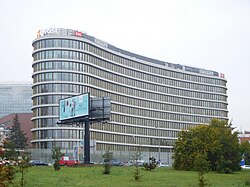
Avast Software s.r.o. is a subsidiary of Gen Digital. It is a Czech multinational cybersecurity software company headquartered in Prague, Czech Republic, that researches and develops computer security software, machine learning, and artificial intelligence. Avast had more than 435 million monthly active users[2] and the second largest market share among anti-malware application vendors worldwide as of April 2020.[3] As of 2025, parent company Gen Digital had approximately 4,000 employees worldwide.[2]
Avast was founded by Pavel Baudiš and Eduard Kučera in 1988 as a cooperative, initially known as Alwil Software. It later rebranded to Avast, and in July 2016, acquired competitor AVG Technologies. At the time, AVG was the third-ranked antivirus product.[4] It was dual-listed on the Prague Stock Exchange and on the London Stock Exchange and was a constituent of the FTSE 100 Index until it was acquired by NortonLifeLock in September 2022.[5]
In July 2021, NortonLifeLock, an American cybersecurity company, announced that it was in talks to merge with Avast Software. In August 2021, Avast's board of directors agreed to an offer of US$8 billion.[6][7] After the merger was completed in September 2022, the combined company became known as Gen Digital.
The company's main product is Avast Antivirus, along with tools such as the Avast Secure Browser and the Avast SecureLine VPN.
Avast produces Avast Online Security, which is its main extension, but it also has extensions like Avast SafePrice and Avast Passwords.
History
[edit]Avast was founded by Eduard Kučera and Pavel Baudiš in 1988.[8] The founders met each other at the Research Institute for Mathematical Machines in Czechoslovakia.[8] They studied math and computer science, because the Communist Party of Czechoslovakia would require them to join the communist party to study physics.[8] At the institute, Pavel Baudiš discovered the Vienna virus on a floppy disk and developed the first program to remove it.[8][9][10] Afterwards, he asked Eduard Kučera to join him in cofounding Avast as a cooperative.[9] The cooperative was originally called Alwil Software and only the software was named Avast.[11]
The cooperative was changed to a joint partnership in 1991, two years after the velvet revolution[12] caused a regime change in Czechoslovakia. The new regime severed ties with the Soviet Union and reverted the country's economic system to a market economy.[9][11] In 1995, Avast employee Ondřej Vlček wrote the first antivirus program for the Windows 95 operating system.[9] In the 1990s, security researchers at the Virus Bulletin, an IT security testing organization, gave the Avast software an award in every category tested, increasing the popularity of the software.[9] However, by the late 1990s, the company was struggling financially.[8] Alwil Software rebuffed acquisition offers by McAfee, who was licensing the Avast antivirus engine.[8]
By 2001, Alwil Software was experiencing financial difficulties, when it converted to a freemium model, offering a base Avast software product at no cost.[9] As a result of the freemium model, the number of users of the software grew to one million by 2004[9] and 20 million by 2006.[11] Former Symantec executive Vince Steckler was appointed CEO of Avast in 2009.[13] In 2010, Alwil Software changed its name to Avast, adopting the name of the software,[11] and raised $100 million in venture capital investments.[14] The following December, Avast filed for an initial public offering, but withdrew its application the following July, citing changes in market conditions.[15] In 2012, Avast fired its outsourced tech support service iYogi, after it was discovered that iYogi was using misleading sales tactics to persuade customers to buy unnecessary services.[16] By 2013, Avast had 200 million users in 38 countries and had been translated into 43 languages.[8] At the time, the company had 350 employees.[17]
In 2014, CVC Capital bought an interest in Avast for an undisclosed sum. The purchase valued Avast at $1 billion.[18][19] Later that year, Avast acquired mobile app developer Inmite in order to build Avast's mobile apps.[20] Additionally, Avast's online support forum was compromised in 2014, exposing 400,000 names, passwords and email addresses.[21][22] By 2015, Avast had the largest share of the market for antivirus software.[15] In July 2016, Avast reached an agreement to buy AVG for $1.3 billion.[23] AVG was a large IT security company that sold software for desktops and mobile devices.[24] In July 2017, Avast acquired UK-based Piriform for an undisclosed sum. Piriform was the developer of CCleaner.[25] Shortly afterwards it was disclosed that someone may have created a malicious version of CCleaner with a backdoor for hackers.[26] Avast had its IPO on the London Stock Exchange in May 2018, which valued it at £2.4bn and was one of the UK's biggest technology listings.[27]
Ondřej Vlček assumed the role of CEO and co-owner of Avast Plc in July 2019.[28] A day later, he changed his annual pay to $1 and pledged his board director's compensation of $100,000 to charity.[28] In October 2019, Jaya Baloo joined Avast as their Chief Information Security Officer.[29]
In April 2020, Avast released a new secure, private mobile web browser for Android based on technology acquired from previously unreported acquisition of Tenta, a Seattle-based startup.[30]
In July 2021, NortonLifeLock, an American cybersecurity company, announced that it is in talks to merge with Avast Software. In August 2021, Avast's board of directors agreed to an offer of US$8 billion. In September 2022, the Competition and Markets Authority approved the proposed takeover by NortonLifeLock so allowing the transaction to be completed. The merged company became known as Gen Digital.[31][32][33][34][35]
Products
[edit]Avast develops and markets business and consumer IT security products for servers, desktops, and mobile devices.[36] The company sells both the Avast product line and the acquired AVG-branded products.[37] As of late 2017, the company had merged the AVG and Avast business product lines and were working to integrate the corporate departments from both companies.[38] Additionally, Avast has developed utility software products to improve battery life on mobile devices, cleanup unnecessary files on a hard drive, find secure wireless networks[39] or create a VPN connection to the internet.[40]
Avast and AVG consumer security software are sold on a freemium model, where basic security features are free, but more advanced features require purchasing a premium version.[37] The free version is also supported by ads.[41] Additionally, all Avast users provide data about their PC or mobile device to Avast, which is used to identify new security threats.[8] Antivirus scanning, browser cleanup, a secure browser, password management, and network security features are provided for free, while firewall, anti-spam, and online banking features have to be purchased.[42][43] About 3% of Avast's users pay for a premium version (10% in the US).[8]
The Avast business product family includes features for endpoint protection, Wi-Fi security, antivirus, identity protection, password management, and data protection.[38] For example, the desktop product will look for vulnerabilities in the wi-fi network and run applications suspect of having malicious software in an isolated sandbox.[44] The Avast Business Managed Workplace monitors and manages desktops, and assesses on-site security protocols.[38] The company also sells management software for IT administrators to deploy and manage Avast installations.[38]
Reception
[edit]In 2021, PC Magazine gave Avast Free Antivirus software an overall score of 4 out of 5[45] and gave AVG, which was purchased by Avast in 2016, a score of 4, plus "AVG AntiVirus Free offers precisely the same virus protection engine as Avast Free Antivirus, but it lacks the impressive collection of additional features you get with Avast."[46] In tests conducted by the AV-TEST Institute in August 2021, Avast and AVG received six out of six points for protection and usability, and six out of six points for performance.[47][48] A review in Tom's Guide says that the free Avast antivirus product has "good protection against malware" and takes up little space on the system. The review says that Avast has a competitive set of features for a free antivirus product, but the scans are sometimes not very fast.[49]
The Avast antivirus product for business users received 4 out of 5 by TechRadar in 2017.[50] The review said that the software had good features, protection, configuration and an "excellent interface", but it took up a lot of hard disk space and did not cover mobile devices.[50] According to Tom's Guide, the mobile version is inexpensive and packed with features. PC Magazine said that the mobile version "has almost all the security features you could want."[51]
AVG has also generally performed well in lab tests. A review in Tom's Hardware gave the AVG software seven out of ten stars.[43] The review highlighted that the software has a small system footprint and has good malware protection, but does not have a quick scan option and lacks many additional features.[43]
Collection and sale of user data
[edit]In late 2019, Avast browser extensions were found to collect user data, including browsing behavior and history, and send it to a remote server. The discovery led to the extensions of the Avast and AVG brands being temporarily removed from the Google Chrome, Firefox, and Opera extension stores, however, they returned a short time later, as there was no concrete evidence that demonstrated a breach of private data of the users.[52][53][54]
In January 2020, a joint investigation by Motherboard and PCMag found that the Avast Antivirus and AVG AntiVirus Free version were collecting user data, which was being resold to personalize advertising through a subsidiary, Jumpshot.[55][56][57] The leaked documents showed that Jumpshot offered to provide its customers with "Every search. Every click. On every site." from more than 100 million compromised devices. In response, Avast announced on January 30, 2020, that it would immediately shut down Jumpshot and cease all operations due to the backlash of its users' data privacy.[58][59]
On the basis of the information revealed, on 11 February 2020 the Czech Office for Personal Data Protection announced that it had initiated a preliminary investigation.[60]
In February 2024, the Federal Trade Commission fined Avast $16.5 million for collecting user data and reselling that data.[61][62] In February 2025, settlement notices were sent to Avast customers by email.[63][64]
See also
[edit]References
[edit]- ^ a b c d e "Annual Results 2020" (PDF). Avast. Retrieved 3 March 2021.
- ^ a b "Investor Relations". Gen Digital. Retrieved 29 December 2025.
{{cite web}}: CS1 maint: url-status (link) - ^ "Market share held by the leading Windows anti-malware application vendors worldwide, as of April 2020". Statista. Retrieved 2 July 2020.
- ^ "Avast Buys Piriform, the Company Behind CCleaner and Recuva". BleepingComputer.
- ^ "NortonLifeLock Inc (USA): Merger with Avast (UK) - Update Changes in FTSE UK Index Series". 7 September 2022. Retrieved 9 September 2022.
- ^ Ray, Tiernan. "NortonLifeLock and Avast PLC to merge in $8.4 billion transaction". ZDNet. Retrieved 10 September 2021.
- ^ "NortonLifeLock and Avast to Merge to Lead the Transformation of Consumer Cyber Safety". www.businesswire.com. 10 August 2021. Retrieved 10 September 2021.
- ^ a b c d e f g h i "Avast emerged from Communism to shine in security". USA Today. 20 October 2013. Retrieved 8 August 2017.
- ^ a b c d e f g "Příběh superobchodu s antiviry: Avast koupí AVG ukázal um "zlatých českých ručiček" v IT". Blesk.cz (in Czech). 8 July 2016. Retrieved 8 August 2017.
- ^ "Interview with Avast's COO Ondřej Vlček". Download3K. 19 November 2014. Retrieved 8 August 2017.
- ^ a b c d Wonder, Dan (17 June 2013). "Who Makes Avast?". Chron.com. Retrieved 8 August 2017.
- ^ "Who We Are". Avast Foundation. 8 August 2017. Archived from the original on 13 April 2018. Retrieved 8 August 2017.
- ^ "Vince Steckler". The CEO Magazine. 22 September 2016. Retrieved 6 October 2017.
- ^ "Security Czechs". The Economist. 1 May 2012. Retrieved 8 August 2017.
- ^ a b Roy, Abhirup (29 October 2015). "Avast worth 'upwards of $2 billion'; no IPO before 2017". Reuters. Retrieved 7 August 2017.
- ^ Dunn, John E (16 March 2012). "Avast suspends antivirus support company after mis-selling allegation". Network World. Archived from the original on 11 September 2018. Retrieved 9 August 2017.
- ^ "Avast becomes most valuable IT company in the CR". Prague Post. 11 March 2015. Retrieved 8 August 2017.
- ^ Tan, Gillian; Cimilluca, Dana (30 January 2014). "CVC Capital Near Deal to Invest in Antivirus Company Avast". The Wall Street Journal. Retrieved 8 August 2017.
- ^ "Security Software Firm Avast Gets CVC Capital Investment, Now Valued At $1B". TechCrunch. 5 February 2014. Retrieved 8 August 2017.
- ^ "Malware buster Avast buys up mobile app maker in move to be mobile friendly". VentureBeat. 24 July 2014. Retrieved 8 August 2017.
- ^ Kirk, Jeremy (26 May 2014). "Avast takes community forum offline after data breach". Network World. Archived from the original on 1 November 2018. Retrieved 9 August 2017.
- ^ Meyer, David (27 May 2014). "Security company Avast suffers embarrassing forum hack". Gigaom. Archived from the original on 29 March 2018. Retrieved 9 August 2017.
- ^ "Security Software Firm Avast to Buy Rival AVG for $1.3 Billion in Cash". Fortune. 7 July 2016. Retrieved 8 August 2017.
- ^ "Avast acquires rival AVG for $1.3 billion to create a security software giant". VentureBeat. 7 July 2016. Retrieved 8 August 2017.
- ^ Sawers, Paul (19 July 2017). "Avast acquires Piriform, maker of popular system cleaning program CCleaner". VentureBeat. Retrieved 19 July 2017.
- ^ "Avast CCleaner used to spread backdoor to two million plus users". eXe Nation. 19 September 2017. Archived from the original on 27 March 2022. Retrieved 28 September 2017.
- ^ Cyber security group Avast valued at £2.4bn in IPO. Financial Times. Aliya Ram in London 10 May 2018.
- ^ a b "CEO Waives Salary and Bonus Forever in Bet on Tech Firm's Stock". 1 July 2019. Retrieved 2 July 2019.
- ^ "Avast appoints Jaya Baloo as Chief Information Security Officer". press.avast.com. Retrieved 9 May 2020.
- ^ "Avast acquires Seattle startup Tenta, leading to release of new secure browser for Android". GeekWire. 17 April 2020. Retrieved 17 April 2020.
- ^ Starr, Dashia. "Cybersecurity firms NortonLifeLock and Avast merge in $8B deal". CNET. Retrieved 10 September 2021.
- ^ Page, Carly (11 August 2021). "Cybersecurity giants NortonLifeLock and Avast merge in $8.1B deal". TechCrunch. Archived from the original on 2 February 2023. Retrieved 12 December 2023.
- ^ "CMA clears NortonLifeLock's £6bn Avast takeover". UK Tech News. 2 September 2022. Retrieved 9 September 2022.
- ^ Barr, Greg (12 September 2022). "NortonLifeLock to change company name in wake of Avast acquisition". American City Business Journals. Archived from the original on 13 September 2022.
- ^ Dexter, Alan (16 August 2021). "Norton and Avast merge to form super-cybersecurity company". PC Gamer. Retrieved 10 September 2021.
- ^ "Download Free Antivirus for PC, Mac & Android". Avast. 9 August 2017. Retrieved 9 August 2017.
- ^ a b Rubenking, Neil J. (23 February 2017). "Avast Free Antivirus 2017". PC Magazine. Retrieved 16 June 2017.
- ^ a b c d Kuranda, Sarah (6 September 2017). "Avast Launches New Business Portfolio And Partner Program, Combining Its Channel Forces With AVG". CRN. Retrieved 28 September 2017.
- ^ "Avast Main Page: For Home/For Business". Retrieved 10 August 2017.
- ^ "Avast SecureLine VPN". PCMAG. 7 August 2017. Retrieved 1 November 2017.
- ^ Larkin, Erik (October 2009). "Can You Trust Free Antivirus Protection?". PC World. Retrieved 9 August 2017.
- ^ "Avast Free Antivirus". PC Pro. April 2015. p. 89.
- ^ a b c Nadel, Brian (3 August 2017). "AVG AntiVirus Free: Nearly the Best". Tom's Guide. Retrieved 10 August 2017.
- ^ Williams, Mike (28 September 2017). "Avast Business Antivirus review". TechRadar. Retrieved 28 September 2017.
- ^ "Avast Free Antivirus Review". PCMAG. 23 February 2021. Retrieved 28 September 2021.
- ^ "AVG AntiVirus Free Review". PCMAG. Retrieved 28 September 2021.
- ^ "Test Avast Free AntiVirus 21.5 & 21.6 for Windows 10 (211403)". www.av-test.org (in German). Retrieved 28 September 2021.
- ^ "Test antivirus software AVG". www.av-test.org (in German). Retrieved 28 September 2021.
- ^ Nadel, Brian (20 May 2020). "AVG AntiVirus Free review". Tom's Guide. Retrieved 28 September 2021.
- ^ a b Williams, Mike (10 October 2018). "Avast Business Antivirus review". TechRadar. Retrieved 28 September 2021.
- ^ "avast! Mobile Security & Antivirus (for Android) Review". PCMAG. 27 June 2013. Retrieved 28 September 2021.
- ^ Brewster, Thomas. "Are You One Of Avast's 400 Million Users? This Is Why It Collects And Sells Your Web Habits". Forbes. Retrieved 28 September 2021.
- ^ Li, Abner (18 December 2019). "Google removes Avast, AVG extensions from Chrome Web Store after data collection concerns". 9to5Google. Retrieved 28 September 2021.
- ^ "Some Avast extensions dropped from Chrome Web Store after data collection abuses". Android Police. 18 December 2019. Retrieved 28 September 2021.
- ^ "The Cost of Avast's Free Antivirus: Companies Can Spy on Your Clicks". PCMAG. 27 January 2020. Retrieved 28 September 2021.
- ^ "Leaked Documents Expose the Secretive Market for Your Web Browsing Data". Vice.com. 27 January 2020. Archived from the original on 29 March 2021. Retrieved 28 September 2021.
- ^ "Avast packaged detailed user data to be sold for millions of dollars". Engadget. 30 January 2020. Retrieved 28 September 2021.
- ^ "Avast to Commence Wind Down of Subsidiary Jumpshot". Avast to Commence Wind Down of Subsidiary Jumpshot. Retrieved 28 September 2021.
- ^ "Website Metrics: Traffic Statistics, Analytics & Conversion". 1 January 2020. Archived from the original on 1 January 2020. Retrieved 28 September 2021.
- ^ "Statement on Avast case". The Office for Personal Data Protection. 11 February 2020. Retrieved 12 February 2020.
- ^ "Avast to pay $16.5 mln to settle US charges linked to user data sale". Reuters. 22 February 2024. Retrieved 25 February 2024.
- ^ "FTC Order Will Ban Avast from Selling Browsing Data for Advertising Purposes, Require It to Pay $16.5 Million Over Charges the Firm Sold Browsing Data After Claiming Its Products Would Block Online Tracking". Federal Trade Commission. 21 February 2024. Retrieved 29 March 2025.
- ^ "Avast Settlement". Federal Trade Commission. 18 February 2025. Retrieved 29 March 2025.
- ^ "Millions of Avast antivirus software customers are getting a refund. Here's why". CBS News. 24 February 2025. Retrieved 29 March 2025.
External links
[edit]


| Authority control databases: National |
|---|
Avast
View on GrokipediaAvast Software s.r.o. is a Czech multinational cybersecurity company headquartered in Prague, specializing in antivirus and internet security software, founded in 1988 by software engineers Pavel Baudiš and Eduard Kučera during the era of Communist Czechoslovakia.[1][2][3] The company initially developed as a cooperative to create anti-malware tools, evolving into a provider of consumer and business security solutions, including Avast Free Antivirus, which gained widespread adoption for its freemium model offering basic protection against viruses, spyware, and phishing.[4][5] Avast's products, such as Avast Premium Security and Avast Business Antivirus, have received high marks in independent testing for malware detection and system performance impact, with the company earning awards like AV-TEST's Best Protection for Windows and macOS users in 2023, and blocking billions of cyber threats monthly across its user base.[6][7] However, Avast faced significant scrutiny for privacy practices, as its subsidiary Jumpshot collected and sold detailed user browsing data to third parties from 2014 to 2020 without adequate consent, despite marketing its software as privacy-protective, leading to a $16.5 million settlement with the U.S. Federal Trade Commission in 2024 and a prohibition on selling such data for advertising purposes.[8][9][10] In 2022, Avast was acquired by NortonLifeLock for over $8 billion, after which the parent company rebranded to Gen Digital, integrating Avast's technologies into a broader cyber safety portfolio while continuing operations under the Avast brand.[11][12]
History
Founding and Early Development
Avast was founded in 1988 in Prague, Czechoslovakia, by software engineers Pavel Baudiš and Eduard Kučera, who established it as the ALWIL cooperative amid the constraints of the communist regime.[4][13] Baudiš, while working at a research institute, encountered the Vienna virus on a floppy disk brought from abroad in May 1988 and developed an early removal program for it, marking the inception of their antivirus efforts.[4][13] This initiative stemmed from their shared background in mathematics and computer science, where they recognized the emerging threat of malware to personal computers in Eastern Europe.[14] Following the Velvet Revolution in 1989, which ended communist rule, Baudiš and Kučera separated from the broader cooperative and formalized ALWIL Software, s.r.o., in spring 1991 to develop and distribute antivirus products via floppy disks.[4][15] Early offerings focused on detecting and removing boot sector viruses prevalent on MS-DOS systems, with distribution limited by the era's technological and economic barriers in post-communist Czechoslovakia.[4] In 1995, Ondřej Vlček joined the team, co-authoring the company's first antivirus solution for Windows 95, which expanded compatibility to graphical operating systems and laid groundwork for broader market penetration.[1][4] During the late 1990s, ALWIL prioritized heuristic detection methods to combat evolving threats like polymorphic viruses, while maintaining a small team and bootstrapped operations without significant external funding.[14] The antivirus engine, initially named avast! (derived from "AV" for antivirus and "last" for comprehensive protection), gained traction among Eastern European users through shareware models and virus signature updates shared via bulletin board systems and early internet connections.[16] This period solidified ALWIL's focus on lightweight, effective scanning tools suited to limited hardware resources of the time.[17]Growth and Key Milestones
Avast's growth accelerated following the introduction of its free antivirus version in the early 2000s, which adopted a freemium model to expand its user base rapidly. By 2004, the company had approximately 1 million users, surging to 20 million by 2006 due to widespread adoption of the no-cost offering.[18] This strategy positioned Avast as a dominant player in consumer cybersecurity, with user numbers reaching 200 million across PCs, smartphones, and tablets by November 2013.[19] A pivotal expansion occurred on July 7, 2016, when Avast acquired AVG Technologies for $1.3 billion in an all-cash deal at $25 per share, integrating AVG's technology and user base to enhance scale in antivirus and IoT security.[20] The merger propelled Avast's total active users beyond 400 million, strengthening its global market presence.[21] The company achieved a major financial milestone with its initial public offering on May 10, 2018, on the London Stock Exchange, raising $200 million in primary proceeds and $616.6 million in secondary proceeds at a valuation of $3.23 billion.[22] This marked the largest technology IPO in Europe for 2018 and one of the top five tech listings historically on the LSE.[23] In June 2020, Avast was admitted to the FTSE 100 index, reflecting sustained revenue growth and market recognition.[24] Growth culminated in Avast's acquisition by NortonLifeLock (later rebranded Gen Digital), completed on September 12, 2022, in a transaction valued at over $8 billion combining cash and shares.[11][18] This integration expanded Avast's reach within a larger cybersecurity portfolio, maintaining a combined user base exceeding 435 million as of recent reports.[25]Mergers, Acquisitions, and Integration into Gen Digital
Avast expanded its capabilities through a series of acquisitions targeting complementary security, privacy, and analytics technologies. A pivotal deal was the acquisition of rival antivirus provider AVG Technologies, announced on July 7, 2016, and completed later that month for $1.3 billion in cash and shares, which added AVG's established user base and product lines to Avast's portfolio.[26][27] Subsequent purchases included data analytics firm Jumpshot in April 2017 for an undisclosed amount, aimed at enhancing threat intelligence through user behavior insights.[28] By 2022, Avast had completed at least seven such transactions across software and related sectors in multiple countries.[28] On August 10, 2021, Avast agreed to a merger with NortonLifeLock Inc., structured as a mix of cash and stock valuing the transaction at $8.1 billion to $8.6 billion, pending regulatory approvals.[29][30] The deal received clearance from the UK's Competition and Markets Authority on September 2, 2022, and closed on September 12, 2022, via a court-sanctioned scheme of arrangement under which Avast shareholders received consideration equivalent to approximately £6.6 billion.[31][11] Upon completion, NortonLifeLock changed its corporate name to Gen Digital Inc., reflecting the combined entity's focus on broader cyber safety solutions beyond traditional antivirus.[32] Post-merger integration efforts centered on consolidating operations, technologies, and internal controls to create a unified platform serving over 500 million users with annual revenues approaching $3.5 billion.[30] Gen Digital continued to allocate resources toward product innovation, leveraging Avast's expertise in consumer security to address evolving threats, though the process involved ongoing harmonization of processes as noted in regulatory filings through late 2022.[33][34] The merger positioned the enlarged company as a leader in consumer cyber protection, with Avast's brands and technologies retained within Gen Digital's ecosystem.[11]Products and Services
Core Antivirus Offerings
Avast's core antivirus offerings encompass a freemium model with tiered products emphasizing real-time scanning, behavioral analysis, and multi-layered shields against malware, viruses, and phishing threats, compatible with Windows, macOS, Android, and iOS platforms.[35] These products leverage a shared engine featuring cloud-assisted detection and AI-driven scam identification to address evolving cyber risks.[36] Avast Free Antivirus serves as the baseline offering, delivering fundamental protections via Core Shields including File Shield for real-time inspection of files during access or transfer, Behavior Shield for flagging anomalous program actions, Web Shield for intercepting malicious URLs and downloads, and Mail Shield for scanning email attachments and links.[36] It supports full system Smart Scans to detect vulnerabilities and quarantines threats for user review, relying on signature-based matching augmented by heuristic and cloud analysis without premium ransomware-specific defenses or firewall enhancements.[36] As of 2025, this free version powers protection for hundreds of millions of devices worldwide, focusing on lightweight installation and basic efficacy against common threats.[36] Avast Premium Security builds on the free edition with advanced components such as a dedicated Ransomware Shield to block encryption attempts and rollback affected files, an intelligent Firewall for inbound/outbound traffic monitoring, and Webcam Protection to alert on unauthorized microphone or camera activation.[37] Additional antivirus-centric features include Email Guard for phishing detection in communications and automatic software updating to close exploitable gaps, enabling coverage across up to 10 devices under a subscription model priced at $69.48 for the first year.[37] This tier targets users requiring fortified defenses against sophisticated attacks, with independent evaluations confirming high detection rates in real-world scenarios.[38] Avast One functions as the integrated flagship product line, incorporating core antivirus elements like AI-enhanced scanning for malware, spyware, and ransomware alongside unified Web and Email Guards for proactive threat blocking.[39] Distinct from Premium Security by its modular structure—offering free Essential, paid Gold ($59.88 first year), Platinum, and Ultimate bundles—it prioritizes holistic device safeguarding with embedded performance tools, while maintaining the same foundational shields and detection heuristics.[35] Available for multi-platform deployment, Avast One's antivirus core emphasizes seamless updates and behavioral monitoring to counter zero-day exploits, positioning it as a comprehensive entry point for users valuing extensibility over isolated AV functions.[39]Complementary Security and Privacy Tools
Avast offers SecureLine VPN, a virtual private network service that encrypts internet traffic using AES-256 encryption and supports protocols such as OpenVPN and IKEv2 to mask users' IP addresses and protect against eavesdropping on public Wi-Fi networks.[40] The tool allows simultaneous connections on up to 10 devices and includes features like a kill switch to prevent data leaks during connection drops, as well as Smart VPN for automatic server selection based on location and load.[41] Independent tests have confirmed its ability to avoid IP and DNS leaks, though its server network of around 700 locations across 34 countries is smaller than some competitors.[42] AntiTrack functions as an anti-fingerprinting tool that actively disrupts online trackers by injecting randomized "noise" data into browser requests, such as fake browser fingerprints and digital personas, to obscure users' true identities from advertisers and websites.[43] It scans for and blocks tracking attempts in real-time, clears cookies and cache traces, and supports major browsers including Chrome, Firefox, and Edge, with reported effectiveness in evading common fingerprinting techniques during controlled tests.[44] Unlike passive blockers, AntiTrack's proactive randomization has been noted for reducing profile-building accuracy, though it may slightly impact page load times due to added processing.[45] BreachGuard provides data breach monitoring by scanning public databases and the dark web for exposed personal information tied to users' email addresses and credentials, delivering alerts within 24 hours of detection.[46] The service includes unlimited email monitoring, password change guidance, and credit monitoring in select regions, with users able to add multiple accounts for comprehensive coverage.[47] It integrates risk assessment tools to prioritize threats, such as leaked credentials from past incidents like the 2019 Capital One breach, and has been utilized by millions to respond to over 10 billion detected leaks as of 2023.[48] Additional privacy-focused extensions, such as the Online Security & Privacy browser add-on, block phishing sites and malicious trackers while rating website reputations based on community data from over 400 million users.[49] These tools are often bundled in suites like Avast Ultimate, enabling cross-device protection without standalone antivirus overlap.[50]Technology and Efficacy
Core Detection Mechanisms
Avast's core detection mechanisms rely on a multi-layered architecture that integrates static analysis, dynamic emulation, behavioral monitoring, and artificial intelligence-driven classification to identify known and emerging threats. The system processes files and behaviors across six defensive layers, leveraging vast telemetry from over 435 million users to enhance accuracy and speed.[51][52] Static analysis forms the initial barrier through the Static Scanner, which examines file structures—such as Portable Executable (PE) headers and linker information—without execution, employing machine learning models for pattern recognition and similarity matching against known malware variants. Heuristic elements within this scanner apply algorithmic rules to flag anomalies in code obfuscation or packing techniques, reducing reliance on exact signature matches. These methods enable proactive detection of polymorphic or repackaged threats before runtime.[51] For unknown or suspicious files, dynamic analysis occurs via emulators and DeepScreen technology, which simulate execution in isolated virtual environments, including full virtual machines hosted in the cloud for deeper scrutiny. DeepScreen correlates findings with global threat intelligence to classify evasive samples, while CyberCapture automatically uploads rare binaries (processing up to 1 million files daily) to Avast Threat Labs for clean-room dissection, revealing hidden payloads through binary command inspection and providing zero-second blocking for Nitro Edition users via immediate reputation checks against the FileRep database of over 5 billion files.[51][53] Behavioral detection complements these through Behavior Shield, which monitors active processes for malicious actions like process termination (e.g., disabling Windows Update) or unauthorized hardware access (e.g., webcam activation), quarantining threats in real-time. Advanced behavioral threat fingerprinting uses graph neural networks (GNNs) to model system events as interconnected graphs—nodes for actions like file writes or network calls, edges for sequences—identifying fingerprints of attacks such as ransomware encryption or loader injections, with multi-output predictions for threat type, severity, and tactics aligned to MITRE ATT&CK.[51][54] Machine learning underpins the ecosystem with multiple engines applying deep convolutional neural networks (Deep CNNs) for feature extraction from code and behaviors, trained on petabyte-scale datasets from endpoint sensors. Models update within 12 hours of new threat emergence, enabling rapid adaptation to zero-days like WannaCry, with cloud orchestration ensuring low-latency deployment across devices. This AI integration prioritizes false-positive minimization through ensemble methods and explainable outputs.[55][52]Performance in Independent Evaluations
Avast has demonstrated strong performance in independent antivirus evaluations conducted by organizations such as AV-TEST and AV-Comparatives, often achieving top ratings for malware detection, protection, and system impact across Windows, macOS, and mobile platforms.[56][57] In AV-TEST's assessments for Windows 11 home users, Avast Free Antivirus versions from 24.8 through 25.7 consistently earned "top product" status in tests from October 2024 to August 2025, scoring full points (6/6) in protection, performance, and usability categories, which totals the maximum 18 points possible.[58][59] This performance contributed to Avast receiving the AV-TEST Award 2024 for sustained excellence in long-term testing.[60] In AV-Comparatives' evaluations, Avast excelled in real-world protection and malware detection. For instance, in the Real-World Protection Test for July-August 2025, Avast achieved high blocking rates with minimal false positives.[57] The Malware Protection Test in September 2025 similarly highlighted Avast's efficacy against advanced threats.[57] In the April 2025 Performance Test, Avast scored 90 out of 100 overall, with a 96.2% system impact score and only 3.8% slowdown, tying for second place among tested products and outperforming several paid competitors in resource efficiency.[61] AV-Comparatives' 2024 Summary Report recognized Avast Free Antivirus as a "Top Rated Product," awarding "Advanced+" ratings in six of seven tests and "Advanced" in one, based on consistent high detection rates exceeding 99% for zero-day and prevalent malware.[62]| Test Organization | Test Type | Date | Key Metrics for Avast |
|---|---|---|---|
| AV-TEST | Windows 11 Home Protection | August 2025 | 6/6 Protection, 6/6 Performance, 6/6 Usability (Top Product)[58] |
| AV-Comparatives | Performance Test | April 2025 | 90/100 Overall; 96.2% Score; 3.8% Impact[61] |
| AV-Comparatives | Anti-Phishing Certification | Recent (2025) | 96% Detection; 0 False Alarms[63] |