


Community hub
0 subscribers8 pages, 0 posts
Recent from talks
All channels
Be the first to start a discussion here.
Be the first to start a discussion here.
Be the first to start a discussion here.
Be the first to start a discussion here.
Contribute something
Welcome to the community hub built to collect knowledge and have discussions related to BP Circini.
Nothing was collected or created yet.
BP Circini
View on Wikipediafrom Wikipedia
| Observation data Epoch J2000 Equinox J2000 | |
|---|---|
| Constellation | Circinus |
| Right ascension | 14h 46m 41.98011s[2] |
| Declination | −61° 27′ 42.9903″[2] |
| Apparent magnitude (V) | 7.37 - 7.71[3] |
| Characteristics | |
| Spectral type | F2/3II + B6V[4] |
| B−V color index | 0.649±0.020[5] |
| Astrometry | |
| Proper motion (μ) | RA: −5.355[2] mas/yr Dec.: −3.920[2] mas/yr |
| Parallax (π) | 0.9952±0.0402 mas[2] |
| Distance | 3,300 ± 100 ly (1,000 ± 40 pc) |
| Absolute magnitude (MV) | −2.91[6] |
| Orbit[6] | |
| Period (P) | 20 yr |
| Semi-major axis (a) | 15.8 AU |
| Details | |
| A | |
| Mass | 5[7] M☉ |
| Radius | 30.38+6.93 −6.50[2] R☉ |
| Luminosity | 917±54[2] L☉ |
| Surface gravity (log g) | 2.75[8] cgs |
| Temperature | 6356±23[8] K |
| B | |
| Mass | 4.7[6] M☉ |
| Surface gravity (log g) | 4.0±0.5[7] cgs |
| Temperature | 16,000±1,000[7] K |
| Other designations | |
| BP Cir, CD−60°5320, HD 129708, HIP 72264, SAO 252879, WDS J14467-6128A[9] | |
| Database references | |
| SIMBAD | data |

BP Circini is a binary star system in the southern constellation of Circinus. It is located at a distance of approximately 3,300 light years from the Sun based on parallax.[2]
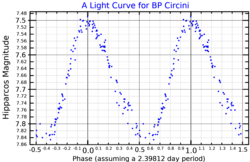
The variability of this star was discovered by D. W. Kurtz in 1979.[7] A small-amplitude Cepheid variable,[8] its apparent magnitude ranges from 7.37 to 7.71 over 2.39810 days.[3] A spectroscopic binary, the primary is a yellow-white bright giant of spectral type F2 or F3II.[4] The spectrum shows peculiarities in the metallic lines.[10] The secondary is a 4.7 solar mass (M☉) blue-white main sequence star of spectral type B6.[6]
References
[edit]- ^ "Hipparcos Tools Interactive Data Access". Hipparcos. ESA. Retrieved 8 December 2021.
- ^ a b c d e f g h Brown, A. G. A.; et al. (Gaia collaboration) (August 2018). "Gaia Data Release 2: Summary of the contents and survey properties". Astronomy & Astrophysics. 616. A1. arXiv:1804.09365. Bibcode:2018A&A...616A...1G. doi:10.1051/0004-6361/201833051. Gaia DR2 record for this source at VizieR.
- ^ a b BSJ (30 November 2013). "BP Circini". AAVSO Website. American Association of Variable Star Observers. Retrieved 24 January 2014.
- ^ a b Skiff, B. A. (October 2014), "General Catalogue of Stellar Spectral Classifications", VizieR Online Data Catalog, Bibcode:2014yCat....1.2023S
- ^ Anderson, E.; Francis, Ch. (2012), "XHIP: An extended hipparcos compilation", Astronomy Letters, 38 (5): 331, arXiv:1108.4971, Bibcode:2012AstL...38..331A, doi:10.1134/S1063773712050015, S2CID 119257644.
- ^ a b c d Evans, Nancy Remage; et al. (2013). "Binary Cepheids: Separations and Mass Ratios in 5M ⊙ Binaries". Astronomical Journal. 146 (4): 93, 10 pp. arXiv:1307.7123. Bibcode:2013AJ....146...93E. doi:10.1088/0004-6256/146/4/93. S2CID 34133110.
- ^ a b c d Petterson, O. K. L.; et al. (May 2004). "The orbits of southern binary Cepheids". Monthly Notices of the Royal Astronomical Society. 350 (1): 95–112. Bibcode:2004MNRAS.350...95P. doi:10.1111/j.1365-2966.2004.07555.x.
- ^ a b c Usenko, I. A.; et al. (December 2014). "Spectroscopic studies of Cepheids in Circinus (AV Cir, BP Cir) and Triangulum Australe (R TrA, S TrA, U TrA, LR TrA)". Astronomy Letters. 40 (12): 800–820. Bibcode:2014AstL...40..800U. doi:10.1134/S1063773714110061. S2CID 122745580.
- ^ "V* BP Cir". SIMBAD. Centre de données astronomiques de Strasbourg. Retrieved 24 January 2014.
- ^ Kurtz, D. W. (1979). "HD 129708: A New, Bright, Short-Period Cepheid with an Unusual Spectrum". Monthly Notes of the Astronomical Society of Southern Africa. 38: 36. Bibcode:1979MNSSA..38...36K.
