


Community hub
Barker code
View on WikipediaIn telecommunication technology, a Barker code or Barker sequence is a finite sequence of digital values with the ideal autocorrelation property. It is used as a synchronising pattern between the sender and receiver of a stream of bits.
Explanation
[edit]Binary digits have very little meaning unless the significance of the individual digits is known. The transmission of a pre-arranged synchronising pattern of digits can enable a signal to be regenerated by a receiver with a low probability of error. In simple terms it is equivalent to tying a label to one digit after which others may be related by counting. This is achieved by transmitting a special pattern of digits which is unambiguously recognised by the receiver. The longer the pattern the more accurately the data can be synchronised and errors due to distortion omitted. These patterns are called Barker sequences or Barker codes, after the inventor Ronald Hugh Barker. The process is described in "Group Synchronisation of Binary Digital Systems" published in 1953.[1] These sequences were initially developed for radar, telemetry, and digital speech encryption in the 1940s and 1950s.
Historical background
[edit]During and after WWII digital technology became a key subject for research e.g. for radar, missile and gun fire control and encryption. In the 1950s scientists were trying various methods around the world to reduce errors in transmissions using code and to synchronise the received data. The problem being transmission noise, time delay and accuracy of received data. In 1948 the mathematician Claude Shannon published an article '"A Mathematical Theory of Communication"' which laid out the basic elements of communication. In it he discusses the problems of noise.
Shannon realised that “communication signals must be treated in isolation from the meaning of the messages that they transmit” and laid down the theoretical foundations for digital circuits. “The problem of communication was primarily viewed as a deterministic signal-reconstruction problem: how to transform a received signal, distorted by the physical medium, to reconstruct the original as accurately as possible” [2] or see original.[3] In 1948 electronics was advancing fast but the problem of receiving accurate data had not. This is demonstrated in an article on Frequency Shift Keying published by Wireless World.[4]
In 1953 R. H. Barker published a paper demonstrating how this problem to synchronise the data in transmissions could be overcome. The process is described in “Group Synchronisation of Binary Digital Systems”. When used in data transmissions the receiver can read and if necessary correct the data to be error free by autocorrelation and cross correlation by achieving zero autocorrelation except at the incidence position using specific codes. The Barker sequence process at the time produced great interest, particularly in the United States as his method solved the problem, initiating a huge leap forward in telecommunications. The process has remained at the forefront of radar, data transmission and telemetry and is now a very well known industry standard, still being researched in many technology fields.
“In a pioneering examination of group synchronization of binary digital systems, Barker reasoned it would be desirable to start with an autocorrelation function having very low sidelobes. The governing code pattern, he insisted, could be unambiguously recognized by the detector. To assure this premise, Barker contended the selected pattern should be sufficiently unlikely to occur by chance, in a random series of noise generated bits”[5]
Definition
[edit]


A Barker code or Barker sequence is a finite sequence of N values of +1 and −1,

with the ideal autocorrelation property, such that the off-peak (non-cyclic) autocorrelation coefficients
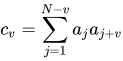
are as small as possible:

for all .[1]

Only nine Barker sequences[6] are known, all of length N at most 13.[7] Barker's 1953 paper asked for sequences with the stronger condition
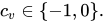
Only four such sequences are known, shown in bold in the table below.[8]
Known Barker codes
[edit]Here is a table of all known Barker codes, where negations and reversals of the codes have been omitted. A Barker code has a maximum autocorrelation sequence which has sidelobes no larger than 1. It is generally accepted that no other perfect binary phase codes exist.[9][10] (It has been proven that there are no further odd-length codes,[11] nor even-length codes of N < 1022.[12])
| Length | Codes | Sidelobe level ratio[13][14] | |
|---|---|---|---|
| 2 | +1 −1 | +1 +1 | −6 dB |
| 3 | +1 +1 −1 | −9.5 dB | |
| 4 | +1 +1 −1 +1 | +1 +1 +1 −1 | −12 dB |
| 5 | +1 +1 +1 −1 +1 | −14 dB | |
| 7 | +1 +1 +1 −1 −1 +1 −1 | −16.9 dB | |
| 11 | +1 +1 +1 −1 −1 −1 +1 −1 −1 +1 −1 | −20.8 dB | |
| 13 | +1 +1 +1 +1 +1 −1 −1 +1 +1 −1 +1 −1 +1 | −22.3 dB | |
Barker codes of length N equal to 11 and 13 are used in direct-sequence spread spectrum and pulse compression radar systems because of their low autocorrelation properties (the sidelobe level of amplitude of the Barker codes is 1/N that of the peak signal).[15] A Barker code resembles a discrete version of a continuous chirp, another low-autocorrelation signal used in other pulse compression radars.
The positive and negative amplitudes of the pulses forming the Barker codes imply the use of biphase modulation or binary phase-shift keying; that is, the change of phase in the carrier wave is 180 degrees.
Similar to the Barker codes are the complementary sequences, which cancel sidelobes exactly when summed; the even-length Barker code pairs are also complementary pairs. There is a simple constructive method to create arbitrarily long complementary sequences.
For the case of cyclic autocorrelation, other sequences have the same property of having perfect (and uniform) sidelobes, such as prime-length Legendre sequences, Zadoff–Chu sequences (used in 3rd- and 4th-generation cellular radio) and maximum length sequences (MLS). Arbitrarily long cyclic sequences can be constructed.

Barker modulation
[edit]
In wireless communications, sequences are usually chosen for their spectral properties and for low cross correlation with other sequences likely to interfere. In the 802.11 standard, an 11-chip Barker sequence is used for the 1 and 2 Mbit/s rates. The value of the autocorrelation function for the Barker sequence is 0 or −1 at all offsets except zero, where it is +11. This makes for a more uniform spectrum, and better performance in the receivers.[16]
Examples of applications
[edit]Applications of Barker codes are found in radar,[17] mobile phone,[18] telemetry,[5] ultrasound imaging and testing,[19][20] GPS,[21] and Wi-Fi.[22]
Many of these technologies use DSSS. This technique incorporates Barker code to improve the received signal quality and improve security.[23]
These codes are also used in radio frequency identification, or RFID. Some examples where Barker code is used are: pet and livestock tracking, bar code scanners, inventory management, vehicle, parcel, asset and equipment tracking, inventory control, cargo and supply chain logistics.[24] It is also used extensively for Intelligent Transport Systems (ITS) i.e. for vehicle guidance[25]
Acceptance probability
[edit] |
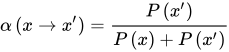
Barker's algorithm is an alternative to Metropolis–Hastings, which doesn't satisfy the detailed balance condition. Barker's algorithm does converge to the target distribution. Given the current state, x, and the proposed state, x', the acceptance probability is defined as:
The formula doesn't satisfy detailed balance, but makes sure that the balanced condition is met.
References
[edit]- ^ a b Barker, Ronald Hugh (1953). "Group Synchronizing of Binary Digital Systems". Communication Theory. London: Butterworth. pp. 273–287.
- ^ Tsa, David (2020). "How Claude Shannon invented the Future". Retrieved February 5, 2023.
- ^ Shannon, Claude (1922). "A Mathematical Theory of Communication" (PDF). The Bell System Technical Journal. pp. 380–381. Retrieved February 5, 2023.
- ^ Roddam, Thomas (November 1948). "Frequency Shift Keying" (PDF). Wireless World. pp. 400–402. Retrieved February 5, 2023.
- ^ a b Siegel, Irv D. (1971). "Development of a Set of Optimum Synchronisation Codes for a Unique Decoder Mechanization". Masters Theses. Missouri S & T Library and Learning Resources: 13. Retrieved February 5, 2023.
- ^ Sloane, N. J. A. (ed.). "Sequence A091704". The On-Line Encyclopedia of Integer Sequences. OEIS Foundation.
- ^ Borwein, Peter; Mossinghoff, Michael J. (2008). "Barker sequences and flat polynomials". In James McKee; Chris Smyth (eds.). Number Theory and Polynomials. LMS Lecture Notes. Vol. 352. Cambridge University Press. pp. 71–88. ISBN 978-0-521-71467-9.
- ^ Using different pulse shape in Barker code also improves certain autocorrelation properties.
- ^ Weisstein, Eric W. "Barker Code". MathWorld.
- ^ Coxson, Greg (2008). "Do the Barker codes End?" (PDF). Worcester Polytechnic Institute. Retrieved February 1, 2023.
- ^ Turyn and Storer, "On binary sequences", Proceedings of the AMS, volume 12 (1961), pages 394–399
- ^ Leung, K.; and Schmidt, B.; "The Field Descent Method", Design, Codes and Cryptography, volume 36, pages 171–188
- ^ "Pulse Compression – Radartutorial". Christian Wolff. Retrieved February 1, 2023.
- ^ Coxson, Greg; Darwich, Tahal. "Amplitude Shifting for Sidelobes Cancellation Pulse Compression" (PDF). University of Louisiana at Lafayette. Retrieved February 1, 2023.
- ^ Sklonik, Merrill I.; Introduction to Radar Systems, 3rd edition, McGraw–Hill, 2001
- ^ "RF Testing of WLAN Products" (PDF). Keysight Technologies.
- ^ Majid, Alolaibi (2021). "Low noise moving target detection in high resolution radar using binary code". EURASIP Journal on Advances in Signal Processing. 2021 (1) 8. Bibcode:2021EJASP2021....8A. doi:10.1186/s13634-020-00716-0.
- ^ "802.11b White Paper" (PDF). Vocal Technologies, Ltd. Retrieved December 30, 2022.
- ^ Zhao, Heng; L. Mo, Larry; Gao, Shangkai (2007). "Barker-coded ultrasound color flow imaging: Theoretical and practical design considerations". IEEE Transactions on Ultrasonics, Ferroelectrics and Frequency Control. 54 (2): 319–331. Bibcode:2007ITUFF..54..319Z. doi:10.1109/tuffc.2007.246. PMID 17328329. S2CID 19527352.
- ^ Fan, Zeng; Rudlin, Ohn; Asfis, Giorgos; Meng, Hongying (2019). "Convolution of Barker and Golay Codes for Low Voltage Ultrasonic Testing". Technologies. 7 (4): 72. doi:10.3390/technologies7040072.
- ^ Matsuyuki, Shota; Tsuneda, Akio (2018). "A Study on Aperiodic Auto-Correlation Properties of Concatenated Codes by Barker Sequences and NFSR Sequences". 2018 International Conference on Information and Communication Technology Convergence (ICTC). pp. 664–666. doi:10.1109/ICTC.2018.8539367. ISBN 978-1-5386-5041-7. S2CID 53713772.
- ^ Mikulka, Jan; Hanus, Stanislav (2007). 2007 17th International Conference Radioelektronikachapter = CCK and Barker Coding Implementation in IEEE 802.11b Standard. pp. 1–4. doi:10.1109/RADIOELEK.2007.371484. S2CID 34865532.
- ^ Latif, Shahid; Kamran, Muhammad; Masoud, Fahad; Sohaib, Muhammad (2012). "Improving DSSS transmission security using Barker code along binary compliments (CBC12-DSSS)". 2012 International Conference on Emerging Technologies. pp. 1–5. doi:10.1109/ICET.2012.6375426. ISBN 978-1-4673-4451-7. S2CID 2901603.
- ^ Amin, Syedul; Reaz, Mamun Bin Ibne; Jalil, Jubayer; Raham, LF (2012). "Digital Modulator and Demodulator IC for RFID Tag Employing DSSS and Barker Code". Journal of Applied Research and Technology. 10 (6): 819–825. doi:10.22201/ICAT.16656423.2012.10.6.341. S2CID 16796254.
- ^ Bekar, Muge; Baker, Chris; Hoare, Edward; Gashinova, Marina (2021). "Joint MIMO Radar and Communication System Using a PSK-LFM Waveform With TDM and CDM Approaches". IEEE Sensors Journal. 21 (5): 6115–6124. Bibcode:2021ISenJ..21.6115B. doi:10.1109/JSEN.2020.3043085. S2CID 231852192.
Barker code
View on GrokipediaIntroduction
Definition
A Barker code is a finite sequence of binary values, typically represented as and , engineered to exhibit minimal sidelobe levels in its autocorrelation function.[3] This design ensures that the sequence produces a sharp, prominent peak in the autocorrelation at zero lag while suppressing secondary peaks, making it particularly valuable for applications requiring precise signal detection.[1] The defining autocorrelation property of a Barker code is ideal in the sense that the peak at zero lag equals , with all off-peak magnitudes bounded by at most 1 in absolute value.[1] This characteristic minimizes interference from echoes or noise, distinguishing Barker codes from longer pseudo-noise sequences.[5] Barker codes find primary application in pulse compression techniques within radar and communication systems, where they improve range resolution by allowing longer transmitted pulses without sacrificing detection accuracy, thereby enhancing the signal-to-noise ratio.[3] In radar, for instance, they enable the compression of modulated pulses into shorter effective durations post-processing.[1] Unlike m-sequences or Gold codes, which offer favorable two-level autocorrelation for spread-spectrum applications over extended lengths, Barker codes prioritize near-ideal sidelobe suppression for concise sequences up to length 13.[6]Key Properties
Barker codes exhibit a distinctive autocorrelation property that distinguishes them from other binary sequences. Autocorrelation refers to the correlation between a sequence and a time-shifted version of itself, measuring how well the sequence matches at different lags .[7] For a Barker code of length , the autocorrelation function satisfies at zero lag, while for all nonzero lags .[7] This low sidelobe level ensures that off-peak correlations remain minimal, approximating the ideal delta-function autocorrelation where sidelobes are zero.[8] These properties provide significant benefits in applications such as radar, where they minimize false detections and reduce interference from echoed signals by suppressing range sidelobes.[7] In practice, Barker codes enable improved signal detection and range resolution without requiring amplitude weighting to control sidelobes.[3] Barker codes are typically represented in bipolar form using values and , corresponding to phase shifts of 0 and radians in phase-coded signals.[7]History
Discovery
The Barker code was first proposed by Ronald Hugh Barker, an Irish physicist and engineer working at the Signals Research and Development Establishment (SRDE), a facility under the British Ministry of Supply. In 1953, Barker published his seminal work on these sequences in a chapter titled "Group Synchronisation of Binary Digital Systems" within the book Communication Theory, edited by Willis Jackson and published by Butterworths Scientific Publications.[5][9][10] Barker's motivation stemmed from the demand for binary sequences that exhibited low sidelobe levels in their autocorrelation function, aimed at reducing false synchronization errors in radar detection. These properties were essential for improving signal discrimination in noisy environments, where unintended correlations could lead to erroneous target identification.[5] This development occurred amid post-World War II advancements in radar technology, where the push for enhanced pulse compression techniques became critical to achieve higher resolution and range without increasing peak power levels. Barker's exhaustive search through thousands of potential sequences yielded the initial known Barker codes of lengths 2, 3, 4, 5, 7, 11, and 13, establishing a foundation for their application in synchronization tasks.[11][5]Early Developments
In the 1950s and 1960s, several researchers independently explored and confirmed the known lengths of binary Barker sequences, building on the initial proposal by Ronald Hugh Barker. Solomon Golomb, in his early work on sequence design for communication and radar, identified and verified sequences of lengths 2 through 13, emphasizing their utility in synchronization and low autocorrelation properties.[12] Similarly, Richard Turyn conducted systematic analyses, confirming these lengths and extending the theoretical framework for their construction. These efforts, often overlapping with studies on shift-register sequences and difference sets, solidified the roster of viable binary Barker codes without uncovering longer ones.[12] A pivotal advancement came in 1961 when Turyn and James Storer provided an elementary proof demonstrating that no binary Barker sequence of odd length greater than 13 exists. Their argument relied on structural constraints in the autocorrelation function, showing that any candidate sequence beyond length 13 would violate the required sidelobe magnitude of at most 1. This result, published in the Proceedings of the American Mathematical Society, ruled out an infinite family of potential codes and shifted focus toward theoretical bounds rather than exhaustive enumeration for odd lengths.[13] Concurrent with these proofs, early computational searches in the 1960s exhaustively enumerated possibilities up to length 13 using nascent digital computers, confirming the known sequences and failing to find extensions. These brute-force approaches, limited by hardware but innovative for the era, tested all 2^N binary combinations for N ≤ 13 and verified the autocorrelation criteria, providing empirical support for the theoretical limits.[12] During the Cold War era, Barker codes found initial applications in military radar systems for pulse compression, enhancing range resolution and signal detection amid escalating aerial threats. Deployed in U.S. and allied systems from the early 1960s, they enabled shorter, more powerful pulses with minimal ambiguity, critical for air defense and surveillance radars like those developed under projects at the MIT Radiation Laboratory legacy. As the binary length constraints became firmly established by the late 1960s, researchers began shifting toward polyphase codes as viable alternatives, allowing more phases (beyond binary ±1) to achieve longer sequences with comparable autocorrelation performance. This transition, initiated in works like those of Golomb and Scholtz in 1965, paved the way for generalized designs that addressed the practical limitations of binary Barker codes in demanding radar environments.[12]Mathematical Formulation
Formal Definition
A Barker code of length $ N $ is a finite binary sequence $ \mathbf{a} = (a_0, a_1, \dots, a_{N-1}) $ where each entry satisfies $ a_i \in {+1, -1} $.[14] This setup was introduced by Ronald H. Barker in his 1953 work on synchronizing binary digital systems.[14] The aperiodic autocorrelation function of $ \mathbf{a} $ is given byAutocorrelation Function
The autocorrelation function of a Barker code sequence , where each , quantifies the similarity between the sequence and a shifted version of itself, which is crucial for its pulse compression properties in signal processing. It is defined asfunction [autocorrelation](/page/Autocorrelation)(a, N):
C = array of size N
for tau in 0 to N-1:
sum = 0
for i in 0 to N-tau-1:
sum += a[i] * a[i + tau]
C[tau] = sum
return C
Known Sequences
Binary Barker Codes
Binary Barker codes consist of sequences of +1 and -1 symbols that satisfy the condition of having an autocorrelation function with sidelobes of magnitude at most 1 for all non-trivial shifts. These codes were first identified by Ronald H. Barker in his 1953 study on synchronization in binary digital systems.[5] The complete set of known binary Barker codes, up to reversal and sign inversion, exists only for lengths 2, 3, 4, 5, 7, 11, and 13. For shorter lengths, multiple inequivalent sequences are listed, while longer ones are unique within equivalence classes. The sequences are as follows, using + for +1 and - for -1:| Length | Sequences |
|---|---|
| 2 | ++, +- |
| 3 | ++- |
| 4 | +++-, ++-+ |
| 5 | +++-+ |
| 7 | +++--+- |
| 11 | +++---+--+- |
| 13 | +++++--++-+-+ |