Hubbry Logo
ChirpChirpMain
Open search
Chirp
Community hub
Chirp
logo
8 pages, 0 posts
0 subscribers
Be the first to start a discussion here.
Chirp
Chirp
from Wikipedia
Not found
Revisions and contributorsEdit on WikipediaRead on Wikipedia
from Grokipedia
A chirp is a signal in which the instantaneous varies continuously with time, typically increasing (up-chirp) or decreasing (down-chirp) in a monotonic fashion, often resembling the sound of a bird's call from which the term derives. Chirp signals are fundamental in and applications due to their ability to achieve high time-bandwidth products, enabling better resolution in time and domains compared to fixed-frequency pulses. The most prevalent form is the linear chirp, where the sweeps linearly from an initial value to a final value over a defined duration, but other variants include quadratic, logarithmic, and exponential chirps that alter the in nonlinear ways. In and systems, chirps serve as transmitted waveforms to facilitate , which enhances range resolution and without requiring high peak power, thus allowing detection of targets at greater distances or in cluttered environments. For instance, CHIRP (Compressed High-Intensity Radiated Pulse) technology in transmits a sequence of frequencies to produce clearer images of underwater objects by distinguishing echoes based on their time delays. Similarly, in automotive , linear frequency-modulated chirps enable simultaneous estimation of range and (Doppler shift) for advanced driver-assistance systems, supporting features like and collision avoidance. Beyond sensing technologies, chirp-based modulation finds use in communications, particularly chirp spread spectrum (CSS), a technique that spreads the signal across a wide bandwidth using up-chirps or down-chirps to improve robustness against interference, multipath fading, and low-power requirements, making it suitable for (IoT) devices and long-range wireless networks. In photonics and systems, chirped pulses—where the frequency varies across the pulse duration—are critical for chirped pulse amplification (CPA), a method that stretches, amplifies, and compresses ultrashort pulses to achieve high peak powers without damaging optical components, revolutionizing applications in micromachining, , and fusion research.

Fundamentals

Definition

A chirp is a signal in which the changes continuously with time, often increasing or decreasing monotonically. Unlike constant- signals such as pure tones, which maintain a fixed throughout their duration, a chirp's instantaneous varies over a specified range. The term "chirp" derives from the short, sharp vocalization produced by birds or and was adopted in during the mid-20th century to describe these frequency-modulated waveforms, owing to the analogous sound generated upon demodulation to audio frequencies. This nomenclature first appeared prominently in technical literature around 1960, associated with advancements in signal design at Bell Laboratories. Chirps are qualitatively described by their direction of frequency sweep: an up-chirp rises from a lower to a higher frequency, while a down-chirp falls from higher to lower.

Mathematical Representation

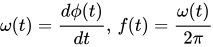
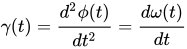
A chirp signal is generally represented in the time domain as s(t)=Acos(ϕ(t))s(t) = A \cos(\phi(t)), where AA is the amplitude and ϕ(t)\phi(t) is the instantaneous phase function that encodes the frequency variation over time. This form captures the essence of a frequency-modulated signal where the phase evolves nonlinearly, distinguishing chirps from constant-frequency sinusoids. Equivalently, the signal can be expressed using sine, s(t)=Asin(ϕ(t))s(t) = A \sin(\phi(t)), as the choice between cosine and sine is a phase shift convention. The instantaneous frequency f(t)f(t) of the chirp is defined as the time of the phase divided by 2π2\pi, that is, f(t)=12πdϕ(t)dtf(t) = \frac{1}{2\pi} \frac{d\phi(t)}{dt}. This definition arises from the interpretation of the phase's rate of change as the local angular frequency ω(t)=dϕ(t)dt\omega(t) = \frac{d\phi(t)}{dt}, with f(t)=ω(t)/(2π)f(t) = \omega(t)/(2\pi). For frequency-modulated chirps, a common phase representation is the ϕ(t)=2π(f0t+12kt2)\phi(t) = 2\pi \left( f_0 t + \frac{1}{2} k t^2 \right), where f0f_0 is the starting and kk is the chirp rate determining the linear frequency sweep; this serves as a foundational model that can be generalized to higher-order polynomials for more complex sweeps. In ideal chirp signals, the amplitude AA is typically held constant to focus on frequency modulation, though amplitude modulation can be incorporated as A(t)A(t) for practical variants without altering the core chirp structure. A key metric for assessing chirp signal efficiency is the time-bandwidth product TB=TBTB = T \cdot B, where TT is the signal duration and BB is the swept bandwidth, quantifying the signal's capacity to achieve high resolution in applications like pulse compression. This product highlights the chirp's advantage over simple pulses, as larger TBTB values enable greater compression gain while maintaining low sidelobes in matched filtering.

Types

Linear Chirp

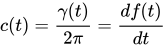
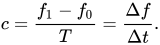
A linear chirp is a signal whose instantaneous increases or decreases at a constant rate over time, making it the most fundamental and commonly used form of chirp signal. The instantaneous is defined as f(t)=f0+ktf(t) = f_0 + k t, where f0f_0 is the initial , kk is the constant chirp rate, and tt is time, typically for 0tT0 \leq t \leq T with TT being the signal duration. The chirp rate kk is calculated as k=f1f0Tk = \frac{f_1 - f_0}{T}, where f1f_1 is the final , determining the linear sweep across the band from f0f_0 to f1f_1. The phase function of a linear chirp derives from integrating the instantaneous , yielding ϕ(t)=2π(f0t+12kt2)\phi(t) = 2\pi \left( f_0 t + \frac{1}{2} k t^2 \right), which introduces a quadratic term characteristic of the linear progression. This quadratic phase distinguishes the linear chirp from constant- signals and enables its representation as a -modulated . The time-domain expression for the linear chirp signal is given by s(t)=Acos(2π(f0t+12kt2))s(t) = A \cos\left(2\pi \left( f_0 t + \frac{1}{2} k t^2 \right)\right) for 0tT0 \leq t \leq T, where AA is the amplitude, often set to 1 for normalized signals. This form assumes a real-valued cosine carrier, though complex exponential variants are used in analytical contexts. The constant sweep rate of the linear chirp results in a quadratic phase profile, which simplifies processing in applications requiring predictable frequency evolution. This property makes linear chirps ideal for matched filtering, where the filter's impulse response mirrors the signal's conjugate time-reversed form to achieve pulse compression and improve signal-to-noise ratio. The bandwidth occupied by the signal approximates f1f0|f_1 - f_0|, providing a straightforward measure of its spectral extent. As an example, consider a linear chirp starting at f0=1f_0 = 1 kHz and ending at f1=10f_1 = 10 kHz over T=1T = 1 second, yielding a chirp rate of k=9k = 9 kHz/s; this configuration sweeps through 9 kHz of bandwidth in a simple, uniform manner.

Quadratic Chirp

A quadratic chirp is a signal whose instantaneous varies quadratically with time, resulting in a nonlinear sweep that accelerates or decelerates. The instantaneous is defined as f(t)=f0+βt2f(t) = f_0 + \beta t^2, where f0f_0 is the initial and β\beta is the quadratic chirp rate, typically for 0tT0 \leq t \leq T with TT the signal duration. The chirp rate β\beta is calculated as β=f1f0T2\beta = \frac{f_1 - f_0}{T^2}, where f1f_1 is the final , leading to a parabolic frequency progression. The phase function derives from integrating the instantaneous frequency: ϕ(t)=2π(f0t+β3t3)\phi(t) = 2\pi \left( f_0 t + \frac{\beta}{3} t^3 \right), introducing a cubic phase term that reflects the quadratic frequency variation. This cubic phase distinguishes quadratic chirps from linear ones and is useful in applications requiring nonlinear frequency modulation. The time-domain expression for the quadratic chirp signal is s(t)=Acos(2π(f0t+β3t3))s(t) = A \cos\left(2\pi \left( f_0 t + \frac{\beta}{3} t^3 \right)\right) for 0tT0 \leq t \leq T, where AA is the amplitude, often normalized to 1. This assumes a real-valued cosine carrier, with complex forms used analytically. Key properties include the accelerating (for positive β\beta) or decelerating frequency change, which can provide more uniform energy distribution in certain nonlinear systems or enhance resolution in advanced . The bandwidth is approximately f1f0|f_1 - f_0|, but the nonlinear nature affects spectral properties differently from linear chirps. As an example, a quadratic chirp from f0=1f_0 = 1 kHz to f1=10f_1 = 10 kHz over T=1T = 1 second has β=9\beta = 9 kHz/s², resulting in a frequency that starts slowly and accelerates toward the end.

Exponential Chirp

An exponential chirp is a time-varying signal characterized by an instantaneous that increases or decreases multiplicatively over time. The instantaneous is given by
f(t)=f0αt,f(t) = f_0 \cdot \alpha^t,
where f0>0f_0 > 0 is the initial at t=0t = 0, and α>1\alpha > 1 for an up-chirp (increasing ) or 0<α<10 < \alpha < 1 for a down-chirp. This formulation ensures exponential growth or decay in , contrasting with additive changes in other chirp types.
The phase ϕ(t)\phi(t) of the exponential chirp is derived by integrating the instantaneous angular frequency 2πf(τ)2\pi f(\tau) from 0 to tt:
ϕ(t)=2πf00tατdτ=2πf0lnα(αt1).\phi(t) = 2\pi f_0 \int_0^t \alpha^\tau \, d\tau = 2\pi \frac{f_0}{\ln \alpha} (\alpha^t - 1).
The resulting signal form is
s(t)=Acos(ϕ(t)+ϕ0),s(t) = A \cos\left( \phi(t) + \phi_0 \right),
where AA is the constant amplitude and ϕ0\phi_0 is an optional initial phase offset (often set to 0). This phase structure arises directly from the exponential frequency profile, leading to a nonlinear accumulation of oscillations that accelerates with time for up-chirps.
Key properties of the exponential chirp include a linear frequency progression when plotted on a logarithmic scale versus time, which yields a constant relative bandwidth Δf/flnαΔt\Delta f / f \approx \ln \alpha \cdot \Delta t. This constant relative rate makes it ideal for applications requiring uniform coverage across multiplicative frequency ranges, such as octave-spanning signals where the sweep rate can be specified in octaves per second. For instance, the logarithmic nature ensures equal time allocation per octave, unlike linear chirps that devote more time to higher frequencies. As a representative example, consider generating an exponential chirp sweeping from 100 Hz to 10 kHz over 1 second. Here, f0=100f_0 = 100 Hz, the final frequency f1=10,000f_1 = 10{,}000 Hz at t1=1t_1 = 1 s, so α=(f1/f0)1/t1=100\alpha = (f_1 / f_0)^{1/t_1} = 100. Equivalently, α=ek\alpha = e^k with k=ln(100)/14.605k = \ln(100) / 1 \approx 4.605, spanning approximately 6.64 octaves at a rate of 6.64 octaves per second. This setup produces a signal with rapidly increasing perceived pitch, emphasizing the logarithmic scaling.

Hyperbolic Chirp

A hyperbolic chirp is a -modulated signal characterized by an instantaneous that decreases hyperbolically with time, following an inverse relationship that results in a decaying sweep rate approaching zero. The function is defined as f(t)=f01+ktf(t) = \frac{f_0}{1 + k t}, where f0>0f_0 > 0 is the starting at t=0t = 0, and k>0k > 0 is the chirp rate with units of inverse time. This form ensures the remains positive and bounded below by zero while starting at f0f_0. The phase ϕ(t)\phi(t) of the hyperbolic chirp is derived from the integral of the instantaneous frequency: ϕ(t)=2π0tf(τ)dτ=2πf0kln(1+kt).\phi(t) = 2\pi \int_0^t f(\tau) \, d\tau = 2\pi \frac{f_0}{k} \ln(1 + k t). This logarithmic phase accumulation reflects the cumulative effect of the inversely varying frequency. The corresponding signal equation for a real-valued cosine-modulated hyperbolic chirp is then s(t)=Acos(2πf0kln(1+kt)),s(t) = A \cos\left( 2\pi \frac{f_0}{k} \ln(1 + k t) \right), where AA is the constant amplitude, typically assuming t0t \geq 0 and the signal windowed to a finite duration in practice. Key properties of the hyperbolic chirp include its asymptoting to zero as tt \to \infty, which inherently bounds the content from below and prevents unbounded excursions. This structure makes it advantageous for modeling scenarios involving Doppler effects, as the exhibits invariance to Doppler scaling, preserving performance under velocity-induced shifts. Additionally, the bounded trajectory contributes to controlled occupancy, aiding in applications requiring spectra confined within specific limits. A representative example is a hyperbolic chirp starting at f0=5f_0 = 5 kHz and decreasing to 500 Hz over 0.1 seconds, requiring k=90k = 90 s1^{-1} to achieve the desired endpoint frequency via f(0.1)=50001+90×0.1=500f(0.1) = \frac{5000}{1 + 90 \times 0.1} = 500 Hz. In limited regimes, such as small ktk t, this form can approximate aspects of an exponential chirp.

Generation

Analytical Generation

Analytical generation of chirp signals relies on deriving the phase function through direct integration of the specified instantaneous frequency profile, providing closed-form expressions under ideal mathematical conditions. The instantaneous frequency f(t)f(t) defines the time-varying frequency content, and the phase ϕ(t)\phi(t) is obtained via ϕ(t)=2π0tf(τ)dτ\phi(t) = 2\pi \int_0^t f(\tau) \, d\tau, assuming a starting time of t=0t = 0 for simplicity. The resulting chirp signal is then expressed as s(t)=Acos(ϕ(t)+ϕ0)s(t) = A \cos(\phi(t) + \phi_0), where AA is the and ϕ0\phi_0 is an initial phase offset, typically set to zero. This integration approach ensures the signal's frequency evolves precisely as prescribed, forming the theoretical foundation for chirp design in . For standard chirp types, closed-form solutions for the phase emerge from evaluating the integral explicitly. In the case of a linear chirp, where f(t)=f0+μtf(t) = f_0 + \mu t with initial frequency f0f_0 and chirp rate μ\mu, the phase simplifies to a quadratic form: ϕ(t)=2π(f0t+μ2t2).\phi(t) = 2\pi \left( f_0 t + \frac{\mu}{2} t^2 \right). This quadratic phase directly yields the familiar linear frequency sweep over time tt. For exponential and hyperbolic chirps, the instantaneous frequency follows f(t)=f0αtf(t) = f_0 \alpha^t or f(t)=f01+βtf(t) = \frac{f_0}{1 + \beta t}, respectively, leading to logarithmic phase expressions: ϕ(t)ln(1+βt)\phi(t) \propto \ln(1 + \beta t) for the hyperbolic case, which provides a frequency decrease approaching zero asymptotically. These analytical solutions facilitate precise theoretical modeling without numerical computation. Asymptotic analysis of chirp envelopes and spectra often employs the stationary phase approximation (SPA), which approximates integrals of the form g(t)eiϕ(t)dt\int g(t) e^{i \phi(t)} \, dt by identifying points where the phase derivative vanishes, i.e., stationary points. For chirp signals, SPA reveals the envelope's behavior in the frequency domain, approximating the magnitude spectrum as S(f)2πϕ(ts)g(ts)|S(f)| \approx \sqrt{\frac{2\pi}{|\phi''(t_s)|}} |g(t_s)|
Add your contribution
Related Hubs
User Avatar
No comments yet.