Hubbry Logo
Barun ValleyBarun ValleyMain
Open search
Barun Valley
Community hub
Barun Valley
logo
8 pages, 0 posts
0 subscribers
Be the first to start a discussion here.
Barun Valley
Barun Valley
from Wikipedia

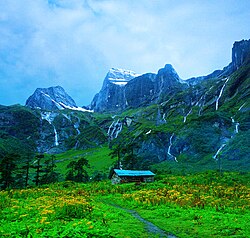
Barun Valley (बरुण उपत्यका) is a Himalayan valley situated at the base of Mt. Makalu in the Sankhuwasabha district of Nepal. This valley rests entirely inside the Makalu Barun National Park. This Valley is also known as Floral Home of Nepal.

Key Information

History

[edit]

The valley was created by the Barun River which becomes a glacier in winter. The river is known as Chukchuwa in the local Limbu language. The study has shown that this place was originally inhabited by Yakkha and Limbu centuries ago.

Beyul

[edit]

In the ancient religious Buddhist books,[which?] seven Beyul ( Nghe-Beyul Khimpalung) situated in the Himalayan region are described as mystical and spectacularly beautiful evergreen places where no one gets old. It is told that, in case of great cataclysm, life will remain only in these seven areas of the world. In those books, one of the Beyul is mentioned to be situated somewhere at this Makalu-Barun region.[1]

Places

[edit]
This is a place called Ripuk within the Barun Valley. Centuries ago, Barun used to be a glacier here, flowing to the north composing these lush green valleys of today.

All of this valley is uninhabited. It is mostly covered by grassland (Kharka). In the summer, some temporary camps are made. Listed below are the names of these camping regions.

  • Mumbuk
  • Yangle Kharka
  • Nghe
  • Ripuk
  • Tadaso
  • Yak Kharka
  • Langmale
  • Shershon

Flora and fauna

[edit]

The Barun Valley climbs from Eastern Himalayan broadleaf forests at low elevations through Eastern Himalayan subalpine conifer forests and into Eastern Himalayan alpine shrub and meadows.

Recognized for its tremendous diversity of plants, animals, and people, the area contains over 3,000 species of flowering plants, including 25 species of rhododendron, 47 types of orchids, and 56 rare plants. 440 species of birds, and 75 species of mammals, including the endangered clouded leopard (snow leopard), red panda, musk deer, wild boar, have been recorded.

This remarkable biodiversity is considered to be of global significance and provides a living laboratory for international scientific research. The Barun Valley is part of a huge international protected area under an agreement between Nepal and China.

Plants like Swertia Barunensis (4200m) and Potentilla Makaluensis (4000 m) nomenclature under the name of river Barun and Mt. Makalu are found only in this area in the entire world. 87 Himalayan medical herbs including Yasrha Gumba and Panch Aule are found here. Panch Aule is a fingered root plant (five fingers max) where fingers indicate the age of the plant in a year.

The trek

[edit]

This valley lies along the trekking route to Makalu Base Camp. This somewhat difficult yet extremely rewarding trek offers a true wilderness experience in the rugged uninhabited terrain of Makalu-Barun National Park. These days there are lodges above Tashigaon till the Base Camp, so one does not need to take camping gear, food and fuel further on. However, the lodges may not have enough blankets for visitors, so it is advisable to take a sleeping bag along. The use of a local guide is strongly recommended, as the trails are difficult to follow in some places.

Other Attractions

[edit]

Shiva Dhara (शिवधारा) This domelike cave, about 500 feet high, has a large waterfall coming out of its stone roof. The waterfall is considered a sacred tap of Lord Shiva. To get to this place one has to climb an extremely dangerous cliff with the help of locals, which will take about three to four hours.

Tadasho

[edit]

This is a large stone cliff with a hole in its face, through which a waterfall cascades. Local legend has it that a dark lake lay atop the cliff, which mysteriously caused the deaths of many Tibetan refugees after nightfall. A Buddhist monk named Rinpoche broke the cliff with his Tadasho[further explanation needed], to destroy the lake and save the lives of the Tibetan refugees.

See also

[edit]

References

[edit]
[edit]
Revisions and contributorsEdit on WikipediaRead on Wikipedia
from Grokipedia
Barun Valley is a remote Himalayan valley in the Sankhuwasabha District of eastern Nepal, lying entirely within the Makalu Barun National Park and situated at the base of Mount Makalu, the world's fifth-highest peak at 8,485 meters. The valley follows the Barun River, spanning a watershed of approximately 472 square kilometers with elevations ranging from around 400 meters in subtropical forests near the Arun River confluence to over 4,000 meters in alpine zones, and up to more than 8,000 meters near glacial sources. This dramatic altitudinal gradient supports five distinct bioclimatic zones—tropical, subtropical, temperate, subalpine, and alpine—featuring diverse vegetation such as dipterocarp and sal forests at lower elevations, broadleaf evergreens and oaks in temperate areas, conifers like Abies spectabilis in subalpine regions, and rhododendron shrubs and alpine herbs at higher altitudes. The valley's ecology is a global biodiversity hotspot, harboring endangered mammals like the Himalayan (Ailurus fulgens) and (Panthera uncia), vulnerable species such as the Himalayan black bear (Ursus thibetanus laniger), with over 400 bird across 60 families recorded in the encompassing , including the Himalayan monal (Lophophorus impejanus) and Tibetan snowcock (Tetraogallus himalayensis). Flora is equally rich, with 25 , 47 varieties, 15 types, and 48 primulas, alongside 84 in its rivers. These ecosystems remain relatively pristine due to the area's remoteness and protected status, established as part of in 1992 to conserve this intact Himalayan landscape spanning 1,500 square kilometers of core area and an 830-square-kilometer buffer zone. Barun Valley holds significant cultural and scientific value, recognized as a sacred in Tibetan Buddhist tradition and supporting indigenous communities including Sherpa, Rai, Bhote, and Gurung peoples who practice traditional livelihoods amid the terrain's challenges. It serves as a key site for ecological research, including long-term monitoring of climate change impacts through bioacoustics, camera traps, and surveys, highlighting its role in understanding Himalayan adaptation and conservation. The valley also attracts adventurous trekkers seeking its unspoiled waterfalls, gorges, and views of peaks like and , though access remains limited to maintain ecological integrity.

Geography

Location and Boundaries

Barun Valley is situated in the of eastern , forming a Himalayan valley at the base of Mount Makalu, the world's fifth-highest peak standing at 8,485 meters. This remote area lies within the broader eastern Himalayan region, with approximate coordinates of 27°40′N 87°10′E. The valley's elevation spans a dramatic range, rising from about 400 meters in its lower reaches near the Arun River confluence to over 8,000 meters at surrounding high peaks. The entire valley is encompassed by the boundaries of , established in 1992 to protect its unique ecosystems. The park covers a core of 1,500 square kilometers, augmented by an 830-square-kilometer that extends community-managed conservation efforts southward and southeastward. Positioned as an eastern adjunct to the region, Makalu Barun National Park bridges key Himalayan landscapes while maintaining distinct administrative boundaries focused on the Makalu-Barun drainage system. Barun Valley's location places it in close proximity to the international border with (Tibet Autonomous Region), approximately 20-30 kilometers to the north, where the park adjoins Chinese protected areas such as Qomolangma National Nature Reserve. This positioning facilitates transboundary conservation cooperation between and , including joint initiatives for monitoring and anti-poaching efforts under bilateral agreements dating back to 2010. The valley itself is shaped by the Barun River, which carves through the terrain from glacial sources on Mount Makalu's flanks.

Physical Features

The Barun Valley is a U-shaped glacial valley carved by the Barun River, which originates from the Barun Glacier at the base of Mount Makalu and flows southward for approximately 50 km before joining the Arun River. In the local , the river is known as Chukchuwa. The valley's diverse features steep gorges, dense subtropical forests at lower elevations below 2,000 m, and alpine meadows above 3,600 m, transitioning to rocky, arid terrain near glacial zones. Prominent glacial lakes punctuate the upper valley, including the Lower Barun Lake at 4,500 m above sea level, recognized as the deepest known in the Nepal Himalaya with a maximum depth of 205 m. This lake formed in the early to mid-1960s through the coalescence of supraglacial ponds amid the retreat of the Lower Barun Glacier, which has thinned and receded at an average rate contributing to the lake's expansion from 0.04 km² in 1975 to 1.8 km² by 2017 and over 2 km² as of 2025. The valley's elevational gradient, spanning over 7,000 m from subtropical lowlands to nival highs, supports a progression of bioclimatic zones influenced by the surrounding peaks such as Baruntse (7,162 m) and Chamlang (7,319 m). Climatic variations range from humid, misty tropical conditions at low altitudes, characterized by high rainfall exceeding 4,000 mm annually (with over 70% falling between June and September), to arctic-like conditions at high passes above 5,400 m, where perpetual snowlines prevail. This steep topographic relief and orographic effects from the encircling peaks foster localized microclimates that enhance the valley's lush through increased and . The Barun Valley forms a core part of the , where these physical elements contribute to its protected status.

History

Early Settlement and Exploration

The Barun Valley was originally inhabited by the , an indigenous Tibeto-Burman ethnic group who migrated eastward from ancestral lands in the region of present-day around the 13th century, establishing communities through and in the eastern Himalayan foothills. These early settlers, along with the related , formed the foundational human presence in the valley, adapting to its rugged terrain and seasonal challenges while maintaining close cultural ties to the surrounding landscapes. In the 17th century, Sherpa and Rai peoples migrated from Solukhumbu, further contributing to the valley's communities. Evidence from historical religious texts indicates that pilgrims began visiting sacred sites within the valley as early as the , drawn by its spiritual significance in local traditions. These visits were sporadic and tied to seasonal migrations, with records showing regular grazing activities by Sherpa herders from the 17th century onward, reflecting a pattern of intermittent human use that respected the valley's remoteness. The valley's isolation, exacerbated by steep gorges and high passes, limited broader settlement and external access during this period. Due to its extreme remoteness, early exploration of the Barun Valley was minimal, with the first documented Western visitors being members of the 1954 New Zealand Alpine Club expedition, including and , who conducted initial surveys during their Himalayan traverse. Systematic Western scientific investigations did not occur until the late ; a key 1991 field study by the Mountain Institute assessed historical and contemporary human disturbances, such as and wood collection, highlighting the valley's vulnerability to even low-level impacts. Local and naming conventions in the valley are closely linked to the Barun River, known as Chukchuwa in the , which originates from the Barun Glacier and seasonally freezes into an extensive during winter, influencing perceptions of the landscape as a dynamic, transformative force in indigenous narratives. This annual transformation underscores the river's central role in shaping both the physical valley and cultural stories of endurance and renewal among early communities.

Conservation History

The , encompassing the Barun Valley, was established in 1992 as Nepal's eighth , serving as the eastern extension of to protect the region's diverse ecosystems spanning from subtropical forests to alpine zones. This designation covered a core area of 1,500 square kilometers, with an additional 830 square kilometers designated as a in 1999 to allow sustainable resource use by local communities while mitigating human impacts on the core protected area. In the , international collaboration advanced transboundary conservation efforts, including a bilateral agreement between and to link the with China's Qomolangma Nature Preserve, established in 1989, forming one of the world's largest contiguous protected areas across the Himalayan border. This partnership emphasized joint management of shared wildlife corridors and buffer zones, promoting sustainable practices such as regulated grazing and resource harvesting to balance conservation with community needs. Conservation initiatives addressed key challenges identified in a 1991 field study, which documented historical and contemporary human disturbances in the upper Barun Valley, including for timber and fuelwood, seasonal by herders, and burning for creation, all contributing to and . Following the legalization of commercial harvesting in 2001, regulations for yartsa gunbu () were implemented post-2003 through the and committees, including permit systems with fees allocated for local development and restrictions on collector numbers (approximately 3,000 annually) to curb and associated . In the 2010s, conservation efforts shifted toward , with ongoing monitoring of (GLOF) risks at Lower Barun Lake, which has expanded rapidly to 1.8 square kilometers by 2017 due to glacier retreat, posing threats from potential outbursts triggered by instability. Projects involving , bathymetric surveys, and early warning systems, supported by organizations like ICIMOD, have informed risk assessments and lake-lowering interventions to safeguard downstream communities and ecosystems within the park.

Cultural and Religious Significance

Beyul Designation

Barun Valley is classified as one of the seven , or hidden valleys, in Tibetan Buddhist tradition, as described in ancient scriptures such as those referencing Nghe-Beyul Khembalung, which portray these sites as mystical refuges for practitioners during periods of strife and turmoil. These are believed to have been concealed to preserve spiritual purity, with Barun Valley encompassing key sites like Upper Khempalung Cave and Tso Karpo (Barun Pokhari), forming part of the broader Beyul Khembalung landscape in . The valley's designation underscores its role as a where the physical and spiritual realms intersect, offering seclusion for and enlightenment. The status of Barun Valley is closely associated with , known as Guru Rinpoche, the 8th-century tantric master who is credited with prophesying and consecrating these enchanted Himalayan sanctuaries during his travels through around 817 CE. According to tradition, subdued local deities and spirits in the region, blessing the valley as a hidden land comparable to sacred sites like , with terma (treasure) texts hidden for future revelation. These prophecies, embedded in texts like the Padma Kathang and revelations by tertöns (treasure revealers) such as Rigdzin Gödemchen in the 14th century, emphasize beyuls as places of refuge where could endure amid chaos. Specific to Barun Valley, its reverence stems from its pristine, misty terrain, which symbolizes and spiritual harmony in , as noted in pilgrimage accounts tied to 14th-century terma traditions that highlight visits to its caves and lakes for ritual circumambulation (kora). Historical texts from this era describe the valley's sacred sites, including Saisimma Monastery and natural formations like Barun Pokhari, as destinations for pilgrims seeking merit through and offerings. This aura of sanctity has drawn devotees for centuries, reinforcing the valley's identity as a timeless haven. The transboundary spiritual significance of Barun Valley's beyul designation bridges Nepalese and Tibetan Buddhist practices, as the valley lies within the shared Himalayan sacred geography that extends across borders, influencing rituals and pilgrimages in both regions through common lineages and shared terma revelations. Local communities play a vital role in upholding this sanctity through traditional guardianship of sites, complementing broader cultural customs in the area.

Local Traditions and Communities

The Barun Valley in eastern is primarily inhabited by indigenous ethnic groups including the Limbu, who are regarded as the original settlers of the region, along with the Rai and Sherpa communities concentrated in the lower valley villages. These groups sustain their livelihoods through subsistence farming of crops like millet, maize, and potatoes, supplemented by herding of yaks and goats, and the collection of such as rhododendrons and orchids for traditional healing and trade. The Limbu and Rai, in particular, maintain a deep connection to the land, viewing it as integral to their identity and survival in the rugged Himalayan terrain. Central to the cultural fabric of the Rai and Limbu are the Mundhum religious practices, an indigenous spiritual system blending animist beliefs with elements of that emphasizes and ancestral reverence. These traditions manifest in annual festivals such as Ubhauli and , which mark seasonal agricultural cycles and involve communal dances, offerings to nature spirits, and rituals at sacred springs and caves within the valley, reinforcing social bonds and . Oral histories among the Limbu link the valley to ancient migration legends tracing their origins from regions in present-day through to eastern , portraying the Barun as a destined refuge in their ancestral . Women play a pivotal role in community , often leading groups for microlending and overseeing the equitable distribution of forest products, which supports household resilience and sustainable practices. As part of the sacred landscape, local interactions with the environment incorporate prohibitions on hunting protected animals like snow leopards and red pandas to preserve spiritual balance, alongside sustainable harvesting techniques for high-value resources such as pods in lower elevations and yartsa gunbu () in alpine meadows. These practices, guided by Mundhum principles, ensure resource renewal while providing economic benefits, with communities rotating collection sites to mitigate ecological strain.

Biodiversity

Flora

The Barun Valley, nestled within the Makalu-Barun National Park in eastern , hosts an extraordinary diversity of plant life, with over 3,000 species of flowering plants recorded across its steep altitudinal gradients from 435 m to over 8,000 m. This richness includes 25 species of , 47 species of orchids, 19 species of bamboos, 15 species of oaks, 48 species of primulas, and 86 species of fodder trees, reflecting the valley's status as a in the . These plants contribute to the valley's lush, verdant landscapes, where forests and meadows form a vibrant influenced by the region's monsoon-fed . Vegetation in the Barun Valley exhibits distinct zonation tied to elevation and climate. Below 2,000 m, tropical and subtropical forests dominate, featuring species such as Shorea robusta (sal) in the lower tropical zones and Pinus roxburghii (chir pine) alongside Schima wallichii and Castanopsis species in subtropical areas up to 2,000 m. From 2,000 to 3,000 m, temperate broadleaf forests prevail, characterized by oaks like Quercus glauca and Q. lamellosa, maples (Acer spp.), and rhododendrons (Rhododendron arboreum). Above 3,000 m, subalpine coniferous forests of fir (Abies spectabilis) and additional rhododendron varieties transition into alpine meadows near the glaciers, where herbaceous plants such as primulas and gentians thrive in the harsh, high-elevation conditions. The valley's flora includes numerous , with 67 species identified for their therapeutic value, supporting local economies through seasonal harvesting. High-value items like Ophiocordyceps sinensis (yartsa gunbu), a parasitic on caterpillars, are collected in alpine meadows above 4,000 m during spring, providing significant income but raising concerns for sustainability and conservation efforts. Endemism is pronounced among the valley's plants, with unique adaptations to the humid, misty microclimates of the , such as epiphytic growth in orchids and thick, leathery leaves in rhododendrons to retain moisture. These features underscore the valley's ecological distinctiveness.

Fauna

The Barun Valley, situated within , supports a rich array of due to its dramatic gradient spanning from subtropical lowlands to alpine zones above 4,000 meters. This vertical diversity fosters habitats ranging from dense and forests to high-altitude meadows and glacial streams, enabling a total of 88 mammal species, 440 bird species, and 84 fish varieties. Among mammals, notable species include the endangered (Panthera uncia), which inhabits rocky glacial areas and high meadows for hunting prey like the (Hemitragus jemlahicus), a sure-footed herbivore adapted to steep slopes. The (Ailurus fulgens), another vulnerable species, thrives in temperate forests where it feeds primarily on bamboo, while gray langur monkeys (Semnopithecus entellus) roam the dense lower forests in troops, foraging on leaves and fruits. These mammals play key ecological roles, such as by and by predators like the snow leopard. The valley's avian diversity is equally impressive, with 440 recorded species, including the colorful (Lophophorus impejanus), Nepal's national bird, often sighted in rhododendron understories where it scratches for insects and seeds. Migratory birds such as the (Aceros nipalensis) utilize the valley's forests seasonally, while riverine habitats host species like the (Tichodroma muraria), which probes crevices along streams. Pheasants and other ground birds exhibit behaviors tied to the rhododendron forests, such as lekking displays during breeding seasons. Aquatic life in the Barun River and its tributaries includes 84 fish species, such as the snow trout (Schizothorax richardsonii), which migrates upstream for spawning in clearer upper reaches, supporting the for piscivorous birds and mammals. In lower valleys, seasonal interactions occur, like flitting among flowering undergrowth alongside foraging langurs, highlighting interconnected behaviors across taxa. As a , the valley's benefits from protections under Nepal's National Parks and Wildlife Conservation Act, which safeguards like and from poaching and habitat loss. The elevation-driven habitat mosaic—from tropical to arctic zones—enhances resilience but also underscores vulnerability to climate change-induced shifts in migration patterns.

Places and Attractions

Key Settlements and Sites

The Barun Valley, a remote Himalayan region within Makalu-Barun National Park, hosts a limited number of permanent settlements primarily occupied by indigenous communities practicing traditional livelihoods such as and . The principal villages are Simbung, Syaksila—the largest among them—and Lingam (also referred to as Magkhim), situated along the eastern slopes of the valley. These communities are predominantly inhabited by the Bhote ethnic group, alongside Rai and Limbu peoples, who preserve ancestral customs including subsistence farming and seasonal . The valley's human population remains sparse, totaling around 1,172 individuals across 235 households as of 2018, underscoring its status as a largely undisturbed area with minimal demographic pressure. Higher elevations feature semi-permanent herder camps, or kharkas, which serve as seasonal bases for grazing during warmer months. Key examples include Yangle Kharka, Nghe Kharka, Ripuk, Kharka, Langmale, and Shershon, where temporary shelters support yak herders and provide basic overnight facilities for visitors. Cultural landmarks in the valley emphasize its spiritual heritage, with notable sites such as Shiva Dhara—a dome-shaped cave approximately 500 feet high from which a sacred waterfall cascades, revered by Hindus as a divine tap of Lord Shiva. This pilgrimage spot draws locals and trekkers seeking its ritual significance, reflecting the valley's broader status as a beyul in Tibetan Buddhist tradition. Traditional Limbu and Rai villages exhibit vernacular architecture, including stone-and-wood homes adapted to the rugged terrain, while scattered sacred caves serve as meditation and ritual spaces for indigenous communities. Infrastructure remains rudimentary to preserve the area's isolation, featuring basic teahouses in lower settlements like Simbung for trekkers and locals, supplemented by seasonal camps in the kharkas. No permanent roads exist, with all access dependent on narrow foot trails that wind through the valley's forested and alpine zones.

Natural Features

The Barun Valley, nestled within the , showcases a dramatic array of geological and hydrological features shaped by glacial and fluvial processes in the eastern Himalaya. Its lower reaches, characterized by a humid , host numerous high waterfalls that cascade into deep gorges, primarily fed by tributaries of the Barun River. These cascades, often exceeding hundreds of meters in height, emerge from the lush, moisture-laden forests and contribute to the valley's reputation as one of the wetter Himalayan drainages, receiving enhanced due to orographic effects. In the upper valley, glacial features dominate, including the prominent Lower Barun Lake, a proglacial body formed by the recession of the Barun . Located at approximately 4,500 meters above , the lake spans 2.7 kilometers in length and 600 meters in width, with a surface area of about 2.09 square kilometers and a volume of 112.3 million cubic meters as of recent assessments. Its moraine-dammed structure, composed of loose boulders and debris, poses significant risks of glacial lake outburst floods (GLOFs), exacerbated by climate change-induced glacier melt and lake expansion; projections indicate potential volume increases to 193.5 million cubic meters, with peak flood discharges reaching up to 52,344 cubic meters per second in extreme scenarios. Hanging glaciers cling to the steep slopes of Mount Makalu, feeding the main Barun through discontinuous ice flows on rocky cliffs and contributing to ongoing valley erosion and sediment transport. The valley's scenic vistas are unparalleled, offering panoramic perspectives of towering Himalayan peaks from high ridges and alpine pastures. Mount Makalu (8,485 meters), the world's fifth-highest peak, dominates the skyline, flanked by Baruntse (7,162 meters) and Chamlang (7,319 meters), creating a rugged amphitheater of spires and icefalls visible across misty meadows and rhododendron-shrouded slopes. These elevated viewpoints highlight the valley's altitudinal gradient, from subtropical forests at lower elevations to nival zones above 5,000 meters. A distinctive atmospheric phenomenon in the Barun Valley arises from its humid, monsoon-influenced , where dense and frequent rainfall—over 70% of annual falling between June and September—envelop the landscape, fostering a perpetually shrouded, "hidden" quality that aligns with its designation as a sacred . This misty veil, combined with the roar of waterfalls and glacial streams, amplifies the valley's remote, ethereal allure while supporting diverse ecosystems.

Trekking and Tourism

The Barun Valley Trek

The Barun Valley Trek is a remote and strenuous expedition spanning 14 to 18 days, covering approximately 46 kilometers along the Barun River from its starting point at Tumlingtar or the nearby village of Num at around 1,500 meters elevation, ascending through diverse ecosystems to Hillary Base Camp at 4,800 meters near the Base Camp. The route involves a total elevation gain of up to 5,000 meters, traversing subtropical forests, thickets, high pastures (kharkas), and alpine meadows, offering trekkers an immersive journey into one of Nepal's least-visited Himalayan valleys. This trek is often integrated with the broader Base Camp Trek, providing access to panoramic views of Mount (8,485 meters), the world's fifth-highest peak. The itinerary typically unfolds in stages, beginning with the initial days (1-3) from Num through hillside villages such as Seduwa and Tashi Gaon, passing farms and terraced fields amid subtropical vegetation. Mid-trek sections (days 4-8) ascend from Tashi Gaon to higher elevations via Khoma Danda (3,500 meters) and Mumbuk (3,400 meters) to Nhe Kharka (3,750 meters, also spelled Nehe), winding through dense and forests where encounters with like red pandas and Himalayan black bears are possible. Upper stages (days 9-12) continue to Kharka (around 3,800 meters) and beyond to Hillary Base Camp, crossing glacial moraines and offering expansive alpine vistas of snow-capped peaks. Optional side trips may include detours to nearby glacial lakes or high pastures, enhancing the route's exploratory nature. Key highlights include intimate close-up views of Makalu's south face and the surrounding Barun Glacier, diverse sightings amid pristine wilderness, and remote camping under starlit skies in isolated kharkas. The trek is best undertaken during the post-monsoon autumn (October-November) or pre-monsoon spring (March-May) seasons, when clear skies and stable weather facilitate optimal visibility and safer passage. Rated as strenuous due to its remoteness, significant elevation changes, and lack of facilities—requiring full camping gear—the trek demands good and prior high-altitude experience. Permits are mandatory, including an entry fee of NPR 3,000 (approximately USD 21 as of 2025) for the , along with a permit (approximately USD 17).

Visitor Guidelines and Challenges

Visitors to Barun Valley must obtain an entry permit for , which costs 3,000 (approximately USD 21 as of 2025) per person for foreigners and is valid per entry, along with a Trekkers' Information Management System (TIMS) card—the TIMS card is now obtained via the online E-TIMS system—costing 2,000 (approximately USD 14 as of 2025) for independent trekkers or 1,000 (approximately USD 7) when booked through an agency. In addition, a local permit from the , priced at USD 17, is required, and guided treks are mandatory in restricted areas of the valley to ensure safety and compliance with regulations. Tourists are encouraged to adhere to principles, such as minimizing campfire impacts and packing out all waste, to preserve the valley's fragile alpine ecosystems. Restrictions prohibit visitors from collecting yartsa gunbu (), a valuable medicinal , as harvesting is regulated and limited to local communities during designated seasons to mitigate like and . Off-trail travel is discouraged to respect the beyul's sacred status and prevent erosion in this culturally significant hidden valley. Trekking in Barun Valley presents significant challenges, including such as monsoon-induced floods and , particularly in the upper reaches where elevations exceed 5,000 meters and is a common risk requiring gradual . The valley's remoteness means it can take 7-10 days to reach from the nearest road access points, with no helipads for emergency evacuations, amplifying dangers from natural hazards. Lower trails are often infested with leeches during the rainy season, necessitating protective measures like salt or repellents. Sustainability efforts include community-based initiatives, such as the Barun Bachaon project, which empower local residents through eco-friendly homestays and conservation training to reduce reliance on resource extraction. exacerbates risks, with outburst floods (GLOFs) posing threats to access routes, as evidenced by a 2017 rockfall-induced event in the upper valley that highlights the need for ongoing monitoring and adaptive management.

References

Add your contribution
Related Hubs
User Avatar
No comments yet.