Hubbry Logo
BasheerbaghBasheerbaghMain
Open search
Basheerbagh
Community hub
Basheerbagh
logo
8 pages, 0 posts
0 subscribers
Be the first to start a discussion here.
Basheerbagh
Basheerbagh
from Wikipedia

Basheerbagh is a neighbourhood of importance in Hyderabad. Now it is a commercial and business centre. The area's importance has increased because of its close proximity to other bigger commercial areas such as Abids, Koti, Nampally and Himayat Nagar. The well-known Bashir Bagh Palace was located here. The neighbourhood is also close to Hussain Sagar Lake.[1]

Key Information

History

[edit]

Basheerbagh is named after Bashir-ud-Daula Nawab Sir Asman Jah Bahadur, who served as Prime Minister of Hyderabad (1887 to 1894). The Bashir Bagh Palace was built by him in 1880.

Commercial area

[edit]

There are large number of Jewellery shops located here and good number of shopping malls around here. Famous theatres in the city such as the Skyline & Sterling movie theatres were located here. Some important government buildings like the Ayakar Bhavan (Income tax office), Police Commissioner's Office, Police control room, Central Excise and customs and Goods and services tax office, Telangana Tourism's reservation office etc. are located here. Huge commercial buildings like the Babu Khan Estate (once it was the tallest building in Hyderabad with 14 floors) and Khan Lateef Khan Estate are present here running a wide variety of businesses.

Education

[edit]
Bashir Bagh Palace, photographed by Lala Deen Dayal circa 1880

The well known Nizam College and club is located in this suburb.[2]

Sports

[edit]

Basheerbagh was a sports hub and the multipurpose L.B Stadium which is used for football and athletics is located here. It was previously called as Fateh Maidan, because the handing over of Hyderabad to the Indian Army had happened here. Earlier it was used to host international cricket matches. An indoor stadium is also present here used for Badminton and Tennis. Presently they are not used much and Gachibowli has become the sports hub of the city.

The rebel ICL matches have revived the stadiums here and they have once again come alive. The flood lights of the stadium light up the evening sky and have caused joy to the public around this area after many years.

Public transport

[edit]
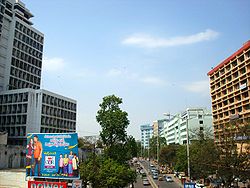
Basheerbagh main road

TGSRTC connects Basheerbagh to other parts of Hyderabad and Secunderabad. Autos and taxis are common forms of public transport here. The nearest Hyderabad Multi-Modal Transport System train station is at Nampally which is a kilometer away from Basheerbagh. The nearest metro station is lakdikapool metro station

Landmarks

[edit]

The landmarks of the city are:

References

[edit]
Revisions and contributorsEdit on WikipediaRead on Wikipedia
from Grokipedia
Basheerbagh is a prominent central neighborhood in Hyderabad, the capital of , , serving as a key commercial and residential hub with excellent connectivity to major parts of the city. Located in the heart of Hyderabad, it features a mix of office spaces, retail outlets, and residential properties, with an average property price of approximately ₹12,000 per square foot (as of 2025) and a high concentration of multistorey apartments. The locality, with pin code 500029, is bordered by areas such as , Hyderguda, and Saifabad, and is rated highly for its environment, commuting options, and places of interest. The neighborhood derives its name from the historic , constructed in the late 19th century by Nawab Sir Muhammad Mazharuddin Khan Bahadur, known as Sir Asman Jah (1839–1898), a member of the influential Paigah noble family who served as of Hyderabad from 1887 to 1894. The palace, built at a cost of about ₹400,000, exemplified the architectural grandeur of the Nizam era and included magnificent interiors that hosted notable figures, such as the classical musician , who passed away there in 1968. However, the palace was demolished by the government in the 1970s, leaving no physical remnants today, though the surrounding area retains its historical nomenclature. In contemporary history, Basheerbagh became synonymous with political activism during the statehood movement, particularly through the tragic events of August 28, 2000, when police opened fire on protesting farmers at the site during a "Chalo Assembly" demonstration against power sector privatization and tariff hikes under the Chandrababu Naidu government, resulting in three deaths. This incident, commemorated annually by left parties and activists, underscored the region's agrarian distress—with reports indicating that by 2013, 90% of farmers were in debt averaging ₹94,000—and galvanized demands for separate statehood, paving the way for the formation of the Telangana Rashtra Samithi (TRS) in 2001 and ultimately 's creation in 2014. Today, the area continues to thrive as a bustling business district with access to educational institutions like Rishi Public School, banking facilities such as IDBI Bank's Basheerbagh , and efficient public transport via nearby Hyderguda Bus Stop.

Geography and Etymology

Location and Boundaries

Basheerbagh is a central locality within Hyderabad, the capital city of , , and forms an integral part of the (GHMC), which governs urban services and administration across the metropolitan area. Geographically positioned at approximately 17.399782°N and 78.476615°E , it occupies a strategic spot in the city's core, contributing to its role as a key urban hub. The locality spans approximately 0.76 square kilometers (0.29 square miles) and sits at an elevation of about 494 meters (1,621 feet) above . The locality's central placement facilitates connectivity to major transport networks, including roads linking it to surrounding districts. The boundaries of Basheerbagh are defined by its proximity to prominent landmarks and adjacent neighborhoods, and it is close to Lake to the north. It borders established localities such as to the west, Koti to the southwest, Nampally to the northwest, and Himayatnagar to the east, creating a compact urban enclave that blends residential, commercial, and institutional zones without rigid physical barriers like rivers or hills. This adjacency enhances Basheerbagh's accessibility, as it lies within a 2-3 kilometer radius of these neighboring areas, promoting seamless integration into Hyderabad's broader urban fabric. Administratively, Basheerbagh operates under the (PIN) 500029, which covers its postal services and logistics. The locality adheres to (IST), set at UTC+5:30, aligning with the national time standard observed throughout . These positional attributes underscore Basheerbagh's significance as a well-connected, centrally located neighborhood in one of India's major metropolitan regions.

Naming Origin

The name Basheerbagh originates from "Bashir-ud-Daula," a title bestowed upon Sir Asman Jah Bahadur (1839–1898), a distinguished Paigah noble and of Hyderabad from 1887 to 1894. This nomenclature reflects the tradition common among the nobility of the , where titles in and Persian denoted status and service to the Nizam. The area's designation became prominent with the construction of Bashir Bagh Palace in 1880, built by Sir Asman Jah as his residence amid expansive gardens, thereby imprinting his title on the surrounding locality. The palace's establishment solidified the name Basheerbagh, evoking the Persian word bagh for "garden," a linguistic element prevalent in Hyderabad's under the Asaf rulers who drew heavily from Persianate and administration.

History

Establishment and Early Development

Basheerbagh was established in 1880, coinciding with the construction of Bashir Bagh Palace by Nawab Sir Asman Jah Bahadur, a leading Paigah noble and of Hyderabad from 1887 to 1894. The palace, built on land previously occupied by an existing garden purchased from an Arab jamadar, featured lavish European-influenced architecture, including a grand foyer with Ionic columns, and amenities such as a , Turkish baths, and courts. This development pioneered suburban palace-building outside Hyderabad's old city, overlooking Lake and near Secunderabad Road. The initial purpose of Basheerbagh was to serve as a residential and palatial area for , particularly the influential Paigah families who held jagirs under the Nizams. As part of Hyderabad's expansion during the , which governed the region from 1724 onward, the area exemplified the aristocracy's role in extending the city's elite quarters beyond the original Qutb Shahi core. The name Basheerbagh itself derives from Asman Jah's title, Bashir-ud-Daula. Early infrastructure in Basheerbagh focused on creating an exclusive enclave near central Hyderabad, with the palace complex including outhouses, a , and botanical gardens to support noble lifestyles. This growth was influenced by the traditions of the Qutb Shahi era, which established Hyderabad's grid layout in 1591, and the Asaf Jahi Nizams' subsequent northward expansions, such as the addition of new bazaars and administrative structures post-1763. By the late 19th century, the locality had become a secure settlement for upper-class residents, including communities like the Kshatriyas, drawn by its proximity to key amenities.

Key Historical Figures and Events

Nawab Sir Asman Jah Bahadur, born Mazharuddin Khan (1839–1898), was a distinguished member of the influential Paigah family and a key statesman in the princely state of Hyderabad. He served as (Diwan) from 1887 to 1894 under Nizam Mahbub Ali Khan, during which he implemented significant administrative reforms in areas such as , women's , and systems. Additionally, he represented the Nizam at Queen Victoria's Golden Jubilee celebrations in , highlighting his stature in both local and British imperial circles. Asman Jah is particularly renowned for constructing the in the late , which he named after himself (with "Basheer" derived from his title Bashir-ud-Daula). The palace exemplified the grandeur and cultural fusion of the Nizam era, featuring European architectural elements, such as an Italian-style villa design, complete with lavish interiors featuring ornate chandeliers, marble flooring, and expansive gardens. It served as a venue for extravagant social events that underscored Hyderabadi nobility's hospitality; for instance, in February 1890, Asman Jah hosted a grand fancy-dress ball at the palace for around 200 guests, including British officers and local elites, illuminated by 10,000 lamps, accompanied by musical performances, fireworks, and a banquet with gold and silver cutlery. This event symbolized the palace's role as a center of opulence and cross-cultural exchange during the height of princely rule. Following the integration of into the Indian Union through Operation Polo in September 1948, the , like many Nizam-era estates, was abandoned after the abolition of the jagirdari system in 1949, with the land sold in the 1960s. This shift marked the end of its role as a private residence. The palace continued to be used in the post-independence period, notably as a residence for the Hindustani classical musician , who died there on 25 April 1968. However, neglect and urban development pressures resulted in the palace's complete demolition by 1970, leaving no major remnants today, though the surrounding area retains its historical name and significance as a reminder of Hyderabad's princely legacy.

Demographics and Governance

Population and Composition

Basheerbagh, as a sub-locality within the (GHMC), contributes to the broader urban fabric of Hyderabad, which recorded a population of 6.809 million in the 2011 Census. The locality itself has an estimated resident population of 21,079, comprising 10,754 males and 10,325 females, reflecting a balanced distribution typical of central urban areas. Spanning approximately 0.76 square kilometers, Basheerbagh exhibits a high of 27,682 persons per square kilometer, consistent with trends in Hyderabad's core commercial zones where vertical development and limited land availability drive intense . The linguistic composition of Basheerbagh mirrors Hyderabad's multicultural profile, with Telugu and as the predominant languages spoken by residents. According to the 2011 Census data for Hyderabad district, Telugu is the mother tongue for 43.4% of the population, while accounts for 43.2%, reflecting the historical and cultural influences of the region's significant Telugu- and Urdu-speaking communities. Minority languages include (5.9%), Marathi (1.7%), and others, with English widely used as a among professionals due to the influx of migrants attracted by commercial opportunities in the area. Socio-economically, Basheerbagh hosts a diverse mix of middle-class residents, IT professionals, and transient workers, shaped by Hyderabad's economic transformation since the IT boom that spurred significant urban migration and job creation in services and sectors. This influx has fostered a dynamic with high rates and in white-collar occupations, though it also includes daily wage earners in retail and support roles. The area's central location and commercial vibrancy contribute to an upwardly mobile profile, with property values indicating middle to upper-middle-class living standards amid ongoing urban growth.

Administrative Structure

Basheerbagh is governed by the (GHMC), which serves as the primary local administrative body responsible for urban services in the area. Specifically, the locality falls under Ward No. 78 (Gunfoundry) in the Central Zone of GHMC, enabling localized decision-making on development and maintenance through the ward committee structure. Electorally, Basheerbagh is part of the Vidhan Sabha constituency (No. 65), represented in the , and the (No. 2) in the . These constituencies facilitate representation of local issues at state and national levels, with the MLA for being , elected in 2023, who resigned from the in 2025. The GHMC oversees key civic services in Basheerbagh, including solid through door-to-door collection, segregation, and processing via its Solid Waste Management department, which operates across all wards to maintain standards. Zoning regulations designate the area for mixed residential-commercial use under the (HMDA) Master Plan 2031, promoting integrated development with commercial dominance in the urban core while permitting compatible residential structures. initiatives, coordinated between GHMC and the state government, focus on sustainable growth, alignment, and compliance with state-level policies to address the area's evolving needs.

Economy

Commercial Activities

Basheerbagh serves as a prominent commercial hub in central Hyderabad, characterized by a mix of government administrative offices, retail establishments, and entertainment venues that drive local economic activity. The area hosts key public sector offices, including the Aayakar Bhavan, which houses multiple divisions of the , facilitating tax administration and compliance services for the region. Adjacent to this, the Central Reservation Office of the Tourism Development Corporation operates from Shakar Bhavan, managing bookings for tours, packages, and promotional activities that promote the state's sector. Retail forms a of Basheerbagh's commercial landscape, with a strong emphasis on shops and outlets catering to both traditional and modern consumers. Establishments like Musaddilal Jewellers, operational since 1899, specialize in and pieces blending heritage craftsmanship with contemporary designs, drawing shoppers seeking high-quality artisanal work. Similarly, Tibarumals has been a fixture for over six decades, renowned for its temple and collections that attract a steady stream of local and regional buyers. These outlets, alongside others such as Jewellers and Shruti Jewellers, contribute to the area's reputation as a go-to destination for premium retail, supported by a dense cluster of smaller stores offering apparel and accessories. Entertainment venues have historically anchored Basheerbagh's commercial vibrancy, particularly through theatres that served as cultural and leisure hubs. The Skyline Theatre and Sterling Theatre, twin landmarks in the , were pivotal for screening English and films, attracting movie enthusiasts and boosting surrounding retail footfall with their prime location and ample parking. Although now repurposed into residential spaces, their legacy underscores the area's role in blending commerce with entertainment. Economically, Basheerbagh plays a vital role in Hyderabad's service sector by integrating administrative, retail, and tourism functions, generating high footfall from adjacent neighborhoods like Abids, a major shopping district. This connectivity enhances the area's contribution to the city's broader commercial ecosystem, supporting employment in services and trade while serving as a nexus for business interactions in the Telangana region.

Major Commercial Buildings

The Babu Khan Estate stands as a prominent commercial landmark in Basheerbagh, Hyderabad, constructed by the renowned Babukhan Properties firm. As of the early , it was recognized as the city's tallest structure with 14 floors, symbolizing the onset of high-rise development in the area. The building continues to function as a key hub for corporate and private offices, contributing to Basheerbagh's status as a business center. The Khan Lateef Khan Estate is another significant multi-storey commercial edifice located at Fateh Maidan in Basheerbagh, primarily accommodating various business offices. Spanning approximately six floors with a built-up area of around 200,000 square feet, it serves as vital for enterprises in the locality. The structure underscores the area's commercial density, though it has faced challenges such as regulatory issues regarding occupancy and safety compliance. The Hyderabad Police Commissioner's Office, situated opposite Nizam Grounds near L.B. Stadium in Basheerbagh, operates as a central administrative hub for law enforcement in the city. It provides essential facilities for oversight, including emergency response coordination and crime prevention operations. The office integrates modern surveillance systems to support policing activities across Hyderabad. The site of the Old Gandhi Medical College in Basheerbagh encompasses a historical 5.61-acre plot that once housed the institution temporarily starting in 1958, before its relocation. The erstwhile City Improvement Board (CIB) building on these premises exemplifies Indo-Saracenic architecture, featuring a single-storey design constructed with granite and lime mortar, and was rededicated for public use following conservation efforts. Today, the reclaimed land holds potential for commercial-adjacent developments, reflecting the area's transition from educational to business-oriented purposes.

Infrastructure

Public Transportation

Basheerbagh is well-connected by road transport, with the (TGSRTC) providing frequent bus services across multiple routes that pass through the locality. Key s, such as Basheerbagh Bus Stop and the adjacent Bus Stop, serve as hubs for commuters traveling to areas like , , and other parts of Hyderabad, offering affordable and extensive coverage for daily mobility needs. Auto-rickshaws and taxis, including metered cabs and ride-hailing options like Ola and , are readily accessible throughout Basheerbagh for short-distance trips and last-mile connectivity, making them popular for navigating the dense urban layout. Rail access is facilitated by the nearby Nampally station, the closest Multi-Modal Transport System (MMTS) hub approximately 1 km away, which supports suburban rail lines connecting Basheerbagh to broader Hyderabad suburbs and nearby cities. The Rail enhances options, with the Lakdikapool station on the Red Line (Miyapur-LB Nagar corridor) situated about a 5-minute walk from central Basheerbagh, providing efficient links to major districts and reducing reliance on road travel. Despite its advantageous central location fostering strong ties to Hyderabad's core commercial and administrative zones, Basheerbagh grapples with notable , especially on elevated sections like the Basheerbagh flyover, which can delay commutes during peak hours.

Utilities and Services

Basheerbagh receives its water supply primarily through the Hyderabad Metropolitan Water Supply and Sewerage Board (HMWSSB), which manages distribution, treatment, and sewage services across the Hyderabad metropolitan area, including this locality. The board operates a network of pipelines and treatment facilities to ensure potable water delivery to residential and commercial areas in Basheerbagh, with customer services available via a dedicated (155313) for complaints related to supply disruptions or billing. Electricity in Basheerbagh is provided by the Southern Power Distribution Company of Limited (TGSPDCL), responsible for power distribution in southern districts, encompassing Hyderabad. TGSPDCL maintains substations and feeder lines in the area, supporting reliable supply to the locality's offices, residences, and businesses, with emergency complaint reporting accessible through the statewide (). Sanitation and in Basheerbagh fall under the (GHMC), which oversees , disposal, and operations citywide. GHMC deploys workers for daily garbage clearance and maintains drainage systems to prevent waterlogging during monsoons, while also managing street lighting through an integrated urban infrastructure framework. The locality benefits from proximity to the Control Room located in Basheerbagh, facilitating rapid response for , (dial 101), and medical emergencies (dial 102/108). This central facility coordinates with statewide services, ensuring efficient handling of incidents in the area.

Institutions

Education

Basheerbagh, as a central locality in Hyderabad, played a pivotal role in the Nizam era's push for educational advancement, where the rulers prioritized modern institutions to foster learning amid the princely state's development initiatives. The seventh Nizam, , notably pioneered compulsory across in the early 20th century, laying the groundwork for accessible schooling that extended to areas like Basheerbagh. Nizam College, founded in 1887 by amalgamating the Hyderabad School (also known as the Noble School) and the Madarsa-i-Aliya, remains one of India's oldest and most prestigious liberal arts colleges. Situated in Basheerbagh, the institution was initially affiliated with the for over six decades before becoming a constituent college of on February 19, 1947. It specializes in undergraduate programs across sciences, humanities, and social sciences, emphasizing interdisciplinary education and research that has shaped generations of scholars in . The college's sprawling 20-acre campus, which includes a historic building that was once the summer palace of Paigah Mulk Fakrul Bahadur, gifted to the college, continues to serve as a hub for academic excellence, with departments like Physics dating back to 1895 offering foundational courses in natural sciences. Complementing higher education, Basheerbagh is served by numerous primary and affiliated with the , which provide structured curricula focused on core subjects like languages, , and sciences to build foundational skills for local youth. Notable institutions include Rishi Public School and Madina Public School. These institutions operate under the state's , ensuring standardized assessments and alignment with national educational goals, though they maintain a community-oriented approach suited to the area's urban demographic.

Healthcare

The Old Gandhi Medical College, located in Basheerbagh from 1958 until its relocation in 2003, served as a key institution for and training in central Hyderabad during its tenure there. Originally established in 1954 as the People's Medical College at Humayun Nagar, it was shifted to Basheerbagh to expand facilities and integrate with operations, where it provided undergraduate and postgraduate medical training while offering limited patient care services. The college's presence in Basheerbagh contributed to the area's role as a hub for healthcare , fostering generations of doctors amid the post-independence growth of public medical infrastructure in . Associated with the college, Gandhi Hospital functioned as the primary teaching facility, delivering general and to the local population. Originating from an 1851 infirmary that evolved into a full-fledged by the early , it was formally linked to the medical college in , enhancing clinical training opportunities during the Basheerbagh era. The hospital's operations emphasized affordable care, including specialized departments for , , and trauma, making it a vital resource for response in the region. This healthcare complex in Basheerbagh improved accessibility for the central Hyderabad populace, drawing patients from surrounding urban areas due to its proximity to major transport links and administrative centers. Integrated into 's state health initiatives, it supported broader programs, such as vaccination drives and maternal care, under the Directorate of . Even after the 2003 relocation to , the historical footprint in Basheerbagh underscores its in equitable healthcare delivery. Today, Basheerbagh hosts several private healthcare facilities, including Hyderabad Nursing Home and multispecialty clinics offering services in general medicine, ENT, and dental care, serving the local residential and commercial population as of 2025.

Sports and Landmarks

Sports Facilities

The Lal Bahadur Shastri Stadium, formerly known as Fateh Maidan and situated in the heart of Basheerbagh, Hyderabad, stands as a historic multi-purpose venue constructed in 1950 for football and cricket. Originally part of the broader Fateh Maidan sports complex, it quickly became a key site for athletic events, hosting its inaugural Test cricket match in November 1955 against New Zealand. With a seating capacity of around 30,000, the stadium features a batsman-friendly grass pitch and floodlights installed in 1993, enabling evening matches and large-scale gatherings for cricket, football, and athletics. Over the decades, it served as Hyderabad's primary international cricket ground until the early 2000s, accommodating domestic leagues and national championships that fostered local sports culture. In the , the experienced a notable revival through the (ICL), an unofficial competition that organized multiple high-profile matches there between 2007 and 2008, drawing crowds and spotlighting the venue amid tensions with the official . These events, including semifinals and finals involving teams like the , reinvigorated interest in the aging facility and underscored its role in alternative formats during a transitional period for Indian sports. Beyond , the stadium has long supported football tournaments and track-and-field meets, contributing to community fitness initiatives and youth training programs under the Sports Authority of State. Complementing the main , the complex includes an indoor facility dedicated to racket such as and lawn tennis, forming part of a multi-sport hub that promotes year-round indoor activities. This indoor , equipped with courts and amenities, hosts local leagues, sessions, and amateur competitions, making it accessible for diverse athletic pursuits in an urban setting. Together with adjacent features like a and gymnasium, these indoor options enhance the complex's versatility for non-outdoor events. Today, the Stadium holds a secondary role to the modern in for major international fixtures, yet it remains vital for regional events, historical commemorations, and everyday recreational use by locals. Its central location ensures easy access via public transportation, sustaining its legacy as a community anchor for sports in Basheerbagh.

Notable Landmarks

Basheerbagh is historically defined by the (detailed in the History section), an opulent structure built circa 1880 by Sir Asman Jah, a prominent Paigah noble who served as of Hyderabad from 1887 to 1894 and was connected to the Nizam through marriage. The palace showcased Nizam-era grandeur with magnificent interiors and European architectural influences, serving as a residence for and a venue for elite cultural gatherings that highlighted the Paigah legacy of service to the . Acquired by the state government in 1956 after the formation of and fully demolished in the 1970s, with its lands parceled and sold in the 1960s following the abolition of the jagirdari system, the palace site has been repurposed into the modern urban landscape of Basheerbagh, featuring commercial buildings and residential areas. Despite its loss, the palace remains a symbol of the area's aristocratic heritage, embodying the Paigah nobles' contributions to Hyderabad's development under the Nizams. Adding to Basheerbagh's cultural profile is its close proximity to Lake, a historic man-made reservoir approximately 2 km away that acts as a central scenic and recreational landmark for Hyderabad. Other notable nearby landmarks include the Telangana Legislature Complex and the State Central Library, enhancing the area's blend of historical and administrative significance. This positioning enhances the locality's identity as a nexus of historical and natural elements, reflecting Hyderabad's fusion of Nizam-era opulence with enduring urban landscapes.

References

Add your contribution
Related Hubs
User Avatar
No comments yet.