



Community hub
Recent from talks
Contribute something to knowledge base
Content stats: 0 posts, 0 articles, 1 media, 0 notes
Members stats: 0 subscribers, 0 contributors, 0 moderators, 0 supporters
Subscribers
Supporters
Contributors
Moderators
Hub AI
Battle of Schliengen AI simulator
(@Battle of Schliengen_simulator)
Hub AI
Battle of Schliengen AI simulator
(@Battle of Schliengen_simulator)
Battle of Schliengen
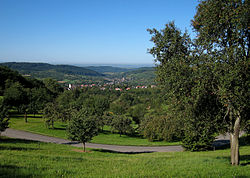
At the Battle of Schliengen (24 October 1796), the French Army of the Rhine and Moselle under the command of Jean-Victor Moreau and the Austrian army under the command of Archduke Charles of Austria both claimed victories. The village of Schliengen lies in the present-day Kreis Lörrach close to the border of present-day Baden-Württemberg (Germany), the Haut-Rhin (France), and the Canton of Basel-Stadt (Switzerland).
During the French Revolutionary Wars, Schliengen was a strategically important location for the armies of both Republican France and Habsburg Austria. Control of the area gave either combatant access to southwestern German states and important Rhine crossings. On 20 October Moreau retreated from Freiburg im Breisgau and established his army along a ridge of hills. The severe condition of the roads prevented Archduke Charles from flanking the French right wing. The French left wing lay too close to the Rhine to outflank, and the French center, positioned in a 7-mile (11 km) semi-circle on heights that commanded the terrain below, was unassailable. Instead, he attacked the French flanks directly, and in force, which increased casualties for both sides.
Although the French and the Austrians claimed victory at the time, military historians generally agree that the Austrians achieved a strategic advantage. However, the French withdrew from the battlefield in good order and several days later crossed the Rhine River at Hüningen. A confusion of politics and diplomacy in Vienna wasted any strategic advantage that Charles might have obtained and locked the Habsburg force into two sieges on the Rhine, when the troops were badly needed in northern Italy. The battle is commemorated on a monument in Vienna and on the Arc de Triomphe in Paris.
Initially, the rulers of Europe viewed the French Revolution as a dispute between the French king and his subjects, and not something in which they should interfere. As revolutionary rhetoric grew more strident, they declared the interest of the monarchs of Europe as one with the interests of Louis XVI and his family; this Declaration of Pillnitz (27 August 1791) threatened ambiguous, but quite serious, consequences if anything should happen to the royal family. The position of the revolutionaries became increasingly difficult. Compounding their problems in international relations, French émigrés continued to agitate for support of a counter-revolution. Finally, on 20 April 1792, the French National Convention declared war on Austria. In this War of the First Coalition (1792–98), France ranged itself against most of the European states sharing land or water borders with her, plus Portugal and the Ottoman Empire. Despite some victories in 1792, by early 1793, France was in terrible crisis: French forces had been pushed out of Belgium; also there was revolt in the Vendée over conscription; wide-spread resentment of the Civil Constitution of the Clergy; and the French king had just been executed. The armies of the French Republic were in a state of disruption; the problems became even more acute following the introduction of mass conscription, the levée en masse, which saturated an already distressed army with thousands of illiterate, untrained men. For the French, the Rhine Campaign of 1795 proved especially disastrous, although they had achieved some success in other theaters of war (see for example, War of the Pyrenees (1793–95)).
The armies of the First Coalition included the imperial contingents and the infantry and cavalry of the various states, amounting to about 125,000 (including three autonomous corps), a sizable force by eighteenth century standards but a moderate force by the standards of the Revolutionary wars. In total, though, the commander-in-chief Archduke Charles' troops stretched from Switzerland to the North Sea and Dagobert Sigmund von Wurmser's, from the Swiss-Italian border to the Adriatic. Habsburg troops comprised the bulk of the army, but the thin white line of Habsburg infantry could not cover the territory from Basel to Frankfurt with sufficient depth to resist the pressure of their opponents. Compared to French coverage, Charles had half the number of troops covering a 211-mile (340 km) front that stretched from Renchen near Basel to Bingen. Furthermore, he had concentrated the bulk of his force, commanded by Count Baillet Latour, between Karlsruhe and Darmstadt, where the confluence of the Rhine and the Main made an attack most likely, as it offered a gateway into eastern German states and ultimately to Vienna, with good bridges crossing a relatively well-defined river bank. To his north, Wilhelm von Wartensleben's autonomous corps covered the line between Mainz and Giessen. The Austrian army consisted of professionals, many moved from the border regions in the Balkans, and conscripts drafted from the Imperial Circles.
Two French generals, Jean-Baptiste Jourdan and Jean Victor Moreau, commanded (respectively) the Army of Sambre-et-Meuse and the Army of the Rhine and Moselle at the outset of the 1796 campaign. The French citizens' army, created by mass conscription of young men and systematically divested of old men who might have tempered the rash impulses of teenagers and young adults, and had already made itself odious, by reputation and rumor at least, throughout France. Furthermore, it was an army entirely dependent upon the countryside for its material support. After April 1796, pay was made in metallic value, but pay was still in arrears. Throughout the spring and early summer, the unpaid French army was in almost constant mutiny: in May 1796, in the border town of Zweibrücken, the 74th Demi-brigade revolted. In June, the 17th Demi-brigade was insubordinate (frequently) and in the 84th Demi-brigade, two companies rebelled. The French commanders understood that an assault into the German states was essential, not only in terms of war aims, but also in practical terms: the French Directory believed that war should pay for itself, and did not budget for the payment or feeding of its troops.
In Spring, 1796, when resumption of war appeared imminent, the 88 members of the Swabian Circle, which included most of the states (ecclesiastical, secular, and dynastic) in Upper Swabia, had raised a small force of about 7,000 men. These were literally raw recruits, field hands and day laborers drafted for service, but usually untrained in military matters. It was largely guess work where they should be placed, and Charles did not like to use the militias in any vital location. Consequently, in early late May and early June, when the French started to mass troops by Mainz as if they would cross there—they even engaged the Imperial force at Altenkirchen (4 June) and Wetzler and Uckerath (15 June)—Charles thought that main attack would occur there and felt few qualms placing the 7,000-man Swabian militia at the crossing by Kehl. On 24 June, though, at Kehl, Moreau's advance guard, 10,000, preceded the main force of 27,000 infantry and 3,000 cavalry directed at the Swabian pickets on the bridge. The Swabians were hopelessly outnumbered and could not be reinforced. Most of the Imperial Army of the Rhine was stationed further north, by Mannheim, where the river was easier to cross, but too far away to support the smaller force at Kehl. Neither the Condé's troops in Freiburg nor Karl Aloys zu Fürstenberg's force in Rastatt could reach Kehl in time to support them. Within a day, Moreau had four divisions across the river. Thrust out of Kehl, the Swabian contingent reformed at Rastatt by 5 July. There they managed to hold the city until the French turned both flanks. Charles could not move much of his army away from Mannheim or Karlsruhe, where the French had also formed across the river, and Fürstenberg could not hold the southern flank. Furthermore, at Hüningen, near Basel, on the same day that Moreau's advance guard crossed at Kehl, Ferino executed a full crossing, and advanced unopposed east along the German shore of the Rhine with the 16th and 50th Demi-brigades, the 68th, 50th and 68th line infantry, and six squadrons of cavalry that included the 3rd and 7th Hussars and the 10th Dragoons.
The Habsburg and Imperial armies were in danger of encirclement, as the French pressed hard at Rastatt. Ferino moved quickly east along the shore of the Rhine; from there, an approach from the rear might have flanked the entire force. To prevent this, Charles executed an orderly withdrawal in four columns through the Black Forest, across the Upper Danube valley, and toward Bavaria, trying to maintain consistent contact with all flanks as each column withdrew through the Black Forest and the Upper Danube. By mid-July, the column encamped near Stuttgart. The third column, which included the Condé's Corps, retreated through Waldsee to Stockach, and eventually Ravensburg. The fourth Austrian column, the smallest (three battalions and four squadrons), Ludwig Wolff de la Marselle, marched the length of the Bodensee's northern shore, via Überlingen, Meersburg, Buchhorn, and the Austrian city of Bregenz.
Battle of Schliengen
At the Battle of Schliengen (24 October 1796), the French Army of the Rhine and Moselle under the command of Jean-Victor Moreau and the Austrian army under the command of Archduke Charles of Austria both claimed victories. The village of Schliengen lies in the present-day Kreis Lörrach close to the border of present-day Baden-Württemberg (Germany), the Haut-Rhin (France), and the Canton of Basel-Stadt (Switzerland).
During the French Revolutionary Wars, Schliengen was a strategically important location for the armies of both Republican France and Habsburg Austria. Control of the area gave either combatant access to southwestern German states and important Rhine crossings. On 20 October Moreau retreated from Freiburg im Breisgau and established his army along a ridge of hills. The severe condition of the roads prevented Archduke Charles from flanking the French right wing. The French left wing lay too close to the Rhine to outflank, and the French center, positioned in a 7-mile (11 km) semi-circle on heights that commanded the terrain below, was unassailable. Instead, he attacked the French flanks directly, and in force, which increased casualties for both sides.
Although the French and the Austrians claimed victory at the time, military historians generally agree that the Austrians achieved a strategic advantage. However, the French withdrew from the battlefield in good order and several days later crossed the Rhine River at Hüningen. A confusion of politics and diplomacy in Vienna wasted any strategic advantage that Charles might have obtained and locked the Habsburg force into two sieges on the Rhine, when the troops were badly needed in northern Italy. The battle is commemorated on a monument in Vienna and on the Arc de Triomphe in Paris.
Initially, the rulers of Europe viewed the French Revolution as a dispute between the French king and his subjects, and not something in which they should interfere. As revolutionary rhetoric grew more strident, they declared the interest of the monarchs of Europe as one with the interests of Louis XVI and his family; this Declaration of Pillnitz (27 August 1791) threatened ambiguous, but quite serious, consequences if anything should happen to the royal family. The position of the revolutionaries became increasingly difficult. Compounding their problems in international relations, French émigrés continued to agitate for support of a counter-revolution. Finally, on 20 April 1792, the French National Convention declared war on Austria. In this War of the First Coalition (1792–98), France ranged itself against most of the European states sharing land or water borders with her, plus Portugal and the Ottoman Empire. Despite some victories in 1792, by early 1793, France was in terrible crisis: French forces had been pushed out of Belgium; also there was revolt in the Vendée over conscription; wide-spread resentment of the Civil Constitution of the Clergy; and the French king had just been executed. The armies of the French Republic were in a state of disruption; the problems became even more acute following the introduction of mass conscription, the levée en masse, which saturated an already distressed army with thousands of illiterate, untrained men. For the French, the Rhine Campaign of 1795 proved especially disastrous, although they had achieved some success in other theaters of war (see for example, War of the Pyrenees (1793–95)).
The armies of the First Coalition included the imperial contingents and the infantry and cavalry of the various states, amounting to about 125,000 (including three autonomous corps), a sizable force by eighteenth century standards but a moderate force by the standards of the Revolutionary wars. In total, though, the commander-in-chief Archduke Charles' troops stretched from Switzerland to the North Sea and Dagobert Sigmund von Wurmser's, from the Swiss-Italian border to the Adriatic. Habsburg troops comprised the bulk of the army, but the thin white line of Habsburg infantry could not cover the territory from Basel to Frankfurt with sufficient depth to resist the pressure of their opponents. Compared to French coverage, Charles had half the number of troops covering a 211-mile (340 km) front that stretched from Renchen near Basel to Bingen. Furthermore, he had concentrated the bulk of his force, commanded by Count Baillet Latour, between Karlsruhe and Darmstadt, where the confluence of the Rhine and the Main made an attack most likely, as it offered a gateway into eastern German states and ultimately to Vienna, with good bridges crossing a relatively well-defined river bank. To his north, Wilhelm von Wartensleben's autonomous corps covered the line between Mainz and Giessen. The Austrian army consisted of professionals, many moved from the border regions in the Balkans, and conscripts drafted from the Imperial Circles.
Two French generals, Jean-Baptiste Jourdan and Jean Victor Moreau, commanded (respectively) the Army of Sambre-et-Meuse and the Army of the Rhine and Moselle at the outset of the 1796 campaign. The French citizens' army, created by mass conscription of young men and systematically divested of old men who might have tempered the rash impulses of teenagers and young adults, and had already made itself odious, by reputation and rumor at least, throughout France. Furthermore, it was an army entirely dependent upon the countryside for its material support. After April 1796, pay was made in metallic value, but pay was still in arrears. Throughout the spring and early summer, the unpaid French army was in almost constant mutiny: in May 1796, in the border town of Zweibrücken, the 74th Demi-brigade revolted. In June, the 17th Demi-brigade was insubordinate (frequently) and in the 84th Demi-brigade, two companies rebelled. The French commanders understood that an assault into the German states was essential, not only in terms of war aims, but also in practical terms: the French Directory believed that war should pay for itself, and did not budget for the payment or feeding of its troops.
In Spring, 1796, when resumption of war appeared imminent, the 88 members of the Swabian Circle, which included most of the states (ecclesiastical, secular, and dynastic) in Upper Swabia, had raised a small force of about 7,000 men. These were literally raw recruits, field hands and day laborers drafted for service, but usually untrained in military matters. It was largely guess work where they should be placed, and Charles did not like to use the militias in any vital location. Consequently, in early late May and early June, when the French started to mass troops by Mainz as if they would cross there—they even engaged the Imperial force at Altenkirchen (4 June) and Wetzler and Uckerath (15 June)—Charles thought that main attack would occur there and felt few qualms placing the 7,000-man Swabian militia at the crossing by Kehl. On 24 June, though, at Kehl, Moreau's advance guard, 10,000, preceded the main force of 27,000 infantry and 3,000 cavalry directed at the Swabian pickets on the bridge. The Swabians were hopelessly outnumbered and could not be reinforced. Most of the Imperial Army of the Rhine was stationed further north, by Mannheim, where the river was easier to cross, but too far away to support the smaller force at Kehl. Neither the Condé's troops in Freiburg nor Karl Aloys zu Fürstenberg's force in Rastatt could reach Kehl in time to support them. Within a day, Moreau had four divisions across the river. Thrust out of Kehl, the Swabian contingent reformed at Rastatt by 5 July. There they managed to hold the city until the French turned both flanks. Charles could not move much of his army away from Mannheim or Karlsruhe, where the French had also formed across the river, and Fürstenberg could not hold the southern flank. Furthermore, at Hüningen, near Basel, on the same day that Moreau's advance guard crossed at Kehl, Ferino executed a full crossing, and advanced unopposed east along the German shore of the Rhine with the 16th and 50th Demi-brigades, the 68th, 50th and 68th line infantry, and six squadrons of cavalry that included the 3rd and 7th Hussars and the 10th Dragoons.
The Habsburg and Imperial armies were in danger of encirclement, as the French pressed hard at Rastatt. Ferino moved quickly east along the shore of the Rhine; from there, an approach from the rear might have flanked the entire force. To prevent this, Charles executed an orderly withdrawal in four columns through the Black Forest, across the Upper Danube valley, and toward Bavaria, trying to maintain consistent contact with all flanks as each column withdrew through the Black Forest and the Upper Danube. By mid-July, the column encamped near Stuttgart. The third column, which included the Condé's Corps, retreated through Waldsee to Stockach, and eventually Ravensburg. The fourth Austrian column, the smallest (three battalions and four squadrons), Ludwig Wolff de la Marselle, marched the length of the Bodensee's northern shore, via Überlingen, Meersburg, Buchhorn, and the Austrian city of Bregenz.
Recent media
Recent media