


Community hub
Recent from talks
Contribute something
Nothing was collected or created yet.
War of the First Coalition
View on Wikipedia| War of the First Coalition | |||||||||
|---|---|---|---|---|---|---|---|---|---|
| Part of the French Revolutionary Wars and the Coalition Wars | |||||||||
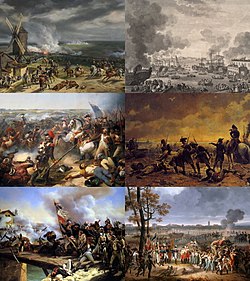
 Click an image to load the appropriate article. Left to right, top to bottom: Battles of Valmy, Toulon, Fleurus, Quiberon, Arcole and Mantua | |||||||||
| |||||||||
| Belligerents | |||||||||
|
First Coalition
 Spain (until 1795)[b] Spain (until 1795)[b] Portugal Portugal Naples (until 1796) Naples (until 1796) Papal States (until 1797) Papal States (until 1797) |
French naval allies | ||||||||
| Commanders and leaders | |||||||||
| Strength | |||||||||
1793: 800,000+[2] 800,000+[2] 65,000[3] 65,000[3] 60,000[4] 60,000[4] 25,000 25,000 20,000[5] 20,000[5] |
| ||||||||
| Casualties and losses | |||||||||
 Austria Austria94,000 soldiers killed in combat[7] ~188,000 died of disease 220,000 captured 100,000 wounded[8] |
 French Republic French Republic100,000 soldiers killed in combat ~200,000 died of disease 150,000 captured[8][7] | ||||||||


The War of the First Coalition (French: Guerre de la première coalition) was a set of wars that several European powers fought between 1792 and 1797, against France.[j][9] They were only loosely allied and fought without much apparent coordination or agreement; each power had its eye on a different part of France it wanted to appropriate after a French defeat, which never occurred.[10]
Relations between the French revolutionaries and neighbouring monarchies had deteriorated following the Declaration of Pillnitz in August 1791. Eight months later, following a vote of the revolutionary-led Legislative Assembly, France declared war on Austria on 20 April 1792; Prussia, having allied with Austria in February, declared war on France in June 1792. In July 1792, an army under the Duke of Brunswick and composed mostly of Prussians joined the Austrian side and invaded France. The capture of Verdun (2 September 1792) triggered the September massacres in Paris. France counterattacked with the victory at Valmy (20 September) and two days later the National Convention, which had replaced the Legislative Assembly, proclaimed the French Republic.
Subsequently, these powers made several invasions of France by land and sea, in association with Prussia and Austria attacking from the Austrian Netherlands and the Rhine, and Great Britain supporting revolts in provincial France and laying siege to Toulon in October 1793. France suffered reverses (Battle of Neerwinden, 18 March 1793) and internal strife (War in the Vendée) and responded with draconian measures. The Committee of Public Safety was formed (6 April 1793) and the levée en masse drafted all potential soldiers aged 18 to 25 (August 1793). The new French armies counterattacked, repelled the invaders, and advanced beyond France.
The French established the Batavian Republic as a sister republic (May 1795) and gained Prussian recognition of French control of the Left Bank of the Rhine by the first Peace of Basel. With the Treaty of Campo Formio, Austria ceded the Austrian Netherlands to France and Northern Italy was turned into several French sister republics. Spain made a separate peace accord with France (Second Treaty of Basel) and the French Directory annexed more of the Holy Roman Empire.
North of the Alps, Archduke Charles, Duke of Teschen defeated the invading armies during the Rhine campaign, but Napoleon Bonaparte succeeded against Sardinia and Austria in northern Italy (1796–1797) near the Po Valley, culminating in the Peace of Leoben and the Treaty of Campo Formio (October 1797). The First Coalition collapsed, leaving only Britain in the field fighting against France.
Background
[edit]Revolution in France
[edit]As early as 1791, other monarchies in Europe were watching the developments in France with alarm, and considered intervening, either in support of Louis XVI or to take advantage of the chaos in France. The key figure, Leopold II, Holy Roman Emperor, brother of the French Queen Marie Antoinette, had initially looked on the Revolution calmly. He became increasingly concerned as the Revolution grew more radical, although he still hoped to avoid war.
On 27 August 1791, Leopold and King Frederick William II of Prussia, in consultation with émigré French nobles, issued the Declaration of Pillnitz, which declared the concern of the monarchs of Europe for the well-being of Louis and his family, and threatened vague but severe consequences if anything should befall them. Although Leopold saw the Pillnitz Declaration as a way of taking action that would enable him to avoid actually doing anything about France, at least for the moment, Paris saw the Declaration as a serious threat and the revolutionary leaders denounced it.[11]
In addition to the ideological differences between the French revolutionaries and the European monarchies, disputes continued over the status of Imperial estates in Alsace,[11] and the French authorities became concerned about the agitation of émigré nobles abroad, especially in the Austrian Netherlands and in the minor states of Germany. In the end, France declared war on Austria first, with the Assembly voting for war on 20 April 1792, after the presentation of a long list of grievances by the newly appointed foreign minister Charles François Dumouriez, who sought a war which might restore some popularity and authority to the King.[12]
1792
[edit]Invasion of the Austrian Netherlands
[edit]Dumouriez prepared an invasion of the Austrian Netherlands, where he expected the local population to rise against Austrian rule. However, the revolution had thoroughly disorganized the French army, which had insufficient forces for the invasion. Its soldiers fled at the first sign of battle, deserting en masse, in one case murdering General Théobald Dillon.[12] The French soldiers were insulted, hissed, even assaulted. The situation of the "Flanders Campaign" was alarming.[13]
While the revolutionary government frantically raised fresh troops and reorganized its armies, an allied army under Charles William Ferdinand, Duke of Brunswick assembled at Koblenz on the Rhine. The invasion commenced in July 1792. The Duke then issued a declaration on 25 July 1792, which had been written by the brothers of Louis XVI, that declared his [Brunswick's] intent to restore the King of France to his full powers, and to treat any person or town who opposed him as rebels to be condemned to death by martial law.[12] This motivated the revolutionary army and government to oppose the Prussian invaders by any means necessary,[12] and led almost immediately to the overthrow of the King by a crowd which stormed the Tuileries Palace.[14]
Prussian progress
[edit]
Brunswick's army, composed mostly of Prussian veterans, crossed into French territory on 19 August and easily took the fortresses of Longwy and Verdun.[15] But at the Battle of Valmy on 20 September 1792 they came to a stalemate against Dumouriez and Kellermann in which the highly professional French artillery distinguished itself. Although the battle was a tactical draw, it bought time for the revolutionaries and gave a great boost to French morale. Furthermore, the Prussians, facing a campaign longer and more costly than predicted, decided against the cost and risk of continued fighting and determined to retreat from France to preserve their army.[9]
Fronts in Italy and Germany
[edit]Meanwhile, the French had been successful on several other fronts, occupying the Duchy of Savoy and the County of Nice until the Massif de l'Authion, while General Custine invaded Germany, capturing Speyer, Worms and Mainz along the Rhine, and reaching as far as Frankfurt. Dumouriez went on the offensive in the Austrian Netherlands once again, winning a great victory over the Austrians at Jemappes on 6 November 1792, and occupying the entire country by the beginning of winter.[9]
1793
[edit].jpg)
On 21 January the revolutionary government executed Louis XVI after a trial.[16] This united all European governments, including Spain, Naples & Sicily, and the Netherlands against the Revolution. France declared war against Britain and the Netherlands on 1 February 1793 and soon afterwards against Spain. In the course of the year 1793 the Holy Roman Empire (on 23 March), the kings of Portugal and Naples, and the Grand Duke of Tuscany declared war against France. Thus the First Coalition was formed.[9]
Introduction of conscription
[edit]France introduced a new levy of hundreds of thousands of men, beginning a French policy of using levée en masse (mass conscription) to deploy more of its manpower than the other states could,[9] and remaining on the offensive so that these mass armies could commandeer war material from the territory of their enemies. The Girondin faction of the French government sent Citizen Genet to the United States to encourage them to enter the war on France's side. The newly formed nation refused, and the Washington administration's 1793 Proclamation of Neutrality threatened legal action against any citizen providing assistance to any side in the conflict.
After a victory in the Battle of Neerwinden in March, the Austrians suffered twin defeats at the battles of Wattignies and Wissembourg.[17] British land forces were defeated at the Battle of Hondschoote in September.[17]
1794
[edit]
Battle of Fleurus
[edit]1794 brought increased success to the revolutionary armies. A major victory against combined coalition forces at the Battle of Fleurus gained all of the Austrian Netherlands and the Rhineland for France.[17] Although the British navy maintained its supremacy at sea, it was unable to support effectively any land operations after the fall of the Belgian provinces.[18] The Prussians were slowly driven out of the eastern provinces[17] and by the end of the year they had retired from any active part in the war.[18] Against Spain, the French made successful incursions into both Catalonia and Navarre[18] in the War of the Pyrenees.
Actions in the West Indies
[edit]Action extended into the French colonies in the West Indies. A British fleet occupied Martinique, St. Lucia, and Guadeloupe, although a French fleet arrived later in the year and recovered the latter by ousting the invaders.[19]
1795
[edit]French capture of the Low Countries
[edit]After seizing the Low Countries in a surprise winter attack, France established the Batavian Republic as a puppet state. Even before the close of 1794 Prussia retired from any active part in the war, and on 5 April 1795 King Frederick William II concluded with France the Peace of Basel, which recognized France's occupation of the left bank of the Rhine. The new French-dominated Dutch government bought peace by surrendering Dutch territory to the south of that river. A treaty of peace between France and Spain followed in July. The grand duke of Tuscany had been admitted to terms in February. The coalition thus fell into ruin and France proper would be free from invasion for many years.[20]
Battle of Quiberon
[edit]Britain attempted to reinforce the rebels in the Vendée by landing French Royalist troops at Quiberon, but failed,[21] and attempts to overthrow the government in Paris by force were foiled by the military garrison led by Napoleon Bonaparte, leading to the establishment of the Directory.[22][23]
Battle of Mainz
[edit]On the Rhine frontier, General Pichegru, negotiating with the exiled Royalists, betrayed his army and forced the evacuation of Mannheim and the failure of the siege of Mainz by Jourdan.[24]
1796
[edit]
The French prepared a great advance on three fronts, with Jourdan and Jean Victor Marie Moreau on the Rhine and the newly promoted Napoleon Bonaparte in Italy. The three armies were to link up in Tyrol and march on Vienna.
Rhine campaign
[edit]In the Rhine campaign of 1796, Jourdan and Moreau crossed the Rhine river and advanced into Germany. Jourdan advanced as far as Amberg in late August while Moreau reached Bavaria and the edge of Tyrol by September. However Jourdan was defeated by Archduke Charles, Duke of Teschen and both armies were forced to retreat back across the Rhine.[24][25]
Invasion of Italy
[edit]Napoleon, on the other hand, was successful in a daring invasion of Italy. In the Montenotte Campaign, he separated the armies of Sardinia and Austria, defeating each one in turn, and then forced a peace on Sardinia. Following this, his army captured Milan and started the Siege of Mantua. Bonaparte defeated successive Austrian armies sent against him under Johann Peter Beaulieu, Dagobert Sigmund von Wurmser and József Alvinczi while continuing the siege.[25][24]
End of the War of the Vendée
[edit]The rebellion in the Vendée was also crushed in 1796 by Louis Lazare Hoche.[25] Hoche's subsequent attempt to land a large invasion force in Munster to aid the United Irishmen was unsuccessful.[19]
1797
[edit]Battle of Mantua
[edit]
On 2 February Napoleon finally captured Mantua,[26] with the Austrians surrendering 18,000 men. Archduke Charles of Austria was unable to stop Napoleon from invading the Tyrol, and the Austrian government sued for peace in April. At the same time, there was a new French invasion of Germany under Moreau and Hoche.[26]
Invasion of Great Britain
[edit]On 22 February, a French invasion force consisting of 1,400 troops from the La Legion Noire (The Black Legion) under the command of Irish American Colonel William Tate landed near Fishguard in Wales. They were met by a quickly assembled group of around 500 British reservists, militia and sailors under the command of John Campbell, 1st Baron Cawdor. After brief clashes with the local civilian population and Lord Cawdor's forces on 23 February, Tate was forced into an unconditional surrender by 24 February. This would be the only battle fought on British soil during the Revolutionary Wars.
Austrian peace
[edit]Austria signed the Treaty of Campo Formio in October,[26] ceding Belgium to France and recognizing French control of the Rhineland and much of Italy.[25] The ancient Republic of Venice was partitioned between Austria and France. This ended the War of the First Coalition, although Great Britain and France remained at war.
See also
[edit]Notes
[edit]- ^ Nominally the Holy Roman Empire, under Austrian rule, also encompassed many other Italian states, such as the
 Duchy of Modena, Grand Duchy of Tuscany, and the
  Duchy of Massa. Left the war after signing the Treaty of Campo Formio with France.
- ^ a b Left the war after signing the Peace of Basel with France.
- ^ Left the war after signing the Treaty of Paris with France.
- ^ Including the Army of Condé. Britain was in personal union with the Electorate of Hanover which was also part of the Holy Roman Empire. Its troops operated under British command.
- ^ Left the war after signing the Treaty of The Hague (1795) with France.
- ^ Including the Polish Legions formed in French-allied Italy in 1797, following the abolition of the Polish–Lithuanian Commonwealth after the Third Partition in 1795.
- ^ The French Revolutionary Army and Dutch revolutionaries overthrew the Dutch Republic and established the Batavian Republic as a puppet state in its place.
- ^ Various conquered Italian states, including the Cisalpine Republic from 1797
- ^ Re-entered the war against Britain as an ally of France after signing the Second Treaty of San Ildefonso.
- ^ initially against the constitutional Kingdom of France and then the French Republic that succeeded it
.svg)

References
[edit]- ^ "Wars of the Vendee". Archived from the original on 19 January 2024.
- ^ Wilson, Peter (2016). Heart of Europe: A History of the Holy Roman Empire. Cambridge, MA: Belknap Press. p. 462.
This trend was compounded by the underlying shift in the Empire's internal military balance as the combined strength of the Austrian and Prussian armies expanded from 185,000 men in 1740 to 692,700 fifty years later, compared to the combined total of all other forces that dropped by around 9,000 men to 106,000 by 1790.
- ^ Clodfelter 2017, p. 104.
- ^ Bas, François de (1887). Prins Frederik Der Nederlanden en Zijn Tijd, vol. 1 (in Dutch). H. A. M. Roelants. Retrieved 31 March 2013. Page 638.
- ^ Rodger, N. A. M. (2007). Command of the Ocean: A Naval History of Britain, 1649–1815. London: Penguin Books. p. 426. ISBN 978-0-14-102690-9. Total number of British soldiers in the Low Countries in late 1793 was 20,000; other British soldiers were not on the continent at this time.
- ^ Lynn, John A. (2018). "Recalculating French Army Growth During the Grand Siede, 1610–1715". In Rogers, Clifford J. (ed.). The Military Revolution Debate. Vol. 18 (2 ed.). Routledge. pp. 117–148. doi:10.4324/9780429496264-6. ISBN 978-0-429-49626-4. Only counting frontline army troops, not naval personnel, militiamen, or reserves; the National Guard alone was supposed to provide a reserve of 1,200,000 men in 1789.
- ^ a b "Victimario Histórico Militar Capítulo IV Guerras de la Revolución Francesa (1789 a 1815)". Archived from the original on 2015-04-30. Retrieved 2020-04-02.
- ^ a b Clodfelter 2017, p. 100.
- ^ a b c d e Holland 1911, Battle of Valmy.
- ^ Shusterman, Noah (2015). De Franse Revolutie (in Dutch). Amsterdam: Veen Media., a translation of "Chapter 7: The federalist revolts, the Vendée and the beginning of the Terror (summer–fall 1793)". The French Revolution. Faith, Desire, and Politics. London/New York: Routledge. 2014. pp. 271–312.
- ^ a b Holland 1911, The king and the nonjurors.
- ^ a b c d Holland 1911, War declared against Austria.
- ^ Howe, Patricia Chastain (2008). "Endgame, March–December 1793". Foreign Policy and the French Revolution. New York: Palgrave Macmillan US. pp. 171–186. doi:10.1057/9780230616882_11. ISBN 978-1-349-37213-3.
- ^ Holland 1911, Rising of the 10th of August.
- ^ Holland 1911, The revolutionary Commune of Paris.
- ^ Holland 1911, Trial and execution of Louis XVI.
- ^ a b c d Holland 1911, The Revolutionary War. Republican successes..
- ^ a b c Holland 1911, Progress of the war..
- ^ a b Hannay 1911, p. 204.
- ^ One of more of the preceding sentences text from a publication now in the public domain: Holland 1911, Progress of the war
- ^ Holland 1911, Progress of the war.
- ^ Holland 1911, Insurrection of 13 Vendémiaire.
- ^ Holland 1911, Character of the Directory.
- ^ a b c Hannay 1911, p. 182.
- ^ a b c d Holland 1911, Military triumphs under the Directory. Bonaparte.
- ^ a b c Hannay 1911, p. 193.
Sources
[edit]- Clodfelter, Micheal (2017). Warfare and armed conflicts: a statistical encyclopedia of casualty and other figures, 1492–2015 (4th ed.). Jefferson, North Carolina: McFarland & Company, Inc., Publishers. p. 100. ISBN 978-1-4766-2585-0.
- Hannay, David (1911). . In Chisholm, Hugh (ed.). Encyclopædia Britannica (11th ed.). Cambridge University Press.
- Holland, Arthur William (1911). . In Chisholm, Hugh (ed.). Encyclopædia Britannica (11th ed.). Cambridge University Press.
Further reading
[edit]- Clausewitz, Carl von; Murray, Nicholas; Pringle, Christopher; Showalter, Dennis E. (2018). Napoleon's 1796 Italian campaign. Lawrence, Kansas: University Press of Kansas. ISBN 978-0-7006-2676-2.
- Fremont-Barnes, Gregory (2013). The French Revolutionary Wars. Routledge. ISBN 978-1-135-97741-2.
- Gardiner, Robert, ed. (1996). Fleet battle and blockade: the French Revolutionary War, 1793–1797. Chatham pictorial histories. London: Chatham. ISBN 978-1-86176-018-0.
- Lefebvre, Georges (1964). The French Revolution. Vol. 2: From 1793 to 1799. Translated by Stewart, John Hall; Friguglietti, James. New York: Columbia University Press.
- Ross, Steven T. (1973). Quest for Victory: French Military Strategy, 1792–1799. A.S. Barnes. ISBN 978-0-498-07490-5.
External links
[edit] Media related to War of the First Coalition at Wikimedia Commons

| Preceded by Siege of Namur (1792) |
French Revolution: Revolutionary campaigns War of the First Coalition |
Succeeded by War in the Vendée |


| International | |
|---|---|
| National | |
| Other | |

War of the First Coalition
View on GrokipediaOrigins
Radicalization of the French Revolution
The Legislative Assembly, convened on 1 October 1791 following the adoption of the Constitution of 1791, was deeply divided between moderate Feuillants, Girondins favoring war to export revolutionary ideals and preempt counter-revolutionary threats, and more radical Jacobins influenced by sans-culottes demands for deeper reforms. Economic distress, including bread shortages and assignat inflation exceeding 100% by mid-1792, fueled urban unrest and pressure from Parisian sections for decisive action against perceived royal intrigue. Jacques-Pierre Brissot and other Girondin leaders argued that war against Austria would unify the nation, regenerate the army through patriotic fervor, and dismantle feudal remnants abroad, though this rationale masked internal power struggles and ideological zeal for universal republicanism. Initial French defeats after the declaration of war on 20 April 1792, including the Austrian army's advance to Valenciennes by July, intensified fears of invasion and royal collusion, prompting radical factions to mobilize. On 10 August 1792, sans-culottes and provincial fédérés stormed the Tuileries Palace, resulting in over 1,000 deaths among Swiss Guards and arrests of Louis XVI and ministers, effectively ending constitutional monarchy amid massacres of prisoners in September that claimed around 1,100–1,400 lives.[4] The National Convention, elected in early September with universal male suffrage turnout estimated at 10–12%, proclaimed the First French Republic on 21 September 1792, sidelining Girondin moderates in favor of Montagnard Jacobins who prioritized survival through emergency measures. The Convention's trial of Louis XVI, initiated on 11 December 1792, culminated in his guillotining on 21 January 1793 by a vote of 387–334, framing him as a traitor responsible for 1792's military failures and foreign plots despite evidence of his limited agency post-Varennes.[5] This regicide, justified by radicals as necessary to prevent restoration amid ongoing Vendée revolts and coalition threats, provoked unified outrage across European courts, accelerating the formation of alliances against French expansionism while domestically enabling the Committee of Public Safety's centralization of power.[6] By June 1793, Jacobin purges expelled 29 Girondin deputies, instituting policies like the levée en masse on 23 August 1793 to conscript 300,000 men, marking the onset of totalitarian governance to combat internal dissent and external foes.Diplomatic Tensions and French Declaration of War
Following the failed Flight to Varennes on June 20–21, 1791, which resulted in the arrest of King Louis XVI and Queen Marie Antoinette, the French monarchy's authority eroded significantly, heightening fears among European powers of revolutionary contagion.[7] Austrian Emperor Leopold II, Marie Antoinette's brother, and Prussian King Frederick William II responded with the Declaration of Pillnitz on August 27, 1791, issued at Pillnitz Castle near Dresden. This document affirmed that the restoration of order and the constitutional rule of Louis XVI constituted a common interest for all European sovereigns and invited other powers to join in measures to achieve this end, with Austria and Prussia pledging to act immediately if a general coalition formed.[8] Though conditional and primarily rhetorical—Leopold sought to avoid unilateral action due to Austria's commitments in the Ottoman Empire and Poland—the declaration alarmed the French Legislative Assembly, which interpreted it as a prelude to invasion and a direct threat to national sovereignty.[9] Diplomatic exchanges intensified through late 1791 and early 1792. The French Assembly, via Foreign Minister Jean de Nivelle, issued demands on November 29, 1791, requiring Austria to renounce the Pillnitz Declaration, evacuate garrisons from the Austrian Netherlands (modern Belgium), and guarantee free navigation of the Scheldt River, contravening prior treaties that closed it to maintain Dutch influence.[10] Leopold countered on December 21, 1791, insisting France repeal its November 1791 decree expelling émigré nobles and halt agitation against monarchies, while rejecting territorial concessions.[11] Mutual mobilizations followed: France decreed general conscription on February 24, 1792, and prepared 110,000 troops under generals like Théobald Dillon and Charles François Dumouriez, while Austria reinforced its borders but delayed full commitment. Tensions peaked with French annexation of the County of Avignon on September 14, 1791, and Savoy on November 27, 1792—actions viewed abroad as expansionist, further eroding diplomatic trust.[7] Internally, the Girondin faction, led by Jacques-Pierre Brissot, advocated war as a means to unify France against perceived external enemies, export revolutionary ideals, and marginalize internal opponents like the refractory clergy and royalists. Brissot argued in Assembly speeches that foreign powers harbored counter-revolutionary designs, framing preemptive war as defensive despite limited evidence of imminent invasion; this reflected ideological zeal over strategic caution, as French forces remained disorganized and under-equipped.[9] Louis XVI, hoping military setbacks would bolster his prerogatives and discredit republicans, withheld vetoes on key war measures after initially resisting. On April 20, 1792, the Assembly voted overwhelmingly (408–0, with 282 abstentions) to declare war on "the King of Hungary and Bohemia" (Archduke Francis, who succeeded Leopold on March 1, 1792), citing Austrian intransigence and threats to French security.[12] This initiated hostilities, with France bearing primary responsibility for the rupture despite mutual provocations.[10]Formation of the Anti-French Coalition
The Declaration of Pillnitz, issued jointly by Holy Roman Emperor Leopold II and King Frederick William II of Prussia on August 27, 1791, expressed solidarity with Louis XVI and warned that any harm to the French monarchy would be viewed as a threat to all sovereigns, inviting other European powers to intervene collectively if consensus was reached.[1] This statement, intended as a diplomatic signal to bolster the endangered French king amid revolutionary unrest, was interpreted in France as preparation for invasion, exacerbating fears among Girondin factions who advocated preemptive war to export revolutionary principles and secure domestic support.[1] The French Legislative Assembly, influenced by such perceptions, declared war on Austria—embodied by Francis II as Holy Roman Emperor—on April 20, 1792, framing it as a crusade against feudal tyranny despite internal divisions and military unreadiness.[13] In direct response to the French declaration, Austria and Prussia formalized their opposition, with Prussia committing forces on May 21, 1792, to repel the invasion and restore monarchical order, viewing the revolutionary regime's aggression as an existential threat to dynastic stability and territorial balances disrupted by French annexations like Savoy in September 1792.[14] This core alliance drew partial support from principalities of the Holy Roman Empire, motivated by proximity to French incursions along the Rhine and aversion to the Revolution's anti-aristocratic excesses, though coordination remained loose due to competing interests such as Prussian ambitions in Poland.[13] The coalition's initial aims centered on containing French expansionism, as evidenced by the Duke of Brunswick's manifesto of July 25, 1792, which threatened severe reprisals against Paris if Louis XVI was harmed, aiming to deter radicalism without immediate full-scale commitment.[1] The coalition expanded in early 1793 following the French Republic's execution of Louis XVI on January 21, 1793, and its subsequent declarations of war on Great Britain and the Dutch Republic on February 1, 1793, provoked by Britain's opposition to France's reopening of the Scheldt River and the Edict of Fraternity's call to incite uprisings abroad.[14] Spain joined in March 1793, incensed by the regicide of their Bourbon kin, while Portugal, the Kingdom of Sardinia, and the Kingdom of Naples acceded later that year, driven by fears of revolutionary contagion and French encroachments in Italy.[13] Britain provided crucial financial subsidies to Austria and other allies, reflecting Prime Minister William Pitt's strategy to counter French naval threats and commercial dominance without large-scale land commitments initially.[14] This broadening transformed the ad hoc defensive pact into a multifaceted anti-revolutionary front, though internal rivalries—such as Austrian priorities for the Low Countries over Prussian eastern goals—limited unified action.[1]Early Engagements (1792)
Invasion of the Austrian Netherlands
Following the stalemate at the Battle of Valmy on 20 September 1792, which checked the Prussian-led Allied advance into France, French commander Charles François Dumouriez reoriented the Army of the North toward an offensive into the Austrian Netherlands.[15] This Habsburg-controlled territory, encompassing modern Belgium, offered strategic ports, industrial resources, and a staging ground for Coalition operations against France; its conquest aligned with revolutionary aims to export liberty and secure economic assets like textiles and ironworks to fund the war effort.[15] Dumouriez, appointed to lead the Army of the North in August 1792, prioritized this theater after coordinating with General François Kellermann's forces at Valmy, leveraging the momentum to relieve the ongoing siege of Lille from 25 September to 7 October.[15] By late October 1792, Dumouriez assembled approximately 36,000 troops, including 32,000 infantry, 3,800 cavalry, and over 100 artillery pieces, supplemented by a detachment of 4,000 men under François Harville with 15 guns.[15] He crossed the Meuse River and advanced northeast toward Mons, prompting the Austrian Army of the Netherlands—commanded by Duke Albert of Saxe-Teschen, governor-general of the territory—to withdraw from forward positions.[15] The Austrians, numbering about 13,800 combatants with 11,600 infantry, 2,170 cavalry, and 56 guns, adopted a defensive posture along a fortified line on the Cuesmes-Jemappes ridge east of Mons, relying on terrain advantages, entrenched artillery, and professional discipline to counter the numerically superior but less trained French levies.[16] Dumouriez divided his forces into three columns for a converging assault, exploiting gaps in the Austrian deployment despite reconnaissance limitations and autumnal weather hindering maneuvers.[15] The ensuing Battle of Jemappes on 6 November 1792 marked the invasion's climax. French artillery opened with a bombardment to soften Austrian positions, followed by infantry assaults across the difficult terrain of orchards, hedges, and ravines; revolutionary volunteers, fueled by ideological zeal and promises of plunder, pressed forward in dense columns, absorbing heavy fire.[15] Dumouriez's left flank under Jean-Nicolas Desandrouins outflanked the Austrian right, capturing key heights, while central attacks seized Jemappes village after prolonged hand-to-hand fighting.[15] Duke Albert, facing overwhelming odds and cohesion strains in his outnumbered force, ordered a tactical withdrawal by midday, preserving much of his army through orderly retreat under cavalry screens. French casualties totaled around 2,000 killed and wounded, reflecting the assault's ferocity against prepared defenses; Austrian losses were lighter at 828 killed and 413 captured, underscoring their tactical proficiency despite the defeat.[15] In the battle's aftermath, French forces pursued the retreating Austrians, occupying Brussels on 14 November and swiftly securing Antwerp, Ghent, and Ostend by month's end, effectively conquering the Austrian Netherlands.[15] This rapid advance, completed within weeks, demonstrated the revolutionary army's capacity for offensive action through mass and morale, though logistical strains and command frictions foreshadowed vulnerabilities; Dumouriez proclaimed the "liberation" of the region, installing provisional governments to legitimize control and extract resources, yet local resistance and Coalition reinforcements loomed.[15] The victory boosted French confidence, enabling further probes into the Dutch Republic, but exposed the fragility of gains reliant on unseasoned troops against professional foes.[15]Prussian Advance into France
The Prussian-led invasion of France began on August 19, 1792, commanded by Duke Charles William Ferdinand of Brunswick, with the primary force comprising approximately 34,000 Prussian troops supported by Austrian contingents and French émigré units.[17] This advance followed the Brunswick Manifesto, proclaimed on July 25, 1792, at Koblenz, which demanded the restoration of Louis XVI's authority and warned of Paris's destruction should the king suffer harm, aiming to demoralize revolutionary forces but instead provoking outrage that accelerated the king's overthrow on August 10.[18][19] Crossing the northeastern frontier near Longwy, the Prussians initiated sieges against border fortresses to secure their lines of communication. Longwy capitulated after a four-day bombardment from August 20 to 23, yielding artillery and supplies with minimal resistance due to the garrison's small size of about 4,000 men.[20] Emboldened, Brunswick's army pressed onward, besieging Verdun, which surrendered on September 2 following heavy artillery fire that breached its defenses, providing a strategic gateway toward the Marne River and Paris, roughly 150 miles distant.[21] The advance proceeded cautiously along the Champagne road, prioritizing fortified positions over rapid maneuvers, as Brunswick sought to avoid overextension amid concerns over French numerical superiority and unreliable Austrian coordination under the Duke of Saxe-Teschen. Logistical strains intensified with early autumn rains transforming fields into quagmires, delaying artillery transport and foraging, while disease and desertion thinned Prussian ranks accustomed to disciplined campaigns like the Seven Years' War.[17] By mid-September, the invaders reached the Argonne forest, where French armies under Charles François Dumouriez maneuvered to block key passes, forcing Brunswick to pivot eastward. On September 20, 1792, near Valmy, the Prussian advance culminated in a standoff against roughly 36,000 French troops positioned on a plateau, commanded by François Christophe Kellermann with Dumouriez's oversight. What ensued was primarily an artillery duel, with Prussian guns firing over 1,300 rounds but failing to dislodge the resolute French lines, whose own 60 cannons inflicted comparable casualties—estimated at around 300 on each side—amid poor weather and low ammunition.[21] Brunswick, citing supply shortages and reports of French reinforcements, ordered a retreat the following day, abandoning the direct thrust on Paris and exposing coalition vulnerabilities despite the Prussian army's superior training and cohesion. This halt preserved the Revolution, shifting momentum as winter set in and French levies bolstered defenses.[17]Opening Actions in Italy and the Rhineland
In September 1792, the French Army of the Alps under General Anne Pierre de Montesquiou launched an invasion of the Duchy of Savoy, a possession of the Kingdom of Sardinia allied with the First Coalition, crossing the frontier on the nights of 21 and 22 September with approximately 12,000 troops.[22] The operation encountered minimal organized resistance from Sardinian forces, which numbered fewer than 5,000 in the region and were disorganized following the broader declaration of war against Sardinia on 15 May 1792, allowing French troops to occupy key passes and towns like Chambéry by late September.[23] Savoy was formally annexed by the National Convention on 27 November 1792, justified by the assembly as reclaiming "natural frontiers" and amid local petitions from pro-revolutionary elements, though Sardinian King Victor Amadeus III rejected French overtures for neutrality.[24] Concurrently, General Joseph Anselme's Army of the Var, comprising about 7,500 men, advanced into the County of Nice on 28 September 1792, capturing the port city after brief skirmishes with Sardinian garrisons that offered token opposition due to supply shortages and low morale.[25] [26] Nice's fall secured the Mediterranean coast for French operations and facilitated the subsequent annexation alongside Savoy, though these gains strained French logistics without decisively engaging main Coalition armies in Piedmont.[24] The Italian theater remained secondary to northern fronts, with French successes attributable to Coalition divisions and Sardinia's focus on defending core territories rather than peripheral enclaves.[27] On the Rhineland front, General Adam Philippe de Custine exploited the Coalition's retreat after the Battle of Valmy by crossing the Rhine into the Palatinate in early October 1792 with the Army of the Rhine, totaling around 20,000-25,000 effectives bolstered by volunteer battalions.[28] Custine's forces captured Speyer on 21 October and Worms on 24 October with little fighting, as Imperial and Prussian garrisons—fragmented among Holy Roman Empire electorates—evacuated or surrendered due to inadequate coordination and fear of encirclement.[28] He then invested Mainz from 4 October, compelling its capitulation on 21 October after a brief siege, enabling an advance to Frankfurt, which yielded on 2 November amid plundering by French troops that alienated local populations.[28] [24] These Rhineland occupations, while tactically successful, represented overextension for Custine, whose lines stretched 100 kilometers without secure supply depots, prompting retreats by December 1792 as Prussian reinforcements under the Duke of Brunswick regrouped and winter conditions set in.[28] The actions diverted Coalition resources from the primary Champagne theater but failed to provoke a decisive response, highlighting French Revolutionary armies' reliance on momentum over sustained logistics amid internal political turmoil.[24] Overall, the opening maneuvers in Italy and the Rhineland underscored the Coalition's strategic caution post-Valmy, allowing opportunistic French gains on flanks ill-prepared for prolonged conflict.[28]Coalition Momentum and French Crises (1793)
Defeats and Internal Rebellions
In early 1793, following France's declaration of war on Great Britain and the Dutch Republic on February 1, French forces under General Charles François Dumouriez attempted to consolidate gains in the Austrian Netherlands but suffered a decisive defeat at the Battle of Neerwinden on March 18. Austrian forces commanded by Prince Josias of Saxe-Coburg-Saalfeld, numbering approximately 43,000 men including Dutch and Hanoverian contingents, repelled Dumouriez's 50,000-strong army, inflicting around 4,000 French casualties and forcing a retreat that evacuated most of Belgium by late March.[29] This loss exposed northern France to invasion, as coalition armies advanced toward the border fortresses of Condé, Valenciennes, and Quesnoy, initiating sieges that tied down Republican troops through the summer.[30] Subsequent engagements compounded these setbacks. On May 23, at the Battle of Famars near Valenciennes, an Anglo-Hanoverian-Austrian force of about 40,000 under the Duke of York defeated 30,000 French troops led by Jean-Nicolas Houchard, securing positions for the prolonged Siege of Valenciennes (June 28–July 28), which fell to the coalition despite French relief attempts.[30] Dumouriez's defection to the Austrians on April 5 further demoralized the Army of the North, enabling Prussian forces under Charles William Ferdinand, Duke of Brunswick, to occupy key positions along the Rhine, while Spanish armies invaded Roussillon and captured Fort Bellegarde on May 29. These reversals reduced French-held territory abroad and strained manpower, with desertions and supply shortages plaguing Republican armies estimated at over 100,000 total effectives but plagued by poor organization.[29] Internally, the National Convention's purge of Girondin deputies on May 31–June 2, 1793, which removed moderate revolutionaries favoring federalism, triggered uprisings in provincial centers opposed to Jacobin centralization in Paris. In Lyon, federalists seized control by June 29, declaring a "Central Committee of the Departments of France" and executing Jacobin officials, holding the city until its recapture by Republican forces in October after brutal street fighting that killed thousands.[31] Marseille followed in July, with rebels expelling Jacobins and aligning with Lyon, but Republican armies under François Carteaux subdued the city by August 25, imposing severe reprisals.[32] Bordeaux declared autonomy in June, forming a provisional government that resisted conscription, while Caen hosted a Girondin-led revolt from June until July, dispersing only after military pressure. These federalist movements, rooted in regional grievances over Parisian dominance and economic policies, diverted up to 50,000 Republican troops from the fronts and facilitated coalition gains, as seen in Toulon's handover of its arsenal and 17 warships to British Admiral Samuel Hood on September 27.[33] The revolts' suppression by December underscored the fragility of Republican unity but at the cost of deepened divisions and executions exceeding 2,000 in Lyon alone.[31]Introduction of Mass Conscription
The levée en masse, decreed by the National Convention on 23 August 1793, represented the first implementation of mass conscription in France, mobilizing the nation's entire adult population in response to existential threats from the First Coalition's invasions and domestic rebellions.[34] This emergency measure, drafted primarily by Bertrand Barère with input from Lazare Carnot, shifted from prior volunteer-based recruitment—which had yielded only partial success, such as the March 1793 call for 300,000 men that met significant shortfalls due to evasion and quotas not filled—to a total societal requisition until foreign forces were expelled.[35] The decree explicitly stated: "From this moment until the enemy is driven from the territory of the Republic, all Frenchmen are requisitioned for the service of the armies," framing defense as a collective national duty rather than individual choice.[35] Under the levée en masse, unmarried men aged 18 to 25 were prioritized for frontline service, with provisions for immediate mustering into 14 armies totaling around 450,000 combatants by late 1793, supplemented by reserves and local militias; married men handled forging weapons, ammunition transport, and subsistence; women contributed by sewing uniforms, tearing linens for bandages, and staffing hospitals; the elderly assembled youth at muster points and propagated revolutionary zeal; and children collected scrap metal like old flintlocks for powder production.[36] Enforcement involved decentralized quotas assigned to departments, overseen by representatives on mission from the Convention, who wielded authority to suppress draft resistance amid widespread desertions estimated at over 200,000 in the initial months.[34] This structure not only addressed acute manpower shortages—French forces had dwindled to under 400,000 effectives amid defeats like Neerwinden in March—but also integrated economic and ideological mobilization, declaring that "the rich will contribute by their gifts in money, the others by their personal service."[35] The policy's immediate impact in 1793 was to swell army ranks to approximately 600,000 by year's end, providing the numerical superiority essential for stabilizing fronts in the Vendée, on the Rhine, and in the Low Countries, though it exacerbated internal tensions through forced levies that fueled peasant uprisings and urban discontent.[36] Unlike the professional, limited armies of ancien régime Europe, this conscription presaged modern total war by treating citizens as interchangeable resources, a causal shift enabled by revolutionary ideology that equated military service with civic virtue, yet implemented coercively to counter the Coalition's professional forces numbering around 500,000 across allied contingents.[37] Subsequent refinements under the Committee of Public Safety, including Carnot's oversight of recruitment, sustained this system, but the 1793 introduction laid the foundation for France's ability to outlast coalition attrition despite logistical strains and high casualties exceeding 100,000 in that year alone.[34]Vendée Counter-Revolution
The Vendée Counter-Revolution began in March 1793 when peasants in the Vendée department and adjacent western regions, numbering around 50,000 armed insurgents by April, rose against the National Convention's decree of February 24, 1793, mandating the levée en masse of 300,000 conscripts to bolster Republican armies amid external threats from the First Coalition. This rural backlash stemmed from longstanding grievances, including the Civil Constitution of the Clergy (1790) that subordinated the Catholic Church to the state, leading to the persecution of refractory priests, and the January 21 execution of Louis XVI, which alienated monarchist sympathizers in conservative bocage terrain where smuggling networks and Chouan guerrilla traditions facilitated organization.[38][39] Economic distress from grain shortages and assignat inflation compounded resistance, as smallholders viewed conscription as a direct assault on family labor and local autonomy rather than abstract republican ideals.[40] Insurgents, self-organizing into the Catholic and Royal Army under leaders like blacksmith Jacques Cathelineau (who proclaimed himself Generalissimo on April 14, 1793) and nobles such as Maurice d'Elbée, initially achieved rapid victories through numerical superiority and terrain knowledge; they captured Saint-Florent-des-Oyseau on April 11, Cholet on April 17 (routing 7,000 Republican troops), and advanced to seize Saumur on June 9 and Angers on June 18, threatening Nantes.[38] However, a failed assault on Nantes on June 29—where Cathelineau was mortally wounded—halted momentum, exposing logistical frailties like ammunition shortages and lack of professional training against disciplined Republican forces reinforced by volunteers from urban centers.[39] Leadership fragmented after Cathelineau's death on July 13, with successors including Henri de la Rochejaquelein and François de Charette directing decentralized columns that relied on hit-and-run tactics rather than sustained sieges. By autumn 1793, Republican counteroffensives under generals like François Westermann reclaimed Cholet on October 17 in a battle killing over 4,000 Vendéens, prompting the "Virée de Galerne" retreat: approximately 30,000 survivors, including civilians, crossed the Loire River on October 18 seeking British aid in Granville but faced defeats at Laval (November 28) and Granville (November 14), culminating in routs at Le Mans on December 13 (15,000 Vendéens dead) and Savenay on December 23, where systematic executions followed.[39] The Convention's response escalated to total war; on January 7, 1794, General Louis Marie Turreau deployed 12 "infernal columns" for scorched-earth operations, burning villages, requisitioning livestock, and massacring non-combatants, while Nantes commissioner Jean-Baptiste Carrier ordered noyades—drownings in the Loire of 4,000 to 9,000 Vendean prisoners between November 1793 and February 1794.[40][39] Casualty figures remain contested due to incomplete records and historiographical debates; conservative estimates place Republican military deaths at 30,000, while Vendéan losses—predominantly civilians—range from 117,000 in the core war zone (per archival tallies analyzed by Reynald Secher) to 170,000-200,000 total, representing 15-20% of the region's 800,000 population, with destruction of 18% of housing stock.[40] Secher's interpretation frames the repression as ideologically driven extermination targeting class, religion, and counterrevolutionary identity, akin to modern genocide definitions, though critics attribute the scale to wartime exigencies rather than premeditated policy; empirical evidence from departmental archives supports the demographic collapse, including orphanages overwhelmed by 5,000-10,000 displaced children.[40] Low-level guerrilla warfare persisted under Charette until his execution on March 29, 1796, diverting up to 100,000 Republican troops from Coalition fronts in 1793 and exacerbating France's military crises until mass conscription stabilized internal lines.[38]Republican Revival (1794)
Battle of Fleurus and Low Countries Front
The Battle of Fleurus, fought on 26 June 1794 near the town of Fleurus in the Austrian Netherlands, marked a decisive turning point on the Low Countries front of the War of the First Coalition. General Jean-Baptiste Jourdan's Army of Sambre-et-Meuse, comprising approximately 70,000 French troops, engaged an Allied army of around 52,000 Austrians, Dutch, and supporting contingents commanded by Prince Friedrich Josias of Saxe-Coburg. The preceding capture of Charleroi by the French on 25 June, where a garrison of 2,800 surrendered, had drawn the Allies into a hasty advance to relieve the fortress and prevent further Republican incursions. Jourdan's forces, revitalized by the levée en masse and operating under the Committee of Public Safety's directives, positioned themselves to exploit numerical superiority and interior lines against the dispersed Coalition elements.[41][42] The engagement unfolded across an extended front of about 18 miles, with the Allies advancing in multiple columns to envelop the French. Jourdan deployed reserves effectively, including divisions under Jean-Baptiste Kléber and others, to counter Allied thrusts on the flanks while maintaining pressure in the center. French artillery and infantry repulsed Dutch forces under the Prince of Orange, part of the 40,000-strong contingent in the Allied order of battle, preventing a coordinated breakthrough. Casualties totaled roughly 2,000 killed and wounded on each side, with the French additionally capturing 3,000 Allied prisoners, reflecting the battle's attritional nature rather than a rout. By evening, Saxe-Coburg ordered a withdrawal to avoid encirclement, yielding the field to the Republicans.[42][41] The Fleurus victory precipitated the collapse of Coalition defenses in the Austrian Netherlands. Saxe-Coburg's retreat to positions near Gembloux and Soignies exposed the region's fortresses, enabling swift French pursuits that secured Brussels, Ghent, Antwerp, and other key centers by early July. This rapid reconquest, completed by autumn 1794, eliminated the Austrian Netherlands as a staging ground for invasions of France and compelled the Habsburg forces to redirect efforts toward the Rhine, diminishing their commitment to the Low Countries theater. British and Dutch elements under the Duke of York, operating in the northern sector, faced parallel pressures, contributing to the overall disintegration of the front.[42] Strategically, Fleurus underscored the French revolutionary armies' adaptation to offensive warfare, leveraging mass mobilization to overcome prior defeats and internal disruptions. The outcome not only boosted Republican morale amid the Terror's excesses but also secured economic resources like Antwerp's port, vital for sustaining the war effort. By year's end, French control over the southern Low Countries solidified the front, paving the way for offensives into the Dutch Republic the following winter, though 1794's campaigns emphasized consolidation against residual Allied pockets.[42]Naval and Colonial Skirmishes
The primary naval engagement of 1794 occurred on 1 June in the Atlantic Ocean, approximately 400 miles west of Ushant, when a British fleet of 25 ships of the line under Admiral Richard Howe intercepted a French fleet of 26 ships of the line commanded by Vice-Admiral Louis Thomas Villaret-Joyeuse, who was escorting a vital grain convoy from the United States to relieve famine in France.[43][44] Howe employed a tactical innovation by breaking the French line with seven ships, raking enemy vessels with broadsides, which disorganized the French formation and led to the capture of six French ships of the line, with a seventh—the 74-gun Vengeur du Peuple—sinking after a prolonged fight; French losses totaled around 7,000 killed or wounded, compared to British casualties of about 1,200 killed or wounded across 25 ships, none lost.[43][45] Although the French convoy largely escaped to Brest, the battle secured British command of the English Channel, prevented French naval interference with Allied operations, and boosted British morale amid ongoing land setbacks for the Coalition.[44][45] Smaller naval actions supplemented this fleet battle, including the Action of 23 April, where a British squadron of five frigates under Commodore John Borlase Warren off the French coast engaged and captured four French corvettes protecting a convoy, seizing 18 merchant vessels and inflicting significant damage without British losses.[46] British blockades of French ports like Brest and Toulon continued throughout the year, restricting French commerce raiding and colonial reinforcements, while French privateers inflicted sporadic losses on British merchant shipping in the Atlantic.[47] In colonial theaters, British forces targeted French possessions in the West Indies to disrupt Republican supply lines and exploit local royalist sentiments amid revolutionary unrest. A expeditionary force of 6,000-7,000 troops under Lieutenant-General Sir Charles Grey, supported by Admiral Sir John Jervis's squadron, landed on Martinique on 5 February and methodically captured key fortifications: Fort Saint-Louis fell on 20 March after naval bombardment and assault, Fort Royal shortly after, and Fort Bourbon surrendered on 24 March, leading to the island's governor, Donatien-Marie-Joseph de Vichy-Embrun, yielding most of the colony by early April, though some southern districts held out briefly under Victor Hugues.[48][49] Grey's campaign extended to Saint Lucia, seized in April with minimal resistance, and Guadeloupe, where Basse-Terre was taken by late April, along with Marie-Galante; however, inadequate garrisons and rampant yellow fever claimed thousands of British lives—over 5,000 from disease by mid-1794—allowing French forces under Hugues to partially recapture Guadeloupe later that year through guerrilla tactics and slave reinforcements.[49] These operations yielded short-term territorial gains for Britain but highlighted the logistical vulnerabilities of tropical warfare, with disease mortality exceeding combat losses by a factor of ten.[50]Committee of Public Safety's Total War Measures
The Committee of Public Safety, exercising de facto executive authority from April 1793 onward, escalated total war policies in 1794 by subordinating civilian economy, administration, and personnel to military imperatives under Lazare Carnot's oversight as the "Organizer of Victory." Carnot restructured fragmented Revolutionary armies into cohesive divisions—each integrating 10,000–15,000 infantry, supported by cavalry and artillery—enabling independent operations and offensive maneuvers that proved decisive in campaigns like Fleurus on June 26, 1794. This reform addressed prior disorganization from volunteer-line fusions post-levée en masse, imposing merit-based promotions and drill regimens to elevate conscript effectiveness despite high desertion rates exceeding 10% in some units.[51] Logistical innovations complemented structural changes, including standardized ammunition columns trailing divisions to sustain firepower and requisitions enforced by représentants en mission who seized foodstuffs, horses, and forage from rural districts, often coercively to meet daily needs for armies totaling around 750,000 effectives by mid-1794. State-directed manufactories ramped up musket and cannon production, with output rising from 80,000 firearms in 1793 to over 140,000 by 1794 through centralized procurement bypassing private markets. These steps mitigated supply bottlenecks that had plagued earlier defeats, though at the cost of agrarian disruption and forced labor drafts.[51] Economic mobilization featured enforcement of the Law of the General Maximum, decreed September 29, 1793, which fixed grain prices at 1790 levels plus one-third and extended caps to wages and commodities by May 1794, aiming to curb assignat-driven inflation (reaching 500% by late 1793) and prioritize military provisioning over civilian hoarding. While securing short-term caloric intake for troops—estimated at 4 pounds of bread per soldier daily—the policy distorted incentives, fostering black markets, goods adulteration, and output drops as suppliers evaded controls, aligning with causal effects of price ceilings reducing supply.[52] Internal security measures intertwined with war aims, as the committee's expansion of the Revolutionary Tribunal from September 1793 onward executed or imprisoned suspected fifth columnists, with over 17,000 guillotinings by July 1794, thereby neutralizing Vendée-style disruptions that diverted 100,000 troops from fronts. This coercive unity, though rooted in paranoia rather than evidence of widespread treason, freed resources for external offensives, enabling the Republic to field 14 field armies by summer 1794 and reverse coalition gains.[51]French Counteroffensives (1795)
Annexation of the Dutch Republic
In January 1795, during an exceptionally severe winter that froze the rivers protecting the Dutch Republic, General Charles Pichegru's Army of the Sambre and Meuse launched an invasion from the south.[53] The frozen Waal River, a key natural barrier, was crossed by French forces on January 10 after initial counterattacks by British and Hessian allies at Tuil and Geldermalsen failed to halt the advance.[54] Supported by Dutch Patriot factions opposed to the Orangist regime, the French encountered minimal organized resistance, as internal divisions weakened the defense.[55] French troops defeated Dutch forces at Utrecht on January 17, prompting Stadtholder William V to flee to England on January 18.[53] Amsterdam fell to the invaders on January 19–20, followed by Haarlem on January 21.[53] A notable incident occurred on January 23 when French hussars under Lieutenant Colonel Louis-Joseph Lahure compelled the surrender of the immobilized Dutch fleet—comprising 14 warships—at Texel Roads without firing a shot, as the vessels were trapped in ice and the Dutch Council of State ordered compliance.[53] This rapid conquest, achieved with few casualties due to the bloodless nature of the revolution aided by local collaborators like General Herman Willem Daendels, led to the collapse of the old republican institutions.[55] The Batavian Republic was proclaimed shortly after the fall of Amsterdam, with a Provisional Assembly convening at The Hague on January 26 to abolish the stadtholderate and estates-general.[55] Formalized later with a constitution in 1798, the new regime established a centralized government modeled on the French Directory but functioned as a French protectorate.[56] The May 16, 1795, treaty between France and the Batavian Republic recognized nominal independence in exchange for alliance obligations, including payment of a 100 million florin indemnity, cession of territories such as Dutch Flanders, provision of a fleet including ten ships of the line, and quartering of 18,000 French troops alongside 16,000 Batavian forces under French command.[55] This effective subjugation removed the Dutch Republic from the First Coalition, depriving Britain of a continental ally and naval base while securing French dominance in the Low Countries.[57] The Batavian regime, reliant on French military presence, implemented reforms inspired by the Revolution but imposed heavy financial burdens, including requisitions that strained the Dutch economy.[55] The conquest exemplified France's strategy of exporting revolutionary principles through occupation, creating satellite republics to sustain the war effort against coalition powers.[56]Quiberon Bay Expedition Failure
The Quiberon Expedition, initiated on 23 June 1795, involved British naval forces escorting approximately 2,500 French royalist émigrés under the command of Joseph de Puisaye to land on the Quiberon peninsula in Brittany, aiming to link up with local Chouan insurgents and ignite a broader counter-revolutionary uprising against the French First Republic.[1] This operation followed a British victory at the Battle of Groix on the same day, where Admiral Alexander Hood's squadron defeated a French fleet under Villaret-Joyeuse, securing temporary naval superiority and enabling the unopposed landing without immediate Republican interference.[58] The expedition's strategic intent was to exploit ongoing Vendéan and Chouan rebellions in western France, with British support providing transport, supplies, and potential reinforcements to restore monarchical forces amid the Coalition's broader war efforts.[59] Initial landings succeeded in establishing a foothold, with émigré troops capturing Fort Penthièvre and repelling minor Republican counterattacks, bolstered by promises of local support from Chouan guerrillas.[60] However, command disputes eroded momentum; on 3 July, Louis-Charles d'Hervilly arrived with reinforcements of about 3,000 more émigrés and British-supplied regulars, but he clashed with Puisaye over leadership, delaying a coordinated advance inland and squandering the element of surprise.[61] Hervilly's subsequent assault on 6 July toward Auray faltered due to poor coordination with Chouan allies and Republican resistance, forcing the royalists—now totaling around 5,000-6,000 men—back to the fortified peninsula without achieving broader objectives.[62] Republican General Lazare Hoche, commanding the Army of the Coasts of Brest, responded decisively, mobilizing 13,000 troops to besiege the peninsula by mid-July, cutting off escape routes and leveraging superior artillery and numbers.[63] British naval evacuation attempts, including a breakout on 15-16 July, failed amid adverse weather and French shore batteries, trapping several thousand royalists and Chouans.[63] On 21 July, after negotiations led by Hoche and the Marquis de Sombreuil (who had assumed field command), the royalists capitulated under assurances of clemency, but these promises were largely ignored post-surrender.[62] The failure stemmed primarily from internal royalist disunity, inadequate intelligence on Chouan reliability, and Hoche's rapid encirclement, which neutralized British sea power's advantages on land.[64] Casualties exceeded 1,000 royalists killed or wounded, with over 700 prisoners subsequently executed by Republican authorities, including Sombreuil, Puisaye's subordinates, and clergy, underscoring the expedition's catastrophic impact on the counter-revolutionary cause.[60] [65] This debacle not only dissipated British resources—estimated at 10,000 arms and substantial supplies—but also demoralized émigré forces, shifting Coalition focus away from peripheral amphibious ventures toward continental campaigns.[60]Siege and Relief of Mainz
Following victories at Fleurus and subsequent advances, French forces under General Charles Pichegru of the Army of the Rhine and Moselle crossed the Rhine River in late 1794, initiating the siege of Mainz on December 14.[66] Mainz, a fortified city on the Rhine's west bank held by Austrian and allied Coalition troops since its recapture in July 1793, represented a strategic objective to secure French control over the Rhineland and facilitate further incursions into German states.[67] The initial besieging force numbered approximately 40,000, facing a garrison of about 10,000 Austrians and German allies under local commanders, but harsh winter conditions and determined resistance limited progress to desultory artillery exchanges and minor sapping operations through early 1795.[41] By summer 1795, as part of broader French counteroffensives, General Jean-Baptiste Jourdan with the Army of the Sambre and Meuse reinforced the effort, crossing the Rhine near Düsseldorf in September and advancing southeast toward Mainz with around 50,000 troops.[68] Jourdan's maneuver aimed to envelop the city from the north, combining with Pichegru's southern forces to tighten the investment, but supply lines stretched thin and uncoordinated movements between the two French armies hampered effectiveness.[66] Coalition commander Field Marshal François Sébastien Charles Joseph de Croix, Count of Clerfayt, responded decisively with his Army of the Lower Rhine, numbering roughly 60,000 Austrians, Prussians, and Hessian contingents, maneuvering to exploit French divisions.[41] Clerfayt first engaged Jourdan at the Battle of Höchst on October 11, where 35,000 Austrians assaulted French positions along the Main River, inflicting 1,500 casualties and forcing Jourdan to retreat northward on October 16, abandoning his northern siege lines.[68] With Jourdan's army withdrawing across Rhine bridges at Düsseldorf, Bonn, and Neuwied, Clerfayt pivoted south to relieve Mainz directly. On October 29, at the Battle of Mainz, approximately 27,000 Coalition troops launched a surprise assault on the remaining French besiegers—around 33,000 under General François Schaal—overrunning entrenched positions and siege artillery.[66] French losses exceeded 3,000 killed or wounded, 1,800 captured, and 138 cannons seized, while Austrian casualties were lighter at about 1,000.[41] The relief shattered French hopes of capturing Mainz, compelling Pichegru's forces to evacuate their positions and retreat west of the Rhine, thus ending the 10-month siege without the city's fall.[66] This Coalition success preserved Mainz as a Rhine anchor until the 1797 Treaty of Campo Formio, disrupted French momentum on the German front, and highlighted tactical disparities in maneuver warfare favoring Clerfayt's experienced regulars over the larger but fragmented Republican armies.[68] Despite the setback, French retention of Rhine bridgeheads enabled later offensives, though the episode underscored logistical vulnerabilities in sustaining prolonged sieges amid divided command.[41]Escalation and Diverging Fronts (1796)
Rhine River Campaigns
In the Rhine campaigns of 1796, French forces sought to exploit successes in the Low Countries by crossing the Rhine River and advancing into the German principalities, aiming to divert Austrian resources from Italy and secure the river as a natural frontier. The Directory assigned General Jean-Baptiste Jourdan to command the Army of Sambre-et-Meuse, approximately 60,000 strong, positioned in the north near Düsseldorf to cross the Lower Rhine, while General Jean Victor Marie Moreau led the Army of the Rhine and Moselle, numbering around 70,000 men, in the south near Kehl and Strasbourg for a thrust across the Upper Rhine toward Swabia and Bavaria.[28] Opposing them were Habsburg Austrian armies under Archduke Charles, Duke of Teschen, totaling about 100,000 troops divided between the Army of the Lower Rhine in the north and the Army of the Upper Rhine in the south, with the Archduke leveraging superior mobility to operate between the separated French columns.[28] This strategic divergence stemmed from French command disputes and the inaction of General Jean-Charles Pichegru, whose Army of the North failed to coordinate an eastern push, later attributed to his royalist sympathies and secret overtures to the Coalition.[41] Initial French crossings commenced in late June 1796, with Jourdan's forces securing bridgeheads at Düsseldorf on June 30 after repelling Austrian rearguards, advancing to capture Frankfurt am Main by July 7 and pushing toward the Main River valley.[28] Moreau similarly bridged the Rhine at Kehl on July 9 following the capture of the fortress on June 24, defeating Austrian elements at Rastatt and entering Baden, reaching the Danube by late July amid logistical strains from extended supply lines across the Black Forest.[28] Minor engagements, such as the Battle of Friedberg on July 10 where Jourdan clashed with Austrian General Wartensleben's corps, yielded tactical French successes but highlighted coordination failures, as the two armies failed to link up despite orders to converge on the Main.[28] Archduke Charles, recognizing the French separation—Jourdan 150 miles north of Moreau—executed rapid marches to concentrate against the northern threat first, exploiting the French armies' independent operations that prioritized local gains over mutual support.[28] The campaign's turning point came in August, when Charles maneuvered to outflank Jourdan. On August 24 at the Battle of Amberg, Austrian forces of roughly 46,000 under Charles and Wartensleben engaged Jourdan's 34,000-man vanguard east of Nuremberg, using cavalry and infantry maneuvers to sever French lines and compel a retreat after heavy fighting that cost the French about 1,200 casualties to Austrian losses of 800.[69] Jourdan withdrew toward the Lahn River but attempted a stand on September 3 at the Battle of Würzburg, where Charles's 40,000 troops assaulted entrenched French positions numbering 30,000, shattering Jourdan's left flank in a three-hour melee that inflicted 3,000-4,000 French casualties against 1,500 Austrian, forcing the Army of Sambre-et-Meuse to evacuate Frankfurt and recross the Rhine by mid-September.[70] These defeats exposed French vulnerabilities in maneuver warfare against a unified command, as Jourdan's reliance on linear advances and divided divisions allowed Charles to achieve local superiority despite overall numerical parity on the front.[28] Moreau, advancing unopposed into Bavaria while Jourdan reeled, reached the Altmühl River but hesitated to exploit further, citing supply shortages and awaiting Jourdan's support that never materialized.[28] Charles then shifted south, compelling Moreau to retreat in October through the Black Forest; skirmishes like Emmendingen on October 19 saw Austrian gains but no decisive battle, as Moreau's orderly withdrawal preserved his army, recrossing the Rhine by November 27 with minimal losses beyond 5,000 from attrition.[71] By winter quarters, French forces held the left bank of the Rhine, fortifying positions from Cleves to Basel, but the campaign failed to achieve territorial conquests or force Austrian capitulation, as Charles's forces remained intact at 80,000 effectives, poised to counter renewed offensives.[28] The outcome underscored causal factors in Coalition resilience—superior generalship and operational tempo—over French advantages in manpower from levée en masse, though French artillery and infantry resilience prevented total rout.[28]Bonaparte's Italian Campaign
Napoleon Bonaparte received his appointment as commander of the French Army of Italy on 2 March 1796, inheriting a force of approximately 38,000 men hampered by supply shortages, low morale, and inadequate equipment.[72] The army faced combined Austrian and Sardinian forces totaling over 50,000 troops under Austrian General Johann Peter de Beaulieu and Sardinian General Michelangelo Colli, positioned along the Ligurian Alps and Apennines to block French advances into Piedmont and Lombardy.[73] Bonaparte's strategy emphasized rapid mobility and division of enemy forces, prioritizing the defeat of the weaker Sardinian army to neutralize it quickly and then turning against isolated Austrian units, leveraging interior lines for concentrated attacks despite numerical inferiority.[74] The campaign commenced with the Montenotte Campaign on 10 April 1796, as Bonaparte descended from the Alps, surprising Allied positions. On 12 April, at the Battle of Montenotte, French forces under André Masséna attacked Austrian troops on high ground near Montenotte Inferiore, achieving a victory that inflicted around 10,000 Allied casualties (dead, wounded, missing, or captured) against French losses of about 5,000, while capturing artillery and disrupting enemy cohesion.[75] This success was followed by victories at Millesimo (13-14 April), where French divisions under Jean Sérurier forced a Sardinian retreat, and Dego (14-15 April), where Masséna repelled an Austrian counterattack, sustaining 4,500 French casualties but inflicting 6,200 on the Austrians and capturing 11 guns.[73] By 22 April, Bonaparte's forces defeated the Sardinians at the Battle of Mondovì, prompting King Victor Amadeus III to seek an armistice on 28 April, effectively removing Sardinia from the coalition and allowing French concentration against Austria.[76] Advancing into Austrian-held Lombardy, Bonaparte crossed the Adda River at the Battle of Lodi on 10 May 1796, where 15,500 French infantry and 2,000 cavalry, supported by 30 guns, overwhelmed 9,500 Austrians, resulting in 335 Austrian killed or wounded, 1,700 captured, and 16 guns lost, against French casualties of at least 350.[77] This bold maneuver opened Milan on 15 May, enabling the establishment of pro-French republics and resource extraction to sustain the army. Beaulieu retreated eastward, but Austrian reinforcements under Joseph Nikolaus de Vins and later Dagobert Sigmund von Wurmser shifted the focus to relieving the besieged fortress of Mantua, which Bonaparte invested in late June after initial assaults failed.[78] French victories at Lonato (3-4 August) and Castiglione (5 August) repelled Wurmser's first relief attempt, with combined actions yielding Austrian losses exceeding 10,000 against French around 4,000, preserving the siege.[79] In autumn, Austrian Field Marshal József Alvinczi launched a second relief with 28,000 men, prompting Bonaparte to divide his 40,000-strong army to intercept. The Battle of Caldiero on 12 November ended inconclusively, but on 15-17 November at Arcole, French troops, led by Bonaparte personally seizing a colors amid marshy terrain, defeated Alvinczi's 24,000 Austrians, incurring 3,500 French killed or wounded and 1,300 captured, while inflicting 2,200 Austrian killed or wounded and 4,000 captured.[80] These engagements demonstrated Bonaparte's tactical innovation in maneuver warfare and artillery employment, compensating for logistical strains through forced marches and local requisitions, positioning French forces to dominate northern Italy by year's end despite ongoing Austrian threats to Mantua.[74]