



Community hub
Recent from talks
Contribute something
Nothing was collected or created yet.
Quartic plane curve
View on WikipediaIn algebraic geometry, a quartic plane curve is a plane algebraic curve of the fourth degree. It can be defined by a bivariate quartic equation:

with at least one of A, B, C, D, E not equal to zero. This equation has 15 constants. However, it can be multiplied by any non-zero constant without changing the curve; thus by the choice of an appropriate constant of multiplication, any one of the coefficients can be set to 1, leaving only 14 constants. Therefore, the space of quartic curves can be identified with the real projective space It also follows, from Cramer's theorem on algebraic curves, that there is exactly one quartic curve that passes through a set of 14 distinct points in general position, since a quartic has 14 degrees of freedom.

A quartic curve can have a maximum of:
- Four connected components
- Twenty-eight bi-tangents
- Three ordinary double points.
One may also consider quartic curves over other fields (or even rings), for instance the complex numbers. In this way, one gets Riemann surfaces, which are one-dimensional objects over but are two-dimensional over An example is the Klein quartic. Additionally, one can look at curves in the projective plane, given by homogeneous polynomials.


Examples
[edit]Various combinations of coefficients in the above equation give rise to various important families of curves as listed below.
-
 Ampersand curve
 -
 Bean curve
 -
 Bicuspid curve
 -
 Bow curve
 -
 Cruciform curve with parameters (b,a) being (1,1) in red; (2,2) in green; (3,3) in blue.
 -
 Cruciform curve with parameters (b,a) being (1,1) in red; (2,1) in green; (3,1) in blue.
 -

-

-
 Three-leaved clover in polar coordinates


Ampersand curve
[edit]The ampersand curve is a quartic plane curve given by the equation:

It has genus zero, with three ordinary double points, all in the real plane. [1]
Bean curve
[edit]The bean curve is a quartic plane curve with the equation:

The bean curve has genus zero. It has one singularity at the origin, an ordinary triple point. [2][3]
Bicuspid curve
[edit]The bicuspid is a quartic plane curve with the equation

where a determines the size of the curve. The bicuspid has only the two cusps as singularities, and hence is a curve of genus one. [4]
Bow curve
[edit]The bow curve is a quartic plane curve with the equation:

The bow curve has a single triple point at x=0, y=0, and consequently is a rational curve, with genus zero. [5]
Cruciform curve
[edit]The cruciform curve, or cross curve is a quartic plane curve given by the equation

where a and b are two parameters determining the shape of the curve. The cruciform curve is related by a standard quadratic transformation, x ↦ 1/x, y ↦ 1/y to the ellipse a2x2 + b2y2 = 1, and is therefore a rational plane algebraic curve of genus zero. The cruciform curve has three double points in the real projective plane, at x=0 and y=0, x=0 and z=0, and y=0 and z=0. [6]
Because the curve is rational, it can be parametrized by rational functions. For instance, if a=1 and b=2, then

parametrizes the points on the curve outside of the exceptional cases where a denominator is zero.

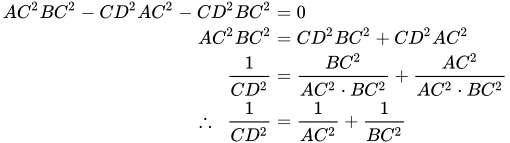
The inverse Pythagorean theorem is obtained from the above equation by substituting x with AC, y with BC, and each a and b with CD, where A, B are the endpoints of the hypotenuse of a right triangle ABC, and D is the foot of a perpendicular dropped from C, the vertex of the right angle, to the hypotenuse:
Spiric section
[edit]Spiric sections can be defined as bicircular quartic curves that are symmetric with respect to the x and y axes. Spiric sections are included in the family of toric sections and include the family of hippopedes and the family of Cassini ovals. The name is from σπειρα meaning torus in ancient Greek.
The Cartesian equation can be written as

and the equation in polar coordinates as

Three-leaved clover (trifolium)
[edit]The three-leaved clover or trifolium[7] is the quartic plane curve

By solving for y, the curve can be described by the following function:
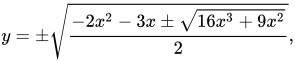
where the two appearances of ± are independent of each other, giving up to four distinct values of y for each x.
The parametric equation of curve is

In polar coordinates (x = r cos φ, y = r sin φ) the equation is
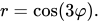
It is a special case of rose curve with k = 3. This curve has a triple point at the origin (0, 0) and has three double tangents.
See also
[edit]References
[edit]- ^ Weisstein, Eric W. "Ampersand Curve". MathWorld.
- ^ Cundy, H. Martyn; Rollett, A. P. (1961) [1952], Mathematical models (2nd ed.), Clarendon Press, Oxford, p. 72, ISBN 978-0-906212-20-2, MR 0124167
{{citation}}: ISBN / Date incompatibility (help) - ^ Weisstein, Eric W. "Bean Curve". MathWorld.
- ^ Weisstein, Eric W. "Bicuspid Curve". MathWorld.
- ^ Weisstein, Eric W. "Bow". MathWorld.
- ^ Weisstein, Eric W. "Cruciform curve". MathWorld.
- ^ Weisstein, Eric W. "Trifolium". MathWorld.
- ^ Gibson, C. G., Elementary Geometry of Algebraic Curves, an Undergraduate Introduction, Cambridge University Press, Cambridge, 2001, ISBN 978-0-521-64641-3. Pages 12 and 78.

Quartic plane curve
View on GrokipediaDefinition
General Form
A quartic plane curve is defined as the set of points in the affine plane satisfying a polynomial equation , where is a polynomial in two variables of degree at most 4.[6] This equation can be written explicitly as which involves 15 independent coefficients corresponding to the monomials of total degree at most 4.[7] In the projective plane, the curve is instead defined by a homogeneous polynomial equation of degree exactly 4 in three variables , such as , where is a sum of 15 monomials; the space of all such equations forms a projective space of dimension 14 after accounting for scalar multiples under projective equivalence.[8] Quartic plane curves are typically represented in implicit form as above, but certain types, such as rational quartics, admit parametric representations using rational functions. For a rational quartic, the curve can be parametrized as , , where and are rational functions in (ratios of polynomials of degree at most 4), providing a birational map from the parameter line to the curve.[9] For instance, one such parametrization for a specific rational quartic is given by [9]Homogenization and Projective Closure
To embed an affine quartic plane curve, defined by a polynomial equation of degree 4 in the affine plane , into projective space, the process of homogenization is applied. This involves introducing a third homogeneous coordinate to form a homogeneous polynomial equation of degree 4 in three variables. Specifically, if where each is the homogeneous component of degree , the homogenized equation is . Equivalently, this can be expressed as , which ensures the equation is homogeneous of total degree 4.[10][11] The resulting projective curve lies in the projective plane , where points are equivalence classes of under scalar multiplication, excluding the zero vector. The original affine curve is recovered by dehomogenization, setting , which yields the affine chart isomorphic to . This embedding, known as the projective closure, compactifies the affine curve by adding points at infinity, located on the line at infinity defined by . The intersection with this line is given by the highest-degree homogeneous part in projective coordinates , forming a degree-4 curve in the projective line , which is typically degenerate into up to four points (counting multiplicity). For example, the affine quartic homogenizes to , intersecting the line at infinity at the four points , where , over the complex numbers.[10][11] This projective closure offers key advantages in the study of quartic curves. It resolves issues arising from asymptotic behavior in the affine plane, such as unbounded branches, by incorporating points at infinity that "close" the curve topologically, making it a compact Riemann surface when smooth. Over the reals, for instance, disconnected affine components may connect through these infinite points, revealing the true global topology. Moreover, the homogeneous formulation facilitates the application of projective invariants and intersection theory, avoiding coordinate-dependent artifacts like vertical asymptotes.[10][11]Properties
Singularities and Their Types
A singular point on a quartic plane curve, defined by a homogeneous polynomial equation of degree 4 in the projective plane, is a point where the curve fails to be smooth, specifically where both partial derivatives vanish simultaneously: .[12] These points are detected by solving the system formed by and its partials, and they contribute to the local multiplicity of the curve at that point, which is at least 2.[12] Singularities on quartic curves are classified by their multiplicity and the local intersection behavior of branches, often using the ADE classification from singularity theory. Common types include nodes, cusps, and tacnodes, all of multiplicity 2, as well as higher-multiplicity singularities like triple points. Nodes, or ordinary double points (A₁ singularity), occur where two distinct branches intersect transversely with two distinct tangent lines.[12][13] Cusps (A₂ singularity) feature a single branch with one tangent line but higher-order contact, such as in the semicubical parabola.[12][13] Tacnodes (A₃ singularity) involve two branches sharing the same tangent with second-order contact.[13] Higher types for quartics include ramphoid cusps (A₄, single branch with even higher contact), oscnodes (A₅, two branches with triple contact), and triple points, such as ordinary triple points (D₄, three branches meeting transversely) or cuspidal triple points (E₆, one branch).[13] Isolated points of multiplicity 4 are possible but degenerate the curve to a point rather than a proper curve.[12] The following table summarizes key singularity types on quartic plane curves, focusing on their multiplicity, branch structure, and local geometry:| Type | Multiplicity | Branches | Tangents | Local Form (Affine) |
|---|---|---|---|---|
| Node (A₁) | 2 | 2 | 2 distinct | |
| Cusp (A₂) | 2 | 1 | 1 | |
| Tacnode (A₃) | 2 | 2 | 1 shared | |
| Ramphoid Cusp (A₄) | 2 | 1 | 1 | Higher-order cusp |
| Ordinary Triple (D₄) | 3 | 3 | 3 distinct | (degenerate) |
Genus and Invariants
A smooth plane quartic curve, being a plane algebraic curve of degree , has arithmetic genus given by the formula , which evaluates to 3.[14] This genus reflects the topological complexity of the curve as a Riemann surface when embedded in the projective plane without singularities.[15] Singularities reduce the geometric genus of a quartic curve relative to its arithmetic genus. Specifically, the geometric genus is computed as , where the sum is over all singular points and denotes the delta invariant of the -th singularity.[16] For ordinary singularities such as nodes or cusps, the delta invariant is .[17] Thus, a smooth quartic has geometric genus 3, while one with three nodes or cusps would have geometric genus 0, and one with two such singularities would have geometric genus 1.[18] Another key invariant is the class , defined as the number of tangent lines from a general point in the plane to the curve. For a smooth plane curve of degree , Plücker's formula gives , so for a quartic, .[19] This invariant arises from the degree of the dual curve and remains unchanged under projective transformations.[19] When the geometric genus is 1, the normalization of the singular quartic yields an elliptic curve, which is classified up to isomorphism over the complex numbers by its -invariant.[20] The -invariant, a modular function, provides a complete algebraic modulus for such elliptic curves, distinguishing their lattice structures.[20]Bitangents and Flexes
A bitangent to a plane algebraic curve is a line that is tangent to the curve at two distinct points, meaning it intersects the curve with multiplicity two at each of those points. For a smooth quartic plane curve over the complex numbers, there are precisely 28 such bitangents.[21] These 28 bitangents form a rich configuration that encodes significant geometric information about the curve, including relations to its linear matrix representations and Gram matrices.[21] The study of these bitangents traces back to classical algebraic geometry, where Arthur Cayley demonstrated that the 28 bitangents constitute a complete system associated with the quartic, providing a canonical set from which the curve can be reconstructed under certain conditions.[22] To detect bitangents computationally or analytically, one approach involves the dual curve of the quartic, which is a curve of class 12 whose nodes correspond precisely to the bitangents of the original curve; each node in the dual represents a line tangent at two points in the primal.[23] Flexes, or inflection points, on a plane curve are points where the tangent line intersects the curve with multiplicity at least three, indicating a change in the curvature's sign or a higher-order contact. A smooth plane quartic curve possesses exactly 24 such flexes over the complex numbers, as determined by the general formula for the number of inflection points on a plane curve of degree , which is . These 24 flexes lie on the Hessian curve of the quartic, a sextic curve (of degree for ) that captures the second-order differential properties of the original curve.[24] The Hessian curve is defined via the Hessian determinant of the quartic's defining polynomial. For a homogeneous polynomial of degree 4 defining the curve, the Hessian is the determinant of the 3×3 matrix of second partial derivatives: where subscripts denote partial derivatives. The flexes are precisely the intersection points of the original quartic curve with this Hessian curve , excluding any singular points of the quartic itself.[24][25]Classification
Smooth Quartics
A smooth quartic plane curve is a non-singular algebraic curve of degree 4 embedded in the projective plane . By the genus-degree formula for plane curves, such a curve has arithmetic genus for degree , and since it is smooth, its geometric genus equals 3.[15] The moduli space of smooth projective curves of genus 3 has dimension . The space of all plane quartics is the projective space parametrizing homogeneous quartic polynomials in three variables (15 monomials minus scaling), and the action of the projective linear group has dimension 8, yielding a quotient of dimension 6 that parametrizes plane quartics up to projective equivalence. The smooth quartics form a dense open subset of this space, corresponding precisely to the non-hyperelliptic locus in . Smooth quartics admit a canonical embedding in via the complete linear system , where is the canonical divisor class of degree . For a non-hyperelliptic curve of genus 3, the canonical map is an isomorphism onto its image, which is a smooth quartic curve. Conversely, any smooth plane quartic realizes the canonical embedding of a genus 3 curve.[26] All smooth plane quartics are non-hyperelliptic. A curve is hyperelliptic if its canonical map has degree 2 onto a rational normal curve of degree in , but for a smooth plane quartic, the canonical map is birational onto a degree 4 curve, hence an embedding, ruling out hyperellipticity. The hyperelliptic genus 3 curves instead occupy a codimension 1 locus in , parametrized separately.[27]Singular Quartics by Singularity Type
Singular quartics are classified primarily by the types and configurations of their singularities, which directly influence the geometric genus through the relation , where is the arithmetic genus of any plane quartic and is the delta-invariant of each singularity .[28] This reduction arises because singularities contribute to the topological complexity resolved in the normalization process. Most singular quartics remain irreducible over the complex numbers, preserving connectivity despite the presence of singularities.[29] A common configuration is a single ordinary node (A₁ singularity, ), yielding geometric genus 2. Such curves are hyperelliptic, as all genus-2 curves admit a degree-2 map to the projective line, and their plane embedding reflects this via the nodal singularity. A representative normal form is , where the parameters and (with suitable conditions, e.g., discriminant nonzero) ensure irreducibility and a single node at the origin in affine coordinates.[28][29] Two ordinary nodes (two A₁ singularities, total ) result in geometric genus 1, with the normalization being an elliptic curve. These are non-hyperelliptic in their plane model but admit an elliptic group law on the desingularization. A standard normal form over fields of characteristic not 2 is , known as a twisted Edwards curve, featuring nodes at the points at infinity.[30][29] An ordinary cusp (A₂ singularity, ) also produces genus 2, similar to the nodal case but with a tangential self-intersection rather than transverse. The curve remains irreducible and hyperelliptic upon normalization. A normal form is , where ensures the cusp at (0:0:1).[29][28] For higher singularities, an ordinary triple point (multiplicity 3 with three transverse branches, ) yields genus 0, making the normalization rational. Such configurations often appear in unicursal quartics. A normal form is .[28] In contrast, a triple point with two branches (e.g., a cusp and a transverse branch, total ) results in genus 1. Normal forms for these include .[28][29] More complex singularities, such as a tacnode (A₃, ) or ramphoid cusp (higher codimension), further reduce the genus accordingly, with comprehensive lists encompassing up to 21 irreducible types over algebraically closed fields of characteristic greater than 7, including combinations like A₁² A₂ (two nodes and a cusp, , genus 0). The sum of δ-invariants across all singularities thus caps at 3 for non-degenerate cases, distinguishing arithmetic genus (always 3) from the lower geometric genus.[29][28]Rational Quartics
A rational plane quartic is an algebraic curve of degree four in the projective plane that has geometric genus zero and is therefore birational to the projective line .[31] Such curves admit a parametrization by rational functions, making them unicursal.[32] The geometric genus of an irreducible plane curve of degree is computed via the Plücker formula , where is the -invariant at each singular point .[33] For , the smooth genus is 3, so achieving requires singularities with total -invariant equal to 3. An ordinary node (double point) contributes , an ordinary cusp contributes , and an ordinary triple point contributes .[33] Thus, the possible configurations for an irreducible rational plane quartic include three nodes, two nodes and one cusp, or one ordinary triple point.[13] These singularity types reduce the genus from 3 to 0 through the cumulative effect of their -invariants. Rational plane quartics are parametrized via a birational rational map , where is the curve; this map embeds into the plane as a degree-4 curve using homogeneous polynomials of degree 4.[32] In cases with a distinguished point, such as a triple point, stereographic projection from that point onto a line can facilitate deriving the rational parametrization.[34] While the twisted cubic provides a rational curve of degree 3 in projective 3-space, degree-4 rational plane curves include unicursal quartics such as the bullet-nose curve, which features three inflection points and fits the singularity requirements for genus 0.[35]Examples
Classical Named Curves
The ampersand curve, named by Cundy and Rollett, is a quartic plane curve defined by the implicit equation . This curve exhibits a looped shape resembling the symbol "&", featuring three nodes (crunodes) at the points (0,0), (1,1), and (1,-1).[36] The bean curve, also identified by Cundy and Rollett, is given by the equation , where controls the shape. It resembles a bean pod and lies primarily in the first and fourth quadrants.[37] The bicuspid curve is defined by for parameter . Named for its tooth-like appearance, it features two cusps at (a, a) and (a, -a). Horizontal tangents occur at approximately (-0.5, \pm \sqrt{1 + 3/(4\sqrt{3})}) and vertical tangents at (-1, \pm 1).[38] The bow curve has the implicit equation . It forms a bowtie-like structure. Vertical tangents occur at (\pm 2/(9\sqrt{3}), 2/9), and horizontal tangents at (\pm \sqrt{2}/4, 1/4).[39] The cruciform curve, also known as the cross curve, is given by for . It displays a cross-shaped form with four unbounded branches.[40] The three-leaved clover, or trifolium, is the quartic curve . This curve consists of three lobes meeting at the origin, which is a triple point singularity. The configuration produces a symmetric, clover-like appearance, and the curve is a special case of a rose curve with rotational symmetry of order 3.[41]Spiric Sections and Other Sections
Spiric sections are quartic plane curves obtained as the intersection of a torus with a plane parallel to the torus's axis of rotational symmetry. These curves, also known as spirics of Perseus, were first investigated in antiquity around 150 BC by the Greek scholar Perseus, who extended the classical conic sections by considering plane intersections with the torus surface. The resulting curves exhibit lemniscate-like shapes, often featuring two nodes when the intersecting plane passes through the interior of the torus.[42] For a torus with major radius and minor radius (where ) centered at the origin with its axis along the z-axis, the intersection with a plane parallel to the z-axis, such as where , yields a bicircular quartic curve symmetric with respect to the axes in appropriate coordinates. For certain values of , such as when , the curve simplifies to a lemniscate of Bernoulli, a special case with two nodes.[43] Other quartic plane curves arise as plane sections of cylindrical or quadric surfaces, providing geometric realizations of singular quartics. For instance, the bicorn curve is a rational quartic with two cusps. Such constructions highlight how higher-degree plane curves emerge from intersections of simpler 3D algebraic varieties, distinct from arbitrary polynomial definitions.[44]References
- https://proofwiki.org/wiki/Definition:Cruciform_Curve