Hubbry Logo
ADE classificationADE classificationMain
Open search
ADE classification
Community hub
ADE classification
logo
8 pages, 0 posts
0 subscribers
Be the first to start a discussion here.
Contribute something
ADE classification
ADE classification
from Wikipedia
The simply laced Dynkin diagrams classify diverse mathematical objects.

In mathematics, the ADE classification (originally A-D-E classifications) is a situation where certain kinds of objects are in correspondence with simply laced Dynkin diagrams. The question of giving a common origin to these classifications, rather than a posteriori verification of a parallelism, was posed in (Arnold 1976). The complete list of simply laced Dynkin diagrams comprises

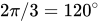
Here "simply laced" means that there are no multiple edges, which corresponds to all simple roots in the root system forming angles of (no edge between the vertices) or (single edge between the vertices). These are two of the four families of Dynkin diagrams (omitting and ), and three of the five exceptional Dynkin diagrams (omitting and ).

This list is non-redundant if one takes for If one extends the families to include redundant terms, one obtains the exceptional isomorphisms

and corresponding isomorphisms of classified objects.

The A, D, E nomenclature also yields the simply laced finite Coxeter groups, by the same diagrams: in this case the Dynkin diagrams exactly coincide with the Coxeter diagrams, as there are no multiple edges.

Lie algebras

[edit]

In terms of complex semisimple Lie algebras:

  • corresponds to the special linear Lie algebra of traceless operators,
  • corresponds to the even special orthogonal Lie algebra of even-dimensional skew-symmetric operators, and
  • are three of the five exceptional Lie algebras.

In terms of compact Lie algebras and corresponding simply laced Lie groups:

  • corresponds to the algebra of the special unitary group
  • corresponds to the algebra of the even projective special orthogonal group , while
  • are three of five exceptional compact Lie algebras.

Binary polyhedral groups

[edit]

The same classification applies to discrete subgroups of , the binary polyhedral groups; properly, binary polyhedral groups correspond to the simply laced affine Dynkin diagrams and the representations of these groups can be understood in terms of these diagrams. This connection is known as the McKay correspondence after John McKay. The connection to Platonic solids is described in (Dickson 1959). The correspondence uses the construction of McKay graph.

Note that the ADE correspondence is not the correspondence of Platonic solids to their reflection group of symmetries: for instance, in the ADE correspondence the tetrahedron, cube/octahedron, and dodecahedron/icosahedron correspond to while the reflection groups of the tetrahedron, cube/octahedron, and dodecahedron/icosahedron are instead representations of the Coxeter groups and

The orbifold of constructed using each discrete subgroup leads to an ADE-type singularity at the origin, termed a du Val singularity.

The McKay correspondence can be extended to multiply laced Dynkin diagrams, by using a pair of binary polyhedral groups. This is known as the Slodowy correspondence, named after Peter Slodowy – see (Stekolshchik 2008).

Labeled graphs

[edit]

The ADE graphs and the extended (affine) ADE graphs can also be characterized in terms of labellings with certain properties,[1] which can be stated in terms of the discrete Laplace operators[2] or Cartan matrices. Proofs in terms of Cartan matrices may be found in (Kac 1990, pp. 47–54).

The affine ADE graphs are the only graphs that admit a positive labeling (labeling of the nodes by positive real numbers) with the following property:

Twice any label is the sum of the labels on adjacent vertices.

That is, they are the only positive functions with eigenvalue 1 for the discrete Laplacian (sum of adjacent vertices minus value of vertex) – the positive solutions to the homogeneous equation:

Equivalently, the positive functions in the kernel of The resulting numbering is unique up to scale, and if normalized such that the smallest number is 1, consists of small integers – 1 through 6, depending on the graph.

The ordinary ADE graphs are the only graphs that admit a positive labeling with the following property:

Twice any label minus two is the sum of the labels on adjacent vertices.

In terms of the Laplacian, the positive solutions to the inhomogeneous equation:

The resulting numbering is unique (scale is specified by the "2") and consists of integers; for E8 they range from 58 to 270, and have been observed as early as (Bourbaki 1968).

Other classifications

[edit]

The elementary catastrophes are also classified by the ADE classification.

The ADE diagrams are exactly the quivers of finite type, via Gabriel's theorem.

There is also a link with generalized quadrangles, as the three non-degenerate GQs with three points on each line correspond to the three exceptional root systems E6, E7 and E8.[3] The classes A and D correspond degenerate cases where the line set is empty or we have all lines passing through a fixed point, respectively.[4]

It was suggested that symmetries of small droplet clusters may be subject to an ADE classification.[5]

The minimal models of two-dimensional conformal field theory have an ADE classification.

Four dimensional superconformal gauge quiver theories with unitary gauge groups have an ADE classification.

Extension of the classification

[edit]

Arnold has subsequently proposed many further extensions in this classification scheme, in the idea to revisit and generalize the Coxeter classification and Dynkin classification under the single umbrella of root systems. He tried to introduce informal concepts of Complexification and Symplectization based on analogies between Picard–Lefschetz theory which he interprets as the Complexified version of Morse theory and then extend them to other areas of mathematics. He tries also to identify hierarchies and dictionaries between mathematical objects and theories where for example diffeomorphism corresponds to the A type of the Dynkyn classification, volume preserving diffeomorphism corresponds to B type and Symplectomorphisms corresponds to C type. In the same spirit he revisits analogies between different mathematical objects where for example the Lie bracket in the scope of Diffeomorphisms becomes analogous (and at the same time includes as a special case) the Poisson bracket of Symplectomorphism.[6][7]

Trinities

[edit]

Arnold extended this further under the rubric of "mathematical trinities".[8] McKay has extended his correspondence along parallel and sometimes overlapping lines. Arnold terms these "trinities" to evoke religion, and suggest that (currently) these parallels rely more on faith than on rigorous proof, though some parallels are elaborated. Further trinities have been suggested by other authors.[9][8][10] Arnold's trinities begin with R/C/H (the real numbers, complex numbers, and quaternions), which he remarks "everyone knows", and proceeds to imagine the other trinities as "complexifications" and "quaternionifications" of classical (real) mathematics, by analogy with finding symplectic analogs of classic Riemannian geometry, which he had previously proposed in the 1970s. In addition to examples from differential topology (such as characteristic classes), Arnold considers the three Platonic symmetries (tetrahedral, octahedral, icosahedral) as corresponding to the reals, complexes, and quaternions, which then connects with McKay's more algebraic correspondences, below.

McKay's correspondences are easier to describe. Firstly, the extended Dynkin diagrams (corresponding to tetrahedral, octahedral, and icosahedral symmetry) have symmetry groups respectively, and the associated foldings are the diagrams (note that in less careful writing, the extended (tilde) qualifier is often omitted). More significantly, McKay suggests a correspondence between the nodes of the diagram and certain conjugacy classes of the monster group, which is known as McKay's E8 observation;[11][12] see also monstrous moonshine. McKay further relates the nodes of to conjugacy classes in 2.B (an order 2 extension of the baby monster group), and the nodes of to conjugacy classes in 3.Fi24' (an order 3 extension of the Fischer group)[12] – note that these are the three largest sporadic groups, and that the order of the extension corresponds to the symmetries of the diagram.

Turning from large simple groups to small ones, the corresponding Platonic groups have connections with the projective special linear groups PSL(2,5), PSL(2,7), and PSL(2,11) (orders 60, 168, and 660),[13][14] which is deemed a "McKay correspondence".[15] These groups are the only (simple) values for p such that PSL(2,p) acts non-trivially on p points, a fact dating back to Évariste Galois in the 1830s. In fact, the groups decompose as products of sets (not as products of groups) as: and These groups also are related to various geometries, which dates to Felix Klein in the 1870s; see icosahedral symmetry: related geometries for historical discussion and (Kostant 1995) for more recent exposition. Associated geometries (tilings on Riemann surfaces) in which the action on p points can be seen are as follows: PSL(2,5) is the symmetries of the icosahedron (genus 0) with the compound of five tetrahedra as a 5-element set, PSL(2,7) of the Klein quartic (genus 3) with an embedded (complementary) Fano plane as a 7-element set (order 2 biplane), and PSL(2,11) the buckminsterfullerene surface (genus 70) with embedded Paley biplane as an 11-element set (order 3 biplane).[16] Of these, the icosahedron dates to antiquity, the Klein quartic to Klein in the 1870s, and the buckyball surface to Pablo Martin and David Singerman in 2008.

Algebro-geometrically, McKay also associates E6, E7, E8 respectively with: the 27 lines on a cubic surface, the 28 bitangents of a plane quartic curve, and the 120 tritangent planes of a canonic sextic curve of genus 4.[17][18] The first of these is well-known, while the second is connected as follows: projecting the cubic from any point not on a line yields a double cover of the plane, branched along a quartic curve, with the 27 lines mapping to 27 of the 28 bitangents, and the 28th line is the image of the exceptional curve of the blowup. Note that the fundamental representations of E6, E7, E8 have dimensions 27, 56 (28·2), and 248 (120+128), while the number of roots is 27+45 = 72, 56+70 = 126, and 112+128 = 240. This should also fit into the scheme [19] of relating E8,7,6 with the largest three of the sporadic simple groups, Monster, Baby and Fischer 24', cf. monstrous moonshine.

See also

[edit]

References

[edit]

Sources

[edit]
[edit]
Revisions and contributorsEdit on WikipediaRead on Wikipedia
from Grokipedia
The ADE classification refers to a fundamental and ubiquitous pattern in , wherein various seemingly unrelated structures across , , , and are bijectively categorized using the simply-laced Dynkin diagrams of types A_n (for n ≥ 1), D_n (for n ≥ 4), and the exceptional types E_6, E_7, E_8. These diagrams, characterized by single bonds between nodes without multiple edges or loops, encode the root systems and Cartan matrices that define the classifications, excluding the non-simply laced types B, C, F, and G. Originating from the early 20th-century work of and on the classification of simple complex Lie algebras, the ADE types correspond precisely to the irreducible simply-laced root systems underlying these algebras, such as su(n+1) for A_n and E_8 for the exceptional case. This foundational result, later formalized in Dynkin's 1940s extensions, provides the complete classification of finite-dimensional simple Lie algebras over the complex numbers into types A, B, C, D, E, F, and G, with the ADE types being the simply-laced subset; semisimple Lie algebras decompose into direct sums of these simple factors. The classification extends remarkably to other domains through deep correspondences, notably John McKay's 1980 observation linking the finite subgroups of SU(2)—cyclic (A_n), binary dihedral (D_n), and binary polyhedral (E_6, E_7, E_8)—to the and graphs that recover the ADE Dynkin diagrams via the McKay correspondence. In , Arnold's 1970s classification of simple surface singularities in the identifies the ADE types with quotient singularities ℂ²/Γ for these finite subgroups Γ, where the minimal resolution's exceptional fibers intersect according to the Dynkin diagrams. Similarly, in , Gabriel's theorem equates quivers of finite representation type with ADE graphs, while in , ADE diagrams classify connected graphs whose largest eigenvalue is less than 2. The profundity of the ADE classification lies in its interconnections, often unified by the McKay correspondence and extended Dynkin diagrams, revealing structural analogies between finite groups, Lie algebras, and singularities that permeate modern and theoretical physics, including and conformal field theories. This meta-pattern, described by mathematicians like and Ivan Cherednik as a building block of "real ," underscores the unity of mathematical objects through shared combinatorial and geometric properties.

Overview

Definition and Scope

The ADE classification provides a unified framework for labeling certain mathematical structures that appear across diverse areas of mathematics, particularly those corresponding to simply-laced Dynkin diagrams. In the context of Lie theory, it specifically classifies the finite-dimensional semisimple Lie algebras over the complex numbers that are simply-laced, meaning their root systems consist of roots of equal length with Cartan integers of absolute value at most 2. This classification establishes a bijection between these Lie algebras and the irreducible simply-laced root systems of types A, D, and E, excluding non-simply-laced cases such as B, C, F, and G types. The scope encompasses infinite families A_n for n ≥ 1 (corresponding to the special linear Lie algebras sl_{n+1}(\mathbb{C})), D_n for n ≥ 4 (corresponding to the special orthogonal Lie algebras so_{2n}(\mathbb{C})), and three exceptional cases E_6, E_7, E_8. These structures extend beyond Lie algebras to isomorphic classifications in other domains, forming a profound "trinity" of interconnections: root systems in algebraic settings, symmetries of binary polyhedral groups in group theory, and labeled graphs such as Dynkin or McKay diagrams in combinatorial geometry. This unified labeling highlights deep structural analogies, appearing in extensions to geometric singularities, finite subgroups of SU(2), and even physical models like string theory compactifications. The of these Lie algebras provide key quantitative context: for type A_n, the dimension is n(n + 2); for D_n, it is n(2n - 1); while the exceptional algebras have dimensions 78 for E_6, 133 for E_7, and 248 for E_8. These finite-dimensional objects, totaling two infinite series and three exceptional instances, underpin much of modern and geometry without encompassing affine or indefinite variants.

Historical Context

The of simple Lie algebras traces its origins to the late 19th century, when undertook the systematic study of finite-dimensional Lie algebras over the complex numbers. In a series of papers published between 1888 and 1890 in Mathematische Annalen, Killing identified four infinite families labeled A_n (n ≥ 1), B_n (n ≥ 2), C_n (n ≥ 3), and D_n (n ≥ 4), along with five exceptional algebras, including those later denoted E_6, E_7, and E_8. Although his proofs contained gaps, Killing's work established the basic structure, with the A, D, and E series emerging as the simply-laced cases where all roots have equal length. Élie Cartan resolved these issues in his 1894 doctoral thesis, providing a rigorous using the invariant bilinear form now known as the Killing-Cartan form, thereby confirming the complete list of simple complex Lie algebras. In the mid-20th century, extended this foundation through his work on semisimple Lie algebras during the 1940s. As a student of at , Dynkin developed a combinatorial approach based on simple root systems, introducing Dynkin diagrams in 1946–1947 to encode the relations among roots via angles and multiplicities. These diagrams streamlined the process, highlighting the ADE types as the simply-laced subfamily without multiple bonds, and his 1947 paper "The structure of semisimple Lie algebras" formalized their enumeration. This graphical method became a cornerstone for subsequent developments in and beyond. A pivotal milestone came in 1980 with John McKay's discovery of a correspondence linking the ADE Dynkin diagrams to finite subgroups of SU(2), known as binary polyhedral groups. In his paper "Graphs, singularities, and finite groups," McKay observed that the adjacency graphs of irreducible representations (minus the trivial one) for these groups reproduce the extended Dynkin diagrams of types A, D, and E, connecting to structure. Building on this, Vladimir Arnol'd in the 1970s had already uncovered the ADE pattern in singularity theory; his 1972 paper "Normal forms of functions near degenerate critical points, the Weyl groups A_k, D_k, E_k and Lagrangian singularities" classified simple singularities of functions via the corresponding Weyl groups, associating A-D-E types with specific normal forms like A_k: x^{k+1} + y^2. The 1980s saw the ADE classification extend into physics, notably through applications by and . In works such as Dixon, Harvey, Vafa, and Witten's 1985 paper "Strings on orbifolds," the ADE series classified fixed-point resolutions in compactifications on orbifolds, mirroring the McKay correspondence. Vafa's 1987 contribution "Conformal theories and punctured surfaces" further linked ADE modular invariants to two-dimensional conformal field theories. This period marked the evolution toward viewing ADE as a unified "trinity" spanning , , and , a perspective emphasized by Arnol'd in his surveys on singularities and later echoed in broader mathematical interconnections.

Core Mathematical Framework

Lie Algebras and Root Systems

Semisimple Lie algebras over the complex numbers are finite-dimensional s that decompose as direct sums of s, where admits no non-trivial ideals. A key structure in their theory is the , obtained relative to h\mathfrak{h}, which is a maximal toral . The g\mathfrak{g} decomposes as g=hαΦgα\mathfrak{g} = \mathfrak{h} \oplus \bigoplus_{\alpha \in \Phi} \mathfrak{g}_\alpha, where Φ\Phi is the consisting of the non-zero weights of the of h\mathfrak{h} on g\mathfrak{g}, and each root space gα\mathfrak{g}_\alpha is one-dimensional. In the simply-laced case, all have the same , leading to a symmetric Cartan matrix and distinguishing these algebras from non-simply-laced ones like those of types BnB_n, CnC_n, or G2G_2. The ADE classification specifically enumerates the simply-laced semisimple algebras, corresponding to irreducible s of types AnA_n, DnD_n, and the exceptional series E6E_6, E7E_7, E8E_8. For type AnA_n, the arises from the special linear sl(n+1,C)\mathfrak{sl}(n+1, \mathbb{C}), with given by εiεj\varepsilon_i - \varepsilon_j for iji \neq j, where {ε1,,εn+1}\{\varepsilon_1, \dots, \varepsilon_{n+1}\} is the of Rn+1\mathbb{R}^{n+1} orthogonal to the vector (1,,1)(1, \dots, 1). The type DnD_n is that of the special orthogonal so(2n,C)\mathfrak{so}(2n, \mathbb{C}), featuring ±εi±εj\pm \varepsilon_i \pm \varepsilon_j for i<ji < j. The exceptional types E6E_6, E7E_7, and E8E_8 correspond to the unique simply-laced exceptional simple s, with s embedded in higher-dimensional Euclidean spaces. This classification, originally due to Killing and Cartan, exhausts all finite-dimensional simply-laced simple complex s up to isomorphism. Root systems in the ADE series exhibit key properties that underpin their structure. A choice of positive roots Φ+\Phi^+ is determined by a basis of simple roots {α1,,αr}\{\alpha_1, \dots, \alpha_r\}, where every root is an integer linear combination of the simple roots with coefficients non-negative for positive roots. The Weyl group WW acts as a finite reflection group on the root system, generated by reflections sαs_\alpha across the hyperplanes perpendicular to roots α\alpha, preserving the set Φ\Phi and acting faithfully on h\mathfrak{h}^*. Fundamental weights ω1,,ωr\omega_1, \dots, \omega_r form the dual basis to the simple roots with respect to the pairing induced by the Killing form, enabling the description of dominant weights in representation theory. The rank rr equals the dimension of h\mathfrak{h}, while the dimension of the Lie algebra is dimg=r+Φ\dim \mathfrak{g} = r + |\Phi|; explicit formulas include rank nn and dimension n2+2nn^2 + 2n for AnA_n, rank nn and dimension n(2n1)n(2n-1) for DnD_n, rank 6 and dimension 78 for E6E_6, rank 7 and dimension 133 for E7E_7, and rank 8 and dimension 248 for E8E_8. The Cartan matrix A=(aij)A = (a_{ij}) for a simply-laced Lie algebra, defined by aij=2(αi,αj)(αj,αj)a_{ij} = 2 \frac{(\alpha_i, \alpha_j)}{(\alpha_j, \alpha_j)} using the invariant bilinear form, has diagonal entries 2 and off-diagonal entries 0 or -1, reflecting the equal lengths of all roots and the angles between adjacent simple roots being 120 degrees. This integer matrix uniquely determines the root system up to isomorphism and encodes the Lie bracket relations among the Chevalley generators. The root systems of the ADE types thus provide the algebraic foundation for the classification, facilitating isomorphisms with other structures such as Dynkin diagrams and finite subgroups of SU(2) through shared symmetry properties.

Dynkin Diagrams

Dynkin diagrams provide a graphical representation of the simple roots in a root system, where each node corresponds to a simple root, and edges connect nodes whose corresponding roots have a nonzero inner product. In the context of the , these diagrams are simply-laced, meaning all roots have equal length and connected nodes are joined by a single undirected edge, indicating an inner product of -1 (corresponding to an angle of 120 degrees between the roots). This construction encodes the essential relations among the simple roots without cycles or loops, ensuring the diagram is a finite tree. The specific forms of the Dynkin diagrams for the ADE series are as follows: the A_n diagram consists of a linear chain of n nodes, representing the root system of sl_{n+1}(\mathbb{C}); the D_n diagram (for n \geq 4) is a linear chain of n-2 nodes with a fork at one end, where the penultimate node connects to two additional terminal nodes; the E_6 diagram is a linear chain of five nodes with an additional node attached to the third node from one end; E_7 extends this by adding one more node to the chain; and E_8 adds yet another to the chain, maintaining the branch at the third position. These configurations uniquely distinguish the irreducible simply-laced root systems in the ADE classification. Nodes in Dynkin diagrams can be labeled with Dynkin labels, which are the nonnegative integer coefficients in the linear expansion of the highest root as a sum of simple roots. These labels provide a basis for describing dominant weights in representations and are determined by the diagram's structure, with the sum of the labels equaling the Coxeter number minus one. For example, in the A_n diagram, the labels are all 1. The adjacency relations in the Dynkin diagram directly yield the Cartan matrix C, whose entries are given by C_{ij} = 2 \langle \alpha_i, \alpha_j \rangle / \langle \alpha_j, \alpha_j \rangle, resulting in 2 on the diagonal, -1 for adjacent nodes, and 0 otherwise in simply-laced cases. For the A_2 diagram, a chain of two nodes connected by a single edge, the Cartan matrix is (2112).\begin{pmatrix} 2 & -1 \\ -1 & 2 \end{pmatrix}. These diagrams classify all irreducible simply-laced finite root systems up to isomorphism, as any such system corresponds uniquely to one of the connected ADE diagrams, with the determining the inner product structure and positive definiteness ensuring finiteness.

Group-Theoretic Aspects

Binary Polyhedral Groups

The binary polyhedral groups constitute a key class of finite subgroups of SU(2), serving as the universal double covers of the finite rotation subgroups of SO(3) associated with the symmetries of regular polyhedra and their infinite families of generalizations, such as prisms and antiprisms. These groups play a central role in the ADE classification through the McKay correspondence, which establishes a bijection between their irreducible representations and the nodes of the Dynkin diagrams for the simply-laced Lie algebras of types A, D, and E. Specifically, the McKay graph constructed from the character table of such a group—where vertices represent irreducible representations labeled by their dimensions, and edges indicate multiplicities in the tensor product with the defining 2-dimensional representation—yields the extended Dynkin diagram, with the subdiagram excluding the affine node giving the simple ADE type. The infinite families within this classification are the cyclic and binary dihedral groups. The cyclic group corresponding to the A_n type (n ≥ 1) has order n+1 and is the preimage under the covering map SU(2) → SO(3) of a cyclic rotation group; its irreducible representations are one-dimensional, and the McKay graph forms a cycle of n+1 nodes (affine \tilde{A}_n), with the subdiagram excluding the affine node being a linear chain of n nodes matching the A_n Dynkin diagram. For the D series, the binary dihedral group of type D_n (n ≥ 4) has order 4(n-2) and covers the dihedral rotation group of order 2(n-2); it admits a mix of one- and two-dimensional irreducible representations, with the McKay graph producing the D_n diagram featuring a forked tail. In both cases, the dimensions of the irreducible representations sum in squares to the group order, and they correspond to the weights of the root lattice of the associated Lie algebra su(n+1) or so(2n). The exceptional cases complete the classification with the binary polyhedral groups tied to the Platonic solids. The binary tetrahedral group, of order 24 and covering the alternating group A_4 of order 12 (rotations of the tetrahedron), corresponds to E_6; its character table includes representations of dimensions 1, 1, 2, 3, and 3, yielding the E_6 Dynkin diagram with six nodes. The binary octahedral group, order 48 covering S_4 of order 24 (rotations of the octahedron or cube), aligns with E_7, featuring irreducible representations of dimensions 1, 2, 3, and 4 (with multiplicities) and the characteristic E_7 chain of seven nodes. Finally, the binary icosahedral group, order 120 covering A_5 of order 60 (rotations of the icosahedron or dodecahedron), matches E_8, with representations including dimensions 1, 2, 3, 3, 4, 5, and 6, producing the E_8 diagram of eight nodes. The character tables of these groups further link to Dynkin labels, where the columns (conjugacy classes) and rows (representations) encode the fusion rules that mirror the Cartan matrix of the Lie algebra, establishing the weights as the basis for the representation theory. Geometrically, as subgroups of SU(2) isomorphic to Spin(3), the binary polyhedral groups act faithfully on the 3-dimensional space via the adjoint representation, projecting to the rotational symmetries in SO(3) while capturing spinorial aspects through the double cover.
ADE TypeGroupOrderCovering Rotation GroupExample Symmetry
A_n (n≥1)Cyclicn+1Cyclic(n+1)-fold rotational symmetries
D_n (n≥4)Binary dihedral4(n-2)Dihedral (order 2(n-2))(n-2)-gonal bipyramid rotations
E_6Binary tetrahedral24Tetrahedral (A_4)Tetrahedron
E_7Binary octahedral48Octahedral (S_4)Octahedron/cube
E_8Binary icosahedral120Icosahedral (A_5)Icosahedron/dodecahedron

Finite Subgroups of SU(2)

The finite subgroups of SU(2) up to conjugation fall into five families: the cyclic groups of order 2n2n for n1n \geq 1, wait no: cyclic groups of order m for m ≥ 1, the binary dihedral groups of order 4m4m for m2m \geq 2, and the three exceptional binary polyhedral groups—the binary tetrahedral group of order 24, the binary octahedral group of order 48, and the binary icosahedral group of order 120. This classification is classical and arises from the fact that SU(2) is the universal double cover of SO(3), with finite subgroups corresponding to central extensions by Z/2Z\mathbb{Z}/2\mathbb{Z} of the finite rotation subgroups of SO(3). Specifically, all such subgroups except the cyclic groups of odd order are nonsplit central extensions of the polyhedral rotation groups by Z/2Z\mathbb{Z}/2\mathbb{Z}. The binary polyhedral groups are closely related to the rotation groups of the Platonic solids: the binary tetrahedral group is the double cover of the alternating group A4A_4, the binary octahedral group is the double cover of the symmetric group S4S_4, and the binary icosahedral group is the double cover of the alternating group A5A_5. These exceptional groups play a central role in the ADE classification, as the full set of finite subgroups of SU(2) partitions into types corresponding to the ADE Dynkin diagrams via the McKay correspondence, where the cyclic groups align with the AnA_n series, the binary dihedral groups with the DnD_n series (for n4n \geq 4), the binary tetrahedral with E6E_6, the binary octahedral with E7E_7, and the binary icosahedral with E8E_8. The ADE structure emerges particularly from the non-abelian cases, highlighting the simply-laced symmetries beyond the abelian cyclic and dihedral families. Up to conjugation, these subgroups are classified by their rings of invariant polynomials under the action on C2\mathbb{C}^2, which generate the coordinate rings of the corresponding quotient singularities, or equivalently through the McKay correspondence relating their character tables to the extended Dynkin diagrams of ADE type. This invariant-theoretic approach confirms the completeness of the list, as distinct subgroups yield inequivalent sets of invariants.

Graphical and Combinatorial Representations

Labeled Graphs in Classification

In the ADE classification, labeled graphs arise prominently through the McKay correspondence, which establishes a bijection between the finite subgroups of SU(2) and the simply-laced Dynkin diagrams of types A, D, and E. This correspondence, discovered by John McKay, links the representation theory of these groups to the combinatorial structure of the diagrams, where the graphs encode the decomposition of tensor products of irreducible representations. Specifically, for a finite subgroup GSU(2)G \leq \mathrm{SU}(2), the McKay graph is constructed with vertices corresponding to the irreducible representations of GG, and edges labeled by the multiplicities in the tensor product decompositions with the fundamental 2-dimensional representation. The construction of the McKay graph proceeds as follows: let Irr(G)\mathrm{Irr}(G) denote the set of irreducible complex representations of GG, including the trivial representation. The vertices are the elements of Irr(G)\mathrm{Irr}(G), and there is a directed edge (or undirected, since the fundamental representation is self-dual) from the representation ρi\rho_i to ρj\rho_j with label equal to the multiplicity χρi,χρjχV\langle \chi_{\rho_i}, \chi_{\rho_j} \otimes \chi_V \rangle, where χρ\chi_\rho is the character of ρ\rho, VV is the faithful 2-dimensional representation of GG, and ,\langle \cdot, \cdot \rangle is the standard inner product on class functions. For simply-laced cases corresponding to the binary polyhedral groups, these multiplicities are 0 or 1, yielding an unweighted graph whose underlying topology matches the affine Dynkin diagram of the associated ADE type, with the trivial representation corresponding to the affine node. The adjacency matrix of this graph encodes the fusion rules under tensoring with VV, and its eigenvalues relate to the character values of GG. A representative example is the binary tetrahedral group, which has order 24 and seven irreducible representations of dimensions 1 (three copies, including the trivial), 2 (three copies), and 3 (one copy). Tensoring these with the fundamental 2-dimensional representation produces a McKay graph that is the affine E6E_6 Dynkin diagram, where the edges reflect the single multiplicities in the decompositions, and vertex labels indicate the representation dimensions. An extension of these graphs to quivers involves orienting the edges of the McKay graph according to the direction of the tensor product decomposition, resulting in the McKay quiver. This oriented structure underlies the path algebra of the quiver, where relations are imposed from the group algebra C[G]\mathbb{C}[G] to model the representations of GG as modules over the algebra. For the finite subgroups of SU(2), the McKay quivers again yield the ADE Dynkin quivers, providing a combinatorial framework for classifying the representations via quiver representations. The uniqueness of this construction ensures that only graphs of ADE type emerge from the McKay correspondence applied to the non-abelian finite subgroups of SU(2), namely the binary dihedral, tetrahedral, octahedral, and icosahedral groups, corresponding respectively to types DD, E6E_6, E7E_7, and E8E_8, while cyclic subgroups yield type A.

Coxeter-Dynkin Diagrams

Coxeter-Dynkin diagrams provide a graphical representation of finite Coxeter groups, where each diagram consists of nodes corresponding to the simple generators (reflections) of the group and edges connecting pairs of nodes to indicate the order of the product of the corresponding generators. Specifically, an edge labeled with an integer mij3m_{ij} \geq 3 between nodes ii and jj denotes that the relation (sisj)mij=1(s_i s_j)^{m_{ij}} = 1 holds in the group presentation, with mii=1m_{ii} = 1 for each generator sis_i and mij=2m_{ij} = 2 if no edge is present (indicating commuting generators). In the simply-laced case, all connected edges are single bonds implicitly labeled mij=3m_{ij} = 3, corresponding to angles of π/3\pi/3 in the associated geometric realization. For the ADE series, the Coxeter-Dynkin diagrams share the same underlying topology as the corresponding Dynkin diagrams but omit any labels distinguishing root lengths, as all roots are of equal length in these simply-laced cases. The AnA_n diagram is a linear chain of nn nodes connected by single edges, representing the symmetric group Sn+1S_{n+1}. The DnD_n diagram (for n4n \geq 4) features a linear chain of n2n-2 nodes with a fork at one end, where the terminal node connects to two additional nodes. The exceptional EE series includes branched structures: E6E_6 has a chain of five nodes with a branch at the third node; E7E_7 extends this to six nodes with the same branch; and E8E_8 has a chain of seven nodes with the branch at the third. These diagrams classify the irreducible finite Coxeter groups of types ADE. The Coxeter number hh of a finite irreducible Coxeter group is the order of a Coxeter element, a product of all simple generators in some order, and it relates to the eigenvalues of the associated Coxeter matrix. For the ADE series, explicit formulas are h(An)=n+1h(A_n) = n+1, h(Dn)=2n2h(D_n) = 2n-2, h(E6)=12h(E_6) = 12, h(E7)=18h(E_7) = 18, and h(E8)=30h(E_8) = 30. The Coxeter matrix is defined by Mij=cos(π/mij)M_{ij} = \cos(\pi / m_{ij}), with mii=1m_{ii} = 1 and mij=mjim_{ij} = m_{ji}; its eigenvalues connect to the group's spectral properties, where the largest eigenvalue influences the growth rate and ties into the Coxeter number via the roots of unity in the representation of the Coxeter element. In the context of ADE classification, the Weyl group of the corresponding root system coincides with the Coxeter group defined by the diagram, generated by reflections across the hyperplanes perpendicular to the simple roots. This Weyl group acts faithfully on the root lattice, the integer span of the roots, preserving its structure and enabling the classification of the simply-laced root systems through the diagram's combinatorial properties.

Applications in Other Fields

Singularity Theory and Resolutions

In algebraic geometry, ADE surface singularities, also known as Kleinian or du Val singularities, arise as quotient varieties C2/G\mathbb{C}^2 / G, where GG is a finite subgroup of SU(2)\mathrm{SU}(2) known as a binary polyhedral group. These singularities are rational double points and are classified into three infinite families—An_n for n1n \geq 1, Dn_n for n4n \geq 4—and three exceptional cases E6_6, E7_7, E8_8, mirroring the simply-laced Dynkin diagrams of the ADE type. This classification stems from the McKay correspondence, which equates the representation theory of GG with the geometry of the resolved singularity. The minimal resolution of an ADE singularity C2/G\mathbb{C}^2 / G is obtained by successive blow-ups at the singular point, yielding a smooth surface with exceptional locus consisting of a configuration of P1\mathbb{P}^1 curves, each with self-intersection number -2. The dual graph of this resolution—where vertices represent the exceptional curves and edges indicate transverse intersections of multiplicity one—is precisely the corresponding , with labels on vertices often denoting multiplicities in the fundamental cycle or genera (all zero for these rational curves). This graph-theoretic structure encodes the topology and intersection theory of the resolution, facilitating computations in deformation theory and mirror symmetry. For the An_n series, the singularity corresponds to a cyclic quotient C2/Zn+1\mathbb{C}^2 / \mathbb{Z}_{n+1}, resolved by a chain of nn exceptional P1\mathbb{P}^1 curves linked linearly, forming the An_n Dynkin diagram. In contrast, the E8_8 singularity arises from the binary icosahedral group quotient, with its minimal resolution featuring eight exceptional curves arranged in a branched configuration: a chain of six curves with additional branches at the third and fifth positions from one end, matching the E8_8 diagram. These quotient singularities are analytically equivalent to the simple hypersurface singularities in C3\mathbb{C}^3 classified by Arnold, providing local models via equations of the form f(x,y,z)=0f(x,y,z) = 0. Arnold's ADE list includes:
  • Ak_k (k1k \geq 1): x2+y2+zk+1=0x^2 + y^2 + z^{k+1} = 0,
  • Dk_k (k4k \geq 4): x2+y2z+zk1=0x^2 + y^2 z + z^{k-1} = 0,
  • E6_6: x3+y4+z2=0x^3 + y^4 + z^2 = 0,
  • E7_7: x3+xy3+z2=0x^3 + x y^3 + z^2 = 0,
  • E8_8: x3+y5+z2=0x^3 + y^5 + z^2 = 0,
where the exponent kk determines the specific type within each series. This equivalence highlights the ADE classification's role in unifying geometric and analytic perspectives on simple singularities.

Physics and String Theory

In theoretical physics, the ADE classification underpins key structures in gauge theories and string compactifications. The exceptional Lie algebra E8E_8 emerges as a grand unified gauge group in heterotic string theory, where the E8×E8E_8 \times E_8 structure arises from the fermionic sector's internal degrees of freedom, enabling unification of the Standard Model forces with gravity in ten dimensions. This choice leverages the anomaly-free properties of E8E_8, allowing consistent chiral matter representations for particle physics model building upon compactification. Complementing this, the simplest ADE algebra A1su(2)A_1 \cong \mathfrak{su}(2) forms the non-Abelian component of the electroweak gauge group SU(2)L×U(1)YSU(2)_L \times U(1)_Y in the Standard Model, governing weak interactions and electroweak symmetry breaking via the Higgs mechanism. Orbifold compactifications in string theory prominently feature ADE singularities in Calabi-Yau manifolds, where finite subgroups of SU(2)SU(2) acting on C2\mathbb{C}^2 produce quotient singularities classified by ADE types. These singularities are resolved using the McKay correspondence, which identifies the irreducible representations of the orbifold group with exceptional divisors in the crepant resolution, thereby expanding the moduli space and stabilizing string vacua with enhanced gauge symmetries. In type II string theory, such resolutions correspond to D-brane configurations on the resolved geometry, facilitating realistic low-energy effective theories with supersymmetric gauge sectors. Two-dimensional conformal field theories (CFTs) admit an ADE classification for modular-invariant extensions of minimal models, particularly in the context of rational CFTs underlying string worldsheets. The A-series unitary minimal models, associated with the Virasoro algebra at specific central charges, have c=16m(m+1)c = 1 - \frac{6}{m(m+1)} for integers m2m \geq 2, describing theories with finitely many primary fields and exact solvability. The full ADE pattern arises in SU(2)kSU(2)_k Wess-Zumino-Witten models coupled to these minimal models, where diagonal (A), exceptional (E), and bipartite (D) invariants classify consistent partition functions under modular transformations. String theory dualities further highlight ADE structures through heterotic/type II correspondence, where the E8×E8E_8 \times E_8 gauge group in the heterotic string on a torus derives from even self-dual lattices built from ADE root systems. This duality maps heterotic toroidal compactifications to type II on dual Calabi-Yau threefolds, equating gauge enhancements from lattice momenta to geometric Kähler moduli, thus unifying perturbative and non-perturbative regimes. Post-2010 advancements in the AdS/CFT correspondence incorporate ADE orbifolds for holographic descriptions of defect CFTs, with the DnD_n series realizing SO(2n) gauge symmetries in boundary defects of N=4\mathcal{N}=4 SYM orbifolds. These models probe confinement-deconfinement transitions and defect entropies via bulk gravity duals on AdS5×_5 \times S5^5/Γ\Gamma.

Extensions and Generalizations

Beyond Simply-Laced Cases

The ADE classification, which encompasses the simply-laced Lie algebras corresponding to root systems with all roots of equal length, extends to non-simply-laced cases involving algebras such as BnB_n, CnC_n, F4F_4, and G2G_2. These algebras feature root systems with two distinct root lengths—short and long roots—reflected in their Dynkin diagrams by multiple bonds (double or triple) and directed arrows indicating the relative lengths. For instance, the BnB_n diagram consists of a chain of nn nodes with single bonds except for a double bond between the penultimate and final nodes, oriented with an arrow pointing toward the penultimate node (\Rightarrow), signifying that the final root is long while the penultimate is short; the squared lengths are 2 for long roots and 1 for short roots. Similarly, the CnC_n diagram mirrors BnB_n but with the double bond and arrow (\Leftarrow) at the initial nodes, where short roots appear first. The exceptional F4F_4 diagram has four nodes in a chain with a double bond (arrow from long to short) between the second and third nodes, maintaining a 2:1 length ratio, while G2G_2 features two nodes connected by a triple bond with an arrow from the long to the short root, yielding a 3:1 ratio. Affine extensions of the arise by augmenting the finite simply-laced with an additional node, connected appropriately to the existing structure, to classify untwisted affine Kac-Moody algebras. This construction, which preserves the simply-laced nature (single bonds only), corresponds to loop algebras of the finite-dimensional ADE algebras extended by a central element and derivation, realized at a fixed level kk. For example, the affine An(1)A_n^{(1)} diagram forms a cycle of n+1n+1 nodes, while affine Dn(1)D_n^{(1)} and EE series add the extra node to the ends or branches of their finite counterparts, encoding the infinite-dimensional structure through degenerations in elliptic fibrations or reflexive polytopes. These diagrams classify the untwisted cases among affine Kac-Moody algebras, distinguishing them from twisted variants derived from outer automorphisms. Non-simply-laced diagrams can be derived from simply-laced ones via foldings, which exploit diagram automorphisms (typically Z2\mathbb{Z}_2 involutions) to identify symmetric nodes and roots, effectively quotienting the structure. For CnC_n, folding the A2n1A_{2n-1} diagram along its central symmetry axis—pairing nodes ii and 2ni2n-i—yields the double bond at one end, with invariant combinations of generators like E±αi+E±α2niE_{\pm \alpha_i} + E_{\pm \alpha_{2n-i}} forming the CnC_n subalgebra. Likewise, folding A2nA_{2n} produces BnB_n through a similar pairing, and other non-simply-laced types like F4F_4 emerge from folding E6E_6 or D4D_4, preserving the overall classification while reducing rank. These foldings highlight how non-simply-laced algebras embed as fixed points under automorphisms of larger simply-laced ones. In the infinite-dimensional affine setting, root systems incorporate imaginary roots alongside real ones, expanding the finite ADE structure. Real roots take the form α+nδ\alpha + n\delta where α\alpha is a finite root and nZn \in \mathbb{Z}, while imaginary roots are nδn\delta for nZ{0}n \in \mathbb{Z} \setminus \{0\}, with multiplicity equal to the rank of the underlying finite algebra; here, δ\delta is a null vector satisfying (δ,δ)=0(\delta, \delta) = 0 and serving as the basic imaginary root. The underlying generalized Cartan matrix, which is symmetrizable but not necessarily positive definite, encodes these via off-diagonal entries reflecting root inner products, with the affine extension adding rows and columns for the new node. For the affine A1(1)A_1^{(1)} (or A~1\tilde{A}_1), the generalized Cartan matrix is (2222),\begin{pmatrix} 2 & -2 \\ -2 & 2 \end{pmatrix}, illustrating the indefinite form that allows infinite roots while maintaining the loop algebra structure at level kk.

Infinite and Exceptional Series

The ADE classification features two infinite families, A_n and D_n, alongside the finite exceptional series E_6, E_7, and E_8, all characterized by simply-laced Dynkin diagrams and corresponding to finite-dimensional simple Lie algebras over the complex numbers. The A_n series grows with increasing rank n, associating to the special unitary Lie algebra su(n+1) of dimension n(n+2), where representations decompose into blocks under SU(n+1) actions. The Weyl group W(A_n) is the symmetric group S_{n+1} of order (n+1)!, reflecting the permutation symmetries of the root system. The D_n series, for n ≥ 4, corresponds to the orthogonal Lie algebra so(2n) of dimension n(2n-1), with the Weyl group W(D_n) being the hyperoctahedral group of order 2^{n-1} n!, incorporating reflections and sign changes. Distinctive to D_n are the half-spinor representations of dimension 2^{n-1}, which arise from the Clifford algebra constructions and play roles in spin geometry. Both infinite series exhibit unbounded growth in dimension and complexity as n increases, contrasting with the fixed exceptional cases. The exceptional E series terminates at E_8, comprising E_6 (dimension 78, fundamental representation of dimension 27), E_7 (dimension 133, fundamental representation of dimension 56), and E_8 (dimension 248, with the adjoint as its smallest nontrivial representation). These algebras link through the Freudenthal-Tits magic square, a construction pairing normed division algebras to generate exceptional algebras, where E_6, E_7, and E_8 emerge from octonionic entries. The E series represents the only exceptions beyond the A and D families in the simply-laced classification, with no E_n for n > 8 due to the complete enumeration of finite-dimensional simple Lie algebras via systems and Dynkin diagrams. Combinatorially, the root systems distinguish these series: |Φ(A_n)| = n(n+1) roots, scaling quadratically, while |Φ(E_8)| = 240 roots marks the largest finite simply-laced system. The highest root of E_8, expressed in simple root coefficients relative to its , is (2,3,4,5,6,4,2,3), highlighting the extended chain structure with a trivalent . This configuration underscores the uniqueness of E_8.

Interconnections and Trinities

ADE Trinities Across Disciplines

The ADE classification manifests in a classical trinity connecting the root systems of simply-laced s, the binary polyhedral groups, and labeled graphs known as Dynkin or McKay quivers. The root systems of the simple s of types A_n, D_n, and E_{6,7,8} are characterized by their s, which encode the and structure underlying . Independently, the finite subgroups of SU(2), known as binary polyhedral groups, were classified by Klein and others into cyclic (A), binary dihedral (D), and binary tetrahedral, octahedral, icosahedral (E) types, with their representation graphs forming the same ADE s via the McKay correspondence. This correspondence, established by in 1980, shows that the McKay quiver—derived from the of tensor powers of the fundamental representation of these groups—precisely matches the of the corresponding , unifying finite group representations with infinite-dimensional . In , the ADE pattern forms another trinity through Kleinian singularities, their resolutions, and associated groups. Kleinian singularities arise as varieties \mathbb{C}^2 / \Gamma, where \Gamma is a finite subgroup of SU(2), and their types are classified as A_n, D_n, and E_{6,7,8} precisely matching the binary polyhedral groups. The minimal resolution of these surface singularities introduces an exceptional divisor consisting of rational curves whose dual intersection graph is the ADE , as shown by Artin in his algebraic criteria for rational double points. Furthermore, the action on the homology of the Milnor fiber of these singularities is governed by the of the corresponding , a result due to Brieskorn linking the topological invariants to the Lie-theoretic structure. Combinatorially, the ADE types appear in Coxeter groups, , and exceptional , highlighting enumerative patterns. The Coxeter diagrams for the irreducible reflection groups of types A, D, E coincide with the Dynkin diagrams, governing the of reduced words and the Bruhat order in these finite Coxeter groups. For the A_n series, the —a whose faces correspond to triangulations of an (n+3)-gon—is enumerated by , with generalizations to other ADE types yielding Coxeter-Catalan numbers that count noncrossing partitions and parking functions adapted to the . In the exceptional case, the E_8 realizes the vertices of the Gosset 4_{21}, an 8-dimensional uniform with 240 vertices and E_8 symmetry, connecting finite to the highest-rank ADE type. Specific examples illustrate these trinities across algebraic structures. The A_n series corresponds to the fundamental representations of SU(n+1), where the Young diagrams of irreps align with the root system's weights, underpinning much of theory. For D_n, the even-dimensional Clifford algebras Cl_{2n}(\mathbb{R}) are isomorphic to matrix algebras over the reals or quaternions, with their spinor representations tied to the Spin(2n) group whose is of type D_n. The E series culminates in the exceptional of 3×3 Hermitian octonionic matrices, a 27-dimensional structure whose involves E_6, embedding the exceptional types in non-associative . This recurring ADE pattern across disciplines reflects a deeper unification, akin to Grothendieck's emphasis on absolute objects that remain invariant under categorical equivalences, where the simply-laced diagrams serve as universal archetypes transcending specific contexts like Lie theory or singularity resolution.

Unified Perspectives

The ADE classification manifests in categorical frameworks through equivalences between derived categories of coherent sheaves on minimal resolutions of quotient singularities and derived categories of quiver representations. For a finite subgroup GSL(2,C)G \subset \mathrm{SL}(2, \mathbb{C}) corresponding to an ADE type, the McKay quiver—derived from the representation graph of GG—governs the structure, where the bounded derived category of coherent sheaves on the resolved surface C2/G\mathbb{C}^2 / G is equivalent to the derived category of finite-dimensional representations of this quiver. This equivalence positions quiver representations as exceptional collections or hearts in the derived category, providing a categorification of the representation theory underlying the ADE Dynkin diagrams. In modular tensor categories, the ADE classification arises prominently in the context of Chern-Simons theories, particularly for SU(2)k\mathrm{SU}(2)_k at level kk, where the modular invariants of the associated Wess-Zumino-Witten model are classified by ADE diagrams. The AnA_n series corresponds to the diagonal invariants, while DD- and EE-type invariants emerge for specific exceptional levels, linking the fusion rules and braiding to the systems of simply-laced algebras. This structure extends to the modular tensor category of anyons in the theory, where the topological invariants encode the ADE fusion categories as building blocks for more general braided structures. The interconnections across ADE manifestations reveal deep dualities, as summarized in the following table:
AspectCorrespondenceKey Relation
Lie AlgebrasADE Dynkin Diagrams (Graphs)McKay graph of finite subgroup representations yields the extended Dynkin diagram, matching the root system.
Finite GroupsQuotient Singularities C2/G\mathbb{C}^2 / GResolution graph of the du Val singularity C2/G\mathbb{C}^2 / G is the ADE Dynkin diagram, with GG binary polyhedral.
These dualities, rooted in the McKay correspondence, unify the classification by mapping representation-theoretic data to geometric and algebraic structures without exception for simply-laced cases. Open problems in unifying the ADE classification include generalizing to higher-dimensional singularities.

References

Add your contribution
Related Hubs
Contribute something
User Avatar
No comments yet.