


Community hub
Recent from talks
Contribute something
Nothing was collected or created yet.
Rose (mathematics)
View on Wikipedia
For proper mathematical analysis, k must be expressed in irreducible form.
In mathematics, a rose or rhodonea curve is a sinusoid specified by either the cosine or sine functions with no phase angle that is plotted in polar coordinates. Rose curves or "rhodonea" were named by the Italian mathematician who studied them, Guido Grandi, between the years 1723 and 1728.[1]
General overview
[edit]Specification
[edit]A rose is the set of points in polar coordinates specified by the polar equation[2]
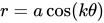
or in Cartesian coordinates using the parametric equations

Roses can also be specified using the sine function.[3] Since
- .

Thus, the rose specified by r = a sin(kθ) is identical to that specified by r = a cos(kθ) rotated counter-clockwise by π/2k radians, which is one-quarter the period of either sinusoid.
Since they are specified using the cosine or sine function, roses are usually expressed as polar coordinate (rather than Cartesian coordinate) graphs of sinusoids that have angular frequency of k and an amplitude of a that determine the radial coordinate r given the polar angle θ (though when k is a rational number, a rose curve can be expressed in Cartesian coordinates since those can be specified as algebraic curves[4]).
General properties
[edit]
Roses are directly related to the properties of the sinusoids that specify them.
Petals
[edit]- Graphs of roses are composed of petals. A petal is the shape formed by the graph of a half-cycle of the sinusoid that specifies the rose. (A cycle is a portion of a sinusoid that is one period T = 2π/k long and consists of a positive half-cycle, the continuous set of points where r ≥ 0 and is T/2 = π/k long, and a negative half-cycle is the other half where r ≤ 0.)
- The shape of each petal is same because the graphs of half-cycles have the same shape. The shape is given by the positive half-cycle with crest at (a,0) specified by r = a cos(kθ) (that is bounded by the angle interval −T/4 ≤ θ ≤ T/4). The petal is symmetric about the polar axis. All other petals are rotations of this petal about the pole, including those for roses specified by the sine function with same values for a and k.[5]
- Consistent with the rules for plotting points in polar coordinates, a point in a negative half-cycle cannot be plotted at its polar angle because its radial coordinate r is negative. The point is plotted by adding π radians to the polar angle with a radial coordinate |r|. Thus, positive and negative half-cycles can be coincident in the graph of a rose. In addition, roses are inscribed in the circle r = a.
- When the period T of the sinusoid is less than or equal to 4π, the petal's shape is a single closed loop. A single loop is formed because the angle interval for a polar plot is 2π and the angular width of the half-cycle is less than or equal to 2π. When T > 4π (or |k| < 1/2) the plot of a half-cycle can be seen as spiraling out from the pole in more than one circuit around the pole until plotting reaches the inscribed circle where it spirals back to the pole, intersecting itself and forming one or more loops along the way. Consequently, each petal forms two loops when 4π < T ≤ 8π (or 1/4 ≤ |k| < 1/2), three loops when 8π < T ≤ 12π (or 1/6 ≤ |k| < 1/4), etc. Roses with only one petal with multiple loops are observed for k = 1/3, 1/5, 1/7, etc. (See the figure in the introduction section.)
- A rose's petals will not intersect each other when the angular frequency k is a non-zero integer; otherwise, petals intersect one another.
Symmetry
[edit]All roses display one or more forms of symmetry due to the underlying symmetric and periodic properties of sinusoids.
- A rose specified as r = a cos(kθ) is symmetric about the polar axis (the line θ = 0) because of the identity a cos(kθ) = a cos(−kθ) that makes the roses specified by the two polar equations coincident.
- A rose specified as r = a sin(kθ) is symmetric about the vertical line θ = π/2 because of the identity a sin(kθ) = a sin(π − kθ) that makes the roses specified by the two polar equations coincident.
- Only certain roses are symmetric about the pole.
- Individual petals are symmetric about the line through the pole and the petal's peak, which reflects the symmetry of the half-cycle of the underlying sinusoid. Roses composed of a finite number of petals are, by definition, rotationally symmetric since each petal is the same shape with successive petals rotated about the same angle about the pole.
Roses with non-zero integer values of k
[edit]

When k is a non-zero integer, the curve will be rose-shaped with 2k petals if k is even, and k petals when k is odd.[6] The properties of these roses are a special case of roses with angular frequencies k that are rational numbers discussed in the next section of this article.
- The rose is inscribed in the circle r = a, corresponding to the radial coordinate of all of its peaks.
- Because a polar coordinate plot is limited to polar angles between 0 and 2π, there are 2π/T = k cycles displayed in the graph. No additional points need be plotted because the radial coordinate at θ = 0 is the same value at θ = 2π (which are crests for two different positive half-cycles for roses specified by the cosine function).
- When k is even (and non-zero), the rose is composed of 2k petals, one for each peak in the 2π interval of polar angles displayed. Each peak corresponds to a point lying on the circle r = a. Line segments connecting successive peaks will form a regular polygon with an even number of vertices that has its center at the pole and a radius through each peak, and likewise:
- The roses are symmetric about the pole.
- The roses are symmetric about each line through the pole and a peak (through the "middle" a petal) with the polar angle between the peaks of successive petals being 2π/2k = π/k radians. Thus, these roses have rotational symmetry of order 2k.
- The roses are symmetric about each line that bisects the angle between successive peaks, which corresponds to half-cycle boundaries and the apothem of the corresponding polygon.
- When k is odd, the rose is composed of the k petals, one for each crest (or trough) in the 2π interval of polar angles displayed. Each peak corresponds to a point lying on the circle r = a. These rose's positive and negative half-cycles are coincident, which means that in graphing them, only the positive half-cycles or only the negative half-cycles need to plotted in order to form the full curve. (Equivalently, a complete curve will be graphed by plotting any continuous interval of polar angles that is π radians long such as θ = 0 to θ = π.[7]) Line segments connecting successive peaks will form a regular polygon with an odd number of vertices, and likewise:
- The roses are symmetric about each line through the pole and a peak (through the middle of a petal) with the polar angle between the peaks of successive petals being 2π/k radians. Thus, these roses have rotational symmetry of order k.
- The rose’s petals do not overlap.
- The roses can be specified by algebraic curves of order k + 1 when k is odd, and 2(k + 1) when k is even.[8]
The circle
[edit]A rose with k = 1 is a circle that lies on the pole with a diameter that lies on the polar axis when r = a cos(θ). The circle is the curve's single petal. (See the circle being formed at the end of the next section.) In Cartesian coordinates, the equivalent cosine and sine specifications are
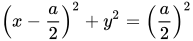
and
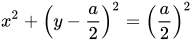
respectively.
The quadrifolium
[edit]A rose with k = 2 is called a quadrifolium because it has 2k = 4 petals and will form a square. In Cartesian coordinates the cosine and sine specifications are

and

respectively.
The trifolium
[edit]A rose with k = 3 is called a trifolium[9] because it has k = 3 petals and will form an equilateral triangle. The curve is also called the Paquerette de Mélibée. In Cartesian Coordinates the cosine and sine specifications are

and

respectively.[10] (See the trifolium being formed at the end of the next section.)
The octafolium
[edit]A rose with k = 4 is called an octafolium because it has 2k = 8 petals and will form an octagon. In Cartesian Coordinates the cosine and sine specifications are

and

respectively.
The pentafolium
[edit]A rose with k = 5 is called a pentafolium because it has k = 5 petals and will form a regular pentagon. In Cartesian Coordinates the cosine and sine specifications are

and

respectively.
The dodecafolium
[edit]A rose with k = 6 is called a dodecafolium because it has 2k = 12 petals and will form a dodecagon. In Cartesian Coordinates the cosine and sine specifications are

and

respectively.
Total and petal areas
[edit]The total area of a rose with polar equation of the form r = a cos(kθ) or r = a sin(kθ), where k is a non-zero integer, is[11]
![{\displaystyle {\begin{aligned}{\frac {1}{2}}\int _{0}^{2\pi }(a\cos(k\theta ))^{2}\,d\theta &={\frac {a^{2}}{2}}\left(\pi +{\frac {\sin(4k\pi )}{4k}}\right)={\frac {\pi a^{2}}{2}}&&\quad {\text{for even }}k\\[8px]{\frac {1}{2}}\int _{0}^{\pi }(a\cos(k\theta ))^{2}\,d\theta &={\frac {a^{2}}{2}}\left({\frac {\pi }{2}}+{\frac {\sin(2k\pi )}{4k}}\right)={\frac {\pi a^{2}}{4}}&&\quad {\text{for odd }}k\end{aligned}}}](https://wikimedia.org/api/rest_v1/media/math/render/svg/58ed28979bb8ca9b9a7b7f44593149ea14500e9d)
When k is even, there are 2k petals; and when k is odd, there are k petals, so the area of each petal is πa2/4k.
As a consequence, if someone wanted to play the popular game He loves me... he loves me not on a rose like above, instead of counting the petals they could calculate the area of the rose to determine the result of the game.
Roses with rational number values for k
[edit]In general, when k is a rational number in the irreducible fraction form k = n/d, where n and d are non-zero integers, the number of petals is the denominator of the expression 1/2 − 1/2k = n − d/2n.[12] This means that the number of petals is n if both n and d are odd, and 2n otherwise.[13]
- In the case when both n and d are odd, the positive and negative half-cycles of the sinusoid are coincident. The graph of these roses are completed in any continuous interval of polar angles that is dπ long.[14]
- When n is even and d is odd, or visa versa, the rose will be completely graphed in a continuous polar angle interval 2dπ long.[15] Furthermore, the roses are symmetric about the pole for both cosine and sine specifications.[16]
- In addition, when n is odd and d is even, roses specified by the cosine and sine polar equations with the same values of a and k are coincident. For such a pair of roses, the rose with the sine function specification is coincident with the crest of the rose with the cosine specification at on the polar axis either at θ = dπ/2 or at θ = 3dπ/2. (This means that roses r = a cos(kθ) and r = a sin(kθ) with non-zero integer values of k are never coincident.)
- The rose is inscribed in the circle r = a, corresponding to the radial coordinate of all of its peaks.
The Dürer folium
[edit]A rose with k = 1/2 is called the Dürer folium, named after the German painter and engraver Albrecht Dürer. The roses specified by r = a cos(θ/2) and r = a sin(θ/2) are coincident even though a cos(θ/2) ≠ a sin(θ/2). In Cartesian coordinates the rose is specified as[17]

The Dürer folium is also a trisectrix, a curve that can be used to trisect angles.
The limaçon trisectrix
[edit]A rose with k = 1/3 is a limaçon trisectrix that has the property of trisectrix curves that can be used to trisect angles. The rose has a single petal with two loops. (See the animation below.)
The rays displayed are the polar axis and θ = π/2.
Graphing starts at θ = 2π when k is an integer, θ = 2dπ otherwise, and proceeds clockwise to θ = 0.


Roses with irrational number values for k
[edit]A rose curve specified with an irrational number for k has an infinite number of petals[18] and will never complete. For example, the sinusoid r = a cos(πθ) has a period T = 2, so, it has a petal in the polar angle interval −1/2 ≤ θ ≤ 1/2 with a crest on the polar axis; however there is no other polar angle in the domain of the polar equation that will plot at the coordinates (a,0). Overall, roses specified by sinusoids with angular frequencies that are irrational constants form a dense set (that is, they come arbitrarily close to specifying every point in the disk r ≤ a).
Rotations required to close the curve
[edit]The number of rotations (or total angular range) required for a rhodonea curve to complete one full closed figure depends on the ratio k = n/d. When k is an integer, the curve closes after π radians if k is odd, and after 2π radians if k is even. When k is a rational number, the total rotation needed for the curve to close is given by dπ/gcd(n,d) if nd is odd, and by 2dπ/gcd(n,d) otherwise. This formula determines how many radians (or loops) are required for the rose curve to complete a full pattern before repeating itself.
See also
[edit]- Limaçon trisectrix - has the same shape as the rose with k = 1/3.
- Quadrifolium – a rose curve where k = 2.
- Maurer rose
- Rose (topology)
- Sectrix of Maclaurin
- Spirograph
Notes
[edit]- ^ O'Connor, John J.; Robertson, Edmund F., "Rhodonea", MacTutor History of Mathematics Archive, University of St Andrews
- ^ Mathematical Models by H. Martyn Cundy and A.P. Rollett, second edition, 1961 (Oxford University Press), p. 73.
- ^ "Rose (Mathematics)". Retrieved 2021-02-02.
- ^ Robert Ferreol. "Rose". Retrieved 2021-02-03.
- ^ Xah Lee. "Rose Curve". Retrieved 2021-02-12.
- ^ Eric W. Weisstein. "Rose (Mathematics)". Wolfram MathWorld. Retrieved 2021-02-05.
- ^ "Number of Petals of Odd Index Rhodonea Curve". ProofWiki.org. Retrieved 2021-02-03.
- ^ Robert Ferreol. "Rose". Retrieved 2021-02-03.
- ^ "Trifolium". Retrieved 2021-02-02.
- ^ Eric W. Weisstein. "Paquerette de Mélibée". Wolfram MathWorld. Retrieved 2021-02-05.
- ^ Robert Ferreol. "Rose". Retrieved 2021-02-03.
- ^ Jan Wassenaar. "Rhodonea". Retrieved 2021-02-02.
- ^ Robert Ferreol. "Rose". Retrieved 2021-02-05.
- ^ Xah Lee. "Rose Curve". Retrieved 2021-02-12.
- ^ Xah Lee. "Rose Curve". Retrieved 2021-02-12.
- ^ Jan Wassenaar. "Rhodonea". Retrieved 2021-02-02.
- ^ Robert Ferreol. "Dürer Folium". Retrieved 2021-02-03.
- ^ Eric W. Weisstein. "Rose (Mathematics)". Wolfram MathWorld. Retrieved 2021-02-05.
External links
[edit]Rose (mathematics)
View on GrokipediaIntroduction
Definition
The rose curve, also known as the rhodonea curve or multifolium, is a plane curve given by the polar equation or , where determines the radial extent of the petals and is a positive real number that controls the number and arrangement of the petals.[1][2] This produces intricate petal-like patterns in the plane, evoking the appearance of a flower.[1][4] These curves are distinguished by their elegant, symmetric forms, which arise from the interplay of radial and angular components in their construction.[4] The sine version is a 90-degree rotation of the cosine version. Rose curves are generated using sinusoidal functions in polar coordinates, yielding multi-lobed shapes that radiate from the origin.[1] The key parameter serves as the angular frequency, fundamentally determining the number and spatial arrangement of the petals.[5] The entire curve is confined within a bounding circle of radius centered at the origin, with the petals extending outward to touch this boundary at specific points.[5] This inscription ensures that all features of the rose remain compactly enclosed, highlighting its geometric elegance.[4]History
The rose curves, known initially as rhodonea curves, were first systematically studied and named by the Italian mathematician and priest Luigi Guido Grandi between 1723 and 1728. Grandi, a professor of mathematics at the University of Pisa, explored these curves in his work on geometric forms, noting their intricate, petal-like patterns that evoked the appearance of roses. He derived the name "rhodonea" from the Greek word rhodon, meaning rose, highlighting their floral resemblance.[6][1] During Grandi's era, these curves gained early recognition as a specialized variant within the broader family of roulette curves, particularly as special cases of hypotrochoids generated by the rolling of circles. This connection positioned rhodonea curves alongside cycloidal forms, which were prominent in 18th-century studies of rolling motions and pedal curves. Grandi's investigations contributed to the understanding of polar representations, though his primary focus remained on their geometric aesthetics rather than practical uses.[1][7] Interest in rhodonea curves persisted into the 19th century amid growing fascination with polar coordinate systems and symmetric plane curves. This period saw rhodonea integrated into broader treatises on algebraic curves, reflecting the era's emphasis on elegant mathematical visualizations.[7]Formulation
Polar Equation
The rose curve in polar coordinates is defined by the equations or , where serves as the scaling factor determining the overall size and is a parameter that governs the curve's complexity.[8][5] To generate the full curve without retracing, the parameter is traced over specific intervals depending on whether is an odd or even integer: for odd , the interval suffices to complete the trace, whereas for even , the interval is necessary.[9] During plotting, negative values of are typically interpreted as positive radii at angle , or the absolute value is used to ensure the curve is rendered in the correct quadrants.[8] The parameter represents the maximum radial distance from the origin, as and , confining the entire curve within the circle of radius .[5][7] The two forms differ in orientation: the cosine version exhibits symmetry about the polar axis (), while the sine version is symmetric about the line , effectively rotating the cosine curve by an angle of radians.[8][7]Equivalent Forms
The rose curve, defined in polar coordinates as , admits a parametric representation in Cartesian coordinates given by[10] This form facilitates analysis in rectangular coordinates, where serves as the parameter ranging appropriately to trace the curve.[11] For the sine-based polar form , the analogous parametric equations are
[10] These representations highlight the rotational offset between cosine and sine variants, with the sine version rotated by relative to the cosine one.[1] Applying trigonometric product-to-sum identities to the cosine parametric form yields expanded expressions:
for integer .[12] Similar expansions apply to the sine version, expressing the curve as a superposition of circular motions.[11] The rose curve is a special case of the hypotrochoid, obtained when the tracing point lies on the rolling circle's circumference, and also arises as the pedal curve of a hypocycloid with appropriate radius ratios.[1][7]
Properties
Petal Configuration
The petal configuration of a rose curve, defined by the polar equation or , depends primarily on the value of the parameter . For integer values of , the number of petals is if is odd and if is even.[1][7] These petals are equally spaced angularly, with consecutive petals separated by radians.[1] In general, each petal corresponds to a region in the polar plane where , bounded between consecutive zeros of the trigonometric function or . The zeros occur where the argument satisfies the equation for the cosine or sine function equaling zero, delineating the extents of each petal.[1] For rational values of in lowest terms, where and are positive integers, the number of petals is if both and are odd, and otherwise. The curve closes after traversing from 0 to if both and are odd, or to otherwise.[7][13] For rational non-integer , the petals may exhibit overlap or result from the curve looping multiple times before closing, leading to more complex configurations compared to the discrete petals of integer cases. For irrational , the curve does not close.[1]Symmetry
The rose curve exhibits distinct reflection symmetries depending on whether it is defined using the cosine or sine function. The cosine form, , is symmetric about the polar axis (), meaning that the curve is invariant under reflection across this axis.[1] In contrast, the sine form, , possesses reflection symmetry about the line , reflecting the perpendicular orientation of its petal arrangement relative to the cosine variant.[6] For integer values of , the rotational symmetry of the rose curve is determined by the parity of . When is an odd integer, the curve has rotational symmetry of order , achieved by rotations of radians around the origin. For even integer , the order increases to , corresponding to rotations of radians. These rotational symmetries, combined with the reflection symmetries, generate the full dihedral group for odd and for even , which describes the complete set of isometries preserving the curve.[1][6] When is rational in lowest terms, the symmetry properties are influenced by both numerator and denominator , with the curve closing after a period of if both and are odd, or otherwise, enabling a finite periodic structure. In such cases, the rotational symmetry order reduces to a value tied to and , typically the number of distinct lobes, while the overall group remains dihedral, though of lower order than in the irrational case where no finite rotational symmetry exists beyond order 2.[14] The value of also affects the overall orientation and perceived symmetry of the rose curve; for even integer , the doubled petal count relative to odd produces a "star-like" configuration with enhanced rotational redundancy, emphasizing the 2k-fold symmetry that aligns with the dihedral group .[1][6]Area
Total Area
The total area enclosed by the rose curve (or equivalently ) is given by the standard polar area formula where is the angular interval over which the curve is traced once without retracing. For integer , this interval is when is odd and when is even. Substituting the polar equation from the formulation section, . The integral simplifies to The sine term evaluates to zero at the limits, yielding . Thus, for odd integer , ; for even integer , .[15] For non-integer , the curve closes after a period determined by the denominator in reduced form , leading to a more complex integral over , but the resulting area follows analogous forms adjusted for the rational multiple, though computation is generally less simplified.[15]Individual Petal Area
The area of an individual petal in a rose curve defined by the polar equation , where is a positive integer, is computed using the standard polar area formula over the angular interval spanning one petal.[1] For the central petal aligned with the positive x-axis, this interval is from to , where . Substituting the equation yields the integral Using the identity , the integral simplifies to .[1] Due to the rotational symmetry of the rose curve, all petals possess identical areas when is an integer; specifically, there are petals if is odd and petals if is even, making the total area the product of the number of petals and the individual petal area.[1] This uniformity arises from the periodic nature of the cosine function, ensuring equivalent contributions from each symmetric lobe. For rational in lowest terms, the computation of per-petal area follows a similar integration approach over appropriate angular sectors, but the presence of self-intersections and overlaps complicates the isolation of distinct "petals," preventing a straightforward simplification akin to the integer case.[1]Integer k Cases
k = 1: Circle
When , the rose curve degenerates into a circle, representing the simplest case in the family of rose curves without any multi-lobed structure. The polar equation is given by , where determines the scale.[1][16] To derive the equivalent Cartesian form, start with the polar equation and multiply both sides by :Substitute and :
Rearrange and complete the square in :
This describes a circle of radius centered at .[16] The curve is interpreted as a single "petal" forming the full circle, serving as the base case for the rose family.[1] As varies from to , the circle is traced twice, a feature particular to this degenerate case.[17] The area enclosed by this circle is , which aligns with the general formula for the area of one petal in odd- rose curves.[1]