



Community hub
Recent from talks
Contribute something
Nothing was collected or created yet.
Wegener–Bergeron–Findeisen process
View on WikipediaThe Wegener–Bergeron–Findeisen process (named after Alfred Wegener, Tor Bergeron, and Walter Findeisen), or "cold-rain process", is a process of ice crystal growth that occurs in mixed phase clouds (containing a mixture of supercooled water and ice) in regions where the ambient vapor pressure falls between the saturation vapor pressure over water and the lower saturation vapor pressure over ice. This is a subsaturated environment for liquid water but a supersaturated environment for ice, resulting in rapid evaporation of liquid water and rapid ice crystal growth through vapor deposition. If the number density of ice is small compared to liquid water, the ice crystals can grow large enough to fall out of the cloud, melting into raindrops if lower-level temperatures are warm enough.
The Wegener–Bergeron–Findeisen process, if occurring at all, is much more efficient in producing large particles than is the growth of larger droplets at the expense of smaller ones, since the difference in saturation pressure between liquid water and ice is larger than the enhancement of saturation pressure over small droplets (for droplets large enough to considerably contribute to the total mass). For other processes affecting particle size, see rain and cloud physics.
History
[edit]The principle of ice growth through vapor deposition on ice crystals at the expense of water was first theorized by the German scientist Alfred Wegener in 1911 while studying hoarfrost formation. Wegener theorized that if this process happened in clouds and the crystals grew large enough to fall out, it could be a viable precipitation mechanism. While his work with ice crystal growth attracted some attention, it would take another 10 years before its application to precipitation would be recognized.[1]
In the winter of 1922, Tor Bergeron made a curious observation while walking through the woods. He noticed that on days when the temperature was below freezing, the stratus deck that typically covered the hillside stopped at the top of the canopy instead of extending to the ground as it did on days when the temperature was above freezing. Being familiar with Wegener's earlier work, Bergeron theorized that ice crystals on the tree branches were scavenging vapor from the supercooled stratus cloud, preventing it from reaching the ground.
In 1933, Bergeron was selected to attend the International Union of Geodesy and Geophysics meeting in Lisbon, Portugal, where he presented his ice crystal theory. In his paper, he stated that if the ice crystal population was significantly small compared to the liquid water droplets, the ice crystals could grow large enough to fall out (Wegener's original hypothesis). Bergeron theorized that this process could be responsible for all rain, even in tropical climates, a statement that caused quite a bit of disagreement between tropical and mid-latitude scientists. In the late 1930s, German meteorologist Walter Findeisen extended and refined Bergeron's work through both theoretical and experimental work.
Required conditions
[edit]The condition that the number of droplets should be much larger than the number of ice crystals depends on the fraction of cloud condensation nuclei that would later (higher in the cloud) act as ice nuclei. Alternatively, an adiabatic updraft has to be sufficiently fast so that high supersaturation causes the spontaneous nucleation of many more droplets than present cloud condensation nuclei. In either case, this should happen not far below the freezing point, as this would cause direct nucleation of ice. The growth of the droplets would prevent the temperature from soon reaching the point of fast nucleation of ice crystals.
The larger supersaturation with respect to ice, once present, causes it to grow fast, thus scavenging water from the vapor phase. If the vapor pressure drops below the saturation pressure with respect to liquid water , the droplets will cease to grow. This may not occur if itself is dropping rapidly, depending on the slope of the saturation curve, the lapse rate, and the speed of the updraft; or if the drop of is slow, depending on the number and size of the ice crystals. If the updraft is too fast, all the droplets would finally freeze rather than evaporate.


A similar limit is encountered in a downdraft. Liquid water evaporates, causing the vapor pressure to rise, but if the saturation pressure with respect to ice is rising too fast in the downdraft, all ice would melt before large ice crystals have formed.

Korolev and Mazin[2] derived expressions for the critical updraft and downdraft speed:
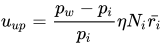
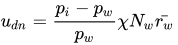
where and are coefficients dependent on temperature and pressure, and are the number densities of ice and liquid particles (respectively), and and are the mean radius of ice and liquid particles (respectively).


For values of typical of clouds, ranges from a few cm/s to a few m/s. These velocities can be easily produced by convection, waves, or turbulence, indicating that it is not uncommon for both liquid water and ice to grow simultaneously. In comparison, for typical values of , downdraft velocities larger than a few m/s are required for both liquid and ice to shrink simultaneously.[3] These velocities are common in convective downdrafts but are not typical for stratus clouds.


Formation of ice crystals
[edit]The most common way to form an ice crystal starts with an ice nucleus in the cloud. Ice crystals can form from heterogeneous deposition, contact, immersion, or freezing after condensation. In heterogeneous deposition, an ice nucleus is simply coated with water. For contact, ice nuclei will collide with water droplets that freeze upon impact. In immersion freezing, the entire ice nucleus is covered in liquid water.[4]
Water will freeze at different temperatures depending upon the type of ice nuclei present. Ice nuclei cause water to freeze at higher temperatures than it would spontaneously. For pure water to freeze spontaneously, called homogeneous nucleation, cloud temperatures would have to be −35 °C (−31 °F).[5] Here are some examples of ice nuclei:
| Ice nuclei | Temperature to freeze |
|---|---|
| Bacteria | −2.6 °C (27.3 °F) |
| Kaolinite | −30 °C (−22 °F) |
| Silver iodide | −10 °C (14 °F) |
| Vaterite | −9 °C (16 °F) |
Ice multiplication
[edit]
As the ice crystals grow, they can bump into each other and splinter and fracture, resulting in many new ice crystals. There are many shapes of ice crystals to bump into each other. These shapes include hexagons, cubes, columns, and dendrites. This process is referred to as "ice enhancement" by atmospheric physicists and chemists.[6]
Aggregation
[edit]The process of ice crystals sticking together is called aggregation. This happens when ice crystals are slick or sticky at temperatures of −5 °C (23 °F) and above because of a coating of water surrounding the crystal. The different sizes and shapes of ice crystals fall at different terminal velocities and commonly collide and stick.
Accretion
[edit]Accretion (or riming) occurs when an ice crystal collides with supercooled water droplets. Droplets freeze upon impact and can form graupel. If the graupel formed is reintroduced into the cloud by wind, it may continue to grow larger and denser, eventually forming hail.[6]
Precipitation
[edit]Eventually, this ice crystal will grow heavy enough to fall. It may even collide with other ice crystals and grow larger still through collision coalescence, aggregation, or accretion.
The Wegener–Bergeron–Findeisen process often results in precipitation. As the crystals grow and fall, they pass through the base of the cloud, which may be above freezing. This causes the crystals to melt and fall as rain. There also may be a layer of air below freezing below the cloud base, causing the precipitation to refreeze in the form of ice pellets. Similarly, the layer of air below freezing may be at the surface, causing the precipitation to fall as freezing rain. The process may also result in no precipitation, evaporating before it reaches the ground, in the case of forming virga.
See also
[edit]References
[edit]- ^ Harper, Kristine (2007). Weather and climate: decade by decade. Twentieth-century science (illustrated ed.). Infobase Publishing. pp. 74–75. ISBN 978-0-8160-5535-7.
- ^ Korolev, A.V.; Mazin, I.P. (2003). "Supersaturation of water vapor in clouds". J. Atmos. Sci. 60 (24): 2957–2974. Bibcode:2003JAtS...60.2957K. doi:10.1175/1520-0469(2003)060<2957:SOWVIC>2.0.CO;2.
- ^ Korolev, Alexei (2007). "Limitations of the Wegener–Bergeron–Findeisen Mechanism in the Evolution of Mixed-Phase Clouds". J. Atmos. Sci. 64 (9): 3372–3375. Bibcode:2007JAtS...64.3372K. doi:10.1175/JAS4035.1.
- ^ Ice Nucleation in Mixed-Phase Clouds Thomas F. Whale University of Leeds, Leeds, United Kingdom, CHAPTER 2,1.1 Modes of Heterogeneous Ice Nucleation.
- ^ Koop, T. (25 March 2004). "Homogeneous ice nucleation in water and aqueous solutions". Zeitschrift für physikalische Chemie. 218 (11): 1231–1258. doi:10.1524/zpch.218.11.1231.50812. S2CID 46915879. Archived from the original on 11 August 2012. Retrieved 7 April 2008.
- ^ a b Microphysics of clouds and precipitation. Pruppacher, Hans R., Klett, James, 1965.
- Wallace, John M. and Peter V. Hobbs: Atmospheric Science, 2006, ISBN 0-12-732951-X.
- Yau, M.K. and Rodgers, R.R.: "A Short Course in Cloud Physics", 1989, ISBN 0-7506-3215-1.
External links
[edit]Wegener–Bergeron–Findeisen process
View on GrokipediaHistorical Development
Discovery and Key Contributors
The Wegener–Bergeron–Findeisen process originated with the foundational thermodynamic insights of Alfred Wegener, a German meteorologist and polar explorer. During his early Arctic expeditions to Greenland in 1906–1908, where he served as the expedition's physicist and meteorologist, Wegener conducted observations of atmospheric phenomena, including hoarfrost formation. These experiences informed his 1911 publication, Thermodynamik der Atmosphäre, in which he argued that the coexistence of supercooled liquid water droplets and ice crystals in clouds is thermodynamically unstable. Wegener posited that ice crystals would preferentially grow through vapor deposition at the expense of surrounding droplets due to the lower saturation vapor pressure over ice relative to supercooled water, providing the initial conceptual basis for the process.[10] Tor Bergeron, a Swedish meteorologist associated with the Bergen School of Meteorology in Norway, advanced Wegener's ideas through observational and theoretical work in the 1920s and early 1930s. In the winter of 1922, while recovering from tuberculosis at a health resort in Voksenkollen near Oslo, Bergeron observed the rapid clearance of supercooled fog and the deposition of frost on trees at temperatures between -5°C and -10°C, attributing this to the growth of ice crystals via water vapor diffusion from liquid droplets. He incorporated these findings into his 1928 doctoral dissertation, Über die dreidimensionale verknüpfende Wetteranalyse, where he linked ice crystal growth to broader precipitation mechanisms in mixed-phase clouds. Bergeron further refined and publicized the concept during lectures at the Bergen School and in his 1933 presentation at the International Union of Geodesy and Geophysics assembly in Lisbon, emphasizing how ice crystals serve as the primary initiators of rain, snow, and hail formation by aggregating vapor from coexisting water droplets.[10] Walter Findeisen, a German meteorologist, provided critical experimental validations and theoretical refinements in the late 1930s, solidifying the process's understanding. Building on Wegener and Bergeron's work, Findeisen's 1932 doctoral thesis examined droplet size distributions in clouds, but his seminal 1938 paper, Kolloid-meteorologische Vorgänge bei der Niederschlagbildung, offered a comprehensive synthesis, including detailed calculations of vapor diffusion rates and the role of ice nuclei. Using a novel 2 m³ cloud chamber equipped with adiabatic expansion capabilities, Findeisen experimentally demonstrated the preferential growth of ice crystals over liquid droplets in mixed-phase conditions, confirming the process's efficiency for precipitation development. His contributions led to the process being eponymously named the Wegener–Bergeron–Findeisen process, honoring the trio's collaborative advancements despite the challenges of the interwar period.[11][10]Evolution of Understanding
Following the foundational theoretical proposal by Alfred Wegener in 1911, further developed by Tor Bergeron in the 1930s, and experimentally validated by Walter Findeisen in 1938, the understanding of the Wegener–Bergeron–Findeisen process advanced significantly through post-World War II observations. In the 1950s, airborne radar measurements provided initial empirical confirmation of ice crystal growth in mixed-phase clouds, revealing precipitation formation mechanisms consistent with differential vapor deposition even in clouds extending below the freezing level. These aircraft-based studies, conducted at altitudes around 14,000 feet, captured radar echoes from ice particles and small snowflakes, demonstrating the process's role in rapid particle enlargement.[12][13] By the 1960s and 1970s, more sophisticated aircraft instrumentation, including early cloud probes, enabled direct in-situ measurements of ice nuclei and crystal concentrations in supercooled clouds, quantifying the depletion of liquid droplets and supporting the process's efficiency in precipitation development. Radar networks during this period tracked echo evolution in orographic and stratiform clouds, corroborating observational evidence of ice supersaturation and crystal fallout. Concurrently, Neville H. Fletcher's seminal 1962 analysis integrated the process into cloud classification schemes, linking ice nucleation thresholds (around -10°C to -20°C for typical atmospheric nuclei) to the onset of differential growth and emphasizing its dependence on heterogeneous nucleation sites.[16] Laboratory experiments in the 1970s further refined comprehension by simulating mixed-phase conditions to measure differential growth rates, showing ice crystals enlarging at rates up to 10-100 times faster than coexisting droplets under ice-supersaturated environments. These controlled setups, using cloud chambers to replicate vapor gradients, highlighted ventilation effects and particle spacing as modulators of growth efficiency.[17] The 1980s marked a transition from qualitative observations to quantitative frameworks, with early numerical cloud models incorporating parameterized vapor deposition equations to simulate the process's dynamics. Pioneering simulations, such as those resolving ice microphysics in convective systems, demonstrated how the process drives net water transfer toward ice phases, establishing benchmarks for precipitation efficiency in layered clouds. These models, often one-dimensional or bulk schemes, laid groundwork for integrating the mechanism into mesoscale forecasts without resolving individual particle interactions.[18]Physical Mechanism
Required Environmental Conditions
The Wegener–Bergeron–Findeisen (WBF) process operates within mixed-phase clouds, where supercooled liquid water droplets coexist with a smaller number of ice crystals, typically at temperatures ranging from 0°C to -40°C. This temperature interval allows for the persistence of supercooled liquid water while enabling ice formation and growth, with the process being most efficient between -10°C and -20°C due to the pronounced difference in saturation vapor pressures over ice and liquid. The initial scarcity of ice crystals relative to liquid droplets is crucial, as it permits the buildup of supersaturation with respect to ice before widespread glaciation occurs. A key prerequisite is an ambient relative humidity positioned between saturation over ice () and saturation over water (), where for temperatures below 0°C, creating a subsaturated environment for liquid droplets but supersaturated conditions for ice. This vapor pressure disequilibrium drives the preferential deposition onto ice without immediate droplet growth, though in practice, mixed-phase clouds often hover near water saturation due to dynamic influences. Cloud dynamics play an essential role in initiating and sustaining the WBF process, particularly through vertical air motions that maintain the necessary supersaturation with respect to ice. The process is efficient when the vertical velocity lies between a downdraft threshold (where liquid droplets evaporate while ice grows) and an updraft threshold (where both phases can grow without excessive liquid supersaturation dominating). These thresholds depend on particle concentrations, sizes, and thermodynamic parameters, typically on the order of 0.1 to several m/s for common cloud conditions. Vertical velocities in observed mixed-phase clouds often have standard deviations of 0.06–0.52 m/s, ensuring the persistence of the mixed-phase regime against rapid glaciation or liquidation.Vapor Deposition Dynamics
The Bergeron–Findeisen effect, central to the vapor deposition dynamics in mixed-phase clouds, arises because the saturation vapor pressure over ice is lower than over supercooled water at temperatures below 0°C, creating a net flux of water vapor from the ambient air toward ice crystals while supercooled droplets evaporate to sustain this gradient. This differential drives the preferential growth of ice crystals at the expense of liquid droplets, with the ambient vapor density typically lying between the saturation values over ice (ρ_{v,i}) and water (ρ_{v,w}). The mass growth rate of an individual ice crystal by vapor diffusion is governed by the equation where is the ice crystal mass, is the capacitance (dependent on crystal shape and size, approximately equal to the radius for spherical equivalents), is the diffusion coefficient of water vapor in air, is the ambient vapor density, and is the vapor density at the crystal surface (equal to saturation over ice under equilibrium). This formulation assumes quasi-stationary diffusion in the continuum regime and neglects thermal effects for simplicity; the growth is supersaturation-driven relative to ice, accelerating as the vapor pressure difference increases.[20] Simultaneously, surrounding supercooled droplets experience net evaporation, depleting their mass as vapor diffuses away to the ice crystals. The radius change rate for a water droplet is approximated by where is the droplet radius, is the liquid water density, and is the saturation vapor density over water; the negative sign reflects evaporation when . This inverse dependence on radius implies smaller droplets evaporate faster, potentially leading to their complete disappearance before larger ones. In dynamic cloud environments, ventilation effects enhance deposition rates by increasing the effective diffusion flux around falling ice crystals. The ventilation coefficient modifies the growth equation as , where for moderate Reynolds (Re) and Schmidt (Sc) numbers, with values exceeding 1 for crystals with significant fall speeds. At low temperatures (below −40°C), kinetic effects further amplify growth for ice particles in general, as molecular collisions at the ice surface limit accommodation; the deposition coefficient (typically 0.5–1 at warmer temperatures) decreases, but enhanced kinetic jump distances in the free-molecular regime can increase effective growth rates by up to 20–50% compared to continuum predictions.Ice Crystal Formation and Growth
Nucleation Processes
The formation of initial ice crystals in mixed-phase clouds, essential for initiating the Wegener–Bergeron–Findeisen process, primarily occurs through heterogeneous nucleation on ice nuclei (IN), which are insoluble particles that lower the energy barrier for ice embryo formation.[21] Heterogeneous nucleation dominates in clouds at temperatures between 0°C and -40°C, where supercooled liquid droplets coexist, allowing IN such as mineral dust, biological particles, and artificially introduced agents like silver iodide to serve as templates for ice crystallization.[22] For example, mineral dust particles from desert regions act as effective IN by providing lattice structures similar to ice, facilitating nucleation at relatively warm temperatures down to -20°C.[21] Specific biological IN, such as the bacterium Pseudomonas syringae, exhibit high nucleation activity through ice-nucleating proteins on their surface, enabling ice formation at temperatures as warm as -2°C, which is critical for initiating glaciation in shallow convective clouds.[23] Silver iodide, commonly used in cloud seeding, promotes heterogeneous nucleation at temperatures around -10°C due to its crystallographic similarity to ice, making it a benchmark for artificial IN efficiency. These IN activate via different modes: immersion freezing, where the nucleus is engulfed within a supercooled droplet and triggers freezing upon reaching a critical temperature or supersaturation; contact freezing, involving collision between the IN and a droplet; and deposition nucleation, where water vapor directly deposits onto the IN surface at ice supersaturations exceeding 10-20%.[22] Critical supersaturation thresholds for IN activation vary by particle type, typically requiring ice supersaturations of 5-15% for mineral dust and biological IN to overcome the nucleation barrier.[21] In the absence of sufficient heterogeneous IN, homogeneous nucleation becomes relevant at colder temperatures, where supercooled water droplets spontaneously freeze without foreign particles, forming ice at approximately -35°C to -40°C due to the high free energy required for embryo formation in pure liquid.[24] This process is rare in most mixed-phase clouds because heterogeneous nucleation typically occurs first, but it sets a lower limit for ice formation in pristine environments. Typical atmospheric IN concentrations range from 0.01 to 100 L⁻¹, depending on aerosol loading and temperature, with lower values (0.01–1 L⁻¹) in remote regions and higher (10–100 L⁻¹) in polluted or dusty air masses; these concentrations determine the initial ice crystal number and thus seed the mixed-phase conditions necessary for the process.[25] Once nucleated, these ice crystals can grow by vapor deposition, as detailed in subsequent sections.Ice Multiplication Mechanisms
Ice multiplication mechanisms refer to secondary processes that generate additional ice crystals from pre-existing ones, amplifying ice concentrations beyond primary nucleation rates in mixed-phase clouds. These mechanical fragmentation pathways enhance the efficiency of the Wegener–Bergeron–Findeisen process by rapidly increasing the number of ice particles available for vapor deposition. While initial nucleation provides the seed crystals, multiplication occurs through physical breakup under specific dynamic and thermal conditions. One key mechanism is riming-splintering, where ice crystals or graupel particles accrete supercooled liquid droplets, leading to splintering upon impact or during the freezing of accreted mass. Laboratory studies have demonstrated that this process produces up to several hundred fragments per milligram of rime accreted, particularly effective at temperatures between -5°C and -10°C, where the formation of a brittle ice shell around freezing droplets facilitates fragmentation.[26] This splintering is driven by the mechanical stress from rapid freezing and collision, releasing small ice shards that serve as new nuclei.[27] Dendritic breakup involves the mechanical fracture of branching ice crystals under aerodynamic stress, shear, or their own weight, commonly observed in plate-like or dendritic habits formed at temperatures around -10°C to -15°C. These complex structures, with extended arms, are prone to shattering during collisions with other particles or turbulent airflow, generating multiple smaller fragments per event. Observations and modeling indicate that such breakups contribute significantly to ice production in regions with high particle concentrations and moderate turbulence.[28] The Hallett-Mossop process, a variant of rime splintering, occurs in temperature gradients between -3°C and -8°C, where shearing forces on growing ice surfaces or frozen droplets cause prolific splintering. This mechanism is activated when ice particles traverse zones of varying temperature, promoting the ejection of small ice splinters from the edges of riming particles or growing crystals. It is particularly relevant in convective clouds with vertical motion, leading to enhanced secondary ice formation through repeated fragmentation cycles.[26] In situ observations of mixed-phase clouds have documented ice crystal concentrations up to ~10³ L⁻¹, representing multiplication factors of up to ~10⁴ from initial levels near 0.01 L⁻¹ to over 100 L⁻¹ within minutes, underscoring the profound impact of these mechanisms on cloud microphysics.[29] However, a 2024 laboratory study found limited evidence for efficient rime-splintering under controlled conditions, suggesting potential refinements needed in parameterizations of these processes.[27]Particle Interaction Processes
Aggregation
Aggregation in the Wegener–Bergeron–Findeisen process refers to the collision and subsequent sticking of ice crystals, serving as a key non-vapor growth mechanism that enlarges particles beyond diffusional growth limits. This process is primarily driven by collision-coalescence, where ice particles of varying sizes and shapes encounter each other due to differential settling velocities induced by gravity in the turbulent environment of mixed-phase clouds. Additionally, electrostatic charges on ice crystals can enhance collision probabilities by altering trajectories through Coulomb forces, particularly in regions with charge separation from vapor growth or fragmentation.[30][31] The sticking efficiency, which determines the fraction of collisions resulting in permanent aggregation, exhibits a strong temperature dependence, peaking around -15°C. At this temperature, dendritic habits dominate, promoting interlocking upon contact, while thin quasi-liquid films on ice crystal surfaces further enhance adhesion through sintering or van der Waals forces, especially for branched habits like dendrites and side planes. These conditions favor the formation of loose aggregates, contrasting with lower efficiencies at colder temperatures where surfaces remain drier and less adhesive. Observations and parameterizations confirm sticking efficiencies ranging from 0.1 to 1.0, with higher values near the peak temperature enhancing aggregate development. Ice multiplication processes can increase the abundance of small crystals available for such collisions, amplifying aggregation rates in supersaturated environments.[32][33] The rate of aggregation is quantified by the aggregation kernel, given by where is the sticking efficiency (0.1–1.0), and are the radii of the colliding ice particles, and is the magnitude of their relative velocity, often dominated by differential settling. This formulation captures the geometric cross-section for collision modulated by efficiency factors and is widely used in microphysics models to simulate ice growth. Resulting aggregates, commonly observed as snowflakes, exhibit low bulk densities of 0.05–0.2 g cm⁻³ due to their porous, branched structures, which further influence fall speeds and radiative properties in clouds.[34][32][35]Accretion
Accretion, also known as riming, involves the collision and freezing of supercooled liquid water droplets onto falling ice crystals within mixed-phase clouds, contributing to the overall growth of ice particles under the supersaturation conditions favored by the Wegener–Bergeron–Findeisen process. This mechanism is distinct from vapor deposition, as it directly incorporates liquid mass into the ice structure, altering particle density, shape, and terminal velocity.[36] The collision efficiency () governing ice-droplet impacts varies with ice crystal habit and droplet size. Plate-like and broad-branched crystals generally achieve higher (up to ~1.0) than columnar crystals due to their larger projected areas and flow fields that better capture droplets.[37] For small droplets, is negligible (<0.1), but it rises sharply and exceeds 0.5 for droplet radii greater than 10 μm, enabling efficient collection of typical cloud droplets in this size range.[37] Upon collision, the supercooled droplets rapidly freeze on the colder ice surface, accreted as a layer of rime that adds mass and increases the particle's fall speed, promoting further interactions. The mass growth rate for an individual ice particle is approximated by where is the ice mass, the effective ice radius, and the terminal velocities of the ice particle and droplet, the liquid water density, and the droplet number concentration; this rate scales with relative velocity and droplet abundance. Continued riming transforms pristine crystals into denser, irregular structures, with the added frozen droplets enhancing the particle's momentum and collection cross-section.[38] Prolonged or intense riming leads to the formation of graupel, characterized by conical or lump-like aggregates of rime layers over the original crystal skeleton, typically 2–5 mm in diameter.[39] In environments with high liquid water content and vigorous updrafts, such as convective storms, graupel particles can grow rapidly and act as embryos for larger hailstones, transitioning from soft rime to denser, layered hail through sustained accretion.[40] Riming efficiency shows a marked temperature dependence, with optimal collection below -10°C where the process is more effective than at warmer subfreezing levels. This enhancement arises from faster freezing of impacted droplets at greater supercooling degrees, shortening the solidification time and improving sticking to the ice surface.[41]Role in Precipitation Formation
The Wegener–Bergeron–Findeisen process (also known as the Bergeron process) is a primary mechanism for precipitation formation in mixed-phase clouds, where ice crystals grow rapidly at the expense of supercooled water droplets due to the lower saturation vapor pressure over ice compared to liquid water. This process is often the dominant mechanism for precipitation in mid-latitude regions, where mixed-phase clouds are common, leading to precipitation that typically begins as snow or graupel. In contrast, the collision-coalescence process dominates in tropical regions, where warm rain forms without significant ice involvement.[42][6]Development of Precipitating Particles
In the Wegener–Bergeron–Findeisen (WBF) process, initial growth of ice crystals occurs primarily through vapor deposition, where supersaturation with respect to ice drives the uptake of water vapor from the surrounding environment, often at the expense of evaporating supercooled liquid droplets. This phase allows nascent ice particles, starting from nuclei on the order of micrometers, to expand rapidly to sizes where sedimentation becomes significant, typically reaching a critical diameter of approximately 100 μm for pristine crystals. At this threshold, the particles acquire sufficient mass relative to drag to begin falling out of the cloud layer under typical updraft conditions. The terminal fall speeds of these growing ice particles vary markedly with size, shape, and environmental factors. For pristine ice crystals, fall speeds range from 10 to 100 cm/s, influenced by crystal habit—such as plates or columns—and the Reynolds number, which accounts for aerodynamic drag and particle orientation during descent. As particles aggregate or accrete, forming snowflakes or rimed structures like graupel, their fall speeds increase to 50–200 cm/s for snowflakes and 200–800 cm/s for graupel, enabling faster removal from the cloud. These dynamics are governed by power-law relationships between particle dimension, mass, and drag coefficient, as established in laboratory and field measurements.[43] The combined effects of vapor deposition followed by aggregation and accretion propel ice particles toward precipitation sizes of 1–10 mm in diameter, where fallout efficiency heightens due to enhanced terminal velocities and reduced susceptibility to turbulent suspension. This sequential growth integrates the differential vapor uptake of the WBF process with collision-based mechanisms, transforming small crystals into viable precipitating entities. Ultimately, the WBF process facilitates cloud glaciation by progressively depleting liquid water content through droplet evaporation, shifting the cloud composition toward an ice-dominated state that alters radiative properties and precipitation potential.Pathways to Surface Precipitation
As ice particles generated through the Wegener–Bergeron–Findeisen process descend from cold cloud regions, they encounter varying sub-cloud environmental conditions that determine the final precipitation type reaching the surface. In scenarios where a deep warm layer exists above the 0°C melting level, typically at altitudes of 1-3 km, these particles fully melt into liquid raindrops upon falling through temperatures exceeding 0°C, provided the layer's depth—often 650-1300 m or more—allows complete phase transition based on particle mass and lapse rates ranging from -5°C/km to -15°C/km.[44][6] This pathway is common in mid-latitude winter storms transitioning from snow to rain as surface temperatures rise above freezing.[6] Partial melting occurs in shallower warm layers, where ice particles partially liquefy before entering a colder sub-cloud layer below 0°C, leading to refreezing and the formation of sleet—small, translucent ice pellets typically 2-5 mm in diameter.[45] This refreezing process is facilitated by the presence of residual ice nuclei within the partially melted particles, requiring a cold layer depth of 200-550 m at temperatures of -5°C to -10°C for complete solidification into ice pellets.[44] In drier sub-cloud environments with low relative humidity, falling ice particles may instead undergo sublimation or evaporation before reaching the ground, producing virga—visible shafts of precipitating ice that dissipate into fall streaks without accumulating at the surface.[46] Under convective conditions with intense updrafts, such as in supercell thunderstorms, ice particles experience rapid accretion of supercooled liquid water, growing into hailstones larger than 5 mm through repeated cycles of ascent and descent in updrafts exceeding 20 m/s (approximately 45-72 km/h).[47] These strong vertical motions, often sustained in cumulonimbus clouds, allow hail embryos—initially frozen droplets or small graupel—to collide with supercooled water, forming layered structures via wet or dry growth regimes, with larger hail (e.g., golf ball-sized at 4.4 cm) requiring updrafts up to 29 m/s.[47] Hail typically develops at higher altitudes in regions of extreme instability, like the Great Plains.[6] Freezing rain arises when ice particles fully melt in an elevated warm layer (1-3 km altitude) into supercooled raindrops that remain liquid through a shallow cold layer near the surface, only to refreeze upon impact with sub-freezing ground or objects below 0°C, forming glaze ice accumulations.[44] This contrasts with ice pellets, as the cold layer is insufficiently deep (less than 200 m) or warm enough to prevent in-air refreezing, allowing droplets with minimal ice fractions (e.g., 0.01) to supercool until surface contact.[44] Particle fall speeds, influenced by size and shape from prior growth stages, modulate the time available for these phase changes during descent.[6]Significance and Modern Applications
Impacts on Weather and Climate
The Wegener–Bergeron–Findeisen (WBF) process plays a critical role in enhancing precipitation efficiency within extratropical cyclones, particularly in frontal systems where mixed-phase clouds dominate. By facilitating the rapid growth of ice crystals at the expense of supercooled liquid droplets, the process promotes the formation of larger precipitating particles that can fall through warmer cloud layers, often melting into rain. In mid-latitude winter storms, this ice-phase mechanism contributes significantly to overall precipitation through the glaciation and subsequent melting of ice crystals.[48][49] On climatic scales, the WBF process influences radiative feedbacks in mixed-phase clouds, which are prevalent between 0°C and -40°C. Glaciation driven by the process reduces the liquid water path while increasing the ice water path, leading to decreased cloud albedo and enhanced longwave radiative forcing, particularly in the Northern Hemisphere midlatitudes where net warming effects range from 0.18 to 0.76 W/m². In the Arctic, this contributes to amplification of warming by altering the lifecycle of persistent mixed-phase clouds, sustaining low-level stratus that trap heat and exacerbate sea ice loss through modified precipitation patterns.[50][51] The process also underpins several weather hazards by enabling the development of heavy precipitation in mixed-phase environments. In wintertime synoptic systems, WBF-initiated ice crystal growth followed by aggregation results in intense snowfall rates, often exceeding 5 cm/h in mid-latitude storms. In convective scenarios, such as supercell thunderstorms, the process supports hail formation in the mixed-phase region through accretion of supercooled droplets onto ice particles, producing hailstones up to several centimeters in diameter. Additionally, by influencing droplet evaporation and cloud persistence, it can exacerbate supercooled fog formation, reducing visibility to below 1 km in affected areas.[52][40] Observational evidence from satellite missions underscores the global prevalence of the WBF process in mixed-phase clouds. Data from the CALIPSO lidar reveal that such clouds, where the process dominates ice growth, comprise 30–50% of cloud layers in mid- to high-latitude regions, with supercooled liquid coexisting with ice in nearly 50% of low-level Antarctic clouds during austral summer. These observations highlight the process's role in ~13% of Arctic liquid-containing clouds producing snowfall, confirming its efficiency in natural settings despite model biases that overestimate glaciation rates.[53][54]Modeling Parameterizations and Limitations
In bulk microphysics schemes used in numerical weather prediction and climate models, the Wegener–Bergeron–Findeisen (WBF) process is typically parameterized within two-moment frameworks that prognose both the mass mixing ratio and number concentration of ice particles to capture the evolution of particle size distributions. For instance, the Morrison double-moment scheme implemented in the Weather Research and Forecasting (WRF) model represents ice growth via vapor deposition as the primary mechanism driving the WBF process, where supercooled droplets evaporate to sustain supersaturation with respect to ice. Similarly, the ICON model's two-moment scheme incorporates comparable formulations, emphasizing the transfer of vapor from liquid to ice phases in mixed-phase clouds. The ice mass mixing ratio growth rate in these schemes is often expressed as where is the ice mixing ratio, is the capacitance of ice particles (dependent on shape assumptions like spherical or hexagonal), is the water vapor diffusivity, and are the ambient and ice-saturated vapor densities, is the ice number concentration, and is air density; this form derives from diffusion-limited growth theory adapted for bulk distributions.[8] Despite these advancements, parameterizations exhibit limitations, particularly in underestimating the WBF process under entrainment-mixing conditions, where inhomogeneous mixing can enhance local supersaturations and accelerate ice growth beyond model predictions, as highlighted in large-eddy simulations from 2020–2021 studies. Additionally, many schemes neglect kinetic growth effects at cold temperatures below -40°C, where molecular accommodation coefficients reduce deposition rates, leading to overestimations of ice formation in polar environments. These shortcomings contribute to biases in simulated cloud lifetimes and precipitation efficiency. Recent developments have addressed some dependencies, such as the 2024 evaluation of ICON in large-eddy mode, which improved WBF representations by incorporating updraft velocity effects on nucleation and growth, enhancing agreement with in-situ observations from the CLOUDLAB campaign. A January 2025 evaluation of mid-to-high-latitude surface snowfall and cloud phase biases in CMIP6 models and ERA5 reanalysis, using CloudSat–CALIPSO observations, reveals persistent overestimations of supercooled liquid-containing cloud frequencies and associated snowfall rates in polar regions, highlighting the need for refined microphysical parameterizations including WBF processes. Observational gaps further complicate validation, as sub-grid scale WBF dynamics—such as rapid local glaciation—are challenging to resolve with radar and lidar, which struggle with distinguishing ice habits and small-scale mixing in mixed-phase layers, limiting direct comparisons to model outputs.[8][55]References
- https://doi.org/10.1175/1520-0450(1980)019<0927:WSOTSJ>2.0.CO;2
- https://doi.org/10.1175/1520-0469(1981)038<1244:TOOIIM>2.0.CO;2
- https://doi.org/10.1175/1520-0469(2003)060<2957:SOWVIC>2.0.CO;2