


Community hub
Recent from talks
Contribute something
Nothing was collected or created yet.
Betizu
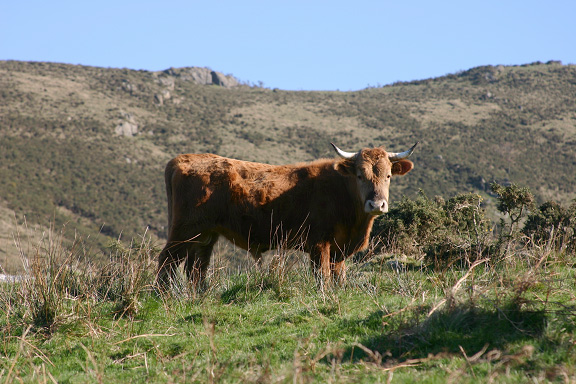
View on Wikipedia Bull on the slopes of Xoldokogaina | |
| Conservation status | |
|---|---|
| Other names | Betizuak[4]: 130 |
| Country of origin |
|
| Distribution | |
| Standard | Gobierno de Navarra (in Spanish) |
| Use | |
| Traits | |
| Weight |
|
| Height | |
| Skin colour | creamy white[5]: 61 |
| Coat | russet brown |
| Horn status | horned |
| |
The Betizu is a breed of small mountain cattle which live in a semi-feral state in some mountainous parts of the Basque Country in both Spain and France. It is classified as an endangered breed by both the Ministerio de Agricultura, Pesca y Alimentación, the agriculture ministry of Spain,[6][7] and by the Conservatoire des Races d'Aquitaine in France.[8]
It is one of a small number of semi-feral cattle populations in Europe, with the Albera of the Pyrenees, the Monchina of Cantabria, and the Raço di Biòu of the Camargue.[9]
History
[edit]The origins of the Betizu are unknown. The name betizu derives from the Basque: behi izua, 'elusive cow', and distinguishes it from the etxebehi or 'house cow'.[5]: 59 [10] It appears in Basque mythology as Zezengorri ('red bull'), guardian of the treasure of the goddess Mari.[11]
The Betizu is sometimes believed to be the remnant of an ancient Pyrenean cattle population adapted to survive in marginal mountain terrain;[5]: 60 or it may derive from animals lost or escaped during the annual transhumance.[4]: 130
In the twenty-first century it is an endangered breed, and in Navarre was listed as such in 2003. At about the same time the Government of Navarre established a conservation herd at the finca of Sastoia in Urraúl Alto, in the comarca of Lumbier; management of the herd was later handed over to the Instituto Navarro de Tecnologías e Infraestructuras Agroalimentarias.[12]
In 2013, the breed population in Navarre was estimated at 254,[13] while the number in Aquitaine was put at less than 150.[8] In 2023 a total of 1267 head was reported from Spain, including 688 cows and 50 bulls registered in the herd-book, distributed over 41 herds;[3] for France a population of 80–100 head was reported.[2] The conservation status for Spain was listed as "at risk/endangered", while for France it was "at risk/critical".[3][2]
References
[edit]
- ^ a b Barbara Rischkowsky, Dafydd Pilling (editors) (2007). List of breeds documented in the Global Databank for Animal Genetic Resources, annex to The State of the World's Animal Genetic Resources for Food and Agriculture. Rome: Commission on Genetic Resources for Food and Agriculture, Food and Agriculture Organization of the United Nations. ISBN 9789251057629. Archived 23 June 2020.
- ^ a b c Breed data sheet: Betizu / France (Cattle). Domestic Animal Diversity Information System of the Food and Agriculture Organization of the United Nations. Accessed November 2024.
- ^ a b c Breed data sheet: Betizu / Spain (Cattle). Domestic Animal Diversity Information System of the Food and Agriculture Organization of the United Nations. Accessed November 2024.
- ^ a b c d Valerie Porter, Lawrence Alderson, Stephen J.G. Hall, D. Phillip Sponenberg (2016). Mason's World Encyclopedia of Livestock Breeds and Breeding (sixth edition). Wallingford: CABI. ISBN 9781780647944.
- ^ a b c Miguel Fernández Rodríguez, Mariano Gómez Fernández, Juan Vicente Delgado Bermejo, Silvia Adán Belmonte, Miguel Jiménez Cabras (editors) (2009). Guía de campo de las razas autóctonas españolas (in Spanish). Madrid: Ministerio de Medio Ambiente y Medio Rural y Marino. ISBN 9788449109461.
- ^ Raza bovina Betizu: Datos Generales (in Spanish). Ministerio de Agricultura, Pesca y Alimentación. Accessed June 2019.
- ^ Loyola de Palacio del Valle-Lersundi (7 November 1997). Real Decreto 1682/1997, de 7 de noviembre, por el que se actualiza el Catálogo Oficial de Razas de Ganado de España (in Spanish). Boletín Oficial del Estado 279 (21 November 1997): 34205–34207. Reference: BOE-A-1997-24860. European Legislation Identifier: permalink.
- ^ a b La Vache Betizu: Présentation (in French). Merignac: Conservatoire des Races d'Aquitaine. Archived 15 July 2024.
- ^ Marleen Felius (1995). Cattle Breeds: An Encyclopedia. Doetinchem, Netherlands: Misset. ISBN 9789054390176.
- ^ Betizu (in Spanish). Euskal Abereak. Archived 31 August 2013.
- ^ Mikel Muez (7 January 2006). Las últimas vacas salvajes de Europa (in Spanish). El País. Archived 19 July 2012.
- ^ [s.n.] (23 March 2018).El Gobierno de Navarra desarrolla un proyecto para comercializar la carne de raza autóctona vacuna "Betizu" (in Spanish). Gobierno de Navarra – Nafarroako Gobernua. Archived 14 June 2019.
- ^ Betizu (in Spanish). Villava: Instituto Navarro de Tecnologías e Infraestructuras Agroalimentarias. Archived 1 January 2015.