Hubbry Logo
search
logo

Biconjugate gradient method

logo
Community Hub0 Subscribers
Read side by side
from Wikipedia

In mathematics, more specifically in numerical linear algebra, the biconjugate gradient method is an algorithm to solve systems of linear equations

Unlike the conjugate gradient method, this algorithm does not require the matrix to be self-adjoint, but instead one needs to perform multiplications by the conjugate transpose A*.

The Algorithm

[edit]
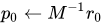
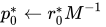
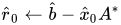
  1. Choose initial guess , two other vectors and and a preconditioner
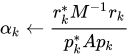
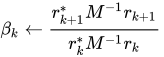
  2. for do

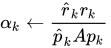
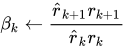
In the above formulation, the computed and satisfy

and thus are the respective residuals corresponding to and , as approximate solutions to the systems

is the adjoint, and is the complex conjugate.

Unpreconditioned version of the algorithm

[edit]
  1. Choose initial guess ,
  2. for do

Discussion

[edit]

The biconjugate gradient method is numerically unstable[citation needed] (compare to the biconjugate gradient stabilized method), but very important from a theoretical point of view. Define the iteration steps by


where using the related projection

with

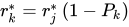
These related projections may be iterated themselves as

A relation to Quasi-Newton methods is given by and , where


The new directions

are then orthogonal to the residuals:

which themselves satisfy

where .

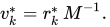
The biconjugate gradient method now makes a special choice and uses the setting
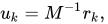
With this particular choice, explicit evaluations of and A−1 are avoided, and the algorithm takes the form stated above.

Properties

[edit]
  • If is self-adjoint, and , then , , and the conjugate gradient method produces the same sequence at half the computational cost.
  • The sequences produced by the algorithm are biorthogonal, i.e., for .
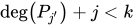
  • if is a polynomial with , then . The algorithm thus produces projections onto the Krylov subspace.

  • if is a polynomial with , then .

See also

[edit]

References

[edit]
Revisions and contributorsEdit on WikipediaRead on Wikipedia
from Grokipedia
The biconjugate gradient method (BiCG) is an iterative Krylov subspace algorithm in numerical linear algebra designed to solve large-scale systems of linear equations Ax=bAx = b, where AA is a large, sparse, and nonsymmetric matrix.[1] Introduced by Roland Fletcher in 1976 as an extension of the conjugate gradient method to handle indefinite and nonsymmetric systems, BiCG generates successive approximations to the solution by projecting the residual onto two biorthogonal sequences of vectors—one generated in the Krylov subspace associated with AA and the other with its transpose ATA^T.[2] The method relies on short-term recurrences to update residuals and search directions, minimizing storage requirements to a small number of vectors while avoiding explicit matrix factorizations.[1] BiCG builds on earlier work in conjugate direction methods and the Lanczos process for tridiagonalization, adapting these to nonsymmetric cases through a Petrov-Galerkin projection framework.[1] In exact arithmetic, the residuals satisfy biorthogonality conditions (ri,r^j)=0(r_i, \hat{r}_j) = 0 for iji \neq j, where r^\hat{r} denotes the residual sequence from the dual system ATr^0=b^A^T \hat{r}_0 = \hat{b}, typically with r^0=r0\hat{r}_0 = r_0.[1] The algorithm proceeds by solving a sequence of tridiagonal systems derived from the projected problem, enabling efficient computation via matrix-vector multiplications with both AA and ATA^T.[2] When AA is symmetric positive definite, BiCG reduces to the standard conjugate gradient method, demonstrating its generality.[1] Key to BiCG's operation is its three-term recurrence relations for updating the solution xmx_m, residuals rmr_m, and directions pmp_m, which keep the computational cost per iteration at approximately two matrix-vector products and a few inner products.[1] Convergence theory for BiCG is less developed than for symmetric cases due to the nonsymmetry, but superlinear convergence can occur when eigenvalues cluster, though it is not guaranteed and depends on the spectral properties of AA.[3] The method has been widely applied in fields such as computational fluid dynamics, electromagnetics, and structural analysis for solving discretized partial differential equations, where nonsymmetric coefficient matrices arise naturally.[1] Despite its efficiency, BiCG is prone to numerical breakdowns when recurrence coefficients vanish or near-zero pivots occur during the implicit tridiagonalization, leading to potential instability in finite precision.[1] Residual histories often exhibit irregular, nonsmooth behavior, sometimes stagnating or oscillating before converging.[3] To mitigate these issues, preconditioning techniques—such as incomplete LU factorization—are commonly incorporated, and variants like biconjugate gradient stabilized (BiCGSTAB) have been developed to smooth convergence without sacrificing the short recurrences.[1] Overall, BiCG remains a foundational tool in the arsenal of iterative solvers for nonsymmetric problems, valued for its simplicity and low memory footprint in parallel computing environments.[1]

Introduction

Overview

The biconjugate gradient method (BiCG) is an iterative Krylov subspace algorithm designed for solving large-scale, sparse systems of non-symmetric linear equations of the form $ Ax = b $, where the coefficient matrix $ A $ is not Hermitian.[1] Introduced as a generalization of the conjugate gradient (CG) method, BiCG extends CG's efficient framework—originally effective only for symmetric positive definite systems—to handle non-symmetric cases prevalent in applications like fluid dynamics and electromagnetics.[2] By operating within expanding Krylov subspaces, it approximates the solution iteratively without computing a full matrix factorization, making it particularly valuable for problems where direct solvers are computationally prohibitive.[1] At its core, BiCG employs a biorthogonalization process that generates two coupled sequences of residual vectors: one for the original system and a shadow sequence for the transpose $ A^T $.[1] This dual mechanism ensures that the residuals remain orthogonal with respect to each other across iterations, enabling short three-term recurrences to update the solution and maintain computational efficiency.[2] Unlike methods relying on longer recurrences, such as GMRES, BiCG's approach leverages matrix-vector products with both $ A $ and $ A^T $ to construct conjugate directions that minimize the residual in a Petrov-Galerkin sense.[1] The primary motivation for BiCG stems from the need to overcome CG's restriction to Hermitian matrices, providing a robust tool for ill-conditioned, non-symmetric problems while preserving much of CG's elegance and speed.[2] Key advantages include its modest storage requirements—typically just a few vectors per iteration—and suitability for parallel computing environments, rendering it more memory-efficient than direct methods or storage-intensive Krylov alternatives.[1] These features have established BiCG as a foundational method in numerical linear algebra, often serving as the basis for stabilized variants in practical implementations.[1]

Historical development

The biconjugate gradient (BiCG) method was introduced in 1976 by Roland Fletcher as an extension of the conjugate gradient method to address indefinite systems, including nonsymmetric linear systems arising in various applications.[2] This development aimed to generalize the efficient Krylov subspace iteration of the conjugate gradient for symmetric positive-definite matrices to broader, nonsymmetric contexts.[1] Fletcher's foundational work appeared in the paper "Conjugate gradient methods for indefinite systems," published in Numerical Analysis (Lecture Notes in Mathematics, vol. 506, pp. 73–89) by Springer.[2] The method's core idea involved generating two coupled sequences of residuals—one from the original system and one from its transpose—to maintain orthogonality properties analogous to those in the conjugate gradient algorithm.[2] The BiCG method traces its conceptual roots to earlier iterative techniques for eigenvalue problems, including the Lanczos algorithm, developed by Cornelius Lanczos in 1950 for tridiagonalizing symmetric matrices, and the Arnoldi process, introduced by W. E. Arnoldi in 1951 as a generalization to non-symmetric matrices. Early adoption highlighted numerical instabilities in BiCG due to potential breakdowns in the orthogonalization process, which spurred refinements in the 1990s, notably the BiCGSTAB variant proposed by Henk A. van der Vorst in 1992 for improved stability and convergence in nonsymmetric systems.[4]

Mathematical background

Non-symmetric linear systems

The biconjugate gradient method is formulated to solve non-symmetric linear systems of equations expressed as
Ax=b, Ax = b,
where ACn×nA \in \mathbb{C}^{n \times n} (or Rn×n\mathbb{R}^{n \times n}) is a square matrix that is generally non-Hermitian, satisfying AAHA \neq A^H with AHA^H denoting the conjugate transpose, bCnb \in \mathbb{C}^n (or Rn\mathbb{R}^n) is the given right-hand side vector, and xCnx \in \mathbb{C}^n (or Rn\mathbb{R}^n) is the unknown solution vector.[1]
Non-symmetry introduces significant challenges, as AA offers no guarantee of positive definiteness and may possess complex eigenvalues, complicating convergence analysis and potentially leading to slower or erratic iteration progress in solvers.[1] Furthermore, algorithms tailored for symmetric matrices, such as the conjugate gradient method, cannot be directly applied, as they depend on symmetry (A=ATA = A^T over reals) or positive definiteness to ensure finite termination and monotonic residual reduction, often resulting in breakdown otherwise.[1] In iterative approaches, the residual vector at the kk-th iteration is defined as rk=bAxkr_k = b - A x_k, providing a measure of approximation accuracy independent of the true solution.[1] For large nn, such as n>104n > 10^4, direct solvers like LU decomposition become impractical due to their O(n3)O(n^3) arithmetic complexity and O(n2)O(n^2) storage demands, exacerbated by fill-in that can eliminate the benefits of sparsity in AA.[1] Iterative methods like the biconjugate gradient are thus essential, offering per-iteration costs of O(n)O(n) while exploiting matrix sparsity; they seek solutions within expanding Krylov subspaces generated from powers of AA applied to initial residuals.[1]

Krylov subspace methods

Krylov subspace methods form the theoretical foundation for iterative solvers like the biconjugate gradient (BiCG) method, particularly for large-scale non-symmetric linear systems. These methods generate successive approximations to the solution by projecting the problem onto a sequence of low-dimensional subspaces that capture the essential behavior of the matrix-vector interactions. The core idea is to build the solution incrementally within a Krylov subspace, which is defined for a matrix ARn×nA \in \mathbb{R}^{n \times n} and an initial residual vector r0Rnr_0 \in \mathbb{R}^n as the span of the vectors obtained by successive applications of AA:
Kk(A,r0)=span{r0,Ar0,A2r0,,Ak1r0}. \mathcal{K}_k(A, r_0) = \operatorname{span}\{r_0, A r_0, A^2 r_0, \dots, A^{k-1} r_0\}.
This subspace, introduced by Krylov in 1931 for polynomial approximation, grows with each iteration and provides a natural space for minimizing residuals or satisfying orthogonality conditions without requiring the full eigendecomposition of AA.[5] For the biconjugate gradient method, which addresses non-symmetric systems, the framework extends to a dual Krylov subspace to handle the lack of symmetry in AA. A shadow residual r^0\hat{r}_0 is introduced, often initialized as r^0=r0\hat{r}_0 = r_0 for simplicity, generating the dual subspace Kk(AH,r^0)=span{r^0,AHr^0,(AH)2r^0,,(AH)k1r^0}\mathcal{K}_k(A^H, \hat{r}_0) = \operatorname{span}\{\hat{r}_0, A^H \hat{r}_0, (A^H)^2 \hat{r}_0, \dots, (A^H)^{k-1} \hat{r}_0\}. This dual structure, rooted in Lanczos' biorthogonalization process for non-Hermitian matrices, enables biconjugate orthogonality: the primal residuals rkr_k are orthogonal to the dual subspace, i.e., (r^i,rj)=0(\hat{r}_i, r_j) = 0 for iji \neq j, and vice versa, ensuring linear independence and short recurrences in the algorithm.[6][5] The general iterative projection in these methods seeks an approximate solution xk=x0+Vkykx_k = x_0 + V_k y_k, where VkV_k is a basis matrix whose columns span Kk(A,r0)\mathcal{K}_k(A, r_0) and yky_k is chosen to minimize the residual error or enforce a Galerkin condition with respect to the dual space. This projection reduces the original nn-dimensional problem to a smaller k×kk \times k system in the subspace, promoting efficiency for sparse matrices. In the BiCG context, the search directions pkp_k and dual directions p^k\hat{p}_k satisfy biconjugacy conditions: specifically, (p^i,Apj)=0(\hat{p}_i, A p_j) = 0 for iji \neq j, maintaining conjugacy and facilitating residual updates.[7][2]

Algorithm

Unpreconditioned BiCG

The biconjugate gradient (BiCG) method is an iterative Krylov subspace algorithm designed to solve large, sparse, non-symmetric linear systems of the form $ Ax = b $, where $ A $ is an $ n \times n $ matrix, $ x $ and $ b $ are vectors in $ \mathbb{R}^n $, and no preconditioning is applied.[2] Developed as an extension of the conjugate gradient method to indefinite and non-symmetric systems, it generates two sequences of residuals and search directions that satisfy bi-orthogonality conditions with respect to the Krylov subspaces generated by $ A $ and $ A^T $.[2] The algorithm begins with initialization. An initial approximation $ x_0 $ is chosen, often $ x_0 = 0 $. The initial residual is computed as $ r_0 = b - A x_0 $. An arbitrary shadow residual $ \bar{r}_0 $ is selected, typically $ \bar{r}_0 = r_0 $ for simplicity, ensuring $ \bar{r}_0^T r_0 \neq 0 $. The initial search directions are set to $ p_0 = r_0 $ and $ \bar{p}_0 = \bar{r}_0 $.[2] The iteration proceeds for $ k = 0, 1, 2, \dots $ until a stopping criterion is met. First, the step length is calculated as
αk=rˉkTrkpˉkTApk. \alpha_k = \frac{\bar{r}_k^T r_k}{\bar{p}_k^T A p_k}.
The approximation and residual are updated via
xk+1=xk+αkpk,rk+1=rkαkApk. x_{k+1} = x_k + \alpha_k p_k, \quad r_{k+1} = r_k - \alpha_k A p_k.
The shadow residual is updated as
rˉk+1=rˉkαkATpˉk. \bar{r}_{k+1} = \bar{r}_k - \alpha_k A^T \bar{p}_k.
The recurrence coefficient is then
βk=rˉk+1Trk+1rˉkTrk, \beta_k = \frac{\bar{r}_{k+1}^T r_{k+1}}{\bar{r}_k^T r_k},
followed by updates to the search directions:
pk+1=rk+1+βkpk,pˉk+1=rˉk+1+βkpˉk. p_{k+1} = r_{k+1} + \beta_k p_k, \quad \bar{p}_{k+1} = \bar{r}_{k+1} + \beta_k \bar{p}_k.
These steps ensure that the residuals remain bi-orthogonal to the shadow directions and vice versa.[2] The following pseudocode summarizes the unpreconditioned BiCG algorithm:
Input: A, b, x_0, tol, max_iter
Output: x (approximate solution)

r_0 ← b - A x_0
Choose \bar{r}_0 (e.g., \bar{r}_0 ← r_0)
p_0 ← r_0
\bar{p}_0 ← \bar{r}_0
k ← 0

while ||r_k|| > tol ||b|| and k < max_iter do
    α_k ← (\bar{r}_k^T r_k) / (\bar{p}_k^T A p_k)
    x_{k+1} ← x_k + α_k p_k
    r_{k+1} ← r_k - α_k A p_k
    \bar{r}_{k+1} ← \bar{r}_k - α_k A^T \bar{p}_k
    β_k ← (\bar{r}_{k+1}^T r_{k+1}) / (\bar{r}_k^T r_k)
    p_{k+1} ← r_{k+1} + β_k p_k
    \bar{p}_{k+1} ← \bar{r}_{k+1} + β_k \bar{p}_k
    k ← k + 1
end while

return x_k
Convergence is typically monitored using the relative residual norm $ |r_k| / |b| < \tol $, where $ \tol $ is a user-specified tolerance (e.g., $ 10^{-6} $), or by reaching a maximum number of iterations $ \max_iter $ to prevent infinite loops. The method requires two matrix-vector products per iteration—one with $ A $ and one with $ A^T $—and is exact in at most $ n $ steps for an $ n \times n $ matrix in exact arithmetic.[2]

Preconditioned BiCG

Preconditioning enhances the biconjugate gradient (BiCG) method by incorporating an approximate inverse matrix MM that approximates AA, transforming the original system Ax=bAx = b into a form with improved spectral properties, such as a reduced condition number, to accelerate convergence for ill-conditioned nonsymmetric systems.[1] The preconditioner MM is typically nonsymmetric and positive definite, allowing solves of the form Mz=rMz = r (and MTz~=r~M^T \tilde{z} = \tilde{r} for the shadow residual sequence) at each iteration instead of direct residual computations, which clusters eigenvalues near unity and mitigates slow convergence in the unpreconditioned case.[8] This approach is particularly effective for sparse matrices arising in engineering applications, where direct factorization is prohibitive due to computational cost.[1] Two primary preconditioning strategies are employed: left preconditioning, which modifies the system to M1Ax=M1bM^{-1}Ax = M^{-1}b and applies the preconditioner to residuals and search directions, and right preconditioning, which solves AM1y=bA M^{-1} y = b with x=M1yx = M^{-1} y, preserving certain residual norms but altering the search space.[8] In left-preconditioned BiCG, the residual update becomes zk=M1rkz_k = M^{-1} r_k and the shadow residual update z~k=(MT)1r~k\tilde{z}_k = (M^T)^{-1} \tilde{r}_k, ensuring biorthogonality in the preconditioned inner products; the step size αk\alpha_k is then computed as αk=z~kTrkz~kTAzk\alpha_k = \frac{\tilde{z}_k^T r_k}{\tilde{z}_k^T A z_k} (with simplified notation omitting explicit MTM^{-T}), and direction vectors are updated accordingly to maintain short recurrences.[8] Right preconditioning similarly adjusts the matrix-vector products to AM1pkA M^{-1} p_k, but requires solving for the final iterate via M1M^{-1}; both variants demand approximately two preconditioner solves per iteration, doubling the cost compared to unpreconditioned BiCG but often reducing total iterations substantially.[1] Common preconditioners for BiCG include incomplete LU (ILU) factorization, which approximates A=LUA = L U with sparsity constraints to yield triangular factors for efficient forward and back substitution solves, and diagonal scaling, where MM is the inverse of the diagonal of AA for simple normalization of rows and columns.[8] Selection of MM depends on the matrix structure: ILU suits banded or sparse nonsymmetric AA by controlling fill-in levels (e.g., ILU(0) drops all nonzeros outside the original sparsity pattern), while diagonal preconditioners are computationally cheap but less effective for highly indefinite systems; more advanced choices like SSOR may be used when symmetry is partial.[1] The choice balances setup cost (e.g., factorization time) against per-iteration solve efficiency, with ILU often preferred for its robustness in practice.[8] The pseudocode for left-preconditioned BiCG is as follows:[8]
Compute r(0) = b - A x(0) for some initial guess x(0)
Choose \tilde{r}(0) (e.g., \tilde{r}(0) = r(0))
for i = 1, 2, ...
    Solve M z(i-1) = r(i-1)
    Solve M^T \tilde{z}(i-1) = \tilde{r}(i-1)
    ρ(i-1) = z(i-1)^T \tilde{r}(i-1)
    if ρ(i-1) = 0, method fails
    if i = 1
        p(i) = z(i-1)
        \tilde{p}(i) = \tilde{z}(i-1)
    else
        β(i-1) = ρ(i-1) / ρ(i-2)
        p(i) = z(i-1) + β(i-1) p(i-1)
        \tilde{p}(i) = \tilde{z}(i-1) + β(i-1) \tilde{p}(i-1)
    end if
    q(i) = A p(i)
    \tilde{q}(i) = A^T \tilde{p}(i)
    α(i) = ρ(i-1) / (\tilde{p}(i)^T q(i))
    x(i) = x(i-1) + α(i) p(i)
    r(i) = r(i-1) - α(i) q(i)
    \tilde{r}(i) = \tilde{r}(i-1) - α(i) \tilde{q}(i)
    check convergence; continue if necessary
end for

Properties

Convergence behavior

The biconjugate gradient (BiCG) method achieves convergence in exact arithmetic through the construction of biorthogonal bases spanning the primal Krylov subspace Kk(A,r0)=span{r0,Ar0,,Ak1r0}\mathcal{K}_k(A, r_0) = \operatorname{span}\{r_0, A r_0, \dots, A^{k-1} r_0\} and the dual Krylov subspace Lk(AT,r^0)=span{r^0,ATr^0,,(AT)k1r^0}\mathcal{L}_k(A^T, \hat{r}_0) = \operatorname{span}\{\hat{r}_0, A^T \hat{r}_0, \dots, (A^T)^{k-1} \hat{r}_0\}, where r0=bAx0r_0 = b - A x_0 is the initial residual and r^0\hat{r}_0 is a shadow residual often chosen as r0r_0. This process implicitly solves both the original system Ax=bA x = b and the dual system ATx^=b^A^T \hat{x} = \hat{b}, leading to a residual that is orthogonal to the dual subspace. In this setting, the method exhibits superlinear convergence when the eigenvalues of AA cluster, as the polynomial approximations improve rapidly over favorable spectral distributions.[1] A characterization of the residual reduction arises from the underlying Lanczos biorthogonalization, yielding the bound rk2=δk+1ekTykvk+12\|r_k\|_2 = |\delta_{k+1} e_k^T y_k| \|v_{k+1}\|_2, where δk+1\delta_{k+1} is the subdiagonal entry from the dual tridiagonal matrix, eke_k is the vector of ones, yky_k solves a small tridiagonal system, and vk+1v_{k+1} is the next Lanczos vector; this reflects the projection properties but does not provide a monotonic decrease. More generally, as a Petrov-Galerkin projection method, the residual satisfies orthogonality constraints from the dual subspace.[1][2] Convergence strongly depends on the eigenvalue distribution and non-normality of AA: it accelerates for clustered real eigenvalues but slows for widely spread or complex spectra, where non-normality amplifies irregular behavior without the monotonicity seen in CG. Unlike CG, residual norms in BiCG do not decrease monotonically, often exhibiting jagged patterns due to the dual subspace dynamics.[1] Empirically, BiCG requires up to nn iterations in the worst case for an n×nn \times n matrix in exact arithmetic, as the biorthogonal subspaces reach full dimension, but practical termination occurs in far fewer steps (n\ll n) for sparse matrices arising in applications. For instance, on the F2DA matrix (n=1024n=1024), convergence to a relative residual of 0.17×1030.17 \times 10^{-3} took 163 iterations, while for the ORS matrix (n=1030n=1030), 301 iterations sufficed for 0.50×1010.50 \times 10^{-1}. Preconditioned BiCG can further reduce iteration counts by improving spectral clustering.[1]

Numerical stability

The biconjugate gradient (BiCG) method exhibits irregular residual behavior in finite-precision arithmetic, where the norm of the residual vector rk\|\mathbf{r}_k\| may temporarily increase even as the approximate solution improves, owing to the non-monotonic convergence properties inherent in the algorithm. This erratic pattern can manifest as stagnation, peaks, or plateaus in the residual history, complicating the monitoring of progress and the selection of reliable stopping criteria. Such behavior arises from the coupled evolution of the primal and dual residual sequences, which do not guarantee monotonic decrease in practice.[1] A primary numerical challenge in BiCG is the occurrence of breakdowns, which happen when the inner product rˉkTrk=0\bar{\mathbf{r}}_k^T \mathbf{r}_k = 0 before convergence is achieved, rendering subsequent steps undefined. These breakdowns are detected through near-zero values in the denominators of the step-size parameter αk=rˉk1Trk1pˉk1TApk1\alpha_k = \frac{\bar{\mathbf{r}}_{k-1}^T \mathbf{r}_{k-1}}{\bar{\mathbf{p}}_{k-1}^T A \mathbf{p}_{k-1}} or the recurrence coefficient βk=rˉkTrkrˉk1Trk1\beta_k = \frac{\bar{\mathbf{r}}_k^T \mathbf{r}_k}{\bar{\mathbf{r}}_{k-1}^T \mathbf{r}_{k-1}}, signaling a failure in the biorthogonalization process underlying the method. Serious breakdowns may halt computation entirely, while "lucky" breakdowns occasionally coincide with an exact solution, though this is rare.[1] Round-off errors pose significant risks in BiCG implementations, particularly accumulating in the shadow (dual) residuals rˉk\bar{\mathbf{r}}_k, which are not directly updated via matrix-vector products but through recursive formulas sensitive to floating-point inaccuracies. This accumulation can lead to instability, exacerbated by factors such as polynomial squaring in the underlying Lanczos process or negative inner products induced by perturbation. The method's storage demands further compound practical concerns, requiring approximately four vectors of length nn (for rk\mathbf{r}_k, pk\mathbf{p}_k, rˉk\bar{\mathbf{r}}_k, and pˉk\bar{\mathbf{p}}_k) in addition to temporary workspace, resulting in O(n)O(n) memory usage that doubles the footprint compared to single-sequence Krylov methods.[1] To mitigate these stability issues, common strategies include restarting the algorithm upon detecting near-breakdowns or stagnation, which resets the Krylov subspaces while retaining the current approximate solution to resume iteration. Employing robust inner product computations, such as those avoiding explicit polynomial evaluations, or dynamically scaling vectors can reduce round-off sensitivity in shadow residuals. In severe cases, switching to stabilized variants like BiCGSTAB is recommended, though this alters the method's core structure. These approaches enhance reliability without fundamentally resolving BiCG's inherent instabilities.[1]

Variants

BiCGSTAB

BiCGSTAB, introduced by H.A. van der Vorst in 1992, is a stabilized variant of the biconjugate gradient method that addresses the irregular and sometimes erratic convergence observed in the standard BiCG algorithm for nonsymmetric linear systems.[4] This method achieves smoother convergence by employing polynomial approximations to minimize the residual over short recurrences, effectively reducing the irregularity in residual histories without significantly increasing computational overhead.[4] A key modification in BiCGSTAB lies in replacing the full β_k update from BiCG with a two-step process that computes an intermediate residual sk=rkαkAp^ks_k = r_k - \alpha_k A \hat{p}_k and a damping parameter ω_k through projections using the fixed shadow residual r^\hat{r} (typically r^0=r0\hat{r}_0 = r_0).[4] [1] This stabilization helps mitigate the sensitivity to the choice of shadow residuals in BiCG, leading to more predictable iteration behavior.[4] The step size αk\alpha_k is computed as αk=r^Trkr^T(Ap^k)\alpha_k = \frac{\hat{r}^T r_k}{\hat{r}^T (A \hat{p}_k)}. The core iterations of BiCGSTAB introduce an auxiliary search direction defined as
p^k=rk+β(pk1+ωk1vk1), \hat{p}_k = r_k + \beta (p_{k-1} + \omega_{k-1} v_{k-1}),
followed by the computation of
vk=Ap^k. v_k = A \hat{p}_k.
[4] After updating the residual to the intermediate sk=rkαkvks_k = r_k - \alpha_k v_k and tk=Askt_k = A s_k, the damping parameter is determined via
ωk=r^Tskr^Ttk. \omega_k = \frac{\hat{r}^T s_k}{\hat{r}^T t_k}.
[4] [1] These steps approximate a quadratic residual minimization at each iteration, contributing to the method's enhanced smoothness.[4]
Compared to BiCG, BiCGSTAB exhibits less oscillatory residual norms, which improves reliability for solving indefinite and strongly nonsymmetric systems, while requiring only about 1.5 times the matrix-vector multiplications per iteration but with comparable overall cost in practice.[4]

QMR

The quasi-minimal residual (QMR) method is a variant of the biconjugate gradient (BiCG) algorithm designed for solving large, sparse, non-Hermitian linear systems Ax=bAx = b, where AA is a nonsymmetric matrix. Developed by Roland W. Freund and Noel M. Nachtigal in 1991, QMR addresses the irregular convergence and numerical instability issues observed in the standard BiCG method by incorporating a quasi-minimal residual property over nested Krylov subspaces.[9] Unlike BiCG, which generates iterates that minimize residuals in a semi-inner product induced by the dual system, QMR employs a pair of coupled Lanczos processes—one primal and one dual—to construct tridiagonal approximations to the projected operator, ensuring smoother convergence behavior.[9] At its core, QMR builds an upper block Hessenberg matrix HkH_k from the biconjugate Lanczos vectors generated in the primal and dual Krylov subspaces, spanning Kk(A,r0)\mathcal{K}_k(A, r_0) and Kk(AT,s0)\mathcal{K}_k(A^T, s_0) respectively, where r0=bAx0r_0 = b - A x_0 and s0s_0 is a shadow residual. This matrix representation allows the method to project the original system onto a lower-dimensional space, where an approximate solution is obtained by solving a least-squares problem that minimizes the norm of the residual in this projected setting: specifically, minzβe1Hkz\min_z \| \beta e_1 - H_k z \|, with β=r0\beta = \| r_0 \| and e1e_1 the first unit vector. The resulting iterate xk=x0+Ykzkx_k = x_0 + Y_k z_k, where YkY_k collects the primal Lanczos basis vectors, yields a residual whose norm is quasi-minimal, providing an upper bound tighter than that of BiCG.[9] To handle potential breakdowns in the Lanczos processes—such as loss of biorthogonality—QMR incorporates look-ahead steps during iterations, which extend the recurrence relations over multiple steps to skip problematic vectors while maintaining short-term recurrences for efficiency. This mechanism detects and resolves near-breakdowns by computing additional Lanczos vectors and adjusting the block structure accordingly, ensuring robustness without resorting to full reorthogonalization. The effective residual at step kk, denoted ϕk\| \phi_k \|, arises from the projected system and serves as a reliable estimate for monitoring convergence, often correlating well with the true residual norm rk\| r_k \|. Compared to BiCG, QMR exhibits superior numerical stability due to its avoidance of irregular residual oscillations, though it incurs higher computational cost from the orthogonalization required in the least-squares solve, typically via QR factorization, making it suitable for problems where reliability outweighs moderate efficiency losses.[9]

Applications

Engineering problems

The biconjugate gradient (BiCG) method is extensively applied in engineering domains involving non-symmetric linear systems derived from discretized governing equations, where its ability to handle indefinite and ill-conditioned matrices provides computational efficiency for large-scale problems. In fluid dynamics, BiCG is utilized to solve the discretized Navier-Stokes equations in computational fluid dynamics (CFD) simulations, particularly for incompressible and compressible flows where convection terms introduce non-symmetry. This makes it suitable for tackling systems arising from meshes with on the order of 10610^6 grid points, enabling simulations of complex phenomena like turbulent flows in engineering designs such as aircraft wings or pipelines. For instance, variants of BiCG have been implemented in implicit solvers for three-dimensional compressible Navier-Stokes equations, demonstrating robust performance in transonic and supersonic regimes.[10][11] In electromagnetics, the method addresses time-harmonic formulations of Maxwell's equations, resulting in complex non-Hermitian matrices due to the frequency-domain representation. It is particularly valuable in antenna design and electromagnetic scattering analyses, where iterative solutions accelerate computations for electrically large structures without requiring matrix storage. A notable application involves BiCG combined with fast Fourier transform acceleration for solving volume integral equations in three-dimensional scattering problems by dielectric objects.[12][13] In structural analysis, BiCG is applied to non-symmetric stiffness matrices that emerge from damping mechanisms or gyroscopic effects in rotordynamics, common in rotating machinery like turbines and compressors. These systems often exhibit skew-symmetric components from rotational inertia, and BiCG's Krylov subspace approach facilitates efficient eigenvalue or steady-state solutions for vibration prediction. Preconditioned BiCG enhances convergence for ill-conditioned models in finite element simulations of rotor-bearing interactions.[14][15] A representative case study is its use in porous media flow simulations, such as modeling groundwater transport or oil reservoir dynamics, where discretized Darcy's law or coupled multiphase equations yield sparse non-symmetric systems.[16][17] Recent applications as of 2025 include extensions to quantum algorithms, such as the quantum bi-conjugate gradient method for solving linear systems in quantum computing frameworks.[18] BiCG also continues to be used in preconditioned iterative solvers for modern simulations of multiphase flows and other PDEs in heterogeneous media.[19]

Software implementations

The Portable, Extensible Toolkit for Scientific Computation (PETSc) provides an implementation of the biconjugate gradient (BiCG) method through its KSPBICG solver, which supports both unpreconditioned and preconditioned variants for solving nonsymmetric linear systems.[20] PETSc also includes stabilized variants like BiCGSTAB via KSPBCGS, enabling flexible integration in high-performance computing environments.[21] In Python, SciPy's sparse.linalg module offers the bicg function for BiCG iteration on sparse matrices, accepting linear operators for matrix-vector products and supporting tolerances for convergence control.[22] SciPy further provides bicgstab for the stabilized version, facilitating use in scientific workflows with NumPy arrays. For commercial software, MATLAB includes a built-in bicg function, which solves Ax = b using BiCG and allows specification of preconditioners like incomplete LU factorization for improved efficiency.[23] User-contributed implementations extend this to preconditioned BiCG variants, often leveraging MATLAB's sparse matrix support for engineering simulations.[24] Effective BiCG implementations emphasize vectorized operations for matrix-vector products to minimize overhead in iterative loops. Sparse matrix formats such as the compressed sparse row (CSR) are recommended for storage and computation, as they optimize memory access and enable efficient multiplication in libraries like SciPy and PETSc.[25] Integration with preconditioners, such as ILU(0), is a standard practice to accelerate convergence, particularly for ill-conditioned systems, and is natively supported in both PETSc and MATLAB. PETSc leverages MPI for parallelization across distributed-memory systems, distributing matrix operations and reducing communication in BiCG iterations to achieve scalability on clusters.[26] GPU acceleration of sparse matrix-vector multiplication (SpMV), a core kernel in BiCG, can provide performance improvements over CPU baselines for large sparse systems, as demonstrated in optimized implementations for variants like BiCGSTAB.[27]

References

User Avatar
No comments yet.