



Community hub
Recent from talks
Contribute something
Nothing was collected or created yet.
Lanczos algorithm
View on WikipediaThe Lanczos algorithm is an iterative method devised by Cornelius Lanczos that is an adaptation of power methods to find the "most useful" (tending towards extreme highest/lowest) eigenvalues and eigenvectors of an Hermitian matrix, where is often but not necessarily much smaller than .[1] Although computationally efficient in principle, the method as initially formulated was not useful, due to its numerical instability.


In 1970, Ojalvo and Newman showed how to make the method numerically stable and applied it to the solution of very large engineering structures subjected to dynamic loading.[2] This was achieved using a method for purifying the Lanczos vectors (i.e. by repeatedly reorthogonalizing each newly generated vector with all previously generated ones)[2] to any degree of accuracy, which when not performed, produced a series of vectors that were highly contaminated by those associated with the lowest natural frequencies.
In their original work, these authors also suggested how to select a starting vector (i.e. use a random-number generator to select each element of the starting vector) and suggested an empirically determined method for determining , the reduced number of vectors (i.e. it should be selected to be approximately 1.5 times the number of accurate eigenvalues desired). Soon thereafter their work was followed by Paige, who also provided an error analysis.[3][4] In 1988, Ojalvo produced a more detailed history of this algorithm and an efficient eigenvalue error test.[5]
The algorithm
[edit]- Input a Hermitian matrix of size , and optionally a number of iterations (as default, let ).
- Strictly speaking, the algorithm does not need access to the explicit matrix, but only a function that computes the product of the matrix by an arbitrary vector. This function is called at most times.
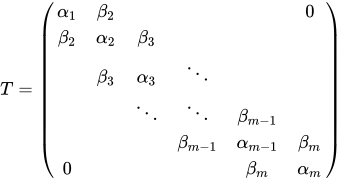
- Output an matrix with orthonormal columns and a tridiagonal real symmetric matrix of size . If , then is unitary, and .
- Warning The Lanczos iteration is prone to numerical instability. When executed in non-exact arithmetic, additional measures (as outlined in later sections) should be taken to ensure validity of the results.
- Let be an arbitrary vector with Euclidean norm .
- Abbreviated initial iteration step:
- Let .
- Let .
- Let .
- For do:
- Let (also Euclidean norm).
- If , then let ,
- else pick as an arbitrary vector with Euclidean norm that is orthogonal to all of .
- Let .
- Let .
- Let .
- Let be the matrix with columns . Let .
- Note for .



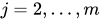






There are in principle four ways to write the iteration procedure. Paige and other works show that the above order of operations is the most numerically stable.[6][7] In practice the initial vector may be taken as another argument of the procedure, with and indicators of numerical imprecision being included as additional loop termination conditions.


Not counting the matrix–vector multiplication, each iteration does arithmetical operations. The matrix–vector multiplication can be done in arithmetical operations where is the average number of nonzero elements in a row. The total complexity is thus , or if ; the Lanczos algorithm can be very fast for sparse matrices. Schemes for improving numerical stability are typically judged against this high performance.


The vectors are called Lanczos vectors. The vector is not used after is computed, and the vector is not used after is computed. Hence one may use the same storage for all three. Likewise, if only the tridiagonal matrix is sought, then the raw iteration does not need after having computed , although some schemes for improving the numerical stability would need it later on. Sometimes the subsequent Lanczos vectors are recomputed from when needed.


Application to the eigenproblem
[edit]The Lanczos algorithm is most often brought up in the context of finding the eigenvalues and eigenvectors of a matrix, but whereas an ordinary diagonalization of a matrix would make eigenvectors and eigenvalues apparent from inspection, the same is not true for the tridiagonalization performed by the Lanczos algorithm; nontrivial additional steps are needed to compute even a single eigenvalue or eigenvector. Nonetheless, applying the Lanczos algorithm is often a significant step forward in computing the eigendecomposition.
If is an eigenvalue of , and its eigenvector (), then is a corresponding eigenvector of with the same eigenvalue:


Thus the Lanczos algorithm transforms the eigendecomposition problem for into the eigendecomposition problem for .
- For tridiagonal matrices, there exist a number of specialised algorithms, often with better computational complexity than general-purpose algorithms. For example, if is an tridiagonal symmetric matrix then:
- The continuant recursion allows computing the characteristic polynomial in operations, and evaluating it at a point in operations.
- The divide-and-conquer eigenvalue algorithm can be used to compute the entire eigendecomposition of in operations.
- The Fast Multipole Method[8] can compute all eigenvalues in just operations.
- Some general eigendecomposition algorithms, notably the QR algorithm, are known to converge faster for tridiagonal matrices than for general matrices. Asymptotic complexity of tridiagonal QR is just as for the divide-and-conquer algorithm (though the constant factor may be different); since the eigenvectors together have elements, this is asymptotically optimal.
- Even algorithms whose convergence rates are unaffected by unitary transformations, such as the power method and inverse iteration, may enjoy low-level performance benefits from being applied to the tridiagonal matrix rather than the original matrix . Since is very sparse with all nonzero elements in highly predictable positions, it permits compact storage with excellent performance vis-à-vis caching. Likewise, is a real matrix with all eigenvectors and eigenvalues real, whereas in general may have complex elements and eigenvectors, so real arithmetic is sufficient for finding the eigenvectors and eigenvalues of .
- If is very large, then reducing so that is of a manageable size will still allow finding the more extreme eigenvalues and eigenvectors of ; in the region, the Lanczos algorithm can be viewed as a lossy compression scheme for Hermitian matrices, that emphasises preserving the extreme eigenvalues.


The combination of good performance for sparse matrices and the ability to compute several (without computing all) eigenvalues are the main reasons for choosing to use the Lanczos algorithm.
Application to tridiagonalization
[edit]Though the eigenproblem is often the motivation for applying the Lanczos algorithm, the operation the algorithm primarily performs is tridiagonalization of a matrix, for which numerically stable Householder transformations have been favoured since the 1950s. During the 1960s the Lanczos algorithm was disregarded. Interest in it was rejuvenated by the Kaniel–Paige convergence theory and the development of methods to prevent numerical instability, but the Lanczos algorithm remains the alternative algorithm that one tries only if Householder is not satisfactory.[9]
Aspects in which the two algorithms differ include:
- Lanczos takes advantage of being a sparse matrix, whereas Householder does not, and will generate fill-in.
- Lanczos works throughout with the original matrix (and has no problem with it being known only implicitly), whereas raw Householder wants to modify the matrix during the computation (although that can be avoided).
- Each iteration of the Lanczos algorithm produces another column of the final transformation matrix , whereas an iteration of Householder produces another factor in a unitary factorisation of . Each factor is however determined by a single vector, so the storage requirements are the same for both algorithms, and can be computed in time.
- Householder is numerically stable, whereas raw Lanczos is not.
- Lanczos is highly parallel, with only points of synchronisation (the computations of and ). Householder is less parallel, having a sequence of scalar quantities computed that each depend on the previous quantity in the sequence.




Derivation of the algorithm
[edit]There are several lines of reasoning which lead to the Lanczos algorithm.
A more provident power method
[edit]The power method for finding the eigenvalue of largest magnitude and a corresponding eigenvector of a matrix is roughly
- Pick a random vector .
- For (until the direction of has converged) do:
- Let
- Let
- In the large limit, approaches the normed eigenvector corresponding to the largest magnitude eigenvalue.


A critique that can be raised against this method is that it is wasteful: it spends a lot of work (the matrix–vector products in step 2.1) extracting information from the matrix , but pays attention only to the very last result; implementations typically use the same variable for all the vectors , having each new iteration overwrite the results from the previous one. It may be desirable to instead keep all the intermediate results and organise the data.
One piece of information that trivially is available from the vectors is a chain of Krylov subspaces. One way of stating that without introducing sets into the algorithm is to claim that it computes
- a subset of a basis of such that for every and all





this is trivially satisfied by as long as is linearly independent of (and in the case that there is such a dependence then one may continue the sequence by picking as an arbitrary vector linearly independent of ). A basis containing the vectors is however likely to be numerically ill-conditioned, since this sequence of vectors is by design meant to converge to an eigenvector of . To avoid that, one can combine the power iteration with a Gram–Schmidt process, to instead produce an orthonormal basis of these Krylov subspaces.


- Pick a random vector of Euclidean norm . Let .
- For do:
- Let .
- For all let . (These are the coordinates of with respect to the basis vectors .)
- Let . (Cancel the component of that is in .)
- If then let and ,
- otherwise pick as an arbitrary vector of Euclidean norm that is orthogonal to all of .




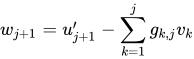






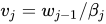
The relation between the power iteration vectors and the orthogonal vectors is that
- .

Here it may be observed that we do not actually need the vectors to compute these , because and therefore the difference between and is in , which is cancelled out by the orthogonalisation process. Thus the same basis for the chain of Krylov subspaces is computed by


- Pick a random vector of Euclidean norm .
- For do:
- Let .
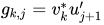
- For all let .
- Let .
- Let .
- If then let ,
- otherwise pick as an arbitrary vector of Euclidean norm that is orthogonal to all of .
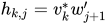
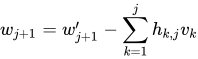



A priori the coefficients satisfy

- for all ;


the definition may seem a bit odd, but fits the general pattern since

Because the power iteration vectors that were eliminated from this recursion satisfy the vectors and coefficients contain enough information from that all of can be computed, so nothing was lost by switching vectors. (Indeed, it turns out that the data collected here give significantly better approximations of the largest eigenvalue than one gets from an equal number of iterations in the power method, although that is not necessarily obvious at this point.)


This last procedure is the Arnoldi iteration. The Lanczos algorithm then arises as the simplification one gets from eliminating calculation steps that turn out to be trivial when is Hermitian—in particular most of the coefficients turn out to be zero.
Elementarily, if is Hermitian then

For we know that , and since by construction is orthogonal to this subspace, this inner product must be zero. (This is essentially also the reason why sequences of orthogonal polynomials can always be given a three-term recurrence relation.) For one gets




since the latter is real on account of being the norm of a vector. For one gets


meaning this is real too.
More abstractly, if is the matrix with columns then the numbers can be identified as elements of the matrix , and for the matrix is upper Hessenberg. Since


the matrix is Hermitian. This implies that is also lower Hessenberg, so it must in fact be tridiagional. Being Hermitian, its main diagonal is real, and since its first subdiagonal is real by construction, the same is true for its first superdiagonal. Therefore, is a real, symmetric matrix—the matrix of the Lanczos algorithm specification.
Simultaneous approximation of extreme eigenvalues
[edit]One way of characterising the eigenvectors of a Hermitian matrix is as stationary points of the Rayleigh quotient

In particular, the largest eigenvalue is the global maximum of and the smallest eigenvalue is the global minimum of .


Within a low-dimensional subspace of it can be feasible to locate the maximum and minimum of . Repeating that for an increasing chain produces two sequences of vectors: and such that and





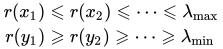
The question then arises how to choose the subspaces so that these sequences converge at optimal rate.
From , the optimal direction in which to seek larger values of is that of the gradient , and likewise from the optimal direction in which to seek smaller values of is that of the negative gradient . In general



so the directions of interest are easy enough to compute in matrix arithmetic, but if one wishes to improve on both and then there are two new directions to take into account: and since and can be linearly independent vectors (indeed, are close to orthogonal), one cannot in general expect and to be parallel. It is not necessary to increase the dimension of by on every step if are taken to be Krylov subspaces, because then for all thus in particular for both and .


In other words, we can start with some arbitrary initial vector construct the vector spaces


and then seek such that

Since the th power method iterate belongs to it follows that an iteration to produce the and cannot converge slower than that of the power method, and will achieve more by approximating both eigenvalue extremes. For the subproblem of optimising on some , it is convenient to have an orthonormal basis for this vector space. Thus we are again led to the problem of iteratively computing such a basis for the sequence of Krylov subspaces.


Convergence and other dynamics
[edit]When analysing the dynamics of the algorithm, it is convenient to take the eigenvalues and eigenvectors of as given, even though they are not explicitly known to the user. To fix notation, let be the eigenvalues (these are known to all be real, and thus possible to order) and let be an orthonormal set of eigenvectors such that for all .



It is also convenient to fix a notation for the coefficients of the initial Lanczos vector with respect to this eigenbasis; let for all , so that . A starting vector depleted of some eigencomponent will delay convergence to the corresponding eigenvalue, and even though this just comes out as a constant factor in the error bounds, depletion remains undesirable. One common technique for avoiding being consistently hit by it is to pick by first drawing the elements randomly according to the same normal distribution with mean and then rescale the vector to norm . Prior to the rescaling, this causes the coefficients to also be independent normally distributed stochastic variables from the same normal distribution (since the change of coordinates is unitary), and after rescaling the vector will have a uniform distribution on the unit sphere in . This makes it possible to bound the probability that for example .




The fact that the Lanczos algorithm is coordinate-agnostic – operations only look at inner products of vectors, never at individual elements of vectors – makes it easy to construct examples with known eigenstructure to run the algorithm on: make a diagonal matrix with the desired eigenvalues on the diagonal; as long as the starting vector has enough nonzero elements, the algorithm will output a general tridiagonal symmetric matrix as .
Kaniel–Paige convergence theory
[edit]After iteration steps of the Lanczos algorithm, is an real symmetric matrix, that similarly to the above has eigenvalues By convergence is primarily understood the convergence of to (and the symmetrical convergence of to ) as grows, and secondarily the convergence of some range of eigenvalues of to their counterparts of . The convergence for the Lanczos algorithm is often orders of magnitude faster than that for the power iteration algorithm.[9]: 477



The bounds for come from the above interpretation of eigenvalues as extreme values of the Rayleigh quotient . Since is a priori the maximum of on the whole of whereas is merely the maximum on an -dimensional Krylov subspace, we trivially get . Conversely, any point in that Krylov subspace provides a lower bound for , so if a point can be exhibited for which is small then this provides a tight bound on .


The dimension Krylov subspace is

so any element of it can be expressed as for some polynomial of degree at most ; the coefficients of that polynomial are simply the coefficients in the linear combination of the vectors . The polynomial we want will turn out to have real coefficients, but for the moment we should allow also for complex coefficients, and we will write for the polynomial obtained by complex conjugating all coefficients of . In this parametrisation of the Krylov subspace, we have





Using now the expression for as a linear combination of eigenvectors, we get
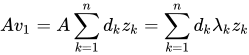
and more generally
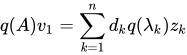
for any polynomial .

Thus

A key difference between numerator and denominator here is that the term vanishes in the numerator, but not in the denominator. Thus if one can pick to be large at but small at all other eigenvalues, one will get a tight bound on the error .


Since has many more eigenvalues than has coefficients, this may seem a tall order, but one way to meet it is to use Chebyshev polynomials. Writing for the degree Chebyshev polynomial of the first kind (that which satisfies for all ), we have a polynomial which stays in the range on the known interval but grows rapidly outside it. With some scaling of the argument, we can have it map all eigenvalues except into . Let



![{\displaystyle [-1,1]}](https://wikimedia.org/api/rest_v1/media/math/render/svg/51e3b7f14a6f70e614728c583409a0b9a8b9de01)
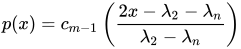
(in case , use instead the largest eigenvalue strictly less than ), then the maximal value of for is and the minimal value is , so



Furthermore

the quantity
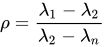
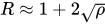
(i.e., the ratio of the first eigengap to the diameter of the rest of the spectrum) is thus of key importance for the convergence rate here. Also writing

we may conclude that
![{\displaystyle {\begin{aligned}\lambda _{1}-\theta _{1}&\leqslant {\frac {(\lambda _{1}-\lambda _{n})\left(1-|d_{1}|^{2}\right)}{c_{m-1}(2\rho +1)^{2}|d_{1}|^{2}}}\\[6pt]&={\frac {1-|d_{1}|^{2}}{|d_{1}|^{2}}}(\lambda _{1}-\lambda _{n}){\frac {1}{\cosh ^{2}((m-1)\operatorname {arcosh} (1+2\rho ))}}\\[6pt]&={\frac {1-|d_{1}|^{2}}{|d_{1}|^{2}}}(\lambda _{1}-\lambda _{n}){\frac {4}{\left(R^{m-1}+R^{-(m-1)}\right)^{2}}}\\[6pt]&\leqslant 4{\frac {1-|d_{1}|^{2}}{|d_{1}|^{2}}}(\lambda _{1}-\lambda _{n})R^{-2(m-1)}\end{aligned}}}](https://wikimedia.org/api/rest_v1/media/math/render/svg/2a971e473f56e04b8e556a5085f49a1025a08878)
The convergence rate is thus controlled chiefly by , since this bound shrinks by a factor for each extra iteration.


For comparison, one may consider how the convergence rate of the power method depends on , but since the power method primarily is sensitive to the quotient between absolute values of the eigenvalues, we need for the eigengap between and to be the dominant one. Under that constraint, the case that most favours the power method is that , so consider that. Late in the power method, the iteration vector:


where each new iteration effectively multiplies the -amplitude by



The estimate of the largest eigenvalue is then

so the above bound for the Lanczos algorithm convergence rate should be compared to

which shrinks by a factor of for each iteration. The difference thus boils down to that between and . In the region, the latter is more like , and performs like the power method would with an eigengap twice as large; a notable improvement. The more challenging case is however that of in which is an even larger improvement on the eigengap; the region is where the Lanczos algorithm convergence-wise makes the smallest improvement on the power method.


Numerical stability
[edit]Stability means how much the algorithm will be affected (i.e. will it produce the approximate result close to the original one) if there are small numerical errors introduced and accumulated. Numerical stability is the central criterion for judging the usefulness of implementing an algorithm on a computer with roundoff.
For the Lanczos algorithm, it can be proved that with exact arithmetic, the set of vectors constructs an orthonormal basis, and the eigenvalues/vectors solved are good approximations to those of the original matrix. However, in practice (as the calculations are performed in floating point arithmetic where inaccuracy is inevitable), the orthogonality is quickly lost and in some cases the new vector could even be linearly dependent on the set that is already constructed. As a result, some of the eigenvalues of the resultant tridiagonal matrix may not be approximations to the original matrix. Therefore, the Lanczos algorithm is not very stable.

Users of this algorithm must be able to find and remove those "spurious" eigenvalues. Practical implementations of the Lanczos algorithm go in three directions to fight this stability issue:[6][7]
- Prevent the loss of orthogonality,
- Recover the orthogonality after the basis is generated.
- After the good and "spurious" eigenvalues are all identified, remove the spurious ones.
Variations
[edit]Variations on the Lanczos algorithm exist where the vectors involved are tall, narrow matrices instead of vectors and the normalizing constants are small square matrices. These are called "block" Lanczos algorithms and can be much faster on computers with large numbers of registers and long memory-fetch times.
Many implementations of the Lanczos algorithm restart after a certain number of iterations. One of the most influential restarted variations is the implicitly restarted Lanczos method,[10] which is implemented in ARPACK.[11] This has led into a number of other restarted variations such as restarted Lanczos bidiagonalization.[12] Another successful restarted variation is the Thick-Restart Lanczos method,[13] which has been implemented in a software package called TRLan.[14]
Nullspace over a finite field
[edit]In 1995, Peter Montgomery published an algorithm, based on the Lanczos algorithm, for finding elements of the nullspace of a large sparse matrix over GF(2); since the set of people interested in large sparse matrices over finite fields and the set of people interested in large eigenvalue problems scarcely overlap, this is often also called the block Lanczos algorithm without causing unreasonable confusion.[citation needed]
Applications
[edit]Lanczos algorithms are very attractive because the multiplication by is the only large-scale linear operation. Since weighted-term text retrieval engines implement just this operation, the Lanczos algorithm can be applied efficiently to text documents (see latent semantic indexing). Eigenvectors are also important for large-scale ranking methods such as the HITS algorithm developed by Jon Kleinberg, or the PageRank algorithm used by Google.

Lanczos algorithms are also used in condensed matter physics as a method for solving Hamiltonians of strongly correlated electron systems,[15] as well as in shell model codes in nuclear physics.[16]
Implementations
[edit]The NAG Library contains several routines[17] for the solution of large scale linear systems and eigenproblems which use the Lanczos algorithm.
MATLAB and GNU Octave come with ARPACK built-in. Both stored and implicit matrices can be analyzed through the eigs() function (Matlab/Octave).
Similarly, in Python, the SciPy package has scipy.sparse.linalg.eigsh which is also a wrapper for the SSEUPD and DSEUPD functions functions from ARPACK which use the Implicitly Restarted Lanczos Method.
A Matlab implementation of the Lanczos algorithm (note precision issues) is available as a part of the Gaussian Belief Propagation Matlab Package. The GraphLab[18] collaborative filtering library incorporates a large scale parallel implementation of the Lanczos algorithm (in C++) for multicore.
The PRIMME library also implements a Lanczos-like algorithm.
Notes
[edit]- ^ The coefficients need not both be real, but the phase is of little importance. Nor need the composants for other eigenvectors have completely disappeared, but they shrink at least as fast as that for , so describes the worst case.

References
[edit]- ^ Lanczos, C. (1950). "An iteration method for the solution of the eigenvalue problem of linear differential and integral operators" (PDF). Journal of Research of the National Bureau of Standards. 45 (4): 255–282. doi:10.6028/jres.045.026.
- ^ a b Ojalvo, I. U.; Newman, M. (1970). "Vibration modes of large structures by an automatic matrix-reduction method". AIAA Journal. 8 (7): 1234–1239. Bibcode:1970AIAAJ...8.1234N. doi:10.2514/3.5878.
- ^ Paige, C. C. (1971). The computation of eigenvalues and eigenvectors of very large sparse matrices (Ph.D. thesis). U. of London. OCLC 654214109.
- ^ Paige, C. C. (1972). "Computational Variants of the Lanczos Method for the Eigenproblem". J. Inst. Maths Applics. 10 (3): 373–381. doi:10.1093/imamat/10.3.373.
- ^ Ojalvo, I. U. (1988). "Origins and advantages of Lanczos vectors for large dynamic systems". Proc. 6th Modal Analysis Conference (IMAC), Kissimmee, FL. pp. 489–494.
- ^ a b Cullum; Willoughby (1985). Lanczos Algorithms for Large Symmetric Eigenvalue Computations. Vol. 1. Birkhäuser. ISBN 0-8176-3058-9.
- ^ a b Yousef Saad (1992-06-22). Numerical Methods for Large Eigenvalue Problems. Wiley. ISBN 0-470-21820-7.
- ^ Coakley, Ed S.; Rokhlin, Vladimir (2013). "A fast divide-and-conquer algorithm for computing the spectra of real symmetric tridiagonal matrices". Applied and Computational Harmonic Analysis. 34 (3): 379–414. doi:10.1016/j.acha.2012.06.003.
- ^ a b Golub, Gene H.; Van Loan, Charles F. (1996). Matrix computations (3. ed.). Baltimore: Johns Hopkins Univ. Press. ISBN 0-8018-5413-X.
- ^ D. Calvetti; L. Reichel; D.C. Sorensen (1994). "An Implicitly Restarted Lanczos Method for Large Symmetric Eigenvalue Problems". Electronic Transactions on Numerical Analysis. 2: 1–21.
- ^ R. B. Lehoucq; D. C. Sorensen; C. Yang (1998). ARPACK Users Guide: Solution of Large-Scale Eigenvalue Problems with Implicitly Restarted Arnoldi Methods. SIAM. doi:10.1137/1.9780898719628. ISBN 978-0-89871-407-4.
- ^ E. Kokiopoulou; C. Bekas; E. Gallopoulos (2004). "Computing smallest singular triplets with implicitly restarted Lanczos bidiagonalization" (PDF). Appl. Numer. Math. 49: 39–61. doi:10.1016/j.apnum.2003.11.011.
- ^ Kesheng Wu; Horst Simon (2000). "Thick-Restart Lanczos Method for Large Symmetric Eigenvalue Problems". SIAM Journal on Matrix Analysis and Applications. 22 (2). SIAM: 602–616. doi:10.1137/S0895479898334605.
- ^ Kesheng Wu; Horst Simon (2001). "TRLan software package". Archived from the original on 2007-07-01. Retrieved 2007-06-30.
- ^ Chen, HY; Atkinson, W.A.; Wortis, R. (July 2011). "Disorder-induced zero-bias anomaly in the Anderson-Hubbard model: Numerical and analytical calculations". Physical Review B. 84 (4) 045113. arXiv:1012.1031. Bibcode:2011PhRvB..84d5113C. doi:10.1103/PhysRevB.84.045113. S2CID 118722138.
- ^ Shimizu, Noritaka (21 October 2013). "Nuclear shell-model code for massive parallel computation, "KSHELL"". arXiv:1310.5431 [nucl-th].
- ^ The Numerical Algorithms Group. "Keyword Index: Lanczos". NAG Library Manual, Mark 23. Retrieved 2012-02-09.
- ^ GraphLab Archived 2011-03-14 at the Wayback Machine
Further reading
[edit]- Golub, Gene H.; Van Loan, Charles F. (1996). "Lanczos Methods". Matrix Computations. Baltimore: Johns Hopkins University Press. pp. 470–507. ISBN 0-8018-5414-8.
- Ng, Andrew Y.; Zheng, Alice X.; Jordan, Michael I. (2001). "Link Analysis, Eigenvectors and Stability" (PDF). IJCAI'01 Proceedings of the 17th International Joint Conference on Artificial Intelligence. 2: 903–910.
- Erik Koch (2019). "Exact Diagonalization and Lanczos Method" (PDF). In E. Pavarini; E. Koch; S. Zhang (eds.). Many-Body Methods for Real Materials. Jülich. ISBN 978-3-95806-400-3.
Lanczos algorithm
View on GrokipediaBackground and Motivation
Symmetric Eigenvalue Problems
The symmetric eigenvalue problem involves determining scalars λ, known as eigenvalues, and corresponding nonzero vectors v, known as eigenvectors, that satisfy the equation Av = λv, where A is a real symmetric n × n matrix.[4] This problem arises frequently in scientific and engineering applications, where the eigenvalues often represent physically meaningful quantities such as energies or frequencies, and the eigenvectors describe associated modes or states.[5] Real symmetric matrices possess several advantageous properties that simplify the eigenvalue problem. All eigenvalues are real numbers, and the matrix is diagonalizable with an orthonormal basis of eigenvectors.[6] The spectral theorem formalizes this by asserting that any real symmetric matrix A can be decomposed as A = QΛQᵀ, where Q is an orthogonal matrix whose columns are the eigenvectors, and Λ is a diagonal matrix containing the eigenvalues on its main diagonal.[7] These properties ensure that the eigenvectors corresponding to distinct eigenvalues are orthogonal, facilitating numerical computations and theoretical analysis.[8] Direct methods for solving the symmetric eigenvalue problem, such as the QR algorithm, incur a computational cost of O(n³) floating-point operations, which becomes infeasible for large n, especially when A is sparse and only a subset of eigenvalues is needed.[9] This high cost motivates the development of iterative approaches that exploit sparsity and target specific spectral regions, enabling efficient solutions for matrices arising in high-dimensional simulations.[4] The significance of symmetric eigenvalue problems emerged prominently in the early 20th century, fueled by advances in quantum mechanics—where the eigenvalues of the Hamiltonian operator correspond to discrete energy levels—and in vibration analysis, where they determine the natural frequencies and modes of mechanical structures like beams and plates.[10] These applications underscored the need for robust computational techniques to handle increasingly complex systems.[11]Connection to Iterative Methods
The power method, first described by Richard von Mises and Hilda Pollaczek-Geiringer in 1929, serves as a foundational iterative technique for approximating the dominant eigenvalue and its associated eigenvector of a matrix . The algorithm initializes with an arbitrary nonzero starting vector , then iteratively updates , where denotes the Euclidean norm, generating a sequence that converges to the eigenvector corresponding to the eigenvalue of largest absolute value, assuming it is real, simple, and strictly dominant. The approximate eigenvalue at each step can be obtained via the Rayleigh quotient . This method relies solely on matrix-vector multiplications, making it computationally efficient for large sparse matrices, but its linear convergence rate is governed by the ratio , where and are the dominant and subdominant eigenvalues, respectively.[12][13] Despite its simplicity, the power method has notable limitations that motivated subsequent advancements. Convergence slows dramatically when eigenvalues cluster near the dominant one, as the ratio approaches unity, potentially requiring an impractically large number of iterations. Moreover, the method does not inherently maintain orthogonality among generated vectors, leading to accumulated numerical errors in finite precision, and it computes only a single extremal eigenpair, offering no direct means to access interior eigenvalues or the full spectrum. These shortcomings highlighted the need for enhanced iterative strategies that could accelerate convergence and produce multiple eigenpairs while preserving numerical stability.[13][14] The Arnoldi iteration, introduced by William E. Arnoldi in 1951, emerged as a key precursor to more sophisticated methods, particularly for nonsymmetric eigenvalue problems. It generalizes the power method by constructing an orthonormal basis for the Krylov subspace spanned by successive powers of applied to the starting vector, resulting in a Hessenberg matrix approximation whose eigenvalues serve as Ritz values. For symmetric matrices, the symmetry imposes additional structure, enabling a three-term recurrence that reduces storage and computational costs compared to the general case. This symmetry exploitation distinguishes symmetric iterative methods from their nonsymmetric counterparts.[13][15] The conceptual foundations of these iterative approaches trace back to earlier 19th-century developments, including Carl Friedrich Gauss's work on quadrature rules in the 1810s, which utilized orthogonal polynomials to approximate integrals, and Lord Rayleigh's 1877 introduction of the variational Rayleigh quotient for bounding eigenvalues in vibration problems. Lanczos himself drew analogies between matrix iterations and the recurrence relations of orthogonal polynomials, akin to those in Gauss-Christoffel quadrature, to motivate efficient eigenvalue extraction. These historical contributions, spanning applied mathematics and physics, underscored the potential of polynomial-based iterations to overcome the power method's deficiencies by leveraging subspace projections and orthogonalization.[16][15]Description of the Algorithm
Core Steps and Recurrence Relations
The Lanczos algorithm begins with the initialization of the process by selecting an arbitrary starting vector normalized such that , setting , and computing the first diagonal coefficient , where is the symmetric matrix of interest.[17][3] This setup establishes the foundation for generating an orthonormal basis in the Krylov subspace spanned by powers of applied to .[18] The core iteration proceeds for , where is the desired number of steps, typically much smaller than the matrix dimension. At each step, a residual vector is computed as , followed by the extraction of the diagonal coefficient . The vector is then orthogonalized against to ensure orthonormality, yielding with normalized so and .[17][3] This three-term recurrence relation, , directly enforces the short recurrence property unique to symmetric matrices, allowing efficient computation without full Gram-Schmidt orthogonalization in exact arithmetic.[18] For practical implementation, the algorithm can be outlined in pseudocode as follows:Initialize: Choose q_1 with ||q_1||_2 = 1, β_1 = 0, α_1 = q_1^T A q_1
For k = 1 to m:
w = A q_k - β_k q_{k-1}
α_k = q_k^T w
w = w - α_k q_k // Short recurrence orthogonalization (against q_k; prior step handled q_{k-1})
β_{k+1} = ||w||_2
If β_{k+1} = 0, stop (exact [invariant subspace](/page/Invariant_subspace) found)
q_{k+1} = w / β_{k+1}
// Optional: Reorthogonalize q_{k+1} against previous q_j for j < k to mitigate rounding errors
Initialize: Choose q_1 with ||q_1||_2 = 1, β_1 = 0, α_1 = q_1^T A q_1
For k = 1 to m:
    w = A q_k - β_k q_{k-1}
    α_k = q_k^T w
    w = w - α_k q_k  // Short recurrence orthogonalization (against q_k; prior step handled q_{k-1})
    β_{k+1} = ||w||_2
    If β_{k+1} = 0, stop (exact [invariant subspace](/page/Invariant_subspace) found)
    q_{k+1} = w / β_{k+1}
    // Optional: Reorthogonalize q_{k+1} against previous q_j for j < k to mitigate rounding errors
Computation of Eigenvalues and Eigenvectors
The Lanczos algorithm computes approximations to the eigenvalues and eigenvectors of a large symmetric matrix by leveraging the Rayleigh-Ritz procedure applied to the tridiagonal matrix generated during the iteration. The eigenvalues of , denoted as for , are called Ritz values and serve as approximations to the eigenvalues of . Similarly, the corresponding eigenvectors of are used to form Ritz vectors , where is the orthonormal basis of the Krylov subspace spanned by the Lanczos vectors; these approximate the eigenvectors of . This approach ensures that the Ritz pairs are optimal approximations within the subspace, minimizing the residual norm , where collects the Ritz vectors and is diagonal with Ritz values.[19] The largest and smallest Ritz values converge rapidly to the extreme eigenvalues of , bounding them according to the Courant-Fischer min-max theorem. Specifically, the largest Ritz value satisfies for some , while the smallest provides a lower bound , with convergence accelerating for well-separated extreme eigenvalues due to the interlacing properties of the Ritz values. This behavior makes the Lanczos method particularly effective for extremal eigenproblems, as interior eigenvalues typically require more iterations to approximate accurately.[19] To manage computational resources when the subspace dimension reaches a storage limit, restarting strategies are employed, such as the thick-restart Lanczos method. In this approach, after steps, converged Ritz pairs are identified based on small residual norms (e.g., ) and deflated by retaining a subset of Ritz vectors forming an orthonormal basis , where are the corresponding eigenvectors of . The algorithm then restarts the Lanczos process in the deflated subspace orthogonal to these converged vectors, preserving previously found eigenpairs while focusing on remaining ones, thus maintaining efficiency without full reorthogonalization.[20] Error bounds for the approximations are derived from the residual norms of the Ritz pairs. For a Ritz pair , the residual satisfies , where is the subdiagonal element from the Lanczos recurrence and is the last component of ; small values of this norm indicate convergence, with the eigenvalue error bounded by . These bounds guide the selection of reliable eigenpairs and inform restarting decisions, ensuring numerical reliability in practical implementations.[19]Tridiagonalization Procedure
The tridiagonalization procedure of the Lanczos algorithm reduces a real symmetric matrix to symmetric tridiagonal form via an orthogonal similarity transformation, yielding an orthogonal matrix such that .[21][22] This process leverages the three-term recurrence relation inherent to the algorithm, where each new Lanczos vector satisfies , with on the diagonal of and on the subdiagonal.[22] The goal is to construct such that its eigenvalues approximate those of , facilitating subsequent eigenvalue computations.[23] In the partial tridiagonalization phase, after iterations starting from an initial unit vector , the columns of form an orthonormal basis for the Krylov subspace , and the projected matrix is symmetric tridiagonal of order .[22] This yields the low-rank approximation , with the residual error captured by the term , where is the -th standard basis vector in , , and is the normalized direction orthogonal to the current subspace.[16] The magnitude of measures the deviation from exact reproduction within the subspace, decreasing as increases for well-converged extremal eigenvalues.[23] For the full tridiagonalization, the process continues iteratively until , at which point in exact arithmetic, resulting in the exact decomposition .[22] This full reduction is mathematically equivalent to the classical Householder bidiagonalization (or tridiagonalization for symmetric matrices) in exact arithmetic, producing the same up to signs in the columns of , but the Lanczos approach is non-direct and iterative, making it suitable for large sparse matrices where only matrix-vector products are feasible without destroying sparsity or introducing fill-in.[24][23] In contrast to Householder's dense operations requiring time and full storage, Lanczos exploits sparsity for efficiency in applications like structural analysis.[23] Storage requirements are minimal: the tridiagonal matrix is represented compactly by its diagonal elements and subdiagonal elements , requiring space, while the Lanczos vectors comprising —each of length —are stored only if full eigenvectors are needed for reconstructing approximate eigenpairs from ; otherwise, they can be discarded after computing the scalars.[22][23] This efficiency enables the method's application to matrices too large for dense storage.[23]Derivation
Extension of the Power Method
The power method is an iterative technique for approximating the dominant eigenvalue and corresponding eigenvector of a symmetric matrix . Starting from an initial vector , it repeatedly computes , converging to the eigenvector associated with the eigenvalue of largest magnitude. However, this approach operates along a single direction and inefficiently recomputes at each step without reusing prior information.[2] To address this inefficiency, the power method can be modified by generating multiple orthogonal directions through orthogonalization of residuals, which avoids redundant matrix-vector multiplications and builds a richer approximation space. This extension computes successive residuals and orthogonalizes them against previous vectors, spanning the Krylov subspace , a low-dimensional subspace that captures the action of on the initial vector.[2] The initial steps of this modified process begin with a normalized starting vector (with ). Compute , then , and the residual . Normalize the residual to obtain and , ensuring is orthogonal to . These steps project out the component of in the direction of , yielding an orthogonal basis for the subspace.[2] This subspace-oriented enhancement motivates the Lanczos algorithm by enabling better approximations to multiple extremal eigenvalues compared to single-vector iterations, as the projected problem on the Krylov subspace reveals spectral information more efficiently for large sparse matrices.[2]Generation of Orthogonal Lanczos Vectors
The Lanczos algorithm generates an orthonormal basis for the Krylov subspace , where is a symmetric matrix and is a unit initial vector, by applying a three-term recurrence relation that leverages the symmetry of to avoid the computational expense of full Gram-Schmidt orthogonalization at each step.[25] In contrast to the power method, which produces successive powers of applied to without orthogonalization, the Lanczos process ensures orthogonality through a short recurrence, enabling efficient construction of the basis vectors .[16] The mathematical basis for this orthogonality can be established by induction on the step . Assume that the vectors form an orthonormal set, i.e., for . Set . The next vector is derived from the recurrence , where and for (for , the term is absent). To show for , take the inner product of the recurrence with : . For , the induction hypothesis implies and , so both last terms vanish, leaving . Due to the symmetry of , , and since lies in the span of by the recurrence (for ), for . For , so the term vanishes, and , since by symmetry and the recurrence for . For , both last terms give , canceled by . Thus, orthogonality propagates.[25][16] This short recurrence exploits the structure imposed by symmetry, as the action of on projects onto at most three consecutive basis vectors: . Consequently, the inner products satisfy for , a property arising directly from the prior orthogonality and the symmetric tridiagonal form of the projected operator (without deriving the explicit coefficients here).[25] The Lanczos vectors admit a polynomial representation that underscores their connection to orthogonal polynomials. Specifically, each , where is a sequence of monic polynomials of degree orthogonal with respect to the inner product (corresponding to the spectral measure induced by and ). These polynomials satisfy a three-term recurrence analogous to that of classical orthogonal polynomials, such as those of Gauss quadrature, ensuring the generated vectors remain orthonormal as the Krylov subspace expands.[16] This perspective highlights the Lanczos process as a matrix analogue of generating orthogonal polynomials via moment-matching in the spectral distribution of .[25]Formation of the Tridiagonal Matrix
In the general case of the Arnoldi iteration applied to a nonsymmetric matrix, the projection yields an upper Hessenberg matrix, where all entries below the first subdiagonal are zero due to the orthogonalization process that ensures the residual lies in the direction of the next basis vector.[26] However, when is symmetric, the resulting Hessenberg form must also be symmetric, which forces all entries above the first superdiagonal to vanish, producing a real symmetric tridiagonal matrix with nonzero elements only on the main diagonal and the adjacent sub- and super-diagonals.[26][27] The explicit entries of this tridiagonal matrix are derived directly from the Lanczos recurrence relations and the orthogonality of the columns of . The diagonal elements are given by which represent the Rayleigh quotients at each step.[26] The subdiagonal (and superdiagonal, by symmetry) elements are where emerges as the norm of the residual vector in the recurrence , ensuring the three-term structure (with ).[26][27] All other entries of are zero because the orthogonality conditions imply that for , as nonadjacent vectors are orthogonal and the action of on only involves , , and .[26] The coefficients of also connect to the spectral properties of through the moment matrix interpretation. Specifically, the entries and match the recursion coefficients for the orthonormal polynomials associated with the spectral measure defined by the initial vector , where the moments are .[28] This relation arises because the Lanczos vectors satisfy a three-term recurrence that mirrors the orthogonal polynomial expansion with respect to , allowing to approximate the action of functions of via quadrature rules on the projected spectrum.[28] As the iteration proceeds to (the dimension of ), the basis becomes a full orthonormal matrix, and the similarity transformation yields exactly, recovering the original matrix from its tridiagonal projection.[26] This exactness holds in exact arithmetic under the assumption of no breakdowns in the recurrence (i.e., ).[26]Theoretical Properties
Convergence Behavior
The convergence of the Lanczos algorithm is primarily driven by the distribution of the eigenvalues of the symmetric matrix . Extreme eigenvalues—those at the largest and smallest ends of the spectrum—tend to be approximated rapidly when there is a significant spectral gap separating them from the rest of the eigenvalues, as the algorithm leverages the properties of Chebyshev polynomials to accelerate convergence in such regions.[3] In contrast, densely clustered interior eigenvalues converge more slowly due to the reduced resolution in those areas.[19] This behavior aligns with the algorithm's tendency to prioritize regions of the spectrum that exhibit "too little charge" relative to an equilibrium distribution determined by the overall eigenvalue spread and the ratio of matrix size to iteration count.[29] The growth of the Krylov subspace plays a central role in determining the accuracy of approximations, with the dimension of the subspace roughly needing to match or exceed the number of desired eigenvalues for reliable convergence. As the subspace expands through successive iterations, it captures increasingly refined projections of , enabling better eigenvalue estimates via the associated Ritz values. Empirically, these Ritz values interlace with the true eigenvalues of , meaning that for each step , the Ritz values from the -step tridiagonal matrix lie between those of the full spectrum, ensuring a monotonic approach to the exact values. Convergence typically proceeds from the outside in, with the largest and smallest eigenvalues stabilizing first, while interior ones require more steps to resolve accurately.[19] Several factors can impede convergence, including the presence of multiple or closely spaced eigenvalues, which lead to slower resolution and potential misconvergence where Ritz values temporarily average over clusters rather than isolating individuals. An ill-conditioned starting vector, with small projections onto the dominant eigenvectors, further delays progress by limiting the initial subspace's informativeness. To mitigate these issues, techniques such as thick restarting have been developed, which retain a subset of previous Ritz vectors (thicker than a single vector) to restart the process, preserving valuable spectral information and accelerating convergence for clustered or degenerate cases without excessive computational overhead.[30][3][31]Kaniel–Paige Theory
The Kaniel–Paige theory establishes rigorous bounds on the convergence of the Lanczos algorithm for approximating the extreme eigenvalues of a large symmetric matrix , emphasizing the rapid approximation of the largest and smallest eigenvalues under certain spectral conditions. This framework, developed in the late 1960s and early 1970s, demonstrates that the algorithm's Ritz values from the -step tridiagonal matrix converge to the corresponding eigenvalues of at a rate influenced by the spectral gap and the final Lanczos coefficient . The theory assumes is symmetric with distinct eigenvalues, ensuring the eigenvectors form an orthogonal basis, though subsequent extensions address cases with clustered spectra by grouping nearby eigenvalues into effective gaps. In his 1966 paper, Shmuel Kaniel derived explicit error bounds for the eigenvalue approximations, focusing on the largest eigenvalue . A central result is the bound on the approximation error for the largest Ritz value : where the gap measures the separation from the next eigenvalue, and is the subdiagonal element in the tridiagonal matrix after steps, which decreases as convergence progresses. This inequality highlights quadratic convergence in terms of , showing that small residuals lead to tight eigenvalue estimates, provided the initial vector has a nonzero projection onto the dominant eigenvector. Kaniel's analysis also extends to eigenvector errors, bounding the deviation by similar residual terms scaled by the spectral diameter. C. C. Paige refined these bounds in his 1971 thesis, introducing residual norm estimates that directly tie the algorithm's accuracy to the off-diagonal . For a converged Ritz pair , the residual satisfies , where is the last unit vector, and Paige showed this implies error bounds of the form for extreme indices , with a constant depending on the global spectrum. This refinement draws an analogy to Chebyshev polynomial acceleration in iterative methods, where the minimax properties of Chebyshev polynomials on the spectral interval explain the superlinear convergence for well-separated extremes: the error diminishes like the square of the polynomial evaluated outside the remaining spectrum. Paige's work assumes simple extreme eigenvalues but notes that for clustered interiors, the bounds hold by treating clusters as pseudo-eigenvalues with widened effective gaps. These bounds underscore the Lanczos algorithm's efficiency for extreme eigenvalues, with convergence accelerating quadratically once becomes small relative to the gap, though the theory requires careful handling of multiple eigenvalues through deflation or blocking in practice.Numerical Stability Considerations
In finite-precision floating-point arithmetic, the Lanczos algorithm encounters significant numerical stability challenges primarily due to the gradual loss of orthogonality among the generated Krylov basis vectors. Rounding errors accumulate during the computation of each new vector through the recurrence relation, causing the inner products for to deviate from zero, rather than remaining exactly orthogonal as in exact arithmetic. This degradation worsens as the iteration progresses, particularly for large matrices, and can lead to the off-diagonal coefficients becoming spuriously small or approaching machine epsilon, resulting in premature breakdown of the algorithm where no further meaningful vectors can be generated.[32] To mitigate this loss of orthogonality, several reorthogonalization strategies have been developed. Selective reorthogonalization monitors the projected components of the new vector onto the previous subspace spanned by , typically by computing the norm of ; if this norm exceeds a small tolerance (often around machine precision times the matrix norm), reorthogonalization is performed only against the recent vectors that contribute most to the error, preserving semiorthogonality at a cost of overall rather than per step. In contrast, full reorthogonalization explicitly orthogonalizes against the entire previous basis at every step using procedures like modified Gram-Schmidt, ensuring near-perfect orthogonality but incurring a high computational expense of total operations, which limits its practicality for very large-scale problems. These techniques, pioneered in the late 1970s, balance accuracy and efficiency by intervening only when necessary to prevent severe instability.[33] A direct consequence of non-orthogonality is the emergence of ghost eigenvalues, which are spurious Ritz values approximating already-converged eigenvalues of the original matrix, often appearing as duplicates due to the algorithm effectively restarting in a contaminated subspace. These artifacts do not reflect true spectral multiplicities and can mislead eigenvalue estimation, but they are identifiable through validation: the residuals for the associated Ritz pairs remain large (on the order of the orthogonality error) compared to true approximations, where residuals decrease rapidly.[34] Modern analyses have quantified these stability issues, particularly for sparse matrices where matrix-vector products dominate computation. Meurant (2006) derives bounds on the propagation of rounding errors in the Lanczos process, demonstrating that while orthogonality loss is inevitable, the eigenvalues of the tridiagonal matrix remain reliable approximations to those of the original matrix as long as reorthogonalization is judiciously applied, with error growth controlled by the condition number and sparsity structure rather than exploding uncontrollably. This framework underscores the algorithm's robustness in practice for well-conditioned problems, informing implementations that prioritize monitoring over exhaustive corrections.[32]Variations and Extensions
Block Lanczos Algorithm
The block Lanczos algorithm extends the standard Lanczos method, which operates on a single starting vector to approximate extreme eigenvalues, by processing multiple starting vectors simultaneously to target invariant subspaces or clusters of eigenvalues more efficiently. This variant is particularly motivated by the need to handle symmetric matrices with multiple eigenvalues or closely spaced spectral clusters, where the single-vector approach may converge slowly or require multiple independent runs.[35] By employing a block of orthogonal vectors, it accelerates the discovery of subspaces corresponding to groups of eigenvalues, making it suitable for large-scale problems in scientific computing. In the procedure, the algorithm begins with an initial block of orthogonal vectors forming the matrix , where is the matrix dimension and is the small block size (typically 2–10). Subsequent blocks are generated via a block recurrence relation: for step , compute where is the symmetric matrix; then extract the block tridiagonal coefficients as (a diagonal block) and orthogonalize the residual via QR factorization to yield , where is the subdiagonal block.[35] After steps, the accumulated ( ) and the block-tridiagonal matrix (with blocks on the diagonal and on the sub- and superdiagonals) approximate the spectral properties, from which Ritz values and vectors are obtained by eigendecomposition of . The primary advantages include faster convergence for spectra with clustered eigenvalues, as the block structure captures multiple Ritz pairs in parallel per iteration, reducing the total number of matrix-vector products compared to running multiple single-vector Lanczos instances. Additionally, block operations enhance parallelizability on modern architectures, leveraging level-3 BLAS for matrix-matrix multiplications, and the method integrates well with restarting techniques to manage storage for very large matrices.[35] These features, building on extensions in Golub and Van Loan's framework, have made it a cornerstone for computing extremal eigenspaces in high-dimensional symmetric problems.Applications Over Finite Fields
The Lanczos algorithm has been adapted for use over finite fields, particularly to compute the nullspace of large sparse matrices in contexts where real or complex arithmetic is inapplicable, such as cryptography and coding theory. Over fields like GF(2) or GF(q) for small q, the core challenge is the absence of a natural inner product that ensures orthogonality as in the real case; instead, adaptations rely on field-specific operations, randomized starting vectors, and techniques to generate linearly independent sequences without explicit normalization or division-prone steps. Pivoting and block-structured approaches are often employed to detect rank deficiencies and maintain numerical reliability in the discrete setting, enabling the identification of kernel bases for matrices arising from linear dependencies. A seminal adaptation is the Wiedemann algorithm, introduced in 1986 as a probabilistic method inspired by the Lanczos process for solving sparse linear systems over finite fields.[36] It generates a Krylov-like sequence from a random starting vector, computes the minimal polynomial of the matrix restricted to the spanned subspace using the Berlekamp-Massey algorithm, and derives solutions or nullspace elements from the polynomial factors, achieving success with high probability after a small number of iterations.[36] For an n × n sparse matrix with w nonzeros per row, the algorithm requires O(n²) matrix-vector multiplications, each costing O(w) field operations, for a total time complexity of O(n² w) while using O(n) space, making it suitable for systems too large for direct Gaussian elimination.[36] This approach has been widely adopted for its efficiency in handling ill-conditioned or singular systems over GF(q). Further refinements include block Lanczos variants tailored for finite fields, notably Montgomery's 1995 block algorithm for GF(2), which processes multiple starting vectors simultaneously to sample nullspace elements and find dependencies in sparse matrices.[37] By generating blocks of vectors and using reorthogonalization only when necessary to avoid breakdowns from linear dependence, it reliably computes a basis for the kernel in O(n² w) time, with practical implementations demonstrating scalability to matrices with millions of rows. These methods excel in applications requiring repeated nullspace computations, such as integer factorization via the general number field sieve (GNFS), where the linear algebra step involves solving enormous sparse systems over GF(2) to identify relations among sieved values— a bottleneck that block Lanczos variants have optimized for records like the factorization of RSA-768.[38] In coding theory, similar adaptations aid in decoding linear codes by solving sparse syndrome equations or finding low-weight codewords, enhancing error-correcting capabilities in finite-field-based systems.Relation to Arnoldi Iteration
The Arnoldi iteration is a generalization of the Krylov subspace method that constructs an orthonormal basis for the Krylov subspace generated by a matrix and an initial vector, applicable to nonsymmetric matrices. It employs the full Gram-Schmidt process to ensure orthogonality of the basis vectors, resulting in an upper Hessenberg matrix that approximates the action of on the subspace.[2] This process yields the relation , where collects the orthonormal vectors, is the Hessenberg matrix, and is the -th standard basis vector. The method was originally proposed by Arnoldi in 1951 as a means to minimize iterations for eigenvalue problems.[39] In contrast, the Lanczos algorithm simplifies this framework when is symmetric (or Hermitian in the complex case), exploiting the matrix's symmetry to produce a tridiagonal matrix instead of the full Hessenberg form. The symmetry implies a three-term recurrence relation for the orthogonalization step: , which avoids the need for full -term orthogonalization required in the general Arnoldi process at each step.[2] This reduction in computational complexity arises because the Lanczos vectors satisfy a shorter recurrence due to the self-adjoint property of , making the algorithm more efficient for symmetric problems while still generating an orthonormal basis for the Krylov subspace. The original Lanczos method from 1950 laid the foundation for this symmetric case. Fundamentally, the Lanczos algorithm is equivalent to the Arnoldi iteration restricted to symmetric matrices, where the Hessenberg matrix reduces to tridiagonal form and the full orthogonalization collapses to the three-term relation.[2] This equivalence highlights Lanczos as a specialized instance of Arnoldi, inheriting its Krylov subspace properties but benefiting from symmetry-induced simplifications. For practical use, the Lanczos algorithm is preferred for Hermitian matrices to compute extremal eigenvalues or solve symmetric systems efficiently, whereas the Arnoldi iteration is essential for nonsymmetric matrices. Additionally, the Arnoldi process serves as the basis for methods like GMRES, which uses the Hessenberg structure to minimize residuals in nonsymmetric linear systems.Practical Applications
In Scientific Computing
The Lanczos algorithm plays a pivotal role in scientific computing for solving large-scale eigenvalue problems arising from discretized partial differential equations (PDEs) in physics and engineering simulations. By iteratively constructing a tridiagonal matrix from sparse symmetric matrices, it enables efficient extraction of dominant eigenpairs without full matrix storage or factorization, which is essential for systems with millions of degrees of freedom.[40] This approach is particularly valuable in handling the sparsity inherent in finite element or finite difference discretizations, allowing computations on matrices up to 10^6 × 10^6 in size through matrix-vector multiplications alone.[41] In structural dynamics, the Lanczos algorithm is widely employed for modal analysis of sparse mass and stiffness matrices generated by the finite element method (FEM). These matrices represent the generalized eigenvalue problem , where is the stiffness matrix and is the mass matrix, both sparse and symmetric due to the underlying mesh structure. The algorithm computes the lowest-frequency modes critical for vibration analysis, earthquake engineering, and design optimization of structures like bridges or aircraft components. For instance, parallel implementations of the implicitly restarted Lanczos method have been used to solve eigenproblems for systems with over 100,000 degrees of freedom, demonstrating convergence to a few dozen accurate modes in under an hour on distributed systems.[42] This efficiency stems from the algorithm's ability to target interior or extreme eigenvalues via spectral shifts, avoiding the need to compute the full spectrum.[43] In fluid dynamics, Lanczos facilitates eigenvalue problems in the stability analysis of flows governed by discretized Navier-Stokes equations. The linearized Navier-Stokes operator, often resulting in large sparse nonsymmetric matrices after spatial discretization, is analyzed to identify unstable modes that predict transition to turbulence or flow instabilities in applications like aerodynamics and heat transfer. A Lanczos-based procedure applied to Euler/Navier-Stokes solvers computes complete eigenspectra for perturbation analysis over airfoils, providing eigenvectors for modal decomposition and reduced-order modeling, which outperforms partial-spectrum methods like power iteration in completeness and accuracy for two-dimensional flows.[44] Krylov subspace methods incorporating Lanczos principles have been integrated into time-stepping frameworks for global stability computations, enabling analysis of high-Reynolds-number flows where direct solvers are infeasible.[45] For optimization in scientific computing, the Lanczos algorithm underpins trust-region methods by approximating solutions to the trust-region subproblem involving the Hessian matrix. In large-scale nonlinear optimization, such as parameter estimation in physical models, the subproblem minimizes a quadratic model subject to , where is the sparse Hessian approximation. The Lanczos method generates an orthonormal basis for the Krylov subspace to solve this exactly in the subspace, yielding a near-optimal step that respects the trust-region boundary and promotes global convergence. This approach, detailed in seminal work on symmetric indefinite Hessians, reduces computational cost compared to full eigenvalue decompositions while maintaining quadratic model fidelity for ill-conditioned problems in engineering design.[46] The algorithm's scalability extends to climate modeling, where it processes massive sparse covariance matrices from atmospheric data for empirical orthogonal function (EOF) analysis, equivalent to principal component analysis on global fields. In such applications, Lanczos eigensolvers handle datasets representing millions of grid points, extracting leading modes that capture variability in temperature or pressure patterns without dense matrix operations.[47] This has enabled efficient spectral analysis in ensemble simulations, supporting predictions of climate phenomena like El Niño with reduced memory footprint.In Spectral Graph Theory
In spectral graph theory, the Lanczos algorithm plays a central role in analyzing the eigenvalues of the graph Laplacian matrix , where is the diagonal degree matrix and is the adjacency matrix of an undirected graph. This matrix is symmetric and positive semidefinite, with eigenvalues satisfying , where the smallest eigenvalues encode structural properties such as connectivity. The Lanczos algorithm efficiently computes these smallest eigenpairs by generating an orthonormal basis for the Krylov subspace, exploiting the sparsity of to reveal insights into graph bottlenecks and expansion.[48][49] A key application is spectral partitioning, where the Fiedler vector—the eigenvector corresponding to the second smallest eigenvalue , known as the algebraic connectivity—guides the division of graphs into balanced components with minimal edge cuts. The Lanczos method computes this vector iteratively, often requiring only a modest number of steps for practical accuracy, by orthogonalizing against the constant eigenvector and using the graph's global structure to produce high-quality partitions superior to local heuristics.[48] This approach leverages the rapid convergence of Lanczos to extreme eigenvalues, ensuring reliable approximations even for large sparse graphs.[49] The algorithm also supports approximations of Google PageRank in symmetric settings, such as undirected web graphs, by applying Lanczos-type iterations to the dominant eigenpairs of the normalized Laplacian, yielding personalized rankings with reduced computational overhead compared to power methods.[50] In community detection for social networks, local variants like the Local Lanczos Spectral Approximation (LLSA) subsample neighborhoods around seed nodes, then use Lanczos to approximate the leading eigenvector of a transition matrix, identifying cohesive groups with high precision on datasets such as YouTube and Amazon co-purchase networks.[51] These techniques trace their origins to the 1980s, when advancements in Lanczos implementations enabled practical eigenvalue computations for bounding the Cheeger inequality, which relates to the graph's edge expansion and informed early spectral partitioning heuristics.[48]In Quantum Mechanics Simulations
In quantum mechanics simulations, the Lanczos algorithm plays a crucial role in addressing the computational challenges posed by large, sparse, symmetric Hamiltonian matrices derived from the second quantization formalism. In this representation, the Hamiltonian is expressed as a sum of one- and two-body terms involving creation and annihilation operators, leading to a matrix structure where most elements are zero due to selection rules that limit interactions to nearby configurations in the Fock space. This sparsity makes the Lanczos method efficient, as it iteratively builds an orthonormal basis in the Krylov subspace without requiring full matrix storage or dense operations.[52] For ground state computation, the Lanczos algorithm is employed to approximate the lowest eigenvalue and eigenvector of the Hamiltonian, corresponding to the ground state energy and wavefunction. Starting from a trial vector close to the expected ground state, the method generates a tridiagonal matrix whose eigenvalues provide Ritz approximations that converge rapidly to the extremal eigenvalues. This approach is integrated into hybrid methods like the density matrix renormalization group (DMRG), where Lanczos diagonalization is applied to small effective Hamiltonians in the renormalized basis during iterative sweeps, enabling accurate treatment of strongly correlated systems with thousands of sites. The Lanczos algorithm also facilitates simulations of quantum time evolution by approximating the matrix exponential , essential for computing real-time dynamics. By reducing the Hamiltonian to a tridiagonal form in the Krylov subspace, the exponential can be evaluated efficiently on this low-dimensional representation, yielding accurate short-time propagators with controlled error bounds based on the subspace dimension. This technique, known as iterative Lanczos reduction, is particularly effective for unitary evolution in molecular systems, avoiding the need for full diagonalization while preserving key dynamical features like autocorrelation functions. Historically, the Lanczos algorithm originated in a 1950 paper motivated by eigenvalue problems for linear differential and integral operators in physical contexts, including quantum vibration analyses where spectral properties of oscillatory systems are central. In contemporary quantum chemistry packages, such as those implementing configuration interaction or coupled-cluster methods, the Lanczos method remains a standard tool for extracting spectral information and enabling scalable simulations of molecular Hamiltonians.[53]Implementations and Software
Standard Library Routines
The Lanczos algorithm is supported in major numerical libraries through routines that address symmetric eigenvalue problems, either via direct solvers for the resulting tridiagonal form or iterative methods for large-scale applications. LAPACK includes driver routines such as SSTEV and DSTEV for computing all eigenvalues and, optionally, eigenvectors of real symmetric tridiagonal matrices, which are produced by the Lanczos tridiagonalization process.[54] For iterative solutions of large sparse symmetric eigenproblems, ARPACK provides the Implicitly Restarted Lanczos Method (IRLM), a variant that uses restarting to focus on a subset of eigenvalues while integrating LAPACK subroutines for efficient matrix operations and orthogonalization.[55] MATLAB's eigs function employs ARPACK under the hood for symmetric problems, performing Lanczos iterations to approximate a specified number of eigenvalues and eigenvectors, with adjustable subspace dimensions to aid convergence.[56] These routines are optimized for matrices up to dimensions of approximately 10^5, particularly in sparse settings, and include parameters for spectral shifts to target interior eigenvalues and tolerances for controlling accuracy and iteration counts.[57] LAPACK's core implementation traces to Fortran 77 standards for portability, with version 3.0 (released in 1999) introducing enhancements to eigenvalue solvers for improved numerical stability and robustness against rounding errors.[58][59]Open-Source and Custom Implementations
The SciPy library, part of the Python scientific computing ecosystem alongside NumPy, provides thescipy.sparse.linalg.eigsh function as a wrapper around the ARPACK Fortran library, implementing the implicitly restarted Lanczos method for computing a few extreme eigenvalues and eigenvectors of large sparse symmetric or Hermitian matrices.[60] This open-source implementation supports user-specified parameters for the number of Lanczos vectors and restart iterations, enabling customization for specific convergence needs in applications like spectral analysis.[60]
SLEPc, the Scalable Library for Eigenvalue Problem Computations, offers robust open-source implementations of Lanczos-based solvers built on the PETSc toolkit, including shifted block Lanczos for symmetric generalized eigenproblems and support for distributed-memory parallelism.[61] It incorporates GPU acceleration through PETSc's vector and matrix operations, allowing efficient handling of large-scale problems on heterogeneous architectures, with options for thick-restart variants to improve convergence.[61][62]
Custom and educational implementations in Python often emphasize pedagogical clarity and flexibility, such as standalone Lanczos codes that include toggles for selective reorthogonalization to mitigate loss of orthogonality in finite-precision arithmetic.[63] For instance, the TeNPy framework provides a simple Lanczos diagonalization routine tailored for quantum many-body simulations, allowing users to adjust reorthogonalization frequency for better numerical stability.[64] Similarly, Julia's IterativeSolvers.jl package delivers pure-Julia iterative eigensolvers, incorporating Lanczos-based procedures like Golub-Kahan-Lanczos bidiagonalization for singular value decomposition, which extends naturally to symmetric eigenvalue problems with customizable restart mechanisms.[65]
In the 2020s, open-source efforts have increasingly targeted exascale computing, with the Trilinos framework's Anasazi package providing distributed-memory Lanczos implementations, including block and thick-restart variants, optimized for parallel execution across thousands of nodes in high-performance computing environments.[66] These enhancements in Trilinos focus on scalability for massive sparse matrices, integrating with other packages for preconditioning and supporting hybrid CPU-GPU workflows to address challenges in scientific simulations at exascale.[67]