


Community hub
Binary GCD algorithm
View on Wikipedia

The binary GCD algorithm, also known as Stein's algorithm or the binary Euclidean algorithm,[1][2] is an algorithm that computes the greatest common divisor (GCD) of two nonnegative integers. Stein's algorithm uses simpler arithmetic operations than the conventional Euclidean algorithm; it replaces division with arithmetic shifts, comparisons, and subtraction.
Although the algorithm in its contemporary form was first published by the physicist and programmer Josef Stein in 1967,[3] it was known by the 2nd century BCE, in ancient China.[4]
Algorithm
[edit]The algorithm finds the GCD of two nonnegative numbers and by repeatedly applying these identities:


- : everything divides zero, and is the largest number that divides .
- : is a common divisor.
- if is odd: is then not a common divisor.
- if odd and .


As GCD is commutative (), those identities still apply if the operands are swapped: , if is odd, etc.


Implementation
[edit]While the above description of the algorithm is mathematically correct, performant software implementations typically differ from it in a few notable ways:
- eschewing trial division by in favour of a single bitshift and the count trailing zeros primitive; this is functionally equivalent to repeatedly applying identity 3, but much faster;
- expressing the algorithm iteratively rather than recursively: the resulting implementation can be laid out to avoid repeated work, invoking identity 2 at the start and maintaining as invariant that both numbers are odd upon entering the loop, which only needs to implement identities 3 and 4;
- making the loop's body branch-free except for its exit condition (): in the example below, the exchange of and (ensuring ) compiles down to conditional moves;[5] hard-to-predict branches can have a large, negative impact on performance.[6][7]

The following is an implementation of the algorithm in Rust exemplifying those differences, adapted from uutils:
use std::cmp::min;
use std::mem::swap;

pub fn gcd(mut u: u64, mut v: u64) -> u64 {
    // Base cases: gcd(n, 0) = gcd(0, n) = n
    if u == 0 {
        return v;
    } else if v == 0 {
        return u;
    }

    // Using identities 2 and 3:
    // gcd(2ⁱ u, 2ʲ v) = 2ᵏ gcd(u, v) with u, v odd and k = min(i, j)
    // 2ᵏ is the greatest power of two that divides both 2ⁱ u and 2ʲ v
    let i = u.trailing_zeros();  u >>= i;
    let j = v.trailing_zeros();  v >>= j;
    let k = min(i, j);

    loop {
        // u and v are odd at the start of the loop
        debug_assert!(u % 2 == 1, "u = {} should be odd", u);
        debug_assert!(v % 2 == 1, "v = {} should be odd", v);

        // Swap if necessary so u ≤ v
        if u > v {
            swap(&mut u, &mut v);
        }

        // Identity 4: gcd(u, v) = gcd(u, v-u) as u ≤ v and u, v are both odd
        v -= u;
        // v is now even

        if v == 0 {
            // Identity 1: gcd(u, 0) = u
            // The shift by k is necessary to add back the 2ᵏ factor that was removed before the loop
            return u << k;
        }

        // Identity 3: gcd(u, 2ʲ v) = gcd(u, v) as u is odd
        v >>= v.trailing_zeros();
    }
}
Note: The implementation above accepts unsigned (non-negative) integers; given that , the signed case can be handled as follows:

/// Computes the GCD of two signed 64-bit integers
/// The result is unsigned and not always representable as i64: gcd(i64::MIN, i64::MIN) == 1 << 63
pub fn signed_gcd(u: i64, v: i64) -> u64 {
    gcd(u.unsigned_abs(), v.unsigned_abs())
}
Complexity
[edit]Asymptotically, the algorithm requires steps, where is the number of bits in the larger of the two numbers, as every two steps reduce at least one of the operands by at least a factor of . Each step involves only a few arithmetic operations ( with a small constant); when working with word-sized numbers, each arithmetic operation translates to a single machine operation, so the number of machine operations is on the order of , i.e. .


For arbitrarily large numbers, the asymptotic complexity of this algorithm is ,[8] as each arithmetic operation (subtract and shift) involves a linear number of machine operations (one per word in the numbers' binary representation). If the numbers can be represented in the machine's memory, i.e. each number's size can be represented by a single machine word, this bound is reduced to:


This is the same as for the Euclidean algorithm, though a more precise analysis by Akhavi and Vallée proved that binary GCD uses about 60% fewer bit operations.[9]
Extensions
[edit]The binary GCD algorithm can be extended in several ways, either to output additional information, deal with arbitrarily large integers more efficiently, or to compute GCDs in domains other than the integers.
The extended binary GCD algorithm, analogous to the extended Euclidean algorithm, fits in the first kind of extension, as it provides the Bézout coefficients in addition to the GCD: integers and such that .[10][11][12]


In the case of large integers, the best asymptotic complexity is , with the cost of -bit multiplication; this is near-linear and vastly smaller than the binary GCD algorithm's , though concrete implementations only outperform older algorithms for numbers larger than about 64 kilobits (i.e. greater than 8×1019265). This is achieved by extending the binary GCD algorithm using ideas from the Schönhage–Strassen algorithm for fast integer multiplication.[13]
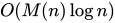

The binary GCD algorithm has also been extended to domains other than natural numbers, such as Gaussian integers,[14] Eisenstein integers,[15] quadratic rings,[16][17] and integer rings of number fields.[18]
Historical description
[edit]An algorithm for computing the GCD of two numbers was known in ancient China, under the Han dynasty, as a method to reduce fractions:
If possible halve it; otherwise, take the denominator and the numerator, subtract the lesser from the greater, and do that alternately to make them the same. Reduce by the same number.
— Fangtian – Land surveying, The Nine Chapters on the Mathematical Art
The phrase "if possible halve it" is ambiguous,[4]
- if this applies when either of the numbers become even, the algorithm is the binary GCD algorithm;
- if this only applies when both numbers are even, the algorithm is similar to the Euclidean algorithm.
See also
[edit]
References
[edit]- ^ Brent, Richard P. (13–15 September 1999). Twenty years' analysis of the Binary Euclidean Algorithm. 1999 Oxford-Microsoft Symposium in honour of Professor Sir Antony Hoare. Oxford.
- ^ Brent, Richard P. (November 1999). Further analysis of the Binary Euclidean algorithm (Technical report). Oxford University Computing Laboratory. arXiv:1303.2772. PRG TR-7-99.
- ^ Stein, J. (February 1967), "Computational problems associated with Racah algebra", Journal of Computational Physics, 1 (3): 397–405, Bibcode:1967JCoPh...1..397S, doi:10.1016/0021-9991(67)90047-2, ISSN 0021-9991
- ^ a b Knuth, Donald (1998), Seminumerical Algorithms, The Art of Computer Programming, vol. 2 (3rd ed.), Addison-Wesley, ISBN 978-0-201-89684-8
- ^ Godbolt, Matt. "Compiler Explorer". Retrieved 4 February 2024.
- ^ Kapoor, Rajiv (21 February 2009). "Avoiding the Cost of Branch Misprediction". Intel Developer Zone.
- ^ Lemire, Daniel (15 October 2019). "Mispredicted branches can multiply your running times".
- ^ "GNU MP 6.1.2: Binary GCD".
- ^ Akhavi, Ali; Vallée, Brigitte (2000), "Average Bit-Complexity of Euclidean Algorithms", Proceedings ICALP'00, Lecture Notes Computer Science 1853: 373–387, CiteSeerX 10.1.1.42.7616
- ^ Knuth 1998, p. 646, answer to exercise 39 of section 4.5.2
- ^ Menezes, Alfred J.; van Oorschot, Paul C.; Vanstone, Scott A. (October 1996). "§14.4 Greatest Common Divisor Algorithms" (PDF). Handbook of Applied Cryptography. CRC Press. pp. 606–610. ISBN 0-8493-8523-7. Retrieved 9 September 2017.
- ^ Cohen, Henri (1993). "Chapter 1 : Fundamental Number-Theoretic Algorithms". A Course In Computational Algebraic Number Theory. Graduate Texts in Mathematics. Vol. 138. Springer-Verlag. pp. 17–18. ISBN 0-387-55640-0.
- ^ Stehlé, Damien; Zimmermann, Paul (2004), "A binary recursive gcd algorithm" (PDF), Algorithmic number theory, Lecture Notes in Comput. Sci., vol. 3076, Springer, Berlin, pp. 411–425, CiteSeerX 10.1.1.107.8612, doi:10.1007/978-3-540-24847-7_31, ISBN 978-3-540-22156-2, MR 2138011, S2CID 3119374, INRIA Research Report RR-5050.
- ^ Weilert, André (July 2000). "(1+i)-ary GCD Computation in Z[i] as an Analogue to the Binary GCD Algorithm". Journal of Symbolic Computation. 30 (5): 605–617. doi:10.1006/jsco.2000.0422.
- ^ Damgård, Ivan Bjerre; Frandsen, Gudmund Skovbjerg (12–15 August 2003). Efficient Algorithms for GCD and Cubic Residuosity in the Ring of Eisenstein Integers. 14th International Symposium on the Fundamentals of Computation Theory. Malmö, Sweden. pp. 109–117. doi:10.1007/978-3-540-45077-1_11.
- ^ Agarwal, Saurabh; Frandsen, Gudmund Skovbjerg (13–18 June 2004). Binary GCD Like Algorithms for Some Complex Quadratic Rings. Algorithmic Number Theory Symposium. Burlington, VT, USA. pp. 57–71. doi:10.1007/978-3-540-24847-7_4.
- ^ Agarwal, Saurabh; Frandsen, Gudmund Skovbjerg (20–24 March 2006). A New GCD Algorithm for Quadratic Number Rings with Unique Factorization. 7th Latin American Symposium on Theoretical Informatics. Valdivia, Chile. pp. 30–42. doi:10.1007/11682462_8.
- ^ Wikström, Douglas (11–15 July 2005). On the l-Ary GCD-Algorithm in Rings of Integers. Automata, Languages and Programming, 32nd International Colloquium. Lisbon, Portugal. pp. 1189–1201. doi:10.1007/11523468_96.
Further reading
[edit]- Knuth, Donald (1998). "§4.5 Rational arithmetic". Seminumerical Algorithms. The Art of Computer Programming. Vol. 2 (3rd ed.). Addison-Wesley. pp. 330–417. ISBN 978-0-201-89684-8.
Covers the extended binary GCD, and a probabilistic analysis of the algorithm.
- Cohen, Henri (1993). "Chapter 1 : Fundamental Number-Theoretic Algorithms". A Course In Computational Algebraic Number Theory. Graduate Texts in Mathematics. Vol. 138. Springer-Verlag. pp. 12–24. ISBN 0-387-55640-0.
Covers a variety of topics, including the extended binary GCD algorithm which outputs Bézout coefficients, efficient handling of multi-precision integers using a variant of Lehmer's GCD algorithm, and the relationship between GCD and continued fraction expansions of real numbers.
- Vallée, Brigitte (September–October 1998). "Dynamics of the Binary Euclidean Algorithm: Functional Analysis and Operators". Algorithmica. 22 (4): 660–685. doi:10.1007/PL00009246. S2CID 27441335. Archived from the original (PS) on 13 May 2011.
An analysis of the algorithm in the average case, through the lens of functional analysis: the algorithms' main parameters are cast as a dynamical system, and their average value is related to the invariant measure of the system's transfer operator.
External links
[edit]- NIST Dictionary of Algorithms and Data Structures: binary GCD algorithm
- Cut-the-Knot: Binary Euclid's Algorithm at cut-the-knot
- Analysis of the Binary Euclidean Algorithm (1976), a paper by Richard P. Brent, including a variant using left shifts
Binary GCD algorithm
View on GrokipediaBackground
Greatest Common Divisor
The greatest common divisor (GCD) of two nonzero integers and , denoted , is the largest positive integer that divides both and without leaving a remainder.[4] This concept assumes and are positive for simplicity, though it extends to all integers via absolute values. Key properties include commutativity, where , and the boundary case .[4] Additionally, , which underpins efficient computation methods.[5] To illustrate, consider . The prime factorization of 48 is , while 18 is ; the highest power of each common prime is , confirming .[6] This example highlights how GCD identifies shared factors, reducing numbers to their common structure. The GCD finds broad applications across mathematics and computing. In number theory, it serves as a cornerstone for analyzing divisibility, prime decompositions, and integer relations.[7] In cryptography, it verifies coprimality (when ) essential for secure key generation in systems like RSA.[8] For fraction simplification, dividing both numerator and denominator by their GCD yields the lowest terms, as in reducing to .[9] The Euclidean algorithm offers a standard method for its computation.[10]Euclidean Algorithm
The Euclidean algorithm for computing the greatest common divisor (GCD) of two integers originates in Euclid's Elements, a foundational mathematical treatise composed around 300 BC. In Books VII and X of the Elements, Euclid describes a method to find the GCD of two lengths by repeated subtraction, which is equivalent to the modern division-based approach. This algorithm laid the groundwork for efficient integer division problems in number theory.[11][12] The recursive formulation of the Euclidean algorithm states that for two positive integers and with , , where is the remainder when is divided by . The recursion continues until , at which point . This principle relies on the fact that any common divisor of and also divides for any integer , and the modulo operation efficiently captures this by minimizing the remainder. An iterative version avoids recursion by repeatedly updating the values: set and as the inputs (assuming ), then while , replace with and with ; the final non-zero remainder is the GCD. This loop-based approach uses repeated modulo operations and is suitable for direct implementation in programming.[13] To illustrate, consider computing : Here, , , and , so the GCD is 21.[13] The algorithm's advantages include its simplicity, requiring only basic arithmetic operations, and guaranteed termination, as each remainder is strictly smaller than the previous divisor and non-negative, ensuring the process ends in a finite number of steps bounded by the input size. However, a key disadvantage is that the division operations, particularly modulo, can be computationally costly in hardware implementations due to their complexity compared to simpler bit-level operations.[13][14] The binary GCD algorithm addresses this limitation by substituting divisions with bitwise shifts and subtractions.[14]Algorithm Description
Core Principles
The binary greatest common divisor (GCD) algorithm, also known as Stein's algorithm, operates on non-negative integers represented in binary form, leveraging the inherent properties of binary arithmetic to compute the GCD efficiently.[15] A fundamental principle is the exploitation of the fact that even numbers are divisible by 2, allowing the algorithm to factor out powers of 2 from the inputs before proceeding. Specifically, if both inputs and share common trailing zeros in their binary representations—indicating divisibility by —then , reducing the problem to smaller odd integers.[15] This step ensures that subsequent operations deal primarily with odd numbers, simplifying the computation by isolating the binary factor of 2.[16] The algorithm relies on several key mathematical identities that preserve the GCD while transforming the inputs using only subtraction and halving. For , , which simulates the remainder operation without division.[15] Additionally, holds when both numbers are even, enabling recursive factoring of 2. When one number is even and the other odd, say even and odd, , as 2 does not divide .[16] These identities, grounded in the properties of divisibility and binary structure, allow the algorithm to maintain correctness while avoiding complex arithmetic.[15] A core operational foundation is the avoidance of multiplication and division operations, which are computationally expensive in binary systems, by substituting them with bitwise right shifts for halving (equivalent to division by 2) and repeated subtractions to approximate the modulo operation.[15] This approach replaces the division step of the classical Euclidean algorithm—known for its inefficiency in binary implementations—with simpler, hardware-friendly operations that align with binary representation.[16] By focusing on parity checks (even or odd) and these transformations, the binary GCD algorithm achieves its efficiency on binary computers.[15]Step-by-Step Procedure
The binary GCD algorithm takes two non-negative integers and . If , return ; if , return . Otherwise, swap and if to ensure .[17] Next, factor out the common powers of 2 from both and . Count the number of common trailing zeros in the binary representations of both numbers (i.e., , where is the 2-adic valuation). Shift both and right by bits (equivalent to integer division by ), and remember to multiply the final result by . This leverages the property that .[17] Now execute the core loop while :- If is even, shift right by 1 bit.
- Else if is even, shift right by 1 bit.
- Otherwise (both odd), if , replace with ; else replace with .
- odd, even → shift to .
- odd, even → shift to .
- odd, even → shift to .
- Both odd, → .
- even → shift to .
- Both odd, → .
Implementation
Pseudocode
The binary GCD algorithm, originally described by Josef Stein, is typically implemented in an iterative form using bit operations for efficiency on binary hardware. The procedure first handles edge cases such as zero or negative inputs by returning the absolute value of the non-zero input or 0 for both zeros (noting that GCD(0,0) is conventionally 0 despite being mathematically undefined). It then factors out common powers of 2 from both inputs, tracking the shift count to multiply back at the end. The main loop ensures at least one input is odd, shifts out trailing zeros from the even input, and replaces the larger odd input with half the difference of the two odds (which is even), repeating until one input reaches zero. Bitwise operations like right shifts (>>) for division by 2 and bitwise AND (&1) for parity checks optimize the implementation.[18] Here is a standard iterative pseudocode representation:function binary_gcd(a, b):
if a == 0:
return abs(b)
if b == 0:
return abs(a)
a = abs(a)
b = abs(b)
// Remove common factors of 2
shift = 0
while (a & 1) == 0 and (b & 1) == 0:
a >>= 1
b >>= 1
shift += 1
// Main loop: at least one is odd
while a != 0:
// Remove factors of 2 from a
while (a & 1) == 0:
a >>= 1
// Remove factors of 2 from b
while (b & 1) == 0:
b >>= 1
// Both odd: subtract and shift
if a > b:
a = (a - b) >> 1
else:
b = (b - a) >> 1
return b << shift
Programming Examples
The binary GCD algorithm lends itself to efficient implementations in various programming languages, leveraging bitwise operations for speed and portability across platforms. Implementations should handle negative inputs by taking absolute values, as GCD is defined for non-negative integers. These examples illustrate practical applications, starting with a C version using unsigned integers to prevent sign-related issues during shifts, followed by Python with integer division for shifts and modulo for parity checks, and a Java variant employing BigInteger for handling large numbers without overflow risks. Each follows the core iterative logic of removing common factors of 2 and iteratively reducing the larger odd number.C Implementation
The C implementation below uses unsigned integers and bitwise operators such as& for parity checks, >> for right shifts (equivalent to division by 2), and subtraction for reduction, ensuring operations remain within the unsigned domain.[19]
#include <stdio.h>

unsigned int binary_gcd(unsigned int u, unsigned int v) {
    if (u == 0) return v;
    if (v == 0) return u;
    unsigned int shift = 0;
    while (((u | v) & 1) == 0) {
        u >>= 1;
        v >>= 1;
        shift++;
    }
    while ((u & 1) == 0) u >>= 1;
    do {
        while ((v & 1) == 0) v >>= 1;
        if (u > v) {
            unsigned int temp = u;
            u = v;
            v = temp;
        }
        v -= u;
    } while (v != 0);
    return u << shift;
}

int main() {
    unsigned int a = 48, b = 18;
    printf("GCD of %u and %u is %u\n", a, b, binary_gcd(a, b));  // Outputs: 6
    return 0;
}
binary_gcd(48, 18) == 6, demonstrating correct reduction through even factor removal and odd subtractions.[19]
Python Example
In Python, the implementation replaces bitwise shifts with floor division (// 2) and uses modulo (% 2) to check for evenness, making it straightforward for arbitrary-precision integers. Input handling is included via user prompts for interactivity.[5]
def binary_gcd(a, b):
    if a == 0:
        return abs(b)
    if b == 0:
        return abs(a)
    a = abs(a)
    b = abs(b)
    shift = 0
    while (a | b) % 2 == 0:
        a //= 2
        b //= 2
        shift += 1
    while a % 2 == 0:
        a //= 2
    while b != 0:
        while b % 2 == 0:
            b //= 2
        if a > b:
            a, b = b, a
        b -= a
    return a << shift

if __name__ == "__main__":
    try:
        a = int(input("Enter first number: "))
        b = int(input("Enter second number: "))
        print(f"GCD of {a} and {b} is {binary_gcd(a, b)}")  # Example: GCD of 48 and 18 is 6
    except ValueError:
        print("Please enter valid integers.")
Java Variant
The Java variant utilizesBigInteger to support arbitrarily large numbers, employing methods like shiftRight(1), testBit(0) for even checks (via and(BigInteger.ONE)), and subtract for reductions, thereby avoiding overflow that could occur with primitive types like long for numbers exceeding 64 bits. This ensures reliability for cryptographic or large-scale computations.[20]
import java.math.BigInteger;
import java.util.Scanner;

public class BinaryGCD {
    public static BigInteger binaryGcd(BigInteger u, BigInteger v) {
        if (u.equals(BigInteger.ZERO)) return v.abs();
        if (v.equals(BigInteger.ZERO)) return u.abs();
        u = u.abs();
        v = v.abs();
        int shift = 0;
        while (((u.or(v)).and(BigInteger.ONE)).equals(BigInteger.ZERO)) {
            u = u.shiftRight(1);
            v = v.shiftRight(1);
            shift++;
        }
        while (u.and(BigInteger.ONE).equals(BigInteger.ZERO)) {
            u = u.shiftRight(1);
        }
        do {
            while (v.and(BigInteger.ONE).equals(BigInteger.ZERO)) {
                v = v.shiftRight(1);
            }
            if (u.compareTo(v) > 0) {
                BigInteger temp = u;
                u = v;
                v = temp;
            }
            v = v.subtract(u);
        } while (!v.equals(BigInteger.ZERO));
        return u.shiftLeft(shift);
    }

    public static void main(String[] args) {
        Scanner scanner = new Scanner(System.in);
        System.out.print("Enter first number: ");
        BigInteger a = scanner.nextBigInteger();
        System.out.print("Enter second number: ");
        BigInteger b = scanner.nextBigInteger();
        System.out.println("GCD of " + a + " and " + b + " is " + binaryGcd(a, b));
        scanner.close();  // Example: GCD of 48 and 18 is 6
    }
}
BigInteger.valueOf(Long.MAX_VALUE).multiply(BigInteger.valueOf(2)) without overflow.[20]
Performance Notes
In C, right-shift operations (>>) on unsigned integers are optimized at compile-time to single CPU instructions on most architectures, contributing to the algorithm's efficiency over division-based alternatives, with worst-case time complexity of O((log n)^2) where n is the larger input.[19]
Analysis
Time and Space Complexity
The binary GCD algorithm exhibits a time complexity of bit operations in the worst case, as the procedure requires iterations to reduce the operands, with each iteration involving bit shifts or subtractions that each cost time.[1] This bound is analogous to the Euclidean algorithm's complexity but leverages simpler operations. The space complexity is extra space beyond the input, achieved through in-place modifications of the operands without auxiliary data structures proportional to their size. In comparison to the Euclidean algorithm, the binary GCD shares a similar asymptotic time complexity of bit operations, yet it proves faster in hardware implementations lacking dedicated division support, as it substitutes expensive divisions with efficient subtractions and right shifts.[3] The worst-case scenario for the binary GCD mirrors that of the Euclidean algorithm, occurring for inputs akin to consecutive Fibonacci numbers, which demand the maximum steps.[21] For random inputs, the average-case performance of the binary GCD is markedly faster than the Euclidean variant, owing to the prevalence of even numbers that trigger early bit shifts, rapidly halving operands and minimizing subtraction steps.[21] Empirical evaluations confirm this advantage, showing the binary GCD outperforming the Euclidean algorithm for operands exceeding 8000 bits in length.[21]Correctness Proof
The correctness of the binary GCD algorithm rests on two main components: the preservation of the greatest common divisor (GCD) as an invariant through each step of the procedure, and the guarantee of termination with the correct base case result. The proof proceeds by mathematical induction on the number of iterations, leveraging key number-theoretic identities that maintain the GCD while reducing the input sizes.[22] Prior to entering the main loop, the algorithm extracts the highest common power of 2 dividing both inputs and , denoted where and is the 2-adic valuation of (the exponent of 2 in the prime factorization of ). It then computes the GCD of the resulting odd integers and , and multiplies the result by . This step is justified by the fundamental theorem of arithmetic, which states that every positive integer greater than 1 has a unique prime factorization (up to ordering of factors). Consequently, the exponent of 2 in is precisely , and the GCD of the odd parts yields the remaining odd prime factors common to and .[23][22] Assuming without loss of generality that the inputs to the main loop are positive odd integers and with , the algorithm maintains the invariant (adjusted for the initial power of 2) across iterations. This preservation relies on the following identities, applied based on the parities of and :- If is even and is odd, then . Any common divisor of and must divide (which is odd, so is odd) and thus divides , while conversely, any common divisor of and divides and .
- If both and are odd and , then . First, since any common divisor of and divides and vice versa. Moreover, is even (difference of odds), but is odd, so 2 does not divide ; thus, the common divisors (all odd) divide , and dividing by 2 removes no shared prime factors. The case is symmetric by swapping.[22][5]
Extensions
Multi-Number Variants
The binary greatest common divisor (GCD) algorithm can be extended to compute the GCD of more than two nonnegative integers by leveraging the associative property of the GCD operation, applying the pairwise algorithm iteratively to reduce the problem successively. For a set of integers , the GCD is obtained by computing , where each intermediate GCD uses the binary method's shift and subtraction operations to maintain efficiency. This approach avoids the need for division, preserving the algorithm's advantages in hardware and software implementations for large integers.[24] An optimization for multiple inputs involves first identifying and factoring out the highest common power of 2, denoted as , that divides all input numbers, then applying the iterative binary GCD to the resulting quotients, and finally multiplying the result by . This global tracking of the common 2-adic valuation reduces redundant shifts across pairwise computations, improving performance especially when many inputs share low powers of 2. Such extensions build on the core principles of Stein's binary algorithm while adapting to the multi-argument case.[24] For example, consider computing the GCD of 48, 18, and 30. Iteratively, (since both are even, shift to 24 and 9, then subtract and shift to reach 3, multiply back by 2), and . With the power-of-2 optimization, the minimum valuation is (48 divisible by 16, but 18 and 30 by only 2), so divide all by 2 to get 24, 9, 15; the GCD of these quotients is 3 (via , ); multiply by to yield 6.[24] A 2024 extension introduces a binary tree-based batch GCD algorithm for computing all-pairs GCDs efficiently among many large integers, useful for identifying weak RSA keys with shared factors in cryptanalysis.[25] In cryptography, multi-number variants of the binary GCD are applied during RSA key generation with multiple primes, where pairwise coprimality must be verified efficiently among large prime factors to ensure the modulus is square-free. The algorithm's speed with big integers makes it suitable for computing modular inverses and GCD checks in this process, as seen in optimized implementations for secure key pair creation.[3]Optimized Implementations
Software optimizations for the binary GCD algorithm primarily focus on exploiting hardware-supported operations for bit manipulation, which are central to its shift and subtraction steps. A key enhancement involves using compiler intrinsics such as GCC's__builtin_ctz to count trailing zeros in integers, enabling efficient removal of factors of 2 without iterative loops. This replaces slower manual counting with a single CPU instruction, significantly reducing execution time in the initialization and loop phases. For instance, implementations incorporating __builtin_ctz achieve up to 55% higher throughput compared to unoptimized versions on Intel processors.[26]
Further software refinements utilize assembly intrinsics for arithmetic operations, particularly in extended binary GCD variants used for modular inversion. Techniques like mutualizing updates to intermediate values (u and v) over multiple iterations and approximating operands with fixed-bit registers minimize data movement and leverage fast multiplication opcodes. Inline assembly with x86 extensions such as BMI2 for population count and ADX for wide multiplication ensures constant-time execution, reducing cycles per iteration to 6-9 on modern CPUs for 256-bit moduli. These optimizations are implemented in libraries like BearSSL, prioritizing security and performance in cryptographic contexts.[3]
In hardware adaptations, the binary GCD benefits from dedicated bit-shift units in FPGA and ASIC designs, which accelerate the right-shift operations inherent to the algorithm. FPGA implementations often replace traditional shift registers with counters to optimize area and latency; for example, an extended binary GCD modular divider for elliptic curve cryptography on a Xilinx Virtex-II FPGA utilizes counters and a modular correction unit, yielding a 62% speed increase at 58.8 MHz while using only 20% of the device resources. Recent scalable FPGA accelerators, such as FELIX for large-integer extended GCD, employ pipelined systolic arrays with custom shift logic, achieving high throughput for post-quantum cryptography applications on up to 4096-bit operands. ASIC designs similarly adopt Stein's subtraction-based approach over division-heavy Euclidean variants, resulting in lower gate counts and faster evaluation for verifiable delay functions.[27][28][14]
For multi-precision integers represented as arrays of limbs (e.g., 64-bit words), parallel variants apply the binary GCD to multiple independent computations concurrently across processor cores or GPU threads, leveraging libraries like GMP for limb-level operations. This batch processing scales well on multi-core systems and GPUs, with performance analyses showing efficient GCD computation for 1024-bit numbers using binary methods in parallel environments. Such variants are particularly effective in high-performance computing for cryptographic primitives requiring big-integer arithmetic.[29][30]
Benchmarks on 64-bit integers demonstrate that optimized binary GCD implementations outperform the standard Euclidean algorithm by 20-50% in low-end devices, where division is costly compared to shifts and subtractions. On modern embedded systems and microcontrollers lacking hardware division support, the advantage is more pronounced, with binary variants achieving up to 2-3 times the throughput for random inputs. For example, on Intel Ice Lake processors, a basic binary GCD processes 7.7 million operations per second versus 7.2 million for std::gcd, while hybrid optimizations extend this to 12 million; similar trends hold on ARM-based low-power devices. These gains establish the binary GCD's suitability for resource-constrained environments like IoT and mobile cryptography as of 2024-2025 evaluations.[31][32]