


Community hub
Recent from talks
Contribute something
Nothing was collected or created yet.
Karatsuba algorithm
View on Wikipedia| Class | Multiplication algorithm |
|---|

The Karatsuba algorithm is a fast multiplication algorithm for integers. It was discovered by Anatoly Karatsuba in 1960 and published in 1962.[1][2][3] It is a divide-and-conquer algorithm that reduces the multiplication of two n-digit numbers to three multiplications of n/2-digit numbers and, by repeating this reduction, to at most single-digit multiplications. It is therefore asymptotically faster than the traditional algorithm, which performs single-digit products.


The Karatsuba algorithm was the first multiplication algorithm asymptotically faster than the quadratic "grade school" algorithm. The Toom–Cook algorithm (1963) is a faster generalization of Karatsuba's method, and the Schönhage–Strassen algorithm (1971) is even faster, for sufficiently large n.
History
[edit]The standard procedure for multiplication of two n-digit numbers requires a number of elementary operations proportional to , or in big-O notation. Andrey Kolmogorov conjectured that the traditional algorithm was asymptotically optimal, meaning that any algorithm for that task would require elementary operations.


In 1960, Kolmogorov organized a seminar on mathematical problems in cybernetics at the Moscow State University, where he stated the conjecture and other problems in the complexity of computation. Within a week, Karatsuba, then a 23-year-old student, found an algorithm that multiplies two n-digit numbers in elementary steps, thus disproving the conjecture. Kolmogorov was very excited about the discovery; he communicated it at the next meeting of the seminar, which was then terminated. Kolmogorov gave some lectures on the Karatsuba result at conferences all over the world (see, for example, "Proceedings of the International Congress of Mathematicians 1962", pp. 351–356, and also "6 Lectures delivered at the International Congress of Mathematicians in Stockholm, 1962") and published the method in 1962, in the Proceedings of the USSR Academy of Sciences. The article had been written by Kolmogorov and contained two results on multiplication, Karatsuba's algorithm and a separate result by Yuri Ofman; it listed "A. Karatsuba and Yu. Ofman" as the authors. Karatsuba only became aware of the paper when he received the reprints from the publisher.[2]

Algorithm
[edit]Basic step
[edit]The basic principle of Karatsuba's algorithm is divide-and-conquer, using a formula that allows one to compute the product of two large numbers and using three multiplications of smaller numbers, each with about half as many digits as or , plus some additions and digit shifts. This basic step is, in fact, a generalization of a similar complex multiplication algorithm, where the imaginary unit i is replaced by a power of the base.


Let and be represented as -digit strings in some base . For any positive integer less than , one can write the two given numbers as




where and are less than . The product is then


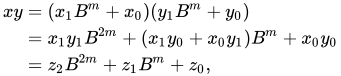
where



These formulae require four multiplications and were known to Charles Babbage.[4] Karatsuba observed that can be computed in only three multiplications, at the cost of a few extra additions. With and as before and one can observe that



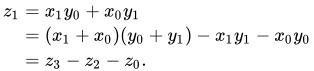
Thus only three multiplications are required for computing and


Example
[edit]To compute the product of 12345 and 6789, where B = 10, choose m = 3. We use m right shifts for decomposing the input operands using the resulting base (Bm = 1000), as:
- 12345 = 12 · 1000 + 345
- 6789 = 6 · 1000 + 789
Only three multiplications, which operate on smaller integers, are used to compute three partial results:
- z2 = 12 × 6 = 72
- z0 = 345 × 789 = 272205
- z1 = (12 + 345) × (6 + 789) − z2 − z0 = 357 × 795 − 72 − 272205 = 283815 − 72 − 272205 = 11538
We get the result by just adding these three partial results, shifted accordingly (and then taking carries into account by decomposing these three inputs in base 1000 as for the input operands):
- result = z2 · (Bm)2 + z1 · (Bm)1 + z0 · (Bm)0, i.e.
- result = 72 · 10002 + 11538 · 1000 + 272205 = 83810205.
Note that the intermediate third multiplication operates on an input domain which is less than two times larger than for the two first multiplications, its output domain is less than four times larger, and base-1000 carries computed from the first two multiplications must be taken into account when computing these two subtractions.
Recursive application
[edit]If n is four or more, the three multiplications in Karatsuba's basic step involve operands with fewer than n digits. Therefore, those products can be computed by recursive calls of the Karatsuba algorithm. The recursion can be applied until the numbers are so small that they can (or must) be computed directly.
In a computer with a full 32-bit by 32-bit multiplier, for example, one could choose B = 231 and store each digit as a separate 32-bit binary word. Then the sums x1 + x0 and y1 + y0 will not need an extra binary word for storing the carry-over digit (as in carry-save adder), and the Karatsuba recursion can be applied until the numbers to multiply are only one digit long.
Time complexity analysis
[edit]Karatsuba's basic step works for any base B and any m, but the recursive algorithm is most efficient when m is equal to n/2, rounded up. In particular, if n is 2k, for some integer k, and the recursion stops only when n is 1, then the number of single-digit multiplications is 3k, which is nc where c = log23.
Since one can extend any inputs with zero digits until their length is a power of two, it follows that the number of elementary multiplications, for any n, is at most .

Since the additions, subtractions, and digit shifts (multiplications by powers of B) in Karatsuba's basic step take time proportional to n, their cost becomes negligible as n increases. More precisely, if T(n) denotes the total number of elementary operations that the algorithm performs when multiplying two n-digit numbers, then

for some constants c and d. For this recurrence relation, the master theorem for divide-and-conquer recurrences gives the asymptotic bound .

It follows that, for sufficiently large n, Karatsuba's algorithm will perform fewer shifts and single-digit additions than longhand multiplication, even though its basic step uses more additions and shifts than the straightforward formula. For small values of n, however, the extra shift and add operations may make it run slower than the longhand method.
Implementation
[edit]Here is the pseudocode for this algorithm, using numbers represented in base ten. For the binary representation of integers, it suffices to set BASE to a different number, usually a power of 2 in line with the size of the machine word that the computer can natively multiply.[5]
const BASE = 10

/* Count the size of num in BASE. For example, 12345 has a size of 5 in base 10 and a size of 2 in base 1024. */
function size_in_base(num)
    string_num = num.toString()
	return string_num.length()

/* Split a digit into its low "d" digits and its high digits. For example, split_at(12345, 3) will extract the 3 final digits, giving: high=12, low=345. */
function split_at(num, d)
	hi =  num / (BASE ^ d)
    low = num % (BASE ^ d) /* remainder of division */
	return hi, low

function karatsuba(num1, num2)
    if (num1 < BASE or num2 < BASE)
        return num1 × num2 /* fall back to traditional multiplication */

    /* Calculates the size of the numbers. */
    m = max(size_in_base(num1), size_in_base(num2))
    m2 = floor(m / 2)
    /* m2 = ceil (m / 2) will also work */

    /* Split the digit sequences in the middle. */
    high1, low1 = split_at(num1, m2)
    high2, low2 = split_at(num2, m2)

    /* 3 recursive calls made to numbers approximately half the size. */
    z0 = karatsuba(low1, low2)
    z1 = karatsuba(low1 + high1, low2 + high2)
    z2 = karatsuba(high1, high2)

    return (z2 × BASE ^ (m2 × 2)) + ((z1 - z2 - z0) × BASE ^ m2) + z0
An issue that occurs with this implementation is that the computation of and for may result in overflow (will produce a result in the range ), which require a multiplier having one extra bit. This can be avoided by noting that




This computation of and will produce a result in the range of . This method may produce negative numbers, which require one extra bit to encode signedness, and would still require one extra bit for the multiplier. However, one way to avoid this is to record the sign and then use the absolute value of and to perform an unsigned multiplication, after which the result may be negated when both signs originally differed. Another advantage is that even though may be negative, the final computation of only involves additions.




References
[edit]- ^ Karatsuba, A. A.; Ofman, Y. P. (1962). "Multiplication of Many-Digital Numbers by Automatic Computers". Proceedings of the USSR Academy of Sciences (in Russian). 145: 293–294.
Translation in the academic journal Physics-Doklady, 7 (1963), pp. 595–596
- ^ a b
Karatsuba, A. A. (1995). "The Complexity of Computations" (PDF). Proceedings of the Steklov Institute of Mathematics. 211: 169–183.
Translation from Trudy Mat. Inst. Steklova, 211, 186–202 (1995)
- ^ Knuth, Donald E. (1969). The Art of Computer Programming. Vol. 2, Seminumerical Algorithms (1st ed.). Reading, Massachusetts: Addison-Wesley. pp. xi+624. ISBN 978-0201038026.
- ^ Babbage, Charles (1864). "Chapter VIII – Of the Analytical Engine, Larger Numbers Treated". Passages from the Life of a Philosopher. London: Longman Green. p. 125.
- ^ Weiss, Mark A. (2005). Data Structures and Algorithm Analysis in C++ (3rd ed.). Boston: Addison-Wesley. p. 480. ISBN 0321375319.
External links
[edit]- Beaver, Jonathan. "Karatsuba's Algorithm for Polynomial Multiplication". University of Pittsburgh – CS1501.
- Bernstein, Daniel J. (2001-08-11). "Multidigit multiplication for mathematicians" (PDF). cr.yp.to. Retrieved 2025-10-06.
Covers Karatsuba and many other multiplication algorithms.
- Weisstein, Eric W. "Karatsuba Multiplication". MathWorld.
- Karatsuba's Multiplication Trick Summarised in 1 Minute on YouTube
- How a Russian student invented a faster multiplication method on YouTube
Karatsuba algorithm
View on GrokipediaHistory
Discovery
The Karatsuba algorithm was developed in 1960 by Anatoly Karatsuba, a 23-year-old graduate student at Lomonosov Moscow State University.[4][5] As a participant in a seminar on mathematical problems in cybernetics organized by Andrey Kolmogorov, Karatsuba was motivated by the need to explore the fundamental limits of computational complexity for arithmetic operations.[6][7] During the seminar, Kolmogorov conjectured that multiplying two -digit numbers requires at least operations in any general algorithm, building on earlier work suggesting that the standard quadratic-time method represented an asymptotic lower bound.[4][5] Within a week of attending, Karatsuba devised a novel divide-and-conquer approach that reduced the number of required multiplications, achieving a time complexity of , where , thereby disproving Kolmogorov's conjecture.[6][4] He provided an initial proof demonstrating that this complexity holds for the recursive multiplication of large integers.[5][7] Karatsuba presented his discovery at the same Kolmogorov seminar later in 1960, where it immediately challenged prevailing assumptions about multiplication efficiency and reportedly led to the seminar's termination.[6][8] This breakthrough marked the first sub-quadratic algorithm for integer multiplication, laying foundational groundwork for subsequent advances in computational arithmetic.[4][5]Publication and Initial Impact
The Karatsuba algorithm was formally published in 1962 in the Doklady Akademii Nauk SSSR (Proceedings of the USSR Academy of Sciences), volume 145, pages 293–294, under the title "Multiplication of Multidigit Numbers on Automata."[2] The paper, authored by Anatoly Karatsuba and Yuri Ofman, was presented by Andrey Kolmogorov on February 13, 1962, and combined Karatsuba's multiplication technique with Ofman's independent extension to the complexity of addition and subtraction operations on multidigit numbers.[2] This joint presentation highlighted the algorithm's broader implications for arithmetic operations in automata, marking an early theoretical advancement in computational efficiency. Following Karatsuba's seminar presentation in late 1960, where he first outlined the algorithm, Kolmogorov expressed initial agitation due to its contradiction of his conjecture on quadratic complexity for multiplication.[9] Despite this, Kolmogorov verified the result and announced it at the subsequent seminar meeting, effectively endorsing its validity and contributing to the paper's submission.[9] An English translation appeared in Soviet Physics Doklady in 1963, volume 7, pages 595–596, broadening accessibility beyond Soviet academia.[10] The publication garnered early recognition within Soviet computing circles, where it challenged prevailing assumptions about arithmetic complexity and spurred research into faster multiplication methods.[9] It laid foundational groundwork for subsequent developments in divide-and-conquer strategies, influencing theoretical work on computational limits during the 1960s.[9]Mathematical Background
Standard Multiplication
The standard multiplication algorithm, often referred to as the schoolbook or grade-school method, computes the product of two large integers by leveraging their positional representation in a given base . Consider two -digit numbers and , where each digit . The product is then given by which expands to at most digits in base . This approach generates partial products, each obtained by multiplying one number (say, ) by a single digit of the other (), and then shifts each partial product by positions to account for the place value . These shifted partial products are subsequently added together column by column, starting from the least significant digit, with carries propagated whenever the sum in a position exceeds or equals . For instance, in base 10, multiplying 123 by 456 yields partial products 123 × 6 = 738 (no shift), 123 × 50 = 6150 (one position shift), and 123 × 400 = 49200 (two positions shift); summing 738 + 6150 + 49200 = 56088, with no carries needed in this case.[11] The algorithm's time complexity is , arising from the individual digit multiplications and a comparable number of additions and carry operations required to form and sum the partial products. This quadratic scaling establishes the baseline efficiency for large , highlighting the need for optimized methods when multiplying very large integers.[11]Divide-and-Conquer Multiplication
The divide-and-conquer strategy for multiplication involves recursively breaking down the problem of multiplying two large numbers into smaller subproblems by splitting each number into its higher and lower halves, computing the necessary products of these halves, and then combining the results through addition and shifting operations.[12] For two -bit numbers and , this approach represents and , where are each approximately -bit numbers.[12] The full product is then formed as , with the combination step requiring time for the additions and shifts.[13] In the naive implementation of this strategy, four separate recursive multiplications are performed: one each for , , , and .[12] Each of these multiplications operates on -bit operands, mirroring the original problem at half the scale, which naturally leads to a recursive structure.[14] This direct approach to decomposition ensures that the subproblems are solved independently before recombination, but it does not reduce the overall computational burden below that of the standard long multiplication method.[12] The time complexity of this naive divide-and-conquer multiplication is captured by the recurrence relation , where the term accounts for the four recursive calls and the term reflects the linear-time work to combine results.[12] Solving this recurrence using the master theorem or recursion tree method yields , which is asymptotically equivalent to the complexity of the grade-school multiplication algorithm.[12] Thus, while the method introduces recursion, it offers no speedup in the big-O sense for the base case.[13] Despite the lack of asymptotic improvement, the recursive divide-and-conquer framework proves valuable for multiplying very large numbers, as it establishes a modular structure that facilitates subsequent optimizations and easier analysis of more advanced techniques.[12] For instance, this approach can enhance cache efficiency in practical implementations by processing data in predictable blocks, and it paves the way for variants that reduce the number of recursive multiplications.[14]Algorithm Description
Core Step
The core step of the Karatsuba algorithm multiplies two n-digit numbers and in base by dividing each into higher and lower parts of approximately digits, expressed as and , where . This splitting leverages the positional nature of base- representation to align the parts for efficient recombination.[15][16] Instead of the four multiplications required in standard divide-and-conquer (, , , ), the algorithm computes only three products: , , and . The key innovation lies in deriving the cross terms from these, as , eliminating the need for a direct fourth multiplication while relying on additions and subtractions.[15][17][16] The final product is then assembled as . Each may span up to digits due to the size of the factors, and the shifts by and correspond to appending zeros in base .[15][17] In practice, additions like and subtractions like may produce temporary values exceeding , requiring carry propagation across digits during these operations and in the final assembly of . These carries are handled through standard base- addition algorithms, each taking time, ensuring the overall step remains efficient for the reduced multiplication count.[17][16]Illustrative Example
To illustrate the core step of the Karatsuba algorithm, consider multiplying the 4-digit numbers 1234 and 5678 in base 10, using a split size of m=2 digits.[18] Split each number into higher and lower parts: 1234 = 12 × 10² + 34 (so x₁=12, x₀=34) and 5678 = 56 × 10² + 78 (so y₁=56, y₀=78). Compute three products: p₁ = x₁ × y₁ = 12 × 56 = 672, p₂ = x₀ × y₀ = 34 × 78 = 2652, and p₃ = (x₁ + x₀) × (y₁ + y₀) = (12 + 34) × (56 + 78) = 46 × 134 = 6164. The middle term, corresponding to x₁ y₀ + x₀ y₁, is then p₃ - p₁ - p₂ = 6164 - 672 - 2652 = 2840.[18] Assemble the result as z = p₁ × 10⁴ + (middle term) × 10² + p₂ = 672 × 10000 + 2840 × 100 + 2652 = 6,720,000 + 284,000 + 2,652 = 7,006,652. This matches the direct multiplication 1234 × 5678 = 7,006,652. In this example, the partial products align without additional carries across the digit boundaries due to their magnitudes, though general implementations must propagate carries when combining terms to ensure correctness in base-b.[18]Recursive Formulation
The Karatsuba algorithm extends its core multiplication step through recursion, enabling the efficient computation of products for arbitrarily large integers by repeatedly dividing the operands into smaller parts until reaching a base case. For two n-digit numbers and in base (typically or ), the algorithm splits each number at a point , yielding and , where have up to digits and have up to digits. This handles uneven splits naturally, as the higher-order parts may have one more digit than the lower-order parts when is odd; no padding is strictly required, though implementations may pad for simplicity to ensure even recursion depths. The sums and may have up to digits due to carry-over.[19][17] The recursion proceeds by computing three subproducts: , , and . These are then combined using the formula , which avoids the fourth multiplication of the naive divide-and-conquer approach by leveraging the algebraic identity for the cross terms. The process recurses on these smaller instances until the base case is reached, typically when or a small threshold (e.g., single-digit multiplication), at which point the product is computed directly using standard arithmetic.[2][3] An outline of the recursive function can be expressed as follows:function Karatsuba(x, y, n):
if n ≤ 1:
return x * y // base case: direct multiplication
m = ceil(n / 2)
x1 = x // b^m // higher part
x0 = x % b^m // lower part
y1 = y // b^m
y0 = y % b^m
z2 = Karatsuba(x1, y1, m)
z0 = Karatsuba(x0, y0, n - m)
z1 = Karatsuba(x1 + x0, y1 + y0, m + 1)
return z2 * b^(2*m) + (z1 - z0 - z2) * b^m + z0
function Karatsuba(x, y, n):
    if n ≤ 1:
        return x * y  // base case: direct multiplication
    m = ceil(n / 2)
    x1 = x // b^m   // higher part
    x0 = x % b^m    // lower part
    y1 = y // b^m
    y0 = y % b^m
    z2 = Karatsuba(x1, y1, m)
    z0 = Karatsuba(x0, y0, n - m)
    z1 = Karatsuba(x1 + x0, y1 + y0, m + 1)
    return z2 * b^(2*m) + (z1 - z0 - z2) * b^m + z0
Complexity Analysis
Time Complexity
The time complexity of the recursive Karatsuba algorithm for multiplying two -digit numbers is captured by the recurrence relation , where the three recursive calls correspond to the multiplications of half-sized operands, and the term accounts for the costs of additions, subtractions, and shifts in combining the results.[3] This recurrence can be solved using the master theorem, with parameters , , and . Since and for , the theorem yields .[20] To derive this explicitly, assume for constants and . Substituting into the recurrence gives for some constant . Dividing through by yields . As , the second term vanishes if , so , or , hence . The leading constant depends on base cases and the exact coefficient but remains in the asymptotic bound.[3] This complexity is asymptotically superior to the time of the standard grade-school multiplication algorithm for sufficiently large , as , though the constant factors in Karatsuba (approximately 3 for multiplications versus 4 in the naive approach, adjusted for linear work) imply a crossover point around 20 to 100 digits in practice.[20]Space Complexity and Optimality
The space complexity of the traditional recursive Karatsuba algorithm follows the recurrence , arising from the sequential recursive subproblems and linear space for intermediate computations at each level, leading to an asymptotic bound of .[21] This bound accounts for temporary storage during the divide-and-conquer process. The algorithm can be further optimized to achieve space complexity through advanced in-place techniques that minimize buffer usage.[21] A key aspect of the recursive formulation is the call stack depth of , which adds negligible space overhead. Iterative versions can eliminate the stack while maintaining the same time complexity and space.[22] In practice, the Karatsuba algorithm outperforms the quadratic schoolbook method starting at around 10 to 100 digits, depending on the number base, hardware architecture, and implementation details; for example, on modern processors, the crossover occurs between 8 and 24 machine words (roughly 150 to 500 decimal digits for 64-bit words).[23][24] Theoretically, integer multiplication has a conjectured lower bound of , making Karatsuba's exponent of a seminal milestone as the first algorithm to achieve sub-quadratic time below , influencing subsequent advancements like the Schönhage–Strassen algorithm.[25][26]Implementations and Extensions
Pseudocode Implementation
The Karatsuba algorithm can be implemented recursively in a high-level pseudocode form, treating the input numbers as arrays of digits in a given base (e.g., for decimal or for binary), which allows handling arbitrary-precision integers without overflow in the base case. This representation facilitates splitting the arrays into high and low halves, performing recursive multiplications, and recombining results while propagating carries during addition. The base case uses a standard schoolbook multiplication for small inputs to terminate recursion.[3] The following pseudocode assumes the inputs and are arrays of digits (least significant digit first) of equal length (padded if necessary), and is a power of 2 for simplicity. The function returns the product as a digit array in the same base, with a helper function for schoolbook multiplication and another for addition with carry propagation.function karatsuba_multiply(x, y, base):
n = [length](/page/Length)(x)
if n <= 1: // Base case for small n
return schoolbook_multiply(x, y, base) // O(1) or O(n^2) for tiny n
m = n // 2
x_low = x[0:m] // Low half (least significant digits)
x_high = x[m:n] // High half (most significant digits)
y_low = y[0:m]
y_high = y[m:n]
// Compute three recursive products
p1 = karatsuba_multiply(x_high, y_high, base) // x_high * y_high
p2 = karatsuba_multiply(x_low, y_low, base) // x_low * y_low
// Compute (x_high + x_low) and (y_high + y_low) with carry
x_mid = add_arrays(x_high, x_low, base) // Temporary sum, carry propagated
y_mid = add_arrays(y_high, y_low, base)
p3 = karatsuba_multiply(x_mid, y_mid, base) // (x_high + x_low) * (y_high + y_low)
// Compute z = p3 - p1 - p2 (cross term x_high y_low + x_low y_high), with carries/borrows handled
z = subtract_arrays(p3, add_arrays(p1, p2, base), base)
// Combine: result = p1 * base^n + z * base^m + p2
// Shift and add with carry propagation
result_high = shift_left(p1, n, base) // Multiply by base^n
z_shifted = shift_left(z, m, base) // Multiply by base^m
result_low = p2
result = add_arrays(add_arrays(result_high, z_shifted, base), result_low, base)
return normalize(result, base) // Remove leading zeros, propagate final carries
function karatsuba_multiply(x, y, base):
    n = [length](/page/Length)(x)
    if n <= 1:  // Base case for small n
        return schoolbook_multiply(x, y, base)  // O(1) or O(n^2) for tiny n

    m = n // 2
    x_low = x[0:m]      // Low half (least significant digits)
    x_high = x[m:n]     // High half (most significant digits)
    y_low = y[0:m]
    y_high = y[m:n]

    // Compute three recursive products
    p1 = karatsuba_multiply(x_high, y_high, base)  // x_high * y_high
    p2 = karatsuba_multiply(x_low, y_low, base)    // x_low * y_low
    // Compute (x_high + x_low) and (y_high + y_low) with carry
    x_mid = add_arrays(x_high, x_low, base)  // Temporary sum, carry propagated
    y_mid = add_arrays(y_high, y_low, base)
    p3 = karatsuba_multiply(x_mid, y_mid, base)  // (x_high + x_low) * (y_high + y_low)

    // Compute z = p3 - p1 - p2 (cross term x_high y_low + x_low y_high), with carries/borrows handled
    z = subtract_arrays(p3, add_arrays(p1, p2, base), base)

    // Combine: result = p1 * base^n + z * base^m + p2
    // Shift and add with carry propagation
    result_high = shift_left(p1, n, base)  // Multiply by base^n
    z_shifted = shift_left(z, m, base)     // Multiply by base^m
    result_low = p2
    result = add_arrays(add_arrays(result_high, z_shifted, base), result_low, base)
    return normalize(result, base)  // Remove leading zeros, propagate final carries
schoolbook_multiply performs direct digit-by-digit multiplication, add_arrays adds two digit arrays element-wise with carry propagation (e.g., carry = (a_i + b_i + carry_in) // base, digit = % base), subtract_arrays does analogous subtraction (handling borrows), shift_left appends zeros to represent multiplication by a power of the base, and normalize ensures the output array has no leading zero digits. This formulation directly implements the core step of computing the cross terms via .[3][27]
For computer science contexts, the algorithm adapts naturally to binary representation (base ), where inputs are bit arrays and operations simplify: digits are 0 or 1, schoolbook multiplication is a simple AND/XOR for bits, and additions/subtractions use bitwise operations with carry (though full carry propagation is still needed for correctness). The pseudocode structure remains identical, but shifts become left-shifts by bit counts (e.g., is appending zero bits), and the three recursive calls reduce the constant factors in practice for hardware implementations.[27]
Practical Optimizations and Variants
In practical implementations, the Karatsuba algorithm is often employed in hybrid strategies that combine it with simpler methods for small operands and more advanced techniques for very large ones to optimize overall performance. For medium-sized integers, typically ranging from hundreds to thousands of bits, Karatsuba provides asymptotic benefits over the quadratic schoolbook multiplication while avoiding the setup costs of faster Fourier transform (FFT)-based methods; thus, implementations switch to schoolbook multiplication below a certain threshold (e.g., around 50-100 limbs in base-2^{32}) and to FFT or number-theoretic transform (NTT) variants for operands exceeding several thousand bits. This adaptive approach minimizes constant factors and overhead, achieving up to 20-30% speedups in real-world benchmarks for cryptographic applications compared to pure Karatsuba recursion.[28][29] To address recursion-related issues such as stack overflow and excessive function call overhead in deep recursions, iterative non-recursive versions of Karatsuba have been developed, reformulating the divide-and-conquer process as a series of loops that process splits level-by-level, often using deques or arrays to manage intermediate results. These variants reduce space complexity from O(n log n) to O(n) in the worst case and improve cache locality on modern CPUs by minimizing branch predictions and function prologue/epilogue costs, with reported reductions in runtime by 10-15% for large inputs. Additionally, windowing techniques allow uneven splits (e.g., dividing into parts of sizes k and n-k where k ≠ n/2) to better align with hardware word sizes or operand asymmetries, further tuning efficiency for specific data distributions.[30][31] Variants extending Karatsuba include the Toom-Cook family, where the three-way split (Toom-3) generalizes the two-way Karatsuba by evaluating polynomials at more points to reduce multiplications from 9 to 5 for ternary divisions, achieving O(n^{1.465}) complexity and serving as a bridge to higher-order methods before FFT dominance. Another adaptation, the Karatsuba-Winograd variant, applies the algorithm to matrix multiplication by treating matrices as bivariate polynomials and using similar reduction tricks to lower the number of scalar multiplications, though it incurs higher addition counts and is practical only for modest dimensions due to constant overhead. Despite these advances, challenges persist: the algorithm's reliance on numerous additions and subtractions (roughly 3n per level) can dominate for small-to-medium n on hardware where multiplications are cheaper than adds, prompting thresholds around 2^{10}-2^{15} bits for breakeven; base choices like 2^{32} or 10^9 optimize limb operations to match CPU word sizes and reduce carry propagations, but poor alignment can inflate costs by 5-10%; and modern CPU cache effects, such as L1/L2 misses from scattered recursive accesses, necessitate strided or blocked layouts to maintain performance within 80-90% of theoretical bounds.[31][28][29]Applications
In Arbitrary-Precision Arithmetic
The GNU Multiple Precision Arithmetic Library (GMP) employs the Karatsuba algorithm as an intermediate multiplication method for large integers, applying it to operand sizes exceeding the basecase threshold and before transitioning to more advanced techniques like Toom-Cook variants or FFT-based methods.[32] This positions Karatsuba to handle multiplications efficiently for numbers up to several thousand digits, where it provides a balance between computational overhead and asymptotic performance gains over schoolbook multiplication.[32] In programming language implementations, Karatsuba serves as a core component for arbitrary-precision integer arithmetic. Python's CPython interpreter integrates Karatsuba multiplication for built-inint types when handling integers larger than approximately 70 digits, acting as a bridge to even faster algorithms like Nussbaumer convolution for extremely large operands.[33] Similarly, Java's BigInteger class in the standard library uses Karatsuba for multiplications in the sub-quadratic regime, specifically for operand sizes between naive methods and theoretical optimal approaches, ensuring robust performance before invoking higher-complexity strategies.[34]
Karatsuba's efficiency proves particularly valuable in cryptographic applications requiring rapid multiplication of large numbers, such as RSA key generation, where it accelerates the computation of products between large primes.[35] For instance, implementations leveraging recursive Karatsuba can achieve measurable speedups in modular exponentiation and key derivation compared to unoptimized methods. In OpenSSL, Karatsuba contributes to an effective O(n^{1.6}) complexity for intermediate-sized operands, enhancing decryption and signing performance in RSA workflows.[36]
As of 2025, Karatsuba remains relevant in blockchain systems for optimizing big-integer operations in cryptographic primitives. It is incorporated in Bitcoin's BitVM paradigm for efficient representation and multiplication of 254-bit numbers, supporting scalable zero-knowledge proofs and layer-2 solutions.[37] Additionally, hybrid Karatsuba variants enhance elliptic curve cryptography processors for IoT applications, delivering high throughput for 191-bit operations in resource-constrained environments.[38]