Hubbry Logo
Blue-and-yellow macawBlue-and-yellow macawMain
Open search
Blue-and-yellow macaw
Community hub
Blue-and-yellow macaw
logo
8 pages, 0 posts
0 subscribers
Be the first to start a discussion here.
Blue-and-yellow macaw
from Wikipedia

Blue-and-yellow macaw
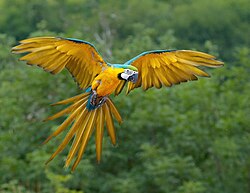
Blue-and-yellow macaw in flight at Jurong Bird Park
CITES Appendix II (CITES)[2]
Scientific classification Edit this classification
Kingdom: Animalia
Phylum: Chordata
Class: Aves
Order: Psittaciformes
Family: Psittacidae
Genus: Ara
Species:
A. ararauna
Binomial name
Ara ararauna
  Distribution
Synonyms

Psittacus ararauna Linnaeus, 1758

The blue-and-yellow macaw (Ara ararauna), also known as the blue-and-gold macaw, is a large Neotropical parrot with a mostly blue dorsum, light yellow/orange venter, and gradient hues of green on top of its head. It is a member of the large group of neotropical parrots known as macaws. It inhabits forest (especially varzea, but also in open sections of terra firme or unflooded forest), woodland and savannah of tropical Central and South America, as well as the island of Trinidad in the Caribbean. They are popular in aviculture because of their striking color, ability to talk, ready availability in the marketplace, and close bonding to humans. It is the most commonly kept macaw species in captivity worldwide as a pet or companion parrot and is also the cheapest among the large macaws. As of 2025, there are 1 million blue and gold macaws living in captivity worldwide, one of the highest population of any large parrot in captivity, such is the popularity of this bird.

Taxonomy

[edit]

The blue-and-yellow macaw was formally described by the Swedish naturalist Carl Linnaeus in 1758 in the tenth edition of his Systema Naturae. He placed it with all the other parrots in the genus Psittacus and coined the binomial name Psittacus ararauna.[3] This macaw is now one of the eight extant species within the Ara genus, first proposed in 1799 by the French naturalist Bernard Germain de Lacépède.[4][5] The genus name is from ará meaning "macaw" in the Tupi language of Brazil. The word is an onomatopoeia based on the sound of their call. The specific epithet ararauna comes from the Tupi Arára úna meaning "big dark parrot" for the hyacinth macaw.[6] The word ararauna had been used by the German naturalist Georg Marcgrave in 1648 in his Historia Naturalis Brasiliae.[7] The species is monotypic: no subspecies are recognised.[5]

Description

[edit]

These birds can reach a length of 81–91 cm (32–36 in) and weigh 1.0–1.5 kg (2–3 lb), making them some of the larger members of their family. They are vivid in appearance with bright aqua blue feathers on the top of their body except for the head, which is lime colored. The bottom, however, is a rich deep yellow/light orange. Their beak is black, as well as the feathers under their chin. Its feet are of a gray color, save for black talons. The bird has white skin, with its face having nearly no feathers beside a few black ones spaced apart from each other forming a striped pattern around the eyes. The irises are pale light yellow.[citation needed]

Blue-and-yellow macaws can live from 30 to 35 years in the wild, and reach sexual maturity between the ages of 3 and 6 years.[8]

Little variation in plumage is seen across the range. Some birds have a more orange or "butterscotch" underside color, particularly on the breast. This was often seen in Trinidad birds and others of the Caribbean area. The blue-and-yellow macaw uses its powerful beak for breaking nutshells, and for climbing up and hanging from trees.[8] As well as nuts, it will also feed on seeds, fruits, vegetable matter, bark and leaves,[9] also (reportedly but rarely) insects and snails.[10]

Distribution and habitat

[edit]

This species occurs in Panama, Trinidad and Tobago, Colombia, Suriname, French Guiana, Venezuela, Guyana, Peru, Brazil, Bolivia, Ecuador, and Paraguay. The range extends slightly into Central America, where it is restricted to Panama. While most breed in rural and forested areas, small numbers breed in urban cities such as Rondonópolis, Mato Grosso, Brazil, nesting in dead palms planted for ornamental purposes alongside city roads.[11] Although they were nearly wiped out in Trinidad due to human activity during the 1970s, a recent programme of reintroduction has proved successful. Between 1999 and 2003, wild-caught blue-and-yellow macaws were translocated from Guyana to Trinidad, in an attempt to reestablish the species in a protected area around the Nariva Swamp;[12] despite this, the IUCN still lists them as extirpated from the country. A small breeding population descended from introduced birds is found in Puerto Rico,[1] and another has inhabited Miami-Dade County, Florida, since the mid-1980s.[13]

Breeding

[edit]
Ara araraunaMHNT
20-day-old blue-and-gold macaw

The blue-and-yellow macaw generally mates for life. They nest almost exclusively in dead palms and most nests are in Mauritia flexuosa palms. The female typically lays two or three eggs. The female incubates the eggs for about 28 days. One chick is dominant and gets most of the food; the others perish in the nest. Chicks fledge from the nest about 97 days after hatching. The male bird's color signals readiness for breeding. The brighter and bolder the colors, the better the chance of getting a mate.[14]

Conservation and threats

[edit]

The blue-and-yellow macaw is on the verge of being extirpated in Paraguay, but it still remains widespread and fairly common in a large part of mainland South America. The species is therefore listed as Least Concern by BirdLife International. Its wild population has not been quantified but is believed to be above 10,000 individuals and is in decline. It is listed on CITES Appendix II, trade restricted.[1]

Aviculture

[edit]

Even well-tended blue-and-yellow macaws are known to "scream" for attention, and make other loud noises. Loud vocalizations, especially "flock calls", and destructive chewing are natural parts of their behavior and should be expected in captivity. Due to their large size, they also require plentiful space in which to fly around. According to World Parrot Trust, an enclosure for a blue-and-yellow macaw should, if possible, be at least 15 m (50 ft) in length.[15] Captive macaws, kept with good diet, exercise, and veterinary care are known to have lived 60 or more years.[16] People considering a macaw as a companion parrot must be aware of this and consider that the bird may outlive the owner.

The blue-and-yellow macaw has been noted to blush its bare facial skin and fluff the feathers of its cheeks, head and nape when interacting with humans. This may be an expression of the parrot's emotional state.[17]

[edit]
Macaw in a bird fair in Italy

See also

[edit]

References

[edit]

Further reading

[edit]
[edit]
Revisions and contributorsEdit on WikipediaRead on Wikipedia
from Grokipedia
The blue-and-yellow macaw (Ara ararauna), also known as the blue-and-gold macaw, is a large renowned for its vibrant , featuring a predominantly upper body, bright underparts and sides, a dull green forehead, black chin and feather lines on the pinkish-white bare facial skin, and a strong hooked . Measuring 81–91 cm (32–36 in.) in length with a of 102–114 cm (40–45 in.) and weighing 900–1,300 g (2–2.9 lbs.), it possesses zygodactyl feet adapted for climbing and grasping, and long tail feathers that aid in agile flight reaching speeds up to 56 kph (35 mph). Native to a broad range across northern and central , formerly including Trinidad, , and northern but now extirpated from some areas such as western and parts of , the inhabits lowland forests, swamps, seasonally flooded várzea forests, and gallery woodlands from eastern southward through , , , , Amazonian , and into northern and . These macaws are primarily herbivorous, feeding on a diverse diet of , nuts, fruits, berries, and occasionally clay from riverbanks to neutralize toxins in unripe , often in flocks within their preferred tropical habitats. Highly social and intelligent, blue-and-yellow macaws form lifelong monogamous pairs and travel in noisy flocks of up to 30 individuals, exhibiting playful behaviors such as hanging upside down, mimicking sounds including human speech, and engaging in mutual . They nest in tree cavities or cliffs, laying clutches of 2–3 eggs that incubate for about 29 days, with fledging occurring after roughly 4 months and reached at 3–6 years; in the wild, they can live up to 30–50 years, and 50–80 years or more in . Despite a wide distribution, the faces threats from loss—projected to affect 20.9–35.3% of suitable areas over three generations (38 years)—illegal pet trade, and hunting for feathers and food, leading to local declines near settlements. Classified as Least Concern by the IUCN due to its large range and stable core populations in remote areas, it is protected under Appendix II, with conservation efforts focusing on and anti-trafficking measures.

Taxonomy and systematics

Classification and etymology

The blue-and-yellow macaw is classified within the order Psittaciformes, which encompasses all parrots and related birds, and the family , comprising true parrots including macaws, parakeets, and conures. It belongs to the genus Ara, a group of large Neotropical macaws characterized by robust builds, strong bills, and vibrant plumage, with the species designated as Ara ararauna. Within the genus Ara, A. ararauna is distinguished from congeners like the (Ara macao) through morphological traits such as its predominantly blue dorsal plumage contrasting with the scarlet macaw's red body and blue , as well as molecular data from phylogenomic analyses that resolve it as a monophyletic lineage separate from the red-phenotype species. The species was first formally described by in 1758 under the Psittacus ararauna in the tenth edition of , placing it initially within the broad genus that encompassed many parrots. Subsequent taxonomic revisions in the late 18th and 19th centuries reclassified it into the genus Ara, established by in 1799 to better reflect phylogenetic relationships among large macaws based on shared anatomical features like bare facial skin and tail structure. By the , its placement remained stable, with modern genetic studies reinforcing the distinction among Ara species without necessitating further revisions. The genus name Ara derives from the Tupi-Guarani word ará, an indigenous Brazilian term for that mimics the bird's raucous vocalizations as an . The specific epithet ararauna likely originates from Tupi roots, combining ara ( or ) with rauna (meaning dark or black), possibly alluding to the bird's dark wing edges or a descriptive indigenous name. The common name "blue-and-yellow " directly reflects its striking coloration, with brilliant blue upperparts and golden-yellow underparts setting it apart visually.

Subspecies and genetic variation

The blue-and-yellow macaw (Ara ararauna) has no formally recognized subspecies according to assessments by the IUCN and BirdLife International. However, genetic and morphological studies have identified regional variants within its range, including differences between populations in the northern and southern Amazon Basin, as well as a larger-bodied morph observed in Bolivian populations. These variants exhibit subtle plumage variations, such as differences in the intensity of blue on the wings or yellow on the underparts, potentially reflecting local adaptations or historical isolation. Genetic research indicates low overall in the , attributed to historical bottlenecks and ongoing . A study using DNA fingerprinting on wild populations in central revealed high genetic similarity indices (mean 0.315 ± 0.090) and evidence of fixation, suggesting reduced variability comparable to that in other vulnerable psittacines. Phylogeographic analyses of and microsatellites have further identified structured regional populations—western, central, and eastern Amazonian groups—with historical isolation estimated at approximately 374,000 years ago, supporting female and male-biased that limits diversity. Studies on the mating system highlight genetic monogamy, with low rates of extra-pair paternity (zero observed in sampled nests), aligning with the species' long-lived social pairs and biparental care. This was confirmed through parentage analysis in a 2011 investigation of wild nests in the Amazon, where microsatellite markers showed all offspring sired by social mates. Phylogenetically, the blue-and-yellow macaw is closely related to other large macaws in the genus Ara, particularly the scarlet macaw (Ara macao), based on shared morphological and genetic traits. Mitochondrial DNA analyses, including complete genome sequencing, demonstrate their proximity within the Arini tribe, reflecting ancient vicariance events in Neotropical forests.

Physical description

Morphology and plumage

The blue-and-yellow macaw exhibits striking plumage characterized by vibrant turquoise-blue feathers covering the upperparts, including the back, wings, and tail, contrasted by golden-yellow underparts and rump. The forehead features green feathers, while the cheeks consist of bare white skin accented by fine lines of tiny feathers extending from the eyes and base of the bill, along with a chin stripe of feathers. Underwing coverts display a yellow-orange hue, enhancing the bird's vivid appearance during flight. Structurally, the species possesses a large, curved black bill adapted for cracking hard nuts and seeds, a hallmark of morphology that enables efficient on tough food items. Its feet are strong and zygodactyl, with two toes facing forward and two backward, providing a powerful grip for and manipulating objects in arboreal environments. The tail is notably long, comprising more than half the total body length, which aids in balance and maneuverability among canopies. The bare white skin can flush red in response to excitement or social stimuli, serving as a signal through rapid changes in blood flow to the . Juveniles display duller coloration overall compared to adults, with less intense blues and yellows, and possess shorter tails that gradually elongate with growth. Full adult plumage is typically achieved by 3-4 years of age, coinciding with sexual maturity.

Size, weight, and sexual dimorphism

The blue-and-yellow macaw (Ara ararauna) attains a total body length of 81 to 91 cm (32 to 36 in), including a prominent tail measuring 45 to 50 cm, with a wingspan ranging from 102 to 115 cm. Adults typically weigh 900 to 1,300 g. Sexual dimorphism is minimal in this species, with no differences in plumage coloration or pattern between males and females; however, males tend to be slightly larger overall, with marginally greater body mass (averaging 1,100 to 1,300 g) and head size compared to females (900 to 1,200 g). Accurate sex determination often requires molecular techniques such as DNA analysis or detailed morphometric assessments rather than visual inspection. Ontogenetic changes in size are pronounced during early development; newly hatched chicks weigh 14 to 20 g and are altricial, lacking feathers and mobility. Fledglings achieve near-adult body dimensions by approximately 3 months of age, coinciding with fledging at 12 to 14 weeks, after which they continue to refine motor skills under .

Distribution and habitat

Geographic range

The blue-and-yellow macaw (Ara ararauna) is native to a broad expanse of tropical lowland forests and woodlands in Central and , with its range extending from eastern southward through , , and (, , and ), and continuing east and south to include , , , , , and northern . This distribution centers primarily on the and the River lowlands, where the species occupies contiguous habitats across multiple countries. Historically, the blue-and-yellow macaw was more widely distributed within this range, but it has been extirpated from several peripheral areas due to extensive and habitat conversion since the mid-20th century. Notably, the species disappeared from , where it was once native, and from portions of southern , including the states of and Rio de Janeiro. These losses have resulted in a more fragmented current distribution, with isolated subpopulations in altered landscapes. Recent conservation initiatives have aimed to restore the species to parts of its former range through reintroductions. In 2025, six captive-bred individuals were released in São Paulo state, marking the first return of blue-and-yellow macaws to the region in over 50 years, facilitated by specialized flight training programs. Similarly, four birds were reintroduced to Rio de Janeiro's Tijuca National Park after more than 200 years of absence, led by the Refauna organization to bolster local biodiversity. The global wild population size has not been quantified, though the species is described as uncommon; the overall population trend is decreasing, suspected to have declined by less than 25% over three generations (38 years), though core populations in remote areas remain stable.

Habitat types and adaptations

The blue-and-yellow macaw (Ara ararauna) primarily inhabits humid tropical rainforests, gallery forests along riverbanks, palm groves, and the edges of savannas, where it exploits a mosaic of forested and open landscapes. These environments provide essential resources such as fruiting trees and water sources, with the showing a strong preference for areas near rivers or in swampy lowlands. It occurs at elevations from up to 1,500 m, though most populations are concentrated in lowland regions below 500 m. The bird relies heavily on large, mature trees for both nesting and feeding, particularly in habitats dominated by palm species that offer year-round food availability. Physiological and behavioral adaptations enable the blue-and-yellow macaw to thrive in these dynamic tropical settings. Its robust, curved bill is specially adapted for exerting powerful force to crack open tough palm fruits and seeds, allowing access to high-energy foods that are staples of its diet. Strong flight muscles and a of 104–114 cm support long-distance travel, with individuals often covering up to 15 km daily between roosting and foraging sites. The also demonstrates tolerance for seasonal flooding in várzea forests, where rising waters alter the but do not deter occupancy, as evidenced by its persistence in periodically inundated palm swamps. In terms of microhabitat use, blue-and-yellow macaws preferentially nest in cavities within dead, standing trunks of palms such as , which provide secure, elevated sites in swampy or settings. They roost in the upper canopy of large trees at night, minimizing exposure to ground predators. While capable of utilizing fragmented edges, the species generally avoids heavily disturbed or deforested areas, favoring relatively intact habitats that maintain structural complexity for protection and resource access.

Behavior and ecology

Social behavior and communication

Blue-and-yellow macaws exhibit a centered on long-term monogamous pair bonds, which typically last for the birds' lifetimes and form the core unit of their . Genetic analyses of nestlings confirm high levels of relatedness consistent with exclusive pairing by parents, supporting the prevalence of social monogamy in this species. Outside of breeding, these pairs integrate into flocks ranging from 10 to 30 individuals, which provide protection from predators and facilitate coordinated activities; flock sizes can occasionally reach up to 34 birds during periods of resource abundance. Within flocks, dominant pairs often lead movements and exhibit agonistic behaviors, such as wing displays and displacement of subordinates, establishing a loose that influences access to resources and roosting positions. Communication among blue-and-yellow macaws combines vocal and visual signals to maintain group cohesion over distances and convey emotional states. Their primary vocalizations are loud, raucous screeches and calls, reaching intensities of 105–120 decibels, which serve to coordinate flock members and signal location during flight or separation. These calls contribute to evening roosting choruses, where flocks gather noisily before settling, reinforcing social bonds. Visually, they employ including head bobbing and tail fanning during interactions, while displays—such as ruffling bare head feathers and flushing the white bare to —indicate affiliation, excitement, or mild in social contexts like conspecifics or humans. A study of captive individuals documented these displays in 80% of observed affiliative encounters, suggesting they play a key role in expressing positive emotional valence and modulating interactions. Daily routines reflect their , with flocks departing roosts in synchronized morning flights to areas, often led by dominant pairs, and reconvening in the late afternoon for . Playful behaviors, such as aerial chases and tumbling flights, are common among juveniles and pairs, strengthening pair bonds and flock cohesion without direct reference to reproductive signaling.

Diet and foraging

The blue-and-yellow macaw (Ara ararauna) maintains a primarily herbivorous diet dominated by seeds, which account for approximately 70% of its intake, supplemented by fruits (around 20-30%), nuts, flowers, and small amounts of insects or other vegetable matter. Prominent food sources include hard-shelled nuts from palms such as Astrocaryum species and the Brazil nut (Bertholletia excelsa), as well as pulpy fruits from trees like Acrocomia aculeata. The diet shows seasonal shifts, with increased consumption of unripe seeds during fruit-scarce periods and visits to clay licks for geophagy, where individuals ingest mineral-rich soil to detoxify plant alkaloids or obtain scarce nutrients like sodium. Foraging occurs diurnally across the forest canopy and , usually in pairs or small flocks of 2 to 30 birds that coordinate to locate and exploit food patches. These macaws use their powerful, curved bills to dexterously seeds, crack tough nuts, and manipulate fruits, often leaving behind damaged in a destructive manner. Such behaviors extend to opportunistic feeding on cultivated crops like corn, which can lead to localized conflicts with agricultural communities. As seed predators and dispersers, blue-and-yellow macaws influence dynamics by consuming pulp from fruits and discarding viable whole beneath distant perching trees, achieving dispersal distances of up to 1,200 meters and rates of 75-100% for many plant species. This external dispersal mechanism promotes plant recruitment and contributes to the spatial patterning and regeneration of Amazonian woodlands.

Reproduction and parental care

The blue-and-yellow macaw (Ara ararauna) is monogamous and typically mates for life, with pairs engaging in elaborate rituals that include mutual feeding, , and synchronized aerial displays to reinforce their bond. Breeding occurs seasonally, generally from to in northern parts of the range and February to April in southern regions, with pairs attempting to breed every 1 to 2 years. Females lay a clutch of 2 to 3 white eggs, which are incubated for 24 to 29 days primarily by the female, although the male may assist briefly and provides food to the incubating female throughout the period. Nesting sites are selected in natural tree cavities, often in dead palms such as , at heights of 10 to 20 meters above the ground to minimize predation risk; pairs do not construct nests but rely on existing hollows and frequently reuse the same site in subsequent seasons. Hatchlings are altricial, emerging blind, featherless, and entirely dependent on their parents, who share duties in brooding and protection. Both parents regurgitate food to feed the chicks for the first 3 to 4 months, with the female handling initial feedings and the male increasingly participating as the young grow. Chicks at around 3 months (90-100 days) but remain with the family group for up to a year to achieve full independence, during which time the strong aids in ongoing parental guidance.

Conservation status

The blue-and-yellow macaw (Ara ararauna) is classified as Least Concern on the , with the most recent assessment confirming this status due to its extensive geographic range across , despite an ongoing . The global wild population has not been precisely quantified but is described as uncommon, with estimates suggesting it numbers in the hundreds of thousands across its range from to northern . The species is listed under Appendix II, reflecting regulated , with over 55,000 wild-caught individuals recorded in trade since 1981. Population trends indicate a decreasing trajectory overall, driven primarily by habitat fragmentation and human activities, though the species remains stable in many core Amazonian areas owing to its broad distribution spanning over 10 million square kilometers. Local extirpations have occurred in urbanized and agricultural regions, such as parts of southeastern Brazil including São Paulo state, where the species was absent for over 50 years prior to recent reintroductions. Models project a potential loss of 20.9% to 35.3% of suitable habitat over three generations (approximately 38 years), based on ongoing Amazonian deforestation rates. Key threats include widespread habitat destruction from logging and agricultural expansion in the Amazon basin and adjacent ecosystems, which reduces nesting sites in large trees and palm swamps critical for the species. Illegal capture for the pet trade, including nest poaching of chicks, continues to impact populations, particularly in accessible areas like Brazil's Emas National Park, where it contributes to reduced reproductive success. Additionally, climate change is altering fruiting cycles of key food plants such as palms, potentially disrupting foraging patterns in tropical forests.

Protection measures and reintroductions

The blue-and-yellow macaw (Ara ararauna) is protected under the Appendix II, a designation implemented in to regulate and prevent overexploitation. In its range countries, the receives national legal safeguards, such as those enforced by Brazil's Instituto Brasileiro do Meio Ambiente e dos Recursos Naturais Renováveis (IBAMA), which prohibits unauthorized capture, trade, and export of native wildlife, including psittacines like this macaw. Key habitats are conserved within protected areas, including Peru's , where the species maintains a density of approximately one pair per square kilometer, and Brazil's wetlands, designated as a with strict anti-deforestation measures. Conservation programs emphasize proactive interventions to counter habitat loss and poaching. Anti-poaching patrols operate in core range areas, such as Amazonian reserves, where rangers monitor nests and deter illegal trappers through surveillance and community collaborations. Habitat restoration efforts include reforestation initiatives in deforested Amazon fringes, planting native trees like palms that provide essential food and nesting resources for the macaw. Notable reintroduction projects have shown promise: in São Paulo state, Brazil, six captive-raised individuals underwent innovative "flying lessons" training—starting flights at three months old to build wild survival skills—resulting in 100% survival over more than two years following their 2022 release, even amid a 2024 wildfire. Similarly, in Rio de Janeiro, the nonprofit Refauna released four birds (three females, one male) into Tijuca National Park after over 200 years of local absence, with initial acclimatization in enclosures to foster adaptation before full release. Ongoing monitoring integrates technology and behavioral to evaluate reintroduction success and inform strategies. GPS tracking devices on released individuals allow real-time assessment of movement patterns, home range establishment, and use, ensuring early intervention if birds stray toward threats. Behavioral studies, such as a 2025 analysis on monogamous pairing in parrots, highlight how lifelong bonds influence population stability, guiding conservation by prioritizing pair protection in reintroduction protocols. Community campaigns in range countries target illegal pet trade reduction, training locals on species identification, legal reporting of poachers, and sustainable to foster long-term stewardship.

Human interactions

Aviculture and captive breeding

The blue-and-yellow macaw (Ara ararauna) is one of the most popular large in the and zoological collections due to its striking , vocal abilities, and relative availability compared to rarer macaws. In the wild, blue-and-yellow macaws typically live 30–50 years, though some reach up to 60 years; in captivity, with proper care, they can live 50–80 years or more. They require spacious enclosures to accommodate their active nature, with a minimum recommended size of 5 feet by 5 feet by 8 feet for suspended flight cages, allowing full wing extension and flight; larger aviaries are preferred for breeding pairs or long-term housing to reduce stress and promote natural behaviors. Captive care emphasizes a balanced diet, , and social interaction to mimic wild conditions and prevent behavioral issues. The primary diet consists of 75-80% high-quality pelleted food formulated for macaws, supplemented with 20-40% fresh fruits (such as ), vegetables (like carrots and leafy greens), nuts (including almonds and walnuts), and limited seeds to avoid nutritional imbalances; daily portions should total about 1/2 to 1 cup per bird, adjusted for activity level. Enrichment through destructible toys, wooden chews, and foraging puzzles is essential to satisfy their strong and inquisitive , helping prevent beak overgrowth from lack of abrasion. Social pairing with a compatible mate or daily human interaction is critical, as isolation can lead to stress-related problems like , a common behavioral disorder in captive macaws often linked to or inadequate . Veterinary care should include annual check-ups to monitor for prevalent issues such as bacterial infections, , and proventricular dilatation disease (PDD), which can be mitigated through , where applicable, and early detection via fecal and blood tests. Captive programs must comply with Appendix II regulations to ensure ethical sourcing and prevent wild capture. Captive breeding of blue-and-yellow macaws is highly successful in well-managed aviaries, with compatible pairs often producing clutches annually under controlled conditions that extend beyond their typical wild breeding cycle. Females lay 2 to 3 eggs per clutch, with an incubation period of about 25 to 29 days; fledging occurs around 12 to 14 weeks (3–4 months), and pairs can raise 2 to 3 chicks successfully per year if provided with secure nest boxes (approximately 18 by 18 by 36 inches) and supplemental high-fat foods like sunflower seeds during rearing. These programs, sourcing birds from ethical breeders, have supported reintroduction efforts, such as a Brazilian reintroduction project by Bird Recovery International, which released six trained fledglings in São Paulo state in 2023, achieving 100% survival rate more than two years post-release as of 2025, using flight conditioning to restore local populations absent for decades.

Cultural and symbolic roles

In Amazonian indigenous cultures, the blue-and-yellow macaw holds sacred significance, with its vibrant feathers integral to rituals and adornments symbolizing spiritual power, protection, and identity. Among the people of northern and , macaw feathers are incorporated into armlets, headdresses, and body ornaments during shamanic ceremonies and dances, where they represent harmony with nature and serve as conduits for ancestral spirits; for instance, shamans invoke xapiri spirits adorned with macaw feathers to heal and communicate with the supernatural world. Similarly, the tribe in the Brazilian Amazon crafts elaborate headdresses featuring alternating scarlet and blue-and-yellow macaw feathers, which denote status and are used in rites of passage to connect wearers to the forest's vitality. In broader Tupi-Guarani traditions, macaws embody freedom and the untamed essence of the , their brilliant plumage evoking the sky and earth in myths that portray them as guardians of natural balance and messengers between realms. Historically, the blue-and-yellow macaw featured prominently in colonial-era depictions and trade, reflecting European fascination with exotica. As early as the late , macaws were shipped across the Atlantic to , with records from 1494 noting 60 long-tailed parrots arriving from , initiating a trade that intensified in the as colonizers exported them to as symbols of and novelty, fueling a craze among for their and colors. By the 17th and 18th centuries, the bird appeared in European illustrations, such as those by François-Nicolas for King , highlighting its role in scientific curiosity about tropical biodiversity. In 19th-century Brazilian colonial art, artists like Pedro Weingärtner and Luiz Maristany de Trias captured the macaw in landscapes and still lifes, portraying it as an emblem of the nation's lush amid post-independence . In modern contexts, the blue-and-yellow macaw serves as a in media and , underscoring its enduring appeal. The animated Rio (2011) and its sequels feature multiple blue-and-gold macaws as vibrant background characters in Rio de Janeiro scenes, such as the samba club and the song "Real in Rio," where they enhance the portrayal of Brazilian biodiversity and urban wildlife. As an symbol in , particularly in the wetlands, the species draws visitors to observe flocks in their natural habitat, promoting awareness of conservation through guided tours that highlight their role as seed dispersers and harbingers of . In local Amazonian folklore, macaws occasionally appear as clever yet troublesome figures, raiding crops like and fruits, which mirrors real tensions between indigenous farmers and the birds' foraging behaviors while emphasizing themes of coexistence with nature.

References

Add your contribution
Related Hubs
User Avatar
No comments yet.