Recent from talks
Nothing was collected or created yet.
Boathouse Row
View on Wikipedia
Boathouse Row | |
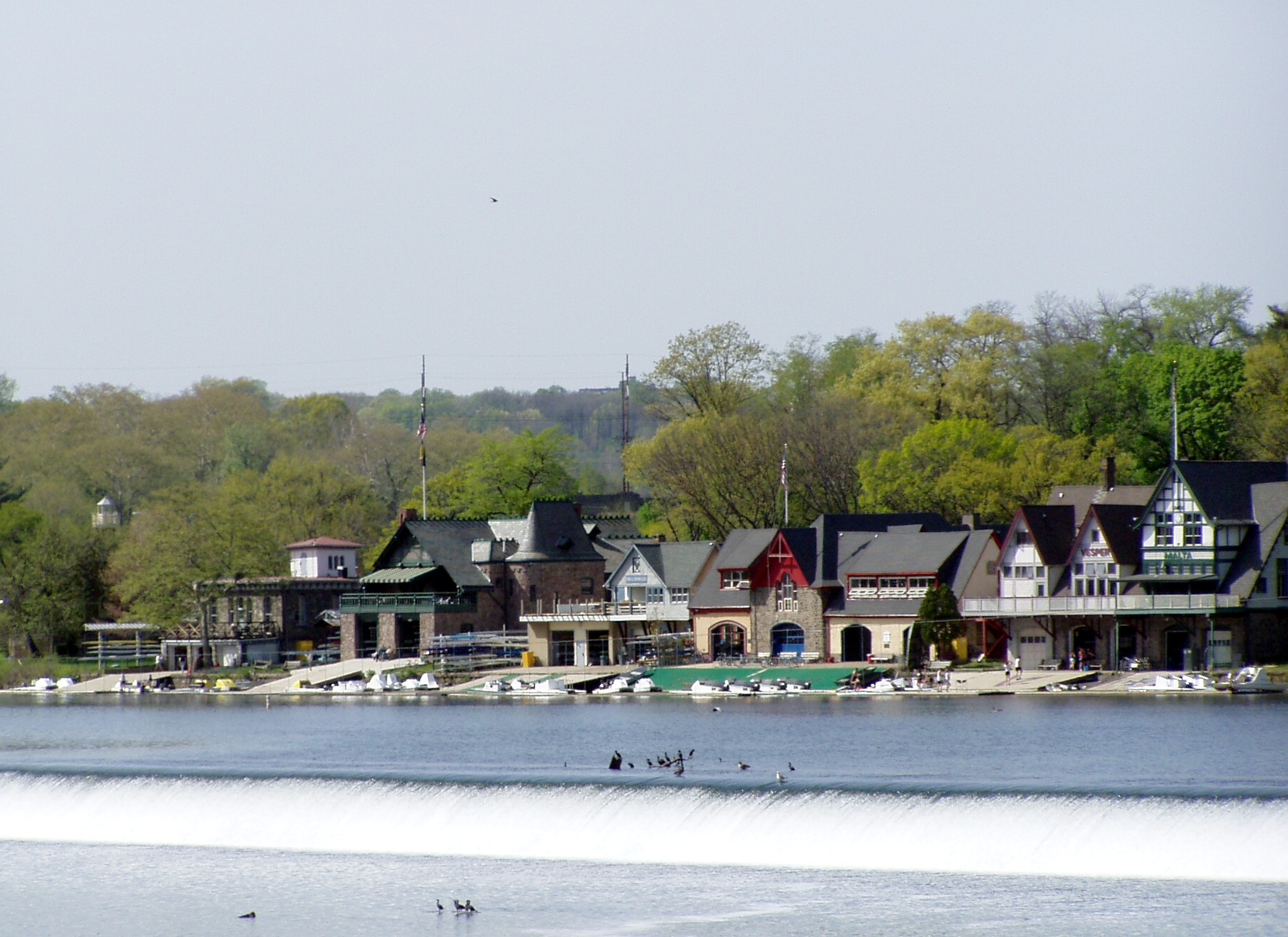
Boathouse Row on the Schuylkill River in Philadelphia | |
| Location | Philadelphia, Pennsylvania, U.S. |
|---|---|
| Area | 12 acres (4.9 ha) |
| Built | 1860 |
| Architect | Furness & Evans, et al. |
| Architectural style | Late 19th- and 20th-century Revivals; Late Victorian; Gothic |
| NRHP reference No. | 87000821[1] |
| Significant dates | |
| Added to NRHP | February 27, 1987 |
| Designated NHL | February 27, 1987 |
Boathouse Row is a historic site which is located in Philadelphia, Pennsylvania, on the east bank of the Schuylkill River just north of the Fairmount Water Works and the Philadelphia Museum of Art. It consists of a row of fifteen boathouses housing social and rowing clubs and their racing shells. Each of the boathouses has its own history, and all have addresses on both Boathouse Row and Kelly Drive, named after Philadelphia oarsman John B. Kelly Jr.
Boathouses #2 through #14 are part of a group known as the Schuylkill Navy, which encompasses several other boathouses along the river. Boathouse #1 is Lloyd Hall and is the only public boathouse facility on the Row.[2] Boathouse #15 houses the Sedgeley Club, which operates the Turtle Rock Lighthouse. The boathouses are all at least a century old, and some were built more than 150 years ago.
History and importance
[edit]Boathouse Row hosts several major rowing regattas, including the Philadelphia Scholastic Rowing Association's Manny Flick regatta series, the Stotesbury Cup Regatta, the Navy Day Regatta, the Independence Day Regatta, and the Head of the Schuylkill Regatta.
The boathouses are seen as centers of the rowing community around the United States. Rowers from the boathouses compete at every level, including local clubs, high schools, colleges, summer racing programs, and international-level athletics.
In 1979, lights designed by architectural lighting designer Ray Grenald were installed to outline each of the boathouses, giving them a nightly Christmas-like gingerbread house appearance and reflecting in the Schuylkill River.[3] He proposed the lights after hearing talk of destroying the decaying Victorian boathouses. Lights on the buildings at night would serve to make them more noticed and appreciated. In 2005, after two refurbishings, the houses were outfitted with computerized LEDs that can light up in various colors, depending on the event or season.
Boathouse Row is a National Historic Landmark and was listed on the National Register of Historic Places in 1987.[4]
Local universities including Drexel, Penn, Philadelphia University and La Salle row out of houses on Boathouse Row. Temple and Saint Joseph's row out of other boathouses along the Schuylkill that are not part of the Row.
Early 19th-century beginnings
[edit]The history of Boathouse Row begins with the construction of the Fairmount Dam and the adjacent water works. The Dam was built in 1821 to keep brackish tidal waters from entering the city's water supply through the Fairmount Water Works, which had been completed in 1815.[5] The Lehigh Coal & Navigation Company would become heavily involved in the improvements.[6] The dam initially submerged the rapids, and later developments transformed the stretch of the Schuylkill between the dam and East Falls from a tidal river into a slack water river resembling a very long freshwater lake.[7] The placid man-made surface was ideal for ice skating in winter and rowing in summer.[5]
In 1835, the first regatta took place between the Blue Devils and the Imps Barge clubs.[7] The excitement from the race sparked the formation of several barge clubs, many of them short-lived.[7]
The frame boathouses
[edit]
A secondary effect of taming the Schuylkill was that the calm water provided a breeding ground for mosquitoes, which drove wealthy residents from their riverside mansions.[5] The abandoned estates were bought by the City of Philadelphia.[7] In 1844, the city purchased the Lemon Hill Estate.[7] The leaseholder of Lemon Hill operated a beer garden and allowed rowing and barge clubs to build frame structure boathouses on the Estate's property along the Schuylkill.[7]
In 1855, the city founded Fairmount Park by converting the Lemon Hill Estate, upon which the frame boathouses were built, into a public park.[7] At the same time, some of the established clubs wanted to regulate the sport of rowing to prevent unscrupulous practices and fixed races.[7] As a result, in 1858, the Schuylkill Navy was founded, which eventually transformed the professional sport of rowing into an amateur sport.[7] In 1859, the city condemned the boathouses along the Schuylkill.[7]
Boathouses of 1860
[edit]Although the city condemned the frame boathouses, it passed an ordinance in 1860 to permit construction of three new boathouses for Pacific Barge Club, the clubs of the Schuylkill Navy, and the Philadelphia Skating Club.[7] After 1860, without city approval, several clubs constructed one-story boathouses similar to the frame structures that the city had previously condemned and removed, but these newer boathouses were built with brick and stone.[7] In 1868, following an expansion of Fairmount Park, the city ordered the removal of all of the one-story brick and stone boathouses except for buildings belonging to the Philadelphia Skating Club (#14 Boathouse Row), Pacific Barge Club (#2-3 Boathouse Row), and Bachelors Barge Club (#6).[7]
Post–Civil War boathouses
[edit]
Between 1869 and 1871, Pennsylvania Barge Club and Crescent Boat Club erected a double boathouse at #4 and #5 Boathouse Row.[8] In 1871, the Fairmount Park commission allowed the University Barge Club and the Philadelphia Barge Club to build a double boathouse at #7-8 Boathouse Row.[9] In 1873, Malta Boat Club and Vesper Boat Club built a double boathouse at #9 and #10 Boathouse Row.[10] In 1874, College Boat Club built the boathouse at #11 Boathouse Row.[11] In 1878, West Philadelphia Boat Club built #12 Boathouse Row.[12]
Five years later, in 1883, Undine Barge Club constructed #13 Boathouse Row. In 1892, with Crescent's permission, Pennsylvania Barge Club tore down and replaced their half of the double boathouse at #4 Boathouse Row.[8] In 1894, Bachelors Barge Club replaced its 1860 building at #6 Boathouse Row.[8] In 1902, the Sedgeley Club was allowed to build #15 Boathouse Row.[13] In 1904, Fairmount Rowing Association demolished the stone building built by Pacific Barge Club at #2 Boathouse Row and replaced the 1860 structure with a new brick structure, leaving #3 and #14 Boathouse Row as the only remaining boathouses dating from 1860.[14]
Photo gallery
[edit]Historic Landmark Boathouses in 1972
[edit]Miscellaneous images
[edit]-
Artist's rendition of the Row (c. 1860-71)
-
The Row with Lemon Hill in background (c. 1860-71)
-
Boathouse Row from the Water Works (c. 1873-74)
-
Boathouse Row from Lemon Hill (c. 1873-74)
-
Declassified KH-11 spy satellite image of the Row
See also
[edit]References
[edit]- ^ "National Register Information System". National Register of Historic Places. National Park Service. January 23, 2007.
- ^ "Lloyd Hall". Archived from the original on July 27, 2011. Retrieved May 11, 2010.
- ^ Saffron, Inga (January 7, 2005). "Lights Out". The Philadelphia Inquirer. pp. 1, 13.
- ^ National Register of Historic Places Inventory—Nomination Form Archived 2011-08-18 at the Wayback Machine
- ^ a b c Burt, Nathaniel (1999). "The Schuylkill Navy". The Perennial Philadelphians: the anatomy of an American aristocracy. University of Pennsylvania Press. p. 200. ISBN 978-0-8122-1693-6.
- ^ Archer B. Hulbert, The Paths of Inland Commerce, A Chronicle of Trail, Road, and Waterway, Vol. 21 The Chronicles of America Series. Editor: Allen Johnson (1921)
- ^ a b c d e f g h i j k l m Moak, Jefferson (November 27, 1983). "National Register of Historic Places Inventory—Nomination Form". NPS Focus, National Register of Historic Places, National Park Service, US Department of the Interior. p. 669. Archived from the original on February 27, 2014. Retrieved May 7, 2010.
- ^ a b c "National Register of Historic Places Inventory—Nomination Form". NPS Focus, National Register of Historic Places, National Park Service, US Department of the Interior. November 27, 1983. p. 661. Archived from the original on February 27, 2014. Retrieved May 7, 2010.
- ^ Stillner, Anna (2005). The Philadelphia Girls' Rowing Club: An Incremental Historic Structure Report (Thesis). p. 28. Retrieved April 30, 2010.
- ^ "National Register of Historic Places Inventory—Nomination Form". NPS Focus, National Register of Historic Places, National Park Service, US Department of the Interior. November 27, 1983. p. 663. Archived from the original on February 27, 2014. Retrieved May 7, 2010.
- ^ "Seth S. Tannenbaum, Clifton R. Hood, & Mary D. McConaghy, College Boat Club, Penn Crew, archives.upenn.edu (April 2006)". Archived from the original on June 13, 2010. Retrieved May 26, 2010.
- ^ "National Register of Historic Places Inventory—Nomination Form". NPS Focus, National Register of Historic Places, National Park Service, US Department of the Interior. November 27, 1983. pp. 664–65. Archived from the original on December 14, 2012. Retrieved May 7, 2010.
- ^ Stillner, Anna (2005). The Philadelphia Girls' Rowing Club: An Incremental Historic Structure Report (Thesis). p. 106. Retrieved April 30, 2010.
- ^ Silverberg, Lee (May 19, 2008). "A Very Brief History of the Fairmount Rowing Association". Fairmount Rowing Association. Archived from the original on October 4, 2013. Retrieved May 1, 2010.
External links
[edit]- The Schuylkill Navy's website, with links to each of the Boathouse Row websites
- Info on Boathouse Row and Schuylkill Navy
- Boathouse Row, viewed from the air
- Historic American Buildings Survey (HABS) No. PA-1650, "Boathouse Row, East River Drive, Philadelphia, Philadelphia County, PA", 15 photos, 2 color transparencies, 2 data pages, 5 photo caption pages
- Boathouse Row on wikimapia.org
Boathouse Row
View on GrokipediaGeography and Setting
Location and Layout
Boathouse Row is situated on the east bank of the Schuylkill River within Fairmount Park in Philadelphia, Pennsylvania, at approximate coordinates 39.9696° N, 75.1875° W.[6] This positioning places it directly along the riverfront, accessible via Kelly Drive, which parallels the row and was renamed in 1985 after John B. Kelly Jr., a prominent Philadelphia oarsman, city councilman, and Olympic bronze medalist.[7][8] The thirteen boathouses are arranged in a linear fashion along the riverbank, numbered sequentially from 1 to 15 running south to north, though numbers 3 and 8 are absent due to historical gaps in construction.[9] Each boathouse holds an address on both Boathouse Row and Kelly Drive, with examples including Boathouse #1 (Lloyd Hall) at 810 Kelly Drive, #2 (Fairmount Rowing Association) at 830 Kelly Drive, and #15 (Sedgeley Club) at 936 Kelly Drive.[9] This compact row spans approximately 1,200 feet, creating a unified waterfront presence dedicated to rowing clubs.[1] When viewed from the Schuylkill River or nearby bridges such as the Strawberry Mansion Bridge, Boathouse Row presents a cohesive, elongated silhouette aligned parallel to the water's edge, enhanced at night by illumination that outlines the structures against the park's greenery.[10] It lies in close proximity to landmarks like the Philadelphia Museum of Art and Fairmount Water Works, just to the south.[1]Surrounding Environment and Access
Boathouse Row is situated along the eastern bank of the Schuylkill River in East Fairmount Park, where the 1821 Fairmount Dam plays a pivotal role in shaping the site's environment. Constructed as part of the Fairmount Water Works to supply the city with water, the dam impounded the river, transforming the previously fast-moving, tidal flow into a calm, six-mile-long freshwater lake ideal for rowing activities. This alteration created stable upstream conditions that supported the development of competitive and recreational boating, making the area a hub for aquatic sports from the early 19th century onward.[11][1] The site integrates seamlessly with Philadelphia's extensive network of trails and roadways, facilitating easy access for pedestrians, cyclists, and drivers. Kelly Drive, a scenic boulevard running parallel to the river, provides vehicular access and borders the row to the east, while the Schuylkill River Trail—a 82.9-mile multi-use path—winds alongside, offering paved routes for walking and biking directly past the boathouses.[12][13][14] These connections are part of Fairmount Park's 215 miles of trails, enabling visitors to explore the area as part of larger loops that include views of the river and surrounding greenery. To the south lies the iconic Philadelphia Museum of Art, just across the river, and to the north, the historic Lemon Hill mansion overlooks the site from a bluff, enhancing the blend of natural and cultural landscapes.[15][10] Boating access to Boathouse Row is primarily reserved for member clubs and university teams, with launches coordinated through private facilities along the riverbank. A public launch point is available north of the row near the Strawberry Mansion Bridge on Kelly Drive, allowing non-motorized craft to enter the water, though permits may be required for organized rowing events. Seasonal water conditions influence usage, with optimal rowing from spring through fall when flows are moderate (typically 1,000–3,000 cubic feet per second) and temperatures above 50°F; winter months bring higher flows from precipitation, colder waters, and occasional ice, limiting access and prompting indoor training for clubs. Water quality monitoring by local agencies advises caution for direct contact due to variable bacteria levels, particularly after heavy rains.[16][1][17][18]Historical Development
Origins of Rowing in Philadelphia
Rowing emerged as a competitive sport in Philadelphia during the early 1800s, heavily influenced by British traditions brought by settlers, where organized races on England's Thames River had popularized the activity among amateur enthusiasts.[19] Early participants adapted English clinker-built boats for racing on the Schuylkill River, fostering a culture of recreational and competitive boating among local estates and social groups.[19] The completion of the Fairmount Dam in 1821 created a calm, protected stretch of water on the Schuylkill, making it suitable for safe and consistent rowing practice.[20] This infrastructure spurred the formation of amateur boat clubs in the 1830s, culminating in the city's first organized regatta on November 12, 1835, which featured a race among seven eight-oared barges, including competitors from the Blue Devils and Imps Barge Clubs.[19][21] By 1858, the growing number of clubs led to the founding of the Schuylkill Navy, the first rowing association in the United States, comprising nine Philadelphia-based organizations with around 300 members.[22] This body standardized competition rules, promoted amateurism, and eliminated gambling influences, thereby professionalizing the sport and organizing annual regattas starting in 1859.[19][23] Prior to the development of dedicated facilities, early rowing clubs relied on informal storage solutions, such as small wooden boatsheds along the riverfront or rented spaces on private estates like Lemon Hill and Sedgley, where boats were kept for seasonal use and maintenance.[19] These makeshift arrangements supported the sport's expansion until more permanent structures became feasible.[19]19th-Century Construction Phases
The construction of boathouses along the Schuylkill River in Philadelphia began in the 1850s amid the growing popularity of organized rowing, facilitated by the Schuylkill Navy, an association of clubs founded in 1858 to regulate competitions and promote the sport.[1] Early structures were primarily temporary wooden frames or simple shacks, such as the initial boathouse of the Undine Barge Club established in 1856, which served basic storage needs but lacked permanence.[1] These rudimentary wooden constructions, often teetering and prone to deterioration, reflected the nascent stage of rowing infrastructure but were increasingly seen as inadequate for the expanding clubs.[24] By 1859, the City of Philadelphia had condemned many of these frame boathouses due to safety and aesthetic concerns, prompting a shift toward more durable designs.[24] In 1860, at the urging of the Schuylkill Navy, the city passed an ordinance permitting the construction of three permanent stone boathouses, marking the onset of substantial builds along what would become Boathouse Row; this included the Malta Boat Club (No. 10) and Bachelors Barge Club (No. 6), both erected that year in stone to align with emerging standards for riverfront development.[25] Despite the ordinance, some clubs initially built simpler one-story structures without full approval, but the emphasis on stone signified a commitment to longevity.[26] The establishment of the Fairmount Park Commission in 1867 further shaped construction by mandating the use of durable materials like stone rather than wood to impose order on the landscape and prevent haphazard development.[1] This regulation influenced post-Civil War builds in the 1860s through 1880s, when stone and brick became predominant for new and replacement boathouses.[27] Notable examples include the 1869–1871 double stone boathouse for the Pennsylvania Barge Club and Crescent Boat Club (Nos. 4 and 5), and the 1873 double boathouse for the Malta and Vesper Boat Clubs (Nos. 9 and 10).[28][26] These phases transformed the row from provisional shelters into a cohesive ensemble of enduring architecture, supporting the Schuylkill Navy's efforts to elevate rowing as a structured athletic pursuit.[1]20th-Century Expansions and Changes
The 20th century brought several key modifications and additions to Boathouse Row, reflecting evolving needs of rowing clubs while adhering to Fairmount Park Commission regulations that standardized designs and limited expansions to maintain the row's cohesive aesthetic. Building on the foundational boathouses established in the 19th century, these changes included reconstructions and new constructions that enhanced functionality without altering the historic skyline.[1] In 1894, the Bachelors Barge Club replaced its original 1860 brownstone structure at #6 Boathouse Row with a two-story brick building, marking one of the earliest significant updates to accommodate growing club activities. This reconstruction adhered to updated park standards that emphasized uniform architectural elements, such as rusticated bases and arched windows, to unify the row's appearance.[29] The Sedgeley Club constructed its boathouse at #15 in 1902, incorporating the existing Turtle Rock Lighthouse into the design to create a distinctive beacon-like structure that served as a social and rowing facility for women. This addition extended the row northward, providing a modern counterpart to the earlier Victorian-era buildings while complying with commission guidelines on height and materials.[30] By 1920, the University of Pennsylvania added a two-bay eastern extension to its 1874 boathouse at #11, increasing storage and operational space with a one- to two-story design that blended seamlessly with the original Gothic Revival facade. This expansion supported the university's expanding rowing program amid rising intercollegiate competition.[31] In 1999, Lloyd Hall was built at #1 as the row's sole public facility, replacing the demolished Plaisted Hall and offering community access to indoor recreation spaces, though preservation rules prohibited boat storage or launching to protect the historic visual integrity of the site.[1] A proposed new boathouse by Temple University in 2013 was withdrawn following opposition under the city's Open Lands Protection Ordinance, which required compensatory parkland but was deemed unfeasible, highlighting ongoing tensions between development and historic preservation along the row. Following the withdrawal, Temple University continued its rowing program by utilizing shared facilities at existing boathouses, such as those at #15, as of 2025.[32][33][34]Architecture and Design
Architectural Styles and Materials
The architecture of Boathouse Row evolved significantly from its inception, reflecting both practical necessities and aesthetic aspirations shaped by municipal oversight and cultural trends. In the 1830s, following the construction of the Fairmount Dam, the earliest structures were rudimentary wooden frames, often simple sheds or shacks constructed hastily to house rowing equipment along the Schuylkill River.[1] These transient designs prioritized functionality over permanence, using timber for quick assembly and low cost. However, following the condemnation of wooden structures in 1859, city ordinances in 1860 permitted the construction of permanent stone boathouses. From 1867, the newly established Fairmount Park Commission enforced regulations mandating a shift to more durable stone materials, such as random rubble and brownstone, to create a cohesive and enduring riverside presence that aligned with the park's landscape goals.[1][29] The 1870s and 1880s marked a period of stylistic maturation, influenced by Late Victorian and Gothic Revival aesthetics, which introduced ornamental flourishes to elevate the boathouses beyond mere utility. Designs incorporated pointed arches, vertical emphasis, and decorative elements like turrets and intricate stonework, evoking a sense of grandeur and club prestige. For instance, these styles manifested in castle-like facades with cupolas and carved details, blending functionality with visual drama to harmonize with Philadelphia's burgeoning park system. This era's constructions maintained a deliberate ornamental quality, using stone to withstand environmental exposure while allowing for expressive architectural detailing.[29][35] By the 1890s and into the early 1900s, practicality drove another material transition to brick, chosen for its superior durability, fire resistance, and affordability compared to stone, while still permitting aesthetic enhancements through terra-cotta accents and textured surfaces. Brick structures balanced utilitarian needs—such as expansive interiors for boat storage—with visual appeal, often adopting eclectic or Colonial Revival motifs to integrate seamlessly into the row's silhouette. This shift supported the row's growth without compromising the site's overall harmony.[35][29] Despite these evolutions in style and material, Boathouse Row exhibits a notable uniformity in scale, with most buildings limited to two or three stories to preserve a low-profile ensemble along the riverfront. This consistency, enforced through park commission guidelines on height and spacing, allowed individual variations in ornamentation while ensuring the collective form contributed to a unified aesthetic vista, enhancing the row's iconic status.[1][29]Structural Features and Adaptations
The boathouses of Boathouse Row are characterized by their two-level functional design, optimized for the storage, maintenance, and launching of rowing vessels. At ground level, expansive boat bays and slips serve as the primary spaces for housing and deploying sculls and shells, allowing rowers to easily access the Schuylkill River for training and competitions.[1] These bays typically feature wide openings facing the water, supported by robust truss systems to span the full width of the structure without internal obstructions, facilitating the maneuvering of long, narrow shells.[36] The upper levels function as clubhouses, providing essential social and preparatory amenities for members. These spaces include locker rooms for changing and storing gear, lounges for post-rowing gatherings, and covered porches or viewing areas that overlook the river, enabling observation of races and practices.[1] For instance, many designs incorporate elevated dressing rooms directly above the boat bays, ensuring privacy and convenience while separating social functions from the damp, operational ground floor.[36] To withstand the variable weather along the Schuylkill River, the boathouses incorporate practical adaptations such as covered docks and porches that shield equipment and rowers from rain and wind. Elevated foundations raise the structures above potential flood levels, a critical measure given the river's history of seasonal overflows, with sturdy materials like stone and brick enhancing overall longevity against environmental stresses.[1] Over time, the boathouses exhibit variations in scale to meet evolving rowing needs, particularly as crew sizes increased in the late 19th and early 20th centuries. Earlier constructions often featured narrower bays suited to single sculls or small teams, while later builds incorporated wider slips to accommodate eight-person shells and larger club operations, reflecting adaptations to the sport's growing demands.[36]The Boathouses
List of Boathouses and Clubs
Boathouse Row comprises 13 distinct structures along the Schuylkill River's east bank, numbered sequentially from north to south starting at #1 Lloyd Hall, of which twelve (numbers 2 through 15) form the historic Victorian-style row. These boathouses serve as facilities for various rowing clubs, primarily members of the Schuylkill Navy, an organization founded in 1858 to govern amateur rowing in Philadelphia. Many boathouses are shared among multiple clubs, universities, and community programs, reflecting collaborative usage within the Schuylkill Navy community.[37] The following table catalogs the boathouses, their construction or major build years, and current or primary associated clubs:| Number | Boathouse Name | Construction Year | Primary Associated Club(s) |
|---|---|---|---|
| #1 | Lloyd Hall | 1999 | Public facility; Philadelphia City Rowing (youth programs) |
| #2–3 | Fairmount Rowing Association | 1860 (original), 1904 (current structure) | Fairmount Rowing Association; shared with Schuylkill Navy affiliates |
| #4 | Pennsylvania Barge Club | 1892 | Pennsylvania Barge Club; USRowing; Dad Vail Regatta; Adaptive Rowing Association |
| #5 | Crescent Boat Club | 1871 | Crescent Boat Club; Roman Catholic High School; Merion Mercy Academy rowing teams |
| #6 | Bachelors Barge Club | 1894 | Bachelors Barge Club; Drexel University Rowing; Wharton Crew Club |
| #7–8 | University Barge Club | 1871 | University Barge Club; Chestnut Hill College and Springside Chestnut Hill Academy rowing |
| #9 | Malta Boat Club | 1873 | Malta Boat Club |
| #10 | Vesper Boat Club | 1873 | Vesper Boat Club |
| #11 | College Boat Club | 1874 | College Boat Club (University of Pennsylvania) |
| #12 | Penn Athletic Club Rowing Association | 1878 | Penn AC Rowing Association |
| #13 | Undine Barge Club | 1883 | Undine Barge Club |
| #14 | Philadelphia Girls' Rowing Club | 1860 | Philadelphia Girls' Rowing Club |
| #15 | Sedgeley Club | 1902 | Sedgeley Club (social club, non-rowing); Turtle Rock Club |