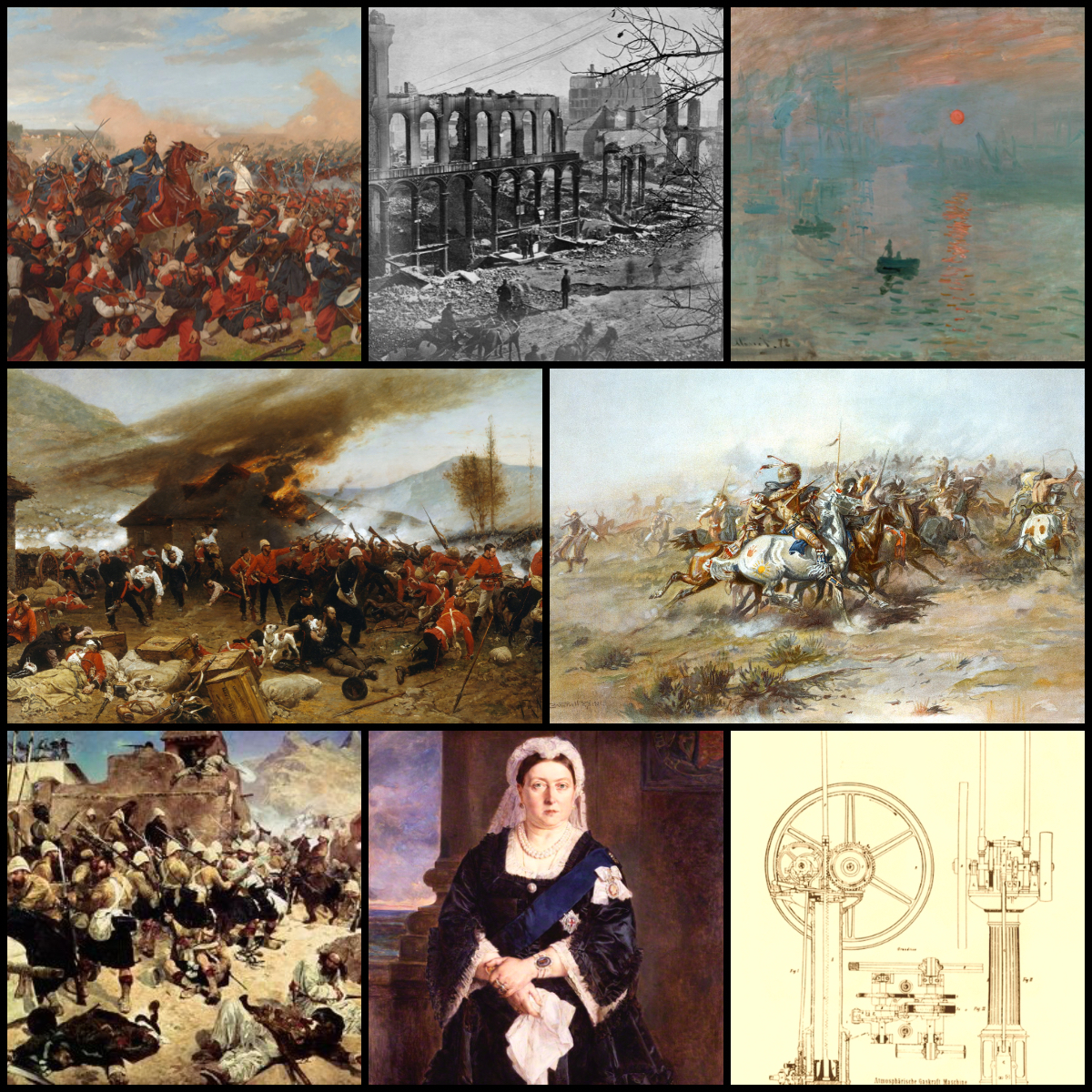
Recent from talks
Nothing was collected or created yet.
1870s
View on Wikipedia

The 1870s (pronounced "eighteen-seventies") was a decade of the Gregorian calendar that began on 1 January 1870, and ended on 31 December 1879.
The trends of the previous decade continued into this one, as great new empires, imperialism and militarism rose in Europe and Asia. The United States was recovering from the American Civil War, though the Reconstruction era introduced its own legacies of bitterness and racial segregation in the country. Germany unified as a nation in 1871 and became the German Empire. Changing social conditions led workforces to cooperate in the form of labor unions in order to demand better pay and working conditions, with strikes occurring worldwide in the later part of the decade and continuing until World War I. The decade was also a period of significant technological advancement; the phonograph, telephone, and electric light bulb were all invented during the 1870s, though it would take several more decades before they became household items.
The last living person from this decade, Jeanne Calment, died in 1997.
| Millennia |
|---|
| 2nd millennium |
| Centuries |
| Decades |
| Years |
| Categories |
Politics and wars
[edit]Wars
[edit]- Dungan Revolt (1862–1877), Hui uprising against the Qing Empire which resulted in 20 million deaths and a Qing victory
- Franco-Prussian War (1870–1871), resulted in the collapse of the Second French Empire and in the formation of both the French Third Republic and the German Empire
- Third Anglo-Ashanti War, also known as the "First Ashanti Expedition" (1873–1874), ended with the destruction of the royal palace at Kumasi and the signing of the Treaty of Fomena, which secured British trading rights in the area
- The Third Carlist War (1872–1876), the last of the Carlist Wars in Spain
- Ethiopian–Egyptian War (1874–1876), a resource conflict over access to the Nile River basin between the Ethiopian Empire and the Khedivate of Egypt, resulting in an Ethiopian victory
- Russo-Turkish War (1877–1878), resulted in Serbia, Romania, and Montenegro becoming completely independent from the Ottoman Empire, while Bulgaria became autonomous
- In the United States, post-Civil War Reconstruction continued until its conclusion under President Rutherford B. Hayes in 1877
- Second Anglo-Afghan War (1878–1880), fought between the British Raj and the Emirate of Afghanistan
- Anglo-Zulu War (11 January – 5 July 1879)
- War of the Pacific (1879–1884), fought over resource-rich territory along the Pacific coast between Chile and an alliance of Bolivia and Peru
Colonization, decolonization, and independence
[edit]- The British Empire continued to grow, with the 1870s marking the beginning of the New Imperialism.
- Bulgaria and Romania declared independence following a war against the Ottoman Empire.
- The Sioux battled the United States Cavalry and resisted encroachment by white settlers on the Great Plains.
Political and social events
[edit]- The German Empire and Alliance System emerged.
- Racial and economic politics at the height of America's Reconstruction Era were bitter, pessimistic, and sometimes violent.
- The Gilded Age began in 1877, lasting until 1896.
- The First Spanish Republic rises and promptly ends (1873–1874).
- The first Ottoman Constitution is promulgated in 1876, starting the First Constitutional Era (1876–1878).
- Contested US presidential election of 1876
Science and technology
[edit]


- The prototype telephone was invented by Alexander Graham Bell in 1876.
- The phonograph is invented in 1877 by Thomas Edison.
- The 6.35mm headphone jack was invented in 1878 and is still widely used today.
- The first version of the light bulb was invented by Thomas Edison in 1879.[1]
- The steam drill is invented in 1879.
- Ludwig Boltzmann statistically defined thermodynamic entropy.
- 1873 Weltausstellung in Vienna, 1876 Centennial Exposition in Philadelphia and 1878 Exposition universelle in Paris.
Environment
[edit]- Atlas bear became extinct in 1870.[2]
- Yellowstone National Park was established and signed into law in 1872.[3]
Popular culture
[edit]Literature and arts
[edit]- Jules Verne (France) publishes Around The World in Eighty Days.
- Claude Monet, Pierre-Auguste Renoir, Camille Pissarro, and Alfred Sisley organized the Société Anonyme Coopérative des Artistes Peintres, Sculpteurs, Graveurs ("Cooperative and Anonymous Association of Painters, Sculptors, and Engravers") for the purpose of exhibiting their artworks independently. Members of the association, which soon included Paul Cézanne, Berthe Morisot, and Edgar Degas, were expected to forswear participation in the Salon. The organizers invited a number of other progressive artists to join them in their inaugural exhibition, including the slightly older Eugène Boudin, whose example had first persuaded Monet to take up plein air painting years before.[4] Another painter who greatly influenced Monet and his friends, Johan Jongkind, declined to participate, as did Manet. In total, thirty artists participated in their first exhibition, held in April 1874 at the studio of the photographer Nadar. The group soon became known as the Impressionists.[5]
- Jeanne Calment, born 1875, would eventually become the longest-living human being with a verified lifespan. She lived until 1997, aged 122. She still holds the record as of November 2024.
- Lewis Carroll publishes Through the Looking-Glass.
- Mark Twain publishes The Adventures of Tom Sawyer in 1876.
- Henrik Ibsen releases A Doll's House in 1879.
Fashion
[edit]People
[edit]Politics
[edit]- Eugène Borel, Director Universal Postal Union
- Rutherford B Hayes, Elected US President in disputed election of 1876
- Thomas W Ferry, Served as Senate Pro tempore and acting US Vice President during 1870s
- Gustave Moynier, President International Committee of the Red Cross
- Samuel Tilden, won popular vote but lost contested election in 1876 US presidential election
Famous and infamous people
[edit]The examples and perspective in this section may not represent a worldwide view of the subject. (July 2024) |
- Sam Bass, Wild West, outlaw
- Charlie Bowdre, Wild West, outlaw/cowboy
- Richard M. Brewer, Wild West, gunslinger/cowboy, outlaw
- Crazy Horse, Native American war leader
- George Armstrong Custer, U. S. Army officer
- Wyatt Earp, Wild West, lawman
- E. B. Farnum, Elected official and one of the first residents of Deadwood, South Dakota
- "Wild Bill" Hickok, Legendary Wild West, lawman, gunfighter, and entertainer
- Doc Holliday, Legendary Wild West, gambler, gunfighter, outlaw, dentist
- Frank James, Wild West, outlaw
- Jesse James, Wild West, outlaw
- Calamity Jane, Frontierswoman and professional scout
- Jack McCall, murderer of "Wild Bill" Hickok
- Henry McCarty a.k.a. William Bonney a.k.a. Billy the Kid, Wild West, outlaw/cowboy
- Alexander McSween, Wild West, figure
- Lawrence Murphy, Wild West, racketeer
- Tom O'Folliard, Wild West, outlaw, best friend of Billy the Kid
- Giovanni Passannante, anarchist, attempted assassin of Umberto I of Italy
- Frank Stilwell, Wild West, outlaw/cowboy
- Al Swearengen, pimp and entertainment entrepreneur who ran the Gem Theater, for 22 years during the late 19th century
- John Tunstall, First man to be killed during the Lincoln County War
- John Younger, Wild West, outlaw
- Jim Younger, Wild West, outlaw
- Cole Younger, Wild West, outlaw
Births
1870


- January 2 – Ernst Barlach, German sculptor, graphic artist and poet (d. 1938)
- January 6 – Gustav Bauer, Chancellor of Germany (d. 1944)
- January 4 – Helena Willman-Grabowska, Polish indologist, Sorbonne and Jagiellonian University professor (d. 1957)
- January 8
- Walter Edwards, American film director (d. 1920)
- Miguel Primo de Rivera, dictator of Spain (d. 1930)
- January 11 – Alexander Stirling Calder, American sculptor (d. 1945)
- January 14 – George Pearce, Australian politician (d. 1952)
- January 20 – Ajahn Mun Bhuridatta, Thai Buddhist monk (d. 1949)
- January 23 – William G. Morgan, American inventor of volleyball (d. 1942)
- February 1 – Erik Adolf von Willebrand, Finnish physician (d. 1949)
- February 7 – Alfred Adler, Austrian psychologist (d. 1937)
- February 12
- Marie Lloyd, English singer (d. 1922)
- Hugo Stinnes, German industrialist, politician (d. 1924)
- February 20 – Jay Johnson Morrow, American military engineer, politician, 3rd Governor of the Panama Canal Zone (d. 1937)
- February 25 – Jelica Belović-Bernardzikowska, Croatian writer (d. 1946)
- March 5 – Frank Norris, American writer (d. 1902)
- March 10 – Ester Rachel Kamińska, Polish actress, "mother of Yiddish theatre" (d. 1925)
- March 13 – Seale Harris, American physician (d. 1957)
- March 17 – Horace Donisthorpe, English entomologist (d. 1951)
- March 20 – Paul von Lettow-Vorbeck, German general (d. 1964)
- March 22 – Arthur Storch (sculptor) (d. 1947)
- March 29 – Pavlos Melas, Greek revolutionary and army officer (d. 1904)
- March 31 – James M. Cox, Democratic candidate for President of the United States in the election of 1920 (d. 1957)


- April 1 – Hamaguchi Osachi, 27th Prime Minister of Japan (d. 1931)
- April 4 – George Albert Smith, 8th president of The Church of Jesus Christ of Latter-day Saints (d. 1951)
- April 17 – Ray Stannard Baker, American journalist, author (d. 1946)
- April 19 – J. Howard Crocker, Canadian educator and sports executive (d. 1959)
- April 21 – Edwin S. Porter, American film director (d. 1941)
- April 22 – Vladimir Lenin, Russian revolutionary, first Premier of the Soviet Union (d. 1924)
- April 24 – Friedrich Freiherr Kress von Kressenstein, German general (d. 1948)[6]
- April 30 – Franz Lehár, Austrian composer (d. 1948)
- May 9 – Harry Vardon, English golf professional (d. 1937)
- May 10 – Reginald Tyrwhitt, British admiral (d. 1951)
- May 19 – Albert Fish, American serial killer (d. 1936)
- May 24
- Benjamin N. Cardozo, Associate Justice of the Supreme Court of the United States (d. 1938)
- Jan Smuts, South African soldier, statesman (d. 1950)
- June 13 – Jules Bordet, Belgian immunologist, microbiologist, recipient of the Nobel Prize in Physiology or Medicine (d. 1961)
- June 18 – Édouard Le Roy, French mathematician and philosopher (d. 1954)
- June 20 – Georges Dufrénoy, French post-impressionist painter (d. 1943)


- July 3 – R. B. Bennett, 11th Prime Minister of Canada (d. 1947)
- July 12 – Louis II, Prince of Monaco (d. 1949)
- July 25 – Maxfield Parrish, American illustrator (d. 1966)
- July 26 – Charles Becker, American policeman and murderer (d. 1915)
- July 27 – Hilaire Belloc, French/English man of letters (d. 1953)
- July 29 – George Dixon, Canadian boxer (d. 1909)
- August 2 – Marianne Weber, German sociologist and suffragist (d. 1954)[7]
- August 4 – Harry Lauder, Scottish entertainer (d. 1950)
- August 10 – Hans Zenker, German admiral (d. 1932)
- August 11 – Tom Richardson, English cricketer (d. 1912)
- August 12 – Hubert Gough, British general (d. 1963)
- August 20 – Edward Stanley Kellogg, 16th Governor of American Samoa (d. 1948)
- August 31 – Maria Montessori, Italian educator (d. 1952)
- September 24 – Georges Claude, French engineer, inventor (d. 1960)
- September 26 – King Christian X of Denmark (d. 1947)
- September 30
- Jean Baptiste Perrin, French physicist, Nobel Prize laureate (d. 1942)
- Thomas W. Lamont, American banker (d. 1948)
- October 2 – Horace Hood, British admiral (d. 1916)
- October 4 – Karl Renner, 1st Chancellor of Austria (d. 1950)
- October 10 – Ivan Bunin, Russian writer, Nobel Prize laureate (d. 1953)
- October 18 – D. T. Suzuki, Japanese philosopher (d. 1966)
- October 22 – Johan Ludwig Mowinckel, Norwegian businessman, Prime Minister of Norway (d. 1943)
- October 25 – Elsa Reger, German writer (d. 1951)[8]
- October 30 – Lawrence Grant, English actor (d. 1952)
- November 21 – Sigfrid Edström, Swedish sports official, President of the International Olympic Committee (d. 1964)
- November 27 – Juho Kusti Paasikivi, Prime Minister and President of Finland (d. 1956)
- November 28 – Gustavus M. Blech, German-American physician, surgeon (d. 1949)
- November 29 – Trixie Friganza, American actress (d. 1955)
- December 5 – Vítězslav Novák, Czech composer (d. 1949)
- December 9 – Francisco S. Carvajal, 36th President of Mexico (d. 1932)
- December 10 – Jadunath Sarkar, Indian historian (d. 1958)
- December 14
- Dirk Jan de Geer, Prime Minister of the Netherlands (d. 1960)
- Karl Renner, 4th President of Austria (d. 1950)
- December 18 – Saki, English writer (d. 1916)
- December 31 (alleged) – Mbah Gotho, Indonesian man, alleged oldest human (d. 2017)
1871


- January 1 – Manuel Gondra, Paraguayan author and journalist, 21st President of Paraguay (d. 1927)[9]
- January 7 – Émile Borel, French mathematician, politician (d. 1956)
- January 8 – Jeanne Adnet, French anarchist (d. 1942)
- January 8 – William O. Taylor, American newspaper executive (d. 1955)
- January 17 – David Beatty, 1st Earl Beatty, British admiral (d. 1936)[10]
- January 19 – Frederick Maurice, British Army officer, military correspondent, writer and academic (d. 1951)
- January 20
- Élisée Bastard, French anarchist (d. 1957)
- Fabián García, Mexican-American horticulturist (d. 1948)
- January 30 – Wilfred Lucas, Canadian-born actor (d. 1940)
- February 4
- Friedrich Ebert, President of Germany (d. 1925)
- Heinrich Schnee, German lawyer, colonial civil servant, politician, writer, and association official (d. 1949)
- February 6 – C. V. Kunhiraman, Indian social reformer, journalist and the founder of Kerala Kaumudi daily (d. 1949)
- February 9 – Howard Taylor Ricketts, American pathologist (d. 1910)
- February 14 – Florence Roberts, American stage actress (d. 1927)
- February 18 – Harry Brearley, English inventor (d. 1948)
- February 25 – Lesya Ukrainka, born Larysa Petrivna Kosach, Ukrainian writer; political, civil and feminist activist (d. 1913)
- February 26 – Matti Turkia, Finnish politician (d. 1946)[11]
- February 27 – Otto Praeger, American postal official, implemented U.S. Airmail (d. 1948)
- February 28
- Manuel Díaz Rodríguez, Venezuelan writer and politician (d. 1927)[12]
- Arthur Charles Fox-Davies, British expert on heraldry (d. 1928)
- March 1
- Ben Harney, American composer and pianist (d. 1938)
- Hermann Kallenbach, Lithuanian-born Jewish South African architect (d. 1945)
- Oskar Heinroth, German biologist and zoologist (d. 1945)
- March 4 – Boris Galerkin, Russian mathematician (d. 1945)
- March 5 – Rosa Luxemburg, German politician (d. 1919)[13]
- March 6 – Afonso Costa, Portuguese lawyer, professor, politician and 3-time Prime Minister of Portugal (d. 1937)
- May 10 – Edward FitzGerald, American-born mountaineer and soldier of British descent (d. 1931)
- March 12 – Kitty Marion, German-born actress and women's rights activist in England and the United States (d. 1944)
- March 15
- Constantin Argetoianu, 41st Prime Minister of Romania (d. 1955)
- James B. A. Robertson, American lawyer, judge and the fourth governor of Oklahoma (d. 1938)
- March 17 – Konstantinos Pallis, Greek general (d. 1941)
- March 19
- Schofield Haigh, English cricketer (d. 1921)
- John Henry Taylor, English professional golfer (d. 1963)
- Baroness Mary Vetsera (d. 1889)
- March 24 – Birdie Blye, American pianist (d. 1935)
- March 26 – Jonah Kūhiō Kalanianaʻole, Hawaiian royalty and politician (d. 1922)
- March 27 – Heinrich Mann, German writer (d. 1950)
- March 28 – Herman van Roijen, Dutch diplomat (d. 1933)
- March 29 – Aleksei Chichibabin, Soviet Russian organic chemist (d. 1945)
- March 31 – Arthur Griffith, President of Ireland (d. 1922)
- April 1 – F. Melius Christiansen, Norwegian-born violinist and choral conductor (d. 1955)
- April 3 – John Wren, Australian business man (d. 1953)
- April 4 – Luke McNamee, American admiral (d. 1952)
- April 6 – Giorgi Mazniashvili, Georgian general and prominent military figures in the Democratic Republic of Georgia (d. 1937)
- April 7 – Charlotte Maxeke, South African religious leader, social and political activist (d. 1939)
- April 8 – Clarence Hudson White, American photographer (d. 1925)
- April 12 – Ioannis Metaxas, Prime Minister of Greece (d. 1941)
- April 13 – Jurgis Matulaitis-Matulevičius, Lithuanian author, Roman Catholic archbishop and blessed (d. 1927)
- April 15 – Jonathan Zenneck, German physicist, electrical engineer (d. 1959)
- May 2 – Francis P. Duffy, Canadian-born American Catholic priest (d. 1932)
- May 3 – Emmett Dalton, American outlaw, train robber and member of the Dalton Gang (d. 1937)
- May 6
- Victor Grignard, French chemist, Nobel Prize in Chemistry laureate (d. 1935)
- Christian Morgenstern, German author (d. 1914)
- May 7 – Gyula Károlyi, 29th Prime Minister of Hungary (d. 1947)
- May 9 – Grand Duke George Alexandrovich of Russia, third son of Alexander III, Maria of Russia and brother of Nicholas II (d. 1899)
- May 14 – Walter Stanley Monroe, businessman, politician, and former Prime Minister of Newfoundland (d. 1952)
- May 19 – Walter Russell, American artist (d. 1963)
- May 26 – Camille Huysmans, Belgian politician and former prime minister of Belgium (d. 1968)
- May 27 – Georges Rouault, French painter, graphic artist (d. 1958)
- May 28 – Teriimaevarua III, last Queen of Bora Bora (d. 1932)
- June 5
- Nicolae Iorga, 34th Prime Minister of Romania (d. 1940)[14]
- Michele Angiolillo, Italian anarchist (d. 1897)
- June 7 – Khwaja Salimullah, fourth Nawab of Dhaka and one of the leading Muslim politicians during the British rule in India (d. 1915)
- June 8 – Howard Gould, American financier and the son of Jay Gould (d. 1959)
- June 11 – Walter Cowan, British admiral (d. 1956)
- June 12
- Ernst Stromer, German paleontologist (d. 1952)
- Lu Zhengxiang, Chinese diplomat and a Roman Catholic priest and monk (d. 1949)
- June 13 – Princess Hélène of Orléans, member of the deposed Orléans royal family of France (d. 1951)
- June 14 – Jacob Ellehammer, Danish inventor (d. 1946)
- June 17 – James Weldon Johnson, American author, politician, diplomat, critic, journalist, poet, anthologist, educator, lawyer, songwriter and early civil rights activist (d. 1938)
- June 18 – Edmund Breese, American actor (d. 1936)
- June 23 – Jantina Tammes, Dutch plant biologist (d. 1947)
- June 26 – Reginald R. Belknap, United States Navy rear admiral (d. 1959)


- July 2 – Wilhelm von Mirbach, German diplomat (d. 1918)
- July 5 – Claus Schilling, German medical researcher and war criminal (d. 1946)
- July 10 – Marcel Proust, French writer (d. 1922)
- July 13 – John Norton-Griffiths, British engineer, army officer, and politician (d. 1930)
- July 17 – Lyonel Feininger, German painter (d. 1956)
- July 18 – Sada Yacco, Japanese stage actress (d. 1946)
- July 22 – Aarnoud van Heemstra, Dutch nobleman, jurist and politician (d. 1951)
- July 25 – Richard Turner, Canadian soldier (d. 1961)
- August 1 – John Lester, American cricketer (d. 1969)
- August 3 – Augusta Holtz, Polish-American supercentenarian, last surviving person born in 1871 (d. 1986)
- August 4 – Lillian Smith, American trick shooter and trick rider (d. 1930)
- August 12
- Gustavs Zemgals, 2nd President of Latvia (d. 1939)
- Carlos Manuel de Céspedes y Quesada, Cuban writer, politician, diplomat, and sixth President of Cuba (d. 1939)
- August 13 – Karl Liebknecht, German politician (d. 1919)
- August 14 – Guangxu Emperor of China (d. 1908)
- August 19
- Orville Wright, American aviation pioneer, co-inventor of the airplane with brother Wilbur (d. 1948)
- Joseph E. Widener, American art collector (d. 1943)
- August 23 – Sofia Panina, Russian politician (d. 1956)
- August 25 – Nils Edén, 15th Prime Minister of Sweden (d. 1945)
- August 26 – Edward Lavin Girroir, Canadian politician (d. 1932)
- August 27 – Theodore Dreiser, American writer (d. 1945)
- August 29 – Albert François Lebrun, French politician (d. 1950)
- August 30 – Ernest Rutherford, New Zealand physicist, recipient of the Nobel Prize in Chemistry (d. 1937)
- August 31
- Ernst II, last reigning duke of Saxe-Altenburg and German general in World War I (d. 1955)
- Syed Hasan Imam, Indian politician and served as President of the Indian National Congress (d. 1933)
- September 1 – J. Reuben Clark, Under Secretary of State for U.S. President Calvin Coolidge (d. 1961)
- September 7 – Francis Aylmer Maxwell, British-Indian Army officer in the Second Boer War and WWI (d. 1917)
- September 10
- Thomas Adams, British urban planner (d. 1940)
- Charles Collett, English Great Western Railway chief mechanical engineer (d. 1952)
- September 11 – Scipione Borghese, Italian aristocrat, industrialist, politician, explorer, mountain climber and race driver (d. 1927)
- September 13 – Alma Kruger, American actress (d. 1960)
- September 15 – Aloysius, Prince of Löwenstein-Wertheim-Rosenberg
- September 17 – Eivind Astrup, Norwegian Arctic explorer (d. 1895)
- September 19
- Frederick Ruple, Swiss-born American portrait painter (d. 1938)
- Gösta Lilliehöök, Swedish Army officer (d. 1952)
- Magnus Johnson, American politician (d. 1936)
- September 22 – Gaskell Romney, American patriarch of the Romney family (d. 1955)
- September 23 – František Kupka, Czech painter and graphic artist (d. 1957)
- September 24 – Lottie Dod, English athlete (d. 1960)
- September 26 – Winsor McCay, American cartoonist, animator (d. 1934)
- September 27 – Grazia Deledda, Italian writer, Nobel Prize laureate (d. 1936)
- September 28 – Pietro Badoglio, Italian field marshal, prime minister (d. 1956)
- September 30 – Adolphe Stoclet, Belgian engineer, financier and noted collector (d. 1949)
- October 2 – Cordell Hull, United States Secretary of State, recipient of the Nobel Peace Prize (d. 1955)
- October 3 – Kim Bo-hyon, paternal grandfather of Kim Il Sung, great-grandfather of Kim Jong Il, and great-great-grandfather of Kim Jong Un (d. 1955)
- October 5 – Sulejman Delvina, Albanian politician (d. 1932)
- October 10 – David Lindsay, British Conservative politician and art connoisseur (d. 1940)
- October 11 – Sidney Dillon Redmond, American civic leader, physician, lawyer, and politician (d. 1948)
- October 14 – Alexander von Zemlinsky, Austrian composer, conductor, and teacher (d. 1942)
- October 19 – Walter Bradford Cannon, American physiologist (d. 1945)
- October 11 – Harriet Boyd Hawes, American archaeologist (d. 1945)
- October 17 – Dénes Berinkey, 21st Prime Minister of Hungary (d. 1944)
- October 20 – Atul Prasad Sen, Bengali composer, lyricist, singer, lawyer, philanthropist, social worker, educationist and writer (d. 1934)
- October 25 – John Gough, British general, Victoria Cross recipient (d. 1915)
- October 27 – Vatslav Vorovsky, Russian Bolshevik, Marxist revolutionary, literary critic, publicist and Soviet diplomat (d. 1923)
- October 30
- Buck Freeman, American baseball player (d. 1949)
- Paul Valéry, French poet (d. 1945)
- November 1 – Stephen Crane, American writer (d. 1900)
- November 12 – Dagmar Hansen, Danish cabaret-singer, stage-performer and Denmark's first "pin-up girl" (d. 1959)
- November 13 – Vladislav F. Ribnikar, Serbian journalist (d. 1914)
- November 14 – Wajed Ali Khan Panni, Bengali aristocrat and philanthropist (d. 1936)[15]
- November 10
- Winston Churchill, American best-selling novelist (d. 1947)
- Sachchidananda Sinha, Indian lawyer, parliamentarian, and journalist (d. 1950)
- November 18 – Amadeu Vives i Roig, Spanish-Catalan composer and writer (d. 1932)
- November 23 – William Watt, Australian politician, Premier of Victoria (d. 1946)
- November 26 – Luigi Sturzo, Italian Catholic priest and politician (d. 1959)
- November 27 – Giovanni Giorgi, Italian physicist and electrical engineer (d. 1950)
- December 9 – Joe Kelley, American Baseball Hall of Famer (d. 1943)
- December 13 – Emily Carr, Canadian artist (d. 1945)
- December 14 – August von Hayek, Austrian physician and botanist (d. 1928)
- December 16 – Manuel Fernández Silvestre, Spanish general (d. 1921)
- December 17 – Virginia Fábregas, Mexican actress (d. 1950)[16]
- December 29 – Meyer London, American politician (d. 1926)
- Mulai Ahmed er Raisuni, Moroccan sharif and tribal leader (d. 1925)
- Sevasti Qiriazi, Albanian educator, women's rights activist (d. 1949)
- Zhang Jinghui, Chinese general and politician, second and final Prime Minister of Manchukuo (d. 1959)
- Armando Falconi, Italian stage and film actor (d. 1954)
- Cyrus Avery, creator of US Route 66 (d. 1963)
- Hasan Rıza Pasha, general in the Ottoman Army (d. 1913)
- Isfandiyar Khan, Khan of Khiva between September 1910 and 1 October 1918 (d. 1918)
- R. Ramachandra Rao, Indian civil servant, mathematician and social and political activist (d. 1936)
- Konstantinos Spanoudis, Greek politician and journalist (d. 1941)
1872 * January 6 – Alexander Scriabin, Russian composer (d. 1915)
- January 11 – Georg Karo, German archaeologist (d. 1963)
- January 14 – Kerstin Hesselgren, Swedish politician (d. 1962)
- January 20 – Julia Morgan, American architect (d. 1957)
- January 23 – Gotse Delchev, Bulgarian revolutionary (d. 1903)
- January 31 – Zane Grey, American writer (d. 1939)
- February 2 – Abul Kasem, Bengali politician (d. 1936)[17]
- February 6 – Robert Maillart, Swiss civil engineer (d. 1940)
- February 11 – Hannah Mitchell, English socialist, suffragette (d. 1956)
- February 19 – Johan Pitka, Estonian entrepreneur, sea captain, and admiral (d. 1944)
- February 27 – Alexandru Vaida-Voevod, 3-time prime minister of Romania (d. 1950)
- February 28 – Mehdi Frashëri, Albanian politician, 15th Prime Minister of Albania (d. 1963)
- March 3 – Willie Keeler, American baseball player (d. 1923)
- March 7 – Piet Mondrian, Dutch painter (d. 1944)
- March 18 – Ludwig Herzer, Austrian musician and composer (d. 1939)
- March 19 – Anna Held, Polish-born French actress (d. 1918)
- March 23 – Michael Joseph Savage, 23rd Prime Minister of New Zealand (d. 1940)
- March 28 – José Sanjurjo, Spanish general (d. 1936)


- April 9 – Léon Blum, French politician, Prime Minister of France (d. 1950)
- April 14 – Abdullah Yusuf Ali, Indian-born Islamic scholar, translator (d. 1953)
- April 29 – Harry Payne Whitney, American businessman, horse breeder (d. 1930)
- May 1 – Sidónio Pais, 4th President, 66th Prime Minister of Portugal (d. 1918)
- May 2 – Ichiyō Higuchi, Japanese author (d. 1896)
- May 6 – William Bowie, American geodetic engineer (d. 1940)
- May 12 – Anton Korošec, Slovenian political leader (d. 1940)
- May 18 – Bertrand Russell, British philosopher and mathematician, recipient of the Nobel Prize in Literature (d. 1970)
- May 22 – Kim Gap-sun, bureaucrat and modern Korean businessman, politician, and realtor(d. 1961)[18]
- May 31
- Charles Greeley Abbot, American astrophysicist (d. 1973)
- W. Heath Robinson, British cartoonist, illustrator (d. 1944)
- June 3 – Saburō Hyakutake, Japanese admiral (d. 1963)
- June 5 – Ladislas Lazaro, U.S. Representatives from Louisiana (d. 1927)
- June 6 – Alexandra Feodorovna (Alix of Hesse) (d. 1918)
- June 8 – Jan Frans De Boever, Belgian painter (d. 1949)
- June 22 – Charles Murray, American actor (d. 1941)
- June 27 – Paul Laurence Dunbar, American poet, publisher (d. 1906)


- July 1 – Louis Blériot, French aviation pioneer (d. 1936)
- July 4 – Calvin Coolidge, 30th President of the United States (d. 1933)
- July 5 – Édouard Herriot, 3-time prime minister of France (d. 1957)
- July 12 – Emil Hácha, 3rd President of Czechoslovakia (d. 1945)
- July 16 – Roald Amundsen, Norwegian polar explorer (d. 1928)[19]
- July 23 – Edward Adrian Wilson, English polar explorer (d. 1912)
- July 28 – Albert Sarraut, 2-time prime minister of France (d. 1962)
- August 3 – King Haakon VII of Norway (d. 1957)
- August 9 – Archduke Joseph August of Austria, Austrian field marshal (d. 1962)
- August 10 – William Manuel Johnson, American jazz double-bassist (d. 1972)
- August 13 – Richard Willstätter, German chemist, Nobel Prize laureate (d. 1942)
- August 15 – Sri Aurobindo, Indian nationalist, writer and mystic (d. 1950)
- August 21 – Aubrey Beardsley, English illustrator (d. 1898)[20]
- August 23 – Egerton Reuben Stedman, Canadian politician (d. 1946)
- August 26 – Joseph Taylor Robinson, American politician (d. 1937)
- September 13 – Kijūrō Shidehara, 31st Prime Minister of Japan (d. 1951)
- September 20 – Maurice Gamelin, French general (d. 1958)
- September 21 – Henry Tingle Wilde, British mariner, Chief Officer RMS Titanic (d. 1912)
- September 28 – David Unaipon, Aboriginal Australian preacher, author and inventor (d. 1967)
- October 4 – Roger Keyes, 1st Baron Keyes, British admiral (d. 1945)
- October 6 – Carl Gustaf Ekman, 2-time prime minister of Sweden (d. 1945)
- October 11
- Harlan F. Stone, Chief Justice of the United States (d. 1946)
- Emily Davidson, English suffragist (d. 1913)
- October 12 – Ralph Vaughan Williams, English composer (d. 1958)
- October 15
- Wilhelm Miklas, 3rd President of Austria (d. 1956)
- Edith Wilson, First Lady of the United States (d. 1961)
- October 27 – Emily Post, American etiquette expert (d. 1960)
- October 30 – Louisa Martindale, British physician, writer, magistrate and prison commissioner (d. 1966)
- November 1 – Louis Dewis, Belgian Post-Impressionist painter (d. 1946)
- November 4 – Barbu Știrbey, 30th Prime Minister of Romania (d. 1946)
- November 11 – Maude Adams, American stage actress (d. 1953)
- November 20 – Joseph M. Reeves, American admiral (d. 1948)[21]
- November 30 – John McCrae, Canadian soldier, surgeon and poet (d. 1918)
- December 3 – William Haselden, Spanish-born English cartoonist (d. 1953)
- December 7 – Johan Huizinga, Dutch cultural historian (d. 1945)
- December 8 – Mace Greenleaf, American actor (d. 1912)
- December 11 – René Bull, British illustrator, photographer (d. 1942)
- December 14 – John Smith Archibald, Canadian architect (d. 1934)
- December 16 – Anton Ivanovich Denikin, Imperial Russian Lieutenant General (d. 1947)
- December 21 – Lorenzo Perosi, Italian composer (d. 1956)
- December 26 – Norman Angell, English politician, recipient of the Nobel Peace Prize (d. 1967)
1873


- January 2 – Thérèse of Lisieux, Catholic saint, mystic (d. 1897)
- January 4 – Blanche Walsh, American stage, screen actress (d. 1915)
- January 7 – Adolph Zukor, Austrian-born film studio pioneer (d. 1976)
- January 8 – Iuliu Maniu, Romanian politician (d. 1953)
- January 9
- Thomas Curtis, American athlete (d. 1944)
- Hayim Nahman Bialik, Israel's national poet (d. 1934)
- January 10 – George Orton, Canadian athlete (d. 1958)
- January 12 – Spyridon Louis, Greek runner (d. 1940)
- January 20 – Johannes V. Jensen, Danish writer, Nobel Prize laureate (d. 1950)[22]
- January 28 – Colette, French writer (d. 1954)[23]
- January 29 – Prince Luigi Amedeo, Duke of the Abruzzi, Italian mountaineer, explorer and admiral (d. 1933)
- January 30 – Vassily Balabanov, administrator, Provincial Governor of Imperial Russia (d. 1947)
- January 31 – Melitta Bentz, German entrepreneur who invented the coffee filter in 1908 (d. 1950)
- February 2 – Maurice Tourneur, French film director (d. 1961)
- February 3
- Hugh Trenchard, British military aviation pioneer (d. 1956)
- Karl Jatho, German aviation pioneer (d. 1933)
- February 4 – Étienne Desmarteau, Canadian athlete (d. 1905)
- February 7 – Thomas Andrews, Irish shipbuilder (d. 1912)[24]
- February 13
- Feodor Chaliapin, Russian bass opera singer (d. 1938)[25]
- Red Wing, Native American silent film actress (d. 1974)
- February 15 – Hans von Euler-Chelpin, German-born chemist, Nobel Prize laureate (d. 1964)
- February 19 – Louis Feuillade, French film director (d. 1925)
- February 25 – Enrico Caruso, Italian tenor (d. 1921)[26]
- February 28 – William McMaster Murdoch, Officer of Titanic (d. 1912)
- March 3 – William Green, American labor leader (d. 1952)
- March 11 – David Horsley, English-born film executive (d. 1933)
- March 19 – Max Reger, German composer (d. 1916)[27]
- March 29 – Billy Quirk, American actor (d. 1926)
- April 1 (N.S.)/March 20 (O.S.) – Sergei Rachmaninoff, Russian pianist and composer (d. 1943)[28]
- April 4 – Gyula Peidl, 23rd prime minister of Hungary (d. 1943)
- April 7 – John McGraw, American baseball player, manager (d. 1934)
- April 10 – Kyösti Kallio, Prime Minister and President of Finland (d. 1940)
- April 13 – John W. Davis, American politician, diplomat, and lawyer (d. 1955)
- April 19 – Sydney Barnes, English cricketer (d. 1967)
- April 20 – Gombojab Tsybikov, Russian explorer (d. 1930)
- April 22 – Ellen Glasgow, American writer (d. 1945)[29]
- April 23 – Theodor Körner, President of Austria (d. 1957)
- April 25
- Walter de la Mare, English poet, short story writer and novelist (d. 1956)
- Félix d'Herelle, French-Canadian microbiologist (d. 1949)


- May 4 – Joe De Grasse, Canadian film director (d. 1940)
- May 5 – Leon Czolgosz, assassin of U.S. President William McKinley (d. 1901)
- May 9 – Anton Cermak, Mayor of Chicago (d. 1933)
- May 10 – Cary D. Landis, American attorney and politician (d. 1938)
- May 15 – Oskari Tokoi, Finnish socialist and the Chairman of the Senate of Finland (d. 1963)[30]
- May 17
- Henri Barbusse, French novelist, journalist (d. 1935)[31]
- Dorothy Richardson, English feminist writer (d. 1957)
- May 21 – Hans Berger, German neurologist (d. 1941)
- May 28 – D. D. Sheehan, Irish politician (d. 1948)
- June 2 – Anna Eliza Williams, British supercentenarian and oldest person in the world (d. 1987)
- June 3 – Otto Loewi, German-born pharmacologist, recipient of the Nobel Prize in Physiology or Medicine (d. 1961)
- June 15 – Leonora Cohen, British suffragette and trade unionist (d. 1978)
- June 28 – Alexis Carrel, French surgeon and biologist, recipient of the Nobel Prize in Physiology or Medicine (d. 1944)
- June 29 – Monroe Dunaway Anderson, Founder of Anderson, Clayton and Company; "Father of Texas Medical Center" (d. 1939)


- July 1
- Alice Guy-Blaché, French-American filmmaker (d. 1968)
- Andrass Samuelsen, 1st prime minister of Faroe Islands (d. 1954)
- July 3 – Prince Yamashina Kikumaro, Japanese prince (d. 1908)
- July 6 – Dimitrios Maximos, Prime Minister of Greece (d. 1955)
- July 8 – Carl Vaugoin, 7th Chancellor of Austria (d. 1949)
- July 12 – Oscar von Sydow, 18th prime minister of Sweden (d. 1936)
- July 17 – Many Benner, French painter (d. 1965)
- July 20 – Alberto Santos-Dumont, Brazilian aviation pioneer (d. 1932)
- August 4 – Dámaso Berenguer, Spanish general and politician (d. 1953)
- August 5 – Joseph Russell Knowland, American politician, newspaperman (d. 1966)
- August 10 – William Ernest Hocking, American philosopher (d. 1966)
- August 13 – Cornelis Jacobus Langenhoven, South African author (d. 1932)
- August 17 – John A. Sampson, American gynecologist (d. 1946)
- August 18 – Otto Harbach, American lyricist (d. 1963)[32]
- August 20 – William Henry Bell, 1st director of the South African College of Music (d. 1946)
- August 21 – Harry T. Morey, American actor (d. 1936)
- August 26 – Lee de Forest, American inventor (d. 1961)
- September 1
- Sir Guy Standing, British actor (d. 1937)
- João Ferreira Sardo, Portuguese presbyter and founder of Gafanha da Nazaré (d. 1925)
- Felicija Bortkevičienė, Lithuanian politician and publisher (d. 1945)
- September 5 – Cornelius Vanderbilt III, American military officer, inventor, engineer (d. 1942)
- September 8
- Alfred Jarry, French author and playwright (d. 1907)[33]
- David O. McKay, 9th president of the Church of Jesus Christ of Latter-day Saints (d. 1970)
- September 17 – Ibrahim of Johor, Malaysian sultan (d. 1959)
- September 20
- Sidney Olcott, Canadian-born pioneer film director (d. 1949)
- Ferenc Szisz, Hungarian-born racing driver (d. 1944)
- September 21 – Papa Jack Laine, American jazz musician (d. 1966)
- October 8 – Ma Barker, American criminal (d. 1935)
- October 9 – Karl Schwarzschild, German physicist, astronomer (d. 1916)
- October 13 – Georgios Kafantaris, Prime Minister of Greece (d. 1946)
- October 14 – Ray Ewry, American athlete (d. 1937)
- October 16 – Juho Kekkonen, Finnish forestry manager and tenant farmer (d. 1928)[34]
- October 18 – Ivanoe Bonomi, 2-time prime minister of Italy (d. 1951)
- October 19
- October 20 – Jussi Merinen, Finnish politician (d. 1918)[35]
- October 26
- Thorvald Stauning, 9th Prime Minister of Denmark (d. 1942)
- A. K. Fazlul Huq, Bengali statesman (d. 1962)
- October 30
- Dave Gallaher, New Zealand rugby union football player (d. 1917)
- Francisco I. Madero, 33rd president of Mexico (d. 1913)

- November 9 – Fritz Thyssen, German industrialist (d. 1951)
- November 16 – W. C. Handy, American blues composer (d. 1958)[36]
- November 20 – Ramón Castillo, Argentinian politician, 25th President of Argentina (d. 1944)
- November 22 – Johnny Tyldesley, English cricketer (d. 1930)
- November 28 – Frank Phillips, American oil executive (d. 1950)
- November 30 – William Boyle, 12th Earl of Cork, British admiral (d. 1967)[37]
- December 7 – Willa Cather, American novelist (d. 1947)[38]
- December 11 – Josip Plemelj, Slovenian mathematician (d. 1967)
- December 17 – Ford Madox Ford, English writer (d. 1939)[39]
- December 20 – Kan'ichi Asakawa, Japanese historian (d. 1948)
- December 26 – Thomas Wass, Nottinghamshire cricketer (d. 1953)
- December 30 – Al Smith, American politician, Democratic presidential candidate (d. 1944)
- Nesaruddin Ahmad, Bengali Islamic scholar (d. 1952)[40]
- Filip Mișea, Aromanian activist, physician and politician (d. 1944)[41]
1874


- January 1
- Alexandros Hatzikyriakos, Greek admiral, politician (d. 1958)
- Gustave Whitehead, German-born aviation pioneer (d. 1927)
- January 4 – Josef Suk, Czech composer, violinist (d. 1935)
- January 5 – Joseph Erlanger, American physiologist, Nobel Prize laureate (d. 1965)
- January 12 – Marta Anna Wiecka, Polish Roman Catholic religious professed and blessed (d. 1904)
- January 16 – Robert W. Service, American poet (d. 1958)
- January 20 – Steve Bloomer, English footballer, cricketer and baseball player (d. 1938)
- January 21 – Frederick M. Smith, American religious leader, author (d. 1946)
- January 25 – W. Somerset Maugham, English author (d. 1965)
- January 28
- Vsevolod Meyerhold, Russian theatre practitioner (d. 1940)
- Gheorghe Mironescu, two-time prime minister of Romania (d. 1949)
- January 29 – John D. Rockefeller Jr., American entrepreneur (d. 1960)
- February 1 – Hugo von Hofmannsthal, Austrian writer (d. 1929)
- February 3 – Gertrude Stein, American writer, patron of the arts (d. 1946)
- February 6 – Henry C. Mustin, American naval aviation pioneer (d. 1923)
- February 9 – Amy Lowell, American poet (d. 1925)
- February 11
- Elsa Beskow, Swedish writer (d. 1953)
- Fritz Hart, English-born composer (d. 1949)
- February 15 – Sir Ernest Shackleton, Irish explorer (d. 1922)
- February 17 – Thomas J. Watson, American computer pioneer (d. 1956)
- February 19 – Carl Stockdale, American actor (d. 1953)
- February 20 – Mary Garden, American opera soprano of Scots descent (some sources state her birth year as 1877) (d. 1967)
- February 23 – Konstantin Päts, 1st President of Estonia (d. 1956)
- February 24 – Honus Wagner, American baseball player (d. 1955)
- February 26 – Nikolai Korotkov, Russian surgeon (d. 1920)
- February 28 – Pawang Nong, Pahang Hero (d. 1977)
- March 5 – Henry Travers, English actor (d. 1965)
- March 16 – Frédéric François-Marsal, Prime Minister of France (d. 1958)
- March 24
- Luigi Einaudi, 2nd president of Italy (d. 1961)
- Harry Houdini, Hungarian-born magician (d. 1926)
- March 26 – Robert Frost, American poet (d. 1963)
- March 29
- Lou Henry Hoover, First Lady of the United States (d. 1944)
- Rudolf Maister, Slovene military officer, leader of "Maister's Fighters" (d. 1934)
- March 30
- Charles Herbert Lightoller, 2nd Officer of the RMS Titanic (d. 1952)
- Nicolae Rădescu, 45th prime minister of Romania (d. 1953)


- April 1 – Emmi Mäkelin, Finnish midwife and politician (d. 1962)
- April 8 – Stanisław Taczak, Polish general, commander-in-chief of the Greater Poland Uprising (d. 1960)
- April 14 – Matti Lonkainen, Finnish politician (d. 1918)[42]
- April 15 – Johannes Stark, German physicist, Nobel Prize laureate (d. 1957)
- April 19 – Ernst Rüdin, Swiss psychiatrist, geneticist (d. 1952)
- April 25 – Guglielmo Marconi, Italian inventor, recipient of the Nobel Prize in Physics (d. 1937)
- April 28 – Sidney Toler, American actor, playwright and theatre director (d. 1947)
- May 3 – François Coty, French perfume manufacturer (d. 1934)
- May 9 – Howard Carter, British archaeologist (d. 1939)
- May 14 – Polaire, French actress, singer (d. 1939)
- May 17 – Mikhail Diterikhs, Russian general (d. 1937)
- May 19 – Gilbert Jessop, English cricketer (d. 1955)
- May 22 – D. F. Malan, 4th prime minister of South Africa (d. 1959)
- May 26 – Henri Farman, French pilot and aircraft designer (d. 1958)
- May 27 – Dustin Farnum, American actor (d. 1929)
- May 29 – G. K. Chesterton, English author (d. 1936)
- June 11 – Lyman Gilmore, American aviation pioneer (d. 1951)
- June 16 – Arthur Meighen, 9th Prime Minister of Canada (d. 1960)
- June 17 – Grant Mitchell, American actor (d. 1957)
- June 18 – King George Tupou II of Tonga (d. 1918)


- July 3 – R. B. Bennett, 11th Prime Minister of Canada (d. 1947)
- July 5 – Eugen Fischer, German professor of medicine, anthropology, and eugenics (d. 1967)
- July 6 – Isaías de Noronha, 13th President of Brazil (d. 1963)
- July 14 – Abbas II, last khedive of Egypt (d. 1944)
- July 25 – Alfred Walton Hinds, 17th Naval Governor of Guam (d. 1957)
- July 26 – Serge Koussevitzky, Russian conductor (d. 1951)
- July 27 – Frank Shannon, Irish-born American actor (d. 1959)
- July 29 – J. S. Woodsworth, Canadian politician (d. 1942)
- August 1 – Constantin Levaditi, Romanian physician and microbiologist (d. 1953)
- August 6 – Charles Fort, Dutch-American writer, researcher into anomalous phenomena (d. 1932)
- August 8 – Albert Stanley, 1st Baron Ashfield, British-American businessman (d. 1948)
- August 10
- Herbert Hoover, 31st President of the United States (d. 1964)
- Jirō Minami, Japanese general, Governor-General of Korea (1936–1942) (d. 1955)
- Tod Sloan, American jockey (d. 1933)
- August 14 – Bertha M. Wilson, American dramatist, critic, and actress (d. 1936)
- August 27 – Carl Bosch, German chemist, Nobel Prize laureate (d. 1940)
- September 12 – Redcliffe N. Salaman, British botanist (d. 1955)
- September 13
- Henry F. Ashurst, American politician (d. 1962)
- Arnold Schoenberg, Austrian composer (d. 1951)
- September 20 – Barbara Schack, Sudeten German politician (d. 1958)[43]
- September 21 – Gustav Holst, English composer (d. 1934)
- September 23 – Ernst Streeruwitz, 6th Chancellor of Austria (d. 1952)


- October 3 – Charles Middleton, American actor (d. 1949)
- October 8
- István Bethlen, 28th prime minister of Hungary (d. 1946)
- Nance O'Neil, American stage and film actress (d. 1965)
- October 9 – Nicholas Roerich, Russian painter (d. 1947)
- October 13 – József Klekl, Slovene politician in Hungary (d. 1948)
- October 15 – Alfred, Hereditary Prince of Saxe-Coburg and Gotha (d. 1899)
- October 17 – Lumsden Hare, Irish-born actor, theatre director and producer (d. 1964)
- October 20 – Charles Ives, American composer (d. 1954)
- October 26 – Martin Lowry, English chemist (d. 1936)
- November 1 – Salima Machamba, Sultan of Mohéli (d. 1964)
- November 13 – Henry Kolker, American stage, screen actor (d. 1947)
- November 14 – Johann Schober, 3rd Chancellor of Austria (d. 1932)
- November 15 – August Krogh, Danish zoophysiologist, recipient of the Nobel Prize in Physiology or Medicine (d. 1949)
- November 22 – Elizabeth Patterson, actress (d. 1966)
- November 27 – Chaim Weizmann, 1st president of Israel (d. 1952)
- November 29 – António Egas Moniz, Portuguese physician and neurologist, recipient of the Nobel Prize in Physiology or Medicine (d. 1955)
- November 30
- Winston Churchill, Prime Minister of the United Kingdom, recipient of the Nobel Prize in Literature (d. 1965)
- Friedrich Hasenöhrl, Austrian physicist (d. 1915)
- Lucy Maud Montgomery, Canadian author (d. 1942)
- December 2 – Eleanor Addison Phillips, English educator and founder of the world's first Soroptimist Movement, the Venture Club (d. 1952)
- December 11
- James L. Kraft, Canadian-American entrepreneur, inventor (d. 1953)
- Paul Wegener, German actor, film director, and screenwriter; one of the pioneers of German Expressionism (d. 1948)
- December 13 – Josef Lhévinne, Russian pianist (d. 1944)
- December 17 – William Lyon Mackenzie King, 10th Prime Minister of Canada (d. 1950)
- December 22 – Franz Schmidt, Austrian composer (d. 1939)
- December 26 – Khan Bahadur Ahsanullah, Indian educationist, philosopher, philanthropist, social reformer, Sufi thinker, scientist and spiritual person (d. 1965)
- December 29 – Thomas W. Benoist, American aviator, aircraft designer and manufacturer, founder of the world's first scheduled airline (d. 1917)
1875


- January 3 – Alexandros Diomidis, Prime Minister of Greece (d. 1950)
- January 5 – J. Stuart Blackton, American film producer (d. 1941)
- January 6 – Leslie Green, English architect (d. 1908)
- January 9 – Gertrude Vanderbilt Whitney, American sculptor, socialite (d. 1942)
- January 11 – Reinhold Glière, Russian composer (d. 1956)
- January 14
- Felix Hamrin, 22nd Prime Minister of Sweden (d. 1937)
- Albert Schweitzer, Alsatian philosopher and musician, recipient of the Nobel Peace Prize (d. 1965)
- January 15
- Thomas Burke, American sprinter (d. 1929)
- King Ibn Saud of Saudi Arabia (d. 1953)
- January 22 – D. W. Griffith, American film director (The Birth of a Nation) (d. 1948)
- February 1 – Eddie Polo, Austrian-American actor (d. 1961)
- February 2 – Fritz Kreisler, Austrian violinist (d. 1962)
- February 4 – Ludwig Prandtl, German physicist (d. 1953)
- February 7 – Erkki Melartin, Finnish composer (d. 1937)
- February 8 – Valentine O'Hara, Irish author, authority on Russia and the Baltic states (d. 1941)
- February 21 – Jeanne Calment, French supercentenarian, world's longest lived person (d. 1997)
- February 26 – Emma Dunn, British-born stage, screen actress (d. 1966)

- March 4 – Mihály Károlyi, Prime Minister and President of Hungary (d. 1955)
- March 7 – Maurice Ravel, French composer (d. 1937)
- March 8 – Kenkichi Ueda, Japanese general (d. 1962)
- March 9
- Juan de Dios Martínez, 23rd President of Ecuador (d. 1955)
- Martin Shaw, English composer and conductor (d. 1958)[44]
- March 19 – Zhang Zuolin, Chinese bandit, soldier, and warlord (d. 1928)
- March 26 – Syngman Rhee, President of South Korea (d. 1965)
- March 28 – Helen Westley, American stage, film actress (d. 1942)
- April 1 – Edgar Wallace, English author (d. 1932)
- April 2 – Walter Chrysler, American automobile pioneer (d. 1940)
- April 4
- Samuel S. Hinds, American actor (d. 1948)
- Pierre Monteux, French-born conductor (d. 1964)
- April 5 – Mistinguett, French singer (d. 1956)
- April 8 – King Albert I of Belgium (d. 1934)
- April 9 – Kristian Laake, Norwegian general (d. 1950)[45]
- April 15 – James J. Jeffries, American boxer (d. 1953)
- April 18 – Abd-ru-shin, German author (d. 1941)


- May 2 – Owen Roberts, Associate Justice of the Supreme Court of the United States (d. 1955)
- May 6 – William D. Leahy, American admiral (d. 1959)
- May 11 – Harriet Quimby, American pilot (d. 1912)
- May 12
- Krishna Chandra Bhattacharya, Indian philosopher (d. 1949)
- Charles Holden, English architect (d. 1960)
- May 23 – Alfred P. Sloan, American automobile industrialist (d. 1966)
- June 4 – Albert E. Smith, English stage magician, film director and producer (d. 1958)
- June 6
- J. Farrell MacDonald, American character actor, film director (d. 1952)
- Thomas Mann, German novelist, Nobel Prize laureate (d. 1955)
- June 9 – Henry Hallett Dale, English pharmacologist and physiologist, Nobel Prize laureate (d. 1968)
- June 12 – Sam De Grasse, Canadian actor (d. 1953)
- June 15 – Herman Smith-Johannsen, Norwegian supercentenarian (d. 1987)
- June 24 – Diedrich Westermann, German linguist (d. 1956)
- June 28 – Henri Lebesgue, French mathematician (d. 1941)


- July 3
- Tanxu, Chinese Buddhist monk (d. 1963)
- Ferdinand Sauerbruch, German surgeon (d. 1951)
- July 10
- Dezső Pattantyús-Ábrahám, Hungarian politician (d. 1973)
- Mary McLeod Bethune, American educator (d. 1955)
- July 25 – Jim Corbett, Anglo-Indian hunter, conservationist and author (d. 1955)
- July 26
- Carl Jung, Swiss psychiatrist (d. 1961)
- Antonio Machado, Spanish poet (d. 1939)
- August 8 – Artur Bernardes, 12th President of Brazil (d. 1955)
- August 10 – Florrie Forde, Australian-born music hall singer (d. 1940)
- August 15 – Samuel Coleridge-Taylor, English composer (d. 1912)
- August 16 – Juho Sunila, Prime Minister of Finland (d. 1936)
- August 21 – Winnifred Eaton, Canadian author (d. 1954)
- August 26 – John Buchan, Scottish-Canadian novelist, historian and politician, 15th Governor General of Canada (d. 1940)
- August 27 – Katharine McCormick, American suffragist (d. 1967)
- August 29 – Leonardo De Lorenzo, Italian flautist (d. 1962)
- August 31 – Rosa Lemberg, Namibian-born Finnish American teacher, singer and choral conductor (d. 1959)[46]

- September 1 – Edgar Rice Burroughs, American fiction writer (d. 1950)
- September 3 – Ferdinand Porsche, Austrian automotive engineer (d. 1951)
- September 16 – James Cash Penney, American businessman, founder of J. C. Penney (d. 1971)
- September 18 – Tomás Burgos, Chilean philanthropist (d. 1945)
- September 20 – Matthias Erzberger, German politician (assassinated 1921)[47]
- September 22 – Mikalojus Konstantinas Čiurlionis, Lithuanian composer (d. 1911)
- October 1 – Eugeen Van Mieghem, Belgian painter (d. 1930)
- October 12 – Aleister Crowley, British occultist (d. 1947)
- October 18 – James Emman Kwegyir Aggrey, Ghanaian-born educationalist (d. 1927)
- October 19 – George Ranetti, Romanian poet, publicist (d. 1928)
- October 23 – Gilbert N. Lewis, American chemist (d. 1946)
- October 31 – Vallabhbhai Patel, Indian political leader ("Iron Man of India") (d. 1950)


- November 6 – Marie Celeste, American soprano and actress (d. 1954)
- November 8 – Qiu Jin, Chinese revolutionary, writer and feminist (executed 1907)
- November 14 – Gregorio del Pilar, Filipino general (k. in action 1899)
- November 17 – Birger Eriksen, Norwegian military officer, sinker of the Blücher (d. 1958)
- November 30 – Otto Strandman, 1st Prime Minister of Estonia (d. 1941)
- December 4 – Rainer Maria Rilke, Austrian poet (d. 1926)
- December 5 – Arthur Currie, Canadian general (d. 1933)
- December 6 – Evelyn Underhill, British writer (d. 1941)
- December 11 – Yehuda Leib Maimon, Bassarabian-born Israeli rabbi, government minister (d. 1962)
- December 12 – Gerd von Rundstedt, German field marshal (d. 1953)
- December 15 – Emilio Jacinto, Filipino poet, revolutionary (d. 1899)
- December 19 – Mileva Marić, Albert Einstein's first wife (d. 1948)
- December 24 – Otto Ender, 8th Chancellor of Austria (d. 1960)
- December 25 – Theodor Innitzer, Austrian Catholic cardinal (d. 1955)
1876


- January 5 – Konrad Adenauer, Chancellor of Germany (d. 1967)[48]
- January 8 – Arturs Alberings, Prime Minister of Latvia (d. 1934)
- January 12
- Ermanno Wolf-Ferrari, Italian composer (d. 1948)
- Jack London, American author (d. 1916)
- January 20 – Józef Hofmann, Polish pianist (d. 1967)
- January 22 – Bess Houdini, wife, stage partner of Harry Houdini (d. 1943)
- January 23 – Otto Diels, German chemist, Nobel Prize laureate (d. 1954)
- January 24 – Theodor Tobler, Swiss chocolatier, founder of Toblerone (d. 1941)
- January 29 – Havergal Brian, British composer (d. 1972)
- February 8 – Paula Modersohn-Becker, German painter (d. 1907)
- February 12 – Thubten Gyatso, 13th Dalai Lama (d. 1933)
- February 16
- Mack Swain, American actor (d. 1935)
- G. M. Trevelyan, British historian (d. 1962)
- February 19 – Constantin Brâncuși, Romanian sculptor (d. 1957)
- February 22 – Zitkala-Sa, Native American writer, activist, editor, educator and translator (d. 1938)[49]
- February 23 – Senjūrō Hayashi, Japanese general and politician, Prime Minister of Japan (d. 1943)
- March 1 – Henri de Baillet-Latour, Belgian International Olympic Committee president (d. 1942)
- March 2
- James A. Gilmore, American businessman and baseball executive (d. 1947)[50]
- Pope Pius XII (d. 1958)
- March 4 – Theodore Hardeen, Hungarian magician and stunt performer, founder of the Magician's Guild (d. 1945)
- March 5 – Tiburcio Carías Andino, 24th President of Honduras (d. 1969)[citation needed]
- March 6 – A. A. Kannisto, Finnish politician (d. 1930)[51]
- March 7 – Edgar Evans, Welsh naval seaman and polar explorer (d. 1912)
- March 11 – Carl Ruggles, American composer (d. 1971)
- March 15 – Óscar R. Benavides, 67th and 76th President of Peru (d. 1945)
- March 21 – Walter Tewksbury, American athlete (d. 1968)
- March 22 – Henry O'Malley, American fish culturist, United States Commissioner of Fisheries (d. 1936)
- March 23 – Ziya Gökalp, Turkish writer and poet (d. 1924)
- March 26 – Wilhelm, Prince of Albania, sovereign Prince of Albania (d. 1945)
- March 31 – Borisav Stanković, Serbian writer (d. 1927)

- April 1
- Peter Strasser, German naval officer, airship commander (d. 1918)
- James Young Deer, Native American film producer (d. 1946)
- April 3 – Margaret Anglin, Canadian stage actress (d. 1958)
- April 4
- Bolesław Roja, Polish general (d. 1940)
- Maurice de Vlaminck, French painter, poet (d. 1958)
- April 9 – Ettore Bastico, Italian field marshal (d. 1972)
- April 11 – Paul Henry, Irish artist (d. 1958)
- April 12 – Oskar Fischer, Czech Scientist (d. 1942)
- April 14 – Sir Murray Bisset, South African cricketer, Governor of Southern Rhodesia (d. 1931)
- April 22 – Róbert Bárány, Hungarian physician, recipient of the Nobel Prize in Physiology or Medicine (d. 1936)
- April 23 – Mary Ellicott Arnold, American social activist, writer (d. 1968)
- April 24 – Erich Raeder, German admiral (d. 1960)
- April 26 – Mariam Thresia Chiramel, Indian Catholic professed religious and stigmatist (d. 1926)
- May 10
- Ivan Cankar, Slovenian writer (d. 1918)
- Shigeru Honjō, Japanese general (d. 1945)
- May 18 – Hermann Müller, Chancellor of Germany (d. 1931)
- June 4 – Clara Blandick, American actress (d. 1962)
- June 13 – William Sealy Gosset, English chemist and statistician (d. 1937)
- June 19 – Sir Nigel Gresley, English steam locomotive engineer (Flying Scotsman & Mallard) (d. 1941)
- June 22 – Madeleine Vionnet, French fashion designer (d. 1975)


- July 2 – Wilhelm Cuno, Chancellor of Germany (d. 1933)
- July 3 – George Murray Levick, British Antarctic explorer and naval surgeon (d. 1956)[52]
- July 6 – Luis Emilio Recabarren, Chilean politician, founder of the Communist Party of Chile. (d. 1924)
- July 8 – Alexandros Papanastasiou, 2-time prime minister of Greece (d. 1936)
- July 12
- Max Jacob, French poet (d. 1944)
- Alphaeus Philemon Cole, American artist, engraver, etcher and supercentenarian (d. 1988)
- July 16 – Alfred Stock, German chemist (d. 1946)
- July 19
- Ignaz Seipel, 4th Chancellor of Austria (d. 1932)
- Joseph Fielding Smith, 10th president of the Church of Jesus Christ of Latter-day Saints (d. 1972)
- July 29 – Maria Ouspenskaya, Russian actress, acting teacher (d. 1949)
- August 5 – Sydney Spencer Sawrey-Cookson, British judge (d. 1933)
- August 7 – Mata Hari, Dutch exotic dancer, spy (d. 1917)
- August 15 – Stylianos Gonatas, Prime Minister of Greece (d. 1966)
- August 17
- Eric Drummond, 16th Earl of Perth, British politician, first Secretary-General of the League of Nations (d. 1951)
- Henri Winkelman, Dutch general (d. 1952)
- August 25 – Eglantyne Jebb, English co-founder of the Save the Children Fund, champion of children's human rights (d. 1928)
- August 29 – Kim Ku, Korean politician (d. 1949)
- September 1 – Harriet Shaw Weaver, English political activist (d. 1961)
- September 5 – Wilhelm Ritter von Leeb, German field marshal (d. 1956)
- September 6 – John Macleod, Scottish-born physician and physiologist, Nobel Prize laureate (d. 1935)
- September 7 – Francesco Buhagiar, 2nd Prime Minister of Malta (d. 1934)
- September 13 – Sherwood Anderson, American writer (d. 1941)
- September 15 – Bruno Walter, German conductor (d. 1962)
- September 16 – Marvin Hart, American boxer (d. 1931)
- September 18 – James Scullin, 9th Prime Minister of Australia (d. 1953)
- September 22 – André Tardieu, 3-time prime minister of France (d. 1945)
- September 23 – Brudenell White, Australian general (d. 1940)
- September 26 – Edith Abbott, American social worker, educator and author (d. 1957)
- September 29 – Charlie Llewellyn, first non-white South African Test cricketer (d. 1964)


- October 7 – Louis Tancred, South African cricketer (d. 1934)
- October 9 – Sol Plaatje, South African political activist (d. 1932)
- October 11 – Karl Leopold von Möller, German officer, journalist, author and politician (d. 1943)
- October 13 – Rube Waddell, American baseball player (d. 1914)
- October 21 – Sir Fraser Russell, South African-born Governor of Southern Rhodesia (d. 1952)
- October 26 – H. B. Warner, English stage, screen actor (d. 1958)
- October 29 – Anton Boisen, American founder of the clinical pastoral education movement (d. 1965)
- November 2 – Alfred S. Alschuler, American architect (d. 1940)
- November 3 – Rupert D'Oyly Carte, English hotelier, theatre owner and impresario (d. 1948)
- November 7
- Culbert Olson, Governor of California (d. 1962)
- Charlie Townsend, English cricketer (d. 1958)
- November 13 – William N. Andrews, American politician and member of the United States House of Representatives from 1919 to 1921 (d. 1937)
- November 17 – August Sander, German photographer (d. 1964)
- November 23 – Manuel de Falla, Spanish composer (d. 1946)
- November 24 – Walter Burley Griffin, American architect (d. 1937)
- December 9 – Berton Churchill, Canadian actor (d. 1940)
- December 12 – Alvin Kraenzlein, American athlete (d. 1928)
- December 21 – Jack Lang, Australian politician (d. 1975)
- December 25
- Adolf Windaus, German chemist, Nobel Prize laureate (d. 1959)
- Muhammad Ali Jinnah, founder, first governor general of Pakistan (official birthday; d. 1948)
- December 29
- Pablo Casals, Catalan cellist (d. 1973)
- Lionel Tertis, English violist (d. 1975)
- Petro Trad, 5th President and 14th Prime Minister of Lebanon (d. 1947)
- Abd Allah Siraj, Prime Minister of Jordan (d. 1949)
1877


- January 2 – Slava Raškaj, Croatian painter (d. 1906)
- January 3 – Josephine Hull, American actress (d. 1957)
- January 22 – Hjalmar Schacht, German economist, politician and banker (d. 1970)
- January 26 – Kees van Dongen, Dutch-French painter (d. 1968)
- February 4 – Eddie Cochems, father of the forward pass in American football (d. 1953)
- February 7 – G. H. Hardy, British mathematician (d. 1947)
- February 8 – Carl Tanzler, German-born radiology technologist (d. 1952)
- February 12 – Louis Renault, French industrialist, founder of Renault automobile company (d. 1944)
- February 14 – Edmund Landau, German mathematician (d. 1938)
- February 17
- Isabelle Eberhardt, Swiss explorer, writer (d. 1904)
- André Maginot, French politician (d. 1932)
- February 19 – Gabriele Münter, German painter (d. 1962)
- February 25 – Erich von Hornbostel, Austrian musicologist (d. 1935)
- March 2 – Consuelo Vanderbilt, Duchess of Marlborough (d. 1964)
- March 4 – Garrett Morgan, American inventor (d. 1963)
- March 7 – Thorvald Ellegaard, Danish track cyclist (d. 1954)[53]
- March 10 – Pascual Ortiz Rubio, Mexican politician, substitute President of Mexico, 1930–1932 (d. 1963)[54]
- March 12 – Wilhelm Frick, German Nazi Minister of the Interior (d. 1946)
- March 17 – Ville Kiviniemi, Finnish politician (d. 1951)[55]
- March 18 – Edgar Cayce, American psychic (d. 1945)

- April 15 – Georg Kolbe, German sculptor (d. 1947)
- April 17 – Lionel Pape, English actor (d. 1944)
- April 26 – Alliott Verdon Roe, English aviation pioneer (d. 1958)
- April 30 – Alice B. Toklas, American writer (d. 1967)
- May 3 – Karl Abraham, German psychoanalyst (d. 1925)
- May 24 – Samuel W. Bryant, American admiral (d. 1938)
- May 25 – Billy Murray, American singer (d. 1954)
- May 27 – Isadora Duncan, American dancer (d. 1927)
- June 4 – Heinrich Otto Wieland, German chemist, Nobel Prize laureate (d. 1957)
- June 7 – Charles Glover Barkla, English physicist, Nobel Prize laureate (d. 1944)
- June 11 – Renée Vivien, British poet who wrote in French (d. 1909)
- June 12 – Thomas C. Hart, American admiral, politician (d. 1971)
- June 14 – Jane Bathori, French opera singer (d. 1970)
- June 18 – James Montgomery Flagg, American artist, comics artist and illustrator (d. 1960)
- June 19 – Charles Coburn, American actor (d. 1961)


- July 2
- Rinaldo Cuneo, American artist ("the painter of San Francisco") (d. 1939)
- Hermann Hesse, German-born writer, Nobel Prize laureate (d. 1962)
- July 6 – Arnaud Massy, French golfer (d. 1950)
- July 13 – Erik Scavenius, Prime Minister of Denmark (d. 1962)
- July 19 – Arthur Fielder, English cricketer (d. 1949)
- July 27 – Ernst von Dohnányi, Hungarian conductor (d. 1960)
- July 31 – Louisa Bolus, South African botanist and taxonomist (d. 1970)
- August 1 – George Hackenschmidt, Estonian strongman, professional wrestler (d. 1968)
- August 6 – Wallace H. White, Jr., U.S. Senator from Maine (d. 1952)
- August 7 – Ulrich Salchow, Swedish figure skater (d. 1949)
- August 16 – Roque Ruaño, Spanish priest, civil engineer (d. 1935)
- August 22 – Ananda Coomaraswamy, Ceylonese Tamil philosopher (d. 1947)
- August 26 – John Latham, Australian politician, judge (d. 1964)
- August 27
- Lloyd C. Douglas, American minister, author (d. 1951)
- Charles Rolls, Welsh co-founder of the Rolls-Royce car firm, pioneer aviator (d. 1910)
- August 29 – Dudley Pound, British admiral (d. 1943)
- September 1
- Francis William Aston, English chemist, Nobel Prize laureate (d. 1945)
- Rex Beach, American novelist, playwright, and Olympic water polo player (d. 1949)
- September 2 – Frederick Soddy, English chemist, Nobel Prize laureate (d. 1956)
- September 6 – Buddy Bolden, American jazz musician (d. 1931)
- September 14 – Leonhard Seppala, Norwegian-American sled dog breeder, trainer and musher (d. 1967)
- September 16 – Thomas Alan Goldsborough, American politician, member of the US House of Representatives from 1921 to 1939 and a United States district judge from 1939 to 1951 (d. 1951)
- September 25 – Plutarco Elías Calles, Mexican general and President of Mexico, 1924–1928; known as Jefe Maximo ("Maximum Boss") from 1928 to 1934 (d. 1945)[56]
- September 26
- Alfred Cortot, Swiss pianist (d. 1962)
- Edmund Gwenn, English actor (d. 1959)
- Bertha De Vriese, Belgian physician (d. 1958)
- October 10 – William Morris, 1st Viscount Nuffield, British businessman, philanthropist (d. 1963)
- October 15 – Helen Ware, American stage, film actress (d. 1939)
- October 21 – Oswald Avery, Canadian-American physician, medical researcher (d. 1955)
- October 22 – Frederick Twort, English bacteriologist (d. 1950)
- October 29 – Narcisa de Leon, Filipino film producer (d. 1966)
- October 30 – Hugo Celmiņš, 2-time prime minister of Latvia (d. 1941)
- November 1 – Else Ury, German writer, children's book author (d. 1943)
- November 2 – Claire McDowell, American silent film actress (d. 1966)
- November 3 – Carlos Ibáñez del Campo, 2-time President of Chile (d. 1960)
- November 9
- Enrico De Nicola, 1st President of Italy (d. 1959)
- Muhammad Iqbal, Islamic philosopher and poet, one of the founding fathers of All-India Muslims League (d. 1938)
- November 15 – William Hope Hodgson, English author (d. 1918)
- November 17 – Frank Lahm, Brigadier General USAF, airship pilot, early military aviator trained by the Wright brothers (d. 1963)
- November 20 – Herbert Pitman, British mariner; 3rd Officer aboard RMS Titanic (d. 1961)
- November 22
- Endre Ady, Hungarian poet (d. 1919)
- Joan Gamper, Swiss-born businessman, founder of FC Barcelona (d. 1930)
- November 24 – Edward C. Kalbfus, American admiral (d. 1954)
- December 3 – Richard Pearse, New Zealand airplane pioneer (d. 1953)
- December 4 – Morris Alexander, South African politician (d. 1946)[57]
- December 16 – Kichisaburō Nomura, Japanese admiral and diplomat (d. 1964)
- December 20 – Thomas Walter Swan, American jurist and judge on the United States Court of Appeals for the Second Circuit from 1926 until 1975 (d. 1975)
- December 30 – Edward Ellington, British military officer; Marshal of the Royal Air Force (d. 1967)
- F. X. Gouraud, French physician and dietitian (d. 1913)
- Rashid Tali’a, Prime Minister of Jordan (d. 1926)
1878


- January 2 – Jaakko Mäki, Finnish politician (d. 1938)[58]
- January 4
- A. E. Coppard, English short story writer and poet (d. 1957)
- Augustus John, Welsh painter (d. 1961)
- January 6 – Carl Sandburg, American poet and historian (d. 1967)
- January 9 – John B. Watson, American psychologist (d. 1958)
- January 11
- Theodoros Pangalos, Greek general, politician and President of Greece (d. 1952)
- Leopoldo Saro, Spanish general (d. 1936)
- January 12 – Ferenc Molnár, Hungarian-born author (d. 1952)
- January 16 – Harry Carey, American actor (d. 1947)
- January 20 – Finlay Currie, Scottish actor (d. 1968)
- January 22 – Constance Collier, English stage, screen actress (d. 1955)
- January 23 – Rutland Boughton, English composer (d. 1960)
- January 25 – Ernst Alexanderson, Swedish-born American television pioneer (d. 1975)
- January 26
- Luís of Orléans-Braganza, Brazilian royalty
- Harry Rountree, New Zealand illustrator (d. 1950)


- February 1 – Milan Hodža, Slovak politician, champion of regional integration in Europe (d. 1944)
- February 2
- Alfréd Hajós, Hungarian swimmer, architect (d. 1955)
- Katharine Martha Houghton Hepburn, American suffragist (d. 1951)
- February 3 – Gordon Coates, 21st Prime Minister of New Zealand (d. 1943)
- February 4 – Grigory Petrovsky, Ukrainian Soviet politician and Old Bolshevik (d. 1958)
- February 5 – André Citroën, French automobile manufacturer (d. 1935)
- February 8 – Martin Buber, Austrian philosopher (d. 1965)
- February 14 – Kōki Hirota, 21st Prime Minister of Japan (d. 1948)
- February 16 – Big Jim Colosimo, Italian-born American gangster (d. 1920)
- February 18 – Kate Gordon Moore, American psychologist (d. 1963)
- February 21 – Mirra Alfassa, multi-origined spiritual leader and founder of Auroville, India (d. 1973)
- February 26 – Emmy Destinn, Czech soprano (d. 1930)
- February 28 – Pierre Fatou, French mathematician (d. 1929)
- March 3 – Edward Thomas, British poet (d. 1917)
- March 4
- Egbert Van Alstyne, American songwriter, pianist (d. 1951)
- Arishima Takeo, Japanese novelist, short-story writer and essayist (d. 1923)
- March 5 – P. D. Ouspensky, Russian mathematician and philosopher (d. 1947)
- March 7 – Boris Kustodiev, Soviet painter and designer (d. 1927)
- March 16
- Reza Shah Pahlavi, Shah of Iran (d. 1944)
- Clemens August Graf von Galen, German Catholic cardinal (d. 1946)
- March 20 – Heinrich XXIV, Prince Reuss of Greiz (d. 1927)
- March 22 – Michel Théato, Luxembourg athlete (d. 1923)
- March 23 – Franz Schreker, Austrian composer (d. 1934)
- March 25 – Frances Glessner Lee, American forensic scientist; known as "mother of forensic science" (d. 1962)
- March 26 – Henry Gullett, Australian politician (d. 1940)
- March 31 – Jack Johnson, American boxer (d. 1946)


- April 1 – C. Ganesha Iyer, Ceylon Tamil philologist (d. 1958)
- April 4 – Stylianos Lykoudis, Greek admiral (d. 1958)
- April 6
- Erich Mühsam, German author (d. 1934)
- Vicente Mejía Colindres, 23rd President of Honduras (d. 1966)
- April 24 – Jean Crotti, Swiss artist (d. 1958)
- April 28
- Lionel Barrymore, American actor (d. 1954)
- Willem Mengelberg, Dutch conductor (d. 1951)
- April 30 – Władysław Witwicki, Polish psychologist, philosopher, translator, historian (of philosophy and art) and artist (d. 1948)
- May 2 – Roy Atwell, American actor, comedian and composer (d. 1962)
- May 10 – Gustav Stresemann, Chancellor of Germany, recipient of the Nobel Peace Prize (d. 1929)
- May 13 – Julia Dean, American actress (d. 1952),
- May 16 – Taylor Holmes, American actor (d. 1959)
- May 17 – Conway Tearle, American actor (d. 1938)
- May 21 – Glenn Curtiss, American aviation pioneer (d. 1930)
- May 22 – The Great Gama, Punjabi wrestler (d. 1960)
- May 25 – Bill Robinson, African-American tap dancer (d. 1949)
- May 28 – Paul Pelliot, French sinologist (d. 1945)
- May 29 – Zelmira Segreda Solera de Cappella, Costa Rican soprano (d. 1923)
- June 1 – John Masefield, English poet, novelist (d. 1967)
- June 3 – Barney Oldfield, American automobile racer, pioneer (d. 1946)
- June 5 – Pancho Villa, Mexican revolutionary (d. 1923)
- June 10 – William Skelly, American oil magnate (d. 1957)
- June 12 – James Oliver Curwood, American writer, conservationist (d. 1927)
- June 19 – Yakov Yurovsky, Russian Old Bolshevik, revolutionary, and Chekist (d.1938)
- June 22 – John Burton Cleland, Australian naturalist, microbiologist, mycologist and ornithologist (d. 1971)
- June 27 – He Xiangning, Chinese revolutionary, feminist, politician, painter and poet (d. 1972)
- July 3 – George M. Cohan, American singer, dancer, composer, actor and writer (d. 1942)
- July 8 – Jimmy Quinn, Scottish footballer (d. 1945)
- July 16 – Andreas Hermes, German agricultural scientist, politician (d. 1964)
- July 24 – Lord Dunsany, Irish author (d. 1957)
- August 1
- Konstantinos Logothetopoulos, Prime Minister of Greece (d. 1961)
- José Pedro Montero, 27th President of Paraguay (d. 1927)
- Eva Tanguay, Canadian-born vaudeville performer (d. 1947)
- August 2
- Princess Ingeborg of Denmark, Princess of Sweden (d. 1958)
- Aino Kallas, Finnish-Estonian author (d. 1956)
- August 9 – Eileen Gray, Irish architect, furniture designer (d. 1976)
- August 10 – Alfred Döblin, German writer (d. 1957)
- August 15 – Paa Grant, Ghanian politician (d. 1956)
- August 19 – Manuel L. Quezon, 2nd President of the Philippines (d. 1944)
- August 20 – Maria Assunta Pallotta, Italian Roman Catholic religious professed and blessed (d. 1905)
- August 26 – Lina Stern, Soviet biochemist, physiologist and humanist (d. 1968)
- August 27 – Pyotr Wrangel, Russian general, anti-Bolshevik leader (d. 1928)
- August 28 – George Whipple, American scientist, recipient of the Nobel Prize in Physiology or Medicine (d. 1976)
- August 31 – Frank Jarvis, American athlete (d. 1933)
- September 1 – Leonhard Kaupisch, German general (d. 1945)[59]
- September 2 – Werner von Blomberg, German field marshal (d. 1946)
- September 5 – Robert von Lieben, Austrian physicist (d. 1913)
- September 9
- Sergio Osmeña, 4th President of the Philippines (d. 1961)
- Princess Catherine Yurievskaya, daughter of Alexander II of Russia (d. 1959)
- September 13 – Matilde Moisant, American pilot (d. 1964)
- September 16 – Karl Albiker, German sculptor, lithographer and teacher (d. 1961)
- September 20 – Upton Sinclair, American writer (d. 1968)
- September 22 – Shigeru Yoshida, Prime Minister of Japan (d. 1967)
- September 24 – Charles-Ferdinand Ramuz, Swiss writer (d. 1947)
- September 26 – Kurt von Hammerstein-Equord, German general and Commander-in-Chief of the Reichswehr (d. 1943)
- September 28 – Jirō Tamon, Japanese general (d. 1934)
- October 1 – Othmar Spann, Austrian philosopher, economist (d. 1950)
- October 5 – Louise Dresser, American actress (d. 1965)
- October 9 – Robert Warwick, American actor (d. 1964)
- October 11 – Nicole Girard-Mangin, French physician in the French Army (d. 1919)
- October 12 – Karl Buresch, 9th Chancellor of Austria (d. 1936)
- October 15 – Paul Reynaud, 77th Prime Minister of France (d. 1966)
- October 16 – Maxie Long, American athlete (d. 1959)
- October 18 – Miguel Llobet, Spanish guitarist (d. 1938)
- October 26 – William Kissam Vanderbilt II, American motor racing driver and yachtsman (d. 1944)
- October 29 – Alexander von Falkenhausen, German general (d. 1966)
- October 30 – Arthur Scherbius, German electrical engineer, mathematician, cryptanalyst and inventor (d. 1929)

- November 1 – Carlos Saavedra Lamas, Argentine politician, recipient of the Nobel Peace Prize (d. 1959)
- November 7
- Lise Meitner, German-Austrian physicist, discoverer of nuclear fission (d. 1968)
- Margaret Cousins, Irish-Indian educationist, suffragist and Theosophist (d. 1954)
- Avrohom Yeshaya Karelitz, Belarusian-born Orthodox rabbi (d. 1953)
- November 8 – Dorothea Bate, British archaeologist and pioneer of archaeozoology (d. 1951)
- November 14
- Inigo Campioni, Italian admiral (d. 1944)
- Julie Manet, French painter (d. 1966)
- Leopold Staff, Polish poet (d. 1957)
- November 17 – Grace Abbott, American social worker, activist (d. 1939)
- November 23
- Ernest Joseph King, Commander in Chief, United States Fleet and Chief of Naval Operations (COMINCH-CNO) during World War II (d. 1956)
- Frank Pick, British transport administrator, designer (d. 1941)
- November 27 – William Orpen, Irish artist (d. 1931)

- December 1 – Jeni Bojilova-Pateva, Bulgarian women's rights activist and suffragist (d. 1955)
- December 3 – Edith Vane-Tempest-Stewart, English noble (d. 1959)
- December 10 – C. Rajagopalachari, Indian politician, freedom fighter (d. 1972)
- December 18 – Joseph Stalin, leader of the Soviet Union (d. 1953)
- December 22 – Myer Prinstein, Polish-American athlete (d. 1925)[60]
- December 25
- Louis Chevrolet, Swiss-born race driver, automobile builder (d. 1941)
- Joseph M. Schenck, Russian-born American film executive (d. 1961)
- December 28 – Nikolai Bryukhanov, Soviet statesman, political figure who served as People's Commissar of Finances (d. 1938)
- December 31
- Elizabeth Arden, Canadian-born beautician, cosmetics entrepreneur (d. 1966)
- Horacio Quiroga, Uruguayan writer (d. 1937)
1879


- January 1
- E. M. Forster, English writer (d. 1970)
- William Fox, Hungarian-American screenwriter and producer, founded the Fox Film Corporation and Fox Theatres (d. 1952)
- January 3 – Grace Coolidge, First Lady of the United States (d. 1957)
- January 12 – Calbraith Perry Rodgers, American pioneer aviator, makes first transcontinental U.S. flight (d. 1912)
- January 20 – Ruth St. Denis, American dancer (d. 1968)
- January 28
- Betty Kuuskemaa, Estonian actress (d. 1966)
- Francis Picabia, French painter, poet (d. 1953)
- February 6 – Magnús Guðmundsson, 3rd prime minister of Iceland (d. 1937)
- February 13 – Sarojini Naidu, Indian independence activist and poet (d. 1949)
- February 20 – Hod Stuart, Canadian professional ice hockey player (d. 1907)
- February 22
- Johannes Nicolaus Brønsted, Danish chemist (d. 1947)
- Norman Lindsay, Australian painter (d. 1969)
- February 26 – Frank Bridge, English composer (d. 1941)
- March 6 – William P. Cronan, 19th Naval Governor of Guam (d. 1929)
- March 8 – Otto Hahn, German chemist, Nobel Prize laureate (d. 1968)
- March 13 – Alfredo Kindelán, Spanish general and politician (d. 1962)
- March 14 – Albert Einstein, German-born physicist, Nobel Prize laureate (d. 1955)
- March 18 – Emma Carus, American opera singer (d. 1927)
- March 20 – Maud Menten, Canadian biochemist and medical researcher (d. 1960)
- March 26 – Othmar Ammann, Swiss-born American engineer (d. 1965)
- March 27
- Sándor Garbai, Prime Minister of Hungary (d. 1947)
- Edward Steichen, Luxembourgeois-born American painter and photographer (d. 1973)


- April 1 – Mary J. L. Black, Canadian librarian and suffragist (d. 1939)
- April 9 – Thomas Meighan, American actor (d. 1936)
- April 11 – Bernhard Schmidt, German-Estonian optician, inventor (d. 1935)
- April 16 – Gala Galaction, Romanian writer (d. 1961)
- April 20
- Italo Gariboldi, Italian general (d. 1970)
- Robert Wilson Lynd, Irish essayist, writer (d. 1949)
- Paul Poiret, French couturier (d. 1944)
- April 21
- Kartini, Indonesian national heroine, women's rights activist (d. 1904)
- Mary Willie Arvin, American nurse (d. 1947)
- April 26 – Owen Willans Richardson, British physicist, Nobel Prize laureate (d. 1959)
- April 29 – Sir Thomas Beecham, English conductor (d. 1961)
- April 30 – Richárd Weisz, Hungarian Olympic champion wrestler (d. 1945)[61]
- May 6 – Bedřich Hrozný, Czech orientalist, linguist (d. 1952)
- May 11 – Ahmad Nami, Prince of the Ottoman Empire, 5th Prime Minister of Syria and 2nd President of Syria (d. 1962)
- May 12
- George Landenberger, United States Navy Captain and the 23rd Governor of American Samoa (d. 1936)
- Georgia Ann Robinson, community worker, first African-American woman to be appointed a Los Angeles police officer (d. 1961)
- May 16 – Gustaf Aulén, Bishop of Strängnäs in the Church of Sweden (d. 1977)
- May 19
- Nancy Astor, Viscountess Astor, American-born British politician, wife of Waldorf Astor, 2nd Viscount Astor (d. 1964)
- Waldorf Astor, 2nd Viscount Astor, British businessman, politician, husband of Nancy Astor, Viscountess Astor (d. 1952)
- May 20 – Hans Meerwein, German chemist (d. 1965)
- May 22 – Alla Nazimova, Russian-born American stage, film actress (d. 1945)
- May 25 – Max Aitken, 1st Baron Beaverbrook, Canadian-born British statesman and newspaper publisher (d. 1964)
- May 27 – Lucile Watson, Canadian-born American film, stage actress (d. 1962)
- May 28 – Milutin Milanković, Serbian scientist (d. 1958)
- June 3 – Raymond Pearl, American biologist (d. 1940)
- June 4 – Mabel Lucie Attwell, British illustrator (d. 1964)
- June 9 – Joseph Avenol, 2nd Secretary General of the League of Nations (d. 1952)
- June 7 – Knud Rasmussen, Danish polar explorer, anthropologist (d. 1933)
- June 10 – Rafael Erich, Prime Minister of Finland (d. 1946)
- June 13
- Charalambos Tseroulis, Greek general (d. 1929)
- Lois Weber, American film director, screenwriter (d. 1939)
- June 23 – Huda Sha'arawi, Egyptian feminist (d. 1947)


- July 1 – Léon Jouhaux, French labour leader, recipient of the Nobel Peace Prize (d. 1954)
- July 5
- Wanda Landowska, Polish harpsichordist, musicologist (d. 1959)
- José Millán-Astray, Spanish general, founder of the Spanish Legion (d. 1954)
- July 9 – Ottorino Respighi, Italian composer, musicologist and conductor (d. 1936)
- July 15 – Joseph Campbell, Irish poet, lyricist (d. 1944)
- July 22 – Janusz Korczak (pen-name of Henryk Goldszmit), Polish-Jewish children's author, pediatrician and child pedagogist (b. 1878 or 1879) (d. 1942)
- July 26 – Shunroku Hata, Japanese field marshal (d. 1962)
- July 28 – Lucy Burns, American women's rights campaigner (d. 1966)
- August 8
- Hisaichi Terauchi, Japanese field marshal (d. 1946)
- Emiliano Zapata, Mexican revolutionary (d. 1919)
- August 13 – John Ireland, English composer and organist (d. 1962)
- August 15 – Ethel Barrymore, American film and stage actress (d. 1959)
- August 21 – Claude Grahame-White, British aviation pioneer (d. 1959)
- August 23 – Yevgenia Bosch, Ukrainian politician (d. 1925)
- August 30 – Fritzi Scheff, Viennese-born American actress and singer (d. 1954)
- August 31
- Isidro Ayora, 22nd president of Ecuador (d. 1978)
- Emperor Taishō, 123rd Emperor of Japan (d. 1926)
- September 6
- Max Schreck, German actor (d. 1936)
- Joseph Wirth, Chancellor of Germany (d. 1956)
- September 14 – Margaret Sanger, American birth control advocate (d. 1966)[62]
- September 15 – Joseph Lyons, 10th Prime Minister of Australia, Premier of Tasmania (d. 1939)
- September 20 – Victor Sjöström, Swedish film actor, director (d. 1960)
- September 25
- Shinobu Ishihara, Japanese ophthalmologist and professor (d. 1963)
- Lope K. Santos, Filipino writer and grammarian (d. 1963)
- September 27
- Hans Hahn, Austrian mathematician (d. 1934)
- Cyril Scott, English composer and writer (d. 1970)


- October 2 – Wallace Stevens, American poet (d. 1955)
- October 3 – Warner Oland, Swedish-born American actor (d. 1938)
- October 5 – Francis Peyton Rous, American pathologist, recipient of the Nobel Prize in Physiology or Medicine (d. 1970)
- October 9 – Max von Laue, German physicist, Nobel Prize laureate (d. 1960)
- October 15 – Jane Darwell, American actress (d. 1967)
- October 18 – Giovanni Marinelli, Italian Fascist political leader (d. 1944)
- October 21
- Joseph Canteloube, French composer, singer (d. 1957)
- Eugene Burton Ely, American pioneer aviator (d. 1911)
- October 25 – Fritz Haarmann, German serial killer (d. 1925)
- October 29 – Franz von Papen, German diplomat and politician; Chancellor (1932) and Vice-Chancellor (1933–34; under Adolf Hitler) (d. 1969)
- November 1 – Pál Teleki, 2-time prime minister of Hungary (d. 1941)
- November 4 – Will Rogers, Native American humorist (d. 1935)
- November 7 – Leon Trotsky, Russian revolutionary (d. 1940)
- November 9 – S. O. Davies, oldest post-war British MP (d. 1972)
- November 10
- Vachel Lindsay, American poet (d. 1931)
- Patrick Pearse, Irish rebel leader (d. 1916)
- November 15 – Lewis Stone, American stage, film actor, known for playing Judge Hardy (d. 1953)
- December 4 – Nagai Kafu, Japanese writer (d. 1959)
- December 5 – Clyde Cessna, American aviator, aircraft designer, manufacturer (d. 1954)
- December 10 – E. H. Shepard, English artist, book illustrator (d. 1976)
- December 12 – Laura Hope Crews, American film, stage actress (d. 1942)
- December 18 – Paul Klee, Swiss artist (d. 1940)
- December 20 – Ion G. Duca, 35th prime minister of Romania (d. 1933)
- December 27
- Prudencia Grifell, Spanish-born Mexican actress (d. 1970)
- Sydney Greenstreet, British-born American film, stage actor (d. 1954)
- December 28 – Billy Mitchell, U.S. general, military aviation pioneer (d. 1936)
- December 29 – Florence Mary Taylor, Australia's first female architect (d. 1969)
- December 30 – Ramana Maharshi, Indian sage, jivanmukta (d. 1950)
- Abdallah Beyhum, 10th prime minister of Lebanon (d. 1962)
- Ali Muhammad Shibli, Bengali revolutionary (d. unknown)[63]
Deaths
1870


- January 20 – Sir George Seymour, British admiral of the fleet (b. 1787)
- January 25 – Victor de Broglie, Prime Minister of France (b. 1785)
- January 29 – Leopold II, Grand Duke of Tuscany (b. 1797)
- February 7 – Sylvain Salnave, Haitian general, 9th President of Haiti (b. 1827)
- February 11 – Carlos Soublette, 2-time President of Venezuela (b. 1789)
- February 19 – Nathaniel de Rothschild, French wine grower (b. 1812)
- March 1 – Francisco Solano López, 2nd President of Paraguay (killed in action) (b. 1827)
- March 3 – Henry Light, third governor of British Guiana (b. 1783)
- March 4 – Thomas Scott, Canadian Orangeman, surveyor of the Red River Rebellion (shot by Louis Riel and the Métis) (b. c. 1842)
- March 11 – Moshoeshoe I of Lesotho (b. 1786?)
- March 28 – George Henry Thomas, American general (b. 1816)
- April 11 – Justo José de Urquiza, General, First constitutional President of Argentina (assassinated) (b. 1801)
- April 15 – Emma Willard, American women's rights activist (b. 1787)
- April 16 – Domnița Rallou Caragea, Greek princess, independence activist (b. 1799)
- May 6 – Sir James Young Simpson, Scottish physician, researcher (b. 1811)
- June 6 – Ferdinand von Wrangel, Baltic-German explorer (b. 1796/1797)
- June 7 – Friedrich Hohe, German lithographer, painter (b. 1802)
- June 9 – Charles Dickens, British novelist (b. 1812)[64]
- June 20 – Jules de Goncourt, French writer, publisher (b. 1830)[65]
- June 23 – Mírzá Mihdí, youngest child of Baháʼí founder Baháʼu'lláh (b. 1848)
- June 27 – Cyrus Kingsbury, American missionary to Choctaw Indians (b. 1786)


- July 10 – Pelaghia Roșu, Romanian heroine (b. 1800)
- July 22 – Josef Strauss, Austrian composer (b. 1827)
- August 4 – Abel Douay, French general (killed in action) (b. 1809)
- August 14 – David Farragut, American admiral (b. 1801)
- August 17 – Pedro Figueredo, Cuban poet, musician and freedom fighter (b. 1818)
- September 4 – Juan Javier Espinosa, 9th President of Ecuador (b. 1815)
- September 23 – Prosper Mérimée, French writer (b. 1803)[66]
- September 27 – William F. Packer, American politician (b. 1807)
- October 12
- Stephen Greenleaf Bulfinch, American minister, hymn writer (b. 1809)
- Robert E. Lee, Confederate general (b. 1807)
- November 3 – Diego Noboa, 4th President of Ecuador (b. 1789)
- November 23 – Giuseppina Bozzacchi, Milanese-born ballerina (b. 1853) (result of deprivation during Siege of Paris)
- November 24 – Comte de Lautréamont, French poet, writer (b. 1846)
- November 26 – Franz Graf von Wimpffen, Austrian general and admiral (b. 1797)
- November 28 – Frédéric Bazille, French painter (b. 1841)
- December 5
- David G. Burnet, early politician within the Republic of Texas (b. 1788)
- Alexandre Dumas, père, French author (b. 1802)[67]
- December 9 – Patrick MacDowell, Northern Irish sculptor (b. 1799)
- December 27 – Juan Prim, Spanish general and prime minister (assassinated) (b. 1814)
1871


- January 8 – José Trinidad Cabañas, Honduran general, president and national hero (b. 1805)
- January 13 – Kawakami Gensai, Japanese swordsman of the Bakumatsu period (b. 1834)
- January 15 – Edward C. Delavan, American temperance movement leader (b. 1793)
- January 19 – Sir William Denison, Governor of New South Wales (b. 1804)
- January 21 – Jan Jacob Rochussen, Governor-General of the Dutch East Indies (b. 1797)
- January 25 – Jeanne Villepreux-Power, French marine biologist (b. 1794)
- February 10 – Étienne Constantin de Gerlache, 1st Prime Minister of Belgium (b. 1785)
- February 12 – Alice Cary, American poet, sister of Phoebe Cary (b. 1820)
- February 20 – Paul Kane, Irish-born painter (b. 1810)
- February 22 – Sir Charles Shaw, British army officer and police commissioner (b. 1795)
- February 23 – Amanda Cajander, Finnish medical reformer (b. 1827)[68]
- March – Emma Fürstenhoff, Swedish florist (b. 1802)
- March 18 – Augustus De Morgan, English professor of mathematics, mathematician (b. 1806)
- March 28 – Nora Hood, Aboriginal Australian religious figure (b. c. 1836)
- April 7
- Prince Alexander John of Wales (b. April 6, prematurely)
- Wilhelm von Tegetthoff, Austrian admiral (b. 1827)
- April 30 – Jane Clouson, teenaged British murder victim (b. 1854)
- May 11 – John Herschel, English astronomer (b. 1792)
- May 12 – Elzéar-Henri Juchereau Duchesnay, Canadian politician (b. 1809)
- May 18 – Constance Trotti, Belgian salonnière, culture patron (b. 1800)
- May 21 – Antonija Höffern, Slovene noblewoman and educator (b. 1803)[69]
- May 23 – Jarosław Dąbrowski, Polish general (b. 1836)
- June 9 – Anna Atkins, British botanist (b. 1799)

- July 5 – Cristina Trivulzio Belgiojoso, Italian noble, patriot, writer and journalist (b. 1808)
- July 6 – Castro Alves, Brazilian poet and playwright (b. 1847)
- July 15 – Tad Lincoln, youngest son of American President Abraham Lincoln (b. 1853)
- July 31 – Phoebe Cary, American poet, sister to Alice Cary (b. 1824)
- August 9 – John Paterson, politician in the New South Wales Legislative Assembly (b. 1831)
- September 16 – Jan Erazim Vocel, Czech poet, archaeologist, historian and cultural revivalist (b. 1803)
- September 20 – John Patteson, Anglican bishop, missionary (martyred) (b. 1827)
- September 21 – Charlotte Elliott, English hymnwriter (b. 1789)
- September 23 – Louis-Joseph Papineau, Canadian politician (b. 1786)
- October 4 – Sarel Cilliers, Voortrekker leader, preacher (b. 1801)
- October 7 – Sir John Burgoyne, British field marshal (b. 1782)
- October 11 – Joan Cornelis Reynst, Governor-General of the Dutch East Indies (b. 1798)
- October 16 – Martha Hooper Blackler Kalopothakes, American missionary, journalist, translator (b. 1830)
- October 18 – Charles Babbage, English mathematician, inventor (b. 1791)
- October 29 – Andrea Debono, Maltese trader and explorer (b. 1821)[70]
- November 2 – Athalia Schwartz, Danish writer, journalist and educator (b. 1821)
- November 22 – Oscar James Dunn, Lieutenant Governor of Louisiana (b. 1825)
- December 21 – Luise Aston, German author, feminist (b. 1814)
- December 28 – John Henry Pratt, English clergyman, mathematician (b. 1809)
1872


- January 7 – Big Jim Fisk, American financier (b. 1835)
- January 9 – Henry Halleck, American general (b. 1815)
- January 13 – William Scamp, English architect and engineer (b. 1801)[71]
- January 21 – Franz Grillparzer, Austrian writer (b. 1791)
- February 4 – John L. Burns, American veteran of the War of 1812, civilian combatant for the Union Army during the American Civil War. (b. 1793)
- March or April – Mercator Cooper, American sea captain (b. 1803)
- March 8 – Priscilla Susan Bury, British botanist (b. 1799)
- March 11 – Emily Taylor, English schoolmistress (b. 1795)
- March 12 – Zeng Guofan (traditional Chinese: 曾國藩 ), Chinese official, military general and Confucian scholar (b. 1811)
- March 15 – Jonathan Letterman, American surgeon, "father" of battlefield medicine. (b. 1824)
- March 20 – William Wentworth, Australian explorer (b. 1790)
- April 1
- Frederick Maurice, English theologian (b. 1805)
- Hugo von Mohl, German botanist (b. 1805)
- April 2 – Samuel Morse, American inventor (b. 1791)
- April 16 – Adolf von Bonin, Prussian general (b. 1803)
- June 1 – James Gordon Bennett Sr., Scottish-American newspaper tycoon (b. 1795)[72]
- June 4
- Stanisław Moniuszko, Polish composer (b. 1819)
- Johan Rudolph Thorbecke, Dutch politician (b. 1798)
- June 20 – Élie Frédéric Forey, Marshal of France (b. 1804)


- July 15 – Mary Eliza Herbert, Canadian publisher and writer (b. 1829)
- July 18 – Benito Juárez, President of Mexico (1858-1872), of a heart attack (b. 1806)[73]
- September 1 – Robert Gray, first Bishop of Cape Town (b. 1809)
- September 10 – Avram Iancu, Romanian Transylvanian insurgent (b. 1824)
- September 13 – Ludwig Feuerbach, German philosopher (b. 1804)
- September 18 – Charles XV, King of Sweden and Norway (b. 1826)
- September 18 – Ana María Martínez de Nisser, Colombian heroine, writer (b. 1812)
- October 4 – Vladimir Dal, Russian lexicographer (b. 1801)
- October 10 – William H. Seward, 24th United States Secretary of State (b. 1801)
- October 23 – Théophile Gautier, French writer (b. 1811)
- October 25 – William F. Johnston, American politician (b. 1808)
- November 6 – George Meade, American Civil War general (b. 1815)
- November 23 – Sir John Bowring, British colonial administrator, 4th Governor of Hong Kong (b. 1792)
- November 28 – Mary Somerville, British mathematician (b. 1780)
- November 29 – Horace Greeley, American newspaper editor, Democratic presidential candidate (b. 1811)
- December 15 – Lady Beaconsfield, wife of Benjamin Disraeli (b. 1792)
- December 31 – Aleksis Kivi, Finnish national author (b. 1834)[74]
1873


- January 9 – Napoleon III, last Emperor of the French (b. 1808)
- January 18 – Edward Bulwer-Lytton, 1st Baron Lytton, English novelist (b. 1803)
- January 20 – Basil Moreau, French founder of the Congregation of Holy Cross (b. 1799)
- January 23 – Ramalinga Swamigal, Hindu religious leader (b. 1823)
- January 26 – Empress Amélie, consort of Pedro I of Brazil (b. 1812)
- February 3 – Isaac Baker Brown, English gynaecologist, surgeon (b. 1811)
- February 7 – Sheridan Le Fanu, Irish writer (b. 1814)[75]
- February 18 – Vasil Levski, Bulgarian revolutionary (executed) (b. 1837)
- February 23 – Jakob von Hartmann, Bavarian general (b. 1795)
- March 10 – John Torrey, American botanist (b. 1796)
- March 24 – Mary Ann Cotton, English serial killer (executed) (b. 1832)
- March 25 – Wilhelm Marstrand, Danish painter (b. 1810)[76]
- March 29 – Prince Unakan Ananta Norajaya Prince of Siam (b. 1856)
- March 31
- Maria Magdalena Mathsdotter, Swedish Sámi educator (b. 1835)
- Hugh Maxwell, American lawyer, politician (b. 1787)
- April 11
- Edward Canby, American general (b. 1817)
- Christopher Hansteen, Norwegian geophysicist (b. 1784)
- April 18 – Justus von Liebig, German chemist (b. 1803)
- April 27 – William Charles Macready, English actor (b. 1793)
- April 29 – Hortense Globensky-Prévost, Canadian heroine (b. 1804)
- May 1 – David Livingstone, Scottish explorer of Africa (b. 1813)
- May 5 – Jerónimo Carrión, 8th president of Ecuador (b. 1804)
- May 6 – José Antonio Páez, first president of Venezuela (b. 1790)
- May 7
- Salmon P. Chase, Chief Justice of the United States (b. 1808)
- John Stuart Mill, British philosopher (b. 1806)[77]
- May 13 – Charles Lucy, English painter (b. 1814)[78]
- May 15 – Alexandru Ioan Cuza, first ruler of Romania (b. 1820)
- May 20 – George-Étienne Cartier, Canadian statesman (b. 1814)
- May 22 – Alessandro Manzoni, Italian poet and novelist (b. 1785)[79]
- May 29 – Édouard de Verneuil, French palaeontologist (b. 1805)
- May 30 – Karamat Ali Jaunpuri, Indian Muslim scholar (b. 1800)[80]
- June 1 – Joseph Howe, Canadian politician (b. 1804)

- August 18 – Charles II, Duke of Brunswick (b. 1804)
- August 31 – Charles Ferdinand Pahud, Governor-General of the Dutch East Indies (b. 1803)
- September 8 – Johan Gabriel Ståhlberg, Finnish priest and father of K. J. Ståhlberg, the first President of Finland (b. 1832)[81]
- September 11 – Agustín Fernando Muñoz, Duke of Riánsares, morganatic husband of Maria Christina of the Two Sicilies (b. 1808)
- September 17 – Alexander Berry, Scottish adventurer, Australian pioneer (b. 1781)
- September 22 – Friedrich Frey-Herosé, Swiss Federal Councilor (b. 1801)
- September 23 – Jean Chacornac, French astronomer (b. 1823)
- September 28 – Émile Gaboriau, French writer (b. 1833)[82]
- October 5 – William Todd, American businessman, Canadian Senate nominee (b. 1803)
- October 9 – George Ormerod, English historian, antiquarian (b. 1785)
- October 17 – Sir Robert McClure, British Arctic explorer (b. 1807)
- December 14
- Louis Agassiz, Swiss-born geologist, naturalist (b. 1807)
- Alexander Keith, Scottish-born brewer, mayor of Halifax, Nova Scotia (b. 1795)
1874


- January 8 – Abbé Charles Étienne Brasseur de Bourbourg, French writer, historian (b. 1814)
- January 14 – Johann Philipp Reis, German scientist, inventor (b. 1834)
- January 17 – Chang and Eng Bunker, Siamese twins, sideshow performers (b. 1811)
- January 19 – August Heinrich Hoffmann von Fallersleben, German poet (b. 1798)
- January 28 – Ludwig von Gablenz, Austrian general (suicide) (b. 1814)
- February 3 – William Charles Lunalilo, last monarch of the House of Kamehameha (b. 1835)
- February 8 – David Friedrich Strauss, German theologian (b. 1808)
- February 24 – John Bachman, American Lutheran minister, social activist and naturalist (b. 1790)
- February 27 – Carlos Manuel de Céspedes, Cuban revolutionary hero (b. 1819)
- March 8 – Millard Fillmore, 74, 13th President of the United States (b. 1800)
- March 10 – Moritz von Jacobi, German engineer, physicist (b. 1801)
- March 11 – Charles Sumner, American senator, civil rights activist (b. 1811)
- March 20 – Hans Christian Lumbye, Danish composer (b. 1810)
- March 30 – Carl Julian (von) Graba, German lawyer and ornithologist who visited the Faroe Islands (b. 1799)
- April 13 – Etō Shimpei, Japanese statesman (executed) (b. 1834)
- April 20 – Alexander H. Bailey, American politician (b. 1807)
- June 17 – Sir Stephen Glynne, British antiquary and politician (b. 1817)
- June 20 – John Ruggles, American politician (b. 1789)
- June 21 – Anders Jonas Ångström, Swedish physicist (b. 1814)
- July 8 – Agnes Strickland, English popular historian (b. 1796)
- July 12 – Fritz Reuter, German novelist (b. 1810)
- July 24 – Gijsbert Haan, Dutch-American religious leader (b. 1801)
- August 14 – Jonathan Clarkson Gibbs, African-American minister, politician (b. 1821)
- August 26 – Julie-Victoire Daubié, French journalist (b. 1824)
- August 27 – Ștefan Golescu, 8th prime minister of Romania (b. 1809)
- September 12 – François Guizot, Prime Minister of France (b. 1787)
- October 5 – Charles-Mathias Simons, Prime Minister of Luxembourg (b. 1802)
- October 6 – Samuel M. Kier, American oil magnate (b. 1813)
- October 23 – Abraham Geiger, German rabbi, a founder of European Reform Judaism (b. 1810)
- October 28 – William Henry Rinehart, American sculptor (b. 1825)
- November 17 – Francisco de Lersundi y Hormaechea, Spanish noble and politician, Prime Minister of Spain (b. 1817)
- November 18 – Sir Henry Prescott, British admiral and colonial administrator (b. 1783)
- November 29 – Ioan Manu, Russian politician (b. 1803)
- December 6 – John Boyle, British politician (b. 1803)
- December 7 – Constantin von Tischendorf, German Biblical scholar (b. 1815)
- December 22 – Johann Peter Pixis, German pianist, composer (b. 1788)
- December 24 – Anna McClarmonde Chase, American spy (b. 1809)
1875


- January 12 – Tongzhi Emperor, 8th emperor of Qing dynasty (b. 1856)
- January 20 – Jean-François Millet, French painter (b. 1814)
- January 23 – Charles Kingsley, English writer (b. 1819)
- February 5 – Birgitte Andersen, Danish actress and ballet dancer (b.1791)
- February 7 – Edmund Spangler, American stagehand at Ford's Theatre (b. 1825)
- February 22
- Jean-Baptiste-Camille Corot, French painter (b. 1796)
- Sir Charles Lyell, Scottish geologist (b. 1797)[83]
- March 1 – Tristan Corbière, French poet (b. 1845)
- April 4 – Karl Mauch, German explorer (b. 1837)
- April 17 – Marija Milutinović Punktatorka, Serbian lawyer (b. 1810)
- April 25 – the 12th Dalai Lama (b. 1857)
- May 17 – John C. Breckinridge, 14th Vice President of the United States, Confederate States Secretary of War (b. 1821)
- May 20 – Amalia of Oldenburg, Greek queen (b. 1818)
- May 31 – Eliphas Lévi, French occult author, magician (b. 1810)
- June 2 – Józef Kremer, Polish philosopher (b. 1806)
- June 3 – Georges Bizet, French composer (b. 1838)
- June 4 – Eduard Mörike, German poet (b. 1804)
- June 25 – Antoine-Louis Barye, French sculptor (b. 1796)
- June 29 – Ferdinand I of Austria, Emperor of Austria (b. 1793)


- July 8 – Francis Preston Blair Jr., American politician, Civil War officer (b. 1821)
- July 29 – Paschal Beverly Randolph, American occultist (b. 1825)
- July 30 – George Pickett, American Confederate general (b. 1825)
- July 31 – Andrew Johnson, 17th President of the United States (b. 1808)
- August 4 – Hans Christian Andersen, Danish writer (b. 1805)
- August 6 – Gabriel García Moreno, President of Ecuador (b. 1821)
- August 10 – Karl Andree, German geographer (b. 1808)
- August 11 – William Alexander Graham, United States Senator from North Carolina, (1840–1843), Confederate States Senator (1864–1865) (b. 1804)
- August 12 – János Kardos, Hungarian Slovenes evangelic priest, teacher and writer (b. 1801)
- August 16 – Prince Karl Theodor of Bavaria, Bavarian field marshal (b. 1795)
- August 17 – Wilhelm Bleek, German linguist (b. 1827)
- August 25 – Charles Auguste Frossard, French general (b. 1807)
- August 27 – William Chapman Ralston, American banker and financier (b. 1826)
- September 12 – Chauncey Wright, American philosopher and mathematician (b. 1830)
- September 22 – Charles Bianconi, Italian-Irish entrepreneur (b. 1786)
- October 10 – Aleksey Konstantinovich Tolstoy, Russian writer (b. 1817)
- October 12 – Jean-Baptiste Carpeaux, French sculptor, painter (b. 1827)
- October 15 – Chief Lone Horn, Native American Chief (b. 1790)
- October 19 – Sir Charles Cowper, Australian politician, Premier of New South Wales (b. 1807)
- October 24 – Jacques Paul Migne, French priest, theologian, and publisher (b. 1800)
- November 14 – Werner Munzinger, Swiss adventurer (b. 1832)
- November 21 – Orris S. Ferry, American Civil War general and politician (b. 1823)
- November 22 – Henry Wilson, 18th Vice President of the United States (b. 1812)
- November 24 – William Backhouse Astor, Sr., American businessman (b. 1792)
- November 27 – Richard Christopher Carrington, English astronomer (b. 1826)
- November 29 – Maximilian Piotrowski, Polish painter, Kunstakademie Königsberg professor (b. 1813)
- December 13 – Théonie Rivière Mignot, American restaurateur and businesswoman (b. 1819)
- December 25 – Young Tom Morris, Scottish golfer (b. 1851)
1876

- January 2 – Meta Heusser-Schweizer, Swiss poet (b. 1797)
- January 10 – Gordon Granger, American General (b. 1822)
- January 15 – Eliza McCardle Johnson, First Lady of the United States (b. 1810)
- February 10 – Reverdy Johnson, American politician (b. 1796)
- February 18 – Charlotte Cushman, American actress (b. 1816)
- February 24 – Joseph Jenkins Roberts, 2-time President of Liberia (b. 1809)
- March 29 – Karl Ferdinand Ranke, German educator (b. 1806)
- April 9 – Charles Goodyear, American politician (b. 1804)
- May 3 – Luis Francisco Benítez de Lugo y Benítez de Lugo (b. 1837)
- May 7 – William Buell Sprague, American clergyman, author (b. 1795)
- May 8 – Truganini, Tasmanian language=Aboriginal woman (b. c. 1812)
- May 24 – Henry Kingsley, English novelist (b. 1830)
- May 25 – Franz von John, Austrian general and politician (b. 1815)[84]
- May 26 – František Palacký, Czech historian, politician (b. 1798)
- June 1 – Hristo Botev, Bulgarian revolutionary (b. 1848)
- June 4 – Abdülaziz, 32nd Sultan of the Ottoman Empire (b. 1830)
- June 6 – Auguste Casimir-Perier, French diplomat (b. 1811)
- June 7 – Josephine of Leuchtenberg, Queen of Sweden and Norway (b. 1807)
- June 8 – George Sand, French writer (b. 1804)
- June 20 – John Neal, American writer, critic and women's rights activist (b. 1793)[85]
- June 21 – Antonio López de Santa Anna, 11-time President of Mexico (b. 1794)[86]
- June 25 – George Armstrong Custer, U.S. Army general (killed in action) (b. 1839)
- June 27 – Harriet Martineau, British social theorist, writer (b. 1802)

- July 1
- Mikhail Bakunin, Russian revolutionary, anarchist (b. 1814)
- Wilhelm von Ramming, Austrian general (b. 1815)
- July 15 – Juan Pablo Duarte, Dominican revolutionary and political activist.
- August 2 – Wild Bill Hickok, American gunfighter, entertainer (b. 1837)
- September 5 – Manuel Blanco Encalada, Spanish-Chilean admiral and politician, 1st President of Chile (b. 1790)
- September 7 – Nicolás Patiño Sosa, Venezuelan military man (b. 1825)
- September 10 – John Ireland Howe, American inventor (b. 1793)
- September 27 – Braxton Bragg, American Confederate Civil War general (b. 1817)
- October 1 – James Lick, American land baron (b. 1796)
- November 16 – Karl Ernst von Baer, Estonian-German scientist, explorer (b. 1792)
- November 18 – Narcisse Virgilio Díaz, French painter (b. 1807)
- December 29 – Titus Salt, English woollen manufacturer, philanthropist (b. 1803)
- December 31 – Catherine Labouré, French visionary, saint (b. 1806)
- Anna Volkova, Russian chemist (b. 1800)
1877


- January 1 – Karl von Urban, Austrian field marshal (suicide) (b. 1802)
- January 2 – Alexander Bain, Scottish inventor (b. 1811)
- January 4 – Cornelius Vanderbilt, American entrepreneur (b. 1794)
- January 20 – Dato Maharajalela Lela, Malay nationalist
- February 15 – Rayko Zhinzifov, Bulgarian poet and translator (b. 1839)[87]
- February 18 – Henrietta A. Bingham, American editor (b. 1841)
- February 20
- Louis M. Goldsborough, United States Navy admiral (b. 1805)
- Marie Simon, German nurse (b. 1824)[88]
- February 25 – Jung Bahadur Rana, Nepalese ruler (b. 1817)
- March 1 – Antoni Patek, Polish watchmaker (b. 1811)
- March 24 – Walter Bagehot, British businessman, essayist and journalist (b. 1826)
- March 25 – Caroline Chisholm, Australian humanitarian (b. 1808)
- March 31 – Bully Hayes, American-born Caribbean blackbirder (killed) (b. 1827 or 1829)
- April 8 – Bernardino António Gomes, Portuguese physician and naturalist (b. 1806)
- April 14 – Konstantin Bernhard von Voigts-Rhetz, Prussian general (b. 1809)
- April 15 – J. P. C. Emmons, American attorney and politician (b. 1818)
- May 6 – J. L. Runeberg, Finnish national poet (b. 1804)[89]
- May 19 – Charlotta Djurström, Swedish actress and theater manager (b. 1807)
- May 26 – Kido Takayoshi, Japanese statesman (b. 1833)
- June 3
- Ludwig Ritter von Köchel, Austrian musicologist (b. 1800)
- Sophie of Württemberg, queen consort of the Netherlands (b. 1818)
- June 17 – John Stevens Cabot Abbott, American historian, pastor and pedagogical writer (b. 1805)
- June 22 – John R. Goldsborough, U.S. Navy commodore (b. 1809)
- July 16 – Samuel McLean, American congressman (b. 1826)
- July 27 – John Frost, British Chartist leader (b. 1784)
- August 2 – Karl Friedrich von Steinmetz, Prussian field marshal Urdu (b. 1796)
- August 8 – William Lovett, British Chartist leader (b. 1800)
- August 17 – Isaac Aaron, English-born physician, owner of the Australian Medical Journal and secretary of the Australian Medical Association (b. 1804)
- August 29 – Brigham Young, American Mormon leader (b. 1801)
- August 30 – Raphael Semmes, American and Confederate naval officer (b. 1809)
- September 2 – Konstantinos Kanaris, Greek politician (b. 1795)
- September 3 – Adolphe Thiers, French historian, politician (b. 1797)
- September 5 – Crazy Horse, American Oglala Lakota chief (b. 1840-45)
- September 12 – Emily Pepys, English child diarist (b. 1833)
- September 13 – Alexandre Herculano, Portuguese writer and historian (b. 1810)
- September 17 – Henry Fox Talbot, English photographer (b. 1800)
- September 24 – Saigō Takamori, Japanese samurai (b. 1828)
- October 3 – James Roosevelt Bayley, first Roman Catholic Bishop of Newark, New Jersey, and eighth Archbishop of Baltimore (b. 1814)
- October 10 – Johann Georg Baiter, Swiss philologist, textual critic (b. 1801)
- October 16 – Théodore Barrière, French dramatist (b. 1823)
- October 28 – Julia Kavanagh, Irish novelist (b. 1824)
- October 29 – Nathan Bedford Forrest, American Confederate Civil War General, first Grand Wizard of the Ku Klux Klan (b. 1821)
- November 1 – Oliver P. Morton, American politician (b. 1823)
- November 2 – Friedrich Graf von Wrangel, Prussian field marshal (b. 1784)
- December 12 – José de Alencar, Brazilian novelist (b. 1829)
- December 17 – Louis d'Aurelle de Paladines, French general (b. 1804)
- December 29 – Angelica Singleton Van Buren, Acting First Lady of the United States (b. 1818)
- December 30 – William Cormick, physician in Qajar Iran of British origin (b. 1822)[90]
- December 31 – Gustave Courbet, French painter (b. 1819)
- Nicolae Golescu, 9th Prime Minister of Romania (b. 1810)
1878


- January 5 – Alfonso Ferrero La Marmora, 6th Prime Minister of Italy (b. 1804)
- January 8 – Nikolay Nekrasov, Russian poet (b. 1821)[91]
- January 9 – King Victor Emmanuel II of Italy (b. 1820)
- January 18 – Antoine César Becquerel, French scientist (b. 1788)
- February 7 – Pope Pius IX (b. 1792)[92]
- February 11 – Gideon Welles, American politician (b. 1802)
- February 19 – Charles-François Daubigny, French painter (b. 1817)
- February 26 – Angelo Secchi, Italian astronomer (b. 1818)
- March 8 – Archduke Franz Karl of Austria (b. 1802)
- March 20 – Julius von Mayer, German physician and physicist, a founder of thermodynamics (b. 1814)
- March 27 – Sir George Gilbert Scott, English architect (b. 1811)
- April 8 – Henrietta Treffz, Austrian soprano, first wife of Johann Strauss II (b. 1818)
- April 11 – Robert Wentworth Little, English occultist (b. 1840)
- April 12 – William M. Tweed, American politician (b. 1823)
- April 13 – Bezalel HaKohen, Russian rabbi (b. 1820)[93]
- April 25 – Anna Sewell, English author (b. 1820)
- May 11 – Pierre Philippe Denfert-Rochereau, French military officer and politician (b. 1823)
- May 12 – Anselme Payen, French chemist (b. 1795)
- May 13 – Joseph Henry, American scientist (b. 1797)
- May 14 – Ōkubo Toshimichi, Japanese samurai, later leader of the Meiji restoration (b. 1830)
- May 28 – John Russell, 1st Earl Russell, Prime Minister of the United Kingdom (b. 1792)
- June 5 – Ernst von Bibra, German scientist (b. 1806)
- June 6
- Achille Baraguey d'Hilliers, Marshal of France (b. 1795)
- Robert Stirling, Scottish clergyman and inventor (b. 1790)
- June 12
- William Cullen Bryant, American poet, journalist and editor (b. 1794)
- Queen Cheorin, Korean queen consort (b. 1837)
- George V of Hanover, deposed German king (b. 1819)
- June 15 – Shiv Dayal Singh, founder and first SatGuru of Radha Soami faith (b. 1818)
- June 27 – Sidney Breese, U.S. senator from Illinois, 'father of the Illinois Central Railroad' (b. 1800)
- July 21 – Sam Bass (outlaw), American outlaw (b. 1851)
- July 23 – Carl Freiherr von Rokitansky, Bohemian pathologist, philosopher and politician (b. 1804)
- August 13 – Henry James Montague, English-born actor (b. 1844)
- August 16 – Richard Upjohn, English-American architect (b. 1802)
- August 26 – Mariam Baouardy, Syrian Discalced Carmelite and Melkite Greek Catholic nun and saint, canonized (b. 1846)
- August 30 – James Geiss, English businessman (b. 1820)
- September 7 – Mehmed Ali Pasha, Prussian-born Ottoman military leader (b. 1827)
- October 4 – Dora Hand, dance hall singer, actress (b.1844)
- October 11 – Satanta, Kiowa war chief (b. 1820)
- December 10 – Henry Wells, American businessman (b. 1805)
- December 14 – Princess Alice of the United Kingdom (b. 1843)
- December 18 – W H Payne, actor and mime artist (b. 1804)
- December 23 – Frederick Aiken, American lawyer, journalist, and soldier (b. 1832)
- December 25 – Henry K. Hoff, American admiral (b. 1809)
1879


- January 8 – Baldomero Espartero, Spanish general, regent and Prime Minister (b. 1793)
- January 24 – Heinrich Geißler, German physicist (b. 1814)
- January 26 – John Cadwalader, American jurist and politician (b. 1805)
- January 28 – Hugh M'Neile, Irish-born English Anglican priest. (b. 1795)
- February 11 – Honoré Daumier, French caricaturist and painter (b. 1808)[94]
- February 21 – Sher Ali Khan, ruler of Afghanistan (b. 1825)
- February 23 – Albrecht Graf von Roon, Prime Minister of Prussia (b. 1803)
- February 28 – Hortense Allart, French writer (b. 1801)[95]
- March 1 – Joachim Heer, Swiss politician (b. 1825)
- March 2 – John Eberhard Faber, German-born American pencil manufacturer (b. 1822)
- March 3 – William Kingdon Clifford, English mathematician and philosopher (b. 1845)
- March 10 – Prince Paul of Thurn and Taxis, German prince (b. 1843)
- March 22 – Sir John Woodford, British army general and archaeologist (b. 1785)
- March 24 – Juan Antonio Pezet, Peruvian general and politician, President of Peru (b. 1809)
- March 27
- Hércules Florence, Brazilian photographer (b. 1804)
- Prince Waldemar of Prussia (b. 1868)
- March 29 – Chō Kōran, Japanese poet, painter (b. 1804)
- March 30 – Thomas Couture, French painter and teacher (b. 1815)
- April 12 – Richard Taylor, American Confederate general (b. 1826)
- April 16 – Bernadette Soubirous, French Roman Catholic saint (b. 1844)
- April 19 – Clara Rousby, English actress (b. 1848)
- April 23 – Elisabetta Fiorini Mazzanti, Italian botanist (b. 1799)
- April 30 – Sarah Josepha Hale, American author (b. 1788)[96]
- May 5 – Félix Douay, French general (b. 1816)
- May 14
- Epameinondas Deligeorgis, Greek politician, 20th Prime Minister of Greece (b. 1829)
- Henry Sewell, New Zealand politician, 1st Premier of New Zealand (b. 1807)
- May 15
- Gottfried Semper, German architect (b. 1803)[97]
- George Fife Angas, English coachbuilder, businessman and politician, founder of South Australia (b. 1789)[98]
- May 21 – Arturo Prat, Chilean lawyer and navy officer (b. 1848)
- May 24 – William Lloyd Garrison, American abolitionist, journalist, suffragist, and social reformer (b. 1805)
- June 1 – Napoléon, Prince Imperial, son of French Emperor Napoleon III (b. 1856)[99]
- June 3 – Frances Ridley Havergal, English religious poet (b. 1836)[100]
- June 7 – William Tilbury Fox, English dermatologist (b. 1836)[101]
- June 11 – William, Prince of Orange, heir to Dutch throne (b. 1840)


- July 7 – Béla Wenckheim, 8th prime minister of Hungary (b. 1811)
- July 17 – Maurycy Gottlieb, Polish painter (b. 1856)
- July 19 – Louis Favre, French engineer (b. 1826)
- August 14 – Ivan Davidovich Lazarev, Russian general (b. 1820)
- August 27 – Anđeo Kraljević, Herzegovinian Catholic bishop (b. 1807)
- August 30 – John Bell Hood, American Confederate general (b. 1831)
- September 9 – John Dennis Phelan, American politician and jurist (b. 1809)
- September 17 – Eugène Viollet-le-Duc, French architect (b. 1814)
- September 26 – Sir William Rowan, British field marshal (b. 1789)
- September 30 – Francis Gillette, American politician (b. 1807)
- October 8 – Miguel Grau Seminario, Peruvian admiral (killed in action) (b. 1834)
- October 25 – Nachum Kaplan, Lithuanian rabbi (b. 1811)
- October 31 – Joseph Hooker, American general (b. 1814)
- November 5 – James Clerk Maxwell, Scottish physicist (b. 1831)[102]
- November 23 – Louisa Susannah Cheves McCord, American political essayist (b. 1810)[103]
- December 2 – Ferdinand Lindheimer, German-born botanist (b. 1801)
- December 7 – Jón Sigurðsson, campaigner for Icelandic independence (b. 1811)
- December 24 – Anna Bochkoltz, German operatic soprano, voice teacher and composer (b. 1815)
- Joseph Welland, Irish missionary and Reverend (b. 1834)
See also
[edit]- 1870s in sociology
- Reconstruction Era (during the decade's earlier years).
- Gilded Age (during the decade's later years).
- Long Depression
- Second Industrial Revolution
- The Great Binge (covering roughly 1870 to 1914)[104]
References
[edit]- ^ "The Incandescent Light Bulb (1879): October 22-23, 2023". Census.gov. 19 October 2023. Retrieved 3 March 2025.
- ^ McLellan, B.N.; Proctor, M.F.; Huber, D.; Michel, S. (2017) [amended version of 2017 assessment]. "Ursus arctos". IUCN Red List of Threatened Species. 2017 e.T41688A121229971. doi:10.2305/IUCN.UK.2017-3.RLTS.T41688A121229971.en. Retrieved 27 April 2021.
- ^ "Yellowstone, the First National Park". Library of Congress. Archived from the original on 11 May 2017.
- ^ Denvir (1990), p.32.
- ^ Bernard Denvir, The Thames and Hudson Encyclopaedia of Impressionism (1990).
- ^ "Friedrich Freiherr Kreß von Kressenstein". prussianmachine.com. Retrieved 30 May 2022.
- ^ Lengermann, Patricia M.; Niebrugge-Brantley, Jill (1998). "Marianne Weber (1870- 1954): A Woman-Centered Sociology". The Women Founders: Sociology and Social Theory, 1830-1930 : a Text/reader. Boston: McGraw-Hill. p. 194. ISBN 978-1-57766-509-0.
- ^ Fischer, Teresa. "Elsa Reger". Musik und Gender im Internet (in German). Musikhochschule Hamburg. Retrieved 23 October 2025.
- ^ Manuel Gondra; Carlos E. Castañeda; Jack Autrey Dabbs (1952). Calendar of the Manuel E. Gondra Manuscript Collection, the University of Texas Library. Editorial Jus. p. xv.
- ^ Roskill, Captain Stephen Wentworth (1980). Admiral of the Fleet Earl Beatty – The Last Naval Hero: An Intimate Biography. London: Collins. p. 20. ISBN 0-689-11119-3.
- ^ "Kansanedustajat: Matti Turkia" (in Finnish). Helsinki, Finland: Parliament of Finland. Archived from the original on 25 July 2020. Retrieved 27 December 2023.
- ^ Solé, Carlos A (1989). Latin American writers. New York: Scribner. p. 431. ISBN 9780684185972.
- ^ Wroe, David (18 December 2009). "Rosa Luxemburg Murder Case Reopened". The Daily Telegraph. Archived from the original on 12 January 2022. Retrieved 30 November 2014.
- ^ Victor Iova, "Tabel cronologic", in N. Iorga, Istoria lui Mihai Viteazul, Vol. I, Editura Minerva, Bucharest, 1979, pp. xxvii. OCLC 6422662
- ^ Mir Shamsur Rahman (2012). "Panni, Wazed Ali Khan". In Sirajul Islam; Miah, Sajahan; Khanam, Mahfuza; Ahmed, Sabbir (eds.). Banglapedia: the National Encyclopedia of Bangladesh (Online ed.). Dhaka, Bangladesh: Banglapedia Trust, Asiatic Society of Bangladesh. ISBN 984-32-0576-6. OCLC 52727562. OL 30677644M. Retrieved 15 November 2025.
- ^ "Virginia Fábregas". Rotonda de las Personas Ilustres. Archived from the original on 14 July 2014. Retrieved 13 June 2014.
- ^ Umar, Badruddin (2012). "Kasem, Abul". In Sirajul Islam; Miah, Sajahan; Khanam, Mahfuza; Ahmed, Sabbir (eds.). Banglapedia: the National Encyclopedia of Bangladesh (Online ed.). Dhaka, Bangladesh: Banglapedia Trust, Asiatic Society of Bangladesh. ISBN 984-32-0576-6. OCLC 52727562. OL 30677644M. Retrieved 15 November 2025.
- ^ Kim Gap-sun Archived 2013-06-27 at archive.today (in Korean)
- ^ "Roald Amundsen | Biography, Facts, Expeditions, South Pole, Northwest Passage, & Death". Encyclopedia Britannica. Retrieved 5 November 2021.
- ^ Crawford, Alan (23 September 2004). "Beardsley, Aubrey Vincent (1872–1898), illustrator". Oxford Dictionary of National Biography. Oxford Dictionary of National Biography (online ed.). Oxford University Press. doi:10.1093/ref:odnb/1821. (Subscription, Wikipedia Library access or UK public library membership required.)
- ^ "Admiral Joseph Mason Reeves, USN". usssanfrancisco.org. United States Navy, Naval Biography Division of Naval Records & History, Op-29. 20 May 1952. Retrieved 1 May 2025.
- ^ Rossel, Sven (1984). Johannes V. Jensen. Boston: Twayne Publishers. p. 1. ISBN 9780805765656.
- ^ Cummins, Laurel (2005). Colette and the conquest of self. Birmingham, Ala: Summa. p. 20. ISBN 9781883479466.
- ^ "Thomas Andrews | Irish ship designer | Britannica". www.britannica.com. Retrieved 15 April 2022.
- ^ Jaffé, Daniel (2012). Historical dictionary of Russian music. Lanham, Md: Scarecrow Press. p. 83. ISBN 9780810879805.
- ^ Caruso, Enrico (1997). Enrico Caruso : my father and my family. Portland, Ore: Amadeus Press. p. 19. ISBN 9781574670226.
- ^ Steinberg, Michael (2000). The concerto : a listener's guide. Oxford New York: Oxford University Press. p. 380. ISBN 9780195103304.
- ^ Steinberg, Michael (1995). The symphony : a listener's guide. New York: Oxford University Press. p. 443. ISBN 9780195126655.
- ^ Parini, Jay (2004). The Oxford encyclopedia of American literature. New York: Oxford University Press. p. 118. ISBN 9780195156539.
- ^ "Etusivu". kansallisbiografia.fi.
- ^ Wharton, Edith (2000). Yrs. ever affly : the correspondence of Edith Wharton and Louis Bromfield. East Lansing: Michigan State University Press. p. 111. ISBN 9780870135163.
- ^ Bloom, Ken (2013). Routledge Guide to Broadway. Hoboken: Taylor and Francis. p. 104. ISBN 9781135871178.
- ^ Ben Fisher (2000). The Pataphysician's Library: An Exploration of Alfred Jarry's 'Livres Pairs'. Liverpool University Press. p. 4. ISBN 9781781388013.
- ^ Urho Kekkosen isä Juho – Kotiseurakuntani (in Finnish)
- ^ "Person: Merinen, Juho Rikard". War Victims of Finland 1914–1922. Helsinki, Finland: National Archives of Finland. Retrieved 23 July 2023.
- ^ Hardy, Phil (1995). The Da Capo companion to 20th-century popular music. New York: Da Capo Press. p. 402. ISBN 9780306806407.
- ^ "William Boyle, 12th Earl of Cork and Orrery". Oxford Dictionary of National Biography (online ed.). Oxford University Press. 2004. doi:10.1093/ref:odnb/32015. Retrieved 20 September 2014. (Subscription, Wikipedia Library access or UK public library membership required.)
- ^ Parini, Jay (2004). The Oxford encyclopedia of American literature. New York: Oxford University Press. p. 240. ISBN 9780195156539.
- ^ Henderson, Lesley (1990). Twentieth-Century romance and historical writers. Chicago: St. James Press. p. 243. ISBN 9780912289977.
- ^ Ahmed, Siraj Uddin (2010). "নেছারউদ্দীন আহমদ (রহ.), শাহ সূফী, (শর্শিনার পির সাহেব)". বরিশাল বিভাগের ইতিহাস [History of Barisal Division] (in Bengali). Vol. 2. Dhaka: Bhaskar Prakashani.
- ^ Tudor, Anghel C. (10 April 2019). "Celebrități medicale buzoiene / Doctor Mișea Filip, creatorul secției de contagioase a Spitalului Gârlași". Opinia Buzău (in Romanian).
- ^ "Person: Lonkainen, Matti". War Victims of Finland 1914–1922. Helsinki, Finland: National Archives of Finland. Retrieved 16 December 2023.
- ^ Kouřimský, Jan (2013). Postavení československého Senátu v politickém systému První republiky [The Position of the Czechoslovakia Senate in the Political System in the First Republic] (PDF) (Thesis) (in Czech). Prague: Charles University. p. 270.
- ^ Thompson, Oscar (1975). The International Cyclopedia of Music and Musicians. Dodd, Mead. p. 2045. ISBN 978-0-460-04235-2.
- ^ Agøy, Nils Ivar. "Kristian Laake". In Helle, Knut (ed.). Norsk biografisk leksikon (in Norwegian). Oslo: Kunnskapsforlaget. Retrieved 25 September 2010.
- ^ Leitzinger, Antero (22 June 2011). "Clay, Rosa Emilia (1875 - 1959)". Finnish Literature Society (in Finnish). Retrieved 27 June 2023.
- ^ Brustein, William (1996). The Logic of Evil: The Social Origins of the Nazi Party, 1925-1933. Yale University Press. p. 191. ISBN 978-0-300-07432-1.
- ^ "BBC - History - Konrad Adenauer". www.bbc.co.uk. Retrieved 29 March 2022.
- ^ "Native American Pioneer Zitkala-Sa (1876-1938) | Institute for Public Relations".
- ^ "James Gilmore". Society for American Baseball Research.
- ^ "Kansanedustajat: Anshelm Kannisto" (in Finnish). Helsinki, Finland: Parliament of Finland. Archived from the original on 7 March 2016. Retrieved 25 July 2023.
- ^ "George Murray Levick (1876-1956)". Christie's. 26 September 2007. Retrieved 31 May 2023.
- ^ "Thorvald Ellegaard (1877-1954) - Dansk cykelrytter". Lex (in Danish). 30 September 2024. Retrieved 20 March 2025.
- ^ "Pascual Ortiz Rubio" (in Spanish). Busca Biografias. Archived from the original on 31 May 2019. Retrieved 31 May 2019.
- ^ "Kansanedustajat: Ville Kiviniemi" (in Finnish). Helsinki, Finland: Parliament of Finland. Archived from the original on 15 March 2019. Retrieved 13 July 2023.
- ^ "Plutarco Elías Calles" (in Spanish). Busca Biografias. Archived from the original on 31 May 2019. Retrieved 31 May 2019.
- ^ Abrahams, Israel (1968). "Alexander, Morris". In De Kock, W. J. (ed.). Dictionary of South African Biography. Vol. 1 (1st ed.). p. 10. OCLC 85921202.
- ^ "Kansanedustajat: Jaakko Mäki" (in Finnish). Helsinki, Finland: Parliament of Finland. Archived from the original on 1 May 2019. Retrieved 4 January 2024.
- ^ "Kaupisch, Leonhard" (in German). lexikon-der-wehrmacht.de. Retrieved 7 September 2025.
- ^ Cox, Jay (1 January 2000). "The Original Orange Olympic Champ". Syracuse University Magazine. 16 (4): 44–45. Retrieved 22 December 2022.
- ^ Siegman, Joseph (1 August 2020). Jewish Sports Legends: The International Jewish Sports Hall of Fame. U of Nebraska Press. ISBN 9781496222121 – via Google Books.
- ^ "Margaret Sanger | Biography, Birth Control, & Significance". Britannica. Retrieved 7 March 2022.
- ^ Sengupta, Subodha. Bose, Anjali (ed.). সংসদ বাঙালি চরিতাভিধান (in Bengali). Vol. 1. Kolkata: Sahitya Samsad.
- ^ . Dictionary of National Biography. London: Smith, Elder & Co. 1885–1900.
- ^ Pages from the Goncourt Journals (2006). NYRB Classics. ISBN 159017190X.
- ^ "Prosper Mérimée". Encyclopaedia Britannica. 24 September 2024.
- ^ Douglas Munro (1978). Alexandre Dumas Père: A Bibliography of Works Translated Into English to 1910. Garland Pub. p. 242. ISBN 978-0-8240-9836-0.
- ^ "Hautausmaita". Hautausmaita (in Finnish). Archived from the original on 24 May 2021. Retrieved 24 May 2021.
- ^ Glonar, Joža (2013). "Höffern, Antonija, pl. (1803–1871)". Slovenian Biographical Lexicon (in Slovenian). Slovenian Academy of Sciences and Arts. Retrieved 5 May 2023.
- ^ "Prominent Sengleans". Senglea Local Council. Archived from the original on 16 February 2020.
- ^ Hughes, Quentin; Thake, Conrad (2005). Malta, War & Peace: An Architectural Chronicle 1800–2000. Midsea Books Ltd. p. 250. ISBN 9789993270553.
- ^ "James Gordon Bennett | New York Herald, journalism, publisher | Britannica".
- ^ "President Benito Juárez". PBS.org. Archived from the original on 10 March 2007. Retrieved 30 May 2019.
- ^ Aleksis Kivi at the Encyclopædia Britannica
- ^ Melada, Ivan (1987). Sheridan Le Fanu. Boston: Twayne Publishers. p. 12. ISBN 9780805769371.
- ^ The American Cyclopædia: A Popular Dictionary of General Knowledge. D. Appleton. 1881. p. 203.
- ^ Bruce Mazlish (1988). James and John Stuart Mill: Father and Son in the Nineteenth Century. Transaction Books. p. 111.
- ^ Robertson, David (23 September 2004). "Lucy, Charles". Oxford Dictionary of National Biography (online ed.). Oxford University Press. doi:10.1093/ref:odnb/17147. (Subscription, Wikipedia Library access or UK public library membership required.)
- ^ Manzoni, Alessandro (2004). Alessandro Manzoni's The Count of Carmagnola and Adelchis. Baltimore: Johns Hopkins University Press. p. 5. ISBN 9780801878817.
- ^ Sirajul Islam; Miah, Sajahan; Khanam, Mahfuza; Ahmed, Sabbir, eds. (2012). "Jaunpuri, Karamat Ali". Banglapedia: the National Encyclopedia of Bangladesh (Online ed.). Dhaka, Bangladesh: Banglapedia Trust, Asiatic Society of Bangladesh. ISBN 984-32-0576-6. OCLC 52727562. OL 30677644M. Retrieved 15 November 2025.
- ^ Johan Gabriel Ståhlberg – KirjastoVirma Archived June 24, 2021, at the Wayback Machine (in Finnish)
- ^ Magill, Frank (1997). Cyclopedia of world authors. Pasadena, Calif: Salem Press. p. 738. ISBN 9780893564360.
- ^ "Sir Charles Lyell (1797-1875)". National Records of Scotland. 31 May 2013. Archived from the original on 28 October 2021. Retrieved 28 October 2021.
- ^ "Franz Freiherr von John". austro-hungarian-army.co.uk. Austro-Hungarian Land Forces 1848-1918. Retrieved 17 November 2024.
- ^ Sears, Donald A. (1978). John Neal. Boston, Massachusetts: Twayne Publishers. p. 121. ISBN 978-0-8057-7230-2.
- ^ "Biografía de Antonio López de Santa Anna" (in Spanish). Mexico Desconocido. 21 June 2010. Retrieved 30 May 2019.
- ^ Igor I. Kaliganov, ed. (2020). Materials for the virtual Museum of Slavic Cultures. Issue II. Moscow: Institute of Slavic Studies of RAS. p. 277. ISBN 978-5-7576-0440-4.
- ^ Haufe, Kay (14 May 2023). "Die vergessene Dresdner Heldin: Marie-Simon-Grab erneuert" [The Forgotten Dresden Heroine: Marie Simon Grave Renewed]. Sächsische Zeitung (in German). Archived from the original on 26 August 2023. Retrieved 26 August 2023.
- ^ Cresswell, Jenita (5 February 2016). "Runeberg: a patriotic 19th-century rapper". Thisisfinland. Ministry for Foreign Affairs (Finland). Archived from the original on 24 November 2020. Retrieved 9 December 2020.
- ^ Momen, Moojan (1993). "Cormick, William". Encyclopaedia Iranica. Vol. VI fasc. 3. pp. 275–276. Archived from the original on 24 May 2019. Retrieved 22 May 2019.
- ^ Lebedev, Yu, V. (1990). "Nekrasov, Nikolai Alekseyevich". Russian Writers. Biobibliographical Dictionary. Vol. 2. Ed. P.A.Nikolayev. Moscow. Prosveshchenye Publishers. Retrieved 1 May 2014.
{{cite web}}: CS1 maint: multiple names: authors list (link) - ^ Patriarca, Silvana (2012). The Risorgimento revisited : nationalism and culture in nineteenth-century Italy. Houndmills, Basingstoke, Hampshire New York: Palgrave Macmillan. p. 188. ISBN 9780230362758.
- ^
Louis Ginzberg (1902). "BEZALEL B. MOSES HA-KOHEN". In Singer, Isidore; et al. (eds.). The Jewish Encyclopedia. Vol. 3. New York: Funk & Wagnalls. p. 136.
- ^ Rey, Robert (1965). Daumier, The Library of Great Painters. Harry N. Abrams, Inc., Publishers. New York.
- ^ Hansen, Helynne Hollstein (1998). Hortense Allart: the woman and the novelist. Lanham, Md: University Press of America. p. 11. ISBN 076181213X.
- ^ Ehrlich, Eugene and Gorton Carruth. The Oxford Illustrated Literary Guide to the United States. New York: Oxford University Press, 1982: 205. ISBN 0-19-503186-5
- ^ Douer, Alisa (1998). Wien, Heldenplatz : Mythen und Massen 1848-1998. Wien: Mandelbaum. p. 25. ISBN 9783854760160.
- ^ Coventry, C.J. (22 March 2019). "Links in the Chain: British slavery, Victoria and South Australia". Before/Now. 1 (1): 27–46. Retrieved 28 December 2020.
- ^ Cite error: The named reference
Dodd, Mead & Cowas invoked but never defined (see the help page). - ^ Humphreys, Maggie (1997). Dictionary of composers for the Church in Great Britain and Ireland. London Herndon, VA: Mansell. p. 152. ISBN 9780720123302.
- ^ "Obituary — Tilbury Fox, M.D". BMJ. 1 (963). BMJ Group: 915–916. 14 June 1879. doi:10.1136/bmj.1.963.915-b. S2CID 220233024.
- ^ Harman, Peter M. (2004). "Maxwell, James". Oxford Dictionary of National Biography (online ed.). Oxford University Press. doi:10.1093/ref:odnb/5624. (Subscription, Wikipedia Library access or UK public library membership required.)
- ^ Fraser, Jessie Melville (1920). Bulletin. Vol. 91 (Public domain ed.). The University of South Carolina. p. 1.
- ^ Bryars, Tim; Harper, Tom (10 December 2014). A Historzy of the Twentieth Century in 100 Maps. Chicago: University of Chicago Press. ISBN 978-0-226-20250-1. Retrieved 5 June 2015.
Further reading
[edit]- Appleton's Annual Cyclopedia ... for 1870 (1871)
- American Annual Cyclopedia ... for 1872 (1873)
- Appleton's Annual Cyclopedia ... for 1873 (1879) online edition
- Appleton's Annual Cyclopedia ... for 1875 (1877)
- The American Annual Cyclopedia and Register of Important Events of the Year 1876
- Appleton's Annual Cyclopedia ... for 1877 (1878)
1870s
View on GrokipediaInternational Politics and Wars
Major Conflicts
The Franco-Prussian War (July 19, 1870–May 10, 1871) stemmed from Prussian Chancellor Otto von Bismarck's calculated maneuvers to consolidate German unification by isolating France diplomatically, culminating in the edited Ems Dispatch that inflamed French honor and prompted their declaration of war. Prussian armies, leveraging superior mobilization via railroads and universal conscription, encircled and defeated French forces at Sedan on September 1–2, 1870, capturing Emperor Napoleon III and 100,000 troops, which precipitated the collapse of the Second French Empire. The subsequent siege of Paris (September 1870–January 1871) starved the city into submission, enabling the proclamation of the German Empire at Versailles on January 18, 1871, with King Wilhelm I as emperor.[8] The Treaty of Frankfurt imposed a 5 billion franc indemnity on France and ceded Alsace-Lorraine—home to 1.6 million people and key industrial resources—to Germany, fueling French revanchism and altering Europe's balance of power by establishing a dominant Prussian-led Germany.[9] This defeat triggered the Paris Commune uprising (March 18–May 28, 1871), a radical socialist experiment suppressed by French republican forces at a cost of 20,000–30,000 lives, underscoring domestic fractures from military humiliation.[8] Geopolitically, the war's outcome neutralized French influence, encouraged Bismarck's alliance system, and set precedents for modern total war through industrialized logistics and breech-loading rifles. In North America, the American Indian Wars persisted as U.S. federal forces enforced treaties and reservations amid settler encroachment on tribal lands, with nomadic Plains tribes employing guerrilla tactics against linear infantry formations. The Battle of the Little Bighorn (June 25–26, 1876) in Montana Territory exemplified these dynamics: a combined Lakota Sioux, Northern Cheyenne, and Arapaho force of approximately 1,500–2,500 warriors, led by Sitting Bull and Crazy Horse, annihilated Lieutenant Colonel George Armstrong Custer's 210-man battalion from the 7th Cavalry, exploiting terrain and numerical superiority in a surprise counterattack. U.S. casualties totaled 268 killed, including Custer, revealing overextension vulnerabilities—such as divided commands and inadequate scouting—despite repeating rifles and artillery.[10] This tactical setback, driven by tribal resistance to the 1868 Fort Laramie Treaty violations and buffalo herd destruction, prompted intensified U.S. campaigns; by 1877, key leaders like Crazy Horse surrendered, and the Nez Perce War (1877) further eroded autonomy, culminating in the subjugation of major tribes by 1881 through scorched-earth policies and reservation confinement.[11] The conflicts' human toll—tens of thousands of Native deaths from battle, disease, and starvation—reflected causal pressures from demographic expansion and resource competition, limiting U.S. overreach until superior numbers and logistics prevailed. The Russo-Turkish War (April 24, 1877–March 3, 1878) arose from the Ottoman Empire's brutal suppression of the Bulgarian April Uprising (1876), where irregular Bashi-bazouk forces massacred 15,000–30,000 civilians in atrocities publicized across Europe, eroding Ottoman legitimacy and aligning with Russian pan-Slavic interests to dismantle Turkish Balkan control.[12] Russia, mobilizing 200,000 troops, advanced through the Balkans and Caucasus, capturing key fortresses like Plevna after prolonged sieges (July–December 1877) that cost 30,000 Russian casualties, while Ottoman armies suffered from supply failures and ethnic unrest.[13] Initial Russian victories prompted the Treaty of San Stefano (March 3, 1878), which envisioned a vast autonomous Bulgaria spanning 140,000 square miles, but Great Power intervention via the Congress of Berlin (June 13–July 13, 1878) redrew maps: Bulgaria was reduced to northern territories, with eastern Rumelia under nominal Ottoman suzerainty, while Romania, Serbia, and Montenegro gained independence, and Bosnia-Herzegovina fell under Austro-Hungarian occupation.[13] These outcomes balanced Russian expansion against British and Austrian fears of disorder, hastening Ottoman decline—losing 10% of territory and 5 million subjects—and sowing Balkan nationalisms that presaged future conflicts, with 200,000–300,000 total deaths underscoring imperial overstretch.[14]National Unifications and Independence Movements
The proclamation of the German Empire on January 18, 1871, in the Hall of Mirrors at the Palace of Versailles solidified Prussian hegemony over 26 German states, with King Wilhelm I of Prussia crowned as emperor by Otto von Bismarck, following Prussian military successes that excluded Austria from German affairs.[15] This federal structure centralized authority in Berlin while preserving monarchical privileges, enabling rapid industrialization and administrative standardization, though it entrenched Bismarck's authoritarian realpolitik over liberal aspirations for broader democracy. Italian unification reached its territorial conclusion on September 20, 1870, when Kingdom of Italy troops under General Raffaele Cadorna breached Rome's Porta Pia after brief papal resistance, annexing the city and dissolving the Papal States' temporal authority, which had persisted under French protection until the Franco-Prussian War diverted resources.[16] A plebiscite on October 2 confirmed annexation by a vote of 133,681 to 1,507, establishing Rome as capital on February 3, 1871, despite Pope Pius IX's non expedit boycott and ongoing Vatican claims, reflecting Risorgimento leaders' prioritization of national sovereignty over ecclesiastical power amid southern economic backwardness.[17] In the Balkans, the Congress of Berlin from June 13 to July 13, 1878, mediated by Bismarck, curtailed Russian gains from the Treaty of San Stefano by recognizing full independence for Romania (with northern Dobruja ceded), Serbia, and Montenegro from Ottoman suzerainty, while creating a reduced autonomous Bulgarian Principality under Ottoman nominal oversight and an Eastern Rumelia province.[18] This realignment prioritized European balance against Slavic irredentism, granting the new states territorial expansions totaling over 30,000 square kilometers but fostering resentment over Bulgaria's partition, which exacerbated multi-ethnic frictions and Ottoman decline without resolving underlying confessional divides.[19] These consolidations enhanced administrative coherence and tariff unification in Germany and Italy, spurring GDP growth rates exceeding 3% annually in the ensuing decade through integrated markets, yet Balkan autonomies perpetuated minority disenfranchisement—such as Romanian Jews' conditional citizenship—and border disputes, empirically correlating with recurrent insurgencies by the 1880s.[20] Causal factors like elite-driven nationalism prevailed over grassroots unity, yielding stable cores amid peripheral volatility unsubstantiated by contemporaneous data on ethnic homogenization.[21]Domestic Politics and Social Changes
United States Developments
The disputed presidential election of 1876 between Republican Rutherford B. Hayes and Democrat Samuel J. Tilden hinged on contested electoral votes from Florida, Louisiana, South Carolina, and Oregon, where both sides alleged fraud and intimidation.[22][23] Tilden secured the popular vote with 4,300,592 ballots to Hayes's 4,036,572, but fell one electoral vote short of a majority amid the disputes, prompting Congress to form a bipartisan Electoral Commission.[22] The commission, voting 8-7 along party lines, awarded all disputed votes to Hayes, securing his 185-184 victory; this resolution, formalized in the Electoral Count Act of 1887's precursor, preserved constitutional mechanisms amid crisis without immediate violence.[22][24] The Compromise of 1877, an informal agreement tied to Hayes's inauguration, committed federal troops' withdrawal from the South by April 1877, ending Reconstruction-era military enforcement of civil rights amendments.[25][26] This shift enabled "Redeemer" Democrats to reclaim state governments, instituting poll taxes, literacy tests, and segregationist measures that systematically disenfranchised Black voters, reducing Southern Black male suffrage from over 1 million registrants in 1870 to under 100,000 by 1900.[26] However, the cessation of federal occupation alleviated ongoing sectional conflict and Northern taxpayer burdens—Reconstruction costs exceeded $1 billion annually in adjusted terms—fostering Southern economic stabilization through restored local control and private investment in cotton and railroads.[27] Reconstruction's collapse stemmed from multiple causal factors, including violent white supremacist resistance like the Ku Klux Klan's estimated 2,000 killings of Black and white Republicans between 1868 and 1871, Northern political fatigue after Grant's 1872 reelection, and the fiscal unsustainability of maintaining 20,000 federal troops in the South amid national debt exceeding $2.7 billion post-Civil War.[28][27] Empirical outcomes post-1877 reveal Southern per capita income convergence toward national averages by the 1880s, driven by agricultural exports rising from $150 million in 1870 to $250 million by 1880, though racial wealth gaps persisted due to sharecropping debt peonage rather than federal intervention alone.[29] President Ulysses S. Grant's administration (1869–1877) grappled with corruption scandals exposing vulnerabilities in wartime expansion's spoils system. The Crédit Mobilier affair, uncovered in September 1872, involved Union Pacific executives bribing congressmen with stock worth up to $329,000 to overlook inflated contracts totaling $94 million, implicating figures like future Vice President Schuyler Colfax but not Grant directly.[30] The Whiskey Ring, busted in May 1875, comprised distillers and Treasury officials defrauding $3.5 million in liquor taxes across 38 states, with Grant's private secretary Orville Babcock acquitted only after presidential testimony, eroding public trust despite 110 convictions.[31] These episodes, amid rapid rail growth to 70,000 miles of track by 1877, underscored patronage risks without institutional reforms like civil service, contributing to Republican losses in the 1874 midterms where Democrats gained 94 House seats.[30]European Domestic Affairs
In the newly proclaimed French Third Republic, established on September 4, 1870, after the collapse of the Second Empire amid military defeat, internal governance focused on stabilizing republican institutions against persistent monarchical pressures. The provisional Government of National Defense, led by Léon Gambetta and others, navigated the siege of Paris and an armistice signed on January 28, 1871, which ceded territories to Prussia and imposed reparations of 5 billion francs. Radical divisions erupted in the Paris Commune from March 18 to May 28, 1871, where insurgents implemented decentralized policies including workplace councils and rent remissions, but the Thiers government suppressed the uprising with Versailles troops, resulting in an estimated 17,000 to 20,000 deaths during "Bloody Week" and the execution or exile of thousands more.[32] This repression consolidated central authority but highlighted the fragility of top-down republican enforcement, as provincial monarchist majorities in the National Assembly threatened restoration, exemplified by Marshal MacMahon's presidency from 1873 and his dissolution of the chamber in 1877 to favor conservatives. Constitutional laws enacted in 1875 provided a compromise framework, establishing a bicameral legislature with a president indirectly elected for seven years and granting the executive dissolution powers, which balanced republicanism with hierarchical elements to avert civil strife. These measures reflected causal limits of state imposition: while suppressing radicalism prevented immediate anarchy, they failed to organically unify a society divided by class and ideology, as evidenced by ongoing Boulangist agitation in the late 1870s and persistent clerical influence despite early anti-Catholic rhetoric. Monarchist attempts, such as the 1873 plebiscite rejecting a republic in favor of a restored Bourbon line, underscored how electoral majorities—over 500 of 700 seats initially—resisted pure democratic centralization, forcing pragmatic concessions that prioritized stability over ideological purity.[32] In the German Empire, Chancellor Otto von Bismarck pursued the Kulturkampf from 1871 to 1878 to subordinate Catholic institutions to state control, targeting the perceived dual loyalty of the Ultramontane Center Party amid Pope Pius IX's 1870 dogma of papal infallibility. Initial measures included the 1871 Kanzelparagraph prohibiting clergy from political commentary in sermons and the 1872 expulsion of Jesuits, followed by the May Laws of 1873 mandating civil marriage, state oversight of seminaries, and oaths of allegiance for priests, leading to the imprisonment or exile of over 1,800 clergy by 1875.[33] Political backlash strengthened the Center Party's representation to 91 seats in 1874 elections, eroding Bismarck's liberal alliances and prompting sequestration laws in 1875–1876 that froze church assets but yielded minimal compliance. By 1878, facing Catholic resistance and socialist threats, Bismarck moderated the campaign, repealing key laws and forging a tactical alliance with the Center Party, revealing the inefficacy of coercive secularization in cultivating loyalty absent voluntary cultural assimilation.[34] Across Europe, such interventions illustrated broader constraints on governance: Bismarck's state-driven purge, while temporarily centralizing authority, amplified confessional divisions rather than resolving them through organic means, as Catholic solidarity intensified under persecution. Similarly, French republican consolidation relied on military suppression over consensual reforms, perpetuating latent monarchist sentiments that required electoral compromises to contain. In Britain, Prime Minister William Gladstone's Liberal government enacted the Elementary Education Act on August 9, 1870, empowering local school boards in underserved districts to build and fund non-sectarian schools via rates (local taxes), addressing literacy gaps where voluntary church schools—covering about 1 million of 2 million children—fell short. The act avoided compulsion or full funding from national taxes, preserving denominational instruction in existing voluntary schools while mandating basic secular subjects like reading and arithmetic, which spurred the creation of over 2,000 board schools by the decade's end and raised attendance from 1.3 million in 1870 to nearly 4 million by 1880.[35] Subsequent Conservative reforms under Benjamin Disraeli, including the 1876 Education Act requiring parental attendance duties, built on this by fining non-compliant families up to 5 shillings but stopped short of universality, reflecting fiscal caution amid debates over expanding state roles. These policies enhanced workforce skills—literacy rates climbing to 80% for men by 1880—but imposed local fiscal strains, with rate increases averaging 2-3 shillings per pound in board areas, prefiguring critiques of governmental overreach as precursors to costlier mandatory systems that strained private initiative without proportionally deepening social bonds. Overall, 1870s European domestic policies emphasized state mechanisms to enforce cohesion—through anti-clerical campaigns, educational mandates, and republican stabilization—yet empirical outcomes demonstrated their bounded efficacy: measurable gains in administration and literacy coexisted with backlash that necessitated retreats, underscoring that durable unity derives more from incremental, bottom-up evolution than imposed uniformity.Global Colonial and Regional Shifts
The British Empire asserted control over West African territories through the Third Anglo-Ashanti War of 1873–1874, where forces under Sir Garnet Wolseley defeated the Ashanti kingdom at the Battle of Amoafo on January 31, 1874, resulting in a treaty that revoked Ashanti claims to the coastal Fante Confederacy, imposed a 50,000 ounce gold tribute, and prohibited human sacrifice while affirming British protectorate status over allied tribes.[36] [37] This campaign, costing 18 British battle deaths and 55 from disease, curtailed Ashanti raids that had sustained regional slave trading networks, aligning with Britain's post-1807 abolition efforts that empirically reduced transatlantic slave exports from Africa, though internal trades persisted until fuller colonial oversight.[37] [38] In southern Africa, British Natal Colony officials under Theophilus Shepstone escalated pressures on the Zulu Kingdom during the 1870s via confederation policies, demanding border adjustments and disarmament from King Cetshwayo kaMpande after 1872 arbitration disputes, setting the stage for invasion while introducing administrative precedents that later facilitated infrastructure like roads and missions, albeit amid Zulu sovereignty erosion and resistance fatalities exceeding 10,000 in ensuing conflicts.[39] These assertions marked early phases of European territorial consolidation, from 10% continental control in 1870 toward intensified claims, yielding governance standardization and trade route security against tribal warfare but entailing native autonomy losses and coerced labor transitions post-slavery.[40] [41] In the Ottoman Empire, Tanzimat-era centralization reforms, including 1876 constitutional promulgation under Sultan Abdul Hamid II, faltered against rising ethnic nationalisms, as evidenced by the Herzegovina Uprising of July 1875, where Serb Christian peasants rebelled against Muslim landowners over tax burdens and conscription, drawing over 200,000 Ottoman troops and inspiring Bulgarian unrest by 1876.[42] These revolts, rooted in post-1839 equality edicts' uneven implementation amid fiscal strains from European loans, exposed reform limits in quelling Balkan separatism, with uprisings claiming thousands of lives and precipitating great-power interventions that foreshadowed 1878 territorial partitions without stemming empire-wide disintegration dynamics.[43] East Asian regional dynamics shifted via Japan's Meiji government's post-isolationist pivot, exemplified by the Iwakura Mission of 1871–1873, which dispatched 107 officials including Iwakura Tomomi to the United States and Europe to assess constitutional, educational, and military models, informing domestic edicts like the 1873 universal conscription law and land tax reform that funded industrialization by reallocating samurai stipends.[44] Returning amid the 1873 Political Crisis that sidelined militarists, the mission's observations rejected sakoku-era stagnation—yielding pre-1868 GDP per capita lags behind Western peers—and spurred empirical modernizations, such as 1872 compulsory education ordinances establishing 26,000 elementary schools by decade's end, elevating literacy from 40% male rates and enabling tech transfers like telegraph lines operational by 1874, thus fortifying sovereignty against unequal treaties while contrasting exploitative colonial models elsewhere.[44] [45]Economic Developments
Industrial Expansion and Capitalism
The expansion of railroad networks exemplified private enterprise's role in fostering economic connectivity during the 1870s. In the United States, following the completion of the first transcontinental railroad in 1869, mileage surged, with an additional approximately 40,000 miles of track laid by the end of the decade, connecting remote regions to markets and spurring commodity transport efficiencies that lowered freight costs by up to 90% on key routes.[46] In Europe, railway mileage grew unevenly but substantially, increasing by over 50% in many regions between 1870 and 1880, facilitating intra-continental trade and resource allocation without centralized planning, as private investors financed extensions that integrated peripheral economies into core industrial hubs.[47] This infrastructure boom, driven by speculative capital and profit motives, multiplied employment in construction and operations, generating hundreds of thousands of jobs while enabling scalable agriculture and manufacturing. John D. Rockefeller's founding of Standard Oil in 1870 marked a pinnacle of capitalist organization through vertical integration, consolidating refining, pipelines, and distribution to achieve cost reductions of up to 50% via economies of scale and waste minimization.[48] By controlling supply chains, the company processed over 90% of U.S. oil by the late 1870s, demonstrating how entrepreneurial consolidation lowered kerosene prices from 58 cents per gallon in 1865 to 8 cents by 1880, democratizing lighting and fueling mechanized industry without government mandates.[49] Such strategies, rooted in competitive risk-taking, contrasted with fragmented production models, yielding rapid wealth accumulation—Rockefeller's fortune grew from modest beginnings to billions in today's terms—while critics later highlighted monopolistic risks, prompting antitrust measures to curb excesses rather than dismantle efficiencies.[50] The scaling of the Bessemer process propelled steel output, with global production rising from under 500,000 tons in 1870 to over 2 million tons by 1880, as air-blown converters decimated costs from £40 to £6-7 per long ton, enabling private firms to erect bridges, rails, and urban frameworks unsubsidized.[51] This heavy industry shift, emblematic of the Second Industrial Revolution's onset around 1870, emphasized steel over iron, with U.S. and European mills leveraging proprietary innovations to support urbanization; for instance, Bessemer steel rails alone jumped from negligible volumes to dominating 80% of U.S. track by decade's end, fostering vertical supply chains that amplified productivity without collectivist interventions.[52] Capitalist dynamism in these sectors underscored causal links between private innovation and prosperity, with U.S. industrial output per capita doubling amid the decade's expansions, creating millions of manufacturing jobs and elevating living standards through cheaper goods, though unchecked trusts invited regulatory scrutiny to preserve competition's incentives.[53] Empirical patterns reveal that risk-financed ventures outperformed state-directed alternatives in scaling technologies, as evidenced by the era's sustained investment flows yielding tangible multipliers in employment and GDP contributions, albeit with wealth concentrations necessitating legal boundaries rather than ideological rejection.[54]Financial Crises and Depressions
The Panic of 1873, which initiated the Long Depression, stemmed from excessive investment in railroad infrastructure financed by speculative bonds, exacerbated by the Vienna Stock Exchange crash on May 9, 1873. European investors, facing insolvencies in Austria-Hungary, rapidly divested from American securities, particularly railroad bonds, triggering liquidity shortages in the United States. The failure of Jay Cooke & Company on September 18, 1873—a major financier of the Northern Pacific Railway—ignited widespread bank runs and the suspension of the New York Stock Exchange for ten days, as depositors withdrew funds amid fears of insolvency. This overexpansion reflected malinvestments during the post-Civil War boom, where fractional-reserve banking and lingering inflationary effects from greenbacks had fueled unsustainable credit growth beyond productive capacity.[4][55][56] The crisis propagated globally, leading to deflationary pressures as monetary contraction liquidated overleveraged positions; in the US, wholesale prices fell by approximately 25% from 1873 to 1879, reflecting a necessary rebalancing of prices to match diminished money supply under the emerging gold standard. Bank failures numbered in the hundreds, with 18,000 businesses collapsing by 1875, including 89 railroads, and unemployment surging to 14% by 1876. Adherence to the gold standard, formalized by the Coinage Act of 1873 (which effectively demonetized silver) and the Resumption Act of 1875 (resuming specie payments by 1879), accelerated recovery by enforcing price corrections without inflationary interventions that might prolong distortions elsewhere in Europe. In contrast, countries with looser monetary policies experienced delayed adjustments, as artificial supports hindered the liquidation of unviable enterprises.[57] While acute unemployment and wage nominal cuts—averaging 25% in some sectors—imposed short-term hardships, the depression's resolution yielded long-term real wage increases through productivity enhancements and resource reallocation to viable sectors. By mid-1879, US industrial output resumed growth, with real wages rising as deflation outpaced nominal declines, underscoring how market-driven corrections, rather than perpetual stagnation, fostered sustainable prosperity absent from narratives emphasizing inequality without causal analysis of prior booms.[57]Labor Movements and Economic Policies
In the United States, the Noble and Holy Order of the Knights of Labor, founded in 1869, underwent gradual expansion during the 1870s, primarily in Pennsylvania's coal and manufacturing regions, attracting skilled and unskilled workers through secretive assemblies aimed at improving wages and conditions without immediate strikes.[58][59] In Britain, the Trade Union Act of 1871 legalized collective bargaining organizations by exempting them from criminal conspiracy doctrines and permitting registration for property ownership, enabling formal growth amid industrial tensions, though unions still faced civil liabilities for breaches of contract.[60] These developments marked early efforts to counter individual workers' vulnerabilities in expanding markets, yet empirical outcomes revealed limited efficacy, as abundant labor supplies allowed employers to hire replacements, often rendering organized actions ineffective without broader support. Strikes in the 1870s highlighted unions' challenges, exemplified by the Great Railroad Strike of 1877, which began on the Baltimore & Ohio Railroad over a 10% wage cut and spread to multiple lines, halting over half of U.S. rail freight but collapsing after federal troops and state militias intervened, resulting in about 100 deaths, thousands arrested, and no sustained wage reversals.[61] Violence further undermined labor aims, as seen in Pennsylvania's anthracite coal fields where the Molly Maguires, an Irish-American secret society, orchestrated assassinations of at least 24 foremen and officials between the Civil War's end and 1877, prompting Pinkerton detective infiltration, trials, and 20 executions by 1878, which discredited union tactics and facilitated employer crackdowns.[62] Such episodes demonstrated how coercive methods alienated public and judicial opinion, contrasting with non-violent bargaining's potential to secure incremental gains, while wage rigidities imposed by unions could prolong adjustments to market fluctuations. Economic policies remained anchored in laissez-faire principles, minimizing state interference to preserve incentives for enterprise and mobility, with interventions confined to verifiable harms like child exploitation; Britain's 1874 Factory Act extended restrictions on children under 10 in textiles and required fencing of machinery, building on prior empirical evidence of physical risks without mandating broader wage floors or unemployment relief that might distort labor allocation.[63] In the U.S., federal responses emphasized restoring order over structural concessions, reflecting classical views that voluntary contracts and competition better aligned worker productivity with rewards than collective mandates, though localized state factory inspections emerged to enforce basic safety amid documented accident rates exceeding 20% in high-risk industries.[64] This targeted approach avoided expansive entitlements, prioritizing causal links between policy and economic dynamism over unproven redistributive schemes.Science and Technological Innovations
Scientific Discoveries
In 1876, German physician Robert Koch isolated Bacillus anthracis from infected animals, cultured it in vitro, and experimentally induced anthrax in healthy subjects by inoculation, while also identifying its dormant spore stage that enables survival outside hosts; these findings provided rigorous causal evidence linking a specific microbe to a disease, advancing the germ theory beyond correlation to demonstration of etiology.[65][66] Koch's methods, including pure culture techniques, refuted alternative explanations like miasma or spontaneous generation by showing consistent reproduction of the pathogen under controlled conditions.[67] This empirical foundation complemented Louis Pasteur's prior work on microbial causation in fermentation and decay, culminating in the 1870s consensus that invisible organisms, identifiable via microscopy and experimentation, drive infectious processes rather than environmental factors alone.[68] In chemistry, spectroscopic analysis by Paul-Émile Lecoq de Boisbaudran in 1875 revealed gallium through its unique emission lines in a zinc ore sample, confirming Dmitri Mendeleev's 1871 prediction of an undiscovered element (eka-aluminium) with atomic mass near 68 and density around 6 g/cm³, thus empirically validating the periodic table's predictive power for elemental properties.[69] Debates surrounding Charles Darwin's theory of natural selection peaked in the 1870s, with empirical critiques emphasizing gaps in the fossil record, such as the scarcity of intermediate forms between major taxa despite extensive geological surveys, and the statistical improbability of gradual mutations yielding complex adaptations without detectable precursors.[70] Critics like St. George Mivart argued that saltatory changes, not incremental selection, better explained discontinuities observed in specimens, while physicist William Thomson (Lord Kelvin) calculated Earth's cooling rate implied an age of 20–400 million years, insufficient for the slow transformations Darwin required based on sedimentation and erosion data.[71] Darwin countered in the 1872 sixth edition of On the Origin of Species by invoking incomplete fossilization and variable geological rates, yet the absence of direct transitional evidence persisted as a core empirical challenge.[72]Key Inventions and Applications
Alexander Graham Bell received U.S. Patent 174,465 for the telephone on March 7, 1876, marking the first practical device for transmitting human voice over wires via electrical signals.[73] This invention, developed through private experimentation, facilitated real-time coordination across distances, enhancing business efficiency by minimizing delays in communication and decision-making that previously required physical travel or mail.[74] By 1880, approximately 49,000 telephones operated in the United States, reflecting swift commercial adoption that amplified productivity in trade, manufacturing, and services through streamlined operations.[75] Thomas Edison conceived the phonograph in 1877 during work on telephone improvements, constructing the initial prototype with a rotating cylinder wrapped in tinfoil to capture and replay sound vibrations via a stylus and diaphragm.[76] Patented on February 19, 1878, this privately funded device represented the inaugural mechanical means of recording audible content, independent of state sponsorship, and served as a foundational step toward scalable audio reproduction technologies.[76] Its capacity to preserve performances foreshadowed mass media dissemination of entertainment, decoupling content creation from simultaneous live delivery and enabling broader cultural access without institutional intermediaries.[77]
British inventor Joseph Swan publicly demonstrated an incandescent electric lamp using a carbon filament in a vacuum-sealed bulb on December 18, 1878, achieving sustained glow without rapid burnout.[78] Concurrently, Thomas Edison's team produced a durable carbon-filament bulb on October 21, 1879, after iterative testing of materials to withstand incandescence.[79] These individual-driven advancements replaced open-flame kerosene and gas lighting, which posed high fire hazards due to ignition risks; electric bulbs empirically diminished such dangers in enclosed environments by eliminating exposed flames.[80] Moreover, reliable indoor illumination extended viable work periods beyond daylight, increasing factory and office output hours without proportional rises in accidents from dim conditions.[81]
