


Community hub
Recent from talks
Contribute something
Nothing was collected or created yet.
Personal protective equipment
View on Wikipedia


 |
| Occupational hazards |
|---|
| Hierarchy of hazard controls |
| Occupational hygiene |
| Study |
| See also |
Personal protective equipment (PPE) is protective clothing, helmets, goggles, or other garments or equipment designed to protect the wearer's body from injury or infection. The hazards addressed by protective equipment include physical, electrical, heat, chemical, biohazards, and airborne particulate matter. Protective equipment may be worn for job-related occupational safety and health purposes, as well as for sports and other recreational activities. Protective clothing is applied to traditional categories of clothing, and protective gear applies to items such as pads, guards, shields, or masks, and others. PPE suits can be similar in appearance to a cleanroom suit.
The purpose of personal protective equipment is to reduce employee exposure to hazards when engineering controls and administrative controls are not feasible or effective to reduce these risks to acceptable levels. PPE is needed when there are hazards present. PPE has the serious limitation that it does not eliminate the hazard at the source and may result in employees being exposed to the hazard if the equipment fails.[1]
Any item of PPE imposes a barrier between the wearer/user and the working environment. This can create additional strains on the wearer, impair their ability to carry out their work and create significant levels of discomfort. Any of these can discourage wearers from using PPE correctly, therefore placing them at risk of injury, ill-health or, under extreme circumstances, death. Good ergonomic design can help to minimise these barriers and can therefore help to ensure safe and healthy working conditions through the correct use of PPE.
Practices of occupational safety and health can use hazard controls and interventions to mitigate workplace hazards, which pose a threat to the safety and quality of life of workers. The hierarchy of hazard controls provides a policy framework which ranks the types of hazard controls in terms of absolute risk reduction. At the top of the hierarchy are elimination and substitution, which remove the hazard entirely or replace the hazard with a safer alternative. If elimination or substitution measures cannot be applied, engineering controls and administrative controls – which seek to design safer mechanisms and coach safer human behavior – are implemented. Personal protective equipment ranks last on the hierarchy of controls, as the workers are regularly exposed to the hazard, with a barrier of protection. The hierarchy of controls is important in acknowledging that, while personal protective equipment has tremendous utility, it is not the desired mechanism of control in terms of worker safety.
History
[edit].jpg)
Early PPE such as body armor, boots and gloves focused on protecting the wearer's body from physical injury. The plague doctors of sixteenth-century Europe also wore protective uniforms consisting of a full-length gown, helmet, glass eye coverings, gloves and boots (see Plague doctor costume) to prevent contagion when dealing with plague victims. These were made of thick material which was then covered in wax to make it water-resistant. A mask with a beak-like structure was filled with pleasant-smelling flowers, herbs and spices to prevent the spread of miasma, the prescientific belief of bad smells which spread disease through the air.[2] In more recent years, scientific personal protective equipment is generally believed to have begun with the cloth facemasks promoted by Wu Lien-teh in the 1910–11 Manchurian pneumonic plague outbreak, although some doctors and scientists of the time doubted the efficacy of facemasks in preventing the spread of that disease since they didn't believe it was transmitted through the air.[3]
Types
[edit]Personal protective equipment can be categorized by the area of the body protected, by the type of hazard, and by the type of garment or accessory. A single item – for example, boots – may provide multiple forms of protection: a steel toe cap and steel insoles for protection of the feet from crushing or puncture injuries, impervious rubber and lining for protection from water and chemicals, high reflectivity and heat resistance for protection from radiant heat, and high electrical resistivity for protection from electric shock. The protective attributes of each piece of equipment must be compared with the hazards expected to be found in the workplace. More breathable types of personal protective equipment may not lead to more contamination but do result in greater user satisfaction.[4]
Respirators
[edit]

Respirators are protective breathing equipment, which protect the user from inhaling contaminants in the air, thus preserving the health of their respiratory tract. There are two main types of respirators. One type of respirator functions by filtering out chemicals and gases, or airborne particles, from the air breathed by the user.[5] The filtration may be either passive or active (powered). Gas masks and particulate respirators (like N95 masks)[6] are examples of this type of respirator. A second type of respirator protects users by providing clean, respirable air from another source. This type includes airline respirators and self-contained breathing apparatus (SCBA).[5] In work environments, respirators are relied upon when adequate ventilation is not available or other engineering control systems are not feasible or inadequate.[5]
In the United Kingdom, an organization that has extensive expertise in respiratory protective equipment is the Institute of Occupational Medicine. This expertise has been built on a long-standing and varied research programme that has included the setting of workplace protection factors to the assessment of efficacy of masks available through high street retail outlets.[citation needed]
The Health and Safety Executive (HSE), NHS Health Scotland and Healthy Working Lives (HWL) have jointly developed the RPE (Respiratory Protective Equipment) Selector Tool, which is web-based. This interactive tool provides descriptions of different types of respirators and breathing apparatuses, as well as "dos and don'ts" for each type.[7]
In the United States, The National Institute for Occupational Safety and Health (NIOSH) provides recommendations on respirator use, in accordance to NIOSH federal respiratory regulations 42 CFR Part 84.[5] The National Personal Protective Technology Laboratory (NPPTL) of NIOSH is tasked towards actively conducting studies on respirators and providing recommendations.[8]
Surgical masks
[edit]Surgical masks are sometimes considered as PPE, but are not considered as respirators, being unable to stop submicron particles from passing through, and also having unrestricted air flow at the edges of the masks.[6][9]
Surgical masks are not certified for the prevention of tuberculosis.[10]
Skin protection
[edit]

Occupational skin diseases such as contact dermatitis, skin cancers, and other skin injuries and infections are the second-most common type of occupational disease and can be very costly.[11] Skin hazards, which lead to occupational skin disease, can be classified into four groups. Chemical agents can come into contact with the skin through direct contact with contaminated surfaces, deposition of aerosols, immersion or splashes.[11] Physical agents such as extreme temperatures and ultraviolet or solar radiation can be damaging to the skin over prolonged exposure.[11] Mechanical trauma occurs in the form of friction, pressure, abrasions, lacerations and contusions.[11] Biological agents such as parasites, microorganisms, plants and animals can have varied effects when exposed to the skin.[11]
Any form of PPE that acts as a barrier between the skin and the agent of exposure can be considered skin protection. Because much work is done with the hands, gloves are an essential item in providing skin protection. Some examples of gloves commonly used as PPE include rubber gloves, cut-resistant gloves, chainsaw gloves and heat-resistant gloves. For sports and other recreational activities, many different gloves are used for protection, generally against mechanical trauma.
Other than gloves, any other article of clothing or protection worn for a purpose serve to protect the skin. Lab coats for example, are worn to protect against potential splashes of chemicals. Face shields serve to protect one's face from potential impact hazards, chemical splashes or possible infectious fluid.
Many migrant workers need training in PPE for Heat Related Illnesses prevention (HRI). Based on study results, research identified some potential gaps in heat safety education. While some farm workers reported receiving limited training on pesticide safety, others did not. This could be remedied by incoming groups of farm workers receiving video and in-person training on HRI prevention. These educational programs for farm workers are most effective when they are based on health behavior theories, use adult learning principles and employ train-the-trainer approaches.[12]
Eye protection
[edit]
Each day, about 2,000 US workers have a job-related eye injury that requires medical attention.[13] Eye injuries can happen through a variety of means. Most eye injuries occur when solid particles such as metal slivers, wood chips, sand or cement chips get into the eye.[13] Smaller particles in smokes and larger particles such as broken glass also account for particulate matter-causing eye injuries. Blunt force trauma can occur to the eye when excessive force comes into contact with the eye. Chemical burns, biological agents, and thermal agents, from sources such as welding torches and UV light, also contribute to occupational eye injury.[14]
While the required eye protection varies by occupation, the safety provided can be generalized. Safety glasses provide protection from external debris, and should provide side protection via a wrap-around design or side shields.[14]
- Goggles provide better protection than safety glasses, and are effective in preventing eye injury from chemical splashes, impact, dusty environments and welding.[14] Goggles with high air flow should be used to prevent fogging.[14]
- Face shields provide additional protection and are worn over the standard eyewear; they also provide protection from impact, chemical, and blood-borne hazards.[14]
- Full-facepiece respirators are considered the best form of eye protection when respiratory protection is needed as well, but may be less effective against potential impact hazards to the eye.[14]
- Eye protection for welding is shaded to different degrees, depending on the specific operation.[14]
Hearing protection
[edit]
Industrial noise is often overlooked as an occupational hazard, as it is not visible to the eye. Overall, about 22 million workers in the United States are exposed to potentially damaging noise levels each year.[15] Occupational hearing loss accounted for 14% of all occupational illnesses in 2007, with about 23,000 cases significant enough to cause permanent hearing impairment.[15] About 82% of occupational hearing loss cases occurred to workers in the manufacturing sector.[15] In the US the Occupational Safety and Health Administration establishes occupational noise exposure standards.[16] The National Institute for Occupational Safety and Health recommends that worker exposures to noise be reduced to a level equivalent to 85 dBA for eight hours to reduce occupational noise-induced hearing loss.[17]
PPE for hearing protection consists of earplugs and earmuffs. Workers who are regularly exposed to noise levels above the NIOSH recommendation should be provided with hearing protection by the employers, as they are a low-cost intervention. A personal attenuation rating can be objectively measured through a hearing protection fit-testing system. The effectiveness of hearing protection varies with the training offered on their use.[18] On January 2025 NIOSH published a Science Policy Update recommending employers use individual, quantitative fit testing to evaluate the attenuation received by workers from their hearing protection devices.[19]
Protective clothing and ensembles
[edit]

This form of PPE is all-encompassing and refers to the various suits and uniforms worn to protect the user from harm. Lab coats worn by scientists and ballistic vests worn by law enforcement officials, which are worn on a regular basis, would fall into this category. Entire sets of PPE, worn together in a combined suit, are also in this category.
Ensembles
[edit]
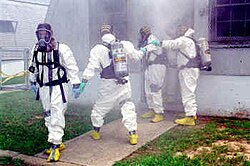
Below are some examples of ensembles of personal protective equipment, worn together for a specific occupation or task, to provide maximum protection for the user:
- PPE gowns are used by medical personnel like doctors and nurses.
- Chainsaw protection (especially a helmet with face guard, hearing protection, kevlar chaps, anti-vibration gloves, and chainsaw safety boots).
- Bee-keepers wear various levels of protection depending on the temperament of their bees and the reaction of the bees to nectar availability. At minimum, most beekeepers wear a brimmed hat and a veil made of fine mesh netting. The next level of protection involves leather gloves with long gauntlets and some way of keeping bees from crawling up one's trouser legs. In extreme cases, specially fabricated shirts and trousers can serve as barriers to the bees' stingers.
- Diving equipment, for underwater diving, constitutes equipment such as a diving helmet or diving mask, an underwater breathing apparatus, and a diving suit.
- Firefighters wear PPE designed to provide protection against fires and various fumes and gases. PPE[20] worn by firefighters include bunker gear, self-contained breathing apparatus, a helmet, safety boots, and a PASS device.
In sports
[edit]Participants in sports often wear protective equipment. Studies performed on the injuries of professional athletes, such as that on NFL players,[21][22] question the effectiveness of existing personal protective equipment.
Limits of the definition
[edit]The definition of what constitutes personal protective equipment varies by country. In the United States, the laws regarding PPE also vary by state. In 2011, workplace safety complaints were brought against Hustler and other adult film production companies by the AIDS Healthcare Foundation, leading to several citations brought by Cal/OSHA.[23] The failure to use condoms by adult film stars was a violation of Cal/OSHA's Blood borne Pathogens Program, Personal Protective Equipment.[23] This example shows that personal protective equipment can cover a variety of occupations in the United States, and has a wide-ranging definition.
Legislation
[edit]
United States
[edit]The National Defense Authorization Act for 2022 defines personal protective equipment as
Equipment for use in preventing spread of disease, such as by exposure to infected individuals or contamination or infection by infectious material (including nitrile and vinyl gloves, surgical masks, respirator masks and powered air purifying respirators and required filters, face shields and protective eyewear, surgical and isolation gowns, and head and foot coverings) or clothing, and the materials and components thereof, other than sensors, electronics, or other items added to and not normally associated with such personal protective equipment or clothing.[24]
Under this Act, US military services are prohibited from purchasing PPE from suppliers in North Korea, China, Russia or Iran, unless there are problems with the supply or cost of PPE of "satisfactory quality and quantity".[24]
European Union
[edit] | This section needs to be updated. (July 2024) |
At the European Union level, personal protective equipment is governed by Directive 89/686/EEC on personal protective equipment (PPE). The Directive is designed to ensure that PPE meets common quality and safety standards by setting out basic safety requirements for personal protective equipment, as well as conditions for its placement on the market and free movement within the EU single market. It covers "any device or appliance designed to be worn or held by an individual for protection against one or more health and safety hazards".[25] The directive was adopted on 21 January 1989 and came into force on 1 July 1992. The European Commission additionally allowed for a transition period until 30 June 1995 to give companies sufficient time to adapt to the legislation. After this date, all PPE placed on the market in EU Member States was required to comply with the requirements of Directive 89/686/EEC and carry the CE Marking.
Article 1 of Directive 89/686/EEC defines personal protective equipment as any device or appliance designed to be worn or held by an individual for protection against one or more health and safety hazards. PPE which falls under the scope of the Directive is divided into three categories:
- Category I: simple design (e.g. gardening gloves, footwear, ski goggles)
- Category II: PPE not falling into category I or III (e.g. personal flotation devices, dry and wet suits, motorcycle personal protective equipment)
- Category III: complex design (e.g. respiratory equipment, harnesses)
Directive 89/686/EEC on personal protective equipment does not distinguish between PPE for professional use and PPE for leisure purposes.
Personal protective equipment falling within the scope of the Directive must comply with the basic health and safety requirements set out in Annex II of the Directive. To facilitate conformity with these requirements, harmonized standards are developed at the European or international level by the European Committee for Standardization (CEN, CENELEC) and the International Organization for Standardization in relation to the design and manufacture of the product. Usage of the harmonized standards is voluntary and provides presumption of conformity. However, manufacturers may choose an alternative method of complying with the requirements of the Directive.
Personal protective equipment excluded from the scope of the Directive includes:
- PPE designed for and used by the armed forces or in the maintenance of law and order;
- PPE for self-defence (e.g. aerosol canisters, personal deterrent weapons);
- PPE designed and manufactured for personal use against adverse atmospheric conditions (e.g. seasonal clothing, umbrellas), damp and water (e.g. dish-washing gloves) and heat;
- PPE used on vessels and aircraft but not worn at all times;
- helmets and visors intended for users of two- or three-wheeled motor vehicles.
The European Commission is currently working to revise Directive 89/686/EEC. The revision will look at the scope of the Directive, the conformity assessment procedures and technical requirements regarding market surveillance. It will also align the Directive with the New Legislative Framework. The European Commission is likely to publish its proposal in 2013. It will then be discussed by the European Parliament and Council of the European Union under the ordinary legislative procedure before being published in the Official Journal of the European Union and becoming law.
Research
[edit]Research studies in the form of randomized controlled trials and simulation studies are needed to determine the most effective types of PPE for preventing the transmission of infectious diseases to healthcare workers.[4]
There is low certainty evidence that supports making improvements or modifications to PPE in order to help decrease contamination.[4] Examples of modifications include adding tabs to masks or gloves to ease removal and designing protective gowns so that gloves are removed at the same time.[4] In addition, there is low certainty evidence that the following PPE approaches or techniques may lead to reduced contamination and improved compliance with PPE protocols: Wearing double gloves, following specific doffing (removal) procedures such as those from the CDC, and providing people with spoken instructions while removing PPE.[4]
See also
[edit]- Biological hazard – Biological material that poses serious risks to the health of living organisms
- Blunt trauma personal protective equipment
- Bomb disposal – Activity to dispose of and render safe explosive munitions and other materials
- CBRN defense – Protective measures against hazardous materials warfare (Chemical Biological Radiological Nuclear, known formerly as NBC)
- Chainsaw safety clothing – Personal protective equipment for operators of chainsaws
- Chemical protective clothing
- Combat suit – Protective clothing; armor worn on the body
- Environmental suit – Clothing worn to protect a person in a hostile environment
- Fall arrest – Equipment which safely stops a person already falling
- Hard hat – Protective headwear
- Hazmat – Solids, liquids, or gases harmful to people, other organisms, property or the environment (hazardous materials)
- High-visibility clothing – Safety clothing
- Motorcycle personal protective equipment – Protective clothing and helmets for motorcycle safety
- NBC suit – Type of military personal protective equipment
- Personal flotation device – Equipment to help the wearer keep afloat in water
- Personal protective equipment for arc flash – Heat and light produced during an electrical arc fault
- PPE Portrait project – Way to humanize medical staff wearing PPE
- Safe handling of hazardous drugs
- Safety harness – Equipment designed to protect from falling
- Usage of personal protective equipment
- Workplace hazard controls for COVID-19 – Prevention measures for COVID-19
- Normalization of deviance – one reason people stop using effective prevention measures
References
[edit]- ^ "Personal Protective Equipment". Citation PLC. Archived from the original on 2012-10-14. Retrieved 2012-10-31. Personal Protective Equipment
- ^ Funderburk, Greg; McGowan, Dennis; Stumph, Charles (2015). Weapons of Mass Destruction. LawTech Publishing Group. ISBN 978-1-56325-283-9.
- ^ Lynteris, Christos (18 August 2018). "Plague Masks: The Visual Emergence of Anti-Epidemic Personal Protection Equipment". Medical Anthropology. 37 (6): 442–457. doi:10.1080/01459740.2017.1423072. hdl:10023/16472. ISSN 0145-9740. PMID 30427733.
- ^ a b c d e Verbeek, Jos H; Rajamaki, Blair; Ijaz, Sharea; Sauni, Riitta; Toomey, Elaine; Blackwood, Bronagh; Tikka, Christina; Ruotsalainen, Jani H; Kilinc Balci, F Selcen (2020-05-15). "Personal protective equipment for preventing highly infectious diseases due to exposure to contaminated body fluids in healthcare staff". Cochrane Database of Systematic Reviews. 2020 (5) CD011621. doi:10.1002/14651858.cd011621.pub5. hdl:1983/b7069408-3bf6-457a-9c6f-ecc38c00ee48. ISSN 1465-1858. PMC 8785899. PMID 32412096.
- ^ a b c d Respirators Archived 2012-08-30 at the Wayback Machine. National Institute for Occupational Safety and Health.
- ^ a b "N95 Respirators and Surgical Masks (Face Masks)". United States Food and Drug Administration. 5 April 2020. Retrieved 18 April 2020.
- ^ "Selecting the right Respiratory Protective Equipment (RPE) for the job" Archived 2012-11-08 at the Wayback Machine. Healthy Working Lives. 2008-4-4
- ^ CDC - NIOSH - Respirator Fact Sheet Archived 2017-09-28 at the Wayback Machine. The National Personal Protective Technology Laboratory.
- ^ "Respiratory Protection Against Airborne Infectious Agents for Health Care Workers: Do surgical masks protect workers?" (OSH Answers Fact Sheets). Canadian Centre for Occupational Health and Safety. 2017-02-28. Retrieved 2020-04-18.
- ^ NIOSH Recommended Guidelines for Personal Respiratory Protection of Workers in Health-care Facilities Potentially Exposed to Tuberculosis. 1992.
- ^ a b c d e CDC - Skin Exposures and Effects - NIOSH Workplace Safety and Health Topic Archived 2012-08-06 at the Wayback Machine. The National Institute for Occupational Safety and Health.
- ^ Luque, John S. (2019). ""I Think the Temperature was 110 Degrees!": Work Safety Discussions Among Hispanic Farmworkers". Journal of Agromedicine. 24 (1): 15–25. doi:10.1080/1059924x.2018.1536572. PMC 7045709. PMID 30317928.
- ^ a b CDC - Eye Safety - NIOSH Workplace Safety and Health Topic Archived 2017-07-07 at the Wayback Machine. The National Institute for Occupational Safety and Health.
- ^ a b c d e f g CDC - Eye Safety - Eye Safety for Emergency Response and Disaster Recovery Archived 2017-09-02 at the Wayback Machine. The National Institute for Occupational Safety and Health.
- ^ a b c CDC - Noise and Hearing Loss Prevention - Facts and Statistics - NIOSH Workplace Safety and Health Topic Archived 2016-07-03 at the Wayback Machine. The National Institute for Occuaptional Safety and Health.
- ^ Occupational noise exposure - 1910.95 Archived 2015-04-02 at the Wayback Machine. The Occupational Safety and Health Administration.
- ^ Criteria for a Recommended Standard: Occupational Noise Exposure Archived 2017-02-02 at the Wayback Machine. DHHS (NIOSH) Publication No. 98-126.
- ^ Tikka, Christina; Verbeek, Jos H; Kateman, Erik; Morata, Thais C; Dreschler, Wouter A; Ferrite, Silvia (2017-07-07). "Interventions to prevent occupational noise-induced hearing loss". The Cochrane Database of Systematic Reviews. 2017 (7) CD006396. doi:10.1002/14651858.CD006396.pub4. ISSN 1469-493X. PMC 6353150. PMID 28685503.
- ^ NIOSH, National Institute for Occupational Safety and Health (2025-01-16). "NIOSH science policy update: individual fit-testing recommendation for hearing protection devices". NIOSH Policy Update. doi:10.26616/NIOSHPUB2025104.
- ^ "Personal Protective Equipment (PPE) On Sale". PPEIN. Archived from the original on February 24, 2021.
- ^ CDC - NIOSH Science Blog - Brain Injury in the NFL Archived 2012-12-20 at Wikiwix. The National Institute for Occupational Safety and Health.
- ^ Lehman, EJ; Hein, MJ; Baron, SL; Gersic, CM (2012). "Neurodegenerative causes of death among retired National Football League players". Neurology. 79 (19): 1970–4. doi:10.1212/WNL.0b013e31826daf50. PMC 4098841. PMID 22955124.
- ^ a b "Larry Flynt's Hustler Video Cited by Cal/OSHA over Condoms, Safety, Says AHF". businesswire.com. 2011-03-31. Archived from the original on 6 August 2016. Retrieved 6 May 2018.
- ^ a b US Government, National Defense Authorization Act for Fiscal Year 2022, Section 802, enacted 15 March 2022, accessed 2 January 2023
- ^ "Council Directive 89/686/EEC of 21 December 1989 on the approximation of the laws of the Member States relating to personal protective equipment". europa.eu. 30 December 1989. Retrieved 6 May 2018.
External links
[edit]

- CDC - Emergency Response Resources: Personal Protective Equipment - NIOSH Workplace Safety and Health Topic
- European Commission, DG Enterprise, Personal Protective Equipment
- Directive 89/686/EEC on Personal Protective Equipment
- A short guide to the Personal Protective Equipment at Work Regulations 1992' Archived 2020-07-28 at the Wayback Machine INDG174(rev1), revised 8/05 (HSE)

| |||||||||||||||||||||||||||||||||||||
| |||||||||||||||||||||||||||||||||||||
| |||||||||||||||||||||||||||||||||||||
| |||||||||||||||||||||||||||||||||||||
| |||||||||||||||||||||||||||||||||||||
| |||||||||||||||||||||||||||||||||||||
| |||||||||||||||||||||||||||||||||||||
| |||||||||||||||||||||||||||||||||||||
| |||||||||||||||||||||||||||||||||||||
| |||||||||||||||||||||||||||||||||||||
| |||||||||||||||||||||||||||||||||||||
| |||||||||||||||||||||||||||||||||||||
| |||||||||||||||||||||||||||||||||||||
| |||||||||||||||||||||||||||||||||||||
| |||||||||||||||||||||||||||||||||||||


| International | |
|---|---|
| National | |
| Other | |

Personal protective equipment
View on GrokipediaPersonal protective equipment (PPE) consists of clothing, helmets, gloves, face shields, respirators, and other garments or devices designed and worn by workers to protect against workplace hazards that may cause injury or illness, including chemical, physical, electrical, mechanical, biological, or radiological risks.[1][2] PPE serves as the final tier in the hierarchy of controls for hazard mitigation, employed when engineering, administrative, or elimination measures prove insufficient to remove or reduce exposures to safe levels.[2] Common categories encompass eye and face protection, head protection, foot and leg protection, hand and arm protection, body protection, hearing protection, and respiratory protection, with specific standards dictating selection, maintenance, and usage based on assessed risks.[3] In the United States, the Occupational Safety and Health Administration (OSHA) mandates employer assessments of workplace hazards and provision of appropriate PPE at no cost to employees, alongside training on proper use, thereby aiming to prevent serious injuries and fatalities documented in occupational settings.[4] While historical precedents trace rudimentary forms like helmets to ancient warfare around 900 BCE, modern systematic application emerged with industrial regulations in the 19th and 20th centuries, underscoring PPE's role as a critical yet supplementary barrier reliant on empirical hazard evaluation rather than universal panacea.[5]
Definition and Fundamentals
Purpose and Core Principles
Personal protective equipment (PPE) functions primarily as a barrier to minimize or prevent exposure to workplace hazards that cannot be fully eliminated through engineering controls, administrative measures, or safe work practices, serving as the final layer of defense in occupational safety protocols.[1][2] Under the Occupational Safety and Health Act of 1970, U.S. employers are mandated to provide PPE at no cost to employees when necessary to protect against recognized hazards, with standards updated in 2008 to include payment requirements for non-specialty foot and hand protection as well.[5] This equipment targets specific risks such as chemical splashes, biological agents, physical impacts, or airborne particulates, protecting vulnerable body areas including the respiratory system, skin, eyes, and extremities to reduce injury or illness rates empirically demonstrated in regulated environments.[6] For instance, proper PPE use has been associated with significant reductions in occupational injury rates, as evidenced by longitudinal data from industries like construction and healthcare where compliance correlates with lower incidence of preventable harms.[5] Core principles of PPE implementation begin with comprehensive hazard assessment, requiring employers to evaluate workplace conditions—including the type, level, duration, and route of potential exposure—to determine if PPE is warranted and what specific types are suitable, rather than applying it universally without evidence of need.[1] Selection must prioritize equipment that effectively matches identified hazards, such as respirators certified by the National Institute for Occupational Safety and Health (NIOSH) for airborne threats or gloves rated for chemical resistance based on permeation testing standards like those in ASTM F739.[2] Fit and comfort are critical, as ill-fitting or uncomfortable PPE leads to non-compliance; principles emphasize adjustable designs and sizing to ensure a secure seal or coverage without impeding mobility, supported by studies showing that ergonomic factors directly influence usage adherence rates exceeding 90% in optimized programs.[7] Training on donning, doffing, limitations, and recognition of degradation is mandatory, with OSHA requiring documented programs that address these elements to mitigate risks from improper use, which accounts for up to 20-30% of PPE-related failures in field audits.[1] Maintenance and inspection form another foundational principle, mandating regular checks for damage, cleanliness, and functionality—such as filter replacement in respirators per manufacturer schedules or decontamination protocols for reusable items—to sustain protective efficacy over time.[7] Limitations must be acknowledged: PPE does not eliminate hazards and can introduce secondary risks like heat stress or reduced dexterity, necessitating integration with monitoring to verify real-world performance through metrics like protection factors derived from fit-testing protocols.[8] Empirical validation, including post-incident analyses, underscores that adherence to these principles yields measurable safety outcomes, such as a 40% drop in certain injury types following rigorous PPE programs in high-risk sectors, though over-reliance without addressing root causes via higher controls remains suboptimal.[5]Integration with Hierarchy of Controls
The hierarchy of controls is a systematic framework for managing occupational hazards, prioritizing interventions that address risks at their source over those that merely mitigate exposure for individuals. Developed by organizations such as the National Institute for Occupational Safety and Health (NIOSH), it consists of five levels: elimination (removing the hazard entirely), substitution (replacing the hazard with a less dangerous alternative), engineering controls (isolating people from the hazard through design changes), administrative controls (altering work practices or policies to reduce exposure), and personal protective equipment (PPE) as the final tier.[9] PPE integrates into this hierarchy as a supplementary measure, employed only when higher-level controls cannot fully eliminate or sufficiently reduce the risk, such as in scenarios involving unpredictable or transient hazards like construction dust or emergency response to chemical spills.[10] PPE's position at the base reflects its inherent limitations as a control method, as it neither eliminates hazards nor prevents their generation but instead serves as a barrier worn by the worker. Unlike engineering controls, which target the hazard's origin—such as ventilation systems capturing fumes—PPE relies on consistent individual compliance, proper fitting, maintenance, and training, which can falter due to human factors like discomfort, forgetfulness, or inadequate supervision.[9] For instance, respirators may fail if not sealed correctly, providing a false sense of security while allowing contaminants to bypass protection, and they offer no safeguard to bystanders or subsequent workers entering contaminated areas.[11] Data from workplace incident analyses indicate that over-reliance on PPE without higher controls correlates with higher injury rates, as evidenced by NIOSH studies showing that administrative and engineering interventions reduce exposures more reliably than PPE alone.[9][12] Effective integration requires layering PPE atop feasible higher controls to achieve comprehensive protection, as recommended by OSHA guidelines which emphasize combining methods—for example, using machine guards (engineering) alongside gloves (PPE) in manufacturing to address both mechanical and contact hazards.[13] This approach acknowledges PPE's role in bridging gaps, such as during maintenance activities where engineering controls are temporarily infeasible, but underscores the need for ongoing hazard reassessment to ascend the hierarchy where possible.[14] Limitations persist, including cost burdens from frequent replacement and the potential for reduced productivity due to encumbrance, prompting regulatory bodies to mandate PPE only as a stopgap while pursuing root-cause reductions.[9] In practice, successful programs, like those in healthcare during infectious disease outbreaks, pair PPE with administrative protocols (e.g., rotation schedules) to minimize fatigue and enhance efficacy, demonstrating that isolated PPE deployment yields inferior outcomes compared to holistic hierarchy application.[15]Historical Evolution
Pre-Industrial and Early Mechanical Era
In ancient civilizations, rudimentary personal protective equipment emerged primarily for warfare and basic labor, with the oldest documented helmets crafted from leather or bronze dating to approximately 900 BC to shield heads from impacts.[16] Artisans in trades like tanning and early metalworking employed animal-hide aprons to guard against heat, sparks, and sharp tools, a practice rooted in practical necessity rather than formalized standards.[17] During the medieval period, specialized protections developed for hazardous occupations. Blacksmiths routinely wore heavy leather aprons and gloves to mitigate burns and flying debris from forging, materials chosen for their heat resistance and availability from local hides.[17][18] Beekeepers initially relied on non-equipment methods like smoke from cow dung or herbal ointments applied to skin for sting prevention, as described in 10th-century Byzantine agricultural texts; by the 14th century, fabric veils over the head appeared in illustrations, evolving into sewn caps, masks, jackets, and gloves by the 15th century to allow safer hive management.[19][20] Physicians confronting the 14th-century bubonic plague outbreaks donned beak-shaped masks stuffed with aromatic herbs, paired with full leather suits and gloves, aiming to filter miasma and block contagion, though efficacy was limited by prevailing humoral theories rather than germ understanding.[21][22] The onset of the early mechanical era during the late 18th-century Industrial Revolution introduced factory-based hazards like machinery entanglement and dust inhalation, prompting continued use of leather aprons and gloves for shielding against cuts, burns, and abrasions in textile mills and nascent metalworks.[23][24] Workers improvised rudimentary respirators from cloth rags to counter airborne particles, while sturdy boots emerged to prevent foot injuries from heavy equipment, reflecting ad-hoc adaptations amid rapid mechanization without regulatory oversight.[23][25] These measures prioritized immediate hazard mitigation over comprehensive safety, as industrial expansion outpaced protective innovations until later legislative reforms.[26]20th-Century Industrial and Wartime Developments
The establishment of the U.S. Bureau of Mines in 1910 marked a pivotal response to frequent coal mining disasters, initiating federal research into safety measures including respiratory devices, ventilation, and protective gear to mitigate risks from gases, dust, and explosions.[27] This agency focused on empirical testing of equipment, such as early self-rescuers for miners trapped by toxic fumes, laying groundwork for standardized PPE in hazardous industrial environments like mining and manufacturing.[28] The 1912 Jed Mine explosion in West Virginia, which killed 84 miners due to methane ignition, spurred the founding of the Mine Safety Appliance Company (MSA) in 1914 by engineers John T. Ryan Sr. and George H. Deike.[29] Collaborating with Thomas Edison, MSA developed the Edison Safety Mining Lamp, a battery-powered electric cap lamp that eliminated open flames and reduced mine explosions by approximately 75% over the subsequent 25 years through safer illumination in gaseous environments.[29] By 1919, the Bureau of Mines launched the first federal respirator certification program, approving the initial device on January 15, 1920, which emphasized filtration efficiency against industrial dusts and fumes.[30] Head protection advanced amid growing factory mechanization; in 1919, Edward W. Bullard introduced the "Hard Boiled Hat," a laminated canvas helmet treated with shellac, modeled on World War I doughboy helmets to shield workers from falling debris in construction and logging.[31] This was followed by MSA's 1930 Skullgard Bakelite helmet, an early rigid plastic alternative offering impact resistance.[32] World War I's introduction of chemical agents, beginning with chlorine gas at Ypres in April 1915, accelerated respiratory PPE innovation; Ukrainian chemist Nikolay Zelinsky developed the first effective activated charcoal gas mask filter that year, enabling absorption of multiple toxic gases.[33] Garrett Morgan's 1914-patented "breathing device," featuring a hood with chemical-soaked sponges, proved vital in early rescue operations and influenced military adaptations.[34] During World War II, wartime production demands and home-front industrial expansion drove mass production of advanced gas masks and respirators, with U.S. efforts enhancing filtration for both military and factory use against chemical hazards and airborne particulates.[35]Post-2000 Global Health Crises and Responses
The 2003 severe acute respiratory syndrome (SARS) outbreak, originating in China and affecting over 8,000 cases globally, underscored the critical role of personal protective equipment (PPE) in containing aerosol-transmitted pathogens among healthcare workers (HCWs). HCWs experienced high infection rates, with studies indicating that proper PPE usage, including masks, goggles, and gowns, reduced viral exposure, though incomplete adherence or breaches contributed to transmission.[36] [37] The World Health Organization recommended PPE ensembles with masks, eye protection, and aprons for high-risk personnel, prompting global enhancements in infection control training and isolation protocols.[38] During the 2009 H1N1 influenza pandemic, which infected an estimated 11-21% of the global population, U.S. Centers for Disease Control and Prevention (CDC) guidelines emphasized N95 respirators for HCWs entering isolation rooms of suspected cases, alongside gloves, gowns, and eye protection to mitigate droplet and contact spread.[39] [40] These measures aimed at full adherence during exposure periods, though real-world implementation varied, highlighting the need for stockpiling to address potential surges in demand.[39] The 2014-2016 Ebola virus disease outbreak in West Africa, resulting in over 28,000 cases and 11,000 deaths, necessitated advanced PPE protocols featuring full-body coverage, waterproof boots, and head covers to shield against bodily fluids.[41] The World Health Organization updated guidelines in October 2014 to prioritize mucosal protection via respirators, face shields, and goggles, while emphasizing rigorous donning and doffing training to prevent self-contamination, a primary HCW infection vector.[42] Limited PPE supplies exacerbated risks, leading to calls for enhanced global stockpiles and safer removal procedures.[43] The 2020 COVID-19 pandemic exposed acute PPE vulnerabilities, with U.S. hospitals reporting shortages of N95 masks, gowns, and gloves amid surging demand that outstripped domestic production reliant on foreign supply chains.[44] [45] Responses included CDC endorsements for extended N95 use, decontamination via vaporized hydrogen peroxide, and ultraviolet irradiation, alongside rapid manufacturing innovations like 3D-printed shields and fabric alternatives.[46] Surveys of over 21,000 U.S. nurses in mid-2020 revealed persistent shortages, prompting federal invocations of the Defense Production Act to boost output, though uneven distribution prolonged risks for frontline workers.[47] These crises collectively drove post-2000 shifts toward resilient supply chains, reusable PPE technologies, and standardized training, informed by empirical outbreak data rather than prior assumptions.[48]Types and Categorization
Respiratory Protection Devices
Respiratory protection devices, commonly referred to as respirators, safeguard users against inhalation of airborne hazards including particulates, gases, vapors, and oxygen-deficient atmospheres by either filtering ambient air or supplying breathable air from an external source.[49] These devices are essential in occupational settings such as mining, healthcare, manufacturing, and firefighting, where exposure to contaminants exceeds safe thresholds.[50] The U.S. National Institute for Occupational Safety and Health (NIOSH) certifies respirators under 42 CFR Part 84, establishing performance criteria for filtration efficiency and durability.[51] Respirators are broadly classified into two categories: air-purifying respirators (APRs) and atmosphere-supplying respirators (ASRs). APRs remove contaminants from the surrounding air via filters or cartridges, suitable for environments with adequate oxygen (at least 19.5%) and identifiable hazards.[52] Non-powered APRs include filtering facepiece respirators (e.g., N95, which filters 95% of non-oil-based particulates ≥0.3 μm) and elastomeric half- or full-facepieces with replaceable filters.[51] Powered air-purifying respirators (PAPRs) use a blower to draw air through filters, enhancing comfort and protection factors up to 1,000.[53] Particulate filters are rated by oil resistance (N: not resistant; R: resistant; P: oil-proof) and efficiency (95%, 99%, 100%), while chemical cartridges target specific gases via adsorption or absorption. ASRs deliver clean air independent of ambient conditions, critical for immediately dangerous to life or health (IDLH) environments or oxygen deficiency. Supplied-air respirators (SARs) connect to an external compressed air source via hoses, offering unlimited duration with escape provisions, and achieve assigned protection factors (APFs) of 1,000 for continuous-flow modes.[54] Self-contained breathing apparatus (SCBAs) provide 30-60 minutes of air from cylinders, standard for firefighting and confined spaces, with APFs up to 10,000.[50] Hybrid devices combine APR and ASR elements for versatility. Efficacy hinges on proper fit-testing, user training, and maintenance, as poor seals can reduce protection by orders of magnitude; qualitative or quantitative fit tests per OSHA 1910.134 ensure APF attainment.[50] Limitations include inability to detect oxygen deficiency or unknown contaminants in APRs, finite filter life, and physiological burdens like increased breathing resistance, which empirical studies quantify as reducing work endurance by 20-50% in demanding tasks.[55] NIOSH-approved devices must undergo laboratory testing for penetration resistance, with real-world performance validated in controlled trials showing N95 respirators achieving 95% filtration under simulated workplace aerosols.[51] Selection prioritizes hazard type, concentration, and APF requirements over cost, with regulations mandating the least protective viable option only after engineering controls fail.[53]Protective Gear for Skin and Extremities
Protective gear for skin encompasses gloves and clothing that form a barrier against direct contact hazards such as chemicals, abrasions, punctures, cuts, heat, and biological agents, preventing absorption, laceration, or thermal injury to exposed areas.[5] OSHA does not publish an official glove selection chart; under 29 CFR 1910.138, employers must select appropriate hand protection based on a hazard assessment, considering task, conditions, duration, and identified hazards, relying on manufacturer-provided performance data such as permeation resistance per ASTM standards (e.g., ASTM F739). References to selection charts may stem from older Department of Energy documents, but current guidance emphasizes manufacturer compatibility charts (e.g., from Ansell or Honeywell) rather than any OSHA or active DOE chart.[5] Gloves are categorized by primary function and material:- Mechanical protection gloves: Constructed from leather, cotton, or synthetic fabrics like Kevlar, these resist cuts, punctures, and abrasions; leather variants endure impacts up to 20 joules under EN 388 testing equivalents.[5]
- Chemical-resistant gloves: Made from nitrile (resistant to oils and solvents), neoprene (for acids and bases), or butyl rubber (for gases and highly corrosive substances), with selection guided by breakthrough times exceeding 8 hours for specific chemicals per manufacturer data sheets.[5] [56]
- Thermal and cryogenic gloves: Insulated with wool or synthetic fibers for heat up to 300°C or insulated for cold down to -20°C, used in welding or handling liquefied gases.[5]