Hubbry Logo
Seattle Public LibrarySeattle Public LibraryMain
Open search
Seattle Public Library
Community hub
Seattle Public Library
logo
8 pages, 0 posts
0 subscribers
Be the first to start a discussion here.
Seattle Public Library
from Wikipedia

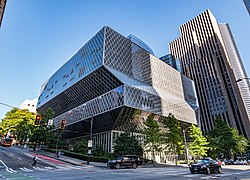
Central Library, looking south on Fifth Avenue

Key Information

The Occidental Block in 1900; to its rear left is a corner of the Collins Block, still standing as of 2008

The Seattle Public Library (SPL) is the public library system serving the city of Seattle, Washington. Efforts to start a Seattle library had commenced as early as 1868, with the system eventually being established by the city in 1890. The system currently comprises 27 branches, most of which are named after the neighborhoods in which they are located. The Seattle Public Library also includes Mobile Services and the Central Library, which was designed by Rem Koolhaas and opened in 2004. The Seattle Public Library also founded the Washington Talking Book & Braille Library (WTBBL), which it administered until July 2008.

All but one of Seattle's early purpose-built libraries were Carnegie libraries. Although the central Carnegie library has since been replaced twice, all the purpose-built branches from the early 20th century survive; however, some have undergone significant alterations. Ballard's former Carnegie library has since housed a number of restaurants and antique stores among other enterprises, while others such as the Fremont and Green Lake branches have been modernized and remain in use as libraries.

As of 2023, the library served 293,000 active patrons, 75,000 new cardholders, 124,000 borrowers of physical materials, and 175,000 borrowers of digital materials. The library answered 234,000 assisted information questions, and it hosted 3,500 classes, events and activities, as well as 341,000 public computer sessions.[1]

Branches

[edit]

The Seattle Public Library system consists of 27 branches including the Central Library; it also provides a mobile library system.[3]

Collections and services

[edit]

As of 2023, the Seattle Public Library contained 1.8 million physical items, with 1 million at the Central Library and 814,000 catalogued at the other 26 branches. The total physical collection includes 4.7 million printed books and other printed items; 1.2 million CDs, DVDs, and audiobooks; and 42,000 other items, including laptops, tablets, Wi-Fi hotspots, and Kill A Watt power meters.[1]

As of 2011, its special collections include an oral history collection, the state document depository, the federal document depository, an aviation history collection, genealogy records, and historical documents about Seattle.[3] A room on the seventh floor of the Central Library houses the ZAPP Zine Collection, over 30,000 zines donated by Richard Hugo House, where it used to constitute the Zine Archive and Publishing Project collection.[5] In addition all locations have uncatalogued collections of books that can be borrowed without a library card.[citation needed]

The library also has extensive online resources, which as of 2023 include, among other things, access to historic archives of The Seattle Times, the Seattle Post-Intelligencer, Seattle Daily Journal of Commerce, and The New York Times, as well as the Britannica Library, Kanopy (video streaming), and ProQuest (academic research), plus access to several e-book collections.[6] In 2023, the library circulated 7.4 million digital items, including 5.5 million e-book and e-audiobooks.[1] Through Books Unbanned, these online resources are available to youth ages 13 to 21 throughout the United States.[7] SPL also offers free admission to 13 local museums, zoos, and other attractions that are reserved online.[8]

History

[edit]
The public library in Henry Yesler's former home downtown at Third and James, burned on the night of January 1–January 2, 1901
The downtown Carnegie Library as it appeared in 1919

Late 19th century: founding

[edit]

Seattle's first attempt to start a library association occurred at a meeting of 50 residents on July 30, 1868, but produced only minimal success over the next two decades.[9] The Ladies' Library Association began a more focused attempt to put together a public library in 1888. They had raised some funds and had even obtained a pledge of land from Henry Yesler, but their efforts were cut short by the Great Seattle Fire of 1889. Nonetheless, encouraged by their ideas, the revised October 1890 city charter formally established the Public Library as a branch of the city government. The ladies' influence can be seen in that the charter required that at least two of the five library commissioners be women. The library was funded by a 10% share of city fines, penalties, and licenses.[10]

The first library opened April 8, 1891 as a reading room on the third floor of the Occidental Block—later the Seattle Hotel—supervised by librarian A. J. Snoke. By December 1891 when books were first allowed to be borrowed, it had 6,541 volumes. Snoke was succeeded in 1893 by John D. Atkinson, who was succeeded in 1895 by Charles Wesley Smith, who remained in the position until 1907. Smith took over a library that, like all of Seattle, had been seriously impacted by the Panic of 1893: by 1895 its annual budget was only half of what it had been that first year.[11]

In its first decade or so, the growing library "developed the traveling habit".[11] In June 1894, it moved across Second Avenue to the Collins Block. By 1895, the budget situation was so dire that Smith initially experimented with charging borrowers ten cents to borrow a book; the experiment was a failure and in 1896 the library moved to the Rialto, a building farther north on Second Avenue, far enough north that at that time it stood outside of Seattle's core. As the city grew out, that building was later occupied by the Frederick and Nelson department store. At the Rialto, the library for the first time moved to an open-stacks policy, where users could browse through the shelves for themselves instead of presenting a request to a librarian.[11] In 1898 the library moved again to the former Yesler Mansion, a forty-room building on the site that would later become the King County Courthouse.[12]

Meanwhile, in 1896, the library established a bindery, and a new city charter drastically decreased the power of the library commission and removed the requirement of its having female members. This greatly increased Smith's power, a change which he himself opposed; in 1902 a new Library Board would be established, again gaining supervisory rather than merely advisory power.[11]

Early 20th century: the first great era of growth

[edit]

On the night of January 1, 1901, the Yesler Mansion burned taking most of the library collection with it.[13] The library records were salvaged, along with the 2,000 volumes of the children's collection. Other than those, though, practically the only books salvaged were the 5,000 that were out on circulation at the time. The library operated for a time out of Yesler's barn, which had survived,[12] then moved to a building that had been left behind when the University of Washington had moved from downtown to its present campus.[14] By January 6, Andrew Carnegie had promised $200,000 to build a new Seattle library; he later added another $20,000 when this budget proved inadequate.[12]

The new Carnegie library was built not far from the former university campus, occupying the entire block between 4th and 5th Avenues and between Madison and Spring Streets. The land was purchased for $100,000. In August 1903, the city selected a design submitted by P. J. Weber of Chicago for a building to be constructed largely of sandstone. Ground was broken in spring 1905 and the library was dedicated December 19, 1906.[12] Shortly after moving to these new permanent quarters, Smith was succeeded in 1907 by Judson T. Jennings.[14]

Meanwhile, the library began to grow in other respects. A reference department had been established in 1899. In 1903 a position was established for a children's librarian. In 1904 a plan was established to grow eventually to 12 departments. The periodical division was established in 1906, the art division in 1907, and the technology division in 1912. Branch libraries had opened in rented quarters in Fremont (1903), Green Lake (1905), and the University District (1908). In 1908, Carnegie donated $105,000 to build permanent branches in the University District, Green Lake, and West Seattle (all of which opened in summer 1910). The annexation by Seattle of the city of Ballard brought with it another already established Carnegie library, and a further Carnegie donation of $70,000 in 1911 built the Queen Anne branch (opened 1914) and the Columbia Branch (opened December 31, 1915 in Columbia City). The land in the Central District donated by Henry Yesler to the Ladies' Library Association was traded to the parks department and the money was city funds were used to buy land and erect a library about 1 mile (1.6 km) east of downtown and named after Yesler.[14] It was later renamed as the Douglass–Truth Branch Library.

The 1921 opening of the permanent Fremont branch—also funded with Carnegie money—brought this era of great expansion to an end. It would be over three decades before The Seattle Public Library opened another proper branch.[9]

Even as early as 1915, the library was collecting books not only in English but in many other languages spoken in Seattle (though all of the languages collected at that time were European: there were as yet no Asian language collections). In 1915, the library had collections in Croatian, "Dano-Norwegian" (Bokmål), Finnish, French, German, Italian, Lithuanian, Modern Greek, Russian, Spanish, Swedish, and Yiddish. Ten other languages were also lightly represented.[15] Seattle also had established one of only three collections for the blind in the country west of the Mississippi River, the other two being in San Francisco and Portland, Oregon. In 1915 this collection had 698 volumes.[16]

In 1916, 67,097 people borrowed books from the library. That was 19 per cent of the population of the city. At that time the system appears to have had more total points of contact with the public than today, though few of these were proper branches. A civics textbook from the era indicates the library's points of contact with the public as "the central library, 9 branch libraries, 8 drug store deposit stations, 32 fire-engine houses, 420 school rooms in 77 schools, 3 play grounds and 8 special deposit stations."[17]

Mid 20th century stagnation

[edit]
The Paul Thiry-designed North East branch (opened 1954) stood in sharp architectural contrast to the older branch libraries.

Seattle suffered heavily in the Great Depression. The Library's official website describes the Library as having been "pummeled" in this period of "soaring demands and evaporating resources".[9] In 1930, a 10-year-plan announced an "urgent" need for a $1.2 million bond issue to expand the Central Library. In the event, nothing of the sort happened. During the Depression, the Central Library became a refuge for the jobless. Library circulation hit record heights, passing 4 million in 1932. Meanwhile, budgets were cut, employees were laid off, and programs were terminated. The Library's 1939 budget was $40,000 less than its 1931 budget.[9]

The Library's 50th anniversary in 1941 occasioned the foundation of Friends of The Seattle Public Library. The economic revival brought about by World War II, and the post-war prosperity, began to bring the library out of its institutional stagnation. Seattle spent $400,000 on a book stack addition to the Central Library in 1949, and three modern new branch libraries were built in 1954.[9] Nonetheless, the library was simply not used nearly as much in this era as in the Depression years. While the city's population had grown from 368,000 to 463,000 since 1932, only 2.4 million books were being borrowed annually, as against over 4 million.[18] Bond issue votes to build a more modern central library failed in 1950 and 1952.[9]

At mid-century, The Seattle Public Library had numerous "book stations" for areas with no branch as such, in locations such as a "rented shop space, clubhouse, or hospital," each with a small, frequently changing collection of books. These book stations were open half-time, and serves one-sixth as many readers as the branch libraries. A bookmobile with 2,500 books serviced two dozen other locations. Also, at this time The Seattle Public Library was a mainstay of the King County Library System (then known as the King County Rural Library District), with 70,000 book loans in 1948 to King County patrons outside the city.[19]

By mid-century, The Seattle Public Library circulated a lot more than books. Even in its early years, the library collection had included items such as sheet music. By 1948, the circulating collection included 3,500 phonograph records, which were borrowed a total of 53,000 times that year, as well as 6,000 pieces of sheet music, 6,000 song books and piano albums, 200 reproductions of famous paintings, and 27,000 other pictures. In 1950, the library subscribed to 200 newspapers (mostly from Washington State) and 1,700 periodicals.[19]

The 1960s

[edit]
The Bindon and Wright downtown library (just below center), photographed here in 1969
Stairs lead up through a garden to the Magnolia library

The city finally passed its first-ever library bond issue in 1956. This funded, among other things, a new $4.5 million, 206,000-square-foot (19,100 m2) central library, designed in the International style by the Seattle firm of Bindon & Wright, and built on the same site as its Carnegie predecessor. Dedicated March 26, 1960, it featured the first-ever escalator in an American library, a drive-up window for book pick-ups and was Seattle's first public building to incorporate significant new works of art. Among the artists represented were James FitzGerald, Glen Alps, and Ray Jensen. It also incorporated a fountain by sculptor George Tsutakawa, the first of many fountains Tsutakawa would construct over the remainder of his career.[9]

The new library energized the public library system. The library's official web site writes that "the atmosphere in the opening weeks was likened to a department store during the holiday shopping season. The new Central Library loaned out almost 1 million volumes in its first nine months, a 31 percent increase over the previous year's circulation." A library that had been "struggling with disinterest in a shabby headquarters" now found itself "loved to tatters," with greater demand than it could readily satisfy.[9]

The 1956 bond issue also provided $500,000 for branch libraries. This paid for the construction of the Southwest Branch (1961), a new Ballard Branch (1963; later Abraxus Books[20]), and the Magnolia Branch (1964). The Magnolia Branch was designed by Paul Hayden Kirk and incorporates the Japanese influences found in much Northwest architecture of the era. The bond issue also bought the land for the Broadview Branch, but did not provide the funds to build it; that branch finally opened in 1976.[9]

Late 20th century: Recession and recovery

[edit]

In the 1970s and into the 1980s, The Seattle Public Library experienced another period of tight budgets and constricted services, but the picture was never as bleak as in the Great Depression. In 1975 the Yesler Branch—earlier in danger of closing—was renamed as the Douglass-Truth Branch, honoring Frederick Douglass and Sojourner Truth. That branch features an extensive African American collection.[9]

A $2.3 million federal grant refurbished and expanded public areas of the Central Library in 1979. Another federal grant gave $1.2 million for the Rainier Beach Branch (1981). In the late 1980s, a $4.6 million project restored the Library's six Carnegie branches; this project was recognized with an honor from the National Trust for Historic Preservation.[9]

Meanwhile, capping the career of Library Board president Virginia Burnside, The Seattle Public Library Foundation was established in 1980 to increase outside financial support of the Library. By the mid-1990s, during the dot-com boom years, annual donations exceeded $1 million, while library circulation passed 5 million items annually.[9]

1998–present: "Libraries for All"

[edit]

In 1998, Seattle voters, with an unprecedented 69 percent approval rate, approved the largest library bond issue then ever submitted in the United States. The $196 million "Libraries for All" bond measure, along with private funds raised by The Seattle Public Library Foundation, nearly doubled the square footage in Seattle's libraries, including the building of new branches and a new Central Library.

As of 2006, The Seattle Public Library system had 699 staff members (538 full-time equivalents). It circulated 3,151,840 adult books, 1,613,979 children's books, 570,316 WTBBL materials, and 3,895,444 other media (CDs, DVDs, videotapes, etc.) Staff members answered more than 1 million reference questions.[21] The system also provides 1,134 public computers.[22] Anyone with a library card can get up to one and a half hour a day of free computer use; the system accepts reservations for a computer at a particular time at a particular branch.

The library has moved to an RFID system for materials, which allows people to check out their materials without assistance, freeing librarians to focus on matters other than circulation.[22]

From 1993 to 2004, the library was home to Nancy Pearl, one of the few celebrity librarians in the English-speaking world. Pearl's Book Lust book series and her much-imitated "If All Seattle Read the Same Book" project (now called "Seattle Reads") resulted in her being perhaps the only librarian who has ever been honored with an action figure.

After the Great Recession resulted in eight separate operating budget cuts between 2009 and 2012,[23] in November 2012 Seattle voters passed a 7-year levy to restore services. The levy enabled all branches to provide Sunday service (15 previously did not), increased the number of branches with 7-day-a-week service from 12 to 14, added to the maintenance and repair fund, and provided new funds to purchase physical materials, electronic content, and additional computer equipment.[24]

The library unveiled its proposed rebranding strategy in September 2015, including a new name and new logo,[25] that attracted widespread controversy over its cost; the first phase of the project cost $365,000 and the total cost would have been $1.3 million out of private donations. The board of trustees ultimately rejected the proposal on October 28, 2015, citing negative public feedback and other pressing uses for the funds.[26][27][28]

A $219 million property tax levy was approved by Seattle voters in August 2019 to fund library services, including extended hours at branches, seismic renovations, social services.[29] The levy also included funding to eliminate overdue fines for patrons, which came into effect on January 2, 2020.[30]

During the beginning of the COVID-19 pandemic in March 2020, the library closed all of its branches and in-person services, operating exclusively with curbside pickup at some locations beginning in August.[31][32] Five branches were reopened in April to provide public bathrooms to unsheltered and homeless people in the city, but other services remained closed.[33] The first branches reopened on April 27, 2021, and the final branch reopened in October.[34][35] The library system incurred an estimated $434,188 in property damage during the pandemic, particularly at the Central Library.[36]

The library's checkout and online services were shut down by a ransomware attack in late May 2024 after a period of scheduled maintenance.[37] Branch services remained open and some online services were restored by May 29.[38] By August, most online services had been restored, with the goal of all online services being available by the end of August.[39] The attack's data breach included information from 26,965 patrons and employees; the library's response and investigation was contracted to private consultants at a total cost of $1 million.[40]

Architecture

[edit]

Many of The Seattle Public Library's facilities are notable works of architecture. They reflect the aesthetics of several very different periods. The various former Carnegie libraries and the Douglass-Truth library all date from a single period of two decades in the early 20th century. No further branch libraries were built between 1921 and 1954, and when branch construction resumed, the International style had swept away the earlier revivalism. Today's Greenwood and North East branches are both expanded versions of 1954 libraries, the latter originally designed by Paul Thiry; a third library from 1954, the Susan J. Henry branch on Capitol Hill, has been entirely replaced, as has Bindon & Wright's 1960 Central Library.[9]

The Seattle Central Library opened in 2004 and was designed by Rem Koolhaas and Joshua Prince-Ramus of the Office of Metropolitan Architecture (OMA)[41] in a joint venture with LMN Architects and Front Inc. [d] Facade Consultants.[42] In 2007, the building was voted #108 on the American Institute of Architects' (AIA) list of Americans' 150 favorite structures in the U.S. The building received a 2005 national AIA Honor Award for Architecture.[43]

Six current Seattle branch libraries are on the National Register of Historic Places: Columbia (architects: Harlan P. Thomas and W. Marbury Somervell),[44] Fremont (architect: Daniel Riggs Huntington),[45] Green Lake (architects: W. Marbury Somervell & Joseph S. Cote [d]),[46] Queen Anne (architects: Harlan P. Thomas and W. Marbury Somervell),[47] University (architects: Somervell & Joseph S. Cote),[48] and West Seattle (architects: W. Marbury Somervell & Joseph S. Cote).[49] The original Ballard branch (architect: Henderson Ryan) also shares this status,[50] as does the old Wallingford Fire and Police Station (architect: Daniel Riggs Huntington),[51] which housed a branch library from 1986 to 2000.[52]

In addition, several buildings have been designated as landmarks by the Seattle Landmarks Preservation Board: Columbia,[53] Douglass-Truth,[54] Fremont, Green Lake, Lake City, Magnolia, North East, Queen Anne, University, and West Seattle.[53]

The new Ballard Branch is also one of the first buildings in Seattle to incorporate green architecture. The library is equipped with solar panels to reduce its electricity demands, as well as a green roof, which provides insulation to the building, and also serves to reduce stormwater runoff.[55]

[edit]

Notes

[edit]

References

[edit]

Further reading

[edit]
[edit]
Revisions and contributorsEdit on WikipediaRead on Wikipedia
from Grokipedia
The Seattle Public Library is the municipal library system serving Seattle, Washington, operating 27 branches including a prominent central facility. Established as an official city department in , its foundations trace to 1868 with the creation of the Seattle Library Association, which initially provided reading materials to residents. The system maintains a collection of 2.9 million items encompassing physical books, media, and digital resources, supporting an annual circulation exceeding 10 million transactions. The Central Library, the system's flagship opened on May 23, 2004, features an audacious design by Dutch architect of OMA in partnership with Seattle's LMN Architects, characterized by a continuous "Books Spiral" ramp organizing volumes and a faceted glass exterior enclosing public spaces. This 362,987-square-foot structure has become an architectural landmark, blending functionality with bold form to prioritize information access over traditional shelving hierarchies. Beyond its collections and facilities, the library advances through programs like author events, classes, and equitable resource distribution, serving over 293,000 active patrons annually. It has garnered acclaim for innovative models, yet faced pointed criticisms in hosting forums for speakers espousing gender-critical views, prompting debates over balancing free inquiry against activist demands for content restrictions—tensions amplified by institutional pressures favoring conformity to dominant cultural narratives.

Administration and Governance

Leadership and Board Structure

The Seattle Public Library is governed by a five-member Board of Trustees, appointed by the and confirmed by the , with members serving staggered five-year terms to ensure continuity. The Board's primary responsibilities include setting library policies, approving annual budgets, hiring and evaluating the Chief Librarian, and providing strategic oversight for the system's operations and long-term planning. Board meetings occur monthly, typically on Thursdays at 11:00 a.m., and are open to the public with hybrid in-person and remote access options. As of September 2025, the Board comprises W. Tali Hairston, Ph.D. (President), Yazmin Mehdi (Vice President), Carmen Bendixen, Ron Chew, and Faith Pettis, reflecting a mix of community leaders, educators, and professionals appointed to represent diverse stakeholder interests. Operational falls under the and Chief Librarian, Tom Fay, who was unanimously selected by the Board on March 2, 2022, after serving as interim Chief Librarian since April 2021 and in prior roles such as Director of Public Services from 2015 to 2021. Fay reports directly to the Board and manages daily administration, including oversight of 27 branches, collections, technology systems, public programming, and a staff of approximately 700 employees. The Chief Librarian position combines executive management with professional librarianship, emphasizing service delivery and alignment with Board-approved strategic goals.

Funding Mechanisms and Voter Levies

The Seattle Public Library (SPL) receives its primary operational funding from the City of Seattle's general fund, which is predominantly sourced from local property taxes subject to state-imposed growth limitations under Washington Initiative 747, capping annual increases at 1% plus inflation. To augment this baseline funding for expanded services, capital maintenance, and infrastructure upgrades, SPL has increasingly relied on voter-approved excess property tax levies, which require supermajority approval and temporarily exceed the regular levy cap. These levies, distinct from one-time bond measures, provide multi-year revenue streams dedicated to specific library priorities such as extended branch hours, collection enhancements, youth programs, and seismic retrofitting of aging facilities. A pivotal shift toward levy dependence occurred with the 2012 Library Levy, approved by voters in August 2012, which restored service levels cut during the 2008-2010 recession by funding year-round operations across all branches and bolstering staffing and materials budgets. This was renewed and expanded as the 2019 "Libraries for All" Levy, a seven-year, $219.1 million measure passed with 76% voter approval in August 2019, replacing the expiring 2012 levy while adding resources for technology upgrades, accessibility improvements, and preventive maintenance on buildings from the earlier 1998 capital program. By 2024, the 2019 levy contributed $50.3 million—or 36.4%—to SPL's total revised budget of $138.4 million, enabling consistent 52-week operations, increased digital access, and targeted investments like $8 million annually for core services. Voter levies have proven essential for addressing funding shortfalls from stagnant general fund allocations amid rising operational costs, though they impose an additional burden estimated at about $3 per month for the average homeowner in terms. Prior to the , SPL operated largely without such supplemental levies, relying on regular city appropriations, but post-recession fiscal constraints and voter support for library enhancements—evidenced by high approval rates—have normalized their use as a mechanism to sustain and evolve public access amid demographic growth and service demands in . Ongoing levy reports detail expenditures, with 2024 allocations emphasizing equity-focused programs and facility resilience, underscoring their role in bridging gaps left by core revenues.

Facilities and Infrastructure

Central Library Overview

The Central Library serves as the flagship facility and administrative headquarters of the Seattle Public Library system, located at 1000 4th Avenue in . Opened to the public on May 23, 2004, it replaced the system's prior central building from 1960, which spanned 206,000 square feet and had become inadequate for growing demands. The new structure, funded through the "Libraries for All" bond measure approved by voters in 1998, addressed capacity constraints and incorporated advanced design principles to function as a hub for both physical and digital information access. Designed by Dutch architect of the Office for Metropolitan Architecture (OMA) in collaboration with Seattle-based LMN Architects, the 11-story building covers 362,987 square feet and features a striking diamond-shaped glass-and-steel envelope that maximizes natural light and visibility. The organizes spaces across five rigid platforms dedicated to specific functions—such as administrative offices, parking, and meeting rooms—interconnected by four flexible "in-between" levels that accommodate evolving uses like public computing and collaborative areas. A hallmark element is the "Book Spiral," a 250-foot-long continuous ramp on Levels 7-9 that arranges over 200,000 nonfiction volumes without Dewey Decimal divisions, facilitating serendipitous discovery and reflecting a shift from rigid categorization to fluid knowledge navigation. The facility includes a 275-seat for events, extensive reading rooms with panoramic views, and infrastructure supporting high visitor volumes, with more than 25,000 people attending on opening day alone. As of 2024, the Central Library's physical collection comprises approximately 1 million items, including , media, and periodicals, underscoring its role as the system's core repository amid a total network collection of nearly 3 million physical and digital holdings. The design prioritizes adaptability for future technological integrations, positioning the library as a civic space for diverse knowledge circulation rather than a traditional book warehouse.

Neighborhood Branches and Accessibility

The Seattle Public Library maintains 26 neighborhood branches that serve Seattle's varied residential areas, providing localized access to collections, programs, and technology distinct from the downtown Central Library. These facilities, often named for their surrounding neighborhoods, address community-specific demands such as initiatives in family-oriented districts or business support in commercial zones. As of 2025, the branches collectively support the system's goal of equitable resource distribution across the city's 73 recognized neighborhoods. Branches include those in Ballard, Beacon Hill, Broadview, , Columbia, Delridge, Douglass-Truth, Fremont, Green Lake, High Point, , Northeast, Queen Anne, , Southwest, University, and , with additional locations covering other areas like Denny, Fairwood, and Lake City. Many originated from early 20th-century expansions or Carnegie grants, while recent bond-funded projects have modernized facilities in underserved southern and eastern neighborhoods. Accessibility features are standardized across all neighborhood branches, including Accessibility Toolkits stocked with assistive devices such as screen magnifiers and audio readers for patrons with low vision or blindness. The Library Equal Access Program (LEAP) equips branches with adaptive technologies like 80-cell refreshable displays and large-print keyboards to facilitate computer use and program participation. Sensory kits and walls, containing noise-canceling and fidget tools, further support neurodiverse individuals. Ongoing renovations enhance physical access; for instance, the Green Lake Branch reopened in October 2024 following upgrades for improved ADA compliance, seismic reinforcement, and HVAC systems. However, operational challenges have periodically limited availability, with most neighborhood branches closing intermittently through June 2024 due to staffing shortages amid a citywide hiring lag. In response, nine branches expanded hours starting , , increasing weekly open time by up to 12 hours each to boost public access. Programs targeting equity in underserved areas, such as the Library to initiative extended since to branches in high-need zones, provide tailored support like one-on-one training, though measurable outcomes on closing access gaps remain tied to broader municipal funding constraints.

Collections and Services

Physical and Digital Holdings

The Seattle Public Library's physical collection consists of approximately 1 million items housed at the Central Library and 820,000 items across its 26 branches, for a total of 1.82 million physical holdings as of 2024. These holdings encompass books, materials, and other tangible resources, with additions exceeding 168,000 physical items acquired in 2024 alone to support circulation and community demand. Complementing the physical assets, the library's digital collection totals 1.1 million items, including e-books, e-audiobooks, , and online databases accessible via platforms such as OverDrive. This digital inventory has nearly doubled since 2019, reaching over 1 million items by 2024, driven by annual acquisitions of nearly 100,000 e-book and e-audiobook copies in the most recent year. Combined, the physical and digital holdings yield a total collection size of 2.9 million items, reflecting sustained investment in both formats to meet patron needs amid rising digital circulation.

Core Public Services and Programs

The Seattle Public Library offers core public services centered on material circulation, with 10.8 million items checked out across its 27 branches and digital platforms in 2024, encompassing physical books, audiobooks, DVDs, and e-resources accessible via apps like . Patrons, numbering over 300,000 active cardholders, benefit from no-fee borrowing policies supported by the 2019 voter-approved levy, which funds collection maintenance and technology infrastructure to ensure broad access to educational and recreational content. Reference assistance is provided through in-person staff consultations and , aiding and queries. Technology services form a foundational offering, including free public computer use with 240,000 sessions logged in 2024, high-speed , and device lending such as hotspots (5,400 checkouts) and laptops for on-site needs. These services address digital divides, with partnerships providing bus tickets (20,000 distributed) to facilitate access for low-income users. The Library Equal Access Program (LEAP) extends core services to individuals with disabilities via adaptive technologies, large-print materials, and sensory-friendly spaces. Public programs emphasize literacy and skill-building, drawing 103,000 attendees in 2023 across categories like storytimes, teen help, and adult ESL classes. Specialized initiatives include business consulting for over 2,000 participants annually and cultural events such as author talks and exhibits, often tied to the Library's strategic focus on through free workshops on resume building and . Mobile vans deliver books and programs to underserved areas, while partnerships with schools support initiatives like the Global Reading Challenge to boost youth engagement.

Historical Development

Founding and Initial Expansion (1891–1920s)

The Public Library was formally established as a department on October 1, 1890, governed by a five-member commission and funded via a dedicated . Efforts to create a had begun as early as 1868 amid 's growth, but the Great Fire of , 1889, which razed much of downtown, postponed initial operations. The first facility, a modest reading room, opened in April 1891 on the fifth floor of the Occidental Building at First Avenue between James and Yesler Way in Pioneer Square, starting with reference materials before introducing lending services. By December 1891, the collection had grown to over 6,500 volumes, prompting multiple relocations to larger temporary spaces as demand surged with the city's post-fire reconstruction and Alaska-Yukon Gold Rush influx. In January 1901, philanthropist granted $200,000 for a permanent central , matched by city contributions including an additional $20,000 from Carnegie for expansions. The site at 1000 Fourth Avenue was acquired in February 1902 for $100,000; construction of the Beaux-Arts structure, designed by architect Peter J. Weber, began in April 1904 with a $196,400 contract. The building opened on December 19, 1906, initially stocking 15,000 books in a facility designed for 200,000 volumes and serving growing patronage—borrower registrations rose 94% to 19,229 by the end of 1907. A 1916 rear addition housed bindery and cataloging operations to handle increasing administrative needs. Branch expansion began to decentralize services, with the inaugural neighborhood outlet opening February 2, 1903, in Fremont as an extension of a prior private reading room. Carnegie funding accelerated growth: the Ballard branch debuted in 1904, followed by 1910 openings in the University District, Green Lake, and . A 1911 Carnegie donation of $70,000 supported two more branches, including Queen Anne, contributing to eight Carnegie-era libraries built citywide from 1904 to 1921. This proliferation reflected Seattle's annexation of suburbs like Ballard (1907) and Fremont (1891), alongside population booms that necessitated localized access over a solely model. By the mid-1920s, the system operated multiple fixed branches, marking the transition from itinerant operations to a networked .

Mid-Century Growth and Stagnation (1930s–1960s)

The Great Depression in the 1930s drove significant increases in library usage across Seattle, as unemployed workers utilized branches for job searches, skill-building, and recreation amid economic hardship. Despite this demand, funding shortages curtailed major expansions, though innovative outreach began with the introduction of bookmobile service in 1930 to serve remote neighborhoods. In 1934, the Henry family donated property on Capitol Hill for a future branch site, signaling community support but not immediate construction. Library administrators persistently lobbied city officials for a larger Central Library to accommodate swelling patronage, yet these efforts yielded no new building until later decades. By 1939, the library expanded offerings with phonograph record lending, adapting to cultural shifts in media consumption. The 1940s brought wartime constraints that further strained resources, though the High Point Branch opened in 1942 specifically to support residents of a federal housing project in . Postwar recovery offered limited relief, with budgets remaining austere and the system struggling to maintain operations without substantial infrastructure upgrades. Circulation and attendance continued to rise, exacerbating overcrowding in aging facilities originally designed for earlier populations. Into the 1950s, modest growth materialized with the opening of the first Branch in 1954, constructed on the donated Henry property, and through city annexations that incorporated additional libraries from expanding suburbs. However, the Central Library had outgrown its 1906 structure by the decade's midpoint, prompting renewed calls for replacement amid persistent space shortages. This era of relative stagnation ended with the 1960 dedication of a new downtown Central Library at 4th Avenue and Spring Street, funded by city bonds and featuring escalators as a novel accessibility feature—the first in a U.S. . The $4.5 million facility tripled the previous space to 100,000 square feet, alleviating decades of pent-up demand but underscoring prior underinvestment in the system.

Recession, Recovery, and Modern Revival (1970s–1990s)

During the 1970s and 1980s, the Seattle Public Library faced tight budgets and constricted services amid broader economic pressures, leading to operational challenges and several controversies. Voters approved the 1-2-3 bond measure in 1984, providing funds for renovations to libraries, fire stations, and facilities, which supported targeted improvements such as the rehabilitation of multiple branches. For instance, the Douglass-Truth Branch received a $790,000 upgrade in 1987 using these resources. In the , recovery gained momentum as annual circulation exceeded 5 million items by the mid-decade, annual donations surpassed $1 million, and the city's dot-com boom enhanced economic support for public services. Modern revival efforts included a 1994 bond measure aimed at library enhancements, which voters rejected, underscoring persistent infrastructure needs and paving the way for future funding campaigns.

Libraries for All Era and Bond-Funded Projects (1998–Present)

In November 1998, Seattle voters approved the "Libraries for All" bond measure by nearly 70 percent, authorizing $196.4 million—the largest library bond issue in U.S. history at the time—for capital improvements to the Seattle Public Library system. The measure funded construction of a new Central Library downtown, designed by Rem Koolhaas and opened on May 23, 2004, as well as renovations, expansions, or replacements for 22 existing branches and new branch libraries, effectively doubling the system's total square footage. Total program costs reached approximately $238 million, supplemented by private donations including a major gift from the Bill & Melinda Gates Foundation. The Libraries for All initiative completed 26 projects by 2008, increasing physical library space by 80 percent to over 600,000 square feet and enhancing accessibility across neighborhoods. Key outcomes included higher circulation, with the new Central Library lending nearly 1 million volumes in its first nine months—a 31 percent increase over the prior year—and expanded public programming areas. Branch examples include the Northeast Branch's expansion and reopening on June 26, 2004, with added shelving and technology upgrades, and the Queen Anne Branch's 2007 renovation improving ventilation and electrical systems. No subsequent major bond measures for new construction have passed since 1998, but voter-approved levies have sustained the . In August 2012, voters approved a seven-year, $123 million levy to maintain facilities, support hours, and update technology, preserving the Libraries for All investments. A 2019 levy of $219.1 million over seven years, approved by 76 percent, funded asset preservation including seismic retrofits at branches like Green Lake, alongside service enhancements amid ongoing capital maintenance ed at $8.4 million for 2025. These efforts have enabled recent operational expansions, such as increased hours at nine branches starting January 29, 2025, ensuring all locations operate at least six days weekly.

Architectural Features

Central Library Design by Rem Koolhaas

The Seattle Central Library's design, led by Dutch architect of the Office for Metropolitan Architecture (OMA) in collaboration with Seattle-based LMN Architects, emerged from an international competition won in 1998. Koolhaas and OMA partner conceptualized the library not as a traditional repository for books but as a dynamic "information machine" integrating physical collections, , and public interaction spaces. Construction commenced in late 2000 following site preparation challenges, culminating in the building's public opening on May 23, 2004, after a total investment of $165.5 million, which exceeded initial estimates due to excavation difficulties and structural redesigns. The 11-story structure spans 362,987 square feet and organizes its programs across five stacked platforms connected by four interstitial "in-between" levels, eschewing conventional floor-by-floor stacking to foster intuitive navigation and programmatic mixing. A defining element is the "Books Spiral," a gently sloped, 200-foot-long continuous ramp that houses the entire nonfiction collection, enabling seamless browsing without vertical interruptions and encouraging accidental discoveries among 1.4 million volumes. This spiral, clad in white metal panels, contrasts with the building's exterior, a faceted glass enclosure supported by a diagonal steel grid that maximizes daylight while providing views of downtown Seattle. Key functional zones include a ground-level "mixing chamber" for collaborative activities, dedicated platforms for , popular titles, and technology labs, and upper levels for administrative and specialized collections. The design incorporates sustainable features such as natural ventilation in select areas and extensive glazing for passive , though the steel-and-glass envelope prioritizes transparency and urban presence over maximal energy efficiency. An underground adds 49,000 square feet, supporting accessibility amid the city's dense core.

Functional and Aesthetic Criticisms

![Seattle Central Library by Rem Koolhaas][float-right] The , designed by and opened in 2004, has drawn functional criticisms centered on and challenges inherent to its unconventional layout. The vertical circulation, dominated by long escalators and the continuous "Book Spiral" shelving across four floors, has been characterized as unwieldy and baffling, complicating efficient access to materials for patrons unfamiliar with the structure. This spiral, while theoretically enabling seamless browsing without floor changes, proves monotonous in practice, offering limited study niches and failing to enhance beyond its conceptual appeal. Additional operational inefficiencies, such as the misplaced restrooms requiring descent from the tenth-floor reading room to the seventh level, underscore persistent design miscues that hinder practical functionality. User comfort in communal spaces has also been faulted, with the third-level "Living Room" criticized for its vast openness fostering noise and distraction, ill-suited to quiet reading, compounded by uncomfortable, deteriorating foam seating. The fifth-level "Mixing Chamber" features rows of computer stations lacking privacy, evoking a funereal atmosphere that detracts from productive use. Koolhaas himself conceded deficiencies in , which exacerbate disorientation in the nonhierarchical program, alongside broader challenges like noise propagation in open volumes and inadequate provisions for coexisting with transient populations, necessitating enhanced rather than purely architectural solutions. Aesthetically, the library's interior has been deemed raw, impersonal, and oppressive, prioritizing theatrical over the intimate, contemplative warmth of conventional libraries, rendering it an uncomfortable venue for sustained reading. Critics note the drab plastic cubicles and improvised steel barriers on upper levels, paired with scrappy sustainable flooring, as symptomatic of a process crudely indifferent to refined user-centric . The muted exterior further contrasts with expectations of civic buildings as engaging pictorial landmarks, enforcing a disorienting "togetherness" amid contemporary . These elements reflect a deliberate rejection of traditional , yet result in enforced spatial experiences that prioritize conceptual over ergonomic and sensory .

Systemwide Branch Designs

The Seattle Public Library's 27 neighborhood branches exhibit a range of architectural styles reflecting their construction eras, from early 20th-century Carnegie-funded buildings to modern facilities built under the 1998 "Libraries for All" bond measure. Historic branches, primarily developed between 1900 and 1920s with philanthropy from Andrew Carnegie, often feature classical or revivalist designs emphasizing grandeur and durability. For instance, the Green Lake Branch, constructed in 1909, adopts a French Renaissance Revival style with a T-shaped layout, dark-stained oak shelving, and intricate interior detailing to evoke a sense of permanence and cultural elevation. Similarly, the University Branch, opened in 1910 and designed by architects Somervell & Coté, embodies Neo-Classical principles through its formal grand entrance, bilateral symmetry, and robust masonry construction, listed on the as one of six surviving Carnegie libraries in the system. The Fremont Branch, built in , follows a comparable Carnegie template with solid and symmetrical facades prioritizing functionality alongside aesthetic appeal suited to residential neighborhoods. These early designs commonly incorporate high ceilings, large windows for natural light, and durable materials like brick and oak to foster inviting yet authoritative reading environments, aligning with Carnegie's vision of accessible public education. Post-1998 renovations and new builds shifted toward contemporary, community-responsive architecture, prioritizing accessibility, sustainability, and integration with local contexts over ornate historicism. Branches like the Douglass-Truth, expanded in 2006, retained historic brick and terra cotta facades while adding modern wings for expanded services, balancing preservation with updated spatial flow. The Montlake Branch employs glu-laminated timber beams, steel-wood composites, and tension trusses to create open, light-filled interiors that complement surrounding natural elements. Queen Anne Branch, in Late Tudor Revival style with leaded glass windows and tall ceilings, exemplifies adaptive reuse in modern updates, maintaining spaciousness for contemporary programming. Across these, systemwide themes include flexible layouts for multipurpose use, energy-efficient materials, and neighborhood-scale footprints to enhance accessibility without dominating urban fabric, funded by voter-approved bonds totaling $196.4 million for branch upgrades. This evolution underscores a transition from monumental symbolism to pragmatic, user-centered design amid Seattle's growth.

Programs and Community Engagement

Educational and Literacy Initiatives

The Seattle Public Library supports development across age groups through targeted programs emphasizing reading proficiency and foundational skills, as outlined in its 2024–2033 strategic plan, which prioritizes fostering lifelong connections to reading and expanding educational resources. These initiatives include early efforts to help children achieve grade-level reading, alongside support for adult learners seeking basic skills improvement. Youth literacy programs feature the annual Summer of Learning, a reading and enrichment series initiated in 1919 to combat summer learning loss, with the 2024 edition themed "Free to Read" and offering activities at branches citywide. Complementary offerings include Learning Buddies, an after-school enrichment program for K–5 students focusing on reading and academic support, and in-person Homework Help sessions providing one-on-one tutoring in literacy-related subjects. K–12 students also access free virtual tutoring through Tutor.com, available via library card, which includes sessions on reading comprehension and writing skills. For adults, the library provides one-on-one tutoring in learning, citizenship preparation, and basic , supplemented by drop-in conversation circles and online resources tailored to diverse learning needs. In June 2025, the library secured a $450,000 Carnegie Corporation grant to expand programs, including enhanced conversation groups and classes aimed at improving functional for non-native speakers. Additional tools, such as Northstar assessments, integrate reading and comprehension with technology skills training for employment and daily use.

Cultural Events and Anti-Censorship Efforts

The Seattle Public Library organizes a diverse array of cultural events, including free performances, film screenings, programs, concerts, exhibits, and talks, held year-round at its branches, in community spaces, and online. These offerings feature cultural celebrations, theater and opera-related resources, and access to recordings of past events for on-demand viewing or listening. Gallery spaces within library facilities host touring exhibits as well as partnerships with local artists to showcase works tied to Seattle's and contemporary issues. In pursuit of , the Library adheres to a policy affirming access to constitutionally protected information without or scrutiny, while pledging to challenge and cooperate with groups defending user rights to privacy and material selection. A key initiative is its participation in the Books Unbanned program, launched on April 27, 2023, which provides free cards to individuals aged 13 to 26 across the , granting access to e-books, audiobooks, and databases in response to local book restrictions and political interference. This effort, the second major library adoption after Brooklyn Public Library's 2022 start, addresses user reports of targeting materials on people of color and LGBTQ+ topics, which participants described as fostering isolation and limiting diverse perspectives. The program has generated thousands of user stories compiled in reports such as "In Their Own Words," highlighting youth encounters with access barriers, alongside broader participation in Banned Books Week to spotlight challenged titles and advocate for unrestricted reading. Funding from the Library's foundation has sustained these anti-censorship measures, emphasizing immediate support for affected young readers and collaboration with other institutions to counter removal efforts.

Controversies and Policy Debates

Meeting Room Neutrality and Free Speech Conflicts

The Seattle Public Library (SPL) maintains a meeting room policy that prohibits discrimination based on viewpoint, ideology, or content of speech, requiring rooms to be made available on an equitable basis to all applicants who meet standard booking criteria such as non-commercial use and capacity limits. This approach aligns with interpretations of First Amendment principles and guidelines from the American Library Association, which advise against content-based restrictions to avoid viewpoint discrimination lawsuits. SPL leadership, including former director Marcellus Turner, has repeatedly affirmed that the library cannot deny access based on controversial topics, citing legal obligations under local, state, and federal law. Tensions arose in late 2019 when the (WoLF), a gender-critical feminist organization, booked the Auditorium for a February 1, 2020, event featuring speakers critical of transgender ideology, prompting protests and demands for cancellation from LGBTQ+ advocates who labeled the group a "hate organization" for questioning aspects of and self-identification. SPL proceeded with the booking, stating it does not endorse event content but must uphold neutrality to prevent establishing the library as a forum for only approved viewpoints. Critics, including library patrons and community groups, argued the event created a hostile environment for individuals, while defenders emphasized that selective denial would violate free speech protections and invite litigation. Similar conflicts recurred in May 2023 when conservative actor , known for critiquing "" influences in institutions, rented a meeting room for a family-oriented event, leading to backlash from transgender advocacy groups like the Gender Justice League, which subsequently excluded SPL from the June 23 Trans Pride event. SPL defended the decision by reiterating its policy of non-discriminatory access, noting that Cameron's group complied with all requirements despite ideological opposition from staff and external activists. In October 2024, USA (WDI USA), another gender-critical group advocating for sex-based , booked a meeting room, sparking renewed outcry including a staff letter from trans and allied employees condemning the event as undermining inclusivity and calling for policy changes, alongside planned protests on November 17. SPL issued a statement on clarifying that it accepts bookings irrespective of beliefs on , race, or , and does not limit speech, while expressing support for but prioritizing legal neutrality over content curation. These incidents highlight ongoing debates where SPL's commitment to viewpoint neutrality—rooted in avoiding government-like —clashes with demands from progressive constituencies for selective exclusions, often framed as protecting marginalized groups but risking broader free expression erosion, as SPL has no record of denying rooms to ideologically aligned applicants during the same period.

Gender Ideology and Access Disputes

In December 2019, the Seattle Public Library (SPL) faced protests after allowing the (WoLF), a gender-critical feminist organization, to book the Auditorium for an event titled "Women's Rights: Where Do We Go From Here?" Critics, including local LGBTQ+ advocates, labeled WoLF as anti-transgender for its opposition to redefining sex as in law and its advocacy for sex-based rights, prompting calls to cancel the booking. SPL proceeded with the event, citing its policy of viewpoint-neutral access to public meeting rooms, and later reaffirmed this stance, stating it does not discriminate based on viewpoints about sex, , or related topics. Similar tensions arose in June 2023 when SPL hosted conservative commentator for a family reading event, leading the Gender Justice League to bar the library from participating in Seattle's Trans Pride on June 23, accusing SPL of platforming anti-LGBTQ views. SPL defended the booking as part of its obligation to provide equal access to facilities without endorsing content, emphasizing legal requirements under First Amendment principles. In October 2024, SPL again drew criticism for permitting USA (WDI USA), successor to , to rent a meeting room for a discussion on women's sex-based , prompting a public letter from library staff condemning the event as harmful to patrons and calling for policy revisions to prioritize "safer" spaces over neutrality. WDI USA argues that distinguishing biological sex from preserves women's protections in areas like sports and prisons, a position SPL has not endorsed but accommodated under its rental guidelines. A separate access dispute occurred in June 2017 when a man was denied entry to the family restroom in the Central Library's children's area, reserved per for parents with minors under 5 or those needing assistance with young children. The patron filed a , citing Seattle's 2015 all-gender restroom ordinance requiring single-stall facilities in buildings to be open regardless of , though SPL maintained the family restroom's child-specific purpose did not conflict as other all-gender options existed elsewhere in the building. The incident highlighted tensions between sex-segregated or purpose-restricted facilities and policies expanding access based on self-identified gender. SPL has hosted events without documented disruptions at its branches, though the program has faced broader national scrutiny from gender-critical groups like , which in 2019 urged libraries to discontinue it over concerns about adult entertainers interacting with children. In response to external book challenges on gender topics, SPL participates in initiatives like Books Unbanned, providing digital access to contested titles such as Gender Queer, positioning itself against removals while navigating internal debates over ideological balance. These incidents reflect ongoing conflicts between SPL's commitment to and pressures to restrict platforms or spaces dissenting from prevailing frameworks.

Safety and Behavioral Management Issues

The Seattle Public Library system has faced escalating safety challenges stemming from disruptive behaviors associated with , , and crises, particularly since the early 2020s amid broader urban issues in . These include open drug use, overdoses, , and threats to staff and patrons, transforming libraries into de facto social service hubs rather than quiet reading spaces. In 2023, the system recorded approximately 400 disruptive incidents requiring staff intervention, with over 100 reported in the first months of alone, often involving drug-addicted individuals creating emergencies such as restroom drug consumption that diverts personnel from core duties. Vandalism and have imposed significant financial burdens, with branches incurring over $434,000 in unbudgeted repairs from , , broken windows, and exterior damage during the 18 months ending in October 2021, predominantly at the Central Library. Behavioral violations lead to annual bans of around 2,000 patrons across 27 locations, enforced via Notices of Exclusion issued by officers for infractions like , loud disturbances, or substance use under the library's Rules of Conduct. Staff, untrained as or medical professionals, have encountered hazards including a 2018 needle-stick from discarded syringes, prompting debates over measures. To address opioid overdoses, linked to prevalent among Seattle's homeless population where about 70% face , the library initially prohibited staff from carrying in July 2022 but reversed course by September, authorizing voluntary administration and later distributing free kits and test strips starting in 2025. Management responses include an in-house team, funded partly by a 2019 levy, which handled 934 referrals for , , and other aid in 2023, alongside staff training in and trauma-informed practices. Despite these efforts, persistent issues contributed to branch closures one day per week starting April 2024, officially attributed to staffing but linked by observers to unmanaged behavioral disruptions from unhoused addicts.

Financial and Operational Challenges

Budget Constraints and Cuts

The Seattle Public Library's operating relies primarily on the City of 's General Fund, which constitutes approximately 60% of its funding, supplemented by a voter-approved levy and other sources. In 2025, the library's operating totaled $100.3 million, including $28.9 million from the levy renewal passed by voters in 2022 to stabilize hours and services amid city fiscal pressures. Citywide budget shortfalls have imposed constraints, prompting measures such as a hiring freeze implemented in early alongside the city's broader hiring restrictions to address anticipated deficits. This contributed to shortages, leading to temporary reductions in branch operating hours starting April ; for instance, three branches shifted to fewer open days per week, with only one local branch maintaining seven-day service to manage limited personnel. For the 2025-2026 biennium, the library absorbed a $2.71 million reduction in General Fund support but avoided layoffs or force reductions by reallocating resources internally. The city's adopted budget included a partial reversal of proposed cuts to library materials funding, though a small overall reduction persists, primarily affecting collections amid rising demand for physical and digital items. Historically, the library has faced episodic cuts tied to municipal fiscal strains; in , a mid-year reduction of $150,000 necessitated program adjustments, while a 2021 proposed budget outlined a $5.8 million General Fund cut equivalent to 10% of that support. Broader state and federal funding disruptions, such as 2025 terminations of Institute of Museum and Library Services grants under the Trump administration, have raised concerns for Washington libraries, though their direct impact on the city-funded SPL remains limited compared to state-level systems experiencing layoffs.

Impacts of External Funding Shifts

In early 2025, the Trump administration terminated federal grants administered through the Institute of Museum and Library Services (IMLS), resulting in a $3.9 million cut to the Washington State Library's budget, which represents approximately one-third of its $12 million annual allocation. This shift primarily affected state-level programs such as e-books, research databases, rural broadband support, and institutional library services, with pass-through funding disruptions to local systems including the Seattle Public Library (SPL). For SPL, the cuts led to the loss of a $90,000 IMLS grant designated for a teen mental health initiative, potentially leaving unreimbursed expenditures and suspending plans for national program promotion. Despite these losses, SPL's reliance on local sources—primarily city general funds and voter-approved levies—mitigated broader operational disruptions, as federal contributions constitute a small fraction of its budget. The library expressed concerns over the cuts' potential to undermine statewide library support but reported no significant service reductions at its branches. By May 5, 2025, IMLS reinstated the Grants to States funding for 2025 following legal challenges, restoring access to the affected allocations and averting prolonged impacts. Private grants and donations provide supplementary external for SPL, integrated into its $115.8 million 2025 budget alongside city and levy sources, though specific shifts in philanthropic support remain minor relative to core operations. Historical external , such as early 20th-century Carnegie grants for branch construction, has not seen comparable recent volatility, with current pursuits focused on targeted federal and state opportunities for capital projects like seismic retrofits. Overall, these shifts underscored vulnerabilities in niche programs but highlighted the resilience of SPL's locally dominant .

Impact, Reception, and Recent Developments

Usage Metrics and Public Value

In , the Seattle Public Library (SPL) recorded 2.9 million patron visits across its 27 branches and facilities, reflecting sustained physical engagement post-pandemic. Total circulation exceeded 10.8 million items, including 4.5 million physical checkouts—3.6 million print materials, 810,000 audiovisual and media items, and 35,000 equipment loans—and 6.3 million digital circulations via e-books, audiobooks, and online resources. The library's collection totaled 2.9 million physical and digital items, supporting approximately 300,000 active patrons who utilized their cards for borrowing and services. These metrics, drawn from SPL's operational data, indicate robust demand for core functions like material access and in-person utilization, with digital lending comprising over half of total circulation amid rising online habits. SPL's usage aligns with broader trends, where high circulation per capita—roughly 14 items annually for Seattle's ~750,000 residents—demonstrates efficient relative to the $96.3 million operating budget, which includes 4.6% from gifts. Program attendance and service interactions further underscore value, with the library delivering thousands of events and reference queries annually, though exact 2024 program figures emphasize community outreach over raw volume. Voter approval of a $219.1 million levy in 2019, renewed through 2026, signals public recognition of these benefits, funding enhancements like extended hours and digital infrastructure that boosted first-quarter 2024 visits to over 786,000. Economic analyses of SPL, such as a assessment of the Central Library's opening, quantified benefits including stimulated local activity and values, with spillover effects from increased foot traffic and cultural draw. More generally, public libraries like SPL yield returns through cost avoidance—e.g., free , job assistance, and early programs substituting for paid alternatives—with studies estimating $5 or more in societal value per invested dollar via avoided expenditures on education and information services. These outcomes, grounded in usage-driven efficiencies rather than subsidized narratives, affirm SPL's role in equitable resource provision without relying on unverified equity claims. High sustained metrics amid fiscal constraints highlight intrinsic , prioritizing verifiable access over ideological programming.

Achievements, Awards, and Broader Influence

The , designed by of OMA in collaboration with LMN Architects and opened on May 23, 2004, earned the 2005 Honor Award for Outstanding from the , recognizing its innovative "book spiral" and multimedia integration that redefined design. The structure's progressive features, including a continuous ramp for book storage and diamond-shaped glass panels, positioned it as a landmark influencing urban library globally. In 2020, the Seattle Public Library system received the / Library of the Year award, the highest honor in the field, for its outward-focused service model emphasizing community listening and equity-driven adaptations amid social challenges. This accolade highlighted operational expansions like increased digital access and program responsiveness, though it drew protests from some librarians questioning the recognition amid internal debates. Additional honors include the American Library Association's John Cotton Dana Award for campaigns demonstrating measurable results in . The library's broader influence extends to economic revitalization, with a 2005 assessment quantifying the Central Library's role in boosting Seattle's activity and cultural vibrancy through heightened foot traffic and events drawing over 1.5 million annual visitors in early years. initiatives have scaled significantly, supported by a $450,000 Carnegie Corporation grant awarded on June 10, 2025, to nearly double free programs, incorporating digital skills training for adult learners from diverse immigrant communities. Annual impact reports underscore sustained public value, with 2024 metrics showing 2.9 million in-person visits across 27 branches, 300,000 card activations, and over 3,300 tax assistance sessions, fostering measurable gains in and .

Key Updates from 2020–2025

In response to the , the Seattle Public Library closed all 27 branches to the public on March 13, 2020, shifting to digital services, virtual programming, and contactless materials pickup to maintain access amid restrictions. Reopenings began with curbside services at select locations in April 2021, progressing to limited in-person access, with all branches fully operational by October 2021; however, temporary hour reductions occurred in July 2022 due to staffing shortages. These disruptions significantly lowered in-person circulation and visits in 2020, though digital checkouts surged. The 2019 voter-approved Library Levy, providing $219.1 million over seven years from 2020 through 2026, supported maintenance of core services, restoration of pandemic-reduced hours, and enhancements like expanded digital collections and upgrades, comprising 39% of the 2024 . By 2025, the operating reached $100.3 million, including $28.9 million from the levy, reflecting a 13% increase focused on programs and collections, while the capital stood at $8.4 million for building preservation. Facility updates included the reopening of the renovated Green Lake Branch on October 28, 2024, following a 20-month project addressing seismic vulnerabilities, HVAC systems, and accessibility improvements in the historic structure. Ongoing multi-year seismic retrofits targeted century-old Carnegie branches, such as the University Branch, which closed January 29, 2025, for renovations expected to conclude in late 2026. In January 2025, nine branches expanded hours to at least six days weekly, enhancing public access. A ransomware attack detected on May 25, 2024, disrupted online catalogs, public computers, and the website, forcing reliance on manual processes; full system recovery occurred by early September 2024, with estimated costs of $1 million for consulting and IT remediation. The incident prompted investments in cybersecurity under the levy-funded technology initiatives. The Library adopted a 2024–2033 Strategic Plan emphasizing free public spaces, resource connections, and sustainability, alongside continued annual Seattle Reads programs, such as the 2025 selection featuring U.S. Ada Limón's visit in May. Levy reports highlighted overdose prevention efforts, including distribution, as part of community safety measures.

References

Add your contribution
Related Hubs
User Avatar
No comments yet.