
Recent from talks
Calabash
Knowledge base stats:
Talk channels stats:
Members stats:
Calabash
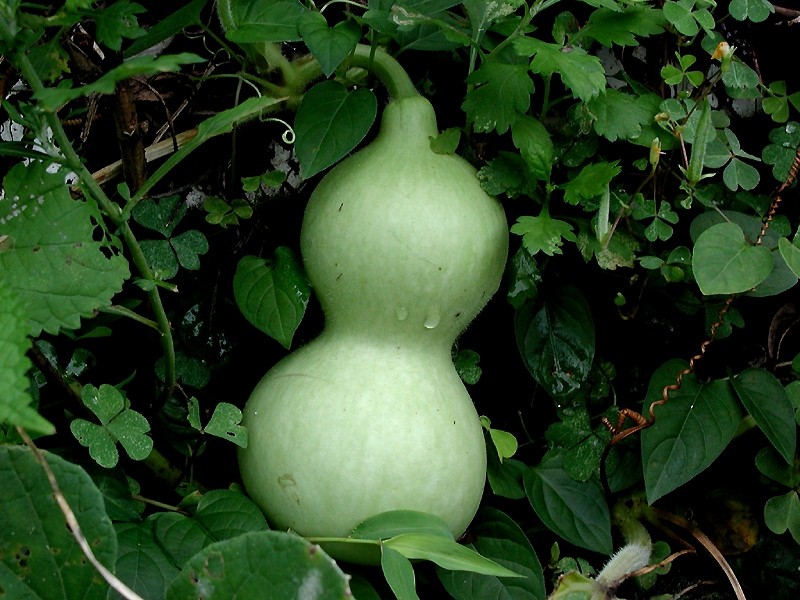
Calabash (/ˈkæləbæʃ/; Lagenaria siceraria), also known as bottle gourd, white-flowered gourd, long melon, birdhouse gourd, New Guinea bean, New Guinea butter bean, Tasmania bean, and opo squash, is a vine which is grown for its fruit. It belongs to the family Cucurbitaceae, is native to tropical Africa, and cultivated across the tropics. It can be either harvested young to be consumed as a vegetable, or harvested mature to be dried and used as a kitchen utensil (typically as a ladle or bowl), beverage container or a musical instrument. When it is fresh, the fruit has a light green smooth skin and white flesh.
Calabash fruits have a variety of shapes: they can be huge and rounded, small and bottle-shaped, or slim and serpentine, and they can grow to be over a metre long. Rounder varieties are typically called calabash gourds (L. s. var. depressa) . Calabash gourds can grow to great size. One grown in Taylorsvlle, Kentucky in 2001 weighed 111.5 kg (246 lb). The gourd was one of the world's first cultivated plants grown not primarily for food, but for use as containers. The bottle gourd may have been carried from Asia to Africa, Europe, and the Americas in the course of human migration, or by seeds floating across the oceans inside the gourd. It has been proven to have been globally domesticated (and existed in the New World) during the Pre-Columbian era.
There is sometimes confusion when discussing "calabash" because the name is shared with the unrelated calabash tree (Crescentia cujete), whose hard, hollow fruits are also used to make utensils, containers, and musical instruments.
The English word calabash is loaned from Middle French: calebasse, which in turn derived from Spanish: calabaza meaning gourd or pumpkin. The Spanish word is of pre-Roman origin. It comes from the Iberian: calapaccu, from -cal which means house or shell. It is a doublet of carapace and galapago. The English word is cognate with Catalan: carabassa ("pumpkin; orange colour"), Galician: cabaza ("gourd, pumpkin, squash; calabash (container)"), Occitan: calebasso, carabasso, carbasso, Portuguese: cabaça ("gourd; calabash (container)") and Sicilian: caravazza (and caramazza).[citation needed]
The bottle gourd has been recovered from archaeological contexts in China and Japan dating to c. 8,000–9,000 BP, whereas in Africa, despite decades of high-quality archaeobotanical research, the earliest record of its occurrence remains the 1884 report of a bottle gourd being recovered from a 12th Dynasty tomb at Thebes dating to ca. 4,000 BP. When considered together, the genetic and archaeological information points toward L. siceraria being independently brought under domestication first in Asia, and more than 4,000 years later, in Africa. The bottle gourd is a commonly cultivated plant in tropical and subtropical areas of the world, and was eventually domesticated in southern Africa. Stands of L. siceraria, which may be source plants and not merely domesticated stands, were reported in Zimbabwe in 2004. This apparent wild plant produces thinner-walled fruit that, when dried, would not endure the rigors of use on long journeys as a water container. Today's gourd may owe its tough, waterproof wall to selection pressures over its long history of domestication.
Gourds were cultivated in Africa, Asia, Europe, and the Americas for thousands of years before Columbus' arrival to the Americas. Polynesian specimens of calabash were found to have genetic markers suggesting hybridization from Asian and American cultivars. In Europe, Walahfrid Strabo (808–849), abbot and poet from Reichenau and advisor to the Carolingian kings, discussed the gourd in his Hortulus as one of the 23 plants of an ideal garden.
The mystery of the bottle gourd – namely that this African or Eurasian species was being grown in the Americas over 8,000 years ago – comes from the difficulty in understanding how it arrived in the Americas. The bottle gourd was theorized to have drifted across the Atlantic Ocean from Africa to South America, but in 2005 a group of researchers suggested that it may have been domesticated earlier than food crops and livestock and, like dogs, was brought into the New World at the end of the ice age by the native hunter-gatherer Paleo-Indians, which they based on a study of the genetics of archaeological samples. This study purportedly showed that gourds in American archaeological finds were more closely related to Asian variants than to African ones.
In 2014 this theory was repudiated based on a more thorough genetic study. Researchers more completely examined the plastid genomes of a broad sample of bottle gourds, and concluded that North and South American specimens were most closely related to wild African variants and could have drifted over the ocean several or many times, as long as 10,000 years ago.
Hub AI
Calabash AI simulator
(@Calabash_simulator)
Calabash
Calabash (/ˈkæləbæʃ/; Lagenaria siceraria), also known as bottle gourd, white-flowered gourd, long melon, birdhouse gourd, New Guinea bean, New Guinea butter bean, Tasmania bean, and opo squash, is a vine which is grown for its fruit. It belongs to the family Cucurbitaceae, is native to tropical Africa, and cultivated across the tropics. It can be either harvested young to be consumed as a vegetable, or harvested mature to be dried and used as a kitchen utensil (typically as a ladle or bowl), beverage container or a musical instrument. When it is fresh, the fruit has a light green smooth skin and white flesh.
Calabash fruits have a variety of shapes: they can be huge and rounded, small and bottle-shaped, or slim and serpentine, and they can grow to be over a metre long. Rounder varieties are typically called calabash gourds (L. s. var. depressa) . Calabash gourds can grow to great size. One grown in Taylorsvlle, Kentucky in 2001 weighed 111.5 kg (246 lb). The gourd was one of the world's first cultivated plants grown not primarily for food, but for use as containers. The bottle gourd may have been carried from Asia to Africa, Europe, and the Americas in the course of human migration, or by seeds floating across the oceans inside the gourd. It has been proven to have been globally domesticated (and existed in the New World) during the Pre-Columbian era.
There is sometimes confusion when discussing "calabash" because the name is shared with the unrelated calabash tree (Crescentia cujete), whose hard, hollow fruits are also used to make utensils, containers, and musical instruments.
The English word calabash is loaned from Middle French: calebasse, which in turn derived from Spanish: calabaza meaning gourd or pumpkin. The Spanish word is of pre-Roman origin. It comes from the Iberian: calapaccu, from -cal which means house or shell. It is a doublet of carapace and galapago. The English word is cognate with Catalan: carabassa ("pumpkin; orange colour"), Galician: cabaza ("gourd, pumpkin, squash; calabash (container)"), Occitan: calebasso, carabasso, carbasso, Portuguese: cabaça ("gourd; calabash (container)") and Sicilian: caravazza (and caramazza).[citation needed]
The bottle gourd has been recovered from archaeological contexts in China and Japan dating to c. 8,000–9,000 BP, whereas in Africa, despite decades of high-quality archaeobotanical research, the earliest record of its occurrence remains the 1884 report of a bottle gourd being recovered from a 12th Dynasty tomb at Thebes dating to ca. 4,000 BP. When considered together, the genetic and archaeological information points toward L. siceraria being independently brought under domestication first in Asia, and more than 4,000 years later, in Africa. The bottle gourd is a commonly cultivated plant in tropical and subtropical areas of the world, and was eventually domesticated in southern Africa. Stands of L. siceraria, which may be source plants and not merely domesticated stands, were reported in Zimbabwe in 2004. This apparent wild plant produces thinner-walled fruit that, when dried, would not endure the rigors of use on long journeys as a water container. Today's gourd may owe its tough, waterproof wall to selection pressures over its long history of domestication.
Gourds were cultivated in Africa, Asia, Europe, and the Americas for thousands of years before Columbus' arrival to the Americas. Polynesian specimens of calabash were found to have genetic markers suggesting hybridization from Asian and American cultivars. In Europe, Walahfrid Strabo (808–849), abbot and poet from Reichenau and advisor to the Carolingian kings, discussed the gourd in his Hortulus as one of the 23 plants of an ideal garden.
The mystery of the bottle gourd – namely that this African or Eurasian species was being grown in the Americas over 8,000 years ago – comes from the difficulty in understanding how it arrived in the Americas. The bottle gourd was theorized to have drifted across the Atlantic Ocean from Africa to South America, but in 2005 a group of researchers suggested that it may have been domesticated earlier than food crops and livestock and, like dogs, was brought into the New World at the end of the ice age by the native hunter-gatherer Paleo-Indians, which they based on a study of the genetics of archaeological samples. This study purportedly showed that gourds in American archaeological finds were more closely related to Asian variants than to African ones.
In 2014 this theory was repudiated based on a more thorough genetic study. Researchers more completely examined the plastid genomes of a broad sample of bottle gourds, and concluded that North and South American specimens were most closely related to wild African variants and could have drifted over the ocean several or many times, as long as 10,000 years ago.
Recent media