Hubbry Logo
Kitchen utensilKitchen utensilMain
Open search
Kitchen utensil
Community hub
Kitchen utensil
logo
8 pages, 0 posts
0 subscribers
Be the first to start a discussion here.
Kitchen utensil
Kitchen utensil
from Wikipedia
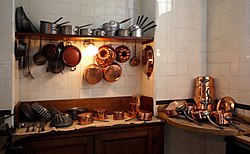
a shelf with kitchen utensils of several kinds stacked upon it, with more utensils hanging from hooks below it, both above two work surfaces with yet further utensils laid out neatly upon them
An exhibit of a batterie de cuisine (professional kitchen tools and pans), from the beginning of the 20th century, at the Musée Cernuschi in Paris
Various kitchen utensils on a kitchen hook strip. From left:
Pastry blender and potato masher
Spatula and (hidden) serving fork
Skimmer and chef's knife (small cleaver)
Whisk and slotted spoon
– Spaghetti ladle
Sieve and measuring spoon set
Bottle brush and (spoon)

A kitchen utensil is a small hand-held tool used for food preparation. Common kitchen tasks include cutting food items to size, heating food on an open fire or on a stove, baking, grinding, mixing, blending, and measuring; different utensils are made for each task. A general purpose utensil such as a chef's knife may be used for a variety of foods; other kitchen utensils are highly specialized and may be used only in connection with preparation of a particular type of food, such as an egg separator or an apple corer. Some specialized utensils are used when an operation is to be repeated many times, or when the cook has limited dexterity or mobility. The number of utensils in a household kitchen varies with time and the style of cooking.

A cooking utensil is a utensil for cooking. Utensils may be categorized by use with terms derived from the word "ware": kitchenware, wares for the kitchen; ovenware and bakeware, kitchen utensils that are for use inside ovens and for baking; cookware, merchandise used for cooking; and so forth.

A partially overlapping category of tools is that of eating utensils, which are tools used for eating (cf. the more general category of tableware). Some utensils are both kitchen utensils and eating utensils. Cutlery (i.e. knives[1] and other cutting implements) can be used for both food preparation in a kitchen and as eating utensils when dining. Other cutlery such as forks and spoons are both kitchen and eating utensils.

Other names used for various types of kitchen utensils, although not strictly denoting a utensil that is specific to the kitchen, are according to the materials they are made of, again using the "-ware" suffix, rather than their functions: earthenware, utensils made of clay; silverware, utensils (both kitchen and dining) made of silver; glassware, utensils (both kitchen and dining) made of glass; and so forth. These latter categorizations include utensils—made of glass, silver, clay, and so forth—that are not necessarily kitchen utensils.

Materials

[edit]
Kitchen utensils in bronze discovered in Pompeii. Illustration by Hercule Catenacci in 1864

Benjamin Thompson noted at the start of the 19th century that kitchen utensils were commonly made of copper, with various efforts made to prevent the copper from reacting with food (particularly its acidic contents) at the temperatures used for cooking, including tinning, enamelling, and varnishing. He observed that iron had been used as a substitute, and that some utensils were made of earthenware.[2] By the turn of the 20th century, Maria Parloa noted that kitchen utensils were made of (tinned or enamelled) iron and steel, copper, nickel, silver, tin, clay, earthenware, and aluminium.[3] The latter, aluminium, became a popular material for kitchen utensils in the 20th century.[4]

Copper

[edit]

Copper has good thermal conductivity and copper utensils are both durable and attractive in appearance. However, they are also comparatively heavier than utensils made of other materials, require scrupulous cleaning to remove poisonous tarnish compounds, and are not suitable for acidic foods.[5] Copper pots are lined with tin to prevent discoloration or altering the taste of food. The tin lining must be periodically restored, and protected from overheating.

Iron

[edit]

Iron is more prone to rusting than (tinned) copper. Cast iron kitchen utensils are less prone to rust by avoiding abrasive scouring and extended soaking in water in order to build up its layer of seasoning.[6] For some iron kitchen utensils, water is a particular problem, since it is very difficult to dry them fully. In particular, iron egg-beaters or ice cream freezers are tricky to dry, and the consequent rust if left wet will roughen them and possibly clog them completely. When storing iron utensils for long periods, van Rensselaer recommended coating them in non-salted (since salt is also an ionic compound) fat or paraffin.[7]

Iron utensils have little problem with high cooking temperatures, are simple to clean as they become smooth with long use, are durable and comparatively strong (i.e. not as prone to breaking as, say, earthenware), and hold heat well. However, as noted, they rust comparatively easily.[7]

Stainless steel

[edit]

Stainless steel finds many applications in the manufacture of kitchen utensils. Stainless steel is considerably less likely to rust in contact with water or food products, and so reduces the effort required to maintain utensils in clean useful condition. Cutting tools made with stainless steel maintain a usable edge while not presenting the risk of rust found with iron or other types of steel.

Earthenware and enamelware

[edit]

Earthenware utensils suffer from brittleness when subjected to rapid large changes in temperature, as commonly occur in cooking, and the glazing of earthenware often contains lead, which is poisonous. Thompson noted that as a consequence of this the use of such glazed earthenware was prohibited by law in some countries from use in cooking, or even from use for storing acidic foods.[8] Van Rensselaer proposed in 1919 that one test for lead content in earthenware was to let a beaten egg stand in the utensil for a few minutes and watch to see whether it became discoloured, which is a sign that lead might be present.[9]

In addition to their problems with thermal shock, enamelware utensils require careful handling, as careful as for glassware, because they are prone to chipping. But enamel utensils are not affected by acidic foods, are durable, and are easily cleaned. However, they cannot be used with strong alkalis.[9]

Earthenware, porcelain, and pottery utensils can be used for both cooking and serving food, and so thereby save on washing-up of two separate sets of utensils. They are durable, and (van Rensselaer notes) "excellent for slow, even cooking in even heat, such as slow baking". However, they are comparatively unsuitable for cooking using a direct heat, such as a cooking over a flame.[10]

Aluminium

[edit]

James Frank Breazeale in 1918 opined that aluminium "is without doubt the best material for kitchen utensils", noting that it is "as far superior to enamelled ware as enamelled ware is to the old-time iron or tin". He qualified his recommendation for replacing worn-out tin or enamelled utensils with aluminium ones by noting that "old-fashioned black iron frying pans and muffin rings, polished on the inside or worn smooth by long usage, are, however, superior to aluminium ones".[11]

Aluminium's advantages over other materials for kitchen utensils is its good thermal conductivity (which is approximately an order of magnitude greater than that of steel), the fact that it is largely non-reactive with foodstuffs at low and high temperatures, its low toxicity, and the fact that its corrosion products are white and so (unlike the dark corrosion products of, say, iron) do not discolour food that they happen to be mixed into during cooking.[4] However, its disadvantages are that it is easily discoloured, can be dissolved by acidic foods (to a comparatively small extent), and reacts to alkaline soaps if they are used for cleaning a utensil.[12]

A museum mannequin standing in front of a table set with various kitchen utensils, with more kitchen utensils hanging from the wall behind
An exhibit of Israeli Defence Forces kitchen utensils at the Batey ha-Osef Museum in Tel Aviv

In the European Union, the construction of kitchen utensils made of aluminium is determined by two European standards: EN 601 (Aluminium and aluminium alloys — Castings — Chemical composition of castings for use in contact with foodstuffs) and EN 602 (Aluminium and aluminium alloys — Wrought products — Chemical composition of semi-finished products used for the fabrication of articles for use in contact with foodstuffs).

Plastics

[edit]
Biodegradable plastic utensils made from bioplastic

Plastics can be readily formed by molding into a variety of shapes useful for kitchen utensils. Transparent plastic measuring cups allow ingredient levels to be easily visible, and are lighter and less fragile than glass measuring cups. Plastic handles added to utensils improve comfort and grip. While many plastics deform or decompose if heated, a few silicone products can be used in boiling water or in an oven for food preparation. Non-stick plastic coatings can be applied to frying pans; newer coatings avoid the issues with decomposition of plastics under strong heating.

Glass

[edit]

Heat-resistant glass utensils can be used for baking or other cooking. Glass does not conduct heat as well as metal, and has the drawback of breaking easily if dropped. Transparent glass measuring cups allow ready measurement of liquid and dry ingredients.

Types

[edit]

Kitchen utensils can be broadly categorized by their function and materials. They serve various purposes, from cutting and mixing to measuring and cooking. Understanding the distinctions between the most common and specialized tools can help streamline meal preparation and ensure the best results in the kitchen.

Cutting

[edit]

Cutting utensils are essential for chopping, slicing, and dicing. The most common cutting tool is the chef's knife, which can handle most tasks. Other cutting tools include paring knives, which are used for intricate cutting tasks like peeling and trimming, and mandolins, which allow for even, thin slices of vegetables. Cutting boards are also essential for protecting surfaces and maintaining knife edges.

Mixing and stirring

[edit]

These tools are designed for combining ingredients and incorporating air or moisture into mixtures. Wooden spoons are favored for stirring hot dishes due to their ability to withstand heat and prevent scratching non-stick surfaces. Spatulas come in many forms: flat-edged ones are great for flipping foods, while flexible ones are used for scraping the sides of bowls. Whisks are indispensable for beating eggs or mixing batter, and mixing bowls provide the perfect space for blending ingredients.

Measuring

[edit]

Accurate measurements are key to successful cooking and baking. Measuring cups and spoons come in both standard and metric units, allowing for precision in recipes. Liquid measuring cups, often made from glass, are designed with spouts for easy pouring, while dry measuring cups are typically used for solid ingredients like flour or sugar.

Cooking

[edit]

These include tools used for the actual cooking process. Ladles, tongs, and serving spoons are used for scooping, turning, and serving food. Slotted spoons are particularly useful for draining liquids from foods like pasta or vegetables. Peelers make it easy to remove skin from fruits and vegetables, while graters are perfect for shredding cheese, vegetables, or zesting citrus fruits.

Specialized tools

[edit]

There are also many specialized utensils for specific tasks. A melon baller allows you to create perfectly round pieces of melon for salads or fruit platters, while a mortar and pestle is used for grinding spices, herbs, or making pastes. Apple corers and egg separators streamline the prep process for dishes requiring these ingredients.


Diversity and utility

[edit]
Various kitchen utensils. At top: a spice rack with jars of mint, caraway, thyme, and sage. Lower: hanging from hooks; a small pan, a meat fork, an icing spatula, a whole spoon, a slotted spoon, and a perforated spatula.

Before the 19th century

[edit]

"Of the culinary utensils of the ancients", wrote Mrs Beeton, "our knowledge is very limited; but as the art of living, in every civilized country, is pretty much the same, the instruments for cooking must, in a great degree, bear a striking resemblance to one another".[13]

Archaeologists and historians have studied the kitchen utensils used in centuries past. For example: In the Middle Eastern villages and towns of the middle first millennium AD, historical and archaeological sources record that Jewish households generally had stone measuring cups, a meyḥam (a wide-necked vessel for heating water), a kederah (an unlidded pot-bellied cooking pot), a ilpas (a lidded stewpot/casserole pot type of vessel used for stewing and steaming), yorah and kumkum (pots for heating water), two types of teganon (frying pan) for deep and shallow frying, an iskutla (a glass serving platter), a tamḥui (ceramic serving bowl), a keara (a bowl for bread), a kiton (a canteen of cold water used to dilute wine), and a lagin (a wine decanter).[14]

Ownership and types of kitchen utensils varied from household to household. Records survive of inventories of kitchen utensils from London in the 14th century, in particular the records of possessions given in the coroner's rolls. Very few such people owned any kitchen utensils at all. In fact only seven convicted felons are recorded as having any. One such, a murderer from 1339, is recorded as possessing only the one kitchen utensil: a brass pot (one of the commonest such kitchen utensils listed in the records) valued at three shillings.[15] Similarly, in Minnesota in the second half of the 19th century, John North is recorded as having himself made "a real nice rolling pin, and a pudding stick" for his wife; one soldier is recorded as having a Civil War bayonet refashioned, by a blacksmith, into a bread knife; whereas an immigrant Swedish family is recorded as having brought with them "solid silver knives, forks, and spoons [...] Quantities of copper and brass utensils burnished until they were like mirrors hung in rows".[16]

19th century growth

[edit]
The up-to-date kitchen fireproof ware in 1894

The 19th century, particularly in the United States, saw an explosion in the number of kitchen utensils available on the market, with many labour-saving devices being invented and patented throughout the century. Maria Parloa's Cook Book and Marketing Guide listed a minimum of 139 kitchen utensils without which a contemporary kitchen would not be considered properly furnished. Parloa wrote that "the homemaker will find [that] there is continually something new to be bought".[17]

A growth in the range of kitchen utensils available can be traced through the growth in the range of utensils recommended to the aspiring householder in cookbooks as the century progressed. Earlier in the century, in 1828, Frances Byerley Parkes (Parkes 1828) had recommended a smaller array of utensils. By 1858, Elizabeth H. Putnam, in Mrs Putnam's Receipt Book and Young Housekeeper's Assistant, wrote with the assumption that her readers would have the "usual quantity of utensils", to which she added a list of necessary items:[18]

Copper saucepans, well lined, with covers, from three to six different sizes; a flat-bottomed soup-pot; an upright gridiron; sheet-iron breadpans instead of tin; a griddle; a tin kitchen; Hector's double boiler; a tin coffee-pot for boiling coffee, or a filter — either being equally good; a tin canister to keep roasted and ground coffee in; a canister for tea; a covered tin box for bread; one likewise for cake, or a drawer in your store-closet, lined with zinc or tin; a bread-knife; a board to cut bread upon; a covered jar for pieces of bread, and one for fine crumbs; a knife-tray; a spoon-tray; — the yellow ware is much the stringest, or tin pans of different sizes are economical; — a stout tin pan for mixing bread; a large earthen bowl for beating cake; a stone jug for yeast; a stone jar for soup stock; a meat-saw; a cleaver; iron and wooden spoons; a wire sieve for sifting flour and meal; a small hair sieve; a bread-board; a meat-board; a lignum vitae mortar, and rolling-pin, &c.

Putnam 1858, p. 318[19]

Mrs Beeton, in her Book of Household Management, wrote:

The following list, supplied by Messrs Richard & John Slack, 336, Strand, will show the articles required for the kitchen of a family in the middle class of life, although it does not contain all the things that may be deemed necessary for some families, and may contain more than are required for others. As Messrs Slack themselves, however, publish a useful illustrated catalogue, which may be had at their establishment gratis, and which it will be found advantageous to consult by those about to furnish, it supersedes the necessity of our enlarging that which we give:

1 Tea-kettle 6s. 6d. 1 Colander 1s. 6d. 1 Flour-box 1s. 0d.
1 Toasting fork 1s. 0d. 3 Block-tin saucepans 3 Flat-irons 3s. 6d.
1 Bread-grater 1s. 0d. 5s. 9d. 2 Frying-pans 4s. 0d.
1 Pair of Brass 5 Iron Saucepans 12s. 0d. 1 Gridiron 2s. 0d.
  Candlesticks 3s. 6d. 1 Ditto and Steamer 1 Mustard-pot 1s. 0d.
1 Teapot and Tray 6s. 6d. 6s. 6d. 1 Salt-cellar 8d.
1 Bottle-jack 9s. 9d. 1 Large Boiling-pot 1 Pepper box 6d.
6 Spoons 1s. 6d. 10s. 0d. 1 Pair of Bellows 2s. 0d.
2 Candlesticks 2s. 6d. 4 Iron Stewpans 8s. 9d. 3 Jelly-moulds 8s. 0d.
1 Candle-box 1s. 4d. 1 Dripping-pan and 1 Plate-basket 5s. 6d.
6 Knives & Forks 5s. 3d.   Stand 6s. 6d. 1 Cheese-toaster 1s. 10d.
2 Sets of Skewers 1s. 0s. 1 Dustpan 1s. 0d. 1 Coal-shovel 2s. 6d.
1 Meat-chopper 1s. 9d. 1 Fish and Egg-slice 1 Wood Meat-screen
1 Cinder-sifter 1s. 3d. 1s. 9d. 30s. 0d.
1 Coffee-pot 2s. 3d. 2 Fish-kettles 10s. 0d.
The Set £8 11s. 1d.

Isabella Mary Beeton, The Book of Household Management[20]

Parloa, in her 1880 cookbook, took two pages to list all of the essential kitchen utensils for a well-furnished kitchen, a list running to 93 distinct sorts of item.[19] The 1882 edition ran to 20 pages illustrating and describing the various utensils for a well-furnished kitchen. Sarah Tyson Rorer's 1886 Philadelphia Cook Book (Rorer 1886) listed more than 200 kitchen utensils that a well-furnished kitchen should have.[21]

"Labour-saving" utensils generating more labour

[edit]

However, many of these utensils were expensive and not affordable by the majority of householders.[17] Some people considered them unnecessary, too. James Frank Breazeale decried the explosion in patented "labour-saving" devices for the modern kitchen—promoted in exhibitions and advertised in "Household Guides" at the start of the 20th century—, saying that "the best way for the housewife to peel a potato, for example, is in the old-fashioned way, with a knife, and not with a patented potato peeler". Breazeale advocated simplicity over dishwashing machines "that would have done credit to a moderate sized hotel", and noted that the most useful kitchen utensils were "the simple little inexpensive conveniences that work themselves into every day use", giving examples, of utensils that were simple and cheap but indispensable once obtained and used, of a stiff brush for cleaning saucepans, a sink strainer to prevent drains from clogging, and an ordinary wooden spoon.[22]

The "labour-saving" devices did not necessarily save labour, either. While the advent of mass-produced standardized measuring instruments permitted even householders with little to no cooking skills to follow recipes and end up with the desired result and the advent of many utensils enabled "modern" cooking, on a stove or range rather than at floor level with a hearth, they also operated to raise expectations of what families would eat. So while food was easier to prepare and to cook, ordinary householders at the same time were expected to prepare and to cook more complex and harder-to-prepare meals on a regular basis. The labour-saving effect of the tools was cancelled out by the increased labour required for what came to be expected as the culinary norm in the average household.[23]

See also

[edit]

References

[edit]

Further reading

[edit]
[edit]
Revisions and contributorsEdit on WikipediaRead on Wikipedia
from Grokipedia
A kitchen utensil is a small, hand-held implement or tool designed for tasks related to food preparation, cooking, and serving in a household or professional setting. These devices facilitate essential activities such as cutting, mixing, measuring, stirring, and straining ingredients, distinguishing them from larger kitchen like ovens or refrigerators, which are fixed or appliance-based. Unlike cookware such as pots and pans, utensils are typically portable and used directly by hand for precise manipulation during meal preparation. Kitchen utensils encompass a wide array of types categorized by function, including cutting, mixing, measuring, and serving tools. Essential examples include knives for chopping, spoons for stirring, and scrapers for folding. In settings, specialized utensils enhance efficiency, while basic sets suffice for home use. Materials for kitchen utensils vary to balance durability, heat resistance, and safety, with common options including , or , and . Other materials like aluminum and are used for specific utensils, though concerns over lead leaching from older ceramics have led to regulatory standards by bodies like the FDA to ensure . Modern innovations include non-toxic, BPA-free plastics and non-stick coatings, which are safe when used below 500°F (260°C) to avoid potential risks from overheating. The evolution of kitchen utensils dates to prehistoric stone tools for around 2.6 million years ago, with advancements through ancient civilizations and the enabling . Today, as of 2025, they incorporate sustainable and ergonomic designs.

Overview

Definition

A kitchen utensil is a small, handheld implement or tool designed for tasks related to food preparation, cooking, and serving in household or professional kitchen settings, typically excluding powered appliances that require electricity or other energy sources. These items are generally portable and manual, facilitating direct manipulation of ingredients or food during various culinary processes. Key characteristics of utensils include their compact size, ease of handling, and specialization for precise functions such as cutting, stirring, mixing, or measuring ingredients. Unlike larger , they emphasize user control and versatility in everyday cooking without relying on mechanical power. The term "utensil" originates from the late 14th century in , derived from "utensile" and Latin "utensilia," the neuter plural of "utensilis" meaning "fit for use" or "useful," stemming from the verb "uti" (to use); its application to contexts dates back to this period as a descriptor for domestic tools. Kitchen utensils differ from cookware in that the former serve as tools for active manipulation of —such as spoons for stirring or knives for slicing—while the latter consists of vessels like pots and pans that primarily hold and contain during heating or cooking.

Classification by Function

Kitchen utensils are broadly classified by their primary functions in the cooking process, which unfolds in sequential stages from handling raw ingredients to presenting finished meals. This framework organizes the vast array of tools into practical groups—preparation, mixing and measuring, cooking, and serving—enabling efficient workflow in both home and professional kitchens. By aligning utensils with these stages, cooks can systematically equip their spaces to support culinary tasks without redundancy. Preparation utensils focus on breaking down and readying raw ingredients for further use, encompassing actions like cutting, peeling, slicing, and . Common examples include chef's knives for chopping and meats, vegetable peelers for removing skins, graters for shredding cheese or zesting , and cutting boards as stable surfaces for these operations. These tools are essential for the initial transformation of whole foods into manageable components. Mixing and measuring utensils enable the precise combination and portioning of ingredients, ensuring consistency in recipes. Key examples are whisks for aerating batters or emulsions, measuring cups and spoons for accurate volume assessments, mixing bowls for containing blends, and rubber scrapers for folding ingredients without waste. This category supports the phase, where flavors and textures are integrated. Cooking utensils facilitate the application of , stirring, flipping, or safe manipulation during thermal processes. Representative tools include spatulas for turning foods in pans, for gripping items without piercing, ladles for distributing liquids, and oven mitts for protecting hands from hot surfaces like trays or pots. Many oven mitts are designed to insulate against temperatures up to 500°F or higher, preventing burns while handling cookware. Serving utensils assist in portioning, transferring, and presenting completed dishes to diners. Examples encompass serving forks and spoons for solid foods, ladles for soups or sauces, and specialized for items like salads or pastries. These tools prioritize ease of use and in the final delivery stage. The rationale for this classification stems from the inherent progression of , mirroring the workflow from raw material processing to table-ready output and promoting organized efficiency in culinary practice. Certain materials enhance functional performance; for example, metal provides durability for preparation tools like knives, as discussed in the Materials section. While these categories delineate core roles, functional overlaps are common in versatile designs, reflecting an evolution toward multi-purpose efficiency in modern kitchens. A chef's knife, for instance, excels in preparation through chopping and slicing but also overlaps into mixing by scraping ingredients from boards or bowls, reducing the need for separate tools.

Materials

Metals

Copper has been utilized in kitchen utensils since ancient times, with evidence of its use dating back to around 4500 BCE in Mesopotamia for early cookware forms. Its primary advantage lies in its exceptionally high thermal conductivity, rated at 385 W/(m·K), which allows for rapid and even heat distribution, making it ideal for applications requiring quick temperature responses. However, copper is highly reactive with acidic foods, such as tomatoes or citrus, leading to the release of copper ions that can impart a metallic taste or discoloration to the contents. This reactivity prompted historical use in lined forms, such as tin-coated copper mixing bowls, which were common in professional kitchens from the 19th century onward for tasks like whipping egg whites due to copper's stabilizing effect on proteins. Additionally, copper exhibits natural antimicrobial properties through the release of ions that disrupt bacterial cell structures, contributing to its hygiene benefits in food contact applications. Cast iron emerged in around the 5th century BCE, with widespread adoption in kitchen utensils by the early colonial period in America. offers superior durability and excellent heat retention, allowing it to maintain consistent temperatures for slow cooking once heated, though it conducts heat more slowly than other metals. This property made it valuable for items like skillets, which have been produced since the 5th century BCE in , and presses, such as those for tortillas or garlic, valued for their sturdiness in applying pressure. A key drawback is its susceptibility to when exposed to , necessitating with to form a protective layer and regular drying after use. Despite this maintenance requirement, 's —often lasting generations—has sustained its popularity in both historical and contemporary settings. Stainless steel, an alloy primarily of iron and at least 10.5% , became prominent in the , revolutionizing kitchen tools after centuries of reliance on more reactive metals like silver or . The content forms a passive layer that provides exceptional resistance, preventing even in humid or acidic environments, while also enhancing by minimizing bacterial adhesion. This durability and low maintenance have made the dominant material in modern knives and utensils since the mid-1900s, offering long-lasting performance without the need for frequent replacement. Its non-porous surface further supports standards, as recommended for contact surfaces in . Particularly, stainless steel of 18/10 grade or higher is very safe and durable, does not release toxins, and is non-reactive with foods, making it a top choice alongside silicone for overall health safety. However, compared to silicone, stainless steel utensils can scratch non-stick pans and conduct heat, which may cause burns during handling if the utensils are left in hot cookware. Aluminum gained traction in kitchen utensils during the late , following its affordable after the Hall-Héroult process in , providing a lightweight alternative to heavier metals like iron. It boasts good thermal conductivity, second only to among common cookware metals, enabling efficient for everyday use. However, pure aluminum can warp under high heat due to its relatively low of around 660°C, and it may react with acidic foods, potentially leaching trace amounts. Anodized aluminum addresses these issues through an electrochemical process that thickens the layer, increasing , resistance, and safety by reducing reactivity and warping susceptibility. This treatment has made anodized versions a cost-effective, hygienic choice for modern utensils.

Non-Metals

Non-metallic materials play a crucial role in kitchen utensils by providing insulation against heat, aesthetic versatility, and resistance to chemical reactions with food, often serving as alternatives to metallic options for handles and non-heating components. These materials, derived from natural or synthetic sources, emphasize safety and functionality in everyday cooking environments. Wood and bamboo are widely used for utensils such as spoons, spatulas, and cutting boards due to their non-scratch properties, which prevent damage to cookware surfaces, and their eco-friendliness as renewable resources. Wood provides a natural feel and is naturally antimicrobial when properly maintained, though it is porous and requires regular oiling to avoid cracking or harboring bacteria. Bamboo, a type of grass, offers greater durability, lighter weight, and inherent antimicrobial qualities, making it suitable for frequent use without splintering easily. Both materials are safe for food contact when sourced sustainably and finished with food-grade oils, but they should not be exposed to extreme heat or dishwashers to preserve longevity. Earthenware, made from clay fired at relatively low temperatures between 1000°C and 1150°C, offers resistance suitable for cookware while remaining more affordable than higher-fired ceramics. However, its porous makes it brittle and prone to cracking under or mechanical stress, limiting its durability compared to vitrified alternatives. Enamelware, often based on earthenware bodies, incorporates a fused glass-like enamel coating that seals the clay surface, preventing chipping, reducing , and enabling vibrant colors for enhanced visual appeal in kitchen settings. This coating also improves by minimizing bacterial adhesion, though the underlying brittleness persists. Glass, particularly borosilicate variants like , excels in transparency for precise measurements and non-reactivity with acidic or alkaline foods, ensuring no flavor alteration or contamination. Borosilicate glass demonstrates superior resistance, capable of withstanding sudden temperature changes up to approximately 165°C without fracturing, due to its low coefficient of . This property makes it ideal for oven-to-table applications, contrasting with more fragile soda-lime glasses. Plastics have evolved significantly since the 1950s, when of items like utensils began, driven by post-war demand for lightweight, affordable tools. Regulatory advancements, including the 1958 Food Additives Amendment requiring FDA pre-market approval for food-contact substances, spurred safer formulations by addressing concerns over chemical migration. , a common BPA-free variety, provides flexibility, chemical resistance, and cost-effectiveness, while variants offer exceptional heat resistance up to 600°F, making them suitable for high-temperature tasks without melting or leaching. These non-conductive properties in plastic handles effectively prevent burns by insulating against hot surfaces, enhancing user safety during prolonged cooking. Compared to stainless steel, silicone utensils do not scratch non-stick surfaces and provide better insulation to avoid heat-related burns during handling.

Types and Uses

Preparation Utensils

Preparation utensils encompass a range of tools essential for the initial manipulation of raw ingredients, including chopping, slicing, peeling, and , to prepare for subsequent cooking processes. These implements prioritize precision, durability, and user safety to facilitate efficient workflow in the kitchen. Common examples include knives, peelers, graters, and cutting boards, each designed to handle specific tasks while minimizing injury risk and preserving ingredient quality. Knives form the cornerstone of preparation work, with the serving as a versatile tool for chopping , mincing , and dicing proteins through controlled rocking motions. The paring knife, smaller and more maneuverable, excels at detailed tasks like coring fruits or trimming fats. Both types typically feature sharp edges crafted from , which offers corrosion resistance and ease of maintenance due to its content of at least 10.5%, or , which achieves superior sharpness and edge retention from higher carbon levels but requires careful drying to prevent rust. Peelers and graters complement knives by addressing surface-level preparations. A Y-shaped efficiently removes thin skins from potatoes, carrots, or ginger with minimal waste, using a pivoting that follows contours for quick, even results. Graters, often in box or flat Microplane styles, shred cheese, zest , or grate via fine to coarse holes, allowing for uniform texture in recipes. For more advanced techniques, the slicer enables precise julienne cuts—thin matchstick strips of —by gliding ingredients over an adjustable , ideal for salads or stir-fries. Safety enhancements, such as ergonomic grips on knives and peelers for reduced hand fatigue and non-slip hand guards on mandolines to keep fingers clear of edges, are critical to prevent cuts during repetitive use. Cutting boards provide a base for these operations, with wooden varieties—such as or —preferred for their end-grain construction that gently yields to edges, thereby extending life compared to harder surfaces. Bamboo cutting boards are also commonly used, appreciated for their sustainability as a fast-growing renewable resource, natural antibacterial properties, hardness, and gentleness on knife edges. These boards absorb minor impacts without dulling edges, though they require regular oiling to maintain integrity. A notable advancement in design occurred in the late with the introduction of serrated edges on bread knives, with early patents dating to 1889, allowing for clean slicing of crusty loaves without compressing the interior.

Cooking and Baking Utensils

Cooking and baking utensils encompass tools designed to facilitate the application of , mixing, and manipulation of ingredients during processes, distinguishing them from preparatory implements by their emphasis on transformation through cooking or . These utensils must often withstand high temperatures while enabling precise control, such as flipping delicate foods or incorporating air into batters. Common materials include heat-resistant for non-stick compatibility and for durability under intense , ensuring safety and efficiency in stovetop, , or grill applications. Spatulas and are essential for heat-resistant handling and flipping during cooking. Fish spatulas, typically made of with a slotted, offset blade, excel at flipping delicate items like fillets or burgers in hot skillets by allowing grease to drain while providing nimble support without breaking the food apart; their angled design, often 72-74 degrees, facilitates easy insertion under ingredients. , constructed from for high-heat tasks up to 600°F, enable secure gripping and turning of items such as whole chickens or in pans, with silicone-tipped variants offering protection for non-stick surfaces during or . spatulas, heat-safe and flexible, complement these by scraping and stirring without scratching cookware. Bamboo spatulas provide an eco-friendly alternative that is gentle on non-stick cookware and durable. Mixing tools like whisks and wooden spoons promote even incorporation and aeration in both cooking and . Balloon whisks, featuring a wide, bulbous head approximately 3 inches across, are optimized for aerating mixtures such as or batters by rapidly incorporating air to achieve soft peaks in under 2 minutes, making them ideal for emulsions and light sauces; versions withstand up to 392°F and suit non-stick pots. Wooden spoons, crafted from durable woods like or cherry, serve for stirring sauces or scraping during due to their poor heat conduction, which prevents burns and allows prolonged contact with hot mixtures without discomfort, though they require hand-washing to avoid cracking. Bamboo spoons offer a sustainable alternative with similar heat-resistant and non-conductive properties. These tools ensure uniform texture in heat-applied processes. Bamboo kitchen utensils sets are eco-friendly cooking tools made from sustainable bamboo. They typically include items like spoons, spatulas, forks, turners, and brushes. Key benefits include being renewable, naturally antibacterial, heat-resistant, non-toxic, gentle on non-stick cookware, durable, and biodegradable. Protective gear such as oven mitts is crucial for safely managing hot cookware. oven mitts, often with polyester-cotton linings, provide heat resistance up to 450°F for about 40-53 seconds, allowing users to grip pans, lift lids, or handle roasting trays without burns, while their water-resistant exterior enhances safety around . fiber models, like those using , offer brief exposure protection up to 932°F, suitable for intense oven tasks. In baking, specialized utensils focus on finishing and dough management. Pastry brushes, available in silicone for heat-safe, dishwasher-friendly glazing or natural boar bristles for absorbing liquids like egg washes, apply even coats of glazes, butters, or syrups to pastries and tarts, promoting a glossy, golden finish without shedding. Dough scrapers, made of stainless steel or sturdy plastic, aid in handling sticky doughs by dividing portions, folding during kneading, or scraping work surfaces clean of flour, with metal blades providing precise cuts for brownies and plastic edges protecting counters. These ensure hygienic and efficient dough manipulation during baking preparations.

History and Evolution

Pre-19th Century Developments

The earliest kitchen utensils emerged in ancient civilizations, where basic tools were crafted from locally available materials to facilitate essential food preparation and cooking tasks. In around 3000 BCE, during the Early Dynastic period, stone and wooden implements such as grinding stones, mortars, and wooden spoons were used for processing grains and preparing simple breads, reflecting the region's reliance on rudimentary, hand-formed tools for daily sustenance. These artifacts, often found in archaeological sites like , highlight the transition from nomadic foraging to settled agriculture, with utensils primarily serving survival-oriented functions like milling and mixing. In , metalworking advanced utensil design, with bronze knives appearing by the late (circa 2000–1500 BCE) for slicing , fruits, and meats. These knives, cast from alloys and fitted with wooden or handles, represented a shift from earlier flint and tools, enabling more precise cutting in household and ritual cooking. Egyptian kitchens also featured clay pots, strainers, and pestles made from local stone, underscoring a material evolution tied to the Nile's resources and emphasizing durability for repetitive tasks like grinding spices. Across , cultural exchanges influenced utensil innovations; in during the (206 BCE–220 CE), spoons crafted from early materials—precursors to true —became common for scooping soups and porridges, predating widespread chopstick use and adapting to liquid-based diets. These spoons, often shallow and wide-mouthed, were produced in kilns alongside proto-porcelain wares, illustrating regional advancements in firing techniques for heat-resistant eating tools. By medieval , utensils began reflecting social norms alongside utility, with iron forks introduced in 11th-century via Byzantine influences, initially as two-pronged tools for handling food at the table. Adopted first by Venetian elites around 1075 CE through trade with , forks spread slowly due to religious and etiquette concerns, viewed by some as unnatural interference with God's creation and limited to upper-class dining until the . This innovation complemented existing wooden and iron spoons and knives, but adoption lagged in , where hands or knives sufficed for communal meals. Prior to the 1700s, kitchen utensils lacked standardization, varying widely by region and artisan skill due to handcrafting from disparate materials like wood, iron, and clay, which constrained diversity to basic forms suited for open-fire cooking and local cuisines. This pre-industrial variability prioritized functionality for survival—such as chopping, stirring, and serving—over uniformity, with tools like wooden paddles in or stone mortars in the adapted to immediate environmental needs rather than mass replication.

19th and 20th Century Innovations

The 19th century marked a pivotal era in kitchen utensil development, driven by the Industrial Revolution's emphasis on mass production using affordable materials like tin and tinned steel. These metals enabled the widespread manufacturing of durable, lightweight tools that replaced handmade wooden or copper alternatives, making utensils accessible to middle-class households. For instance, tin-plated iron became the dominant material for items such as cookie cutters, funnels, and colanders due to its nontoxic, easy-to-clean properties and low cost. By the mid-1800s, innovations like apple corers emerged, with over 100 patents granted between 1850 and 1890 for devices that efficiently cored and peeled fruit, exemplified by early mechanical models that streamlined food preparation. Labor-saving gadgets proliferated during this period, promising to reduce domestic drudgery through mechanical ingenuity. A landmark example was the Dover egg beater, patented in 1870 by the Dover Stamping Company as an improvement on earlier designs, featuring geared rotary whisks that doubled beating efficiency compared to manual stirring. This device, produced in millions—reaching four million units by 1890—exemplified the shift toward specialized tools like crank-operated mixers and peelers. By 1900, the burgeoning "" market reflected this growth, with mass-produced items flooding catalogs and stores, transforming kitchens from ad-hoc spaces into equipped workstations. In the , particularly after , the introduction of plastics revolutionized utensil design by offering inexpensive, lightweight, and colorful alternatives to metal and wood. Postwar manufacturers rapidly adopted materials like and for spatulas, measuring cups, and storage containers, which resisted and were easier to sanitize than traditional options. This shift aligned with the era's consumer boom, replacing many metal tools by the . Manual mixers, such as hand-cranked rotary beaters and stand models, served as crucial precursors to electric appliances, bridging 19th-century mechanics with mid-century electrification while maintaining portability for everyday use. Despite their promised efficiencies, many 19th- and 20th-century innovations drew for introducing unintended complexities, particularly in multi-part gadgets that required assembly, , and storage. Historians note that devices like geared and segmented peelers, while reducing physical effort in specific tasks, often elevated household standards—such as more frequent or elaborate meals—ultimately increasing overall workload and clutter for homemakers. Ruth Schwartz Cowan's analysis highlights this irony, arguing that industrial-era tools shifted labor dynamics without truly liberating women from domestic burdens, as rising expectations for cleanliness and variety offset mechanical gains. In the , kitchen utensils have increasingly incorporated eco-friendly materials to address environmental concerns, with emerging as a prominent sustainable alternative due to its rapid renewability, biodegradability, and natural properties. utensils, such as spoons and cutting boards, have gained popularity for their lightweight durability and lack of chemical treatments, reducing reliance on non-renewable resources. Similarly, recycled and bio-derived , like those made from plant-based sources, have been adopted in utensil manufacturing to minimize , offering viable substitutes for traditional petroleum-based products while maintaining functionality. Technological integration has introduced smart utensils with embedded sensors, particularly since the 2010s, enhancing precision in cooking tasks. For instance, wireless temperature probes like the MEATER, launched around 2015, allow real-time monitoring of food internal temperatures via connectivity to smartphones, alerting users to optimal doneness and preventing overcooking. These devices build on earlier concepts but have proliferated with IoT advancements, enabling seamless data sharing for better meal preparation. Innovations in material hybrids have focused on versatility, with -based utensils combining heat resistance and flexibility for multi-purpose use. spoonulas, which merge and functions, exemplify this trend by facilitating stirring, scraping, and folding in one tool, often withstanding temperatures up to 600°F without degrading. Complementing these are minimalist designs inspired by Scandinavian aesthetics, emphasizing clean lines, ergonomic forms, and natural materials like wood or matte to promote functional simplicity in modern kitchens. Regulatory pressures have accelerated the shift toward safer materials, notably with the European Union's 2011 ban on (BPA) in baby bottles, prompting widespread adoption of BPA-free alternatives across general to mitigate risks from chemical leaching. This has contributed to robust market growth, with the global cookware and utensils sector valued at approximately $19 billion in 2020. More recently, in December 2024, the EU adopted a broader ban on BPA and related bisphenols in , entering into force on January 20, 2026, with a transition period until July 2027, further driving demand for non-toxic options. As of 2024, the global cookware market was valued at approximately $24 billion. The utility of these modern utensils lies in their integration with smart appliances, such as ovens and stoves, where sensors sync with apps to automate processes like timing and temperature adjustments, thereby reducing manual labor. However, this connectivity raises e-waste concerns, as disposable electronic components in smart utensils contribute to growing electronic discard volumes, necessitating improved recycling protocols to balance convenience with environmental impact.

Design and Safety

Ergonomics and Handles

Ergonomic principles in kitchen utensil design emphasize features that minimize physical during prolonged use, such as contoured handles that conform to the natural shape of the hand to distribute pressure evenly and reduce . For instance, pistol-grip ladles incorporate a curved, pistol-like that allows users to maintain a neutral wrist position while scooping, thereby lowering the risk of repetitive strain injuries. These designs promote efficient application, enabling smoother movements in tasks like stirring or serving without excessive gripping effort. Accessibility is enhanced through one-handed operation features, particularly in utensils with adjustable or bendable handles that accommodate users with limited dexterity, such as those with or motor impairments. Such adaptations, like bendable forks and spoons with necks, allow for self-feeding by aligning the utensil head independently of hand positioning, improving in and consumption. Angled designs further support wrist alignment by positioning the tool at 20-40 degrees relative to the , which helps prevent ulnar deviation and reduces on the during chopping or flipping. Handle materials play a crucial role in slip resistance, with options like providing a natural, textured surface for secure grip even when wet, while rubber or coatings add cushioning and non-slip properties to prevent accidents in oily environments. Stainless steel handles, while durable and safe without toxic release, can conduct heat from cooking surfaces, potentially causing burns during handling, whereas silicone's insulating properties keep handles cooler and reduce such risks. Post-1990s indicates that ergonomic kitchen tools, including those with optimized handles, can reduce physical strain and compared to traditional designs, based on occupational analyses of repetitive tasks. This is particularly evident in studies on , where contoured and angled grips lower muscle activation in the and by facilitating better biomechanical alignment. As of 2025, innovations include IoT-enabled handles with sensors providing real-time feedback on grip force and posture to further minimize strain risks. The evolution of handles reflects a shift toward , moving from plain wooden grips predominant before the mid-20th century to molded s introduced in the 1940s and mass-produced by the 1950s, which allowed for more precise shaping to fit hand contours and improve durability without compromising comfort. These handles, often combined with non-metallic cores as referenced in classifications, enabled innovations like integrated textures for enhanced grip, marking a key advancement in reducing user fatigue over time.

Hygiene and Maintenance

Maintaining proper for kitchen utensils is essential to prevent foodborne illnesses and extend their usability. Cleaning methods vary by material to ensure effective removal of food residues and pathogens without damaging the utensil. For non-porous materials like metal and certain plastics, utensils are often dishwasher-safe, allowing for thorough sanitization through high-temperature cycles that kill most . In contrast, wooden utensils, such as cutting boards and spoons, should be hand-washed with hot, soapy water immediately after use to avoid warping or cracking from prolonged moisture exposure in dishwashers. To preserve wooden utensils and prevent the development of cracks that could harbor , apply food-grade monthly after cleaning and drying. This conditioning seals the wood's pores, reducing absorption of liquids and odors while maintaining structural integrity. For enhanced sanitization, submerge wooden items in a solution of 1 unscented chlorine per of water for at least 2 minutes, then rinse and air-dry thoroughly. Hygiene risks arise primarily from inadequate cleaning, allowing on surfaces that come into contact with . Porous materials like can absorb moisture and residues, potentially fostering pathogens such as or E. coli if not dried properly, though studies indicate that do not proliferate as readily on as on due to natural properties. A study demonstrated that unwashed utensils, particularly knives and graters, can transfer from contaminated to subsequent items, increasing cross-contamination risks in home kitchens. For metal tools, sterilization by in water for 10 minutes effectively eliminates most microorganisms, especially after handling raw proteins. Modern utensils increasingly incorporate coatings, such as silver ions or , to inhibit on surfaces as of 2025. Proper storage practices further mitigate and damage. Utensils should air-dry completely before storage to inhibit mold and ; hanging racks or blocks promote and prevent moisture buildup. Avoid overcrowding drawers, as this can lead to blade dulling on knives from contact with other items and increase the risk of bacterial transfer among utensils. According to USDA guidelines, replace utensils, such as cutting boards, when they develop deep grooves or excessive wear that harbors , typically after regular use over 1-5 years depending on frequency.

References

Add your contribution
Related Hubs
User Avatar
No comments yet.