
Calabash
View on Wikipedia
| Calabash | |
|---|---|

| |
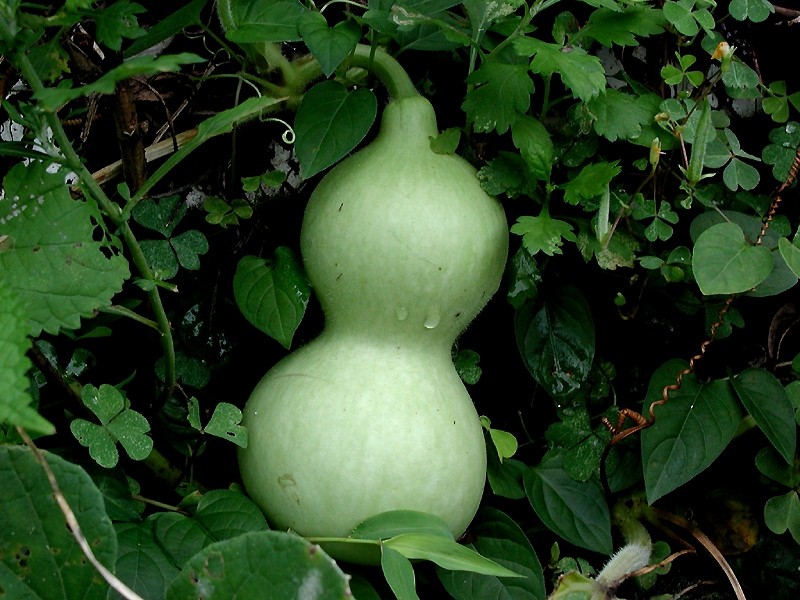
| Green calabash growing on its vine | |
Scientific classification 
| |
| Kingdom: | Plantae |
| Clade: | Tracheophytes |
| Clade: | Angiosperms |
| Clade: | Eudicots |
| Clade: | Rosids |
| Order: | Cucurbitales |
| Family: | Cucurbitaceae |
| Genus: | Lagenaria |
| Species: | L. siceraria
|
| Binomial name | |
| Lagenaria siceraria | |
| Synonyms[1] | |
|
List
| |
Calabash (/ˈkæləbæʃ/;[2] Lagenaria siceraria), also known as bottle gourd,[3] white-flowered gourd,[4] long melon, birdhouse gourd,[5] New Guinea bean, New Guinea butter bean, Tasmania bean,[6] and opo squash, is a vine which is grown for its fruit. It belongs to the family Cucurbitaceae, is native to tropical Africa, and cultivated across the tropics.[1] It can be either harvested young to be consumed as a vegetable, or harvested mature to be dried and used as a kitchen utensil (typically as a ladle or bowl), beverage container or a musical instrument. When it is fresh, the fruit has a light green smooth skin and white flesh.
Calabash fruits have a variety of shapes: they can be huge and rounded, small and bottle-shaped, or slim and serpentine, and they can grow to be over a metre long. Rounder varieties are typically called calabash gourds (L. s. var. depressa) . Calabash gourds can grow to great size. One grown in Taylorsvlle, Kentucky in 2001 weighed 111.5 kg (246 lb).[7] The gourd was one of the world's first cultivated plants grown not primarily for food, but for use as containers. The bottle gourd may have been carried from Asia to Africa, Europe, and the Americas in the course of human migration,[8] or by seeds floating across the oceans inside the gourd. It has been proven to have been globally domesticated (and existed in the New World) during the Pre-Columbian era.
There is sometimes confusion when discussing "calabash" because the name is shared with the unrelated calabash tree (Crescentia cujete), whose hard, hollow fruits are also used to make utensils, containers, and musical instruments.[9]
Etymology
[edit]The English word calabash is loaned from Middle French: calebasse, which in turn derived from Spanish: calabaza meaning gourd or pumpkin. The Spanish word is of pre-Roman origin. It comes from the Iberian: calapaccu, from -cal which means house or shell. It is a doublet of carapace and galapago.[10][11][12] The English word is cognate with Catalan: carabassa ("pumpkin; orange colour"), Galician: cabaza ("gourd, pumpkin, squash; calabash (container)"), Occitan: calebasso, carabasso, carbasso, Portuguese: cabaça ("gourd; calabash (container)") and Sicilian: caravazza (and caramazza).[citation needed]
History
[edit].jpg)
The bottle gourd has been recovered from archaeological contexts in China and Japan dating to c. 8,000–9,000 BP,[13] whereas in Africa, despite decades of high-quality archaeobotanical research, the earliest record of its occurrence remains the 1884 report of a bottle gourd being recovered from a 12th Dynasty tomb at Thebes dating to ca. 4,000 BP.[13] When considered together, the genetic and archaeological information points toward L. siceraria being independently brought under domestication first in Asia, and more than 4,000 years later, in Africa.[13] The bottle gourd is a commonly cultivated plant in tropical and subtropical areas of the world, and was eventually domesticated in southern Africa. Stands of L. siceraria, which may be source plants and not merely domesticated stands, were reported in Zimbabwe in 2004.[14] This apparent wild plant produces thinner-walled fruit that, when dried, would not endure the rigors of use on long journeys as a water container. Today's gourd may owe its tough, waterproof wall to selection pressures over its long history of domestication.[15]
Gourds were cultivated in Africa, Asia, Europe, and the Americas for thousands of years before Columbus' arrival to the Americas. Polynesian specimens of calabash were found to have genetic markers suggesting hybridization from Asian and American cultivars.[16] In Europe,[17] Walahfrid Strabo (808–849), abbot and poet from Reichenau and advisor to the Carolingian kings, discussed the gourd in his Hortulus as one of the 23 plants of an ideal garden.[18][19]
The mystery of the bottle gourd – namely that this African or Eurasian species was being grown in the Americas over 8,000 years ago[20] – comes from the difficulty in understanding how it arrived in the Americas. The bottle gourd was theorized to have drifted across the Atlantic Ocean from Africa to South America, but in 2005 a group of researchers suggested that it may have been domesticated earlier than food crops and livestock and, like dogs, was brought into the New World at the end of the ice age by the native hunter-gatherer Paleo-Indians, which they based on a study of the genetics of archaeological samples. This study purportedly showed that gourds in American archaeological finds were more closely related to Asian variants than to African ones.[8]
In 2014 this theory was repudiated based on a more thorough genetic study. Researchers more completely examined the plastid genomes of a broad sample of bottle gourds, and concluded that North and South American specimens were most closely related to wild African variants and could have drifted over the ocean several or many times, as long as 10,000 years ago.[21]
Cultivation
[edit]
Bottle gourds are grown by direct sowing of seeds or transplanting 15- to 20-day-old seedlings. The plant prefers well-drained, moist, organic rich soil. It requires plenty of moisture in the growing season and a warm, sunny position, sheltered from the wind. It can be cultivated in small places such as in a pot, and allowed to spread on a trellis or roof. In rural areas, many houses with thatched roofs are covered with the gourd vines. Bottle gourds grow very rapidly and their stems can reach a length of 9 m in the summer, so they need a solid support along the stem if they are to climb a pole or trellis. If planted under a tall tree, the vine may grow up to the top of the tree. To obtain more fruit, farmers sometimes cut off the tip of the vine when it has grown to 2 metres in length. This forces the plant to produce side branches that will bear flowers and yield more fruit.
The plant produces night blooming white flowers. The male flowers have long peduncles and the females have short ones with an ovary in the shape of the fruit. Sometimes the female flowers drop off without growing into a gourd due to the failure of pollination if there is no night pollinator (probably a kind of moth) in the garden. Hand pollination can be used to solve the problem. Pollens are around 60 microns in length.
First crop is ready for harvest within two months; first flowers open in about 45 days from sowing. Each plant can yield 1 fruit per day for the next 45 days if enough nutrients are available.
Yield ranges from 35 to 40 tons/ha, per season of 3 months cycle.
-
 Pear-shaped bottle gourd in Seoul, Korea
 -
 Slim, elongated upo squash, in San Rafael, Bulacan, Philippines
 -
 A female Calabash flower with a visible ovary at night, in West Bengal, India.
 -
 Crook-necked "geese" cultivar in Granville Island Public Market, Canada
 -
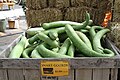 Serpentine snake gourds in Media, Pennsylvania, United States
 -
 Calabash flower
 -
 Calabash seeds
 -
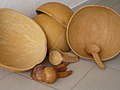 Collection of bowls and spoons made of bottle gourd from Mali, 2007
 -

-

-
 the cantaloupe couterpart
 -
 watermelon couterpart
_in_Seoul.jpg)

_with_flower_captured_at_night.jpg)


_Bamako,ML_mon29oct2007-1315h.jpg)
_DSCF3570.jpg)
.jpg)


Toxicity
[edit]Like other members of the family Cucurbitaceae, gourds contain cucurbitacins that are known to be cytotoxic at a high concentration. The tetracyclic triterpenoid cucurbitacins present in fruits and vegetables of the cucumber family are responsible for the bitter taste, and could cause stomach ulcers. In extreme cases, people have died from drinking the juice of gourds.[22][23][24] The toxic cases are usually due to the gourd being used to make juice, which the drinkers described as being unusually bitter.[25] In three of the lethal cases, the victims were diabetics in their 50s and 60s.[25] In 2018, a healthy woman in her 40s was hospitalized for severe reactions after consuming the juice and died three days later from complications.[26]
The plant is not normally toxic when eaten. The excessively bitter (and toxic) gourds are due to improper storage (temperature swings or high temperature) and over-ripening.[25]
Nutrition
[edit]Boiled calabash is 95% water, 4% carbohydrates, 1% protein, and contains negligible fat (table). In a reference amount of 100 grams (3.5 oz), cooked calabash supplies a moderate amount of vitamin C (10% of the Daily Value), with no other micronutrients in significant amounts (table).
| Nutritional value per 100 g (3.5 oz) | |||||||||||||||||||||||||||||||||||||||||||
|---|---|---|---|---|---|---|---|---|---|---|---|---|---|---|---|---|---|---|---|---|---|---|---|---|---|---|---|---|---|---|---|---|---|---|---|---|---|---|---|---|---|---|---|
| Energy | 63 kJ (15 kcal) | ||||||||||||||||||||||||||||||||||||||||||
3.69 g | |||||||||||||||||||||||||||||||||||||||||||
| Dietary fiber | 1.2 g | ||||||||||||||||||||||||||||||||||||||||||
0.02 g | |||||||||||||||||||||||||||||||||||||||||||
0.6 g | |||||||||||||||||||||||||||||||||||||||||||
| |||||||||||||||||||||||||||||||||||||||||||
| Other constituents | Quantity | ||||||||||||||||||||||||||||||||||||||||||
| Water | 95 g | ||||||||||||||||||||||||||||||||||||||||||
| †Percentages estimated using US recommendations for adults,[27] except for potassium, which is estimated based on expert recommendation from the National Academies.[28] | |||||||||||||||||||||||||||||||||||||||||||
Culinary uses
[edit]Central America
[edit]In Central America the seeds of the bottle gourd are toasted and ground with other ingredients (including rice, cinnamon, and allspice) to make one type of the drink horchata.
East Asia
[edit]China
[edit]The calabash is frequently used in southern Chinese cuisine in either a stir-fry dish or a soup.
Japan
[edit]_Standl.,_1804.jpg)
In Japan, it is commonly sold in the form of dried, marinated strips known as kanpyō and is used as an ingredient for making makizushi (rolled sushi).
Korea
[edit]Traditionally in Korea, the inner flesh has been eaten as namul vegetable and the outside cut in half to make bowls. Both fresh and dried flesh of bak is used in Korean cuisine. Fresh calabash flesh, scraped out, seeded, salted and squeezed to draw out moisture, is called baksok. Scraped and sun-dried calabash flesh, called bak-goji, is usually soaked before being stir-fried. Soaked bak-goji is often simmered in sauce or stir-fried before being added to japchae and gimbap.[29][30] Sometimes uncooked raw baksok is seasoned to make saengchae.
-
 Bak-namul (seasoned calabash side dish)
.jpg)
Southeast Asia
[edit]Burma
[edit]In Burma, it is a popular fruit. The young leaves are also boiled and eaten with a spicy, fermented fish sauce. It can also be cut up, coated in batter and deep fried to make fritters, which are eaten with Burmese mohinga.
Philippines
[edit]In the Philippines, calabash (known locally as upo) is commonly cooked in soup dishes like tinola. They are also common ingredients in noodle (pancit) dishes.
-
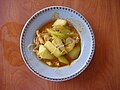 Upo with sotanghon
 -
 Upo being sauteed (ginisa)


Vietnam
[edit]In Vietnam, it is a very popular vegetable, commonly cooked in soup with shrimp, meatballs, clams, various fish like freshwater catfish or snakehead fish or crab. It is also commonly stir-fried with meat or seafood, or incorporated as an ingredient of a hotpot. It is also used as a medicine. Americans have called calabashes from Vietnam "opo squash".
The shoots, tendrils, and leaves of the plant may also be eaten as greens.
South Asia
[edit]India
[edit]

A popular north Indian dish is lauki chana, (chana dal and diced gourd in a semi-dry gravy). In the state of Maharashtra in India, a similar preparation called dudhi chana is popular. The skin of the vegetable is used in making a dry spicy chutney preparation. It is consumed in Assam with fish curry, as boiled vegetable curry and also fried with potato and tomatoes. In Andhra Pradesh it is called sorakaya and is used to make sorakaya pulusu (with tamarind juice), sorakaya palakura (curry with milk and spices) and sorakaya pappu (with lentils). Lau chingri, a dish prepared with bottle gourd and prawn, is popular in West Bengal.[31] The edible leaves and young stems of the plant are widely used in Bengali cuisine. Although popularly called lauki in Hindi in northern part of the country, it is also called kaddu in certain parts of country like eastern India. (However, "kaddu" popularly translates to "pumpkin" in northern India.) It can be consumed as a dish with rice or roti for its medicinal benefits. In Gujarat, a traditional Gujarati savoury cake called handvo is made primarily using bottle gourd (in Gujarati, dudhi), sesame seeds, flour, and often lentils. Lauki kheer (grated bottle gourd, sugar and milk preparation) is a dessert from Telangana, usually prepared for festive occasions. In Karnataka, bottle gourd is called Sorekayi and is used to prepare palya (stir-fry) and Sambaru (a south Indian stew). Also, crispy sorekayi dosé (dosa) is one of the popular breakfasts in Karnataka.
Bangladesh
[edit]In Bangladesh the fruit is served with rice as a common dish. It is called "Lau" in this country.
Nepal
[edit]In Nepal, in the Madheshi southern plains, preparations other than as a normal vegetable include halva and khichdi.
Pakistan
[edit]In Pakistan, the calabash is cultivated on a large scale as its fruit are a popular vegetable.
Sri Lanka
[edit]In Sri Lanka, it is used in combination with rice to make a variety of milk rice, which is a popular dish in Sri Lanka. Different types of curries are also made using this, especially white curries with coconut milk.
Europe
[edit]Italy
[edit]In Southern Italy and Sicily, the variety Lagenaria siceraria var. longissima, called zucca da vino, zucca bottiglia, or cucuzza, is grown and used in soup or along with pasta.
In Sicily, mostly in the Palermo area, a traditional soup called "Minestra di Tenerumi" is made with the tender leaves of var. Longissima along with peeled tomato and garlic. The young leaves are themselves called "tenerumi", and Lagenaria in Sicily is cultivated both professionally and in home orchards mostly to use the leaves as a vegetable, the fruit being treated almost as a secondary product.[32]
It is also grown by the Italian diaspora.[33]
-
 Man with cucuzza

Cultural uses
[edit]Africa
[edit]Hollowed-out and dried calabashes are a very typical utensil in households across West Africa. They are used to clean rice, carry water, and as food containers. Smaller sizes are used as bowls to drink palm wine. Calabashes are used in making the West African instruments like the Ṣẹ̀kẹ̀rẹ̀, a Yoruba instrument similar to a maraca, kora (a harp-lute), xalam/ngoni (a lute), the goje (a traditional fiddle), and the sacred Gamba of the Serer ethnoreligious group of the Senegambia – which is beaten in the event of the death of a Serer elder, followed by the usual funeral regalia to send them to the next life.[34] They also serve as resonators underneath the balafon (West African marimba). The calabash is also used in making the shegureh (a Sierra Leonean women's rattle)[35] and balangi (a Sierra Leonean type of balafon) musical instruments. Sometimes large calabashes are simply hollowed, dried and used as percussion instruments by striking them, especially by Fulani, Songhai, Gur-speaking and Hausa peoples. In Nigeria the calabash has been used by some motorcyclists as an imitation helmet in an attempt to circumvent motorcycle helmet laws.[36] In South Africa it is commonly used as a drinking vessel and a vessel for carrying food by communities, such as the Bapedi and AmaZulu. Erbore children of Ethiopia wear hats made from the calabash to protect them from the sun. South Africa's FNB Stadium, which hosted the 2010 FIFA World Cup, is known as The Calabash as its shape takes inspiration from the calabash. The calabash is also used in the manufacture of puppets.
Calabash also has a large cultural significance. In many African legends, Calabash (commonly referred to as gourds) are presented as a vessel for knowledge and wisdom.[37]
-
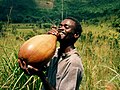 Calabashes (nkalu in Kikongo) are used to collect and store palm wine in Bandundu Province, Democratic Republic of the Congo (c. 1990)
 -
 The Malian kora player Toumani Diabaté with his instrument (2007)
 -
 Calabash puppet (Marionette) (2020)
 -
 The African percussion calabash (2017)


China
[edit]The húlu (葫芦/葫蘆), as the calabash is called in Mandarin Chinese, is an ancient symbol for health. Hulu had fabled healing properties due to doctors in former times carrying medicine inside it. The hulu was believed to absorb negative, earth-based qi (energy) that would otherwise affect health, and is a traditional Chinese medicine cure. The bottle gourd is a symbol of the Eight Immortals, and particularly Li Tieguai, who is associated with medicine. Li Tieguai's gourd was said to carry medicine that could cure any illness and never emptied, which he dispensed to the poor and needy.[38][39] Some folk myths say the "gourd had spirals of smoke ascend from it, denoting his power of setting his spirit free from his body,"[40] and that it "served as a bedroom for the night..."[39] The gourd is also an attribute of the deity Shouxing and a symbol of longevity.[41]
Dried calabash were also used as containers for liquids, often liquors or medicines. Calabash gourds were also grown in earthen molds to form different shapes with imprinted floral or arabesque designs. Molded gourds were also dried to house pet crickets. The texture of the gourd lends itself nicely to the sound of the insect, much like a musical instrument. The musical instrument, hulusi, is a kind of flute made from the gourd.[clarification needed]
-
 A Qing dynasty cricket cage
 -
 A bottle gourd
 -
 A hulusi, the calabash gourd flute or bottle gourd flute


_-_2012_Richmond_Folk_Festival.jpg)
Jewish culture
[edit]In the Safaradi Jewish culture, the gourd is eaten during Rosh Hashana (Jewish New Year's Eve). According to the texts the gourd is eaten as a symbol of tearing apart the enemies who may come and attack. It is called Qaraa, which in Hebrew means "torn" קרע. "שיקרעו אויבנו מעלינו" meaning "may our enemies be torn apart over from us".[citation needed]
Polynesia
[edit]The plant is spread throughout Polynesia known by hue in many related languages.[42]
In Hawaii the word "calabash" refers to a large serving bowl, usually made from hardwood rather than from the calabash gourd, which is used on a buffet table or in the middle of the dining table. The use of the calabash in Hawaii has led to terms like "calabash family" or "calabash cousins", indicating an extended family grown up around shared meals and close friendships. This gourd is often dried when ripe and used as a percussion instrument called an ipu heke (double gourd drum) or just Ipu in contemporary and ancient hula.
The Māori people of New Zealand grew several cultivars of calabash for particular uses like ipu kai cultivars as food containers and tahā wai cultivars as water gourds. They believed the gourd as a representation of Pū-tē-hue, one of Tāne (their god of forests)'s offspring.[43] Several types of taonga pūoro (musical instruments) are made from gourds, including types of flute (ororuarangi, kōauau ponga ihu) and shakers (hue rarā, hue puruwai).[44]
India
[edit]The calabash is used as a resonator in many string instruments in India. Instruments that look like guitars are made of wood, but can have a calabash resonator at the end of the strings table, called toomba. The sitar, the surbahar, the tanpura (north of India, tambura south of India), may have a toomba. In some cases, the toomba may not be functional, but if the instrument is large, it is retained because of its balance function, which is the case of the Saraswati veena. Other instruments like rudra veena and vichitra veena have two large calabash resonators at both ends of the strings table. The instrument, Gopichand used by the Baul singers of Bengal is made out of calabash. The practice is also common among Buddhist and Jain sages.[45]
These toombas are made of dried calabash gourds, using special cultivars that were originally imported from Africa and Madagascar. They are mostly grown in Bengal and near Miraj, Maharashtra. These gourds are valuable items and they are carefully tended; for example, they are sometimes given injections to stop worms and insects from making holes in them while they are drying.
-
 Sitars and one rudra veena (bottom right)
 -
![Sitar with resonator made from a bottle gourd.[46] Surbahar is similar but larger and with lower sounds (something like a bass sitar)[47]](//upload.wikimedia.org/wikipedia/commons/thumb/d/d0/Sitar3.jpg/120px-Sitar3.jpg)
-
![Saraswati veena, the calabash resonator is not always functional but it is kept in place because of the balancing effect.[48]](//upload.wikimedia.org/wikipedia/commons/thumb/1/10/Srivani_veena.jpg/120px-Srivani_veena.jpg) Saraswati veena, the calabash resonator is not always functional but it is kept in place because of the balancing effect.[48]
Saraswati veena, the calabash resonator is not always functional but it is kept in place because of the balancing effect.[48] -
![Rudra veena is a large plucked string instrument used in Hindustani classical music. One of the major types of veena played in Indian classical music, it has two calabash gourd resonators.[48] The vichitra veena, also with two large resonators, is a similar instrument.](//upload.wikimedia.org/wikipedia/commons/thumb/d/db/Asad_Ali_Khan.jpg/120px-Asad_Ali_Khan.jpg) Rudra veena is a large plucked string instrument used in Hindustani classical music. One of the major types of veena played in Indian classical music, it has two calabash gourd resonators.[48] The vichitra veena, also with two large resonators, is a similar instrument.
Rudra veena is a large plucked string instrument used in Hindustani classical music. One of the major types of veena played in Indian classical music, it has two calabash gourd resonators.[48] The vichitra veena, also with two large resonators, is a similar instrument. -
 Ektara (one string) resonator made from a calabash gourd
 -
![The tambura or tanpura may have a toomba (although not in this picture), a resonator made of calabash at the end of the strings table.[49]](//upload.wikimedia.org/wikipedia/commons/thumb/4/4b/Shubha_Mudgal_in_playing_the_Tanpura_%282527339532%29.jpg/120px-Shubha_Mudgal_in_playing_the_Tanpura_%282527339532%29.jpg)
.jpg)
![Sitar with resonator made from a bottle gourd.[46] Surbahar is similar but larger and with lower sounds (something like a bass sitar)[47]](https://en.wikipedia.org/wiki/File:Sitar3.jpg)
![Saraswati veena, the calabash resonator is not always functional but it is kept in place because of the balancing effect.[48]](https://en.wikipedia.org/wiki/File:Srivani_veena.jpg)
![Rudra veena is a large plucked string instrument used in Hindustani classical music. One of the major types of veena played in Indian classical music, it has two calabash gourd resonators.[48] The vichitra veena, also with two large resonators, is a similar instrument.](https://en.wikipedia.org/wiki/File:Asad_Ali_Khan.jpg)

![The tambura or tanpura may have a toomba (although not in this picture), a resonator made of calabash at the end of the strings table.[49]](https://en.wikipedia.org/wiki/File:Shubha_Mudgal_in_playing_the_Tanpura_(2527339532).jpg)
Hindu ascetics (sadhu) traditionally use a dried gourd vessel called the kamandalu. The juice of a bottle gourd is considered to have medicinal properties and be very healthy (see juice toxicity above).
In parts of India a dried, unpunctured gourd is used as a float (called surai-kuduvai in Tamil) to help people learn to swim in rural areas.
Philippines
[edit]In the Philippines, dried calabash gourds are one common material for making a traditional salakot hat.[50]
In 2012, Teófilo García of Abra in Luzon, an expert artisan who makes the Ilocano tamburaw variant using calabash, was awarded by the National Commission for Culture and the Arts with the "Gawad sa Manlilikha ng Bayan" (National Living Treasures Award). He was cited for his dedication to practising and teaching the craft as an intangible cultural heritage of the Philippines under the Traditional Craftsmanship category.[50]
-
 Salakot in the Bangko Sentral ng Pilipinas Money Museum, with the bottom one made from calabash
 -
 Salakot from the Philippines (c.1900), the top one is made from calabash
 -
 Bust of Diego Silang, the 18th-century Ilocano revolutionary leader, shown wearing a tamburaw made from gourd

.jpg)

New Guinea
[edit]Among some New Guinea highland tribes, the calabash is used by men as a penis sheath.
South America
[edit]In Argentina, Uruguay, Paraguay, Chile and southern Brazil, calabash gourds are dried and carved into mates (from the Quichua word mathi,[51] adopted into the Spanish language), the traditional container for mate, the caffeinated, tea-like drink brewed from the yerba mate plant. In the region the beverage itself is called mate as well as the calabash from which the drinking vessels are made. In Peru it is used in a popular practice for the making of mate burilado; "burilado" is the technique adopted for decorating the mate calabashes.
-
 L. siceraria "mate" type
 -

-
 Mate carved and decorated as a drinking container (also called mate, and the infusion also called mate)
 -
 Mate burilado in Peru


.jpg)

In Peru, Bolivia and Ecuador calabash gourds are used for medicinal purposes. The Inca culture applied symbols from folklore to gourds, this practice is still familiar and valued.
North America
[edit]Calabash's watertight features allowed it to be often used as a container to ship seeds across the translantic slave trade.[37] They were also used by enslaved people to carry seeds for planting on plantation fields.[37] On plantations that held enslaved African Americans, the calabash symbolized freedom—as alluded to in the song "Follow the Drinking Gourd" that referenced the Big Dipper constellation that was used to guide the Underground Railroad.[37]
Other uses
[edit]Tobacco smoking pipe
[edit]The gourd can be dried and used to smoke pipe tobacco. According to American consular reports from the early 20th century calabash pipes were commonly used in South Africa. Calabash was said to bestow a "special softness" of flavor that could not be duplicated by other materials. The lining was made of meerschaum, though tin was used for low-grade models.[52] A typical design yielded by this squash is recognized (theatrically) as the pipe of Sherlock Holmes, but the inventor of this character, Sir Arthur Conan Doyle, never mentioned Holmes using a calabash pipe. It was the preferred pipe for stage actors portraying Holmes, because they could balance this pipe better than other styles while delivering their lines.[citation needed]
Enema equipment
[edit]The gourd is used traditionally to administer enemas. Along the upper Congo River an enema apparatus is made by making a hole in one end of the gourd for filling it, and using a resin to attach a hollow cane to the gourd's neck.[53]
References
[edit]- ^ a b "Lagenaria siceraria (Molina) Standl". Plants of the World Online. Board of Trustees of the Royal Botanic Gardens, Kew. 2017. Retrieved 2 December 2020.
- ^ "calabash noun - Definition, pictures, pronunciation and usage notes | Oxford Advanced Learner's Dictionary at". Oxfordlearnersdictionaries.com. Retrieved 6 May 2022.
- ^ NRCS. "Lagenaria siceraria". PLANTS Database. United States Department of Agriculture (USDA). Retrieved 22 January 2016.
- ^ BSBI List 2007 (xls). Botanical Society of Britain and Ireland. Archived from the original (xls) on 26 June 2015. Retrieved 17 October 2014.
- ^ "Grow Birdhouse Gourds". FineGardening. 25 April 2009. Retrieved 25 July 2021.
- ^ Hill, Kathryn (1 September 2009). "Ingredient Spotlight: Cucuzza ("Googootz")". The Kitchn.
- ^ "2001 - The Third Annual Giant Gourd Growing Contest". 2001. Retrieved 8 July 2003.
- ^ a b Erickson, D. L; Smith, B. D; Clarke, A. C; Sandweiss, D. H; Tuross, N (2005). "An Asian origin for a 10,000-year-old domesticated plant in the Americas". Proceedings of the National Academy of Sciences. 102 (51): 18315–20. Bibcode:2005PNAS..10218315E. doi:10.1073/pnas.0509279102. PMC 1311910. PMID 16352716.
- ^ Price, Sally (1982). "When is a calabash not a calabash". New West Indian Guide: 56:69–82.
- ^ Romance Philology Volume 13. Brepols Publishers. 1960. p. 39. Retrieved 26 August 2024.
- ^ Del origen y principio de la lengua castellana ò romance que oi se usa en España ideas lingüísticas de Aldrete · Volume 2. Consejo Superior de Investigaciones Científicas. 1975. p. 345. Retrieved 26 August 2024.
- ^ "calabaza". Etimologías de Chile. Retrieved 26 August 2024.
- ^ a b c Erickson, David L.; Smith, Bruce D.; Clarke, Andrew C.; Sandweiss, Daniel H.; Tuross, Noreen (20 December 2005). "An Asian origin for a 10,000-year-old domesticated plant in the Americas". Proceedings of the National Academy of Sciences. 102 (51): 18315–18320. Bibcode:2005PNAS..10218315E. doi:10.1073/pnas.0509279102. PMC 1311910. PMID 16352716.
- ^ Decker-Walters, Deena S; Wilkins-Ellert, Mary; Chung, Sang-Min; Staub, Jack E (2004). "Discovery and Genetic Assessment of Wild Bottle Gourd [Lagenaria Siceraria (Mol.) Standley; Cucurbitaceae] from Zimbabwe". Economic Botany. 58 (4): 501–8. doi:10.1663/0013-0001(2004)058[0501:DAGAOW]2.0.CO;2. hdl:10113/44303. JSTOR 4256864. S2CID 32430173.
- ^ Clarke, Andrew C; Burtenshaw, Michael K; McLenachan, Patricia A; Erickson, David L; Penny, David (2006). "Reconstructing the Origins and Dispersal of the Polynesian Bottle Gourd (Lagenaria siceraria)". Molecular Biology and Evolution. 23 (5): 893–900. doi:10.1093/molbev/msj092. PMID 16401685.
- ^ Clarke, Andrew C.; Burtenshaw, Michael K.; McLenachan, Patricia A.; Erickson, David L.; Penny, David (May 2006). "Reconstructing the Origins and Dispersal of the Polynesian Bottle Gourd (Lagenaria siceraria)". Molecular Biology and Evolution. 23 (5): 893–900. doi:10.1093/molbev/msj092. PMID 16401685. Retrieved 28 November 2022.
- ^ Gemüse des Jahres 2002: Der Flaschenkürbis (in German). Schandelah: VEN – Verein zur Erhaltung der Nutzpflanzen Vielfalt e.V. 2002. Archived from the original on 10 August 2007. Retrieved 14 July 2010.
- ^ Strabo, Walahfrid (2000). De cultura hortorum (in Latin and German). Näf, W.; és Gabathuler, M. (ford.). Thorbecke. ISBN 978-3-7995-3504-5. Archived from the original on 29 September 2007. Retrieved 14 July 2010.
- ^ Walahfrid Strabo (2002). De cultura hortorum sive Hortulus VII Cucurbita (in Latin). Fachhochschule Augsburg: bibliotheca Augustana.
- ^ White, Nancy (2005). Nancy White University of South Florida – South American Archaeology: Archaic, Preceramic, Sedentism. Bloomington: Indiana University Bloomington MATRIX project.
- ^ Kistler, Logan; Montenegro, Álvaro; Smith, Bruce D.; Gifford, John A.; Green, Richard E.; Newsom, Lee A.; Shapiro, Beth (25 February 2014). "Transoceanic drift and the domestication of African bottle gourds in the Americas". Proceedings of the National Academy of Sciences. 111 (8): 2937–2941. Bibcode:2014PNAS..111.2937K. doi:10.1073/pnas.1318678111. PMC 3939861. PMID 24516122.
- ^ Adhyaru-Majithia, Priya (13 March 2010). "Not all bitter veggies are good, they can kill you: Doctors". DNA. Bhaskar Group. Archived from the original on 26 June 2010. Retrieved 9 July 2010.
- ^ Chandra, Neetu (9 July 2010). "Toxin in lauki kills diabetic city scientist". India Today. Living Media. Archived from the original on 12 July 2010. Retrieved 9 July 2010.
- ^ "Bitter 'lauki' juice can kill you". The Times of India. 28 June 2011. Archived from the original on 5 July 2011. Retrieved 28 June 2010.
- ^ a b c Puri, Rajesh; Sud, Randhir; Khaliq, Abdul; Kumar, Mandhir; Jain, Sanjay (September 2011). "Gastrointestinal toxicity due to bitter bottle gourd (Lagenaria siceraria)─a report of 15 cases". Indian Journal of Gastroenterology. 30 (5): 233–236. doi:10.1007/s12664-011-0110-z. PMID 21986853. S2CID 12653649.
- ^ "Pune woman dies after drinking bottle gourd juice - Times of India". The Times of India. Retrieved 7 July 2018.
- ^ United States Food and Drug Administration (2024). "Daily Value on the Nutrition and Supplement Facts Labels". FDA. Archived from the original on 27 March 2024. Retrieved 28 March 2024.
- ^ "TABLE 4-7 Comparison of Potassium Adequate Intakes Established in This Report to Potassium Adequate Intakes Established in the 2005 DRI Report". p. 120. In: Stallings, Virginia A.; Harrison, Meghan; Oria, Maria, eds. (2019). "Potassium: Dietary Reference Intakes for Adequacy". Dietary Reference Intakes for Sodium and Potassium. pp. 101–124. doi:10.17226/25353. ISBN 978-0-309-48834-1. PMID 30844154. NCBI NBK545428.
- ^ Jeong, Jaehoon (14 September 2016). [정재훈의 밥상 공부] 광해군이 먹고 감탄해 벼슬까지 내린 잡채는? [[Jeong Jaehoon's dining table study] What japchae impressed Gwanghaegun so much that he gave it a title of a public official?]. ChosunBiz (in Korean). Retrieved 15 December 2016.
- ^ 김, 민지 (14 March 2012). 냄비우동·박고지김밥…"5000원의 행복 맛보러 오세요" [Naembi udong, bakgoji gimbap... "Come to taste the happiness of 5,000 won]. Gyeongnam Domin Ilbo (in Korean).
- ^ Waheed, Karim (14 July 2021). "For Bangladesh, Kishwar has already won". The Daily Star. Retrieved 12 August 2021.
- ^ Puca, Davide (2019). "Che cos'è una minestra? Il sistema delle minestre siciliane" [What is a soup? The system of Sicilian soups]. E/C (in Italian). 27: 1–11. hdl:10447/492973.
- ^ Nicastro, Francesca (1 August 2017). "How to Cook with Cucuzza".
- ^ Mwakikagile, Godfrey, "The Gambia and Its People: Ethnic Identities and Cultural Integration in Africa." p. 141. ISBN 9987-16-023-9
- ^ image at Joseph Opala Archived 18 May 2008 at the Wayback Machine, "Origin of the Gullah", yale.edu.
- ^ "Nigeria bikers' vegetable helmets". BBC News. 6 January 2009.
- ^ a b c d Carney, Judith (2019). "Food and the African Past". In the Shadow of Slavery. University of California Press. pp. 6–26. doi:10.1525/9780520949539-004. ISBN 978-0-520-94953-9. S2CID 243438207.
- ^ Ho, Kwok Man (1990). The Eight Immortals of Taoism: Legends and Fables of Popular Taoism. Translated and edited by Joanne O'Brien. New York: Penguin Books. pp. 93–94. ISBN 9780452010703.
- ^ a b "Li T'ieh-kuai". Encyclopædia Britannica Online. Encyclopædia Britannica. 2008. Retrieved 26 October 2008.
- ^ Wilson, Eddie W. (April 1951). "The Gourd in Folk Symbolism". Western Folklore. 10 (2): 162–164. doi:10.2307/1497969. JSTOR 1497969.
- ^ Werner, E. T. C. (1922). Myths & Legends of China. New York: George G. Harrap & Co. Ltd. Retrieved 10 October 2021.
- ^ "Hue". Te Māra Reo: The Language Garden. Benton Family Trust. 2022. Retrieved 29 November 2022.
- ^ Best, Elsdon (1976). Maori Agriculture - Part VII The Hue or Gourd. Lagenaria Vulgaris. Wellington, New Zealand: A. R. Shearer. pp. 245–255 – via NZETC at Victoria University of Wellington Library.
- ^ Flintoff, Brian (2004). Taonga Pūoro Singing Treasures: The Musical Instruments of the Māori. Nelson: Craig Potton Publishing. pp. 27–35.
- ^ Landsberg, Steven (4 February 2000). "Kanailal and Brother, Calcutta: The History of an Indian Musical Instrument Maker".
- ^ Kasliwal, Suneera (2001). "Classical Musical Instruments - Sitar" (in German). Archived from the original on 19 March 2014 – via Small Encyclopedia of Indian Instruments at India-instruments.de.
- ^ "Dhrupad Surbahar". Pt. Ashok Pathak. Archived from the original on 25 September 2022.
- ^ a b "Veena, Saraswati Veena, Rudra Veena and Vichitra Veena". Archived from the original on 20 March 2014. Retrieved 19 March 2014.
- ^ "Tambura/tanpura". Daly Music. Archived from the original on 31 December 2014.
- ^ a b Peralta, Jesus T. (2013). Salakot and Other Headgear (PDF). National Commission for Culture and the Arts (NCCA) & Intangible Cultural Heritage in the Asia-Pacific Region (ICHCAP), UNESCO. p. 232. Archived from the original (PDF) on 24 November 2021. Retrieved 6 March 2020.
- ^ Lara, Jesus (1971). Diccionario Qhëshwa—Castellano Castellano—Qhëshwa. Cochabamba: Editorial Los Amigos del Libro. p. 171.
- ^ "Daily Consular and Trade Reports". 1906.
- ^ Julius Friedenwald and Samuel Morrison (January 1940). "The History of the Enema with Some Notes on Related Procedures (Part I)". Bulletin of the History of Medicine. 8 (1): 75–76. JSTOR 44442727.
External links
[edit]
- How Bottle Gourds were brought to America by Native Americans
- Multilingual taxonomic information at the University of Melbourne
- Calabashes used for flotation and to store fish during huge Nigerian fish festival
- Brief discussion of the species, uses, ecology, and etymology of generic and specific names (Archived 6 December 2016 at the Wayback Machine)
| National | |
|---|---|
| Other | |

Calabash
View on GrokipediaBotany
Taxonomy and Classification
The calabash, scientifically known as Lagenaria siceraria (Molina) Standl., belongs to the genus Lagenaria within the family Cucurbitaceae, order Cucurbitales.[8][9] This classification places it among other cucurbits such as cucumbers (Cucumis sativus) and melons (Cucumis melo), sharing traits like vining growth and tendril-bearing stems typical of the family.[9] The genus Lagenaria comprises six species, all native to tropical Africa, with L. siceraria being the sole species domesticated and widely cultivated globally for its utilitarian fruits.[2] Synonyms for L. siceraria include L. vulgaris Ser. and Cucurbita lagenaria L., reflecting historical taxonomic revisions that separated it from the genus Cucurbita, which encompasses squashes and pumpkins with distinct genetic and morphological profiles.[10] Unlike Cucurbita species, which originated in the Americas and feature harder rinds suited for storage, Lagenaria species exhibit lighter, more buoyant fruits adapted for long-distance dispersal.[2] Genetic analyses confirm L. siceraria's African origins, with chloroplast and nuclear markers indicating pre-human transoceanic drift via Atlantic currents to the Americas around 10,000 years ago, predating human migration and supporting its classification as a pantropical species without relying on anthropogenic spread for initial dispersal.[11][12] These studies, using DNA sequencing of ancient and modern specimens, refute earlier Asian domestication hypotheses for American populations and underscore the genus's evolutionary resilience to oceanic voyaging, distinguishing it from co-familial gourds lacking such evidence of natural long-range propagation.[2]Morphological Features
Lagenaria siceraria is an annual, monoecious climbing vine characterized by a vigorous growth habit, with stems that twine and extend up to 9 meters in length, aided by coiling tendrils for support; larger-fruited cultivars may exhibit enhanced vigor with broader leaves and more extensive branching.[13] [14] The stems are typically angular and pubescent, contributing to the plant's ability to adhere to and ascend vertical structures.[15] The leaves are simple, arranged alternately along the stems, and palmately lobed, usually with 5 to 7 lobes, featuring a rough, pubescent texture and a cordate base.[14] [16] Roots develop as a fibrous system typical of cucurbits, supporting rapid vegetative expansion but not extensively documented in morphological studies beyond facilitating nutrient uptake in sprawling habits.[17] Reproductive structures include large, trumpet-shaped white flowers, unisexual and borne separately on the same plant, with male flowers typically on longer peduncles than female ones, which possess an inferior ovary.[14] [17] The fruits are pepos, exhibiting diverse morphologies including bottle-shaped, dipper forms with elongated necks, long cylindrical or serpentine shapes, and round or giant spherical variants, with smooth to slightly warty green skin when immature and fleshy; upon maturation, they undergo lignification, drying to form hard, waterproof woody shells enclosing fibrous flesh and numerous flat, white seeds.[14] [1] [18] This maturation process transitions the fruit from an edible, watery stage to a durable, dry structure suitable for non-culinary uses.[19]Varieties and Cultivars
Lagenaria siceraria displays significant intraspecific morphological diversity among its varieties and cultivars, particularly in fruit shape, size, and surface texture, which influence their primary applications as food or craft materials; notable forms include compact bottle-shaped for containers, dipper types with handle-like necks, serpentine or long cylindrical for decorative twisting, and large round or giant spherical for voluminous storage. Studies of germplasm collections reveal variations in traits such as fruit length (ranging from 10 to over 100 cm), diameter, and neck elongation, with elongated forms dominating edible selections and bulbous or twisted shapes favored for ornamentals.[20][17][18] This diversity arises from both natural landraces and selective breeding, enabling adaptations to local environments like varying humidity and soil types across tropical regions.[21] Edible cultivars, such as those known regionally as 'Dudhi' or 'Lauki' in India, typically feature slender, cylindrical fruits 30-50 cm long with smooth, light green rinds when immature, prized for their mild flavor and high water content in culinary uses. These varieties often exhibit high yield potential in hybrid forms, with F1 hybrids showing uniform fruit shape and sizes up to 45 cm in length among 36 tested genotypes.[22][15] In contrast, ornamental cultivars like 'Birdhouse' produce hourglass-shaped fruits approximately 25-30 cm tall, with a rounded bulbous base transitioning to a narrower neck, developing hard, tan shells suitable for hollowing into containers or avian habitats after drying.[23][24] Serpentine or snake-like varieties, including forms akin to var. longissima, yield highly elongated and coiled fruits exceeding 1 meter in length with irregular, twisted morphologies, valued for decorative crafts due to their unique aesthetics and durable rinds. Heirloom cultivars, such as 'Nam Tao Yao', preserve these traditional shapes and genetic variability, often achieving germination rates of 93-94% under optimal conditions, while modern hybrids prioritize uniformity, disease resistance, and enhanced vigor for commercial production.[25][26] Regional landraces from Africa and Asia further demonstrate drought tolerance in root and fruit traits, supporting cultivation in semi-arid areas.[27][21]Etymology
Origin of the Term
The English term "calabash," denoting a dried gourd shell used as a vessel, first appeared in the late 1500s, borrowed from Middle French calebasse, which itself derived from Spanish calabaza referring to a gourd or squash-like fruit.[28][29] The Spanish calabaza likely evokes the bottle- or flask-shaped dried fruits of plants like Lagenaria siceraria, hollowed out for utilitarian purposes such as cups or containers, distinguishing it from mere botanical descriptors.[30] The ultimate roots of calabaza remain debated among linguists, with proposed origins including Arabic qarʿa or qarʿah yābisah ("dry gourd"), reflecting Islamic trade networks that disseminated knowledge of such vessels across the Mediterranean by the medieval period, or pre-Roman Iberian substrates unrelated to Semitic influences.[30][31] Some etymologists trace a parallel influence to Persian kharbūzeh ("melon" or gourd-like fruit), potentially transmitted via Arabic intermediaries during Sassanid or Abbasid exchanges, though direct evidence for this pathway is circumstantial and contested in favor of the Hispanic core.[31] Portuguese calabaça or cabaça, a cognate of the Spanish form, facilitated the term's dissemination during 15th- and 16th-century explorations in Africa and the Americas, where dried gourds were ubiquitous artifacts, embedding "calabash" in colonial lexicons beyond Europe.[30] This contrasts with "bottle gourd," a later English functional label emphasizing shape over cultural artifact status, applied specifically to Lagenaria siceraria fruits resembling flasks when mature and desiccated.[29]Regional and Linguistic Variations
In South Asia, Lagenaria siceraria is commonly referred to as lauki or ghiya in Hindi, dudhi bhopala or simply dudhi in Marathi, and lau in Bengali, with these terms often emphasizing the vegetable's elongated, bottle-like form suitable for culinary use.[32][33] In China, the plant is known as hulu (葫芦), a term derived from its gourd-shaped fruit and widely used in both botanical and cultural contexts.[34] Across Africa, nomenclature reflects indigenous linguistic families and regional morphologies. In southern Africa, it is called iselwa in Zulu and Xhosa, segwana in Tswana, and moraka in Northern Sotho, names that distinguish it from harder tree gourds like Crescentia cujete.[35] In West Africa, Hausa speakers use kwarya, highlighting its prevalence as a vining crop in Sahelian agriculture. These terms often contrast with European loanwords like calabash, which entered via colonial trade and derive from Portuguese calabaza or Spanish equivalents, adapting to local phonetics without altering core descriptive roots tied to the fruit's utility.[36]| Region/Language | Common Name(s) | Etymological Note |
|---|---|---|
| Hindi (India) | Lauki, Ghiya | Descriptive of milky (doodh-like) interior or gourd shape[32] |
| Bengali (India/Bangladesh) | Lau | Phonetic adaptation from Sanskrit alabu for gourd[32] |
| Zulu/Xhosa (South Africa) | Iselwa | Indigenous Bantu term for the vine's fruit[35] |
| Hausa (West Africa) | Kwarya | Reflects bottle-like storage form in local dialects |
| Chinese | Hulu (葫芦) | Literally "bottle gourd," emphasizing hollow vessel potential[34] |
History
Domestication and Origins
The bottle gourd (Lagenaria siceraria) originated from wild populations native to Africa, with genomic analyses of 197 global varieties indicating that domestication occurred in southern Africa around 12,000 years ago.[38] This timeline emerges from demographic modeling of genetic variation, which traces a bottleneck event associated with human selection for traits like larger, non-bitter fruits suitable for consumption and hard-shelled mature gourds for utensils.[39] Prior hypotheses of multiple independent domestications—such as in Asia or the Americas—have been challenged by this data, which supports a single primary center of origin followed by human-mediated radiation.[40] Archaeological evidence corroborates an African domestication but dates the earliest morphologically domesticated remains later, around 6,000–10,000 BP in various Old World sites, with traits like reduced seed bitterness and increased fruit size distinguishing cultivated forms from wild ones that produce small, bitter, floating gourds adapted for long-distance ocean dispersal.[12] In Africa, selection likely began with foraging of wild fruits for food and rinds for crafts, gradually intensifying as hunter-gatherers transitioned to cultivation amid Holocene environmental shifts favoring vining crops.[41] Genetic markers for domestication syndromes, including loss of bitterness via mutations in cucurbitacin pathways, align with this co-evolutionary process, prioritizing utility over wild dispersal adaptations.[39] Subsequent pangenomic studies highlight low nucleotide diversity in domesticated lineages, consistent with a founder effect from southern African wild relatives, underscoring causal human intervention in fixing advantageous traits for dual edible and utilitarian roles.[38] While wild gourds could raft across oceans—remaining viable after 130 days afloat—domesticated spread required human agency, distinguishing initial African origins from later global patterns.[2]Global Dispersal and Archaeological Evidence
Archaeological remains of Lagenaria siceraria in the Americas date to at least 10,000 years BP, with fragments recovered from sites in Mexico such as Coxcatlán Cave and Guila Naquitz, predating human colonization of the region by Clovis peoples around 13,000–12,000 years BP.[42] Genetic sequencing of ancient and modern American specimens reveals chloroplast DNA haplotypes identical to wild African populations, indicating independent arrival via natural means rather than human transport from Asia or elsewhere.[42] Oceanographic modeling demonstrates that dried, buoyant fruits could survive transatlantic drift from West Africa to northeastern South America in 10–30 days during seasonal currents, with viability experiments confirming seed germination post-immersion.[11] This pre-human dispersal allowed local wild populations to establish, which were later domesticated separately from Old World lineages, as evidenced by distinct nuclear genetic markers in American gourds.[42] In the Old World, human agency drove post-domestication spread from African origins to Asia, with the earliest extra-African archaeological evidence from Spirit Cave in northwest Thailand, where rind fragments date to approximately 9,000 BP and associate with early Holocene forager sites.[12] This presence aligns with the timing of Neolithic dispersals out of Africa into Eurasia, likely via migratory farmers carrying seeds or fruits for their utility as water vessels and storage containers.[12] By 8,000–7,000 BP, the plant appears in Chinese archaeological contexts, such as at sites in the Yangtze River basin, where carbonized remains confirm cultivation and use in early agricultural societies.[12] Evidence of dispersal to Europe and the Mediterranean emerges later, with L. siceraria documented in Bronze Age contexts around 2000 BCE, including desiccated fruits and artifacts from Egyptian tombs and Levantine sites, where gourds functioned as durable, lightweight utensils traded along Nile and Silk Road precursors.[43] In ancient Jewish agriculture during the Roman and Talmudic periods, the bottle gourd was identified as "dlu‘im" in rabbinic literature, including Mishnah Kilayim 3:6 and Tosefta Kilayim 1:4; young fruits were edible after shaving hairs ("piqqus") and cooking due to short shelf life, with sprawling growth requiring field spacing, though it was less favored than other cucurbits.[44] These finds underscore human selection for the plant's hard rind, facilitating its propagation through commerce and migration networks, distinct from the passive oceanic mechanism in the Americas.[43] Subsequent utility in vessel-making, as seen in ancient Near Eastern and Greco-Roman records, reinforced its establishment across Eurasia by the first millennium BCE.[43]Cultivation
Environmental and Soil Requirements
Calabash (Lagenaria siceraria) thrives in warm climates with daytime temperatures ranging from 24°C to 30°C, exhibiting optimal growth between 25°C and 35°C, while minimum temperatures for development should not fall below 15°C.[45][46] The plant requires full sun exposure, ideally at least six hours of direct sunlight daily, and performs well in hot, humid conditions typical of tropical and subtropical regions, though it is highly sensitive to frost and should not be planted until after the last frost date.[1][47] Soil preferences include well-drained sandy or loamy types, with well-aerated, fertile soils yielding the best results; the plant demonstrates adaptability to poorer soils but achieves higher productivity in enriched conditions.[1][36] Optimal soil pH ranges from 6.0 to 7.5, supporting robust root development and nutrient uptake.[48] Field trials indicate that cultivation in these pH-balanced, well-drained soils correlates with increased yields, such as up to 76 tons per hectare under favorable management.[49] Water requirements are moderate, with plants needing consistently moist but not waterlogged soil, typically irrigated 1–2 times per week depending on environmental conditions and soil moisture levels; established vines exhibit some drought tolerance once rooted.[50][51] Overwatering should be avoided to prevent root rot in heavy soils.[52]Propagation and Growth Practices
 is propagated primarily through seeds, which possess hard coats requiring pretreatment for optimal germination. Scarification via nicking or notching the seed coat, followed by overnight soaking in water and pre-germination in moist toweling at 75-80°F (24-27°C) for 3-5 days, significantly improves viability rates for hardshell varieties like bottle gourd.[53] Seeds are direct-sown ½-1 inch (1.3-2.5 cm) deep, spaced 2-4 feet (0.6-1.2 m) apart in rows 5 feet (1.5 m) apart, or in hills 4 feet (1.2 m) apart to accommodate vigorous vine growth.[54][55] Transplants can be used after hardening off, typically started indoors 3-4 weeks before the last frost in temperate regions.[56] The plant's vining habit necessitates support structures for efficient cultivation. Vertical training on trellises or fences promotes straighter fruits, enhances air circulation, and maximizes space utilization in gardens, with vines capable of reaching 10-15 feet (3-4.5 m) in length.[57] Pruning excessive lateral shoots early encourages main vine development and fruit load management. Flowers bloom nocturnally and are primarily pollinated by moths; in areas with low natural pollinator activity, hand-pollination improves fruit set by transferring pollen from male flowers (lacking an ovary) to the stigma of female flowers (with a small fruitlet base) during evening hours.[58] Edible immature fruits are harvested 55-75 days after sowing, when 12-18 inches (30-45 cm) long and tender-skinned to ensure quality.[59] Mature gourds for crafting are left on the vine until the rind hardens and turns brown, typically 100-120 days post-planting, indicated by stem drying and seed rattle inside.[60] Recent horticultural advances include grafting calabash scions onto rootstocks like interspecific hybrids for enhanced resistance to soilborne pathogens such as Fusarium wilt, though L. siceraria itself serves frequently as a resistant rootstock for other cucurbits.[61][62]Pests, Diseases, and Management
Bottle gourd (Lagenaria siceraria) is susceptible to several insect pests that can reduce yields by feeding on foliage, stems, and fruits, with losses estimated at 20-30% from unchecked infestations.[63] Common pests include aphids, which colonize tender shoots and undersides of leaves, causing distortion, yellowing, and stunted growth while transmitting viral pathogens.[64] Fruit flies (Bactrocera cucurbitae) lay eggs in developing fruits, leading to maggot infestation and fruit rot, identifiable by punctures exuding brown resinous fluid.[65] Other notable pests are squash vine borers, which tunnel into stems causing wilting and plant death, and cucumber beetles, which chew foliage and transmit bacterial wilt.[66] Fungal and viral diseases pose significant threats, often exacerbated by humid conditions and leading to yield reductions up to 50% in severe cases among cucurbits.[67] Powdery mildew (Podosphaera xanthii) manifests as white powdery patches on leaves, reducing photosynthesis and fruit quality.[68] Fusarium wilt, caused by Fusarium oxysporum, results in vascular discoloration, wilting, and plant collapse, particularly in warm soils.[69] Viral infections, such as begomoviruses causing chlorotic curly stunt disease, lead to leaf curling, stunting, and mottling, with reported losses approaching 100% in bottle gourd in affected regions.[70] Bacterial leaf spot (Xanthomonas campestris) produces angular necrotic lesions on leaves, further compromising plant vigor.[66] Effective management relies on integrated pest management (IPM) strategies prioritizing cultural, biological, and resistant varieties over broad-spectrum pesticides to minimize resistance development and environmental impact. Crop rotation with non-host plants every 2-3 years disrupts soil-borne pathogens like Fusarium, while mulching suppresses weeds and prevents fruit contact with soil to reduce rot incidence.[55] Resistant germplasm lines, such as USVL351-PMR and USVL482-PMR for powdery mildew or Arka Shreyas for multiple diseases, provide genetic control when grafted as rootstocks.[68][71] For pests, yellow sticky traps capture aphids and whiteflies, pheromone traps target fruit flies, and neem seed kernel extract (NSKE) at 5% serves as a botanical repellent; need-based application of approved insecticides follows when thresholds are exceeded.[65] Monitoring and early intervention, combined with sanitation like removing infested debris, sustain yields under biotic stress.[72]Health Aspects
Nutritional Composition
The immature fruit of Lagenaria siceraria, commonly consumed as bottle gourd, has a high moisture content of approximately 92–94.5%, contributing to its low energy density at 14 kcal per 100 g and establishing it as a low-calorie vegetable.[73][74] Proximate analysis reveals 3.39 g carbohydrates, 0.62 g protein, 0.02–0.2 g fat, and 0.5–0.7 g dietary fiber per 100 g, with ash content around 0.5%.[73][74] Minerals include calcium (26 mg/100 g), iron (0.2 mg/100 g), and potassium, while vitamins such as C and folates (6 μg/100 g) are present in modest quantities, supporting basic nutritional needs in low-calorie diets. Per 100 g of immature fruit, most nutrients provide less than 5% of the US Recommended Dietary Allowances (RDAs) for adult males due to the ~94% moisture content, with vitamins B12, D, and selenium at 0%, choline <5%, though vitamin C contributes approximately 11%.[73][75][76] The seeds of L. siceraria exhibit higher nutrient density, with protein levels reaching 20–30% on a dry basis and oil content of 25–39%, predominantly unsaturated fatty acids including linoleic acid (63%) and palmitic acid (21%).[77][78] Per 100 g dry seeds, they provide approximately 450 kcal, reflecting elevated fat and protein contributions compared to the fruit.[79] These seeds also contain essential amino acids and minerals like phosphorus, magnesium, and zinc.[80] Bioactive compounds in the fruit, including flavonoids, phenolics, and chlorophyll derivatives, alongside fiber (up to 24 g/100 g dry matter in peels), support antioxidant activity and digestive function, as evidenced in phytochemistry analyses.[81][82] Relative to other cucurbits like cucumber, bottle gourd fruit offers comparable hydration and fiber but lower caloric load per typical 100–200 g serving, aiding satiety without excess energy intake.[73] Bottle gourd (also known regionally as lauki) has a low glycemic index of 15, classifying it as a low-GI food. It contains approximately 3-4 g of carbohydrates per 100 g and has high water content (around 96%), resulting in minimal impact on blood sugar levels and making it suitable for inclusion in diets aimed at diabetes management.[83][84]| Nutrient (per 100 g fresh fruit) | Amount | Reference |
|---|---|---|
| Energy | 14 kcal | [73] |
| Moisture | 92–94.5% | [74] |
| Carbohydrates | 3.39 g | [73] |
| Protein | 0.62 g | [73] |
| Fat | 0.02 g | [73] |
| Fiber | 0.5 g | [73] |