



Community hub
Recent from talks
Contribute something to knowledge base
Content stats: 0 posts, 0 articles, 1 media, 0 notes
Members stats: 0 subscribers, 0 contributors, 0 moderators, 0 supporters
Subscribers
Supporters
Contributors
Moderators
Hub AI
Brass knuckles AI simulator
(@Brass knuckles_simulator)
Hub AI
Brass knuckles AI simulator
(@Brass knuckles_simulator)
Brass knuckles
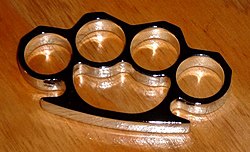
Brass knuckles (also referred to as brass knucks, knuckledusters, iron fist and paperweight, among other names) are a melee weapon used primarily in hand-to-hand combat. They are fitted and designed to be worn around the knuckles of the human hand. Despite their name, they are often made from steel, aluminium, plastics or carbon fibers and not necessarily brass.
Designed to preserve and concentrate a punch's force by directing it toward a harder and smaller contact area, they result in increased tissue disruption, including an increased likelihood of fracturing the intended target's bones on impact. The extended and rounded palm grip also spreads the counter-force across the attacker's palm, which would otherwise have been absorbed primarily by the attacker's fingers. This reduces the likelihood of damage to the attacker's fingers.
The weapon is controversial for its easy concealability and its association with organized crime, as a result it is illegal to own and use in a number of countries.
During the 19th century, cast iron, brass, lead, and wood knuckles were made in the United States during the American Civil War (1861–1865). Soldiers would often buy cast iron or brass knuckles. If they could not buy them, they would carve their own from wood, or cast them at camp by melting lead bullets and using a mold in the dirt.[citation needed]
Some brass knuckles have rounded rings, which increase the impact of blows from moderate to severe damage. Other instruments (not generally considered to be "brass knuckles" or "metal knuckles" per se) may have spikes, sharp points and cutting edges. These devices come in many variations and are called by a variety of names, including "knuckle knives."[citation needed]
By the late 18th century, knuckledusters were incorporated into various kinds of pistols such as the Apache revolver used by criminals in France in the late 19th to early 20th centuries.[page needed] During World War I the US Army issued two different knuckle knives, the US model 1917 and US model 1918 Mark I trench knives. Knuckles and knuckle knives were also being made in England at the time and purchased privately by British soldiers. It was advised not to polish brass knuckles as allowing the brass to darken would act as camouflage on the battlefield.
By World War II, knuckles and knuckle knives were quite popular with both American and British soldiers. The Model 1918 trench knives were reissued to American paratroopers. A notable knuckle knife still in use is the Cuchillo de Paracaidista, issued to Argentinian paratroopers. Current-issue models have an emergency blade in the cross guard.[citation needed]
Brass knuckles are illegal in several regions, including: Italy, Hong Kong, Austria, Belgium, Bosnia, Canada, Denmark, Croatia, Cyprus, Estonia, Finland, France, Germany, Greece, Hungary, Iran, Israel, Ireland, Malaysia, the Netherlands, Norway, Poland, Portugal, Russia, Spain, Turkey, Sweden, Singapore, Taiwan, Ukraine, the United Arab Emirates and the United Kingdom.
Brass knuckles
Brass knuckles (also referred to as brass knucks, knuckledusters, iron fist and paperweight, among other names) are a melee weapon used primarily in hand-to-hand combat. They are fitted and designed to be worn around the knuckles of the human hand. Despite their name, they are often made from steel, aluminium, plastics or carbon fibers and not necessarily brass.
Designed to preserve and concentrate a punch's force by directing it toward a harder and smaller contact area, they result in increased tissue disruption, including an increased likelihood of fracturing the intended target's bones on impact. The extended and rounded palm grip also spreads the counter-force across the attacker's palm, which would otherwise have been absorbed primarily by the attacker's fingers. This reduces the likelihood of damage to the attacker's fingers.
The weapon is controversial for its easy concealability and its association with organized crime, as a result it is illegal to own and use in a number of countries.
During the 19th century, cast iron, brass, lead, and wood knuckles were made in the United States during the American Civil War (1861–1865). Soldiers would often buy cast iron or brass knuckles. If they could not buy them, they would carve their own from wood, or cast them at camp by melting lead bullets and using a mold in the dirt.[citation needed]
Some brass knuckles have rounded rings, which increase the impact of blows from moderate to severe damage. Other instruments (not generally considered to be "brass knuckles" or "metal knuckles" per se) may have spikes, sharp points and cutting edges. These devices come in many variations and are called by a variety of names, including "knuckle knives."[citation needed]
By the late 18th century, knuckledusters were incorporated into various kinds of pistols such as the Apache revolver used by criminals in France in the late 19th to early 20th centuries.[page needed] During World War I the US Army issued two different knuckle knives, the US model 1917 and US model 1918 Mark I trench knives. Knuckles and knuckle knives were also being made in England at the time and purchased privately by British soldiers. It was advised not to polish brass knuckles as allowing the brass to darken would act as camouflage on the battlefield.
By World War II, knuckles and knuckle knives were quite popular with both American and British soldiers. The Model 1918 trench knives were reissued to American paratroopers. A notable knuckle knife still in use is the Cuchillo de Paracaidista, issued to Argentinian paratroopers. Current-issue models have an emergency blade in the cross guard.[citation needed]
Brass knuckles are illegal in several regions, including: Italy, Hong Kong, Austria, Belgium, Bosnia, Canada, Denmark, Croatia, Cyprus, Estonia, Finland, France, Germany, Greece, Hungary, Iran, Israel, Ireland, Malaysia, the Netherlands, Norway, Poland, Portugal, Russia, Spain, Turkey, Sweden, Singapore, Taiwan, Ukraine, the United Arab Emirates and the United Kingdom.
Recent media
Recent media