Hubbry Logo
BultacoBultacoMain
Open search
Bultaco
Community hub
Bultaco
logo
8 pages, 0 posts
0 subscribers
Be the first to start a discussion here.
Bultaco
Bultaco
from Wikipedia

Bultaco Formula IV 1968

Key Information

Bultaco was a Spanish manufacturer of two-stroke motorcycles from 1958 to 1983.

In May 2014, a new Bultaco was announced.[1]

Origins

[edit]

The origin of the Bultaco motorcycle company dates from May 1958. Francesc "Paco" Bultó was a director of the Montesa motorcycle company, founded in 1944.[2] After several years of steady growth and road-racing success, in 1957, Montesa moved to larger facilities.[2] The move was protracted, disrupting production, and was followed by a downturn in the Spanish economy.[2] This slump brought to a head disagreements between Bultó and the other senior director, Pere Permanyer.[2] As an economy measure, Permanyer (the majority shareholder) felt that the company should withdraw from racing. Bultó, the driving force behind the racing program and responsible for much of the company’s technical expertise, was vehemently opposed. Failing to reach a compromise, Bultó decided to leave Montesa to concentrate on his other business interests.[2] Perhaps unsurprisingly, the majority of Montesa's racing department left shortly afterwards, as well.[2]

Bultaco is formed

[edit]

The suggestion to form a new company is said to have come a few days later when Sr. Bultó was invited to a meeting by several of the former staff of Montesa's racing department. Keen to return to racing, they persuaded him that their greatest hope lay in forming a new company.[2] Setting up shop in very primitive conditions at an old farm owned by Bultó, things developed quickly. On 24 March 1959, Bultaco held a press day and launched its first motorcycle, the road-going 125 cc Bultaco Tralla 101, named after a Spanish word for whip.[2][3] Just two months later, Bultaco entered its first Spanish Grand Prix, taking seven of the first ten places.[2]

[edit]

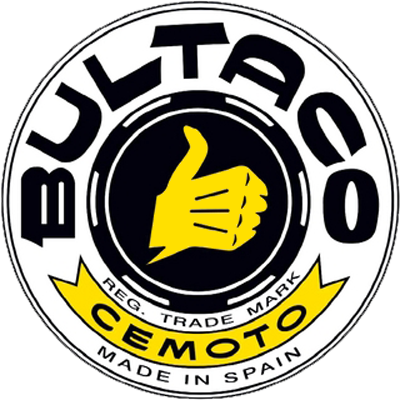
"Bultaco" comes from combining the first four letters of Sr. Bultó's surname with the last three of his nickname "Paco".[2] The name was a suggestion of one of Bultaco's premier racers, and close friend of Sr. Bultó, John Grace from Gibraltar. CEMOTO is an acronym for "Compañia Española de Motores". The other part of the company logo, the "Thumbs up" symbol, came after Sr. Bultó witnessed British motorcycle racer David Whitworth giving the signal to his pit crew to signify that all was well.[2] Sete Gibernau had this on the back of his crash helmet when he raced MotoGP.

In 1998, rights to the Bultaco name were purchased by Marc Tessier, who used it to help launch a range of purpose-built trials motorcycles from his company Sherco Moto S.A.R.L. The bikes were initially named Bultaco Shercos. In 2000, the bikes became Sherco by Bultaco, and in 2001, the Bultaco name was dropped altogether. The US trademark is now owned by HDW Enterprises, parent company of a parts and repair specialist for vintage Bultacos.[4][5]

Bultaco produces electric motorbikes in Barcelona, Catalonia, Spain, also the site of the original 1958 factory.

Notable products

[edit]
Metralla MK2, 250 cc
Bultaco engine detail

Although they made road and road-racing motorcycles, the company had its greatest success with models for off-road competition - the Pursang for motocross, the Matador for enduros, the Sherpa T for observed trials competition, and the Astro for short flat-track. Perhaps the most famous Bultaco model, the Sherpa T trials bike, revolutionised the sport in the 1960s. At that time, trials were almost exclusively a British sport using big, heavy, four-stroke machines. Irish trials ace Sammy Miller teamed with Bultó to produce a lightweight, two-stroke machine, which, overnight, rendered the heavy four-strokes obsolete. Miller won the gruelling Scottish Six Days Trial in 1965, and then repeated the feat with wins in 1967 and 1968. He also claimed the European trials championship in 1968 and 1970. This coincided with, and perhaps stimulated, the growth in the popularity of trials in Europe and later the USA, which provided a lucrative market for Bultaco in the years to come. Bultaco dominated the World Trials Championship in the 1970s, winning the title eight times, and winning the Scottish Six Days Trial four times. Bultaco's premier model in the USA, the Pursang, was an excellent-handling and powerful 250 cc competition model that was competitive in virtually any type of speed-based off-road competition. The Pursang range was later expanded to 125, 360, and 370 cc. The Bultaco Astro was a very popular short-track racer in the United States, and was used by many AMA Grand National riders in the US in pursuit of their championships, including Mike Kidd, Terry Poovey, Bubba Rush, and hundreds of other top-class competitors. The Astro had a superb power band, perfectly suited for short tracks, and some half-miles, as well. Bultaco motorcycles were mainly powered by single-cylinder, air-cooled, two-stroke engines, but they also made water-cooled powerplants. The rider was required to mix the oil and gasoline manually. Built in Barcelona, Spain, Bultaco motorcycles were exported throughout the world, but their largest market ultimately became the USA, allowing aspiring racers to purchase legitimately competitive motorcycles without modification. The Bultaco engine and transmission were universally interchangeable between models and engine capacities; one could replace the cylinder from a 175 cc engine with a 200 cc, 250 cc, 350 cc, or even 360 cc capacity Bultaco cylinder. As Bultaco produced the cylinders, pistons, rings, and cylinder heads for all engine capacities, no aftermarket parts were required, as with other brands. Due to industrial unrest and market pressures, Bultaco production closed in 1979. The factory reopened in 1980, but closed again in 1983. A new series of electric Bultacos was announced mid-2014, and it began sales in 2015.[1] Sherco motorcycle company , founded in 1998 in Barcelona, derives its name from an amalgamation of two words, Sherpa and Bultaco. Former MotoGP star Sete Gibernau is the grandson of Paco Bultó.

References

[edit]
[edit]
Revisions and contributorsEdit on WikipediaRead on Wikipedia
from Grokipedia
Bultaco was a prominent Spanish motorcycle manufacturer specializing in lightweight, two-stroke-powered off-road, trials, and bikes, founded on May 17, 1958, by Francisco Xavier Bultó after his departure from the rival firm Montesa due to disagreements over racing commitments. The company, initially based in a farmhouse in Sant Adrià del Besòs near , quickly gained renown for its innovative engineering and competitive success, producing over 200 models during its primary run and exporting to more than 40 countries by the mid-1960s. At its peak in 1966, Bultaco achieved annual production of over 20,000 units, establishing itself as Spain's largest maker with a focus on high-performance dirt machines that emphasized agility and power-to-weight ratios. Key to Bultaco's legacy were iconic models like the Sherpa T trials bike, introduced in the 1960s, which revolutionized the sport with its lightweight frame and responsive handling, securing eight FIM World Trials Championships in the 1970s. The Pursang motocrosser, evolving from 125cc to 360cc displacements, became a bestseller in the U.S. market during the 1970s, while enduro offerings such as the Alpina and Matador excelled in long-distance events, boasting top speeds around 75-78 mph and durable two-stroke engines delivering up to 25 horsepower. Racing triumphs included early victories like seven top-10 finishes at the 1959 and international wins against established brands such as and , underscoring Bultaco's rapid ascent in global competitions. Facing economic challenges from the 1970s oil crisis, intensifying competition from Japanese manufacturers, labor disputes, and declining U.S. sales—from 25,000 units in 1974 to 16,000 by 1979—Bultaco ceased operations in 1983. The brand briefly revived in 2014 under Bultaco Motors, shifting to electric "moto-bikes" like the Brinco series, which fused pedal-assist and motor power for off-road use, with models featuring and ranges up to 100 km; however, this electric initiative ended production in 2018 amid financial difficulties. Today, Bultaco endures as a celebrated name in heritage, with enthusiast clubs preserving its vintage machines and legacy of innovation in two-stroke technology.

History

Origins

Francesc "Paco" Bultó, a prominent Spanish industrialist and motorcycle enthusiast, co-founded Montesa in 1944 alongside Pedro Permanyer, serving as its technical director with a strong focus on racing and advancements in two-stroke engine technology. Bultó's passion for competition drove Montesa's early successes in events like the International Six Days Trial, where innovative two-stroke designs emphasized lightweight construction and performance. His vision prioritized aggressive participation in international racing to push engineering boundaries, contrasting with the company's more conservative management approach. In 1958, tensions escalated when Montesa's leadership decided to withdraw from international racing to prioritize commercial stability amid financial pressures, a move Bultó vehemently opposed as it undermined his commitment to motorsport innovation. Unable to sway the board, Bultó resigned in May 1958, taking with him a core group of disillusioned engineers from Montesa's racing department who shared his dedication to competitive development. Initial operations for the new venture began immediately in May 1958 at a rudimentary old farm (finca) owned by Bultó near , where the small team operated under severe resource limitations in primitive outbuildings lacking basic facilities like proper power or tooling. Hand-building by hand, they focused on lightweight off-road machines drawing directly from Bultó's extensive background, with the first 125cc two-stroke completed and tested by October 1958. These early efforts laid the groundwork for Bultaco's emphasis on agile, competition-ready designs despite the makeshift setup. This phase transitioned to formal company incorporation in 1959.

Formation and Early Development

Bultaco was officially founded in May 1958 by Francisco Xavier Bultó, a co-founder of the earlier Spanish motorcycle manufacturer Montesa, from which he departed due to disagreements over the company's racing commitments. The company was incorporated as Bultaco S.A. in , , with initial capital drawn primarily from Bultó's personal wealth as a industrialist and piston manufacturer, supplemented by a small group of investors and former Montesa technicians who joined him. Operations began modestly at Bultó's farmhouse in Sant Adrià de Besòs near , where a team of about twelve engineers and mechanics worked in rudimentary conditions to develop the company's debut products. The first , the Tralla 101, was unveiled to on , 1959, as a 125 cc two-stroke single-cylinder road bike designed for affordability and sporting performance. Featuring a basic producing approximately 10 horsepower, a four-speed gearbox, and swinging-arm rear suspension, the Tralla 101 emphasized lightweight construction under 90 kg and a top speed around 110 km/h, positioning it as an accessible entry for everyday riders with off-road potential. Initial production involved handmade assembly at the farmhouse facility, with output scaling to over 1,100 units in the first year as demand grew from its competitive pricing and racing heritage. Bultaco's racing debut came swiftly at the 1959 Spanish Grand Prix in May, where the Tralla 101 variants secured seven of the top ten finishing positions in the 125 cc class, instantly establishing the brand's credibility in competition circles. This success validated the company's focus on durable, off-road-oriented designs from the outset, even as the Tralla 101 served primarily as a road model, and prompted a transition to a more structured small factory setup by late 1959 to meet rising production needs.

Expansion and Peak Era

In the early 1960s, Bultaco relocated its operations to a larger facility at Mas Caselles in Sant Adrià del Besòs, near , to accommodate growing demand after outgrowing its initial farmhouse setup. This expansion allowed production to scale significantly, reaching 17,392 units in 1965 and surpassing 20,000 units by 1966. The move supported Bultaco's shift toward a broader range of off-road motorcycles, capitalizing on the rising global interest in , enduro, and trials during the decade. Export markets began to drive growth starting in 1964, with total shipments abroad reaching 2,479 units that year, including 2,161 to the . Sales to the and accelerated thereafter, fueled by the introduction of the Pursang model in 1965, which delivered 36 horsepower and quickly gained favor among American riders for its performance in scrambles and TT-style races. Models like the Sherpa T further propelled this international expansion by dominating trials competitions and appealing to off-road enthusiasts. Technological advancements in design, including water-cooling systems and six-speed gearboxes tested in works models by 1963, enhanced low-end and overall efficiency for off-road use. By the mid-1960s, these innovations extended to production bikes like the water-cooled TSS series, boosting power outputs to around 38.8 horsepower in the 250cc variant. Bultaco's workforce expanded to over 400 employees by the mid-1970s, peaking at 460 by 1980, enabling diversification into enduro models like and trials specialists amid the worldwide off-road boom. This period marked the company's zenith, with a lineup of 21 models by 1968 spanning various displacements and disciplines.

Decline and Closure

By the late 1970s, Bultaco faced severe economic pressures exacerbated by the 1973 and 1979 oil crises, which reduced global demand for and increased operational costs in . Industrial unrest, including prolonged worker strikes in 1976, 1978, and 1979, further disrupted production, with demands for higher wages amid rising leading to a 90-day shutdown in 1976 and eventual cessation of operations in late 1979. These labor conflicts, combined with a 36% drop in productivity from 25,000 units in 1974 to 16,000 in 1976, pushed the company into as Compañía Española de Motores. In April 1980, Bultaco temporarily reopened with Spanish government financial , including a 480 million peseta and a reduced workforce of around 200-412 employees, allowing limited production to resume in July. However, ongoing challenges persisted, including fierce competition from Japanese manufacturers' reliable four-stroke engines and a declining market preference for two-stroke motorcycles like Bultaco's offerings. U.S. exports, a key revenue source, fell from 25,000 units in 1974 to 16,000 by 1979, reflecting broader industry shifts. Production dwindled to a trickle in the early , with only 249 units made in 1983, leading to the factory's definitive closure in 1984 after failed efforts and asset liquidation, including the sale of facilities whose proceeds were distributed to former workers. Over its 25-year run, Bultaco had produced approximately 350,000 motorcycles in . Founder Paco Bultó, who had intervened briefly in 1979, shifted focus to consulting and family ventures following the closure. Post-closure, the Bultaco brand rights were sold multiple times; in 1998, they were acquired by Marc Tessier of Moto, who used the name for trials bike components and models like the 250cc Sherpa 2.5 until production ended in 2001.

Products and Innovation

Early Models

Bultaco's early models, launched in the late and early , established the company's reputation for lightweight, reliable two-stroke motorcycles suited to Spain's varied road conditions, blending on-road usability with basic off-road versatility. These entry-level machines typically employed single-cylinder two-stroke engines with carbureted systems, delivering 10–18 hp based on displacement, and featured simple, durable construction to appeal to everyday riders and young enthusiasts. Production emphasized affordability, with sales growing rapidly from 1,136 units in 1959 to over 4,000 by 1960. The Tralla 101, Bultaco's debut model produced from 1959 to 1962, was a 125 cc air-cooled two-stroke road bike with a bore and stroke of 51.5 x 60 mm, generating 12 hp at around 6,500 rpm. Equipped with a 4-speed gearbox, swinging-arm rear suspension, and a flexible , it reached a top speed of about 71 mph (114 km/h) while offering sufficient ground clearance for light off-road excursions on Spanish terrain. Its design prioritized simplicity and performance, with alloy hub brakes and an enclosed contributing to its reliability; the model evolved into variants like the Tralla 102 and Tralla 125, incorporating minor refinements in tuning and ergonomics through the early . The Bultaco 155 and 200 models, produced from 1960 to 1964, expanded Bultaco's entry-level offerings with 155 cc and 200 cc displacements aimed at younger riders seeking affordable mobility. These bikes featured enhanced suspension over the Tralla, including telescopic front forks and improved rear , paired with cost-effective pressed-steel to keep prices low while maintaining structural integrity for urban and light trail use. A representative example, the 1960 Bultaco 155 touring variant, used a 155 cc two-stroke engine producing around 12–14 hp, achieving 62 mph top speed, and was praised for its comfortable ride and precise handling on paved roads. The Lobito series, introduced in 1966, continued this lineage with smaller displacements like the 99 cc Lobito Mk II delivering 10 hp through a 5-speed transmission, making it suitable for novice off-road adventures. In 1964, Bultaco introduced the Metralla 250 as a versatile 250 cc road/trail hybrid, building on earlier designs with a focus on touring reliability and optional electric starting for ease of use. This single-cylinder two-stroke model, with approximately 20 hp output, utilized a 5-speed gearbox and produced around 5,000 units across its initial variants, emphasizing durable components like a lightweight tubular frame and effective drum brakes for mixed-terrain travel. By the mid-1960s, these foundational models paved the way for Bultaco's shift toward more specialized competition-oriented designs.

Iconic Competition Bikes

Bultaco's Sherpa T trials debuted in 1964 and remained in production through the 1980s, establishing the company as a dominant force in observed trials competition. Available in 250 cc, 325 cc, and 350 cc variants, the Sherpa T featured a lightweight design weighing approximately 100 kg dry, with a single downtube cradle frame that evolved in later models to incorporate the engine as a stressed member for enhanced rigidity. Its low seat height and precise handling, aided by features like a forward-mounted front wheel spindle to prevent tuck-under on steep drops, revolutionized trials riding by prioritizing balance and control over raw power. The Pursang line, introduced in and produced until , represented Bultaco's breakthrough in machinery, offered in 125 cc, 250 cc, and 360 cc displacements. Drawing influence from the Rickman Metisse frame design, it utilized an open cradle frame paired with long-travel suspension to deliver exceptional power-to-weight ratios, enabling superior performance on rugged tracks. Early models like the 250 cc variant produced around 36 bhp, emphasizing agile cornering and straight-line speed that set benchmarks for Spanish off-road engineering. The El Bandido, introduced in 1967 as a 350 cc model and updated to 360 cc in 1968, was a -oriented of the Pursang platform, designed for open-class competition. The 360 cc model, weighing about 114 kg, retained the Pursang's robust and frame but incorporated refinements for enhanced performance in events. Bultaco's late-model competition bikes incorporated key innovations such as advanced carburetors for optimized fuel delivery and hydraulic disc brakes, introduced around , which enhanced control and in challenging terrain. These developments built on foundational technologies from earlier road models, refining response and braking precision for elite off-road performance.

Road and Utility Models

Bultaco developed a range of road and utility motorcycles during the and , adapting their competition-oriented engineering for civilian use in urban commuting and adventure touring, particularly to meet demand in and export markets like the . These models emphasized simplicity, reliability, and versatility, often building on the brand's lightweight two-stroke engines while incorporating features such as enclosed chains, , and for street legality. The , produced from 1966 to 1977 with the 350 cc variant from 1975 to 1977, served as a versatile enduro-road bike suitable for both off-road adventures and on-road touring. Featuring a 350 cc two-stroke delivering approximately 20-22 horsepower at 5,000 rpm, it included knobby tires, high fenders, and a rugged pressed-steel frame for durability over varied . The model weighed around 265 pounds dry and offered a five-speed transmission, making it ideal for long-distance travel while maintaining agile handling for urban and rural routes in . Bultaco's Astro, manufactured from 1968 to 1973, originated as a 250 cc flat-track racer but saw adaptations for street use in select markets, including a shortened for enhanced agility on pavement. Powered by a high-revving tuned for quick acceleration, these versions retained the model's competitive DNA while adding basic road equipment to appeal to enthusiasts seeking a nimble urban rider. To facilitate exports, especially to the where street-legal requirements were stringent, Bultaco modified competition frames by incorporating turn signals, mirrors, headlights, and taillights, transforming off-road prototypes into compliant dual-sport machines. This approach allowed models like the to enter American markets as ready-to-ride utility bikes, boosting sales amid growing demand for versatile two-strokes in the early 1970s.

Racing Achievements

Trials Dominance

Bultaco established unparalleled dominance in during the 1960s and 1970s, largely through the pivotal contributions of rider , who joined the factory team in 1964 and helped refine their machines for competitive success. Riding the Sherpa T, Miller secured victories at the prestigious Scottish Six Days Trial (SSDT) in 1965, 1967, and 1968, marking the first wins for a two-stroke Spanish motorcycle in this grueling event and demonstrating Bultaco's growing prowess in observed trials. Additionally, Miller claimed the European Trials Championships in 1968 and 1970, titles that served as precursors to the FIM World Trials Championship and showcased Bultaco's engineering edge in precision riding disciplines. Building on this foundation, Bultaco captured seven major international trials titles from 1973 to 1979, solidifying their status as the era's leading brand. These included European Championships in 1973 (Martin Lampkin) and 1974 (Malcolm Rathmell), followed by five consecutive FIM World Trials Championship wins from 1975 to 1979 with riders such as Lampkin (1975), Yrjö Vesterinen (1976–1978), and Bernie Schreiber (1979). Other key contributors like Ulf Karlén supported the team's efforts in high-stakes events, contributing to Bultaco's streak that emphasized reliability and rider-machine synergy in challenging terrains. This run of victories highlighted Bultaco's strategic focus on trials, outpacing rivals like Montesa and Ossa in a sport demanding exact control over obstacles. Central to Bultaco's trials supremacy was the evolution of the Sherpa T, a model specifically engineered for the demands of observed trials with features like soft suspension for absorbing rough terrain and a low center of gravity for enhanced balance and maneuverability. Developed in collaboration with riders like Miller, the Sherpa T's design innovations— including a lightweight frame and responsive two-stroke engine—set new standards for trials motorcycles, influencing subsequent generations of bikes with its emphasis on agility over raw power. These technical advancements not only powered Bultaco's championship hauls but also transformed the sport by making two-stroke machines viable for elite competition. Bultaco further cemented their legacy with three consecutive SSDT victories from 1976 to 1978, all won by Martin Lampkin, which underscored the brand's endurance in one of trials' most demanding multi-day challenges. These triumphs, amid Scotland's rugged landscapes, reinforced Bultaco as the preeminent trials marque of the decade, with the Sherpa T proving instrumental in navigating the trial's technical sections and long-distance rides.

Motocross and Grand Prix Successes

Bultaco's entry into Grand Prix road racing began with immediate impact in 1959, when race versions of the Tralla 101 model secured seven of the top ten finishes in the , marking the company's debut and establishing its reputation for competitive two-stroke performance. In the United States, the Pursang model became a standout in during the and , powering riders to victories in AMA national events and holding its own against dominant Japanese marques like and Yamaha. American rider Jim Pomeroy achieved notable success on the Pursang, including an AMA Pro Motocross win in 1972 and a historic breakthrough in international competition. also contributed to Bultaco's tally with two AMA 250cc national victories in 1972, alongside an Inter-AMA win in 1971. Bultaco enjoyed consistent successes in the 125cc and 250cc classes throughout the and , with multiple podium finishes highlighting the effectiveness of its TSS and Pursang-derived racers. Ginger Molloy delivered a landmark victory for the brand in the 1966 Ulster 250cc Grand Prix, the first Spanish win in a World Championship event, with a 1-2-3 finish in that event. In 1973, Jim Pomeroy extended this legacy by winning the Spanish 250cc Grand Prix on a Pursang, becoming the first American to claim a round. Rall's historic win at the 1969 Houston Astrodome short track event on a modified Pursang helped cultivate Bultaco's presence in American flat-track racing. The purpose-built Astro model, introduced in 1970, secured further victories on dirt ovals.

Revivals and Legacy

2014 Electric Revival

In May 2014, Bultaco Motors S.L., a Barcelona-based startup formerly known as LGN Tech Design S.L., acquired the rights to the historic brand from the Bultó family and announced its revival as an electric motorcycle manufacturer, emphasizing sustainable urban mobility and high-performance electric propulsion systems. The initiative, backed by the Bultó family and an international team of engineers, aimed to blend the brand's heritage of innovation with modern electric technology, targeting both enthusiasts and city commuters. The first product, the Brinco, launched in late as a limited-edition electric off-road designed for trials and light , featuring a rear-hub-mounted 2 kW brushless , a removable 1.3 kWh , and a range of up to 30 km in full electric mode or over 100 km with pedal assist. Priced at approximately €4,800, the 38 kg Brinco included three riding modes—Sport, Tour, and Eco—for varied terrain, drawing inspiration from Bultaco's original two-stroke legacy to create an agile, low-emission alternative for off-road enthusiasts. Production began at a dedicated factory in , with battery and systems developed in partnership with European supplier Viesca Engineering, experts in high-speed rail supercapacitors. In 2016, Bultaco expanded the lineup with street-legal variants of the Brinco, including the Brinco R-E, C, and S models, equipped with regenerative braking via the Bultaco Control Unit (BCU) to extend range during urban use, a top speed limited to 45 km/h for moped compliance, and features like lights and indicators for city commuting. These models, produced in Barcelona, targeted daily riders with their lightweight aluminum frames and hydraulic disc brakes, achieving initial sales of around 1,000 units by early 2017, including over 100 in the UK market. The revival underscored Bultaco's shift to electric innovation while honoring its competitive roots.

Post-2021 Status and Cultural Impact

Following the cessation of operations for the electric motorcycle revival initiated in 2014, Bultaco Motors suspended activities in 2018 due to financial difficulties and has remained inactive since 2021, with no new vehicle production as of 2025. The brand rights for Bultaco are currently held by Bultaco S.L., a private entity that renewed its registration in 2021, primarily supporting the production and distribution of parts rather than new . This ownership has enabled limited conceptual explorations, such as designer proposals for retro-inspired models like the Pursang 500 Twin, though none have advanced to production. Bultaco's cultural legacy endures through its profound influence on trials motorcycle design, particularly via the Sherpa T model, which revolutionized the discipline in the 1970s by introducing lighter frames, agile handling, and monocoque elements that informed subsequent generations of off-road bikes. In the collector market, restored vintage Bultacos command significant value, with examples like a 1964 TSS Model 6 road racer selling for $40,700 in early 2025 and others routinely exceeding $10,000 at auctions. The brand's iconic models have also appeared in notable films, including the 1968 Pursang 250 MkII ridden by Peter Fonda in Easy Rider, and are preserved in museums such as the National Motorcycle Museum, which houses multiple exhibits like the 1971 El Montadero 360 and 1976 Pursang Mk IX, alongside dedicated collections at the Museo Moto Bassella in Spain. Francisco "Paco" Bultó, the founder of Bultaco, left a lasting personal racing legacy as a pioneering engineer-racer who competed successfully in events like the Isle of Man TT, and his influence extended post-Bultaco through family members, including son Ignacio Bultó's development work incorporating engines in prototype off-road projects during the 1980s and 1990s.

References

Add your contribution
Related Hubs
User Avatar
No comments yet.