


Community hub
Recent from talks
Contribute something
Nothing was collected or created yet.
Common krait
View on Wikipedia
| Common krait | |
|---|---|

| |
Scientific classification 
| |
| Kingdom: | Animalia |
| Phylum: | Chordata |
| Class: | Reptilia |
| Order: | Squamata |
| Suborder: | Serpentes |
| Family: | Elapidae |
| Genus: | Bungarus |
| Species: | B. caeruleus
|
| Binomial name | |
| Bungarus caeruleus (Schneider, 1801)
| |

| |
| Synonyms | |
|
Pseudoboa caerulea Schneider, 1801, Bungarus candidus var. Cærulus Boulenger, 1896 | |

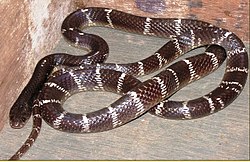
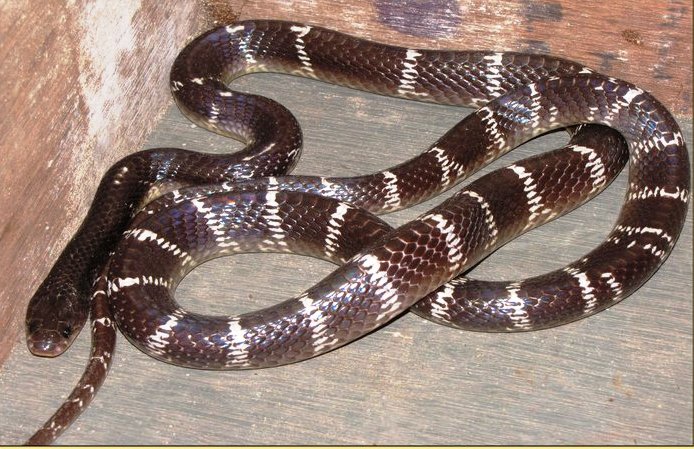
The common krait (Bungarus caeruleus) is a highly venomous snake species belonging to the genus Bungarus in the family Elapidae. Native to South Asia, it is widely distributed across India, Pakistan, Bangladesh, Sri Lanka, and Nepal, inhabiting diverse environments such as grasslands, agricultural fields, and human settlements. The species is nocturnal and is characterized by its black or bluish-black body with narrow white crossbands, typically reaching lengths of 3 to 4 feet (0.9 to 1.2 m). Known for its potent neurotoxic venom, the common krait is one of the "Big Four" snake species responsible for the majority of medically significant snakebites in South Asia.[2]
Description
[edit]
The average length of the common krait is 0.9 m (2 ft 11 in), but it can grow to 1.75 m (5 ft 9 in).[3] Males are longer than females, with proportionately longer tails. The head is flat and the neck is hardly visible. The body is cylindrical, tapering towards the tail. The tail is short and rounded. The eyes are rather small, with rounded pupils, indistinguishable in life. The head shields are normal, with no loreals; four shields occur along the margin of the lower lip; the third and fourth supraoculars touch the eye. The scales are highly polished, in 15–17 rows; the vertebral row is distinctly enlarged and hexagonal. Ventrals number 185–225 and caudals 37–50, and are entirely intact.[4] Their coloration is generally black or bluish-black, with about 40 thin, white crossbars, which may be indistinct or absent anteriorly. Albino specimens can be found, although such cases are extremely rare. The pattern, however, is complete and well-defined in the young, which are marked with conspicuous crossbars even anteriorly; in old individuals, the narrow white lines may be found as a series of connected spots, with a prominent spot on the vertebral region. A white preocular spot may be present; the upper lips and belly are white.[4]
Distribution and habitat
[edit]The common krait is widely distributed across South Asia, including India, Pakistan,[5] Bangladesh,[6] Sri Lanka, Nepal[7][8] and possibly Bhutan. Its range extends westward into Afghanistan and potentially parts of Iran. Within India, it is found throughout the country including the Andaman and Nicobar Islands.[9][1][3]
This snake inhabits a diverse range of environments, including scrub jungles, grasslands, agricultural fields, semi-desert areas, rocky terrains, and suburban gardens. It is frequently found in human-modified landscapes such as plantations and cultivated lands. The common krait often takes refuge in termite mounds, rat burrows, or under debris. It is particularly associated with areas near water sources, such as streams, canals, and ponds.[2][1]
The species demonstrates high adaptability to various habitats and is common in rural areas, where rodent populations are abundant. During the monsoon season, it often enters human dwellings in search of shelter or prey. This adaptability has contributed to their stable population despite localized threats, such as habitat fragmentation and human persecution.[1]
Behaviour and ecology
[edit]

The common krait is a nocturnal snake, most active during the night when it hunts for prey and moves about its environment. During the day, it remains inactive and hides in concealed locations such as rodent burrows, termite mounds, or under debris. This secretive behavior makes it difficult to spot during daylight hours. Despite its potent venom, the common krait is generally non-aggressive and prefers to avoid confrontation. When threatened, it often coils itself tightly with its head tucked underneath as a defensive posture. It may flatten its body or make sudden movements as a warning but rarely bites unless provoked. At night, however, it can become more active and aggressive if disturbed. Records of people sleeping on the ground getting bitten are common.[2] It is debated whether such bites are defensive or predatory.[10]

Diet
[edit]The common krait feeds primarily on other snakes,[11] including venomous snakes like other kraits and vipers.[12] It also feeds on small rodents, lizards, birds and frogs.[13] Cannibalism[14] and scavenging[15] are known in this species. The young are known to prey on arthropods and the blind snakes snakes of the family Typhlopidae.
Reproduction
[edit]The common krait is oviparous. Females lay clutches of 5–15 eggs during late winter or summer months in secluded areas such as leaf litter or burrows. Unlike many snake species, female kraits exhibit parental care by guarding their eggs until they hatch, which is after about 60 days. The hatchlings emerge fully independent and equipped with venom from birth. The males are known to engage in combat displays.[2][10]
Venom
[edit]The common krait possesses one of the most potent venoms (on humans) among Indian snakes, possibly only after that of the Sind Krait.[10] Bites without envenomation, i.e. dry bites are not uncommon. In mice, the LD50 values of its venom are 0.325 mg/kg subcutaneously, 0.169 mg/kg intravenously, and 0.089 mg/kg intraperitoneally.[16][17] The average venom yield is 10 mg (0.15 gr) dry weight.[18] The estimated lethal dose for humans is 2–3 mg (0.031–0.046 gr).[19]
Venom composition
[edit]The venom is dominated by phospholipases A2 (PLA2), constituting approximately 64.5% of its proteome, with presynaptic β-bungarotoxins (similar to β-caerulotoxins) being the primary neurotoxic components.[20] These toxins irreversibly damage motor nerve terminals by depleting synaptic vesicles and disrupting acetylcholine release, leading to neuromuscular blockade.[21][22] Additionally, 15–19% of the venom consists of postsynaptic α-neurotoxins (κ-bungarotoxins), which competitively inhibit nicotinic acetylcholine receptors at neuromuscular junctions. Notably, the venom lacks pro-coagulant or cytotoxic agents, explaining the absence of local tissue damage or swelling at bite sites.
The common krait is nocturnal, and seldom encounters humans during daylight; incidents occur mainly at night. The snake has relatively small fangs and frequently, little or no pain occurs from the bite, which may go unnoticed especially if the victim is sleeping and the minimal pain may provide false reassurance to the victim. Bites also generally present minimal to no local effects, like swelling or bleeding at the site. These characteristics often makes it difficult to locate the bite site in some cases. Typically, victims complain of severe abdominal cramps and shortness of breath accompanied by progressive paralysis. The clinical progression is rapid and death may follow in about 4–8 hours if untreated. Cause of death is general respiratory failure, i.e. suffocation.[23]
The few symptoms of the bite include tightening of the facial muscles in 1–2 hours of the bite and inability of the bite victim to see or talk, and if left untreated, the patient may die from respiratory paralysis within 4–5 hours. A clinical toxicology study reports an untreated mortality rate as high as 70–80%.[3] Resistance against treatment with polyvalent antivenom is likely once paralysis has set in, and hence sometimes immediate administration of antivenoms is suggested regardless of neurotoxic symptom presentation.[24] Neostigmine, an anticholinesterase, which is effective in neutralizing postsynaptic neurotoxins (such as those of cobras) is not useful against the venom of common krait or the Russel's viper, which predominantly consists of presynaptic neurotoxins.[25]
Current antivenoms, while life-saving, require optimization to address biogeographic venom variations and improve neutralization potency across its range.[26][27]
References
[edit]- ^ a b c d Mohapatra, P.; Giri, V.; Suraj, M.; Das, A.; Srinivasulu, C.; Kandambi, D.; Ukuwela, K. (2021). "Bungarus caeruleus". IUCN Red List of Threatened Species. 2021 e.T172702A1369896. doi:10.2305/IUCN.UK.2021-3.RLTS.T172702A1369896.en. Retrieved 15 August 2023.
- ^ a b c d Whitaker, Romulus; Captain, Ashok (2004). Snakes of India: The Field Guide. Chennai, India: Draco Books. ISBN 81-901873-0-9.
- ^ a b c "Clinical Toxinology-Bungarus caeruleus". Archived from the original on 2016-10-16. Retrieved 2011-11-10.
- ^ a b Gopalkrishnakone, P.; Chou, L.M. (1990). Snakes of Medical Importance: Asia-Pacific Region. Singapore: Venom and Toxin Research Group, National University of Singapore. pp. 284–28?. ISBN 9971-62-217-3.
- ^ Ashraf MR, Nadeem A, Smith EN, Javed M, Smart U, Yaqub T, Hashmi AS, Thammachoti P. 2019. Phylogenetic analysis of the Common Krait (Bungarus caeruleus) in Pakistan based on mitochondrial and nuclear protein coding genes. Amphibian & Reptile Conservation 13(2) [General Section]: 203–211 (e205)
- ^ Ahsan, M. F.; Rahman, M. M. (2017-03-26). "Status, distribution and threats of kraits (Squamata: Elapidae: Bungarus) in Bangladesh". Journal of Threatened Taxa. 9 (3). doi:10.11609/jott.2929.9.3.9903-9910. ISSN 0974-7907. Archived from the original on 2025-02-07.
- ^ Chhetry, Damodar Thapa (2010-11-15). "Diversity of Herpetofauna in and around the Koshi Tappu Wildlife Reserve". Bibechana. 6: 15–17. doi:10.3126/bibechana.v6i0.3933. ISSN 2382-5340.
- ^ Chettri, Krishna; Chhetry, Damodar Thapa (2013). "Diversity of Snakes in Sarlahi District, Nepal". Our Nature. 11 (2): 201–207. doi:10.3126/on.v11i2.9600. ISSN 2091-2781.
- ^ Bungarus&species=caeruleus 'Bungarus caeruleus' at the Reptarium.cz Reptile Database
- ^ a b c Martin, Gerry. "The Dark Knight: Enigma of the Common Krait | Roundglass | Sustain | Roundglass | Sustain". roundglasssustain.com. Retrieved 2025-04-13.
- ^ Kulkarni, Pranav; Gurav, Yogesh (2022-03-14). "Feeding behavior and prey of Common Kraits, Bungarus caeruleus (Schneider 1801), from Western Maharashtra, India". Reptiles & Amphibians. 29 (1): 250–251. doi:10.17161/randa.v29i1.16591. ISSN 2332-4961.
- ^ Patel, Ravikumar (2024-02-20). "A Common Krait (Bungarus caeruleus) feeding on a Saw-scaled Viper (Echis carinatus)". Reptiles & Amphibians. 31 (1) e18950. doi:10.17161/randa.v31i1.18950. ISSN 2332-4961.
- ^ Pandey, Deb P.; Bhattarai, Pranish; Piya, Ram C. (2020-02-06). "Food Spectrum of Common Kraits (Bungarus caeruleus): An Implication for Snakebite Prevention and Snake Conservation". Journal of Herpetology. 54 (1): 87. doi:10.1670/18-054. ISSN 0022-1511.
- ^ Yadav, Vikas; Shinde, Anuj (2021-01-31). "A Case of Cannibalism in Common Krait Bungarus caeruleus (Schneider, 1801) (Reptilia: Serpentes: Elapidae)". Journal of the Bombay Natural History Society. doi:10.17087/jbnhs/2021/v118/154209. ISSN 2454-1095.
- ^ Mohalik, Rakesh & Kar, Niladri Bhusan. (2019). BUNGARUS CAERULEUS (Common Krait). COLORATION and DIET. Herpetological Review. 50. 150-151.
- ^ "LD50". Archived from the original on 2012-02-01.
- ^ "LD50 menu". Archived from the original on 2012-04-13.
- ^ Engelmann, W.-E. (1981). Snakes: Biology, Behavior, and Relationship to Man. Leipzig; English version NY, USA: Leipzig Publishing; English version published by Exeter Books (1982). p. 51. ISBN 0-89673-110-3.
- ^ Ceylon Medical Journal. Ceylon Medical Association. 1983.
- ^ Oh, Angeline Mei Feng; Tan, Choo Hock; Ariaranee, Gnanathasan Christeine; Quraishi, Naeem; Tan, Nget Hong (2017-07-05). "Venomics of Bungarus caeruleus (Indian krait): Comparable venom profiles, variable immunoreactivities among specimens from Sri Lanka, India and Pakistan". Journal of Proteomics. 164: 1–18. doi:10.1016/j.jprot.2017.04.018. ISSN 1876-7737. PMID 28476572.
- ^ Singh, G.; Pannu, H. S.; Chawla, P. S.; Malhotra, S. (December 1999). "Neuromuscular transmission failure due to common krait (Bungarus caeruleus) envenomation". Muscle & Nerve. 22 (12): 1637–1643. doi:10.1002/(sici)1097-4598(199912)22:12<1637::aid-mus4>3.0.co;2-a. ISSN 0148-639X. PMID 10567075.
- ^ Silva, Anjana; Maduwage, Kalana; Sedgwick, Michael; Pilapitiya, Senaka; Weerawansa, Prasanna; Dahanayaka, Niroshana J.; Buckley, Nicholas A.; Johnston, Christopher; Siribaddana, Sisira; Isbister, Geoffrey K. (February 2016). "Neuromuscular Effects of Common Krait (Bungarus caeruleus) Envenoming in Sri Lanka". PLOS Neglected Tropical Diseases. 10 (2) e0004368. doi:10.1371/journal.pntd.0004368. ISSN 1935-2735. PMC 4734751. PMID 26829229.
- ^ "Medical Management for bites by Kraits (Bungarus species)". Archived from the original on 2012-04-02.
- ^ Blessmann, Joerg; Kreuels, Benno (April 2024). "Urgent administration of antivenom following proven krait bites in Southeast Asia irrespective of neurotoxic symptoms". PLOS Neglected Tropical Diseases. 18 (4) e0012079. doi:10.1371/journal.pntd.0012079. ISSN 1935-2735. PMC 11008851. PMID 38603643.
- ^ Anil, A.; Singh, Surjit; Bhalla, Ashish; Sharma, Navneet; Agarwal, Ritesh; Simpson, Ian D. (2010-01-01). "Role of neostigmine and polyvalent antivenom in Indian common krait (Bungarus caeruleus) bite". Journal of Infection and Public Health. 3 (2): 83–87. doi:10.1016/j.jiph.2010.01.002. ISSN 1876-0341. PMID 20701896.
- ^ Rashmi, U.; Bhatia, Siddharth; Nayak, Muralidhar; Khochare, Suyog; Sunagar, Kartik (2024-11-07). "Elusive elapids: biogeographic venom variation in Indian kraits and its repercussion on snakebite therapy". Frontiers in Pharmacology. 15. doi:10.3389/fphar.2024.1443073. ISSN 1663-9812. PMC 11579489. PMID 39575383.
- ^ Theakston, R. D. G.; Phillips, R. E.; Warrell, D. A.; Galagedera, Yamuna; Abeysekera, D. T. D. J.; Dissanayaka, P.; de Silva, Anslem; Aloysius, D. J. (1990-03-01). "Envenoming by the common krait (Bungarus caeruleus) and Sri Lankan cobra (Naja naja naja): efficacy and complications of therapy with Haffkine antivenom". Transactions of the Royal Society of Tropical Medicine and Hygiene. 84 (2): 301–308. doi:10.1016/0035-9203(90)90297-R. ISSN 0035-9203. PMID 2389328.
Further reading
[edit]- Whitaker, R. (1978). Common Indian Snakes: A Field Guide. Macmillan India Limited.
External links
[edit]- "Krait bites and their management" – Bungarus caeruleus and Bungarus ceylonicus (PDF)
Common krait
View on GrokipediaTaxonomy
Classification
The common krait, Bungarus caeruleus, is classified within the kingdom Animalia, phylum Chordata, class Reptilia, order Squamata, suborder Serpentes, family Elapidae, genus Bungarus, and species B. caeruleus.http://reptile-database.reptarium.cz/Bungarus/caeruleus[3] This placement situates it among the venomous elapid snakes, characterized by front-fanged venom delivery systems, a trait shared with cobras and mambas in the family Elapidae.https://www.iucnredlist.org/species/pdf/1369896 The species was first described as Pseudoboa caerulea by Johann Gottlob Theodor Schneider in 1801, based on specimens collected in India.http://reptile-database.reptarium.cz/Bungarus/caeruleus[4] Subsequent synonyms include Boa lineata (Shaw, 1802), Boa latotecta (Hermann, 1804), and Bungarus arcuatus (Duméril & Bibron, 1854), reflecting early taxonomic revisions as the genus Bungarus was formalized by François Marie Daudin in 1803.http://reptile-database.reptarium.cz/Bungarus/caeruleus[4] It has been recognized as a distinct species in modern herpetology since George Albert Boulenger's comprehensive catalog in 1890, with ongoing refinements in works like Wallach et al. (2014).[5] Phylogenetically, B. caeruleus belongs to the genus Bungarus, which comprises about 17 species of nocturnal, banded venomous snakes distributed across South and Southeast Asia, forming a monophyletic group within Elapidae.https://zse.pensoft.net/article/116601/element/7/0/Bungarus/ It shares close evolutionary ties with congeners such as the banded krait (B. fasciatus) and the many-banded krait (B. multicinctus), based on mitochondrial DNA analyses. Recent molecular studies have revealed that B. caeruleus is polyphyletic, with significant genetic divergence among populations, suggesting the presence of cryptic species.[6][7] These relationships highlight B. caeruleus as a basal member of the South Asian krait clade, distinct from Southeast Asian lineages.[7]Nomenclature
The binomial name of the common krait is Bungarus caeruleus (Schneider, 1801). The genus Bungarus originates as a Latinized form of the Telugu term baṅgāru, meaning "gold," which may reference the yellowish bands present in certain krait species.[8] The specific epithet caeruleus derives from Latin, translating to "dark blue" or "sky-blue," in allusion to the snake's predominant bluish-black body coloration. Common names for the species include the common krait, Indian krait, and blue krait in English. Regionally, it is known as karait in Hindi, a name stemming from the Hindi word karait that likely traces back to the Sanskrit kāla, signifying "black" and descriptive of its dark hue. In Marathi, it is called manyar.[9] The species received its initial scientific description from Johann Gottlob Schneider in 1801 as Pseudoboa caerulea, drawing from specimens and accounts collected by Patrick Russell in southern India. Later taxonomic revisions placed it within the genus Bungarus, formalized by François Marie Daudin in 1803, reflecting its banded elapid characteristics.[1]Physical characteristics
Morphology
The common krait (Bungarus caeruleus) is a slender elapid snake with a total body length averaging 0.9–1.75 m, though males typically attain the maximum length of 1.75 m.[10] The tail constitutes 22–26% of the total length in both sexes. Its head is small and rounded, indistinct from the neck, while the eyes feature black pupils and minimal eyelid development. The body is covered in smooth, polished dorsal scales arranged in 15 rows at midbody, with 207–218 ventral scales and a divided anal plate.[6] Sexual dimorphism manifests primarily in the tail, where males possess relatively longer tails and a higher count of undivided subcaudal scales (40–54) compared to females (30–54).[6]Coloration and variation
The common krait (Bungarus caeruleus) displays a characteristic dorsal coloration of bluish-black to black, marked by 40–50 narrow white or yellowish crossbands that are typically narrower than the black interspaces separating them. These crossbands often begin indistinctly or are absent near the head and become more prominent posteriorly, contributing to the snake's striped appearance.[11][12] The ventral surface is white or pale, with black bands that extend from the dorsal pattern across the sides; these ventral bands may fuse or form paired markings toward the tail, where they can appear as dark triangular patches along the subcaudals.[13] In adult specimens, the crossbands frequently fade, transitioning from distinct stripes in juveniles to a series of connected spots or a prominent vertebral row of markings, enhancing the overall uniform dark appearance.[11] Rare color variations include albinism, where individuals exhibit yellow-white bands on a pinkish or pale background due to the absence of melanin, with such forms documented sporadically across the species' range. Other aberrations, such as leucism or hypomelanism, result in reduced pigmentation but retain normal eye color.[14][15] Sexual differences in coloration are minimal, with both males and females sharing the typical banded pattern and no notable disparities in hue or marking intensity.Distribution and habitat
Geographic range
The common krait (Bungarus caeruleus) is native to the Indian subcontinent, where it occurs across much of India (including most states except the far northeast, where records require validation), Pakistan (particularly in Punjab, Sind, Baluchistan, and Azad Kashmir), Bangladesh, Nepal, Bhutan, and Sri Lanka (including the Andaman and Nicobar Islands).[1][16][17] It is also present in Afghanistan.[16] The species' extent of occurrence is estimated at approximately 3,940,000 km², reflecting its broad but regionally patchy distribution.[1] This snake inhabits elevations from sea level to 1,700 meters, primarily in lowland and foothill regions, but it is absent from the higher altitudes of the Himalayas.[18] Within its range, populations appear stable, with no documented historical expansions, contractions, or introduced populations outside the native area.[1] Recent surveys have confirmed its presence in core areas like western Pakistan and southern India, but no significant range extensions have been reported since the 2021 IUCN assessment.[1]Habitat preferences
The common krait (Bungarus caeruleus) primarily inhabits subtropical and tropical dry forests, shrublands, grasslands, semi-desert regions, and rocky areas, favoring open and semi-arid landscapes over dense forests.[18] It shows a strong preference for microhabitats such as termite mounds, rodent burrows, loose soil, piles of debris, and sandy patches within these environments, often seeking shelter in these concealed spots during the day.[18] Proximity to water sources, including canals and natural waterbodies, is also common, supporting its nocturnal foraging activities. This species exhibits notable adaptations to human-modified habitats, thriving in agricultural farmlands, plantations, suburban gardens, and rural settlements where rodent populations are abundant. It frequently enters human dwellings and structures for shelter, particularly in areas like mud huts and homes in India, Pakistan, Bangladesh, and Sri Lanka, which increases encounters with people. These preferences align with its distribution across tropical and subtropical climates, from sea level to elevations up to 1,700 meters, where it tolerates dry conditions typical of warmer months.[18]Behavior and ecology
Activity patterns
The common krait (Bungarus caeruleus) exhibits a predominantly nocturnal lifestyle, emerging at night to forage while remaining largely inactive during daylight hours.[19] It spends the day in seclusion, often appearing sluggish and docile if encountered, which reduces daytime interactions.[20] As a terrestrial species, the common krait moves slowly via lateral undulation or concertina locomotion on the ground and rarely climbs, though it can employ specialized concertina techniques to scale low obstacles when necessary.[21] Activity levels show seasonal variation, with peaks during the monsoon (July–August) due to increased prey availability and favorable humidity, correlating positively with rainfall (r=0.72, p<0.001), while encounters decline in cooler, drier months (October–January).[22] The species is notably non-aggressive and shy, rarely biting unless provoked by direct handling or accidental trampling, at which point it may flatten its body in warning before striking.[20] Bites typically occur at night when the snake enters human dwellings in search of shelter or prey, often leading to painless envenomations on sleeping individuals on the floor.[19] A 2023 study (published online December 2023) highlighted rising urban incursions in areas like Delhi, with clustered sightings in residential zones and gardens linked to habitat fragmentation and synanthropization; trends continued during the 2025 monsoon with multiple rescues reported.[22][23]Diet
The common krait (Bungarus caeruleus) is primarily ophiophagous, feeding predominantly on other snakes, which can constitute a significant portion of its diet, including venomous species such as cobras due to its physiological resistance to α-neurotoxins common in elapid venoms.[24][25] Secondary prey includes small mammals like rodents, as well as lizards, birds, and frogs, with studies documenting these items in stomach contents of wild specimens.[26][24] This dietary preference underscores the krait's role as an apex predator within snake communities, often engaging in cannibalism or consuming non-venomous snakes like the common sandboa (Eryx conicus).[26] Juveniles exhibit a more generalized diet, preying on smaller invertebrates such as arthropods, including insects and centipedes, before transitioning to vertebrate prey as they grow.[16] A 2022 observational study from western Maharashtra confirmed the dominance of ophiophagy in adult feeding behavior, with documented instances of kraits actively seizing and consuming snakes.[26] Hunting occurs primarily through nocturnal ambushes, where the krait relies on stealth to approach prey in low-light conditions, striking with envenomation to immobilize it rapidly via neurotoxic effects.[26] For smaller or struggling prey, kraits may employ constriction to subdue it before swallowing whole, often holding the neck or body to prevent escape while venom takes effect.[26] Ecologically, this feeding strategy helps control populations of rodents and other snakes in agricultural farmlands and human-adjacent habitats, reducing pest pressures on crops.[24][27]Reproduction
The common krait (Bungarus caeruleus) is oviparous, with females laying eggs during the monsoon season. Reproductive timing varies regionally; in South India, mating occurs in December with oviposition in February, while in northern areas, mating takes place in early summer (April–June) followed by egg-laying in late spring to early monsoon (April–July). Males may engage in combat-like rituals when approached by rivals, involving tail twitching, head jerks, and defensive posturing to protect the copulating pair.[28][29][30] Typical clutch sizes range from 6 to 12 eggs, though up to 12–15 eggs have been documented in rare cases of communal oviposition in India; eggs are laid in humid burrow sites or protected areas under leaf litter.[31][1] The female guards the eggs throughout the incubation period, which lasts approximately 50 to 65 days, after which the eggs hatch.[28][32] Hatchlings emerge independent, measuring 15 to 20 cm in length at birth, and receive no further parental care.[28] Sexual maturity is reached at a snout–vent length of approximately 890 mm or more; in one study of killed specimens, about 35% were sexually mature. Specific age data are limited; in captivity, individuals may live up to 17.4 years.[33][3]Venom and envenomation
Composition
The venom of the common krait (Bungarus caeruleus) is predominantly neurotoxic, with phospholipases A₂ (PLA₂) forming the major component at approximately 64.5% of total proteins.[34] This fraction includes β-bungarotoxins, presynaptic neurotoxins whose A-chains account for about 4.6% of the venom proteome.[34] Postsynaptic neurotoxins, such as α-bungarotoxins, belong to the three-finger toxin family and comprise around 19% of the venom, including 15.6% κ-neurotoxins.[34] Minor components include hyaluronidase, an enzyme that facilitates venom spread by degrading extracellular matrix. The average venom yield from a bite is approximately 9 mg of dry weight (range: 0.1–32 mg).[35] Its potency is evidenced by an LD₅₀ of 0.045–0.251 mg/kg (intravenous in mice), with variation across geographic populations.[36] Regional variations in venom composition have been documented, particularly in PLA₂ isoforms. A 2024 study found differences between Indian and Sri Lankan populations, with PLA₂ abundance ranging from 45% to 62% across Indian regions and higher enzymatic activity in eastern and some southern samples compared to Sri Lankan profiles.[36] The prevalence of neurotoxins in B. caeruleus venom represents an evolutionary adaptation in elapid snakes, enabling rapid paralysis of prey through disruption of neuromuscular transmission.Clinical effects
The bite of the common krait (Bungarus caeruleus) is typically painless and often goes unnoticed, particularly as it frequently occurs at night while victims are sleeping, with minimal or no local swelling or inflammation at the site.[19][37] Local symptoms, when present, are mild and affect only about 9% of cases.[37] Systemic envenomation symptoms usually begin within 30 minutes to 2 hours after the bite, though progression can vary, with severe effects manifesting up to 7 hours post-bite in some instances.[38] Initial signs include ptosis (drooping eyelids), which occurs in nearly all severe cases, followed by abdominal pain in up to 91% of victims, often described as severe and colicky.[38][37] This is rapidly followed by descending paralysis, starting with ophthalmoplegia, facial and bulbar weakness, and progressing to limb and neck muscle involvement, ultimately leading to respiratory failure in 50–64% of untreated or severe cases due to diaphragmatic and intercostal paralysis.[38][37][19] Without treatment, the condition advances to profound neuromuscular blockade and coma, with death resulting from respiratory arrest within 4–8 hours in 70–80% of cases.[2] The estimated lethal dose for an adult human is 2–3 mg of venom, though children are more vulnerable due to their smaller body mass, requiring proportionally less venom to cause fatal outcomes.[2] Envenomation by the common krait shows high incidence in India, where snakebites overall cause an estimated 58,000 deaths annually (average 2000–2019), with the common krait accounting for a substantial portion as one of the "Big Four" venomous species responsible for about 90% of cases.[39] Recent case studies from 2024 highlight instances of delayed neurotoxicity, including ptosis and diplopia appearing up to 36 hours post-bite, underscoring the variable progression and potential for late-onset paralysis even after initial stabilization.[40]Treatment
Upon suspicion of a common krait (Bungarus caeruleus) bite, immediate first aid involves immobilizing the bitten limb with a splint or sling to minimize venom spread, while avoiding the use of tourniquets, incisions, or suction, as these can exacerbate tissue damage or delay effective treatment.[41] The patient should be transported rapidly to a medical facility without unnecessary delays for unproven remedies.[41] The primary specific treatment is intravenous administration of polyvalent antivenom effective against Indian elapids, including B. caeruleus, with an initial dose of 10–20 vials diluted in fluid and infused slowly over 30–60 minutes to reduce the risk of adverse reactions.[41][42] Additional vials (5–10) may be given every 6 hours if neurotoxic symptoms persist, guided by clinical response rather than fixed schedules.[41] No monovalent antivenom specific to the common krait is commercially available, relying instead on this polyvalent formulation.[43] Supportive care is critical due to the neurotoxic effects, particularly respiratory paralysis, and includes close monitoring of vital signs and neuromuscular function in an intensive care setting.[41] Mechanical ventilation via endotracheal intubation or bag-mask should be initiated if oxygen saturation drops below 90% or signs of diaphragmatic weakness appear, often requiring prolonged support until recovery.[41] Patients should be observed for 24–48 hours after apparent recovery to detect delayed complications, with adjunctive trials of neostigmine (0.02 mg/kg intramuscularly, with atropine) considered for potential postsynaptic blockade, though its efficacy against presynaptic krait toxins is limited.[41][44] Challenges in treatment include variable antivenom efficacy stemming from biogeographic differences in venom composition, which can lead to incomplete neutralization in some populations, as noted in a 2024 study on Indian krait venoms.[43] A pilot study from the same year suggested that a low initial dose of 10 vials may suffice for severe neuroparalysis in certain cases but highlighted the need for tailored dosing to address these inconsistencies.[45] Prevention in endemic regions focuses on community education about recognizing kraits and safe practices, such as sleeping under well-tucked mosquito nets or on raised beds to deter nocturnal entry into homes.[41][46] Additional measures include using protective footwear in rural areas and improving household lighting to reduce encounters.[47]Conservation
Status
The common krait (Bungarus caeruleus) is classified as Least Concern on the IUCN Red List, as assessed in 2010, based on its extensive distribution across South Asia, including India, Pakistan, Bangladesh, Nepal, and Sri Lanka, as well as its adaptability to diverse habitats from forests to agricultural areas.[1] This status reflects the species' resilience despite localized pressures, with no evidence of significant range-wide declines.[1] The population trend for the common krait is unknown, with no comprehensive quantitative estimates available due to the challenges of surveying this nocturnal and cryptic species.[1] The snake remains commonly observed in rural and semi-urban environments throughout its core range in India and Pakistan, where it frequently interacts with human settlements.[1] Monitoring efforts are limited, relying primarily on opportunistic records and regional herpetological surveys.[16] In terms of legal protection, the common krait is included under Schedule II, Part C, of India's Wildlife (Protection) Amendment Act, 2022, which prohibits hunting and regulates trade to conserve the species.[48] It is not globally listed under the CITES Appendices, though regional implementations may provide additional safeguards in countries like India through national legislation.Threats
Habitat alteration represents a primary threat to common krait populations, driven largely by agricultural expansion and urbanization. These activities fragment grasslands and rural landscapes, converting natural habitats into croplands and built-up areas, which restricts the snake's access to suitable foraging and shelter sites. In regions like Bangladesh and India, infrastructure development exacerbates this fragmentation, leading to isolated populations vulnerable to local extirpation.[49] Additionally, intensive pesticide application in agricultural zones indirectly impacts kraits by reducing prey abundance; as ophiophagous predators, common kraits rely on small snakes and lizards whose own food sources—such as rodents and insects—are diminished by chemical contaminants in the ecosystem. Human persecution further endangers the species, with individuals frequently killed out of fear of their potent venom, especially in rural communities where nocturnal encounters occur during farming or residential activities. This fear-driven retaliation contributes to direct mortality, compounded by road kills as expanding road networks in rural areas increase vehicle-snake collisions during the snake's active nighttime hours. No major disease threats have been documented for common kraits, though localized outbreaks could pose risks in altered environments.[49] Climate change introduces additional environmental pressures, with projected shifts in monsoon patterns potentially disrupting breeding cycles tied to seasonal rainfall and temperature fluctuations. Modeling indicates over 50% decline in suitable habitat by 2080 under moderate emissions scenarios, with ranges shifting northward and northeastward into new agricultural zones, heightening human-snake conflicts.[50] Antivenom shortages, as highlighted in 2024 reports, elevate bite mortality rates and pose indirect threats by increasing human-snake conflict risks.[51]References
- https://en.wiktionary.org/wiki/krait