


Community hub
Recent from talks
Contribute something
Nothing was collected or created yet.
Bungarus
View on Wikipedia
| Bungarus | |
|---|---|
_by_David_V_Raju.jpg)
| |
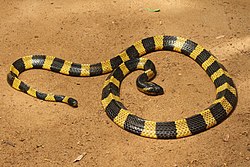
| Bungarus fasciatus (banded krait), the largest species of krait | |
Scientific classification 
| |
| Kingdom: | Animalia |
| Phylum: | Chordata |
| Class: | Reptilia |
| Order: | Squamata |
| Suborder: | Serpentes |
| Family: | Elapidae |
| Genus: | Bungarus Daudin, 1803 |
| Type species | |
| Bungarus annularis Daudin, 1803[1]
| |
| Synonyms[1] | |
Bungarus (commonly known as kraits /kraɪt/)[2][3] is a genus of venomous snakes in the family Elapidae. The genus is native to Asia. Often found on the floor of tropical forests in South Asia, Southeast Asia and Southern China, they are medium-sized, highly venomous snakes with a total length (including tail) typically not exceeding 2 metres (6 ft 7 in). These are nocturnal ophiophagious predators which prey primarily on other snakes at night, occasionally taking lizards, amphibians and rodents. Most species are with banded patterns acting as a warning sign to their predators. Despite being considered as generally docile and timid, kraits are capable of delivering highly potent neurotoxic venom which is medically significant with potential lethality to humans. The genus currently holds 18 species and 5 subspecies.
Distribution
[edit]Kraits are found in tropical and subtropical South and Southeast Asia and Indochina, ranging in the west from Iran, east through the Indian subcontinent (including Bangladesh, Nepal, Pakistan, and Sri Lanka) and into Southeast Asia (including the island of Borneo, Brunei, Cambodia, Indonesia, Laos, Malaysia, Myanmar, Thailand and Vietnam).[4]
Description
[edit]Kraits usually range between 1.0 and 1.5 m (3 ft 3 in and 4 ft 11 in) in total length (including tail), although specimens as large as 2.0 m (6 ft 7 in) have been observed. The banded krait (B. fasciatus) may grow as large as 2.125 m (6 ft 11.7 in).[5] Most species of kraits are covered in smooth, glossy scales arranged in bold, striped patterns of alternating black and light-colored areas. This may serve as aposematic colouration in its habitat of grassland and scrub jungle. The scales along the dorsal ridge of the back are hexagonal. The head is slender, and the eyes have round pupils. Kraits have pronounced dorsolateral flattening, which causes them to be triangular in cross section.
Ecology
[edit]Kraits are nocturnal and ophiophagous, preying chiefly upon other snakes including those of their kinds, although occasional hunt for small rodents and lizards has been observed.[6] They are seldom encountered during daytime while becoming highly alert at night. If disturbed, they usually flee; failing this they tend to coil up with the head underneath the body for protection. Though most kraits are docile and timid, some species thrash fiercely when caught for relocation. Repeated provocation may result in bites which are the last resort of the snakes.[7] Kraits are oviparous, releasing a clutch of 12 to 14 eggs in piles of leaf litter. The female usually stays with them until they hatch.
Venom
[edit]Bungarus contains some species that are among the most venomous land snakes in the world, to mice, based on their LD50.[8][verification needed] They have a highly potent, neurotoxic venom, which can induce muscle paralysis. Clinically, their venom contains mostly presynaptic neurotoxins, which affect the ability of neuron endings to properly release a chemical communication mechanism to the next neuron. Following envenomation with bungarotoxins, transmitter release is initially blocked (leading to a brief paralysis), followed by a period of massive overexcitation (cramps, tremors, spasms), which finally tapers off to paralysis.
These phases of envenomation may or may not be experienced in all parts of the body; they may or may not be experienced simultaneously. The severity of the bite itself and the actual dosage of venom delivered plays a role in the intensity of symptoms. As kraits are mainly nocturnal, encounters with humans are rare during the daytime. Bites mainly occur after sunset, and are often (initially) painless; thus, a bite may go unnoticed if the victim is sleeping or otherwise does not see or notice the krait, further prolonging envenomation damage within the body. Still—whenever possible—medical treatment should be sought posthaste, as a bite from a krait is considered potentially life-threatening. All venomous snake bites must be taken seriously as an immediate medical emergency.
Typically, victims will start to notice severe abdominal cramps accompanied by progressive muscular paralysis, and frequently starting with ptosis. As no local symptoms are usually seen, a patient should be carefully observed for tell-tale signs of paralysis (e.g. the onset of bilateral ptosis, diplopia, and dysphagia), and subsequently treated (as quickly as possible) with antivenom. Frequently, little or no pain occurs at the site of a krait bite, which can provide false reassurance to the victim. The major medical difficulty of envenomated patients is the lack of medical resources (especially intubation supplies and mechanical ventilators in rural hospitals) and potential for ineffectiveness by the antivenom.
Upon arriving at a healthcare facility, support must be provided until the venom has metabolised and the victim can breathe unaided, especially if no species–specific antivenom is available. Given that the toxins alter acetylcholine transmission—which causes the paralysis—some patients have been successfully treated with cholinesterase inhibitors, such as physostigmine or neostigmine, but success is variable and may be species-dependent, as well. If death occurs, it typically takes place about 6–12 hours after the krait bite, but can be significantly delayed. The usual cause of death in that situation is respiratory failure—suffocation by complete paralysis of the diaphragm. Even if patients make it to a hospital, subsequently entering a permanent coma (and even brain death from hypoxia) may occur, given the potential for long transport times to get medical care, in some regions.
Mortality rates caused by bites from the members of this genus vary by species; according to University of Adelaide Department of Toxicology, bites from the banded krait have a mortality rate of 1–10% in untreated humans,[9] while that of the common krait is 70–80%.[10] In common with those of all other venomous snakes, the death time and fatality rate resulting from bites of kraits depend on numerous factors, such as the venom yield and the health status of the victim.
Polyvalent elapid antivenom is effective in neutralizing of the venoms of B. candidus and B. flaviceps, and rather effective for B. fasciatus, and the monovalent B. fasciatus antivenom is also moderately effective.[11]
Species
[edit]


_is_a_species_of_venomous_snake_endemic_to_the_island_Sri_Lanka.jpg)
.jpg)


*) Not including the nominate subspecies (typical form).
T) Type species
Nota bene: A binomial authority in parentheses indicates that the species was originally described in a genus other than Bungarus.
See also
[edit]References
[edit]- ^ a b "Bungarus". RepFocus - A Survey of the Reptiles of the World. Rune Midtgaard. Retrieved 21 July 2021.
- ^ "krait, n." Oxford English Dictionary Online. Oxford University Press (accessed June 30, 2014).
- ^ "krait". American Heritage Dictionary. Accessed June 30, 2014.
- ^ "Genus Bungarus - taxonomy & distribution / RepFocus". repfocus.dk. Retrieved 2025-09-04.
- ^ Smith, Malcolm A. (1943). The Fauna of British India, Ceylon and Burma, Including the Whole of the Indo-Chinese Sub-region. Reptilia and Amphibia. Vol. III.—Serpentes. London: Secretary of State for India. (Taylor and Francis, printers). xii + 583 pp. (Bungarus, genus and species, pp. 407-418).
- ^ Richard Mastenbroek's Elapid Pages: Kraits (Bungarus ssp.)
- ^ "Living in Indonesia:Banded Krait". Archived from the original on 2006-05-08. Retrieved 2006-06-01.
- ^ Whitaker, Romulus; Captain, Ashok (2004). Snakes of India, The Field Guide. Chennai: Draco Books. p. 495. ISBN 81-901873-0-9.
- ^ "Bungarus fasciatus ". WCH Clinical Toxinology Resources.
- ^ "Bungarus caeruleus ". WCH Clinical Toxinology Resources. Archived from the original on 2016-10-16. Retrieved 2011-11-10.
- ^ Nget Hong Tan. "Antivenoms against Malaysian poisonous snakes". University of Malaya. Archived from the original on 2009-02-28. Retrieved 2009-09-23.
- ^ Kuch, Ulrich; Kizirian, David; Nguyen, Quang Truong; Lawson, Robin; Donnelly, Maureen A.; Mebs, Dietrich (2005). "A new species of krait (Squamata: Elapidae) from the Red River System of Northern Vietnam". Copeia 2005 (4): 818-833. (Bungarus slowinskii, new species).
Further reading
[edit]- Boulenger GA (1896). Catalogue of the Snakes in the British Museum (Natural History). Volume III., Containing the Colubridæ (Opisthoglyphæ and Proteroglyphæ) ... London: Trustees of the British Museum (Natural History). (Taylor and Francis, printers). xiv + 727 pp. + Plates I-XXV. (Genus Bungarus, pp. 365-366, Figure 26, three views of skull).
- Daudin FM (1803). Histoire Naturelle, Génerale et Particulière des Reptiles; Ouvrage faisant suite aux Œuvres de Leclerc de Buffon, et partie de Cours complete d'Histoire naturelle rédigé par C.S. Sonnini, membre de plusieurs Sociétés savantes. Tome cinquième [Volume 5]. Paris: F. Dufart. 365 pp. (Bungarus, new genus, p. 263). (in French).
External links
[edit]- Genus Bungarus at The Reptile Database
- "Bungarus". Integrated Taxonomic Information System. Retrieved 6 May 2006.
- Detailed account of Joe Slowinski's death via krait bite Archived 2020-05-27 at the Wayback Machine
Bungarus
View on GrokipediaTaxonomy
Etymology and Discovery
The genus name Bungarus is derived from the Telugu word baṅgāru, meaning "golden," in reference to the distinctive yellow or golden bands on the body of the type species.[2] The genus was first established by French naturalist François Marie Daudin in his 1803 work Histoire Naturelle, Générale et Particulière des Reptiles, where he described it within the family of venomous snakes.[8] Daudin designated Bungarus annularis as the type species, based on earlier descriptions of banded elapids from Asia; this name is now considered a synonym of Bungarus fasciatus (Schneider, 1801).[2] Early taxonomic efforts were marked by confusion with other elapids, such as misidentifications under genera like Aspidoclonion (e.g., Aspidoclonion annulare Wagler, 1830), due to similarities in banded patterns among Asian venomous snakes.[2] In 1839, Danish physician and zoologist Theodore Edward Cantor significantly expanded knowledge of Asian Bungarus species through his Spicilegium Serpentium Indicorum, describing several new taxa including Bungarus bungaroides and Bungarus lividus from regions like India and the Malay Peninsula.[9] Cantor's work helped clarify distributions and morphological variations, building on Daudin's foundation amid ongoing debates over elapid classifications. Later, in 1847, Cantor further refined nomenclature by synonymizing names like Bungarus fasciatus.[2] Major taxonomic advancements continued into the 20th century, with British herpetologist Frank Wall providing a comprehensive overview in his 1913 monograph The Poisonous Terrestrial Snakes of Our British Indian Dominions (Including Ceylon), and How to Recognize Them; With Symptoms of Snake Poisoning and Treatment, which synthesized descriptions and distributions of Bungarus species across South Asia.[10] Wall's contributions, including earlier papers from 1908, addressed lingering ambiguities in species identification and regional variations up to that era.[2]Classification and Phylogeny
Bungarus is classified within the family Elapidae, specifically in the subfamily Elapinae, which encompasses terrestrial venomous snakes primarily distributed across Africa, Asia, and Australia.[11] Within Elapidae, Bungarus forms part of the Asian elapid radiation, exhibiting close phylogenetic relationships with other Old World genera such as Naja (cobras) and Ophiophagus (king cobras), based on shared morphological and molecular traits that distinguish them from African and Australasian lineages.[12] This placement positions Bungarus as a derived member of Elapinae rather than basal, with molecular evidence supporting an Asian colonization event from an Australo-Papuan origin of the family around 25-30 million years ago.[13] Phylogenetic analyses utilizing mitochondrial genes, including 16S rRNA, cytochrome b (cyt b), and COI, alongside nuclear markers, have reconstructed the evolutionary history of Bungarus, revealing a monophyletic genus that diversified during the Miocene epoch approximately 15-20 million years ago.[14] These studies indicate that the genus arose through vicariance and dispersal across Southeast Asia, with clades corresponding to geographic barriers like the Indo-Burman ranges and island archipelagos.[15] The Miocene diversification aligns with paleoclimatic shifts that facilitated habitat fragmentation and adaptive radiation among elapids, as evidenced by fossil-calibrated timetrees showing accelerated speciation rates in Asian lineages during this period.[13] Key synapomorphies defining Bungarus include proteroglyphous dentition with fixed front fangs for venom delivery, an undivided anal plate, and consistent dorsal scale arrangements typically comprising 15 rows at midbody with hexagonal or sub-hexagonal shapes.[16] These morphological features, analyzed in parsimony-based phylogenies, support the genus's monophyly and distinguish it from congeners in Calliophis or Sinomicrurus.[17] Debates persist regarding the monophyly of certain species complexes, with molecular data prompting revisions such as the elevation of former subspecies (e.g., populations previously under Bungarus caeruleus) to full species status based on genetic divergence exceeding 5% in mitochondrial loci.[18]Description
Morphology
Bungarus species possess an elongated, cylindrical body covered in smooth, glossy, imbricate scales that contribute to their streamlined form. Adults typically measure 1 to 2 meters in total length, though some species, such as B. fasciatus, can attain a maximum of up to 2.7 meters.[19] The head is only slightly distinct from the neck and broader than the body, with a rounded snout; it features fixed anterior maxillary teeth followed by a diastema and short, proteroglyphous fangs grooved for venom delivery, characteristic of elapid snakes.[20] Dorsal scales are arranged in 15–17 rows at midbody, with the vertebral row enlarged, hexagonal, and broadest; there are usually 7 supralabials (the third and fourth contacting the eye), and subcaudals are divided throughout. Ventrals number 200–250, depending on the species.[20][1] Sensory structures include paired nasal openings separated by a small nasorostral scale, but loreal pits and heat-sensing pits are absent, relying instead on visual and chemosensory cues via the tongue and Jacobson's organ.[20] Sexual dimorphism is present, with males typically longer overall and exhibiting relatively longer tails than females, often reflected in higher subcaudal counts (e.g., 40–50 in males vs. 30–40 in females).[21][22]Coloration and Patterns
Species of the genus Bungarus exhibit a characteristic coloration featuring alternating black and light bands that completely encircle the body, with the light bands typically yellow or white. These bands generally number between 20 and 50 across the body and tail, though the exact count varies by species; for instance, the many-banded krait (B. multicinctus) often has 35 to 50 bands, while others like the common krait (B. caeruleus) have fewer, around 20 to 30. In many species, the black bands are broader than the light ones, with the light bands being narrower, particularly in adults.[23] Ontogenetic changes in coloration are evident across the genus, with juveniles displaying brighter, more vivid colors and wider light bands compared to adults, whose patterns become more subdued and bands narrower over time. For example, in B. caeruleus, the white bands in young individuals are prominently wide, narrowing as the snake matures, which may reduce visibility in their environment. Similarly, species like B. lividus show a broad whitish collar in juveniles that fades in adulthood, contributing to a less contrasting appearance.[24] The banding pattern provides cryptic adaptations suited to nocturnal lifestyles, allowing Bungarus species to blend with leaf litter and forest floor debris during activity periods. This camouflage is particularly effective in low-light conditions, where the alternating bands mimic the dappled shadows and organic matter, helping to evade predators while foraging.[25] Intraspecific variation occurs within the genus, including geographic morphs and polymorphic forms; notably, B. niger (greater black krait) displays a predominantly melanistic coloration, with uniform black or near-black dorsal surfaces lacking the typical banding, representing a deviation from the banded pattern seen in most congeners. This melanism is phylogenetically linked to B. lividus, forming a clade characterized by reduced patterning.[17][26] Band width and color ratios play a crucial role in species identification within Bungarus, serving as key diagnostic traits. For instance, black bands are often 3–4 vertebral scales wide in some species, with inter-band spaces covering 3–5 scales, and the ratio of black to light band width helps distinguish taxa like B. fasciatus from close relatives. The total number of bands, combined with these measurements, allows for precise differentiation in taxonomic assessments.[27]Distribution and Habitat
Geographic Range
The genus Bungarus is primarily distributed across South and Southeast Asia, extending from southeastern Iran and Pakistan in the west through the Indian subcontinent, Bangladesh, Myanmar, Thailand, and Vietnam, to southern China and the Indonesian archipelago in the east.[16] This broad range spans diverse biogeographic zones within the Oriental region, with the westernmost extent marked by B. sindanus in arid and semi-arid habitats of Iran and Pakistan.[28] Species-specific distributions vary considerably within this core range; for instance, the common krait (B. caeruleus) is widespread across the Indian subcontinent, including Pakistan, India (including the Andaman and Nicobar Islands), Bangladesh, Sri Lanka, and Nepal, often occurring in lowland and agricultural areas up to elevations of 1,700 m. In contrast, the Malayan krait (B. candidus) predominates in Indochina and extends southward through Laos, Cambodia, Thailand, Vietnam, and Malaysia to Java, Sumatra, and Bali in Indonesia, favoring forested and rural landscapes.[29] These variations reflect ecological adaptations, with some species like B. fasciatus bridging subcontinental and Southeast Asian populations across Myanmar and southern China.[30] The current distribution of Bungarus has been shaped by historical expansions, including post-glacial migrations that allowed colonization of northern refugia in southern China and the Himalayas following the Pleistocene, as inferred from phylogenetic analyses of mitochondrial DNA indicating diversification from southern Asian lineages. Endemism within the genus is concentrated in biodiversity hotspots, notably the Tenasserim Hills along the Thailand-Myanmar border, where recent discoveries like B. sagittatus (described in 2024) highlight the region's role as a center for cryptic speciation driven by topographic isolation.[1] Similarly, biodiversity hotspots like the Tenasserim Hills and Himalayan foothills underscore the influence of montane barriers on lineage divergence.[31][32] Ongoing threats to the geographic ranges of Bungarus species include habitat fragmentation, primarily from agricultural expansion, urbanization, and deforestation, as documented in IUCN assessments for multiple taxa; for example, B. bungaroides in the eastern Himalayas faces population declines due to forest conversion.[33][34] Such fragmentation isolates subpopulations, limiting gene flow and increasing vulnerability to local extinctions, particularly for range-restricted endemics in hotspots like the Tenasserim Hills.Habitat Preferences
Species of the genus Bungarus primarily inhabit tropical and subtropical environments across South and Southeast Asia, favoring moist habitats such as lowland forests, grasslands, agricultural fields, and rural areas. These snakes are commonly found in primary and secondary forests, rice paddies, and cultivated lands, where vegetation cover and proximity to water sources provide suitable conditions for foraging and shelter. Elevations typically range from sea level up to approximately 2,300 meters, though most records occur below 1,000 meters in humid, warm climates that avoid arid regions.[15][35] Microhabitat preferences include burrows, termite mounds, rodent holes, and areas under logs, rocks, or debris, which offer protection and access to prey. Some species, such as B. multicinctus, show affinity for wetland-adjacent areas like irrigation ditches, ponds, and streams, occasionally utilizing semi-aquatic edges but remaining predominantly terrestrial. Nocturnal burrowing behaviors serve as an adaptation to evade diurnal predators and regulate body temperature in humid environments.[36][35] Bungarus species frequently occur in close proximity to human settlements, including villages, gardens, and agrarian landscapes, where they exploit abundant rodent populations but also contribute to human-snake conflicts through envenomations. This tolerance for anthropogenic habitats underscores their adaptability, though natural forested areas remain preferred for refuge during the day.[35][15]Behavior and Ecology
Activity Patterns
Bungarus species, commonly known as kraits, exhibit a predominantly nocturnal lifestyle, emerging at night to forage and move while remaining inactive during the day, often sheltering in burrows, termite mounds, or debris piles.[37] This pattern minimizes exposure to diurnal predators and aligns with the activity of their primary prey. Studies on the Malayan krait (B. candidus) confirm that nearly all movements occur after dusk, with individuals returning to refugia by dawn.[38] In terms of locomotion, Bungarus snakes primarily utilize rectilinear movement for straight-line progression, involving the ventral scales to propel the body forward in a slow, deliberate manner without lateral undulation. They are capable of slow climbing using concertina locomotion, where the body forms an accordion-like fold to grip surfaces, though this is less efficient than in more arboreal elapids. Observations of the common krait (B. caeruleus) demonstrate this self-locking concertina technique during ascents on rough substrates.[39] Kraits are largely solitary, with individuals maintaining separate home ranges and showing no evidence of territorial displays or group interactions outside of brief mating encounters. Radio-tracking of B. candidus reveals isolated movement patterns, with snakes rarely overlapping ranges except during the breeding period.[3] Seasonal activity varies by region but generally peaks during monsoon periods when increased humidity and prey availability enhance foraging opportunities, while activity decreases in cooler or drier months due to lower temperatures and reduced metabolic rates. For instance, in Southeast Asian populations of B. candidus, movements are more frequent in wet seasons compared to hot, dry intervals.[37] In South Asian habitats, common krait encounters align with monsoon rains, with reduced sightings in winter.[40] Defensive behaviors in Bungarus are typically mild-mannered, with individuals preferring flight over confrontation; when handled or threatened, they rarely bite and instead coil tightly while hiding the head beneath the body loops. The banded krait (B. fasciatus) exemplifies this by tucking its head under coils and remaining passive during daytime disturbances, becoming slightly more defensive at night.[41]Diet and Predation
Bungarus species, commonly known as kraits, are predominantly ophiophagous, with snakes comprising the majority of their diet across many taxa, including blind snakes (Typhlopidae), other elapids, and viperids.[42] For instance, the banded krait (B. fasciatus) primarily consumes other snakes but occasionally preys on fish, frogs, skinks, and snake eggs.[42] Intra-guild predation is common, as evidenced by observations of B. fasciatus consuming conspecifics and congeners like B. caeruleus. In the common krait (B. caeruleus), stomach content analyses reveal a more varied diet, with nonsnake prey such as frogs, rodents, and birds in approximately 15% of examined individuals and snakes in 5%, though many specimens had empty stomachs, suggesting opportunistic feeding.[43] Kraits employ an ambush predation strategy, remaining nocturnal and motionless to strike passing prey, followed by envenomation and whole ingestion after immobilization.[44] Prey items allow consumption of sizable snakes relative to their own dimensions of 1–2 meters. Their slow metabolism supports infrequent meals, enabling long periods between feedings after large ingestions. Although formidable predators, Bungarus face threats from birds of prey, mongooses, and larger reptiles, particularly as juveniles; adults' cryptic coloration and nocturnal habits provide some defense.[45] Rare deviations from ophiophagy include documented fish consumption in the Malayan krait (B. candidus), highlighting dietary flexibility in wetland habitats.[5]Reproduction and Life Cycle
Bungarus species are oviparous, with females typically laying clutches of 4–12 eggs in concealed sites such as soil burrows, leaf litter, or under rocks.[46] Clutch size varies with female body length, larger individuals producing more eggs, as observed in species like Bungarus flaviceps where clutches ranged from 3–7 eggs.[47] Females exhibit maternal care by coiling around the clutch to protect and incubate the eggs until hatching.[48] Mating in Bungarus occurs seasonally, often in the post-monsoon period from September onward in regions like India, aligning with increased activity after rainy seasons.[49] Males engage in ritualized combat, entwining bodies and attempting to overpower rivals to gain access to females, a behavior documented in Bungarus caeruleus and Bungarus fasciatus.[50] Copulation involves the male aligning with the female, often lasting several hours, and may occur multiple times during the breeding season.[48] The gestation period, from mating to oviposition, lasts approximately 2–3 months, with egg-laying typically in late winter to summer months depending on locality.[51] Incubation requires 60–80 days, influenced by environmental temperatures; for instance, Bungarus multicinctus eggs hatch after about 60 days at constant 28–30°C, while fluctuating regimes can extend this slightly and affect hatchling traits.[52] Sexual maturity is attained at 2–3 years, coinciding with reaching adult body lengths of around 1 meter.[53] Hatchlings emerge at 20–30 cm in total length, fully independent and venomous from birth, with rapid growth in the first year allowing them to double in size as they feed on small prey.[41] In the wild, longevity reaches up to 15–20 years, though data are limited; captive records indicate at least 17 years for Bungarus caeruleus.[54]Venom and Envenomation
Venom Composition
The venom of Bungarus species is predominantly neurotoxic, consisting mainly of three-finger toxins (3FTx), phospholipases A2 (PLA2), and beta-bungarotoxins, which together account for over 90% of the total protein content in species such as B. multicinctus.[55] These components target neuromuscular junctions, with 3FTx acting postsynaptically to block acetylcholine receptors and PLA2, particularly in beta-bungarotoxin complexes, exerting presynaptic neurotoxicity by disrupting neurotransmitter release.[56] Metalloproteinases are present but constitute only a minor fraction of the venom proteome, typically less than 5% in elapid venoms including Bungarus.[57] Venom yield varies by species but generally ranges from 5 to 20 mg of dry weight per extraction, enabling potent envenomation despite relatively low volumes delivered in bites.[58] The median lethal dose (LD50) in mice is highly toxic, falling between 0.1 and 0.3 mg/kg subcutaneously across Bungarus species, with intravenous values often lower (e.g., 0.027 mg/kg for B. multicinctus from China).[59] This potency underscores the venom's evolutionary adaptation for rapid prey immobilization. The core toxins in Bungarus venom have evolved through recruitment and duplication of ancestral salivary proteins, with gene families like 3FTx originating from LY6/uPAR-related domains present in vertebrate saliva.[60] Species-specific isoforms enhance functional diversity; for instance, alpha-bungarotoxins, potent postsynaptic blockers, are highly expressed in B. multicinctus venom due to lineage-specific gene expansions and accelerated evolution in toxin-coding regions.[61] Recent proteomic studies (2023–2024) reveal interspecific variations in venom profiles, such as elevated PLA2 content (40.29% total proteins) in B. suzhenae compared to other kraits, including subtypes like beta-bungarotoxin (8.86%) and acidic PLA2 (11.89%), potentially reflecting adaptations to local prey or environments.[56] These analyses, using LC-MS/MS, highlight lower abundances of 3FTx in some species like B. fasciatus (∼1–2%) while confirming the dominance of neurotoxic families overall.[62]Bite Effects and Symptoms
Bites from Bungarus species, commonly known as kraits, often result in envenomation characterized by a delayed onset of symptoms, typically appearing 0.5 to 12 hours post-bite, with a mode of around 6 hours.[63] This latency can lead victims to underestimate the severity initially, as the bite itself is usually painless and causes minimal local swelling, pain, or tissue damage.[64] The hallmark of krait envenomation is progressive descending flaccid paralysis, beginning with cranial nerves and affecting the eyelids first, manifesting as bilateral ptosis and diplopia.[64] Symptoms then advance to involve facial muscles, causing difficulty in speaking and chewing, followed by dysphagia due to paralysis of pharyngeal and laryngeal muscles.[64] In severe cases, generalized muscle weakness leads to respiratory failure as diaphragmatic and intercostal muscles become paralyzed, often within 6 to 30 hours if untreated; pupils may appear fixed and dilated, and consciousness can remain intact until late stages, resulting in a "locked-in" syndrome.[64] Abdominal pain and tightness may occur early but are not universal.[65] The toxicological mechanism involves postsynaptic blockade at neuromuscular junctions, primarily driven by α-bungarotoxins—long-chain three-finger toxins that irreversibly bind to nicotinic acetylcholine receptors on the postsynaptic membrane, preventing acetylcholine-mediated muscle contraction and leading to flaccid paralysis.[66] These neurotoxins, abundant in Bungarus venom, target skeletal muscle receptors with high affinity, sparing autonomic and central nervous system effects in early stages but contributing to systemic failure through respiratory compromise.[66] Untreated envenomation carries a high fatality rate of 50-70%, primarily from asphyxiation due to respiratory paralysis, with children at even greater risk due to lower body mass and faster toxin distribution.[67] In regions like India, where B. caeruleus is prevalent, krait bites account for a substantial portion of the estimated 1 million annual snakebite incidents, contributing to thousands of deaths yearly, as documented in rural case series showing rapid progression to coma and death without intervention.[68] For instance, clinical studies from Sri Lanka and India report over 70 cases of Bungarus envenomation with 40-50% mortality in untreated adults, highlighting the nocturnal biting pattern and delayed symptoms that exacerbate outcomes in remote areas.Medical Treatment
Diagnosis of krait envenomation primarily relies on clinical symptoms such as progressive neuromuscular paralysis, ptosis, and respiratory distress, supplemented by laboratory confirmation through enzyme-linked immunosorbent assay (ELISA) for detecting Bungarus venom toxins in serum or urine.[69][70] This approach enables rapid identification, as ELISA kits have demonstrated high specificity (up to 100%) for neurotoxic venoms, distinguishing krait envenomation from other snakebites.[69] The cornerstone of treatment is prompt intravenous administration of polyvalent antivenom, such as that produced by the Haffkine Institute in India or the Thai Red Cross Society, which targets multiple elapid venoms including those of Bungarus species.[71][72] An initial dose of 10 vials is recommended for neurotoxic envenomation, with additional vials (up to 20 or more in severe cases) given based on clinical response to neutralize circulating toxins and halt progression.[73][74] Recent preclinical studies (as of 2025) have explored adjunct therapies like adenosine administration (25 mg/kg intraperitoneally) to mitigate neurotoxicity in B. multicinctus envenomation, showing survival benefits in mouse models when given early post-envenomation.[75] Supportive care is essential, particularly for managing respiratory failure due to diaphragmatic paralysis, often requiring mechanical ventilation in intensive care settings for 24-48 hours or longer until recovery.[76] Close monitoring of vital signs, neuromuscular function, and potential complications like aspiration is critical during this period. Challenges in treatment include limited cross-reactivity of existing antivenoms with venoms from newly described species, such as Bungarus suzhenae, due to proteomic variations that reduce neutralization efficacy.[56][55] This underscores the need for updated antivenom formulations to address intraspecific and interspecific venom diversity. Prevention strategies emphasize community education in krait-endemic regions of South and Southeast Asia, including promoting elevated sleeping platforms to avoid nocturnal bites and proper footwear use.[77] According to WHO estimates, snakebites affect up to 5 million people annually worldwide, with krait envenomations contributing significantly to the 81,000-138,000 deaths, particularly in rural agricultural areas where awareness campaigns can reduce incidence by promoting habitat modification and rapid medical access.[78][79]Species Diversity
Recognized Species
The genus Bungarus currently encompasses 18 recognized species, as cataloged by the Reptile Database, primarily distributed across South and Southeast Asia with some extending into southwestern Asia. These species are typically identified by variations in body banding patterns, scale row counts (usually 15-17 dorsal rows at midbody), number of ventral and subcaudal scales, and subtle differences in hemipenial morphology, though genetic analyses have refined distinctions in recent taxonomy.[15] Most species are assessed as Least Concern by the IUCN due to their relatively wide ranges, though some endemics face data deficiencies; synonyms have been resolved for several, such as B. bungaroides absorbing former junior synonyms like B. cantoris in part. Below is an alphabetical summary of the recognized species, highlighting key morphological traits, approximate adult size, geographic range, and conservation status.- Bungarus andamanensis Biswas & Sanyal, 1978 (Andaman krait): Endemic to the Andaman Islands (India); adults reach 0.7–0.9 m with 23–27 narrow black bands on a white ground color, 15 dorsal scale rows, and 194–210 ventral scales; hemipenes forked with spines; IUCN Least Concern.[80]
- Bungarus bungaroides (Cantor, 1839) (Northeastern hill krait): Found in northeastern India, Nepal, Bhutan, Myanmar, and southern China; adults 0.9–1.5 m long with 27–35 black bands narrower than interspaces, 15 dorsal rows, 210–223 ventrals, and bifurcate hemipenes; resolves synonyms like B. cantoris; IUCN Least Concern.[81]
- Bungarus caeruleus (Schneider, 1801) (Common krait): Widespread in India, Sri Lanka, Bangladesh, Pakistan, and Nepal; adults 0.9–1.75 m with thin black bands (20–40) on a dark brown to black body, 15 dorsal rows, 200–227 ventrals, and short-spined hemipenes; IUCN Least Concern.[82]
- Bungarus candidus Linnaeus, 1758 (Malayan krait): Occurs in southeastern Asia including Thailand, Vietnam, Cambodia, Laos, Myanmar, and southern China; adults 1.0–1.5 m with broad black bands (20–30) alternating with thin white ones, 15 dorsal rows, 194–221 ventrals, and calyculate hemipenes; IUCN Least Concern.[83]
- Bungarus ceylonicus Günther, 1864 (Ceylon krait): Restricted to Sri Lanka; adults 0.9–1.2 m with 20–25 black bands on a blackish body, 15 dorsal rows, 206–217 ventrals, and hemipenes with proximal spines; closely related to B. caeruleus but with distinct genetics; IUCN Least Concern.[84]
- Bungarus fasciatus (Schneider, 1801) (Banded krait): Ranges from northeastern India through southeastern Asia to southern China and Indonesia; largest species at 1.2–2.25 m with 23–32 wide black bands on yellow-white background, 15 dorsal rows, 188–205 ventrals, and spinose hemipenes; IUCN Least Concern.[2]
- Bungarus flaviceps Reinhardt, 1843 (Red-headed krait): Distributed in southern Vietnam, Cambodia, Laos, and Myanmar; adults 1.0–1.6 m with red-brown head and 18–25 black bands on cream body, 15 dorsal rows, 202–225 ventrals, and bifurcate hemipenes; includes subspecies B. f. baluensis; IUCN Least Concern.[85]
- Bungarus lividus Cantor, 1839 (Lesser black krait): Known from northeastern India and adjacent Myanmar; adults 0.8–1.0 m with uniform blackish body and faint bands (15–20), 15 dorsal rows, 198–210 ventrals, and short hemipenes; IUCN Data Deficient.[86]
- Bungarus magnimaculatus Wall & Evans, 1901 (Greater black krait): Endemic to northeastern India (Assam, Arunachal Pradesh); adults 1.0–1.1 m with black body and large white spots rather than full bands, 15 dorsal rows, 205–212 ventrals, and hemipenes with spines; IUCN Data Deficient.[87]
- Bungarus multicinctus Blyth, 1861 (Many-banded krait): Found in southern China, Taiwan, northern Vietnam, and Laos; adults 1.0–1.9 m with numerous narrow black bands (50–70) on white, 15 dorsal rows, 208–232 ventrals, and calyculate hemipenes; IUCN Least Concern.[88]
- Bungarus niger Wall, 1908 (Black krait): Restricted to northeastern India and possibly adjacent areas; adults 0.9–1.5 m with glossy black body and minimal banding (fewer than 20 faint bands), 15 dorsal rows, 212–225 ventrals, and bifurcate hemipenes; previously confused with B. bungaroides; IUCN Data Deficient.[89]
- Bungarus persicus Abtin, Nilson, Mobaraki, Hosseini & Dehghannezhad, 2014 (Persian krait): Endemic to southeastern Iran; adults 0.6–1.0 m with 25–30 black bands on white, 15 dorsal rows, 200–215 ventrals, and hemipenes with proximal calyces; recently described; IUCN Not Evaluated.[90]
- Bungarus sagittatus Aksornneam, Rujirawan, Yodthong, Sung & Aowphol, 2024 (Arrow-vented krait): Endemic to the Tenasserim Mountain Range in Ratchaburi Province, western Thailand; adults 0.8–1.1 m with 25–30 black bands and distinctive arrow-shaped markings on subcaudals, 15 dorsal scale rows, 215–217 ventral scales, and spinose hemipenes; IUCN Not Evaluated.[1]
- Bungarus sindanus Boulenger, 1897 (Sind krait): Distributed in Pakistan, northwestern India, and eastern Afghanistan; adults 0.7–1.1 m with 20–25 black bands on pale brown, 15 dorsal rows, 192–210 ventrals, and short hemipenes; includes synonym B. walli in some classifications; IUCN Least Concern.[91]
- Bungarus slowinskii Kieckbusch et al., 2008 (Slowinski's krait): Known from northern Vietnam; adults approximately 1.0 m with 30–40 narrow black bands, 15 dorsal rows, 215–220 ventrals, and hemipenes with spines; named after herpetologist Joe Slowinski; IUCN Data Deficient.[92]
- Bungarus suzhenae Jiang, Chen, Rao & Li, 2021 (Suzhen's krait): Found in southwestern China (Yunnan Province), northern Myanmar, and recently India (Nagaland, Manipur); adults 0.9–1.2 m with 21–23 narrow black bands on white background, 15 dorsal rows, 213–219 ventrals, and bifurcate hemipenes; IUCN Not Evaluated.[20]
- Bungarus walli Gray, 1835 (Walli's krait): Found in northeastern India; adults 0.8–1.0 m with indistinct bands (15–20) on dark body, 15 dorsal rows, 195–205 ventrals, and bifurcate hemipenes; often considered a synonym of B. sindanus but retained in some taxonomies; IUCN Data Deficient.[93]
- Bungarus wanghaotingi Pope, 1928 (Wanghating krait): Restricted to central and southern China; adults 0.9–1.3 m with 25–35 black bands on yellow-white, 15 dorsal rows, 200–218 ventrals, and calyculate hemipenes; IUCN Not Evaluated.[94]