Hubbry Logo
CZ 97BCZ 97BMain
Open search
CZ 97B
Community hub
CZ 97B
logo
8 pages, 0 posts
0 subscribers
Be the first to start a discussion here.
CZ 97B
CZ 97B
from Wikipedia

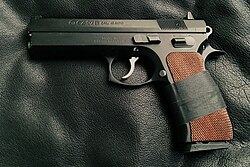
The CZ 97B is a semi-automatic handgun introduced in 1997 in the .45 ACP cartridge.

Key Information

History

[edit]

Designed and first manufactured during the Federal Assault Weapons Ban, the CZ-97B was designed with a 10-round capacity magazine in compliance.

The firearm was never designed with magazines larger than 10 rounds, this makes it popular in states and countries that limit handgun magazine capacity.

In early 2022, CZ announced that the CZ 97B would be discontinued with the last batches being made for the California market due to the handgun roster.

Design

[edit]

The CZ 97B is essentially the CZ 75B in .45 ACP rather than 9mm, leading many gun enthusiasts to call the 97B the "big brother" to the very popular CZ 75B.

The CZ 97B includes a screw-in barrel bushing and loaded chamber indicator. It was designed with the intent to retain the functionality, ergonomics and accuracy of its smaller sibling and includes some parts compatibility.

The CZ 97B carries 10 rounds in the double column magazine. It features a dust cover on the frame similar to other CZ-75 models with the exception of not having an accessory rail.

In 2013, thin aluminum grips and a fiber optic front sight were added and improvements were made to the feed ramp to improve reliability.

Variant

[edit]

CZ 97 BD

[edit]

.45 ACP version of the CZ 75 BD.

In the United States

[edit]

With the popularity of the CZ 75 and the .45 ACP cartridge in the United States thanks to the popularity of the 1911 pistol, the CZ 97 was supposed to become a commercial success because of the two factors mentioned but, was not a popular choice for American shooters who favored the 1911 for a semi-automatic pistol in .45 ACP.

After 25 years of production, CZ decided to stop production of the 97B and all other 97 models in 2022. The weapon is also not known to be used by any police departments who favored the .45 ACP, with most choosing either 1911 or Glock models.

Due to California's handgun roster which forces manufacturers to go through a certification process in order to sell handguns in the state and have to renew their product yearly, CZ decided to limit production in 2022 to only customers in California before the expiration of the certification for sale in the state. Thus 97B 2022 models were only sold in limited quantity to California customers, before production was discontinued at the end of the year.

See also

[edit]

References

[edit]
[edit]
Revisions and contributorsEdit on WikipediaRead on Wikipedia
from Grokipedia
The CZ 97B is a full-sized, semi-automatic pistol chambered in .45 ACP, manufactured by the Czech firm Česká zbrojovka a.s. (CZUB) and introduced in 1997 as a big-bore adaptation of the CZ 75 design. Featuring an all-steel construction for enhanced durability and recoil management, it employs a short-recoil operated, locked-breech system with a double-action/single-action trigger mechanism. The pistol measures 8.3 inches in overall length, with a 4.65-inch barrel, a height of 5.9 inches, and a standard 10-round double-stack magazine capacity compliant with certain regulatory limits. Designed primarily for target and personal defense up to 50 meters, the CZ 97B incorporates ergonomic enhancements such as a low for improved control and a manual thumb safety, distinguishing it from earlier variants through features like a screw-in barrel bushing and loaded chamber indicator. Its development targeted American shooters favoring the .45 ACP's , building on the 's reputation for reliability and accuracy, though it achieved more niche appeal compared to 9mm counterparts due to the cartridge's dimensions and the model's eventual discontinuation. Notable for its smooth double-action pull transitioning to a crisp single-action release, the delivers low impulse relative to its , supporting precise in practical applications.

History and Development

Origins and Design Intent

The CZ 97B originated as a project by (CZ-UB), the Czech arms manufacturer, in the late 1990s to adapt the established CZ 75B platform—a short-recoil, locked-breech originally chambered in —for the cartridge. This development leveraged the CZ 75 series' reputation for reliability, ergonomics, and all-steel construction, which had gained international acclaim since the CZ 75's debut in 1975, while addressing the mechanical scaling required for the wider, more powerful round, including a heavier slide and modified frame dimensions. The primary design intent was to target the American firearms market, where held enduring popularity among enthusiasts and users due to its perceived superior compared to 9mm, stemming from historical preferences dating to the U.S. military's adoption of the in the early . CZ-UB sought to capitalize on the CZ 75's export success in the U.S. by offering a "big-bore" variant that retained the series' low for reduced muzzle flip, high-capacity potential (initially limited to 10 rounds for compliance with the 1994 U.S. ), and suitability for aimed shooting up to 50 meters. Initial production commenced in 1997, positioning the CZ 97B as a direct competitor to established pistols like the Colt and , with CZ emphasizing enhanced accuracy through a match-grade barrel and the platform's inherent safety features, such as the block and optional decocker. This intent reflected CZ-UB's strategy to diversify beyond European 9mm dominance into larger calibers without compromising the core design philosophy of simplicity, durability, and shooter-friendly handling proven in military and competitive applications.

Introduction and Initial Production

The CZ 97B is a chambered in , manufactured by Česká zbrojovka a.s. in Uherský Brod, . Introduced in 1997, it represents an adaptation of the CZ 75B design, enlarged to accommodate the larger .45 ACP cartridge, primarily targeting the American market where demand for .45 caliber handguns remained strong amid preferences for its perceived . The pistol features a , double-action/single-action trigger mechanism, and an all-steel construction weighing approximately 40 ounces unloaded, with a 4.65-inch barrel and a standard capacity of 10 rounds to comply with the U.S. of 1994, which restricted magazines over 10 rounds. Initial production of the CZ 97B began in , with early examples entering the market by 1998. These first models included a manual thumb safety, wooden grip panels, absence of front slide serrations, and a fixed solid front sight, distinguishing them from later iterations that incorporated aluminum grips, front serrations for easier manipulation, and fiber optic front sights. The design modifications from the series involved shifting the locking mechanism to the front of the chamber and ejection port area, along with a threaded barrel bushing for easier disassembly, aimed at enhancing reliability with the more powerful round while maintaining the ergonomic all-steel slide-inside-frame configuration. Production serial numbers for early units often featured prefixes like "A" or "C," accompanied by proof marks indicating the manufacturing year, such as "98" on the barrel or frame. The CZ 97B's launch coincided with post-Cold War export opportunities for Czech firearms, leveraging the CZ 75's established reputation to introduce a .45 variant suited to U.S. tastes, though it did not achieve the same widespread adoption as its 9mm predecessor due to the niche appeal of and competition from established American designs like the 1911. Initial shipments were handled through CZ-USA, the American importer, focusing on and civilian markets where the pistol's accuracy and low recoil for its caliber were highlighted in early evaluations.

Discontinuation and Legacy

The CZ 97B ceased production in 2022, marking the end of a 25-year run that began with its introduction in 1997 as a adaptation of the CZ 75B platform. Manufacturer announcements via CZ-USA indicated the model, along with its decocker variant (97 BD), would no longer be offered starting that year, reflecting a broader shift in the company's lineup toward lighter polymer-framed and striker-fired designs amid declining demand for heavy, all-steel double-action/single-action pistols in . Post-discontinuation, the CZ 97B has garnered a dedicated following among enthusiasts for its robust construction, high capacity (10+1 rounds of in a double-stack ), and proven reliability in civilian applications, though its adoption by military or agencies remains negligible due to the platform's size and weight. Its legacy endures as a benchmark for ergonomic steel-frame handguns tailored to the American market's preference for , often praised in user reports for accuracy and low management despite a grip circumference criticized as overly thick for smaller hands. Remaining inventory and secondary-market examples have appreciated in value, positioning the model as a collectible for those seeking "old-school" DA/SA triggers and cold-hammer-forged barrels without modern modular features.

Design and Features

Core Mechanism and Specifications

The CZ 97B employs a short -operated mechanism, where the barrel and slide remain locked during initial before the barrel cams downward to unlock via a linkless system akin to Hi-Power, but modified for with locking surfaces at the chamber front and ejection port rather than relying solely on the ejection port. This design utilizes internal slide rails and a coil spring, enabling reliable cycling with the higher-pressure cartridge. The trigger mechanism operates in double-action/single-action (DA/SA) mode, permitting the first shot via a longer double-action pull followed by shorter single-action pulls for subsequent rounds, with a frame-mounted manual thumb , firing pin block, safety stop, and loaded chamber indicator for enhanced . Key specifications include a caliber, cold -forged barrel of 4.65 inches, overall length of 8.3 inches, height of 5.9 inches, width of 1.4 inches, unloaded weight of 41 ounces, and a 10-round double-stack detachable magazine capacity. The features fixed with a front and rear square notch, a screw-in barrel bushing, and thin aluminum grip scales to reduce width.

Ergonomics and Controls

The CZ 97B inherits the ergonomic grip geometry of the CZ 75 series, with a full-size featuring a high beavertail tang and sculpted backstrap that positions the shooting hand close to the for intuitive pointing and enhanced recoil control. Grip width measures 1.4 inches to house the double-stack magazine, offering substantial purchase and stability for medium to large hands but often feeling bulky or unwieldy for smaller ones. Standard thin aluminum panels provide a slim profile relative to rubber alternatives, with checkering for traction; aftermarket options like G10 or wood allow customization for improved fit. Controls emphasize simplicity and ambidextrous compatibility where feasible, including a left-frame manual thumb safety that blocks the sear and firing pin while permitting safe hammer lowering in double-action mode. Positioned for natural thumb reach, the safety engages firmly without excessive grip alteration, though the model's discontinuation limits factory support for modifications. The double-action/single-action trigger yields a heavy initial pull of around 11 pounds for first-shot capability, followed by a single-action break averaging 5.5 pounds with minimal creep and a clean, audible reset, facilitating precise follow-up shots. The extended on the left frame locks the slide open on empty magazines and releases it with upward pressure, accessible to the shooter's during reloads. Magazine release, a behind the , supports rapid changes but may require extension or weak-hand assistance for some users due to its placement amid the grip's contours. Overall handling suits duty or range use, with the 41-ounce unloaded weight contributing to low perceived recoil despite the caliber.

Materials and Construction

The CZ 97B employs an all- construction for both its frame and slide, which contributes to its unloaded weight of 41.3 ounces and enhances durability while managing through increased mass. The frame incorporates a full-length dust cover to house the spring assembly, improving balance and stability during firing. The slide and frame are finished in black polycoat for resistance and reduced . To offset the heft of the components, the features thin, checkered grips, which provide a secure hold without adding significant weight. The 4.65-inch barrel is hammer-forged from and secured by a screw-in bushing, facilitating field stripping and while ensuring precision for the cartridge.

Variants

CZ 97 BD

The CZ 97 BD is a variant of the CZ 97B semi-automatic pistol, distinguished primarily by its frame-mounted decocking lever, which replaces the manual thumb safety of the standard model. This mechanism allows the hammer to be safely lowered from the single-action position to double-action readiness without discharging the weapon, appealing to shooters who prioritize streamlined operation over a traditional safety. The design retains the core short-recoil operation and all-steel frame of the CZ 97 series, adapted from the CZ 75 platform to accommodate the larger .45 ACP cartridge. Chambered exclusively in .45 ACP, the CZ 97 BD features a 10-round double-stack magazine capacity compliant with prevailing U.S. import restrictions at the time of production. Key dimensions include a 4.65-inch barrel length, an overall length of 8.3 inches, a height of 5.9 inches, a width of 1.4 inches, and an unloaded weight of 41.3 ounces, contributing to its reputation for manageable recoil despite the cartridge's power. The pistol employs rubber grips for enhanced control, fixed three-dot sights for target acquisition, and a black polycoat finish for corrosion resistance. Like the CZ 97B, the BD model emphasizes a low bore axis for reduced muzzle flip and improved follow-up shot accuracy, with double-action/single-action trigger mechanics providing a long first pull followed by a crisp single-action break. User reports note subtle trigger differences, with the BD exhibiting slightly more creep in some exemplars compared to the safety-equipped B variant, though both deliver reliable performance in testing. Production of the CZ 97 BD ceased in 2022, limiting availability to existing stock and secondary markets.

California-Compliant Models

The California-compliant variant of the CZ 97B, model designation 01401, was engineered to adhere to the Handgun Roster standards, which enforce capacity limits and safety certifications for new sales in the state. This version limits magazine capacity to 10 rounds of , incorporates a loaded chamber indicator, and features a screw-in barrel bushing for enhanced reliability, all while passing required drop-safety and tests for roster approval. The retains a 4.65-inch barrel length, steel construction, and black polycoat finish, with thin aluminum grip scales designed to slim the profile for improved in a double-stack configuration. Česká zbrojovka maintained production of this pre-2013 design iteration exclusively for , even after introducing updates to the standard CZ 97B—such as revised sights and grips—that rendered newer models ineligible for the roster, likely due to evolving requirements like on critical components. This older configuration avoided such mandates by leveraging prior certification, allowing continued legal sales amid 's restrictive framework, which prioritizes legacy-approved firearms over redesigned ones. The model was discontinued in early 2022, with final manufacturing runs dedicated to inventory to exhaust roster viability before broader sunset of the CZ 97B lineup, reflecting manufacturers' strategic focus on compliant stockpiles amid roster attrition risks. Post-discontinuation, remaining units could still be sold in via approved dealers until inventory depletion or roster expiration, underscoring the state's influence on specialized production lines for high-capacity pistols.

Performance and Testing

Accuracy and Shootability

The CZ 97B exhibits strong inherent accuracy typical of the design lineage, with benchrest tests yielding five-shot groups of 1.7 to 1.9 inches at 15 yards across 185-grain JHP, 230-grain TAP, and handloaded 230-grain FMJ ammunition. In comparative evaluations, group sizes varied from 1.0-1.5 inches with Speer 200-grain GDHP to 2.8 inches with 230-grain FMJ, demonstrating consistent performance under controlled conditions. These results position the CZ 97B as competitive among double-stack pistols, often matching or exceeding traditional single-stack platforms in precision at practical distances. Shootability benefits from the pistol's all-steel frame and slide, which provide an unloaded weight of approximately 36.2-40 ounces, effectively mitigating the 's recoil impulse for smoother operation and faster follow-up shots. The full-length dust cover and low inherited from the further reduce muzzle flip, enabling rapid transitions in drills—such as 1.59 seconds for multiple hits in a speed test—while maintaining control. Testers note the natural heft and wooden grip panels absorb effectively, rendering it one of the easier platforms for sustained fire without excessive fatigue. Field reports corroborate laboratory findings, with shooters achieving sub-2-inch groups at 25 yards offhand or rested, attributing this to the pistol's stable platform and ergonomic grip angle. Overall, the CZ 97B's combination of mechanical precision and makes it highly shootable for both precision work and defensive scenarios.

Reliability and Durability

The CZ 97B exhibits strong reliability in controlled testing, with reviewers consistently reporting zero malfunctions when firing diverse loads, including steel-cased training ammunition, jacketed hollow points, and handloads. In one evaluation, it completed accuracy groups and transition drills at 7-15 yards using 230-grain projectiles without failures. Another test involved 51 rounds of 230-grain reloads in slow-fire and rapid sequences at 7-25 yards, performing flawlessly. Durability benefits from its all-steel frame and slide, contributing to a unloaded weight of 36.2 ounces that mitigates stress and supports sustained operation. The cold hammer-forged barrel further enhances longevity under repeated firing. No widespread component failures emerge in aggregated reviews, though early production examples occasionally experienced barrel bushing wear, addressed via manufacturer updates. Isolated user accounts mention on springs in new units or infrequent trigger spring breakage, but these do not indicate systemic defects. Long-term high-round-count data remains anecdotal, with CZ maintenance guidelines suggesting around 5,000 rounds for related models, though specific 97B endurance exceeds typical civilian use without reported breakdowns.

Reception and Usage

Market Adoption in the United States

The CZ 97B was introduced in by Česká zbrojovka specifically to target American shooters' preference for chambering, adapting the proven platform with an all-steel frame to handle the cartridge's and provide high capacity relative to contemporaries like the 1911. Despite this intent, the pistol achieved only niche adoption in the civilian market, appealing primarily to enthusiasts valuing DA/SA triggers and ergonomic grips in a full-size .45, but limited by its large dimensions (length: 8.3 inches, height: 5.75 inches with magazine) and thick grip circumference, which deterred users with smaller hands or those seeking options. Market availability has historically been sporadic, with CZ-USA importing batches irregularly, leading to scarcity on retail shelves and secondary markets like GunBroker, where new or lightly used examples often command premiums over $800. As of 2025, used CZ 97B average $846, reflecting steady but low-volume demand among collectors and range shooters rather than mass-market appeal, especially amid competition from polymer-framed alternatives like the 21 or P220. Production ceased in 2022 after 25 years, further constraining supply and positioning remaining units as sought-after for their durability in recreational and competitive shooting. No documented adoption by U.S. agencies exists, with the model's size and decocker-only configuration (lacking manual safety in standard variants) misaligning with holster requirements and qualification standards favoring striker-fired or SAO designs. Civilian uptake centers on enthusiasts and aficionados experimenting with higher capacity (10+1 rounds standard, limited by post-1994 import restrictions and state laws), though user forums indicate preferences for it as a "range queen" over daily carry due to weight (2.5 pounds unloaded). California-compliant variants with 10-round magazines saw localized sales but did not broaden overall penetration.

User Reviews and Comparisons

Users report the CZ 97B as highly accurate, with many describing it as outperforming other factory pistols in precision, often grouping tighter than comparably priced variants at 25 yards. Reliability is consistently praised, with owners noting flawless function across thousands of rounds of diverse , including lead reloads, hollow points, and +P loads, without malfunctions after break-in. The pistol's all-steel construction contributes to a soft impulse, described as smoother and more controllable than lighter aluminum-framed competitors, aiding rapid follow-up shots. However, its substantial weight—approximately 2.5 pounds unloaded—and large frame dimensions draw criticism for , with users preferring it for range or defense over everyday transport. The double-action trigger pull, averaging 10-12 pounds, is frequently called heavy and gritty initially, though single-action breaks cleanly at 4-5 pounds post-break-in; some recommend aftermarket polishing for improvement. In comparisons to the platform, the CZ 97B is favored for its double-stack 10-round capacity versus the 's typical 7-8 rounds, higher mechanical robustness with forged components and no MIM parts, and lower perceived due to mass and slide-inside-frame design. Enthusiasts note it achieves -like accuracy with upgrades like bushings and triggers at a fraction of custom costs, though it lacks the single-action-only simplicity and -specific ergonomics, positioning it as a durable DA/SA alternative rather than a direct replacement. Discontinuation in recent years has led to mixed sentiments, with some users stockpiling parts amid concerns over , yet affirming its enduring value for those unconcerned with portability.

Applications and Modifications

The CZ 97B is primarily employed by civilians for recreational target shooting, personal defense, and informal due to its manageable recoil and capacity in . Its all-steel construction suits range use and home defense scenarios, where the cartridge's is valued, though its size limits practicality for most users. No verified widespread adoption by law enforcement or military units has been documented, distinguishing it from CZ's 9mm models like the 75 series. In competitive shooting, particularly USPSA or IDPA divisions accommodating , the pistol benefits from its accuracy and low , though competitors often modify it for enhanced performance. Common modifications focus on , compatibility, and trigger refinement. Aftermarket sights, such as tritium night sights or adjustable blacked-out models, improve low-light aiming and precision. Grips in rubber or aluminum variants enhance control, while Picatinny rails enable mounting red dots, lights, or lasers. Trigger upgrades from specialists like Cajun Gun Works include reduced-weight springs, single-action-only conversions, and polished components for crisper pulls suited to . Barrel bushing conversions to a 1911-style design simplify disassembly and maintenance. Extended magazines and threaded barrels for suppressors represent further customizations, though availability diminished after production ceased in 2022.

Criticisms and Issues

Feeding and Ammunition Compatibility

The CZ 97B , particularly early production models introduced in the late and early 2000s, has demonstrated sensitivity to profile during feeding, with frequent reports of failures to feed (FTF) when using jacketed (JHP) rounds. These issues stem from the interaction between the cartridge's overall length (OAL) and bullet shape with the pistol's feed ramp and magazine lips, where JHP bullets with pronounced ogives or longer OAL (exceeding 1.250 inches) can nose-dive or hang up during chambering. In contrast, (FMJ) or typically feeds reliably without modification, as its rounded profile aligns more consistently with the ramp geometry. User experiences indicate that compatibility varies by specific JHP brands and bullet weights; for instance, lighter 185-grain or certain 230-grain hollow points from manufacturers like Federal or often malfunction, while truncated or semi-wadcutter profiles may exacerbate nose-dives into the feed ramp. Early models were especially prone, leading some owners to return pistols to CZ-USA for feed ramp polishing or extractor adjustments, which reportedly improved JHP reliability in many cases. Later iterations, particularly those produced after approximately 2010, show reduced incidence due to refined manufacturing tolerances, though sporadic FTF persists with non-optimal loads or worn magazines. Magazine compatibility is generally limited to factory 10-round units, with aftermarket options risking exacerbated feeding due to inconsistent follower geometry or spring tension. To mitigate issues, handloaders are advised to maintain OAL between 1.240 and 1.250 inches for JHP, avoiding maximum SAAMI specs that promote ramp contact failures. Despite these workarounds, the CZ 97B's ammunition pickiness has drawn criticism for limiting defensive or carry applications reliant on expanding projectiles, contrasting with more forgiving .45 ACP platforms like the 1911. No widespread recall has been issued, but consistent forum documentation underscores the need for ammo testing prior to reliance.

Mechanical Concerns and Recalls

No official recalls have been issued for the CZ 97B by Česká zbrojovka or CZ-USA, despite its production spanning from 2005 until discontinuation in 2022. User reports document instances of the lower barrel lug fracturing under stress, with at least one owner experiencing failure after approximately three years of competitive use in 2014, followed by a repeat breakage in 2018. Such lug failures appear linked to high-round-count or match conditions, potentially exacerbated by the pistol's full-size design and all-steel construction, though CZ has not acknowledged this as a systemic defect. Firing pin durability has been a recurrent , particularly with excessive dry firing causing or metal displacement on the pin's angled tip, as observed in user examinations after mere months of practice. Light primer strikes have also been noted, sometimes persisting despite recoil spring, guide rod, and firing pin block spring replacements, with aftermarket extended firing pins cited as a partial remedy in isolated cases involving thousands of live rounds. Other reported anomalies include incomplete slide return to battery, halting approximately 1/8 inch short, potentially tied to or spring tension inconsistencies. Additionally, some units exhibit resistance to slide racking when the is uncocked or at half-cock, limiting rearward travel to about 1/8 inch, which users attribute to internal geometry or grease buildup in the channel rather than flaws. These issues, drawn predominantly from enthusiast forums, lack independent verification from manufacturers or testing bodies, and many resolve via , spring swaps, or limited use adjustments, suggesting they may reflect individual maintenance variances more than inherent unreliability.

References

Add your contribution
Related Hubs
User Avatar
No comments yet.