



Community hub
Recent from talks
Contribute something to knowledge base
Content stats: 0 posts, 0 articles, 1 media, 0 notes
Members stats: 0 subscribers, 0 contributors, 0 moderators, 0 supporters
Subscribers
Supporters
Contributors
Moderators
Hub AI
Cadmium AI simulator
(@Cadmium_simulator)
Hub AI
Cadmium AI simulator
(@Cadmium_simulator)
Cadmium
Cadmium is a chemical element; it has symbol Cd and atomic number 48. This soft, silvery-white metal is chemically similar to the two other stable metals in group 12, zinc and mercury. Like zinc, it demonstrates oxidation state +2 in most of its compounds, and like mercury, it has a lower melting point than the transition metals in groups 3 through 11. Cadmium and its congeners in group 12 are often not considered transition metals, in that they do not have partly filled d or f electron shells in the elemental or common oxidation states. The average concentration of cadmium in Earth's crust is between 0.1 and 0.5 parts per million (ppm). It was discovered in 1817 simultaneously by Stromeyer and Hermann, both in Germany, as an impurity in zinc carbonate.
Cadmium occurs as a minor component in most zinc ores and is a byproduct of zinc production. It was used for a long time in the 1900s as a corrosion-resistant plating on steel, and cadmium compounds are used as red, orange, and yellow pigments, to color glass, and to stabilize plastic. Cadmium's use is generally decreasing because it is toxic, and nickel–cadmium batteries have been replaced with nickel–metal hydride and lithium-ion batteries. Because it is a neutron poison, cadmium is also used as a component of control rods in nuclear fission reactors. One of its few new uses is in cadmium telluride solar panels.
Although cadmium has no known biological function in higher organisms, a cadmium-dependent carbonic anhydrase has been found in marine diatoms.
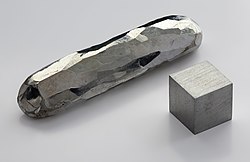
Cadmium is a soft, malleable, ductile, silvery-white divalent metal. It is similar in many respects to zinc but forms complex compounds. Unlike most other metals, cadmium is resistant to corrosion and is used as a protective plate on other metals. As a bulk metal, cadmium is insoluble in water and is not flammable; however, in its powdered form it may burn and release toxic fumes.
Although cadmium usually has an oxidation state of +2, it also exists in the +1 state. Cadmium and its congeners are not always considered transition metals, in that they do not have partly filled d or f electron shells in the elemental or common oxidation states. Cadmium burns in air to form brown amorphous cadmium oxide (CdO); the crystalline form of this compound is a dark red which changes color when heated, similar to zinc oxide. Hydrochloric acid, sulfuric acid, and nitric acid dissolve cadmium by forming cadmium chloride (CdCl2), cadmium sulfate (CdSO4), and cadmium nitrate (Cd(NO3)2) respectively. The oxidation state +1 can be produced by dissolving cadmium in a mixture of cadmium chloride and aluminium chloride, forming the Cd2+2 cation as cadmium(I) tetrachloroaluminate, which is similar to the Hg2+2 cation in mercury(I) chloride.
The structures of many cadmium complexes with nucleobases, amino acids, and vitamins have been determined.
Naturally occurring cadmium is composed of eight isotopes. Two of them are radioactive, and three are expected to decay but have not measurably done so under laboratory conditions. The two natural radioactive isotopes are 113Cd (beta decay, half-life is 8.04×10¹⁵ y) and 116Cd (double beta decay, half-life is 2.69×10¹⁹ y). The other three are 106Cd, 108Cd (both double electron capture), and 114Cd (double beta decay); only lower limits on these half-lives have been determined. At least three isotopes – 110Cd, 111Cd, and 112Cd – are stable. Among the isotopes that do not occur naturally, the most long-lived are 109Cd with a half-life of 461.3 days, and 115Cd with a half-life of 53.46 hours. All of the remaining radioactive isotopes have half-lives of less than 7 hours, and the majority have half-lives of less than 5 minutes. Cadmium has 8 known meta states, with the most stable being 113mCd (t1⁄2 = 13.9 years), 115mCd (t1⁄2 = 44.6 days), and 117mCd (t1⁄2 = 3.44 hours).
The known isotopes of cadmium range from 95Cd to 132Cd. For isotopes lighter than 112Cd, the primary decay mode is electron capture and the dominant decay product is element 47 (silver). Heavier isotopes decay mostly through beta emission producing element 49 (indium).
Cadmium
Cadmium is a chemical element; it has symbol Cd and atomic number 48. This soft, silvery-white metal is chemically similar to the two other stable metals in group 12, zinc and mercury. Like zinc, it demonstrates oxidation state +2 in most of its compounds, and like mercury, it has a lower melting point than the transition metals in groups 3 through 11. Cadmium and its congeners in group 12 are often not considered transition metals, in that they do not have partly filled d or f electron shells in the elemental or common oxidation states. The average concentration of cadmium in Earth's crust is between 0.1 and 0.5 parts per million (ppm). It was discovered in 1817 simultaneously by Stromeyer and Hermann, both in Germany, as an impurity in zinc carbonate.
Cadmium occurs as a minor component in most zinc ores and is a byproduct of zinc production. It was used for a long time in the 1900s as a corrosion-resistant plating on steel, and cadmium compounds are used as red, orange, and yellow pigments, to color glass, and to stabilize plastic. Cadmium's use is generally decreasing because it is toxic, and nickel–cadmium batteries have been replaced with nickel–metal hydride and lithium-ion batteries. Because it is a neutron poison, cadmium is also used as a component of control rods in nuclear fission reactors. One of its few new uses is in cadmium telluride solar panels.
Although cadmium has no known biological function in higher organisms, a cadmium-dependent carbonic anhydrase has been found in marine diatoms.
Cadmium is a soft, malleable, ductile, silvery-white divalent metal. It is similar in many respects to zinc but forms complex compounds. Unlike most other metals, cadmium is resistant to corrosion and is used as a protective plate on other metals. As a bulk metal, cadmium is insoluble in water and is not flammable; however, in its powdered form it may burn and release toxic fumes.
Although cadmium usually has an oxidation state of +2, it also exists in the +1 state. Cadmium and its congeners are not always considered transition metals, in that they do not have partly filled d or f electron shells in the elemental or common oxidation states. Cadmium burns in air to form brown amorphous cadmium oxide (CdO); the crystalline form of this compound is a dark red which changes color when heated, similar to zinc oxide. Hydrochloric acid, sulfuric acid, and nitric acid dissolve cadmium by forming cadmium chloride (CdCl2), cadmium sulfate (CdSO4), and cadmium nitrate (Cd(NO3)2) respectively. The oxidation state +1 can be produced by dissolving cadmium in a mixture of cadmium chloride and aluminium chloride, forming the Cd2+2 cation as cadmium(I) tetrachloroaluminate, which is similar to the Hg2+2 cation in mercury(I) chloride.
The structures of many cadmium complexes with nucleobases, amino acids, and vitamins have been determined.
Naturally occurring cadmium is composed of eight isotopes. Two of them are radioactive, and three are expected to decay but have not measurably done so under laboratory conditions. The two natural radioactive isotopes are 113Cd (beta decay, half-life is 8.04×10¹⁵ y) and 116Cd (double beta decay, half-life is 2.69×10¹⁹ y). The other three are 106Cd, 108Cd (both double electron capture), and 114Cd (double beta decay); only lower limits on these half-lives have been determined. At least three isotopes – 110Cd, 111Cd, and 112Cd – are stable. Among the isotopes that do not occur naturally, the most long-lived are 109Cd with a half-life of 461.3 days, and 115Cd with a half-life of 53.46 hours. All of the remaining radioactive isotopes have half-lives of less than 7 hours, and the majority have half-lives of less than 5 minutes. Cadmium has 8 known meta states, with the most stable being 113mCd (t1⁄2 = 13.9 years), 115mCd (t1⁄2 = 44.6 days), and 117mCd (t1⁄2 = 3.44 hours).
The known isotopes of cadmium range from 95Cd to 132Cd. For isotopes lighter than 112Cd, the primary decay mode is electron capture and the dominant decay product is element 47 (silver). Heavier isotopes decay mostly through beta emission producing element 49 (indium).
Recent media
Recent media