Hubbry Logo
Caerphilly CastleCaerphilly CastleMain
Open search
Caerphilly Castle
Community hub
Caerphilly Castle
logo
8 pages, 0 posts
0 subscribers
Be the first to start a discussion here.
Caerphilly Castle
Caerphilly Castle
from Wikipedia

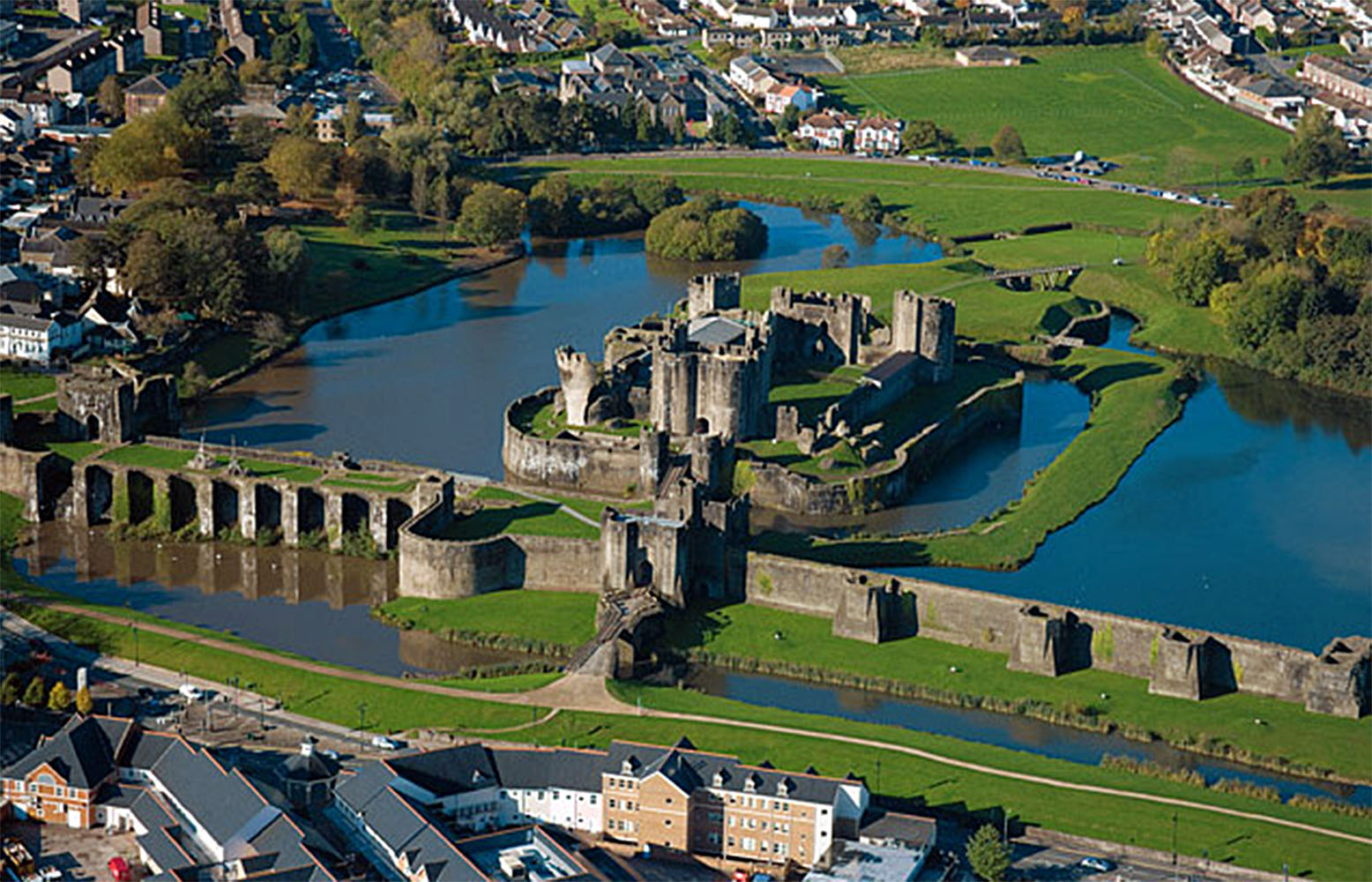
Caerphilly Castle (Welsh: Castell Caerffili) is a medieval fortification in Caerphilly in South Wales. The castle was constructed by Gilbert de Clare in the 13th century as part of his campaign to maintain control of Glamorgan, and saw extensive fighting between Gilbert, his descendants, and the native Welsh rulers. Surrounded by extensive artificial lakes – considered by historian Allen Brown to be "the most elaborate water defences in all Britain" – it occupies around 30 acres (12 ha) and is the largest castle in Wales and the third-largest castle in the United Kingdom (after Dover Castle & Windsor Castle).[3] It is famous for having introduced concentric castle defences to Britain and for its large gatehouses. Gilbert began work on the castle in 1268 following his occupation of the north of Glamorgan, with the majority of the construction occurring over the next three years at a considerable cost. The project was opposed by Gilbert's Welsh rival Llywelyn ap Gruffudd, leading to the site being burnt in 1270 and taken over by royal officials in 1271. Despite these interruptions, Gilbert successfully completed the castle and took control of the region. The core of Caerphilly Castle, including the castle's luxurious accommodation, was built on what became a central island, surrounding by several artificial lakes, a design Gilbert probably derived from that at Kenilworth. The dams for these lakes were further fortified, and an island to the west provided additional protection. The concentric rings of walls inspired Edward I's castles in North Wales, and proved what historian Norman Pounds has termed "a turning point in the history of the castle in Britain".[4]

Key Information

The castle was attacked during the Madog ap Llywelyn revolt of 1294, the Llywelyn Bren uprising in 1316 and during the overthrow of Edward II in 1326–27. In the late 15th century, however, it fell into decline and by the 16th century the lakes had drained away and the walls were robbed of their stone. The Marquesses of Bute acquired the property in 1776 and under the third and fourth Marquesses extensive restoration took place. In 1950 the castle and grounds were given to the state and the water defences were re-flooded. In the 21st century, the Welsh heritage agency Cadw manages the site as a tourist attraction.

History

[edit]

13th century

[edit]

Caerphilly Castle was built in the second half of the 13th century, as part of the Anglo-Norman expansion into South Wales. The Normans began to make incursions into Wales from the late 1060s onwards, pushing westwards from their bases in recently occupied England.[5] Their advance was marked by the construction of castles and the creation of regional lordships.[6] The task of subduing the region of Glamorgan was given to the earls of Gloucester in 1093; efforts continued throughout the 12th and early 13th centuries, accompanied by extensive fighting between the Anglo-Norman lords and local Welsh rulers.[7] The powerful de Clare family acquired the earldom in 1217 and continued to attempt to conquer the whole of the Glamorgan region.[8]

Caerphilly Castle from the south-west

In 1263, Gilbert de Clare, also known as "Red Gilbert" because of the colour of his hair, inherited the family lands.[9] Opposing him in Glamorgan was the native Welsh prince Llywelyn ap Gruffudd.[8] Llywelyn had taken advantage of the chaos of the civil war in England between Henry III and rebel barons during the 1260s to expand his power across the region.[10] In 1265 Llywelyn allied himself with the baronial faction in England in exchange for being granted authority over the local Welsh magnates across all the territories in the region, including Glamorgan.[11] De Clare believed his lands and power were under threat and allied himself with Henry III against the rebel barons and Llywelyn.[12]

The baronial revolt was crushed between 1266 and 1267, leaving de Clare free to advance north into Glamorgan from his main base in Cardiff.[13] De Clare started to construct a castle at Caerphilly to control his new gains in 1268. The castle lay in a basin of the Rhymney Valley, alongside the Rhymney River and at the heart of network of paths and roads, adjacent to a former Roman fort.[14] Work began at a huge pace, with ditches cut to form the basic shape of the castle, temporary wooden palisades erected and extensive water defences created by damming a local stream.[15] The walls and internal buildings were built at speed, forming the main part of the castle.[15] The architect of the castle and the precise cost of the construction are unknown, but modern estimates suggest that it could have cost as much as castles such as Conwy or Caernarfon, perhaps as much as £19,000, a huge sum for the period.[16]

Llywelyn responded by intervening with his own forces but outright conflict was prevented by the diplomatic efforts of Henry III.[17] De Clare continued building work and in 1270 Llywelyn responded by attacking and burning the site, probably destroying the temporary defences and stores.[18] De Clare began work again the following year, raising tensions and prompting Henry to send two bishops, Roger de Meyland and Godfrey Giffard, to take control of the site and arbitrate a solution to the dispute.[19]

Great Hall (l), private apartments (c), Inner West Gatehouse (r)

The bishops took possession of the castle later in 1271 and promised Llywelyn that building work would temporarily cease and that negotiations would begin the following summer.[19] In February of the next year, however, de Clare's men seized back the castle, threw out the bishops' soldiers, and de Clare – protesting his innocence in these events – began work once again.[19] Neither Henry nor Llywelyn could readily intervene and de Clare was able to lay claim to the whole of Glamorgan.[15] Work on the castle continued, with additional water defences, towers and gatehouses added.[20]

Llywelyn's power declined over the next two decades. In 1277 Henry's son, Edward I, invaded Wales following a dispute with the prince, breaking his power in South Wales, and in 1282 Edward's second campaign resulted in Llywelyn's death and the collapse of independent Welsh rule.[15] Further defences were added to the walls until work stopped around 1290.[21] Local disputes remained. De Clare argued with Humphrey de Bohun, the earl of Hereford, in 1290 and the following year the case was brought before the king, resulting in the temporary royal seizure of Caerphilly.[21]

In 1294 Madog ap Llywelyn rebelled against English rule, the first major insurrection since the 1282 campaign.[22] The Welsh appear to have risen up over the introduction of taxation and Madog had considerable popular support.[22] In Glamorgan, Morgan ap Maredudd led the local uprising; Morgan had been dispossessed by de Clare in 1270 and saw this as a chance to regain his lands.[23] Morgan attacked Caerphilly, burning half of the town, but failed to take the castle.[23] In the spring of 1295 Edward pressed home a counter-attack in North Wales, putting down the uprising and arresting Madog.[22] De Clare attacked Morgan's forces and retook the region between April and May, resulting in Morgan's surrender.[23] De Clare died at the end of 1295, leaving Caerphilly Castle in a good condition, linked to the small town of Caerphilly which had emerged to the south of it and a large deer park in the nearby Aber Valley.[24]

14th–17th centuries

[edit]
The restored Inner East Gatehouse (l), inspired by that at Tonbridge Castle in Kent (r)

Gilbert's son, also called Gilbert de Clare, inherited the castle, but he died fighting at the battle of Bannockburn in 1314 while still quite young.[25] The family's lands were initially placed under the control of the Crown, but before any decision could be taken on the inheritance, a revolt broke out in Glamorgan.[19] Anger over the actions of the royal administrators caused Llywelyn Bren to rise up in January 1316, attacking Caerphilly Castle with a large force of men.[25] The castle withstood the attack, but the town was destroyed and the rebellion spread.[25] A royal army was despatched to deal with the situation, defeating Bren in a battle at Caerphilly Mountain and breaking the Welsh siege of the castle.[25]

In 1317 Edward II settled the inheritance of Glamorgan and Caerphilly Castle on Eleanor de Clare, who had married the royal favourite, Hugh le Despenser.[26] Hugh used his relationship with the king to expand his power across the region, taking over lands throughout South Wales.[27] Hugh employed Master Thomas de la Bataile and William Hurley to expand the Great Hall at the castle in 1325–1326, including richly carved windows and doors.[28] In 1326, however, Edward's wife, Isabella of France, overthrew his government, forcing the king and Hugh to flee west.[27][29] The pair stayed in Caerphilly Castle at the end of October and early November, before leaving to escape Isabella's approaching forces, abandoning the extensive stores and £14,000 held at the castle.[30] William la Zouche besieged the castle with a force of 425 soldiers, cornering the constable, Sir John de Felton, Hugh le Despenser, Baron le Despenser (1338) Hugh's son – also called Hugh – and the garrison of 130 men inside.[31] Caerphilly held out until March 1327, when the garrison surrendered on the condition that the younger Hugh was pardoned, his father having been already executed.[31]

The South-East tower, leaning at an angle, probably due to subsidence

Tensions between the Welsh and the English persisted and spilled over in 1400 with the outbreak of the Glyndŵr Rising.[32] It is uncertain what part the castle played in the conflict, but it seems to have survived intact.[33] It was captured by the forces of Glyndwr during the rebellions.[34][35] In 1416, the castle passed through Isabel le Despenser in marriage to her first husband Richard de Beauchamp, the earl of Worcester, and then to her second husband, Richard Beauchamp, the earl of Warwick.[36] Isabel and her second husband invested heavily in the castle, conducting repairs and making it suitable for use as their main residence in the region.[37] The castle passed to Richard Neville in 1449 and to Jasper Tudor, the earl of Pembroke, in 1486.[38]

After 1486, the castle went into decline, eclipsed by the more fashionable residence of Cardiff Castle; once the sluice-gates fell into disrepair, the water defences probably drained away.[39] Antiquarian John Leland visited Caerphilly Castle around 1539, and described it as having "waulles of a wonderful thiknes", but beyond a tower used to hold prisoners it was in ruins and surrounded by marshland.[40] Henry Herbert, the earl of Pembroke used the castle for his manorial court.[33] In 1583 the castle was leased to Thomas Lewis, who stripped it of much of its stone to extend his house, causing extensive damage.[40]

In 1642 the English Civil War broke out between the Royalist supporters of Charles I and those of Parliament. South Wales was predominantly Royalist in sympathy, and during the conflict, a sconce, or small fort, was built overlooking Caerphilly Castle to the north-west, on the site of the old Roman fort.[41] It is uncertain if this was built by Royalist forces or by the Parliamentary army that occupied the area during the final months of the war in March 1646, but the fort's guns would have dominated the interior of the castle.[42] It is also uncertain whether or not Caerphilly Castle was deliberately slighted by Parliament to prevent its future use as a fortification. Although several towers had collapsed by the 18th century, possibly as a result of such an operation, it is probable that this deterioration was actually the result of subsidence damage caused when the water defences retreated, as there is no evidence of deliberate destruction having been ordered.[43]

18th–21st centuries

[edit]
The South and North Dams, re-flooded in 1950s

The Marquesses of Bute acquired the castle in 1776.[44] John Stuart, the first marquess, took steps to protect the ruins.[31] His great-grandson John Crichton-Stuart, the third marquess, was immensely rich as the result of the family's holdings in the South Wales coalfields and was passionately interested in the medieval period.[45] He had the site fully surveyed by the architect William Frame, and reroofed the great hall in the 1870s.[31] The marquess began a process of buying back leasehold properties around the castle with the intent of clearing back the town houses that had been built up to the edge of the site.[46]

An original aquatint of the castle at the end of the eighteenth century, prior to rebuilding.

The fourth marquess, John Crichton-Stuart, was an enthusiastic restorer and builder and commissioned a major restoration project between 1928 and 1939.[47] The stonework was carefully repaired, with moulds made to recreate missing pieces.[44] The Inner East Gatehouse was rebuilt, along with several of the other towers.[48] The marquess carried out landscaping work, with the intent of eventually re-flooding the lakes, and thanks to several decades of purchases was finally able to demolish the local houses encroaching on the view of the castle.[49]

By 1947, when John Crichton-Stuart, the fifth marquess, inherited the castle, the Bute family had divested itself of most of its land in South Wales.[50] John sold off the family's remaining property interests and in 1950 he gave Caerphilly Castle to the state.[51] The lakes were re-flooded and the final stages of the restoration work were completed in the 1950s and 1960s.[48] The South Lake was intended to be re-flooded (and three new bridges built) in time for the 1958 Empire Games.[52] The East Moat was refilled with water in 1962, with the stop cock being turned on by Richard Thomson, Parliamentary Secretary for the Ministry of Works, on 21 June.[53]

In the 21st century the castle is managed by the Welsh heritage agency Cadw as a tourist attraction.[48] In 2006, the castle saw 90,914 visitors.[54] It is protected as a scheduled monument and as a grade I listed building. The Great Hall is available for wedding ceremonies.[55]

Architecture

[edit]
Plan of Caerphilly Castle: A – West Gatehouses; B – South Lake; C – Great Hall; D – Inner Ward; E – Middle Ward; F – North Bank; G – North Lake; H – East Gatehouses; I – South Gatehouse; J – South Dam Platform; K – Mill; L – Felton's Tower; M – Outer East Moat; N – Outer Main Gatehouse; O – North Dam Platform; P – North Gatehouse

Caerphilly Castle comprises a set of eastern defences, protected by the Outer East Moat and the North Lake, and fortifications on the Central Island and the Western Island, both protected by the South Lake.[56] The site is around 30 acres (120,000 m2) in size, making it the second largest in Britain.[57] It is constructed on a natural gravel bank in the local river basin, and the castle walls are built from Pennant sandstone.[58] The castle's architecture is famous and historically significant.[59] The castle introduced concentric castle defences to Britain, changing the future course of the country's military architecture, and also incorporated a huge gatehouse.[60] The castle also featured a sophisticated network of moats and dams, considered by historian Allen Brown to be "the most elaborate water defences in all Britain".[3]

The eastern defences were reached via the Outer Main Gatehouse, which featured circular towers resting on spurred, pyramidic bases, a design particular to South Wales castles.[61] Originally the gatehouse would have been reached over a sequence of two drawbridges, linked by an intervening tower, since destroyed.[62] To the north side of the gatehouse was the North Dam, protected by three substantial towers, and which may have supported the castle's stables.[63] Despite subsidence damage, the dam still holds back the North Lake.[62] The South Dam was a massive structure, 152 metres (499 ft) long, ending in a huge buttressed wall.[64] The remains of the castle mill – originally powered by water from the dam – survive. Four replica siege engines have been placed on display.[65] The dam ended in Felton's Tower, a square fortification designed to protect the sluicegates regulating the water levels of the dam, and the South Gatehouse – also called Giffard's Tower – originally accessed via a drawbridge, which led into the town.[66]

Caerphilly's water defences were almost certainly inspired by those at Kenilworth, where a similar set of artificial lakes and dams was created.[67] Gilbert de Clare had fought at the siege of Kenilworth in 1266 and would have seen these at first hand.[67] Caerphilly's water defences provided particular protection against mining, which could otherwise undermine castle walls during the period, and are considered the most advanced of their kind in Britain.[68]

The central island held Caerphilly's inner defences, a roughly square design with a walled inner and middle ward, the inner ward protected by four turrets on each of the corners.[69] The walls of the inner ward overlooked those of the middle ward, producing a concentric defence of two enclosed rings of walls; in the medieval period, the walls of the middle ward would have been much higher than today, forming a more substantial defence.[70] Caerphilly was the first concentric castle in Britain, pre-dating Edward I's famous programme of concentric castles by a few years.[71] The design influenced the design of Edward's later castles in North Wales, and historian Norman Pounds considers it "a turning point in the history of the castle in Britain".[72] Probable subsidence has caused the south-east tower in the Inner Ward to lean outwards at an angle of 10 degrees.[73]

The interior of the Great Hall

Access to the central island occurred over a drawbridge, through a pair of gatehouses on the eastern side. Caerphilly Castle's Inner East Gatehouse, based on the gatehouse built at Tonbridge in the 1250s, reinforced a trend in gatehouse design across England and Wales.[74] Sometimes termed a keep-gatehouse, the fortification had both exterior and interior defences, enabling it to be defended even if the perimeter of the castle was breached.[75] Two huge towers flanked the gatehouse on either side of an entrance that was protected by portcullises and murder-holes.[76] The substantial size of the gatehouse allowed it to be used for accommodation as well as defence and it was comfortably equipped on a grand scale, probably for the use of the castle constable and his family.[77] Another pair of gatehouses protected the west side.[78]

Inside the inner ward was the castle's Great Hall and accommodation. Caerphilly was built with fashionable, high-status accommodation, similar to that built around the same time in Chepstow Castle.[79] In the medieval period the Great Hall would have been subdivided with wooden screens, colourful decorations, with rich, detailed carving and warmed by a large, central fireplace.[80] Some carved medieval corbels in the shape of male and female heads survive in the hall today, possibly depicting the royal court in the 1320s, including Edward II, Isabella of France, Hugh Despenser and Eleanor de Clare.[81] To the east of the Great Hall was the castle chapel, positioned above the buttery and pantry.[82] On the west side of the hall were the castle's private apartments, two solar blocks with luxurious fittings.[83]

Beyond the central island was the Western Island, probably reached by drawbridges.[78] The island is called Y Weringaer or Caer y Werin in Welsh, meaning "the people's fort", and may have been used by the town of Caerphilly for protection during conflicts.[84] On the north-west side of the Western Island was the site of the former Roman fort, enclosing around 3 acres (1.2 ha), and the remains of the 17th-century civil-war fortification built on the same location.[78]

[edit]

The long-running British television show Doctor Who chose Caerphilly Castle as a filming location for several episodes, including "The End of Time" in 2009, "The Vampires in Venice" in 2010, two parter "The Rebel Flesh" and "The Almost People" in 2011; "Robot of Sherwood" in 2014 and "Heaven Sent" in 2015. For "The End of Time", producers used the residential quarters of the East Gatehouse, Constable's Hall and Braose Gallery for the filming of a dungeon in the fictional Broadfell Prison.[85]

See also

[edit]

Notes

[edit]

Bibliography

[edit]
[edit]
Revisions and contributorsEdit on WikipediaRead on Wikipedia
from Grokipedia
Caerphilly Castle is a medieval fortress in , southeast , renowned as the largest castle in and the second largest in Britain after , spanning acres with massive concentric walls, towers, and extensive water defenses. Constructed starting in 1268 by Gilbert de Clare, 7th and a powerful , it was built amid Anglo-Welsh tensions to counter threats from Prince Llywelyn ap Gruffudd, who twice attempted to demolish the unfinished structure during its early years. This innovative design, one of the earliest planned concentric castles in Britain, featured artificial lakes and moats that rendered it nearly impregnable, earning it a reputation as a formidable symbol of English lordship in the . Following Llywelyn's death in 1282, the castle evolved from a military stronghold into a luxurious residence under later owners, including , who enhanced its palatial elements like the in the early . It endured sieges and conflicts, including damage during the in the 17th century that caused its southeast tower—known as the "Leaning Tower"—to tilt dramatically due to gunpowder explosions. By the , the castle had fallen into ruin, but it underwent major restoration from 1928 through the Second World War under the fourth , who employed dozens of local workers to rebuild half of the visible structure, reflood the moats, and repair dams at a cost exceeding £100,000 (equivalent to millions today). Today, managed by —the Welsh Government's historic environment service—Caerphilly Castle attracts visitors with its recreated working siege engines, interactive exhibits, and a fully restored following a 2025 refurbishment costing over £8 million that enhanced accessibility and . Its enduring legacy highlights medieval military architecture, Anglo-Welsh history, and 20th-century preservation efforts that transformed it into a vibrant cultural site.

Location and Context

Site Description

Caerphilly Castle is situated in the center of the town of , in , , at coordinates 51°34′34″N 3°13′13″W and an elevation of approximately 79 meters (259 feet) above . The site lies on relatively flat terrain within a basin encircled by hills and low mountains, providing a naturally contained landscape that facilitated defensive modifications. This positioning in the Rhymney Valley offered oversight of the surrounding lowlands while leveraging local watercourses for fortification. The surrounding geography features two key streams: the Nant y Gledyr flowing from the southwest and the smaller Nant y Risca from the north, both draining eastward toward the River Rhymney. These watercourses, along with connecting brooks like Porset Brook, shaped the site's environmental context and were harnessed to create an extensive network of moats and artificial lakes. The man-made lake system, formed by damming the streams, encompasses northern and southern lakes that together cover about 30 acres, serving as formidable natural barriers integrated into the castle's layout. In the 13th century, the castle's location was strategically vital, positioned roughly 8 miles (13 km) north of along vital routes through the valley that linked settlements such as Newport to the east and upland areas to the north. This proximity to emerging trade and military paths in enhanced control over regional movement and resources. The water defenses, including a 152-meter-long southern and associated moats, amplified the site's inherent defensibility against incursions.

Historical Background

Following the of in , created the Marcher lordships along the Anglo-Welsh border to stabilize the frontier and counter persistent Welsh resistance. These semi-independent territories, extending from to Pembroke, granted Norman lords extensive autonomy, including rights to fortify lands, impose laws, and conduct military campaigns without royal interference, serving as a buffer against Welsh principalities. The system empowered figures like the lords of to enforce border control, though it often fueled local conflicts amid ongoing Anglo-Welsh hostilities that dated back to the Conquest. By the 1260s, these tensions escalated as , , exploited the Second Barons' War to assert Welsh dominance over Marcher territories, allying with English rebels against King Henry III and seizing lands in and beyond. His campaigns culminated in the Treaty of Montgomery in September 1267, where Henry III acknowledged Llywelyn as , accepted his homage, and ceded several Marcher lordships to Welsh overlordship, representing the peak of native Welsh authority. This agreement, signed at Rhyd Chwima near Montgomery, underscored the precarious balance of power but intensified fears among Marcher lords of further encroachments. Gilbert , the powerful and Lord of , had actively participated in the baronial rebellion against Henry III, initially supporting Simon de Montfort's opposition to royal favoritism toward foreign advisors, before switching his allegiance to the royalists in 1265 and fighting at the . Reconciled with the crown yet facing Llywelyn's territorial ambitions in his domain, de Clare recognized the urgent need for impregnable fortifications to safeguard his holdings amid the volatile Anglo-Welsh dynamics. The Treaty's provisions proved short-lived, as I's subsequent campaigns from 1277 to 1283 systematically dismantled , culminating in Llywelyn's death in 1282 and the full annexation of by 1283. Within this broader English expansion, Caerphilly's strategic position in Glamorgan's defensive landscape—leveraging surrounding marshes for natural barriers—positioned it as a pivotal outpost for securing southern against residual resistance and integrating Marcher territories into royal control.

Construction and Early History

Building Phases

Construction of Caerphilly Castle began on 11 April 1268 under the direction of , the 7th and lord of , as a strategic response to escalating tensions in the following the Treaty of Montgomery in 1267. , seeking to consolidate control over northern amid conflicts with Welsh prince , initiated the project to establish a formidable stronghold capable of deterring incursions. The Welsh conflict served as the primary catalyst, prompting rapid fortification efforts in a volatile border region. The initial building phase, spanning 1268 to the mid-1270s, focused on the core defenses, including the inner ward, gatehouses, corner towers, middle ward, curtain walls, and west gateway, utilizing local Pennant sandstone for the robust masonry structures. These works were completed swiftly, with the outer defenses substantially finished by 1271, reflecting the urgency of the enterprise. Subsequent phases under advanced the complex: the second works from 1278 to 1285 added the kitchen tower and granary/store in the middle ward, while the third works from 1285 to 1300 incorporated lodgings in the , east and west gate towers, and embankments for the outer ward lake. By the 1280s, the inner ward was operational, marking the castle's emergence as a fully defensible concentric fortress. De Clare employed a large workforce of masons, supported by contingents of laborers and contractors drawn from local and regional sources to execute the demanding labor. The construction incorporated innovative engineering solutions, such as scarp walls to enhance stability on the marshy site, multiple drawbridges for access control, and extensive artificial lakes formed by dams to create a unique water-based defense system. These features exemplified advanced military architecture, with the castle's concentric layout—featuring overlapping rings of walls and towers—representing the first such design in Britain and predating, while influencing, Edward I's later fortifications like Beaumaris Castle.

13th-Century Events

In the late 1260s, Gilbert de Clare, 7th , initiated the construction of Caerphilly Castle in 1268 as a strategic bulwark against Welsh expansion under , , amid escalating tensions following the Treaty of Montgomery in 1267, which had granted Llywelyn oversight of certain marcher territories. The castle's development rapidly drew opposition from Llywelyn, who viewed it as an encroachment on his authority, leading to a period of conflict that tested the site's early viability. Llywelyn twice attempted to halt construction in its early years. In 1269, he destroyed parts of the unfinished castle. The following year, in October 1270, Welsh forces launched another attack, burning the temporary timber palisades and outer works to disrupt progress and assert territorial claims. Although these assaults caused damage and temporary halts, the castle's core defenses held against capture, and Llywelyn withdrew due to logistical challenges and impending royal intervention. Gilbert de Clare personally funded the subsequent repairs and fortifications, resuming building in 1271 after royal officials briefly oversaw the site amid disputes with the crown; these efforts reinforced the walls and moats, ensuring the castle's completion by the mid-1270s as a formidable concentric stronghold. Throughout the 1270s and early 1280s, Caerphilly Castle played a pivotal role in Edward I's campaigns to conquer , serving as a key logistical base for English forces in the south, particularly during the 1277 invasion that subdued 's holdings in and the decisive 1282–1283 offensive that culminated in the prince's death and the full annexation of . The fortress facilitated the suppression of local Welsh unrest by housing garrisons that patrolled the marcher lands, deterring revolts and securing 's lordship over against sporadic resistance from native chieftains aligned with . By 1283, with the Welsh conquest complete, the castle transitioned from active frontline use to administrative oversight, though it remained under control until his death in 1295, after which it passed to his heirs.

Later History

Medieval and Tudor Periods

In the early , Caerphilly Castle became a focal point during the (1321–1322), a baronial revolt against King Edward II led by Marcher Lords, including Roger Mortimer, who targeted the properties of , the king's favorite. The castle, held by Despenser through his marriage to in 1306, was seized by rebel forces in May 1321 but later reclaimed by royal troops after Despenser's restoration in 1322. Despenser subsequently enhanced the castle's interiors, including remodeling the with ornate features like ogee-arched windows and a raised roof, transforming it into a luxurious residence. The castle's strategic importance peaked in 1326 amid the political crisis following Edward II's deposition. Edward and Despenser sought refuge there while fleeing Queen Isabella and Mortimer's invading forces, but the pair escaped before began in December 1326. The , loyal to Despenser, withstood the for over three months until surrendering in March 1327, marking the castle's last significant military engagement and demonstrating the enduring strength of its 13th-century defenses. Following Despenser's execution, the castle reverted to crown control before being restored to his heirs. Ownership remained with the Despenser family until 1416, when it passed through marriage to Richard de Beauchamp, Earl of Warwick, and later to the Neville family via his daughter Anne Beauchamp. During the Wars of the Roses (1455–1487), the castle suffered only minor damage from the civil strife, avoiding major sieges or battles. In 1485, Henry VII granted the lordship to his uncle Jasper Tudor, Earl of Pembroke, who used it sporadically as a residence. By the Tudor era in the 16th century, Caerphilly served as an occasional royal property under , reflecting broader shifts in land management influenced by the , which repurposed many crown assets. In 1583, the castle was leased to local member Thomas Lewis of the Van, who dismantled parts of its structures for building materials, initiating visible neglect and decline.

Decline and Early Modern Era

During the (1642–1651), Caerphilly Castle saw limited military action but was subsequently slighted by Parliamentarian forces on the orders of to render it unusable as a . Explosives were used to demolish several towers, including the south-east tower, which now leans at an angle of approximately 10 degrees due to the resulting structural damage. This deliberate destruction, combined with prior wear from medieval sieges, marked the onset of the castle's prolonged period of neglect and decay. In the 17th and 18th centuries, the castle's moats were drained, exacerbating natural deterioration through and exposure to the elements, including water ingress from poor drainage. The ruins served as a convenient , with stones removed for local construction projects, such as nearby houses and farm buildings, further accelerating the dilapidation. Portions of the site were repurposed as a farmstead, with structures built against the walls and within the enclosures, reflecting its transition from a military stronghold to utilitarian domestic use amid ongoing abandonment. Ownership of the castle passed through various minor families in the post-medieval period, with limited investment in upkeep, until it was acquired by John Stuart, 1st Marquess of Bute, in 1776 through marriage into the of Pembroke. The new owner commissioned an initial survey of the extensive ruins that year, highlighting the site's advanced state of disrepair, though substantial maintenance efforts did not commence until the following century.

Architecture

Overall Design

Caerphilly Castle exemplifies early design in Britain, featuring a layered defensive layout with three principal wards: an outer ward enclosed by a low curtain wall, a middle ward providing additional buffering, and an inner ward protected by higher fortifications. This arrangement creates a double-skinned structure, allowing for flexible defense in depth while maintaining a unified architectural conception on its virgin site. The castle spans approximately 30 acres, making it the largest in and the second largest in Britain after . The design integrates extensive natural and artificial water barriers, including moats, , and adjacent lakes to the north and south, which surround the on an artificial island-like platform, producing a striking "floating" effect that enhances its impregnability. Walls within the inner ward reach heights of about 30 feet on average, with individual sections extending up to 200 feet in length, such as the east-west span of the inner enclosure. This water-dominated perimeter not only deterred direct assaults but also symbolized the castle's dominance over the surrounding . Constructed between 1268 and 1271, Caerphilly predates the concentric ringwork castles built by Edward I in during the late 1270s and 1280s, yet shares design principles that influenced later Edwardian fortifications, marking it as a pioneering model of scaled water-integrated defenses.

Defensive Features

Caerphilly Castle's defensive system is renowned for its innovative use of water, featuring an extensive network of artificial lakes and moats that span approximately 30 acres, creating a formidable barrier against attackers. The primary water defenses consist of two major dams—the southern and northern—engineered to impound water from local streams and form the south and north lakes, which surround the castle on three sides and render direct assaults nearly impossible without bridging extensive waterways. These lakes, fed by sluices in the southern dam, allowed defenders to control water levels and flood areas strategically, a technique tested during early threats from Welsh forces in the late . The southern dam, a massive and stone measuring about 152 meters long with eight projecting buttresses, served as both a barrier and a fortified , complete with a gate and at its end. The northern dam, narrower and built on marshy ground, is protected by three towers and has faced ongoing risks, contributing to structural such as the 10-degree lean of the adjacent southeast tower, which stands 15 meters high. Maintenance of these dams has historically been challenging due to the soft terrain and water pressure, with the northern particularly vulnerable to if not reinforced, as evidenced by periods of drying in the before reflooding in the 20th. Sluice mechanisms enabled rapid flooding during sieges, such as the 1270 incursion by and the 1326–1327 blockade by Queen Isabella, where the water defenses effectively deterred prolonged attacks without significant breaches. Access to the castle was tightly controlled through twin-towered s, with the outer east featuring D-shaped towers equipped with portcullises, murder holes for dropping projectiles, and a to funnel attackers into kill zones. The inner east similarly includes double portcullises and a constable's apartment for oversight, while scarp walls—steep, sheer faces along the inner wards—prevented mining attempts by making undermining difficult. These elements integrate with the castle's concentric layout, where multiple rings of fortifications amplify the water defenses' effectiveness, allowing defenders to repel forces from elevated positions. The overall system, described by historian R. Allen Brown as the most elaborate water defenses in Britain, prioritized deterrence through isolation over direct confrontation.

Interior Structures

The interior structures of Caerphilly Castle were designed to support the daily life and administration of its noble occupants within the secure inner ward, reflecting a blend of functionality and medieval luxury. Enclosed by defensive walls, these buildings evolved from basic provisions in the late to more comfortable accommodations by the , accommodating prolonged stays amid regional conflicts. The , situated on the south side of the inner ward, served as the primary communal and ceremonial space, measuring approximately 22 by 11 meters. It featured a raised at the end for the and guests, subdivided by timber screens to create a corridor-like entrance area, and was adorned with colorful decorations, rich carvings, and ogee-shaped windows with molded frames originally fitted with glass. A large central provided heating, while four carved corbels in the south wall supported a timber roof, depicting royal figures added during 14th-century enhancements. Doors at the east end connected to a buttery and cellar below, underscoring its role in hosting banquets and gatherings. Adjoining the great hall to the west were the private apartments, comprising two solar blocks in the South Tower area of the inner ward, equipped with luxurious fittings such as fireplaces and a large traceried on the first for and ventilation. These spaces offered seclusion and comfort for the castle's elite residents, including garderobes (latrines) integrated into the design for , indicative of high-status living arrangements. The Chapel of St. Catherine, a 14th-century addition located east of the on the first floor above the buttery and , provided a dedicated space for religious observance, emphasizing the spiritual needs of the household amid the castle's fortified setting. Service buildings, including kitchens in a two-storey D-shaped tower on the south side of the outer ward, supported the castle's operations with large fireplaces and ovens for food preparation, alongside stores, a brewhouse, , and . These facilities ensured self-sufficiency, with evidence of medieval amenities like additional fireplaces throughout for warmth during extended occupations. The layout underwent significant evolution in the under Hugh le Despenser, who expanded the and apartments between 1322 and 1326, incorporating ornate facing, decorated doors, and enhanced roofing to prioritize comfort and grandeur during his tenure as Edward II's favorite. This transformation shifted the castle from a primarily defensive stronghold to a more palatial residence, better suited for administrative and social functions in .

Preservation and Significance

Restoration Efforts

In 1776, the castle was acquired by John Stuart, 1st Marquess of Bute, marking the beginning of family ownership that would lead to significant preservation efforts. Restoration commenced in the 1870s under the direction of John Crichton-Stuart, 3rd Marquess of Bute, who initiated conservation by re-roofing the and rebuilding the along the north side of the inner ward to stabilize the structure. These works involved detailed examination of the surviving medieval fabric to guide repairs, reflecting the Marquess's keen interest in and antiquarian studies. Major consolidation continued from 1928 to 1939 under John Crichton-Stuart, 4th Marquess of Bute, who employed 15 full-time masons and additional laborers to clear encroaching ivy, dredge the moats, repair dams, and rebuild collapsed towers, bridges, and gatehouses stone by stone. This phase, motivated partly by economic support for the local community amid the , exceeded £100,000 in costs by 1936 and emphasized recreation of original features over mere stabilization. Efforts specifically addressed the iconic southeast leaning tower, preventing further through structural reinforcements. Following , the 5th transferred the castle to state care in 1950, after which the Ministry of Works undertook further stabilization in the 1950s, including improved drainage systems and the refilling of the moats to restore their defensive role and visual impact. Since 1984, when was established as the Welsh Government's historic environment service, the site has been managed by this body, overseeing ongoing maintenance such as dam repairs and fabric conservation to ensure long-term preservation. In 2021, initiated a major regeneration project at the castle, investing over £8 million (initially planned at £5 million) in conservation, refurbishment of the , new exhibits, improved accessibility, and restoration of historic gateways. The works, completed in July 2025, enhanced the site's interpretive facilities and visitor experience while preserving its medieval fabric.

Historical Importance

Caerphilly Castle stands as an exemplar of early design in Britain, constructed between 1268 and 1290 by the Gilbert de Clare to assert control over the strategically vital region in . This innovative layout, featuring multiple rings of fortifications with inner and outer walls, round and square towers, and extensive water defenses including artificial lakes, marked a departure from earlier motte-and-bailey structures and drew inspiration from French crusader castles as well as de Clare's experiences during the 1266 Siege of Kenilworth. The castle's design influenced subsequent Edwardian fortifications, such as those built by I in during the late , by demonstrating the effectiveness of concentric defenses in repelling assaults and symbolizing unassailable authority. Its strategic role was pivotal in the Anglo-Norman efforts to pacify amid rising Welsh resistance led by Prince , serving as a bulwark to secure the Rhymney Valley's lowland approaches and deter incursions into English-held territories. Built at a cost of about £19,000, the fortress withstood multiple sieges, including attacks in 1270 and 1294, without ever being captured, thereby reinforcing Marcher lordship power and Anglo-Norman dominance over the . As a symbol of this feudal authority, underscored the Marcher lords' semi-independent status, enabling figures like to amass wealth and military might to counter both Welsh princes and rival English barons. Archaeologically, the castle has yielded insights into medieval engineering through excavations and conservation efforts, revealing advanced techniques such as the use of to create moated defenses spanning 30 acres—the largest such system in Britain at the time. These finds, combined with the castle's enduring features like the leaning southeast tower—damaged by 17th-century but preserving original stonework—contribute significantly to scholarly understanding of how such bastions facilitated the consolidation of English power in .

Cultural Representations

In Media and Literature

Caerphilly Castle has served as a prominent filming location for British television productions, leveraging its to depict historical and fantastical settings. The series has frequently utilized the site, including for exterior and interior scenes in episodes such as "The Vampires of Venice" (2010), where it represented the House of Calvierri; "" (2011), portraying parts of a ; "" (2014), featuring in Robin Hood-inspired sequences; and "Heaven Sent" (2015), which incorporated the castle's towers and grounds for key dramatic moments. Additionally, the 2009 special "The End of Time" filmed scenes there, including the Master's resurrection sequence. The BBC fantasy series Merlin (2008–2012) also employed Caerphilly Castle's interiors, notably the Great Hall, to depict Hengist's Fortress in the third-season episode "The Castle of Fyrien" (2010). This usage highlighted the castle's suitability for period dramas, with production teams returning for multiple shoots during the series run. In literature and art, Caerphilly Castle appears in 19th-century Romantic depictions, particularly in the works of . Turner's watercolor Caerphilly Castle from the West (1798), held by , captures the castle's imposing silhouette against a dramatic , emphasizing its romantic ruinous quality during his early sketching tours of . The castle also features in historical novels focused on medieval , such as Sharon Kay Penman's The Reckoning (1991), the third novel in her Welsh Princes Trilogy, which references its construction by Gilbert de Clare in 1268 amid Anglo-Welsh conflicts.

Modern Usage and Tourism

Caerphilly Castle is owned and managed by , the Welsh Government's historic environment service, which oversees its preservation as a key heritage site. As a prominent , it draws significant annual visitors, with figures reaching between 100,000 and 120,000 in the early 2020s, including pre-COVID levels and recovery periods post-2020. The site features modern facilities to enhance the visitor experience, including a newly constructed visitor centre providing ticketing, , and retail spaces, alongside audio guides available for self-paced tours and accessibility improvements such as ramps, enhanced paths, dedicated parking, and accessible toilets. The castle hosts a variety of events that engage visitors with its medieval heritage, including jousting tournaments, ghost tours during Halloween, and medieval reenactments featuring archery and sword skills demonstrations. Recent updates from 2023 to 2025 include the completion of a £10 million regeneration project, which culminated in the full reopening of the and inner ward in July 2025 following two years of refurbishment. This work introduced state-of-the-art digital and interactive exhibits that immerse visitors in the castle's history, alongside improved site-wide interpretation. Conservation efforts by address ongoing challenges such as bank erosion and periodic flooding, which affect the site's water defences, through measures like stabilisation works and enhancements. Educational programs focus on Welsh , offering free self-led school visits and resources that allow learners to explore the castle's role in national heritage, with recent initiatives including guided tours for local pupils during the regeneration phase.

References

Add your contribution
Related Hubs
User Avatar
No comments yet.