
Recent from talks
Carl Bosch
Knowledge base stats:
Talk channels stats:
Members stats:
Carl Bosch
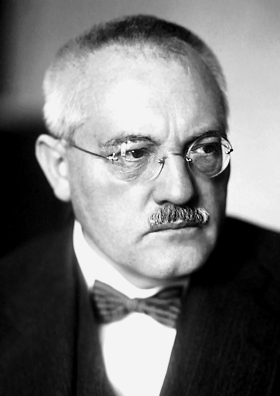
Carl Bosch (German pronunciation: [kaʁl ˈbɔʃ] ⓘ; 27 August 1874 – 26 April 1940) was a German chemist and engineer and Nobel Laureate in Chemistry. He was a pioneer in the field of high-pressure industrial chemistry and founder of IG Farben, at one point the world's largest chemical company.
He also developed the Haber–Bosch process, important for the large-scale synthesis of fertilizers and explosives. It is estimated that one-third of annual global food production uses ammonia from the Haber–Bosch process, and that this supports nearly half of the world's population. In addition, he co-developed the so-called Bosch-Meiser process for the industrial production of urea.
Carl Bosch was born in Cologne to a successful gas and plumbing supplier. His father was Carl Friedrich Alexander Bosch (1843–1904) and his uncle was Robert Bosch, who pioneered the development of the spark plug and founded the multinational company Bosch. Carl, trying to decide between a career in metallurgy or chemistry, studied at the Königlich Technische Hochschule in Charlottenburg (now Technische Universität Berlin) and the University of Leipzig from 1892 to 1898. [citation needed]
Carl Bosch attended the University of Leipzig, and this is where he studied under Johannes Wislicenus, and he obtained his doctorate in 1898 for research in organic chemistry. After he left in 1899 he took an entry-level job at BASF, then Germany's largest chemical and dye firm. From 1909 until 1913 he transformed Fritz Haber's tabletop demonstration of a method to fix nitrogen using high-pressure chemistry through the Haber–Bosch process to produce synthetic nitrate, a process that has countless industrial applications for making a near-infinite variety of industrial compounds, consumer goods, and commercial products. His primary contribution was to expand the scale of the process, enabling the industrial production of vast quantities of synthetic nitrate. To do this, he had to construct a plant and equipment that would function effectively under high gas pressures and high temperatures. [citation needed] Bosch was also responsible for finding a more practical catalyst than the scarce osmium and expensive uranium being used by Haber.
There were many more obstacles as well, such as designing large compressors and safe high-pressure furnaces. A means was needed to provide pure hydrogen gas in quantity as the feedstock. Also, cheap and safe means had to be developed to clean and process the product ammonia. The first full-scale Haber–Bosch plant was erected in Oppau, Germany, now part of Ludwigshafen. With the process complete he was able to synthesize large amounts of ammonia, which was available for the industrial and agricultural fields. In fact, this production has increased the agricultural yields throughout the world. This work won him the Nobel prize for Chemistry in 1931.
After World War I Bosch extended high-pressure techniques to the production of synthetic fuel via the Bergius process and methanol. In 1925 Bosch helped found IG Farben, and was the first head of the company.
He received the Siemens-Ring in 1924 for his contributions to applied research and his support of basic research. In 1931 he was awarded the Nobel Prize in Chemistry together with Friedrich Bergius for the introduction of high pressure chemistry. Today the Haber–Bosch process produces 100 million tons of nitrogen fertilizer every year.
In mid-1932, Bosch instructed two IG Farben executives to meet Adolph Hitler in an attempt to stop the Nazi Party's political attacks on the company's synthetic fuel project. In December 1933, the Nazi government granted IG Farben a price and purchase guarantee to expand the production of synthetic oil at Leuna, in a context of increasing state oversight of the company's operations.
Hub AI
Carl Bosch AI simulator
(@Carl Bosch_simulator)
Carl Bosch
Carl Bosch (German pronunciation: [kaʁl ˈbɔʃ] ⓘ; 27 August 1874 – 26 April 1940) was a German chemist and engineer and Nobel Laureate in Chemistry. He was a pioneer in the field of high-pressure industrial chemistry and founder of IG Farben, at one point the world's largest chemical company.
He also developed the Haber–Bosch process, important for the large-scale synthesis of fertilizers and explosives. It is estimated that one-third of annual global food production uses ammonia from the Haber–Bosch process, and that this supports nearly half of the world's population. In addition, he co-developed the so-called Bosch-Meiser process for the industrial production of urea.
Carl Bosch was born in Cologne to a successful gas and plumbing supplier. His father was Carl Friedrich Alexander Bosch (1843–1904) and his uncle was Robert Bosch, who pioneered the development of the spark plug and founded the multinational company Bosch. Carl, trying to decide between a career in metallurgy or chemistry, studied at the Königlich Technische Hochschule in Charlottenburg (now Technische Universität Berlin) and the University of Leipzig from 1892 to 1898. [citation needed]
Carl Bosch attended the University of Leipzig, and this is where he studied under Johannes Wislicenus, and he obtained his doctorate in 1898 for research in organic chemistry. After he left in 1899 he took an entry-level job at BASF, then Germany's largest chemical and dye firm. From 1909 until 1913 he transformed Fritz Haber's tabletop demonstration of a method to fix nitrogen using high-pressure chemistry through the Haber–Bosch process to produce synthetic nitrate, a process that has countless industrial applications for making a near-infinite variety of industrial compounds, consumer goods, and commercial products. His primary contribution was to expand the scale of the process, enabling the industrial production of vast quantities of synthetic nitrate. To do this, he had to construct a plant and equipment that would function effectively under high gas pressures and high temperatures. [citation needed] Bosch was also responsible for finding a more practical catalyst than the scarce osmium and expensive uranium being used by Haber.
There were many more obstacles as well, such as designing large compressors and safe high-pressure furnaces. A means was needed to provide pure hydrogen gas in quantity as the feedstock. Also, cheap and safe means had to be developed to clean and process the product ammonia. The first full-scale Haber–Bosch plant was erected in Oppau, Germany, now part of Ludwigshafen. With the process complete he was able to synthesize large amounts of ammonia, which was available for the industrial and agricultural fields. In fact, this production has increased the agricultural yields throughout the world. This work won him the Nobel prize for Chemistry in 1931.
After World War I Bosch extended high-pressure techniques to the production of synthetic fuel via the Bergius process and methanol. In 1925 Bosch helped found IG Farben, and was the first head of the company.
He received the Siemens-Ring in 1924 for his contributions to applied research and his support of basic research. In 1931 he was awarded the Nobel Prize in Chemistry together with Friedrich Bergius for the introduction of high pressure chemistry. Today the Haber–Bosch process produces 100 million tons of nitrogen fertilizer every year.
In mid-1932, Bosch instructed two IG Farben executives to meet Adolph Hitler in an attempt to stop the Nazi Party's political attacks on the company's synthetic fuel project. In December 1933, the Nazi government granted IG Farben a price and purchase guarantee to expand the production of synthetic oil at Leuna, in a context of increasing state oversight of the company's operations.
Recent media